THE GIRL IN THE RAIN: She was running from a monster. I made the mistake of calling him.
Chapter 1: THE TRIGGER
The rain wasn’t just falling; it was assaulting the city.
It hammered against the plate-glass window of the Moonlight Diner like handfuls of gravel being thrown by an angry god.
I stood there, paralyzed, the rag in my hand dripping gray water onto the linoleum floor. The clock above the espresso machine read 2:14 AM.
My feet throbbed with a dull, rhythmic ache that traveled all the way up to my hips—the specific kind of agony you only earn after fourteen hours of standing on concrete. I wanted to go home. I wanted to soak my feet in a plastic tub of Epsom salts and pretend that the stack of unpaid hospital bills on my kitchen table didn’t exist.
Then I saw her.
At first, I thought it was a trick of the storm—a shadow cast by the swinging streetlamp. But then a jagged bolt of lightning tore the sky open, bleaching the street in a flash of violent white light.
It wasn’t a shadow. It was a child.
She was curled into a ball beneath the diner’s narrow awning, shivering so violently I could see the tremors from twenty feet away.
I didn’t think. I didn’t check the lock or grab my coat. I shoved the door open, the bell above it jingling a cheerful, pathetic little note that was instantly swallowed by the roar of the wind.
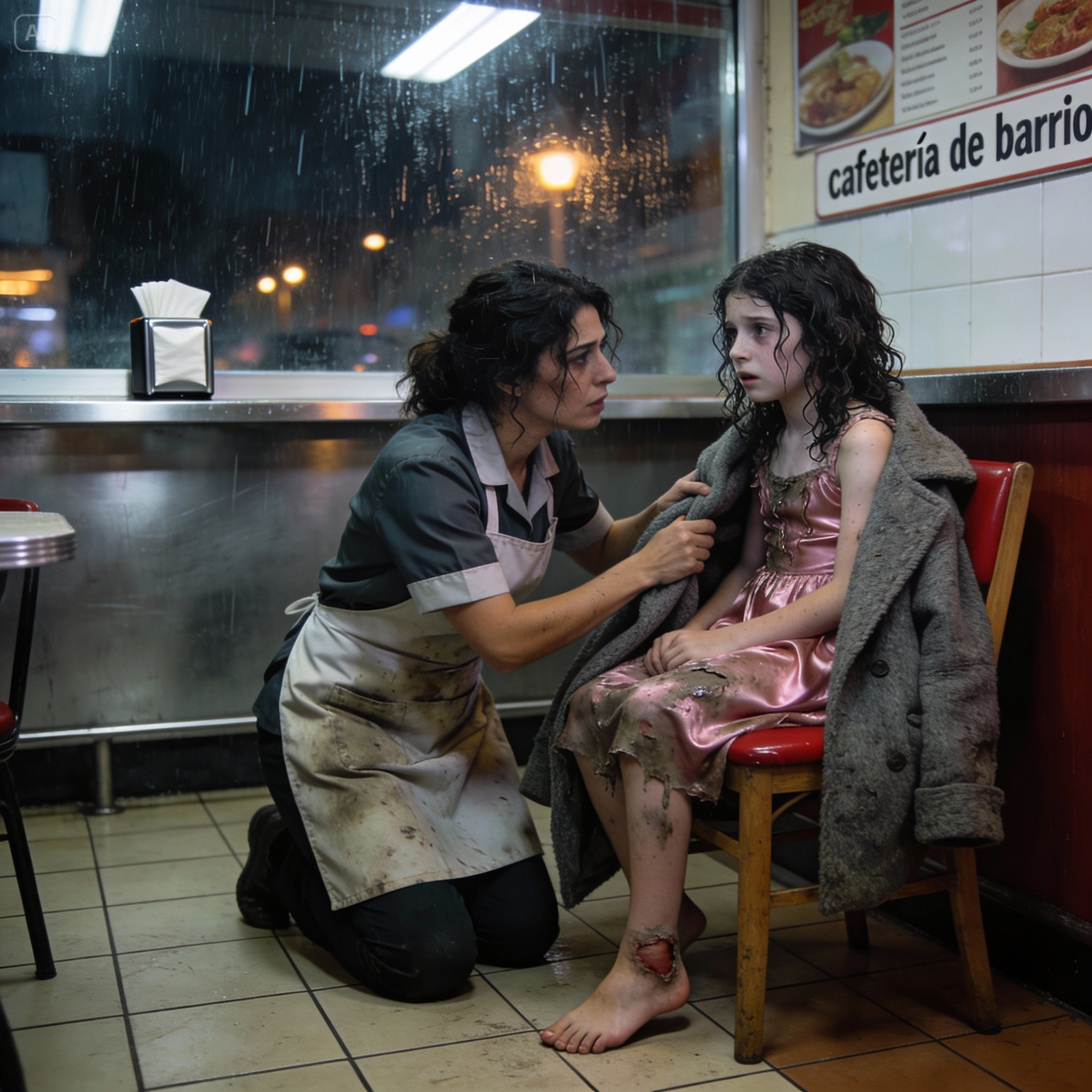
The cold hit me like a physical blow, soaking my uniform in seconds.
“Hey!” I shouted over the thunder. “You can’t stay out here!”
The girl flinched. Her head snapped up, and what I saw froze the breath in my lungs.
She couldn’t have been more than ten. But she wasn’t dressed for a storm. She was wearing a pink princess dress—silk, tulle, the kind that costs more than my rent—now plastered to her skin like a second layer of flesh.
But it was her feet that made my stomach turn over. One was bare, the skin scraped raw and bleeding against the dirty pavement. The other wore a jeweled ballet flat that glittered mockingly in the gloom.
She looked at me with eyes that were too big, too dark, and filled with a terror no child should know.
“Please,” she whispered, though I read her lips more than I heard the sound.
I lunged forward, scooped her up—she was terrifyingly light, like a bundle of wet hollow bones—and dragged her inside. I kicked the door shut, cutting off the scream of the wind.
The sudden silence of the diner was deafening.
I set her down in the corner booth, my hands shaking as I stripped off my own wool coat—the only thing of value Mrs. Patterson had left me before the cancer took her—and wrapped it around the girl. She vanished inside the heavy fabric, teeth chattering with a sound like dice rattling in a cup.
“I’m going to get you something hot,” I said, my voice trembling. “Then I’m calling the police.”
Her hand shot out.
It was a lightning strike of movement. Her small, freezing fingers clamped around my wrist with a strength that shouldn’t have been possible.
“No!” she gasped, her eyes wide, wild. “No police. Please.”
I froze. “Honey, you’re hurt. You’re bleeding. We have to—”
“They’ll find me,” she choked out, tears finally spilling over, mixing with the rain on her cheeks. “If you file a report… if the bad people see my name… they’ll know where I am.”
I looked at her. Really looked at her.
This wasn’t a runaway from the suburbs. The silk dress. The real diamond pendant at her throat. The sheer, feral panic in her eyes. This was a child running from something organized. Something powerful.
“Okay,” I said slowly, sinking into the booth opposite her. “Okay. No police. But I have to call someone. Your parents?”
She hesitated, chewing her lip until it turned white. Then, with a shaking hand, she recited a number. No name. Just ten digits.
I pulled my phone from my apron pocket. The screen was cracked, a spiderweb of glass over the glowing numbers as I dialed.
My heart was hammering against my ribs, a frantic bird trapped in a cage. I didn’t know why, but the air in the diner felt suddenly heavy, charged with a static electricity that made the hair on my arms stand up.
The phone didn’t even ring.
It connected instantly. There was no “hello.” No confusion. Just a silence so thick, so heavy, it felt like I had stepped into a vacuum.
“Speak.”
The voice was low. A growl wrapped in velvet. It wasn’t a question; it was a command given by a man who had never been disobeyed in his life.
I swallowed, my throat clicking audibly in the quiet room.
“My name is Serena,” I stammered. “I… I’m a waitress at the Moonlight Diner on Bleecker. There’s a little girl here.”
I heard a sharp intake of breath on the other end. Then, a sound I couldn’t identify—like glass breaking against a wall.
“Sophia,” the man whispered.
It wasn’t a name. It was an exhalation of pure, agonizing relief. But then the tone shifted, sharpening into a blade.
“Is she bleeding?”
“Her feet,” I said, watching the girl sip the hot chocolate I’d managed to slide in front of her. “And her knees. She’s terrified. She said… she said people were chasing her.”
The silence returned, but this time it was different. It was the silence of a predator that has just caught a scent.
“Lock the door,” the man ordered. His voice was terrifyingly calm. “Turn off the lights. Move her away from the windows.”
“Who are you?” I whispered, a cold dread pooling in my stomach.
“I’m her father,” he said. “And if anyone touches that door before I get there… you kill them.”
The line went dead.
I lowered the phone, my hand trembling uncontrollably. I looked at the girl—Sophia. She was watching me, huddled in my coat, waiting.
I walked to the front door. My fingers felt numb as I turned the deadbolt and flipped the sign to CLOSED. Then I reached up and killed the lights.
We sat in the dark, the rain lashing against the glass, waiting for a monster to come save his child.
And I had the sinking, terrible realization that I had just invited the devil into my kitchen.
Chapter 2: THE HIDDEN HISTORY
The darkness inside the diner wasn’t empty; it was heavy. It pressed against my skin like a physical weight, smelling of stale coffee grounds, lemon floor cleaner, and the metallic tang of old fear.
I sat in the booth across from the girl, my back rigid against the red vinyl. The only light came from the streetlamps outside, fractured and distorted by the rain hammering against the plate glass. Every time a car drove past, headlights swept across the ceiling like searchlights in a prison yard, illuminating the dust motes dancing in the stagnant air before plunging us back into the gloom.
Sophia was shivering again.
It wasn’t the violent shaking from before, but a low, constant vibration that seemed to emanate from her bones. She held the ceramic mug of hot chocolate with both hands, her knuckles white, using the heat to anchor herself to the world.
I watched her. I couldn’t help it.
In the shadows, the jeweled ballet flat on her right foot caught a stray beam of light, glittering with an arrogance that made my teeth ache. It was a shoe meant for recitals and birthday parties, not for running for your life through a Manhattan storm.
“Drink,” I whispered, my voice sounding too loud in the quiet room. “It’ll help.”
She took a small, hesitant sip. A mustache of whipped cream and marshmallows left a white smear on her upper lip. It was such a childish, innocent detail that it made my chest tighten with a sudden, sharp grief.
She looked so much like her. Not in the face—Sophia was dark-haired and olive-skinned, while the memory I was fighting was fair—but in the smallness. The fragility.
I reached out, my hand hovering over the wool coat I’d wrapped around her.
It was an ugly coat. A heavy, scratchy, charcoal-gray monstrosity that smelled faintly of mothballs and lavender laundry detergent. It was the smell of Mrs. Patterson.
I closed my eyes for a second, letting the scent hit me.
“You take this, Serena,” Mrs. Patterson had said, her voice thin as paper in that sterile hospital room two years ago. “It’s not stylish, Lord knows, but it’ll keep the wind out. You’ve had enough cold in your life, baby girl.”
It was the only thing I had left of her. The only physical proof that for two years, out of twenty-eight, someone had actually loved me. And now, it was wrapped around a stranger’s child who was waiting for a man who might kill me.
“Your knee,” I said softly. “Let me look.”
Sophia flinched, pulling her leg back. “It’s okay.”
“It’s not okay. It’s dirty.”
I slid out of the booth and knelt on the cold linoleum. The floor smelled of bleach and wet shoe rubber. I pulled a clean napkin from the dispenser and dipped it into the glass of ice water I’d brought over earlier.
“This is going to sting,” I warned her.
She didn’t pull away this time. She just watched me with those wide, terrified eyes.
I dabbed at the scrape on her knee. It was nasty—gravel embedded in the skin, a smear of road grime mixing with the blood. My hands, rough and red from years of scrubbing dishes and bleaching countertops, looked monstrous next to her smooth, pampered skin.
“You said… you said bad people were chasing you,” I murmured, keeping my eyes on the wound. I needed to keep her talking. I needed to know what was coming through that door.
Sophia nodded. She lowered the mug, her voice trembling.
“I went to Madison’s party,” she whispered. “Papa said I could go if Tony came. Tony is… he watches me.”
“A bodyguard?”
“Yes. But I wanted to be normal.” She sniffled, a tear tracking through the grime on her cheek. “I just wanted to walk home like the other kids. So I hid. I waited until Tony was talking on his phone, and I ran out the back.”
I stopped cleaning her knee. My heart gave a painful thud.
She was just a kid who wanted to walk down the street without a shadow. I knew that feeling. I had spent my entire childhood in the foster system wishing I was invisible, or wishing I was someone else entirely.
“A black car started following me,” she continued, her voice hitching. “Slow at first. Then fast. I saw the man inside. He had a… a mask. Like a ski mask.”
I felt the blood drain from my face. This wasn’t a custody dispute. This wasn’t a misunderstanding. This was a snatch-and-grab operation targeting a high-value asset.
And I was sitting here with the asset.
“You were brave,” I told her, my voice fierce. “You ran. You survived.”
“Papa is going to be so mad,” she whispered, shrinking into Mrs. Patterson’s coat.
“No,” I said, thinking of the voice on the phone. The voice that had sounded like tectonic plates shifting. “He’s not going to be mad at you, Sophia. He’s terrified.”
Time began to stretch.
The clock on the wall ticked with agonizing slowness. Click. Click. Click.
2:28 AM.
2:29 AM.
Every sound from the street made me jump. The hiss of tires on wet pavement. The distant wail of a siren. I found myself counting the beats of my own heart, wondering if each one was bringing me closer to the end of my shift, or the end of my life.
I stood up and walked to the window, peering through the slats of the blinds.
The rain was coming down harder now, washing the city in a deluge of gray and black. The streetlights blurred into hazy orange streaks, like watercolor paint left out in a storm.
Then I saw them.
It wasn’t a sound at first. It was a change in the light.
Three sets of high-intensity LED headlights cut through the darkness down the block. They were brighter than normal cars, bluer, sharper. They didn’t slow down for the speed bumps.
They moved in a formation that made the hair on the back of my neck stand up. Tight. synchronized. Predatory.
“He’s here,” I whispered.
Sophia scrambled up on the booth seat, looking out the window over my shoulder.
The three black SUVs didn’t park. They claimed the street.
The lead vehicle swerved hard, cutting across the centerline to block the lane completely. The rear vehicle did the same, sealing off the street from behind. The middle vehicle—a massive, armored beast that looked like it could drive through a brick wall—rolled to a stop directly in front of the diner’s glass door.
The engines cut.
For a second, there was nothing but the rain drumming on the roof.
Then, the doors opened.
It was like watching a magic trick. One second, the street was empty. The next, it was filled with men.
Seven of them.
They didn’t look like cops. They didn’t look like the security guards at the mall. They looked like soldiers who had traded their fatigues for five-thousand-dollar suits. They moved with a terrifying economy of motion, stepping into the pouring rain without even flinching, their eyes scanning the rooftops, the alleyways, the shadows.
One of them tapped an earpiece and nodded to the middle car.
The rear door of the center SUV opened.
A man stepped out.
Even from this distance, through the rain-streaked glass, he felt… massive.
He was tall, broad-shouldered, wearing a long black trench coat that swirled around his legs in the wind. He didn’t look at his security team. He didn’t look at the street. He looked straight at the diner.
Straight at me.
I stepped back from the window, my breath catching in my throat. I felt like I’d just looked into the barrel of a loaded gun.
“Papa!” Sophia cried out, her small hand pressing against the glass.
The man walked toward the door. He didn’t run. He didn’t rush. He moved with the unstoppable, terrifying momentum of a landslide.
I backed up until my hips hit the counter. I wanted to hide. I wanted to dissolve into the floor tiles.
The bell above the door jingled—a cheerful ding-ding that sounded absurdly out of place.
The door swung open, bringing the storm inside with it. The wind howled, scattering napkins from the dispenser, and the smell of rain and ozone filled the diner.
Marcus Valente stepped over the threshold.
The room seemed to shrink. He sucked all the oxygen out of the air just by existing. He was soaked, his black hair plastered to his forehead, water dripping from the hem of his coat onto the clean floor I had just mopped.
He was terrifyingly handsome, in a way that made you want to look away before you got burned. High cheekbones, a jaw that looked like it was carved from granite, and a thin, pale scar cutting through his left eyebrow.
But it was his eyes that froze me.
They were dark, almost black, and they were scanning the room with a lethality that made my knees weak. He looked past the empty tables. He looked past the counter.
Then he saw her.
Sophia was standing in the booth, Mrs. Patterson’s oversized coat hanging off her small shoulders like a gray blanket.
The change in him was instantaneous. It was like watching a skyscraper collapse.
The mask of the warlord shattered. His shoulders dropped. The ice in his eyes melted into an agony so raw it was hard to look at.
“Piccola,” he choked out.
It was a whisper, but in the silence of the diner, it sounded like a scream.
He didn’t walk to her. He fell.
He dropped to his knees on the wet linoleum, heedless of the mud, heedless of his suit, and opened his arms.
“Papa!”
Sophia launched herself from the booth. She hit him with enough force to knock a smaller man over, burying her face in his neck, her small hands clutching the lapels of his soaked coat.
He wrapped his arms around her, folding her into himself, burying his face in her hair. I saw his back heave. I saw his large hands trembling violently as they pressed against her spine, checking her, holding her, making sure she was real.
“Bambina mia,” he murmured, his voice thick with tears. “Il mio cuore. Sei salva. Sei salva.”
My heart. You are safe.
I stood in the shadows behind the counter, gripping a dirty dishrag like a lifeline. I felt like an intruder. I was witnessing something holy and primal—a father reclaiming his child from the void.
It made my chest ache with a hollow, biting jealousy.
I had never been hugged like that. Not once. Not by the mother who left me in a basket. Not by the foster families who returned me like a defective appliance. Even Mrs. Patterson, god rest her soul, had been too frail for this kind of crushing, desperate embrace.
This was love. This was what love looked like when you stripped away the politeness and the pretense. It was messy and wet and shaking on the floor of a diner at 3:00 AM.
Marcus pulled back slightly, framing Sophia’s face in his hands. He wiped the tears from her cheeks with his thumbs, his eyes darting over her face, cataloging every scrape, every smudge of dirt.
Then he looked down.
He saw the bandaged knee. He saw the bare foot with the small cut I had cleaned.
His jaw locked. The tenderness vanished, replaced by a flash of violence so pure it made the air temperature drop. For a second, I saw the monster I had feared on the phone. The man who would burn a city to the ground for a single drop of his daughter’s blood.
“I’m sorry, Papa,” Sophia sobbed, pressing her forehead against his chest. “I wanted to walk. I lost my shoe.”
“Shhh,” he whispered, pulling her back in, tucking her head under his chin. “It doesn’t matter. Nothing matters. You are here.”
He held her for a long time. The rain battered the glass. His security team stood outside the door, backs to the glass, silent sentinels guarding the reunion.
I took a step back, intending to slip into the kitchen and give them privacy.
My shoe squeaked on the wet floor.
Marcus’s head snapped up.
He didn’t look at me like a customer looks at a waitress. He didn’t look through me.
He saw me.
Those dark eyes locked onto mine, and I felt pinned to the wall. It was a physical sensation, a pressure in the center of my chest. He stood up, lifting Sophia effortlessly in one arm as if she weighed nothing.
He turned toward me.
He was huge. Up close, the sheer scale of him was overwhelming. He smelled of rain, expensive leather, and something sharp like gunpowder.
He walked to the counter. I had to tilt my head back to look him in the eye.
He didn’t speak immediately. His gaze traveled over me, slow and deliberate.
He looked at my hair, frizzy and damp from the humidity. He looked at the dark circles under my eyes, purple bruises of exhaustion. He looked at my uniform, the polyester faded from too many washes, the name tag slightly crooked.
He looked at my hands.
My hands were red, chapped, the knuckles swollen. I tried to hide them behind the rag, shame flaring hot in my stomach. I knew what he saw. He saw the poverty. He saw the struggle. He saw a woman who was barely keeping her head above water.
I waited for the sneer. I waited for the dismissal.
It didn’t come.
Instead, his gaze softened. It settled on my face with a gravity that made my breath hitch.
“You are Serena,” he said.
His voice was a low rumble, vibrating in the space between us. It wasn’t a question. It was a statement of fact, as if my name was something important. Something to be remembered.
“Yes,” I whispered.
He shifted Sophia’s weight, never breaking eye contact.
“Thank you.”
Two words. But the way he said them—with a raw, stripped-down sincerity—hit me harder than the cold outside.
“I… I just did what anyone would do,” I stammered, looking down at the counter.
“No,” he said softly. “Not anyone.”
He reached out his free hand.
It was a large hand. Broad palm, long fingers, a signet ring on his pinky finger bearing a crest I didn’t recognize. He held it out over the counter, palm open. Waiting.
My heart was hammering a frantic rhythm against my ribs. Don’t touch him, a voice in my head warned. He is dangerous. He is fire. If you touch him, you will burn.
I reached out anyway.
My hand looked small and rough in his.
As soon as our skin touched, I gasped.
It wasn’t just warmth. It was a shock—a static discharge that snapped between us, sharp and sudden. It traveled up my arm, settling in the base of my throat.
His fingers closed around mine. His grip was firm, calloused, dry. It was the most solid thing I had ever felt.
I looked up, startled, and saw the same shock reflected in his eyes. His pupils dilated, swallowing the iris. He had felt it too.
He didn’t let go.
For three seconds, the world stopped. There was no rain. No diner. No debt. Just the heat of his hand and the dark, magnetic pull of his gaze. He was looking at me not as a savior, not as a waitress, but as a woman.
He squeezed my hand once—a pressure that felt like a code I couldn’t decipher—and then released me.
The loss of contact was sudden and cold.
“We have to go,” he said, his voice rougher now. “She needs a doctor.”
I nodded, mute.
He turned toward the door. The security team opened it before he even reached for the handle.
Sophia lifted her head from his shoulder. She looked back at me, her eyes sleepy and safe.
“Bye, Serena!” she called out, her voice muffled by his coat. “Thank you for the marshmallows!”
“Bye, honey,” I managed to choke out.
Marcus paused in the doorway. He looked back over his shoulder. One last look. Intense. Searching. Unfinished.
Then he stepped out into the rain.
The door swung shut. The bell jingled.
I stood there in the silence, staring at the empty street where the black SUVs were already peeling away, disappearing into the storm.
I looked down at the counter.
The mug was empty. The napkin with the blood was gone.
And then I realized it.
The coat.
Mrs. Patterson’s coat. The gray wool coat that smelled of lavender and safety. The only thing I had left in the world that mattered.
It was gone. He had taken it with him, wrapped around his daughter.
I stared at the space where it should have been, and a strange, hysterical laugh bubbled up in my throat. I had saved a child. I had met a monster. And I had lost the only thing that kept me warm.
But as I looked down at my right hand, still tingling from his touch, I had a sinking feeling that the coat was the least of what I had just lost.
And the least of what was coming back to find me.
Chapter 3: THE AWAKENING
The afternoon sun didn’t clean the city; it just exposed the grime.
It was 4:15 PM on the third day. The Moonlight Diner was in its lull, that dead zone between the lunch rush and the early bird dinner crowd. The air inside was stagnant, smelling of burnt coffee, fryer grease, and the lemon-scented despair of the floor cleaner Frank bought in bulk.
I stood behind the counter, a spray bottle of sanitizer in one hand and a gray rag in the other.
Spray. Wipe. Circle.
Spray. Wipe. Circle.
I was moving, but I wasn’t really there. I was a ghost haunting my own life.
My right hand, the one Marcus Valente had held for those three impossible seconds, throbbed. It wasn’t a physical pain, exactly. It was a phantom sensation, a low-level hum of electricity that lived under the skin of my palm. I kept rubbing it against my apron, trying to friction the memory away, trying to scrub off the feeling of his calluses and the terrifying heat of his grip.
It wouldn’t go away.
Stop it, I told myself, the words sharp and cruel in the silence of my head. Just stop it. He’s gone. You’re nobody.
I forced my hand back to the counter. I scrubbed at a stubborn ring of dried ketchup until the Formica squeaked in protest.
I needed to focus on reality. And reality was the white envelope currently burning a hole in the back pocket of my jeans.
I hadn’t opened it until this morning, standing by my mailbox in the dim hallway of my building, but I hadn’t needed to. I knew the return address. St. Jude’s Medical Center.
Five thousand dollars.
The number was etched into the back of my eyelids. It was the remaining balance for Mrs. Patterson’s palliative care. Two years of double shifts, two years of eating ramen noodles and walking to work to save bus fare, and the mountain still hadn’t moved.
Five thousand dollars might as well have been five million. It was a number that meant I didn’t get to have dreams. It meant I didn’t get to think about dark eyes and warm hands. It meant I was drowning, and the water was rising an inch every day.
“Serena.”
The voice made me jump. I dropped the spray bottle. It clattered loudly on the floor, rolling in a wobbly circle.
Frank was standing at the pass-through window to the kitchen, his elbows resting on the stainless steel shelf. He was fifty-five, with hair the color of steel wool and a face that looked like it had been crumpled up and smoothed back out a few too many times. He was the closest thing to a father I had, which was sad, considering he paid me minimum wage to ruin my back.
“You’re scrubbing the varnish off the counter, kid,” Frank said. His voice was gravelly, shaped by forty years of smoking.
I bent down to pick up the bottle. My knees popped—a sharp, dry sound.
“Sorry, Frank. Just… getting a spot.”
“There’s no spot,” he grunted. He pushed a white ceramic bowl across the pass. Steam curled off the top, carrying the scent of chicken broth and celery. “Eat.”
I looked at the soup. My stomach gave a hollow, cramping twist. I hadn’t eaten since yesterday morning.
“I’m not hungry,” I lied.
“You’re a terrible liar,” Frank said. “You look like a stiff wind would blow you into the Hudson. Eat the soup. It’s on the house.”
I walked over and took the bowl. The warmth of the ceramic seeped into my fingers, and for a second, my chest tighted so hard I couldn’t breathe.
It reminded me of the coat.
Mrs. Patterson’s coat.
For three days, I had felt naked without it. Walking home in the chill of the early morning, the wind cut right through my thin cardigan, biting into my skin. But it wasn’t just the cold. It was the loss of the armor. That coat had been my shield. It smelled like her. It felt like her arms around me.
And now it was gone, carried away into the darkness by a man who drove an armored SUV.
I took the soup to the end of the counter and picked up a spoon. I stared into the yellow broth.
Forget him, I commanded myself. Forget the way he looked at you. Forget the way he said your name.
It was a survival mechanism. I had learned it in the foster homes. When you want something you can’t have, you have to kill the want before it kills you. You have to turn your heart into stone.
He is a mob boss, I thought, forcing the spoon to my mouth. He is violence. He is money. You are a waitress with a five-thousand-dollar debt and a hole in your shoe.
I swallowed the soup. It tasted like salt and regret.
The diner was silent. The only sound was the hum of the refrigerator unit and the distant, muffled roar of traffic on Bleecker Street. The afternoon light filtering through the blinds was weak and gray, casting long, prison-bar shadows across the floor.
Then, the sound changed.
It wasn’t the rattle of a delivery truck or the whine of a taxi. It was a low, guttural purr. A deep, vibrating thrum that I felt in the soles of my feet before I heard it with my ears.
It was the sound of power.
I froze, the spoon halfway to my mouth.
No, I thought. Don’t look. Don’t be stupid.
But my body betrayed me. It moved on its own, turning my head toward the window.
A car was pulling up to the curb.
It wasn’t the fleet of SUVs from the storm. It was a single car. A Maserati. Sleek, black, and predatory, it crouched against the curb like a panther waiting to pounce. It looked alien against the cracked sidewalk and the overflowing trash can on the corner.
My heart slammed against my ribs. Thud. Thud. Thud.
The driver’s door opened.
A man stepped out.
He wasn’t wearing the long, soaked trench coat. He wasn’t surrounded by soldiers. He was wearing black slacks and a gray button-down shirt, the top button undone, the sleeves rolled up to reveal forearms that were thick with muscle and dusted with dark hair.
It was him.
Marcus Valente.
I dropped the spoon. It clattered into the bowl, splashing broth onto the counter.
I couldn’t move. I couldn’t breathe. I just watched as he walked around the front of the car. He moved with that same terrifying grace, that controlled lethality, but there was something else now. He wasn’t storming a castle. He was just… walking.
In his hands, he carried a bundle of gray fabric.
My breath hitched. The coat.
He walked to the door. I saw his hand reach for the handle—a large hand, a signet ring flashing in the weak sunlight.
The bell jingled. Ding-ding.
The sound seemed to shatter the frozen atmosphere of the diner.
Frank stuck his head out of the kitchen. “Customer?”
I didn’t answer. I couldn’t have spoken if my life depended on it.
Marcus stepped inside.
The air in the room changed instantly. It became heavier, charged with static. He brought the scent of the outside world with him—cool air, exhaust, and that specific, expensive wood-and-spice cologne that I had been smelling in my dreams for three nights.
He stopped in the center of the room.
His eyes found me immediately.
There was no searching. No hesitation. His gaze locked onto mine with a physical weight.
They were dark, those eyes. Endless. But the coldness I remembered from the first moment of the storm was gone. In its place was something intense and quiet. He looked at me not like I was a stranger, but like I was the only point of focus in a blurry world.
“Serena,” he said.
His voice was a low rumble, wrapping around my name, making it sound significant. Important.
My hands were shaking. I hid them behind the counter, wiping them frantically on my apron.
“Mr. Valente,” I managed to whisper. It came out breathless, weak.
One corner of his mouth ticked up. A micro-movement. Almost a smile.
“Marcus,” he corrected gently. “Call me Marcus.”
He walked toward the counter.
I wanted to run. I wanted to stay. I wanted to sink through the floor. I felt painfully aware of everything—the soup stain on my apron, the frizz in my ponytail, the dark circles that concealer couldn’t hide.
He stopped right in front of me. The counter was the only barrier between us, a thin strip of Formica separating my world from his.
He set the gray bundle down between us.
Mrs. Patterson’s coat.
I reached out and touched it. The wool was soft, far softer than I remembered. It was folded with military precision, crisp lines, no wrinkles.
“Sophia wouldn’t let it go,” Marcus said quietly.
I looked up at him. He was close. I could see the individual lashes framing his eyes, the faint shadow of stubble along his jawline.
“She carried it around the house for two days,” he continued, his voice dropping an octave, becoming intimate. “She slept with it. She said it smelled like safety.”
My throat tightened so hard it hurt. Safety. That’s what it had smelled like to me, too.
I leaned in, just an inch, and I caught the scent coming off the fabric. The mothballs were gone. The old dust was gone. It smelled of fresh lavender—expensive, real lavender—and something clean and airy.
“I had to promise her I’d bring it back to you personally,” he said. “Or she wasn’t going to let me take it to the cleaners.”
“Thank you,” I whispered. My fingers curled into the wool. “Thank you… Marcus.”
Using his name felt illicit. Dangerous. Like tasting something I couldn’t afford.
He watched my mouth form the word, his gaze darkening slightly. Then he reached into his pocket.
“I came to return what belongs to you,” he said. “And to give you this.”
He placed a small box on the counter, right next to the coat.
It wasn’t a jewelry box. It was a simple, rectangular box wrapped in plain brown paper. No bow. No flash. Just a box.
I stared at it. “I… I can’t take anything.”
“It’s not payment,” he said quickly, a hard edge entering his voice, as if the idea of paying me offended him. “It’s an apology. And a thank you.”
“You already thanked me.”
“Not enough.”
He pushed the box forward with one finger. His finger was thick, the nail short and square. “Open it. If you don’t want it, throw it in the trash. I won’t be offended.”
I hesitated. My heart was thumping a frantic rhythm against my ribs. Don’t open it, the survival instinct warned. Gifts come with strings. Gifts are traps.
But I reached out.
The paper tore easily. It was heavy, high-quality paper.
I lifted the lid.
The breath left my lungs in a rush.
Inside, resting on black tissue paper, was a pair of gloves.
Leather. A rich, deep cognac brown that matched the buttons on Mrs. Patterson’s coat perfectly.
I reached in and lifted one.
My god. The leather was like butter. Soft, supple, lined with cashmere that felt like a cloud against my calloused fingertips. These weren’t department store gloves. These were hand-stitched. Masterpieces.
But it wasn’t the quality that made my vision blur. It wasn’t the price, which I knew was more than I made in a month.
It was the why.
I looked up at him, my eyes stinging.
“How?” I choked out. “Why gloves?”
Marcus was watching me with an intensity that made my knees weak. He wasn’t looking at the gloves. He was looking at my hands.
“I saw them,” he said simply.
He reached out—slowly, giving me time to pull away—and took my right hand. He turned it palm up on the counter.
His thumb traced the red, chapped skin across my knuckles. He brushed over the roughness of my palm, the dryness caused by cheap soap and harsh winters and endless work.
“That night,” he murmured, his eyes locked on my skin. “When you shook my hand. Your skin was freezing. And when I saw you put your hands in your pockets…”
He paused, his jaw tightening.
“I saw your gloves, Serena. They were wool. They were full of holes. They weren’t keeping you warm.”
A tear escaped. It tracked hot and fast down my cheek.
He had seen.
In the middle of a storm, while clutching his traumatized daughter, while surrounded by armed men, he had looked at a waitress and noticed that her gloves had holes in them.
He had noticed that I was cold.
Nobody noticed that I was cold. I was the person who brought the coffee. I was the person who cleaned the mess. I wasn’t a person who felt things.
“I…” I tried to speak, but my voice broke.
“Try them on,” he urged softly.
I pulled the right glove on. It slid over my hand like a second skin, the cashmere lining instantly warming my frozen fingers. It fit perfectly. Not just close—perfectly. As if he had memorized the size of my hand from that one touch.
I looked at my hand, clad in the beautiful leather. It looked like someone else’s hand. A hand that was cared for. A hand that mattered.
“They’re beautiful,” I whispered. “But they’re too much.”
“They are necessary,” he corrected. “It’s going to snow tomorrow. You walk to work.”
It wasn’t a question. He knew. He had checked.
“Thank you,” I said again, looking up at him. “Really.”
The air between us shifted. It thickened, becoming heavy with unspoken things. He didn’t let go of my gloved hand. His thumb continued to stroke the leather over my knuckles, a rhythmic, hypnotic motion.
“Sophia drew a picture of you,” he said abruptly.
I blinked, the sudden change of topic throwing me off balance. “She did?”
“Yes. She drew you in the diner. You’re wearing a cape.”
A wet laugh bubbled up in my throat. “A cape?”
“She thinks you’re a superhero.” Marcus’s mouth quirked again. “She asked if you could come over. She wants to show you her drawings. She wants… she wants to know if you can teach her how to make the hot chocolate.”
He paused, and for the first time, the great Marcus Valente looked unsure. He looked vulnerable.
“She hasn’t asked for anyone since her mother died,” he said, his voice rough. “Only you.”
The mention of his wife hung in the air. A ghost I hadn’t known existed.
“I…” I didn’t know what to say. My world was $5,000 debts and ramen noodles. His world was armored cars and dead wives and trauma.
“I’m not asking for a favor,” he said quickly. He released my hand and stepped back, looking around the empty diner. “I’m asking if I can buy you a coffee.”
I stared at him. “You want… to buy me a coffee? Here?”
“Unless you’re busy.”
I looked around. The diner was a tomb. Frank was in the back, probably smoking near the grease trap.
“I’m not busy,” I said.
Marcus walked over to the booth by the window—the same booth where Sophia had sat. He slid onto the red vinyl bench. He looked absurdly large for the table, his broad shoulders taking up the entire space. He looked out of place, like a lion sitting in a house cat’s basket.
But he looked comfortable.
“Black,” he said, watching me. “No sugar.”
I turned to the coffee machine. My hands were shaking so badly I almost dropped the pot.
What are you doing? my brain screamed. Run. He tracked you down. He knows you walk to work. He knows your glove size. This is obsession.
But my heart… my stupid, treacherous heart was beating a rhythm against my ribs that sounded like a song.
He noticed you were cold.
I poured the coffee. I put it on a tray. I walked over to the booth.
I set the cup down in front of him.
“Sit,” he said.
It wasn’t a command. It was an invitation.
I sat.
Across from him, the table felt very small. His knees brushed against mine under the table, and a jolt of electricity shot up my leg. He didn’t pull away.
He took a sip of the coffee—diner sludge that had been sitting on the burner for two hours. He didn’t wince.
“Tell me,” he said, setting the cup down. “Who are you, Serena? Besides the woman who saves children in storms?”
I looked at him. I looked at the scar through his eyebrow. I looked at the dark, intelligent eyes that were dissecting me layer by layer.
And I realized the awakening wasn’t just about realizing how grim my life was. It was about realizing that for the first time, I didn’t want to hide it.
“I’m nobody,” I said.
“Wrong answer,” Marcus said softly. “Try again.”
And God help me, I did.
Chapter 4: THE WITHDRAWAL
4:12 AM is a time that doesn’t belong to the living. It belongs to ghosts, to insomnia, and to things that can’t face the light of day.
I stood on the edge of the pier, the wind whipping my hair across my face, stinging my eyes with salt and the smell of diesel.
The water of the Hudson River was black ink, heavy and oily, slapping rhythmically against the wooden pilings. Slap. Slap. Slap. It was the only sound in the world. The city behind us—Manhattan—was a sleeping giant, its breathing shallow and muffled by the distance.
I wasn’t supposed to be here.
I was supposed to be in my bed, under my thin duvet, getting the four hours of sleep I needed before opening the diner. I was supposed to be Serena the waitress, Serena the invisible, Serena the girl who paid her bills and kept her head down.
Instead, I was standing in the freezing pre-dawn dark with a man who owned the city.
“Give me your hand,” Marcus said.
He stood on the deck of the boat—no, not a boat. A yacht. A sleek, white predator floating on the black water, glowing with soft, recessed lighting that made it look like a spaceship that had crash-landed in the harbor.
He reached down toward me.
I looked at his hand. I was wearing the gloves he had given me. The cognac leather was soft and warm, a second skin that made me feel protected, expensive.
I reached up.
His fingers closed around my gloved hand. His grip was iron. He didn’t pull me; he anchored me. I stepped onto the gunwale, the boat shifting slightly under my weight, a slow, heavy roll that made my stomach drop.
“I’ve never been on a boat,” I whispered. The words were snatched away by the wind.
“It’s safer than land,” Marcus murmured.
He didn’t let go of my hand. He led me toward the bow, moving with a sure-footed grace that ignored the shifting deck. He was wearing a thick black sweater that hugged the width of his shoulders and dark jeans. No suit. No tie. Just the man.
There were two lounge chairs set up at the front of the yacht, facing east. Facing the empty horizon where the sky was a bruised purple, bleeding into black.
A heavy wool blanket was folded on one of the chairs. A silver thermos sat on a small teak table bolted to the deck.
“Sit,” he said.
I sat. The cushions were deep, swallowing me.
Marcus sat beside me. He didn’t sit like a man relaxing. He sat with a kind of coiled alertness, his back straight, his legs stretched out but ready to move. He unscrewed the thermos. Steam rose into the cold air, white ribbons dancing in the dark.
He poured a cup. He handed it to me.
“Coffee,” he said. “Black.”
I took it. The heat seeped through my gloves. I took a sip. It was strong, bitter, and hot enough to scald my tongue. It tasted like life.
“Why are we here, Marcus?” I asked. My voice sounded small against the vastness of the water.
He looked at me. In the dim light of the deck lamps, his eyes were pools of shadow. The scar through his eyebrow looked stark, a white line of violence written on his face.
“Because the city is too loud,” he said quietly. “And because you’re withdrawing.”
I froze, the cup halfway to my mouth. “I’m what?”
“Withdrawing,” he repeated. He turned his gaze toward the horizon. “I see it, Serena. For a week, you’ve let me into your life. You came to the house. You baked with Sophia. You let me pay the hospital bill.”
I flinched at the mention of the bill. The freedom of it still felt like a stolen coat I might have to give back.
“But every time we get close,” he continued, his voice low and rhythmic, matching the slap of the water, “you pull back. You look at the door. You check the time. You wait for the other shoe to drop.”
He turned back to me. His gaze was heavy, pinning me to the chair.
“You’re waiting for me to hurt you.”
The air left my lungs.
It wasn’t an accusation. It was a statement of fact, delivered with the clinical precision of a surgeon cutting out a tumor.
I looked down at the coffee. The dark liquid trembled, mirroring the shaking of my hands.
“Everyone hurts me,” I whispered. It was the truest thing I had ever said. “Eventually. When they get bored. Or when I’m too much trouble. Or when they realize I’m not worth the effort.”
“Who?” Marcus asked.
One word. But it was a demand. A key turning in a lock I had rusted shut twenty years ago.
“Tell me,” he urged, his voice dropping, becoming rougher. “I told you about Isabella. I told you about my father. I told you about the art I hide in the greenhouse. Now you tell me. Who made you think you were disposable?”
I stared at the horizon. A faint, pale line of gray was starting to separate the water from the sky. The beginning of the end of the night.
I wanted to lie. I wanted to tell him it was nothing, just a run of bad luck. I wanted to keep the armor on.
But then he reached out and covered my hand with his. He didn’t squeeze. He just rested it there, a heavy, warm weight. A promise.
“I don’t know who my parents were,” I said. The words came out rusty, scraping my throat. “I was left at St. Jude’s the day I was born. No note. No name. Just a baby in a basket.”
Marcus didn’t move. He didn’t make a sound of pity. He just waited.
“The nurse on duty named me Serena,” I continued, staring at the gray line on the horizon. “She said it was because I didn’t cry. I was silent. She said… she said I looked like I already knew nobody was coming.”
My thumb rubbed against the leather of the glove. Rub. Rub. Rub. A nervous tic I couldn’t stop.
“I was in the system for eighteen years. Five group homes. Three foster families.”
“Three,” Marcus echoed. His voice was neutral, but his hand tightened slightly on mine.
“The first one returned me after two months. They said I was ‘too intense.’ The second one… they wanted a baby. When they got pregnant six months later, they gave me back to the state like a library book.”
I took a breath. The cold air burned my lungs.
“And the third?” Marcus asked.
I closed my eyes.
I was back there. Twelve years old. The smell of stale beer and unwashed laundry. The sound of heavy footsteps on the stairs. The way the door handle rattled before it opened.
“Mr. Higgins,” I whispered. The name tasted like bile. “He… he drank. A lot. And when he drank, he got angry. He didn’t like noise. He didn’t like mess. He didn’t like me.”
I pulled my hand away from Marcus. I couldn’t let him touch me while I said this. I felt dirty. I felt like the bruised twelve-year-old girl hiding in the closet.
“He hit his wife,” I said, my voice flat, devoid of emotion. “And when she learned to hide, he hit me. For eighteen months. I learned to be invisible. I learned to walk without making a sound. I learned that if I held my breath, sometimes he wouldn’t notice I was in the room.”
The yacht rocked gently. Slap. Slap. Slap.
“A teacher saw the bruises,” I said. “On my arm. They called the cops. They took me away in a cruiser while the neighbors watched from their porches.”
I opened my eyes. I looked at Marcus.
I expected to see disgust. I expected to see the look people always gave damaged goods—a mix of pity and revulsion, like looking at a car wreck.
But Marcus wasn’t looking at me with pity.
He was looking at me with a rage so profound, so quiet, that it was more terrifying than his shouting would have been. His jaw was locked tight enough to snap bone. His eyes were black holes.
“Is he alive?”
The question was soft. Deadly.
“I don’t know,” I said. “It was a long time ago.”
“He should be dead,” Marcus said. He didn’t say it like a wish. He said it like a correction to the universe.
He reached out again. He took my hand back. He stripped off the glove, pulling the leather finger by finger until my skin was bare. Then he laced his fingers through mine, skin to skin, palm to palm.
“And then?” he asked. “After him?”
“I was done,” I said. “I built a wall. I decided I would never let anyone in again. I became the cold girl. The difficult case. I was waiting to age out. waiting to turn eighteen and disappear.”
I looked down at our joined hands. His skin was tan against my pale fingers.
“Then Mrs. Patterson found me.”
The name softened the air. Even saying it made the cold less biting.
“She was sixty. A widow. She lived in a tiny house in Queens that smelled like yeast and lavender. She didn’t need the money. She didn’t need a kid. She chose me.”
I swallowed the lump in my throat.
“She taught me how to bake,” I said, a small, watery smile touching my lips. “She taught me that bread rises better if the room is warm. She taught me that… that love isn’t something you have to earn. It’s not a wage. It’s a gift.”
A tear slipped out. It felt hot on my frozen cheek.
“She held me when I had nightmares about Mr. Higgins. She told me I was good. She told me I was worthy. She was the first person in my life who looked at me and didn’t see a burden. She saw Serena.”
“She saw you,” Marcus whispered.
“Yes. And then she got sick.”
The grief hit me then, fresh and sharp as the day she died.
“Pancreatic cancer,” I choked out. “Fast. Brutal. I dropped out of community college. I got the job at the diner. I worked double shifts to pay for the treatments insurance wouldn’t cover. I held her hand while she withered away. I fed her ice chips. I read to her.”
I looked at Marcus, my vision blurring.
“I was holding her hand when she died. And when she took that last breath… I was an orphan again. I was twenty-six years old, and I was completely alone in the world. And I had a five-thousand-dollar debt that reminded me every day that I had failed to save her.”
I tried to pull my hand away again, to hide my face, but Marcus wouldn’t let me.
He pulled.
He pulled me out of the chair, pulled me toward him, until I was kneeling on the deck between his legs.
He framed my face with his large, warm hands. His thumbs brushed away the tears that were falling freely now.
“Look at me,” he commanded.
I looked.
“You are not weak,” he said, his voice fierce, vibrating in his chest. “You survived hell. You walked through fire and you came out carrying kindness. You took care of the woman who loved you until the very end. That isn’t failure, Serena. That is honor.”
He leaned his forehead against mine. I could feel his breath, warm and coffee-scented, mingling with mine.
“You are the strongest person I have ever met,” he whispered. “Stronger than me. I break things. You fix them. I take lives. You save them.”
“I’m just a waitress,” I sobbed, the dam finally breaking. “I’m nobody.”
“You are everything,” he growled.
He kissed my forehead. Then my eyelids. Then my cheek. Each kiss was a seal, a stamp of ownership and protection.
“You are withdrawing because you think you’re going to lose this,” he murmured against my skin. “You think I’m going to realize you’re damaged and leave.”
“Yes,” I whispered.
He pulled back just enough to look me in the eye. The sky behind him was lightening, bleeding into a pale, bruised blue.
“I am not going anywhere,” he said. “My world is dark, Serena. It is full of shadows and monsters and men who want to take what is mine. But you…”
He touched the center of my chest, right over my heart.
“You are the light. Do you understand? You are the only clean thing I have found in thirty-six years. I will burn this city to ash before I let anyone hurt you again. Including yourself.”
The sun broke the horizon.
It wasn’t a slow dawn. It was a flare. A slice of burning orange fire cut through the gray water, igniting the river, turning the black waves into molten gold.
The light hit Marcus’s face. It illuminated the hard lines, the scar, the darkness of his eyes. But it also lit up the tenderness there.
“Watch,” he said, turning my head toward the sunrise. “New day.”
We watched the sun climb out of the water.
It was blinding. It was beautiful.
I sat there, kneeling on the deck of a yacht, my hand in the hand of a mafia don, watching the sun rise over a city that had chewed me up and spit me out for twenty-eight years.
And for the first time, I didn’t feel the urge to run. I didn’t feel the need to hide.
I felt the withdrawal stop.
I looked at my hand, resting in his. The leather glove lay on the table where he had tossed it. My bare skin against his.
“Marcus,” I said.
He looked at me.
“I’m scared,” I admitted.
“Good,” he said. “Fear keeps you alive. But you don’t have to be scared alone anymore.”
He reached into his pocket.
My heart skipped a beat. Another gift?
He pulled out a key.
It was a simple silver key on a plain ring.
“This isn’t for the apartment,” he said quickly, seeing my expression. “I’m not asking you to move in. Not yet.”
He pressed the key into my palm and closed my fingers over it.
“This is for the greenhouse,” he said. “The gate. The door. It’s yours.”
I stared at him. “The greenhouse?”
“Go whenever you want,” he said. “When the world is too loud. When you need to breathe. When you need to hide. It’s yours. It’s the only place I have peace. I want you to have it too.”
I looked at the silver key. It was heavy. It was real.
It was an invitation not into his bed, or his wallet, but into his soul. Into the place where he kept his art, his vulnerability, his mother’s memory.
He was giving me his sanctuary.
I closed my hand around the key. The metal bit into my palm, grounding me.
“Thank you,” I whispered.
He leaned back, watching me in the golden morning light. A look of profound satisfaction settled over his face, as if he had just secured the most valuable deal of his life.
“Now,” he said, picking up the thermos. “More coffee. You have a shift at ten.”
I laughed. It was a wet, shaky sound, but it was real laughter.
“You know my schedule better than I do.”
“It’s my business to know things.” He poured the coffee, the steam rising between us. “And Serena?”
“Yes?”
“Wear the gloves walking home.”
I smiled. It felt fragile, but it held.
“I will.”
We drank our coffee as the city woke up across the water. The skyline of Manhattan turned from a silhouette into a glittering wall of glass and steel.
I knew, with a sudden, bone-deep certainty, that things were going to get harder before they got easier. Marcus Valente was a dangerous man with dangerous enemies. Stepping into his light meant stepping into his shadow, too.
But as I watched the sun glint off the signet ring on his finger, I realized I had already made my choice.
I had spent my whole life withdrawing from the world to survive it.
It was time to step forward.
Chapter 5: THE COLLAPSE
The snow Marcus had predicted arrived on schedule.
It wasn’t the romantic, fluffy snow of Christmas movies. It was New York snow—wet, heavy, and gray before it even hit the pavement. It fell in thick clumps, sticking to the window of the Moonlight Diner like wet cotton, turning the world outside into a blurred, monochromatic mess.
It was 7:45 PM. Two days after the yacht. Two days since the sunrise that had burned itself into my retinas.
I stood at the register, tallying the receipts for the dinner rush. My hands were steady, but my mind was miles away, drifting back to the sensation of the river wind and the warmth of a silver key pressed into my palm.
I was wearing the gloves.
I hadn’t taken them off since I walked into the diner, except to wash dishes. They were on my hands now, the cognac leather stark against the white paper of the receipts. Frank hadn’t said a word about them, but I caught him looking. He knew expensive things when he saw them, and he knew a waitress on minimum wage didn’t buy Italian leather.
The bell above the door jingled. Ding-ding.
A blast of freezing air cut through the smell of frying onions.
“Be with you in a second,” I called out, head down, stabbing numbers into the calculator.
“No rush.”
The voice was unfamiliar. Scratchy. Like gravel sliding down a metal chute.
I looked up.
A man was standing on the welcome mat, shaking snow from a dark green parka. He was average height, nondescript, with a face that you would forget five seconds after seeing it. But his eyes were wrong. They were flat, devoid of the usual tired resignation of the dinner crowd. They were scanning the room with a sharp, insect-like precision.
He looked at the empty booths. He looked at Frank, who was visible through the pass-through window, scraping the grill.
Then he looked at me.
A cold prickle of instinct—the survival instinct honed in three foster homes—danced down my spine.
“Just coffee?” I asked. My voice sounded normal, professional.
He walked to the counter. He didn’t sit. He stood.
“I’m looking for a girl,” he said.
My heart skipped a beat. Thump-pause-thump.
“It’s a diner,” I said, forcing a tight smile. “Lots of girls come in here.”
“Not this girl.”
He reached into his pocket. I tensed, my hand drifting toward the heavy glass sugar dispenser. But he only pulled out a phone. He tapped the screen and turned it toward me.
It was a photo.
It was blurry, taken from a distance, maybe through a telephoto lens. It showed the front of the diner. It showed the rain. It showed a woman in a waitress uniform carrying a small girl wrapped in a gray wool coat out to a black SUV.
It was me. And Sophia.
The blood drained from my face so fast I felt dizzy.
“Cute kid,” the man said. His lips peeled back in a smile that didn’t reach his flat eyes. “Expensive kid.”
I gripped the counter edge. The leather of my gloves creaked.
“I don’t know who that is,” I lied. “That’s not me.”
“Don’t insult my intelligence, Serena,” he said. He read my nametag. “We know Valente came here. We know he took the girl. What we need to know… is what you told him.”
“I didn’t tell him anything,” I whispered. “I called him. He picked her up. That’s it.”
“See, I don’t think that’s it.”
He leaned in. He smelled of wet wool and stale cigarettes.
“Valente has been hitting our operation for forty-eight hours. Burning safe houses. Seizing accounts. He knows things he shouldn’t know. He’s reacting to something.”
He placed a hand on the counter. His fingernails were dirty.
“Did the girl talk to you? Did she tell you names? Did she give you a phone?”
“She was ten years old,” I snapped, anger flaring through the fear. “She was terrified. She wanted marshmallows, not a confession.”
“And the coat?” he asked softly. “The gray coat. Where is it?”
I froze.
The coat was in the back room, hanging on a hook next to my purse. Marcus had returned it.
“I don’t have it,” I said.
He stared at me. He was deciding whether to believe me or to come over the counter and make me tell the truth.
“Hey!”
Frank’s voice boomed from the kitchen window. He was holding a metal spatula like a weapon.
“Order or get out, pal. You’re blocking the register.”
The man didn’t even look at Frank. He kept his eyes on me.
“You have something of ours,” the man murmured. “We’re going to find out what it is. Maybe we take you for a ride. Maybe we ask you in a room without windows.”
Fear, cold and paralyzing, washed over me. This was the monster Sophia had run from. This was the world Marcus lived in.
But then, a strange thought cut through the panic.
He gave me the key.
Marcus had given me the key to his sanctuary. He had given me the gloves to keep me warm.
He sees me.
And if he saw me… he was watching.
I looked the man in the eye. I straightened my spine.
“Get out,” I said.
The man blinked. He hadn’t expected the mouse to squeak.
“Excuse me?”
“I said get out. Before you regret being here.”
He laughed. A short, bark-like sound. “You think Valente protects his strays? You’re nothing to him. A waitress. A warm body for a night.”
The door chime jingled again.
It wasn’t a customer.
Two men stepped in from the street. They didn’t shake off the snow. They moved with the silent, heavy grace of predators. They wore black peacoats.
I recognized one of them. He had been standing guard outside the diner that rainy night.
The man at the counter didn’t hear them. He was too focused on intimidating me.
“You’re coming with me,” the man snarled, reaching for my wrist.
His hand never made it.
A hand—a massive, gloved hand—clamped onto the man’s shoulder.
It wasn’t a tap. It was a vice.
The man at the counter flinched, his eyes going wide. He tried to spin around, but the grip on his shoulder held him rooted to the spot.
“You are touching something that does not belong to you,” a voice said.
Low. Deep. A rumble that vibrated through the floorboards.
Marcus Valente stood behind him.
He looked… terrifying.
He wasn’t the gentle man who had watched the sunrise with me. He wasn’t the father making pasta. He was the Warlord. His face was a mask of granite, his eyes black pits of violence. He wore a black wool coat with the collar turned up, snowflakes melting on his dark hair.
The man at the counter paled. His bravado evaporated like steam.
“Valente,” he choked out.
“You came to my city,” Marcus said, his voice deceptively calm. “You threatened my daughter. And now…”
Marcus leaned down, bringing his face close to the man’s ear.
“…now you threaten her.”
He didn’t shout. He didn’t scream. He simply applied pressure.
I heard a sound—a wet, crunching pop—from the man’s shoulder. The man screamed, his knees buckling, but Marcus held him upright with one hand.
“Serena,” Marcus said. He didn’t look at me. His eyes were fixed on the man whimpering in his grip. “Go to the back. Get your coat. Get your bag.”
“Marcus,” I whispered.
“Go.”
It was a command. Absolute.
I backed away. I stumbled into the kitchen. Frank was standing there, spatula lowered, his face pale.
“Kid,” Frank breathed. “Who is that guy?”
“A friend,” I said, my voice shaking. “He’s a friend.”
I grabbed my bag. I grabbed Mrs. Patterson’s coat. My hands were trembling so hard I could barely zip it.
When I came back out, the diner was empty of threats.
The man in the green parka was gone. The two men in peacoats were gone.
Only Marcus remained.
He was standing by the door, adjusting his cuffs. He looked untouched. Unruffled. Except for his knuckles. The leather of his gloves was pulled tight over knuckles that looked like stone.
He looked up as I entered the room. The violence in his eyes receded, pulled back behind a curtain of control, but the embers were still there.
“Are you hurt?” he asked.
“No,” I said. “He didn’t touch me.”
Marcus exhaled. A long, shuddering breath. He walked over to me. He checked me anyway. His hands—gentle now, so incredibly gentle—touched my shoulders, my arms, framed my face.
“I’m sorry,” he rasped. “I thought… I thought if I stayed away during the day, you would be safer. I was wrong.”
“You were watching?”
“Always,” he said. “I have had men on this street since the night of the storm. They saw him go in. They called me.”
He rested his forehead against mine. He was cold from the outside, smelling of snow and adrenaline.
“It’s over,” he whispered. “The organization that took Sophia… they made a mistake tonight. They revealed their last hand. My men are finishing it now.”
“Finishing it?”
“The collapse,” he said simply. “They are done. They will never come near you or Sophia again.”
I knew what that meant. I knew, looking at the hard line of his jaw, that “finishing it” meant violence. It meant things I couldn’t imagine, things that happened in the dark.
I should have been afraid. I should have been repulsed.
But I looked at him, and I remembered the man in the green parka reaching for me. I remembered the fear of being small and helpless.
And then I looked at Marcus, who had crossed a city in a snowstorm to stand between me and the dark.
“Okay,” I whispered.
He pulled back, searching my face. “You aren’t afraid?”
“I’m afraid of them,” I said. “I’m not afraid of you.”
He closed his eyes for a second, as if that was the only absolution he needed.
“Come,” he said. “We’re leaving.”
“Where?”
“Home. My home. You aren’t staying in that apartment tonight. It’s not safe until the dust settles.”
He took my hand. He led me out into the snow.
Frank watched us go, shaking his head, but he didn’t stop us.
We got into the black Maserati. The heat was on, blasting warm air.
As we drove away, leaving the diner behind, Marcus reached into the center console.
“This came for you,” he said. “My men intercepted it at your apartment building. They didn’t want you going there alone to get it.”
He handed me a white envelope.
It looked familiar.
It was from the hospital. St. Jude’s.
I stared at it. “Is this… another bill?”
“Open it.”
I tore the flap. My fingers, clad in the gloves he gave me, felt clumsy.
I pulled out the letter.
It wasn’t a bill.
Dear Ms. Hayes,
We are writing to confirm that the outstanding balance for the account of Margaret Patterson has been paid in full. Account status: Closed. Zero Balance.
Additionally, an anonymous donor has established the ‘Margaret Patterson Palliative Care Grant’ in the amount of $500,000 to assist families in similar financial distress.
I stopped reading. The words swam before my eyes.
Five hundred thousand dollars.
In Mrs. Patterson’s name.
I looked at Marcus. He was driving, his eyes fixed on the snowy road, his profile stoic. His hand rested on the gear shift, relaxed.
“You paid the debt,” I whispered.
“Yes.”
“And the grant?”
He shrugged one shoulder. A small, elegant movement.
“She raised a woman like you,” he said quietly. “She deserves to be remembered.”
The collapse hit me then.
Not the collapse of my safety, or the collapse of the bad men.
It was the collapse of my walls.
The final brick in the fortress I had built around my heart crumbled into dust. I sat there in the passenger seat of a Maserati, holding a piece of paper that erased my past and honored the only mother I had ever known, and I shattered.
I started to cry.
Not the quiet, polite crying I had done before. This was ugly crying. Heaving sobs that tore out of my chest, shaking my whole body. I cried for the fear. I cried for the exhaustion. I cried for Mrs. Patterson, who would have loved this man. I cried because for the first time in twenty-eight years, I didn’t have to be strong.
Marcus pulled the car over.
He didn’t care that we were on a busy avenue. He didn’t care about the honking horns.
He unbuckled his seatbelt. He reached across the console. He pulled me into him.
He held me while I fell apart. He stroked my hair. He let me soak his expensive shirt with my tears and snot. He murmured things in Italian that sounded like lullabies.
“Let it go,” he whispered against my temple. “Let it all go, Serena. You don’t have to carry it anymore. I’ve got it. I’ve got you.”
And he did.
He held me until the sobbing stopped. He held me until I was empty.
Then, he lifted my chin. He wiped my face with his thumbs, just like he had done for Sophia.
“Better?” he asked.
I nodded, sniffing. “I ruined your shirt.”
He glanced down at the wet spot on his chest. He smiled—a real, dazzling smile that made his eyes crinkle.
“It’s just a shirt. I have others.”
He kissed my forehead.
“Now,” he said, shifting back into the driver’s seat. “Let’s go home. Sophia is waiting. She made cookies. They are… terrible. You need to save us.”
I laughed. It was a watery, broken sound, but it was there.
“I can do that,” I said.
He put the car in gear. The engine growled.
We drove through the snow, leaving the city behind. Leaving the diner. Leaving the debt. Leaving the fear.
The antagonists had collapsed. They were gone, swept away by the force of nature sitting next to me.
I looked out the window at the white world rushing past.
I wasn’t Serena the invisible waitress anymore. I wasn’t the girl with the hole in her shoe.
I was the woman sitting beside Marcus Valente. And for the first time in my life, I knew exactly where I was going.
Chapter 6: THE NEW DAWN
The greenhouse smelled of earth, humidity, and a thousand blooming roses.
Outside the glass walls, the world was white. Snow piled up against the panes, thick and heavy, muffling the landscape of the Valente estate into a silent, frozen kingdom. But inside, the air was seventy degrees and thick with the scent of white roses.
I stood in the center of the aisle, the silver key Marcus had given me warm in my pocket.
It had been a month.
Thirty days since the night at the diner. Thirty days since the collapse of my old life and the violent, beautiful birth of this new one.
I wasn’t wearing my waitress uniform. I was wearing a cream-colored cashmere sweater and jeans that didn’t have fraying hems. I was wearing the gloves Marcus had given me, the leather now softened by wear, molding to my hands like they had always been there.
I reached out and touched a white rose. The petals were cool and velvet-soft.
“Serena!”
The shout shattered the peace, but not in a way that made me jump. It was a happy sound.
Sophia burst through the inner door of the greenhouse. She wasn’t the shivering, terrified child wrapped in a gray coat anymore. She was a hurricane of energy, wearing a bright yellow winter jacket and boots that stomped loudly on the stone path.
She ran to me, slamming into my legs with a force that almost knocked me over.
“You’re here!” she squealed, looking up. Her brown eyes—Marcus’s eyes—were bright and clear. The shadows were gone.
“I’m here,” I said, smoothing her dark curls. “Where’s the fire?”
“Papa said I couldn’t come in until he was ready, but I couldn’t wait,” she breathless. “Did he do it yet?”
I laughed. “Do what?”
Sophia clamped her hands over her mouth, her eyes widening. “Oops. It’s a secret. I promised Rosa I wouldn’t spoil the surprise.”
“Sophia.”
The voice came from the doorway. Low. Commanding. But wrapped in a warmth that melted the frost on the glass.
Marcus stood there.
He was wearing a black suit, tailored to perfection, but he had left the tie behind. The collar of his white shirt was open. He looked tired—the good kind of tired, the kind that comes from building something rather than fighting for survival.
He walked toward us. The crunch of his shoes on the gravel path was the only sound in the room.
“Papa, I didn’t tell!” Sophia cried, letting go of me and running to him. “I almost did, but I stopped!”
Marcus caught her, swinging her up into his arms. He kissed her cheek loudly, making her giggle.
“Go inside to Rosa,” he said gently. “Tell her to start the hot chocolate. The kind Serena taught you.”
“With the extra marshmallows?”
“With all the marshmallows.”
Sophia scrambled down. She looked at me, grinned a conspiratorial, toothy grin, and sprinted back toward the main house. The door clicked shut behind her.
Silence settled over the greenhouse again, but it wasn’t empty. It was full of him.
Marcus walked up to me. He didn’t stop until he was close enough that I could smell the wood-and-spice cologne, close enough to feel the heat radiating off him.
He reached out and took my gloved hands in his.
“You came,” he said.
“I had a key,” I replied, smiling.
He looked at me. His gaze traced my face, lingering on my eyes, my mouth. It was the same look he had given me in the diner, but the desperation was gone. In its place was a possessive, quiet peace.
“The business is done,” he said softly. “The threats are gone. The city is quiet.”
“And the man in the green parka?” I asked, the memory still a faint shadow in my mind.
“He will never frighten anyone again,” Marcus said. The steel entered his voice for just a second, a reminder of the wolf that lived beneath the skin, before vanishing. “You are safe, Serena. You, Sophia, me. We are safe.”
He squeezed my hands.
“I brought you here because this is where my mother was happiest,” he said, looking around at the white roses. “She believed that white roses meant new beginnings. She said they were proof that beautiful things could grow even after a hard winter.”
He looked back at me. The intensity in his eyes dialled up, stealing my breath.
“I lived in winter for four years,” he whispered. “Since Isabella died. I thought the cold was all there was. I thought I would just… endure. For Sophia.”
He released my hands.
He reached into his pocket.
My heart hammered against my ribs. Thump. Thump. Thump.
“Then you answered the phone,” he said. “You saved my daughter. You stood in a diner with holes in your shoes and protected what was mine.”
He dropped to one knee.
Right there on the stone path, surrounded by the scent of earth and life, the King of the City knelt before the waitress.
He opened a small black velvet box.
It wasn’t a diamond. It was an emerald. A deep, vibrant green stone, oval-cut, surrounded by a halo of tiny diamonds. It looked like spring. It looked like life. It looked like my eyes.
“Serena Hayes,” Marcus said, his voice rough with emotion. “You are the light. You are the warmth. You are the only person who has ever seen me and not looked away.”
Tears pricked my eyes, hot and fast.
“I cannot promise you a normal life,” he said. “My world is complicated. But I promise you this: I will love you every day I have breath in my lungs. I will protect you with everything I am. I will spend the rest of my life trying to be the man you deserve.”
He looked up at me, vulnerable and open.
“Will you marry me? Will you be our family?”
I looked at the ring. I looked at the man.
I thought about the lonely apartment with the water stains. I thought about the hospital bills. I thought about the little girl who wanted to be invisible.
She was gone.
I pulled off my glove. I dropped it on the path.
I reached out with my bare hand and touched his face. His skin was warm, rough with stubble, real.
“Yes,” I whispered.
“Yes?”
“Yes,” I said, louder this time, laughing through the tears. “Yes, Marcus. Yes.”
He slid the ring onto my finger. It fit perfectly.
He stood up and pulled me into him. His mouth found mine, and the kiss wasn’t tentative. It was a seal. It was a promise of fire and shelter. It was the feeling of coming home after a long, cold walk in the rain.
The door to the greenhouse banged open.
“Did she say yes?!” Sophia screamed from the threshold, jumping up and down in her boots. “Did she? Did she?”
Marcus broke the kiss, resting his forehead against mine. He was laughing, a low rumble in his chest that vibrated through me.
“She said yes,” he called out.
Sophia shrieked with joy and ran toward us. Marcus caught her with one arm, scooping her up, but he didn’t let go of me. He pulled us both in—his daughter, his wife-to-be—into a tight, impenetrable circle.
I looked over his shoulder at the white roses blooming against the backdrop of the snow.
The storm was over. The debt was paid. The long night of my life had finally broken.
I wasn’t invisible anymore. I was Serena Valente.
And for the first time in twenty-eight years, I wasn’t just surviving.
I was home.
END