Serrano’s silence: A tycoon humiliates his pregnant wife at dinner, unaware that the chef was hiding a military past that would change the course of the night.
Chapter 1: The Rhythm of Cooking
My name is Mateo, and my world is measured in seconds, degrees of temperature, and the perfect edge of a Japanese knife. I’ve been running kitchens for twenty years, from the dives of Valencia’s port to this gastronomic palace in the heart of Madrid’s Salamanca district. “El Asador de Velázquez” is the name of my kingdom. Here, people don’t just come to eat; they come to be seen, to close million-dollar deals over sips of Ribera del Duero, and to prove they’ve reached the top of the capital’s food hierarchy.
Thursday night promised to be like any other. The kitchen ran with the precision of a Swiss watch, or rather, with the discipline of a Legionnaire. The air was thick with the sweet, smoky scent of oak wood, the pungent aroma of saffron, and the constant sizzle of fat from the rib-eye steak falling onto the embers. My boys moved in a dance rehearsed a thousand times: “Listen up!”, “Table five!”, “Three acorn-fed Iberian hams coming right up!” There was no room for error. In my kitchen, chaos is forbidden.
From my position at the pass, that narrow strip of stainless steel separating the creative inferno of the kitchen from the feigned tranquility of the dining room, I controlled everything. Not just the dishes. I controlled the rhythm of the room. Through the horizontal window, I could see fragments of the diners’ lives. I saw the politicians’ forced smiles, the nervousness of first dates, the loneliness of widowers ordering the best bottle to drink alone. I’ve learned to read people by how they hold their forks or how they treat the waiter.
And then I saw them come in. Or rather, I saw him come in.
It was nine-thirty, rush hour in Madrid. He walked first, as if he owned the building—no, the entire street. A man in his mid-forties, wearing a bespoke navy suit—probably from a tailor on Serrano Street—a heavy Swiss watch on his wrist, and that aura of confidence often mistaken for competence, but which is usually just inherited arrogance. Behind him, walking a step behind, came she.
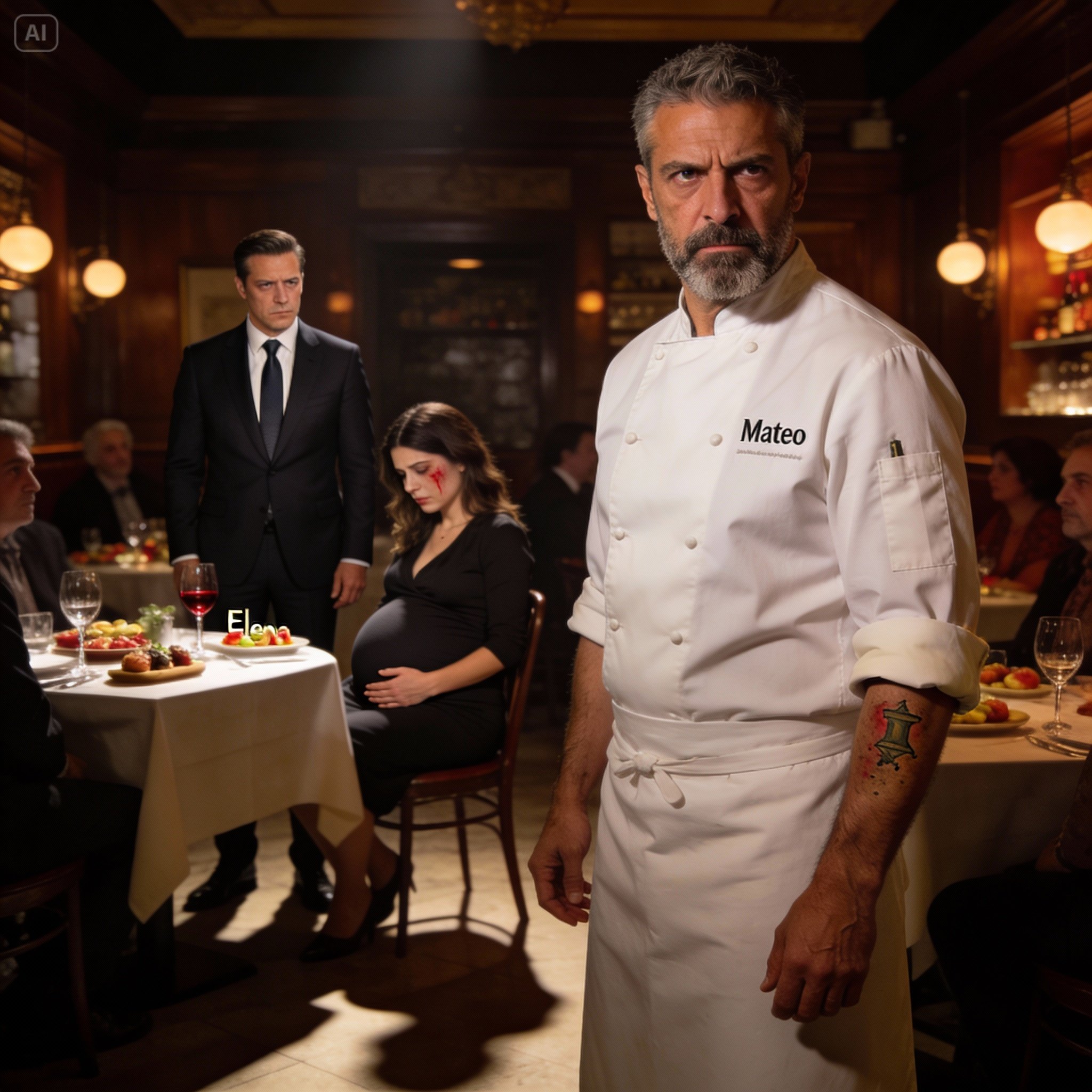
Elena. I learned her name much later, but at that moment I only saw her silhouette. She was pregnant, very pregnant, perhaps seven or eight months along. She wore an elegant, cream-colored dress that accentuated her condition, but her posture told a different story than her clothing. She walked with her head slightly bowed, her shoulders drawn in, as if trying to take up less space in the world. Her thin, pale hands instinctively cradled her belly, like a constant shield.
Luis, my head waiter, greeted them with that cloying reverence he reserves for customers who spend more than a thousand euros on wine.
—Don Alejandro, what a joy to see you again —said Luis, bowing almost ridiculously—. Your usual table is ready.
Alejandro didn’t even look her in the eye. He just nodded, handed his coat to the flight attendant without saying “thank you,” and continued walking toward the corner table, the most secluded one, the one with the best view in the room but offering the most privacy. Elena followed him in silence.
From the kitchen, I felt a twinge in the back of my neck. It’s hard to explain. Before becoming a chef, in another life that now seems like a distant dream, I served in units where instinct wasn’t a luxury, but a survival tool. You learn to sense danger before you see it. You learn to recognize the tension in the air, the static electricity that precedes a storm. And that couple brought a dark storm with them.
“Mateo, are you okay?” Javi, my sous-chef, asked, pulling me out of my trance. He had a tray of grilled carabineros waiting for my approval.
“Yes,” I grunted, wiping the rim of the plate with an immaculate cloth. “Get table seven ready. And tell Luis to keep an eye on the corner table.”
“Don Alejandro’s?” Javi snorted. “That guy’s a jerk, excuse my language, Chef. He always sends the wine back, saying it’s not at the right temperature even when it’s perfect.”
“It’s not the wine,” I murmured, more to myself than to him. “Keep an eye on him.”
The service continued, but my attention was divided. As I plated a sirloin steak with foie gras, my eyes kept returning to the window. I observed the dynamics of that table like someone studying an operational map. They weren’t speaking. Or rather, he was speaking; she was listening. He gestured with his fork, sometimes pointing it at her, slicing through the air with abrupt movements. She barely touched her water. She didn’t order wine, obviously, but he had ordered a bottle of Vega Sicilia and was drinking it at a worrying pace.
I saw him order for both of them. He didn’t even let her open the menu. I saw her try to say something, maybe suggest an appetizer, and he raised his hand, palm open, to silence her. It wasn’t a violent gesture in itself, but it was a gesture of absolute control. “Be quiet, I know what’s best.”
The atmosphere in the restaurant was the usual one: a respectful murmur, stifled laughter, the clinking of silver against china. A haven of civilization. But at that corner table, civilization hung by a thread.
Forty minutes passed. The appetizers had gone out and returned empty (on his side) and untouched (on hers). The main course arrived.
“Javi, do me a favor,” I said, lowering my voice. “Take a peek into the living room for a moment. Tell me what you see.”
Javi wiped his hands and approached the swinging door, peering through the small porthole. He returned seconds later, frowning.
“They’re arguing, Chef. But very quietly. In a way that’s scarier than if they were shouting. I think she’s crying. But she’s trying to hide it.”
I nodded. I knew it.
—Understood. Let’s get to work.
I tried to concentrate on the turbot in front of me, but the sound happened.
It wasn’t a crash. No tray fell. No glass shattered. It was a dry sound, flesh against flesh. Splat .
Immediately afterwards, silence.
That silence was what chilled me to the bone. In a crowded restaurant, the background noise is like a tide; when it suddenly stops, it’s because the sea has receded before the tsunami.
I put the knife down on the board. I went over to the ticket window.
What I saw is seared into my memory. Elena was half-turned in her chair, her left hand covering her cheek. Her eyes were wide and staring, filled with a liquid, utter terror. Her other hand clutched her stomach so tightly her knuckles were white. The chair had been thrown backward by the force of the impact.
In front of her, Alejandro was readjusting the napkin on his lap. His face didn’t show uncontrolled anger, which would have been, somehow, more human. No. His face showed a reptilian coldness. A calculated annoyance. As if she had spilled the water and he was correcting her.
Nobody moved.
I saw a couple at the next table staring at their plates, pretending the tablecloth pattern was fascinating. I saw Luis, my manager, frozen near the wine cellar, a bottle in his hand, pale as wax, calculating the cost of intervening against the richest customer of the evening.
Power has a curious way of freezing people. We’ve been taught to respect money, to not meddle in “private matters,” to look the other way. In Spain, we have a very ugly saying: “Dirty laundry should be washed at home.” But there, they weren’t at home. They were in my house.
“Mateo…” Javi whispered beside me. All the cooks had stopped working. The kitchen helper, a young lad, looked scared.
I saw Alexander lean toward her. I couldn’t hear what he was saying, but I read his lips. The articulation was precise, venomous.
“Stop making a fool of yourself. Sit up straight.”
Elena was trembling. She could see the trembling from twenty meters away. It was a trembling that originated in her bones. She tried to compose herself, tried to swallow her tears, tried to become the invisible trophy wife he demanded. But fear is hard to hide when you carry another life inside you.
Alejandro looked around. His eyes swept the room with an implicit warning: “Does anyone have anything to say?” His gaze was a challenge. He was betting that his three-thousand-euro suit and his surname were armor enough. He was betting that we were all cowards.
And for a moment, he won. The murmur began to return, timid, ashamed. People started eating again, justifying their inaction. “It probably wasn’t that bad,” they must have thought. “It’s not our problem.”
I looked at my hands. They were clean, but I felt an invisible stain on them. I remembered Kabul. I remembered situations where I could do nothing. I remembered oaths sworn to flags and fallen comrades to protect the defenseless. What was the point of all that if I allowed a thug in a tie to beat a pregnant woman in my own restaurant?
I took off my apron stained with sauce.
—Javi—I said. My voice sounded strange, metallic, as if it came from very far away.
—Yes, Chef?
—Take charge of the pass.
—What are you going to do, Mateo? Don’t do anything crazy, that guy is powerful, they say he’s friends with…
“I don’t care who your friend is,” I interrupted. I smoothed down my white jacket. I made sure my name, embroidered on the chest, was visible. “I’m going out.”
—Mateo, you’re going to be fired. The owners…
“If they fire me for this, I don’t want to work for them. Keep bringing out the plates. People are hungry.”
I crossed the kitchen. The sound of my clogs against the non-slip floor marked a war rhythm. I pushed open the swinging doors with both hands and the living room air conditioner blasted me in the face.
The light was dimmer here, more golden. The music was soft jazz that now seemed obscene. I walked between the tables. I wasn’t running, but my stride was steady. The customers who saw me pass fell silent. A chef emerging from the kitchen in the middle of service is never a good sign; it usually means someone has food poisoning or there’s a fire.
But I was the fire.
I reached the corner table. I stopped about a meter away, close enough to invade her personal space without being aggressive, but close enough to block her view of the room. I stood there, feet shoulder-width apart, hands clasped behind my back in a military at-ease position.
Alejandro was cutting his meat. He stopped, the fork halfway to his mouth. He slowly looked up, with a mixture of boredom and disdain.
“Can I help you with anything?” he asked. His voice was soft, polite, the voice of someone who has never had to shout to be obeyed.
I didn’t answer him. I looked at Elena.
Her cheek was red and swollen. Her watery eyes met mine. There was so much shame in them. Shame of being hit, shame of being seen.
“Ma’am,” I said, my voice echoing in the silence that had fallen over the room again, “are you alright? Do you need me to call an ambulance or the police?”
Elena opened her mouth, but no sound came out. She looked at her husband in panic.
Alejandro let out a short, dry laugh. He placed his silverware on the plate with a deliberate clinking sound.
“Listen,” he said, turning his attention to me as if I were an annoying mosquito. “I think you’re at the wrong table. Everything’s fine here. Go back to your kitchen and make sure my meat doesn’t get cold.”
“I didn’t ask you, sir,” I replied. I didn’t raise my voice. Staying calm is the best weapon against a man who’s waiting for you to lose your temper.
Alejandro’s face changed. The mask of indifference cracked, revealing the thug beneath. His eyes narrowed.
“What did you say?” he hissed. “Do you know who you’re talking to? He could buy this restaurant tomorrow and turn it into a garage. He could make sure you never work in Madrid again.”
“Maybe so,” I admitted, without moving a muscle. “But that’ll be tomorrow. Today, in my living room, I’m not going to allow anyone to hit a woman. And certainly not a pregnant woman. So I’m going to ask you, please, to get up and leave.”
The collective gasp in the room was audible. Luis, the manager, came running over, sweating profusely.
“Mateo, for God’s sake…” Luis whispered, trying to grab my arm. “Mr. Alejandro, I’m so sorry, our chef is under a lot of stress, you know, the heat… Mateo, go to the kitchen, now.”
I pulled away from Luis with a smooth but firm movement. I didn’t take my eyes off Alejandro.
—It’s not stress, Luis. It’s decency.
Alejandro stood up. He was tall, but so am I. And while he had a gym and personal trainers, I had years of experience hauling cattle and sacks of flour. And before that, years of carrying combat backpacks. We looked into each other’s eyes. He was searching for fear in mine. He was looking for the doubt of an employee who fears for his paycheck.
He didn’t find it.
“This is a private matter,” Alejandro said, approaching me, invading my space, trying to intimidate me with his expensive cologne and red wine breath. “A marital argument. You have no right to intervene.”
“The moment you raise your hand in a public place, it ceases to be private,” I replied. “And it becomes everyone’s business.”
“Elena,” he said, without looking at her, keeping his eyes fixed on mine as if in a duel, “let’s go. This place has become… unpleasant.”
Alejandro extended his hand toward her, hoping she would take it, stand up, and follow him as always. Like an obedient dog. It was the moment of truth. If she stood up and left with him, I couldn’t do anything more without committing a crime. It would be the end. She would disappear into the night, in that black car waiting outside, and whatever happened behind closed doors would be an invisible tragedy.
I looked at Elena.
“You don’t have to go with him,” I said gently. “You can stay here. You’ll be safe. My staff will take care of you. We’ll call a taxi, your family, whoever you want.”
Elena stared at her husband’s outstretched hand. That hand that wore a platinum wedding ring. That same hand that, two minutes earlier, had struck her face.
“Elena, I don’t have all day,” Alejandro said, and this time there was a clear threat in his tone. An implicit “we’ll talk at home.”
The room held its breath.
Elena placed both hands on the table to push herself up. Her knuckles were white. She stood up slowly, weighed down by her pregnancy.
My heart sank. I was going to give in. I was going to go with him. I had lost.
Alejandro smiled. A disgusting, triumphant smile. He looked at me smugly.
—You see, cook. She knows her place. Learn yours.
Alejandro turned to leave, hoping she would follow him.
But Elena didn’t move. She stood by the table, trembling, but standing.
“No,” she said.
It was a whisper, but in that sepulchral silence, it sounded like a scream.
Alejandro stopped dead in his tracks. He turned around slowly, as if he hadn’t heard correctly.
—What did you say?
Elena looked up. Tears were running down her face, ruining her makeup, but her chin was held high.
“I said no,” she repeated, and this time her voice was louder, more vibrant. “I’m not going with you. I’m not getting in that car. I’m never going to let you touch me again.”
Alejandro’s face turned red, a violent and ugly color.
“You’re making a scene,” he growled, taking a step toward her. “You’re hysterical because of your hormones. Let’s leave right now before you embarrass yourself even more.”
He raised his hand to grab her arm.
It was instinct. I didn’t think. My body remembered a movement I’d practiced decades ago. I took a step to the side, positioned myself between them, and blocked his hand with my forearm. It was a sharp, hard movement. Bone against bone.
“I told him not to touch it,” I said. My voice dropped an octave, becoming guttural. “And this is the last time I’m asking him politely.”
Alejandro stared at me, stunned, rubbing his wrist. For the first time, I saw real fear in his eyes. He realized that money was useless in a physical confrontation. He realized I wasn’t playing around.
“Luis!” Alejandro shouted, looking for the manager of the establishment. “Call security! This animal attacked me! I want him arrested!”
Luis was trembling, looking from side to side. But then, something wonderful happened.
At the next table, an older man stood up. Then another one at the back table. A young woman took out her phone and began recording openly, without hiding.
“I saw him hitting her,” the woman on the phone said loudly. “I have it on video. If you call the police, manager, make sure you tell them this man is an abuser.”
“And I saw it too,” said the older man, placing his napkin on the table. “If this gentleman, the chef, hadn’t intervened, I would have done it myself.”
The room awoke. The spell of money was broken. Suddenly, Alejandro wasn’t a powerful CEO; he was a lonely man, surrounded by hostile witnesses. The shame shifted. It was no longer Elena’s. It was his.
Alejandro looked around, cornered. His narrative of a “private matter” had crumbled. His “misunderstanding” was now public evidence.
“You’re all crazy,” he spat, straightening his jacket with trembling hands. “You don’t know who you’re messing with. This isn’t going to end like this.”
He looked at Elena one last time.
“If you stay here, don’t come home. I’ll cancel your cards. I’ll leave you with nothing.”
Elena put her hand to her belly, caressing it.
“I already have everything that matters,” she said. “Go, Alejandro.”
Alejandro uttered a curse, shot me a look of pure hatred, and turned away, marching quickly towards the exit, fleeing from judgmental stares, fleeing from the truth.
When the front door closed behind him, the air in the restaurant seemed to change. It became lighter.
I turned to Elena. She was staggering. The adrenaline had sustained her until now, but it was starting to fail.
—Please sit down— I said, pulling out the chair for him. —Luis, bring some water. And some chamomile tea.
Elena sat down, and then, finally, she broke down. She began to sob, covering her face with her hands. But it wasn’t a cry of despair; it was a cry of release. Years of tension bursting forth.
I knelt beside his chair to be at his level, not caring about the grease stain on my knee or what the customers thought.
“She did very well,” I whispered to her. “She was very brave.”
She took her hands away and looked at me. Her eyes, despite the tears and the blow, had a new light.
“Thank you,” she said, her voice breaking. “Thank you for seeing me. Nobody ever sees me. Everyone looks at his suit, or his car… nobody looks at me.”
“I see her,” I assured her. “And I promise you she’ll leave here safely.”
Luis arrived with the water, looking ashamed of his own previous cowardice.
“I… I’ve called a trusted taxi,” Luis said. “And I’ve notified the local police so they can take a statement if the lady wants to file a complaint.”
—Yes, I do —Elena said firmly—. I want to put it in.
I stood up. The room was still silent, watching us. But it was no longer an awkward silence. It was a respectful silence. Someone in the back began to applaud timidly. Then another. It wasn’t a stadium ovation, it was something more intimate, a recognition of our shared humanity.
I glanced into the kitchen. Javi and the rest of the team were peering through the porthole, smiling.
I knew there would be trouble tomorrow. I knew Alejandro would call his lawyers, that he would try to destroy my reputation, that he would pressure the owners to fire me. I knew a legal and media storm was brewing.
But as I watched Elena drink her water, her protective hand resting on her unborn child, I knew I didn’t care. Some things are priceless. Some dishes can’t be served cold, and justice is one of them.
I went back into the kitchen.
“Heard in the kitchen!” I shouted as I entered. “Table seven is still waiting for its turbot! Get moving!”
The team responded in unison: “Yes, Chef!”
The clatter of pans returned. The fire roared again. But that night, the food tasted different. It tasted of dignity.
Chapter 2: The Echo of Silence
Going back to the kitchen was like stepping into a decompression chamber. The adrenaline that had been pumping through my veins, hot and sharp like boiling oil, began to cool, leaving behind an almost imperceptible tremor in my hands. My boys weren’t saying anything, but the silence in a professional kitchen is louder than the clatter of pots and pans.
Javi approached, pretending to check a garnish of piquillo peppers.
“Boss,” he murmured without looking at me, “the office phone hasn’t stopped ringing. Luis isn’t answering it. He says it’s the partners’ private line.”
“Let it ring,” I replied, concentrating on chopping chives with surgical precision. I needed that repetition, that mechanical control, to keep my mind off what I’d just done. “If they have something to say, let them come here and put on their aprons.”
“You know it won’t be like that, Mateo. That guy, Alejandro… his company supplies half the luxury hotels in the city. He has tentacles everywhere. Tomorrow morning, your name will be on a blacklist.”
I slammed the knife down on the board. I looked at Javi. He’s a good kid, talented, with a mortgage and two newborn twins. His fear was rational. Mine had long since ceased to be.
“Javi, listen to me.” My voice was hoarse. “There are lists I care about being on, and lists I couldn’t care less about. The list of men who look the other way when a pregnant woman is assaulted… I’ll never be on that one. If I go down, I go down alone. You guys keep bringing out the dishes. The quality doesn’t drop. The standard doesn’t drop. Understood?”
“Yes, Chef.” He nodded, but I saw the glimmer of respect in his eyes. That respect that isn’t earned with Michelin stars, but with scars.
The service continued, but the energy had shifted. It was no longer just work; it was resilience. Every dish that came off the pass that night carried an extra measure of care, as if feeding that room full of witnesses was our way of thanking them for their silent support.
An hour passed. The dining room gradually emptied. As some customers left, they peeked shyly into the kitchen or asked the waiters to thank me. It was surreal. In twenty years of my career, I’d been praised for my reductions and my cooking times, but never for being human.
When the last order came out—a chocolate soufflé for table four—I took off my hat. The warmth from the stovetop had dissipated, replaced by the acrid smell of cleaning products and the whir of the industrial dishwasher.
I approached the porthole in the door.
She was still there.
Elena hadn’t moved. The table was clear, except for the glass of water and the empty chamomile teacup. Luis, my manager, had stayed near the bar, talking on his cell phone in nervous whispers, but keeping a respectful distance from her. Elena was staring out the window at Velázquez Street, where car headlights painted red and white stripes across the night. She looked like a castaway on a deserted island in the middle of an ocean of white tablecloths.
I felt a pang of guilt. I had saved her from the fall, yes, but now she was alone, facing the abyss of what would come next. The “next” is always the hardest part of heroism.
—Javi, take care of closing up —I said—. I’m going out for a moment.
I went to my small office in the back, where I keep my things. I took out a bottle of stock I had set aside for myself. It was bone broth, slow-cooked for forty-eight hours, thick, dark, full of collagen and soul. It wasn’t on the menu. It was what I drank when exhaustion reached my very bones. I heated it in a small saucepan, added a few drops of sherry and some fresh herbs.
I placed the steaming bowl on a tray, along with a piece of freshly baked sourdough bread, and went out to the dining room.
Chapter 3: A broth for the soul
The restaurant was almost empty. Only a couple of tables remained, people finishing their drinks, talking in hushed tones, and stealing glances at the solitary woman in the corner. I approached her.
Elena didn’t turn around when I arrived. She was lost in thought, her hand caressing her belly in slow, hypnotic circles. The mark on her cheek had faded from bright red to a darker, purplish hue. It pained me to see her.
I gently placed the tray on the table. The aroma of the broth, deep and comforting, broke her trance. She blinked and looked at me. Her eyes were swollen, but there was no more panic, only an infinite weariness.
“I’m not hungry,” he said, his voice weak.
“It’s not food, it’s medicine,” I replied, sitting down in the chair opposite her, the one her husband had occupied hours earlier. It seemed important to me to occupy that space, to reclaim it with a different energy, one that wasn’t toxic. “Drink some. It will settle your body. Shock cools the blood; you need warmth.”
She looked at the bowl, then at me. There was a moment of hesitation, but finally she picked up the spoon. Her hand was trembling. She took a small sip, then another. Her shoulders dropped an inch. She closed her eyes for a moment as she swallowed.
“It’s… it’s very good,” she whispered.
“My grandmother’s recipe. She used to say that a good broth cures everything except stupidity and death.” I smiled slightly, trying to lighten the weight of the air.
Elena gave a half-smile, a sad smile.
—I wish it could cure fear.
She put down her spoon and stared at me. There was a sharp intelligence in her gaze that had previously been hidden beneath submissiveness.
“Do you know what’s going to happen now?” she asked. “Alejandro isn’t a man who loses. Never. Right now he’s probably talking to his lawyers, his friends in the press, maybe even the police. He’s going to say I provoked him. That I’m unstable. That my hormones have driven me crazy. It’s his favorite strategy: to discredit his opponent before they can even speak.”
“These days, cell phone cameras are very impartial judges, Elena,” I said, pointing to the phone she had on the table. “People saw it. I saw it.”
“You…” She hesitated. “You risked your job for me. You don’t even know me. Why?”
I leaned back in my chair, crossing my arms over my chest. It was the million-dollar question. Why would a tired, cynical, middle-aged chef decide to become a human shield?
I looked at my hands. Worker’s hands, full of small cuts and burns, marks of a hard trade. But beneath the sleeve of my jacket, on my left forearm, was a different scar. Old, jagged, the result of a metal splinter on a dusty road thousands of kilometers from Madrid.
“Before I was a cook, I had another life,” I began, lowering my voice. The restaurant was silent; Luis had turned off the background music. “I was in the military. I was in special operations units. Peacekeeping missions, they called them, although they weren’t very peaceful.”
Elena opened her eyes slightly, surprised.
“I was in the Balkans, and then in Afghanistan,” I continued. “I saw things… things that change the very structure of your DNA. I saw what strong men do when they think no one is watching. I saw villages where silence was the only law, because speaking out meant death.”
I paused, swallowing the familiar lump that always formed in my throat when talking about this.
—Once, in a village near Herat… we saw something. A situation of abuse. A woman and a local warlord. We couldn’t intervene. The rules of engagement, politics, bureaucracy… ordered us to stay put. “It’s not our war,” they told us. “Don’t interfere in the local culture.”
I clenched my jaw at the memory. The helplessness. The cold rage.
“I stood by that day, Elena. I obeyed orders. And that night, that woman died. I promised myself, when I traded my uniform for kitchen knives, that I would never again hide behind ‘not my problem.’ That if I saw evil right in front of me, I would act. No matter the cost. No matter if I carried a rifle or a ladle.”
Elena listened to me with absolute intensity. A single tear rolled down her uninjured cheek.
“So no, I don’t know her,” I concluded, looking her in the eye. “But I know fear. And I know men like Alexander. They’re cowards disguised as kings. They’re only strong when you’re weak.”
She reached down on the table and tentatively touched my forearm, right over the fabric covering my scar.
“Thank you, Mateo,” she said. It was the first time she’d used my name. She’d read it on my jacket. “You’ve given me more than just protection today. You’ve reminded me that I can say no.”
At that moment, the blue lights of a siren bounced off the mahogany walls of the restaurant. Reality was knocking at the door again.
Chapter 4: Law and Order (and Disorder)
The front door opened and two National Police officers entered. They were in uniform, with serious and professional expressions. Behind them, to my surprise and dismay, was not Alejandro, but a man in an impeccable gray suit carrying a leather briefcase.
I recognized the guy immediately. A lawyer. One of the expensive ones. The kind who charge by the minute and can smell blood from miles away.
Luis hurried to greet them, pale as a ghost.
“Good evening, officers,” Luis said. “How can we help you?”
“We received a call about a domestic violence incident,” said one of the officers, a heavyset man with graying temples. “And also a cross-complaint for assault and threats from a Mr. Alejandro Vega against an employee of this establishment.”
The lawyer took a step forward, with a smile that didn’t reach his cold eyes.
“Good evening. I’m Ricardo Méndez, representing Mr. Vega. My client was the victim of an unjustified physical assault by…” He consulted some notes on his phone, “…a certain Mateo, the head chef. Furthermore, my client is extremely concerned about the mental state of his wife, who is being held here against her will.”
I felt my blood boil again, but I forced myself to remain seated. Elena tensed, her hand instinctively returning to her stomach.
“No one is holding me back,” Elena said. Her voice trembled slightly, but it was clear. “I’m here because I want to be. And because I’m afraid of your client, Mr. Méndez.”
The lawyer looked at her with a patronizing condescension that made me nauseous.
—Doña Elena, I understand you’re upset. Alejandro only wants what’s best for you and the baby. He’s very worried. He says you had a… nervous episode. The car is outside to take you to the rest clinic that…
“Don’t even think about it!” I jumped up. The chair scraped against the floor. The two police officers instinctively reached for their belts, though they didn’t draw their weapons.
“Officers,” I said, raising my open hands to show I wasn’t a threat, “I’m Mateo. The man this lawyer is accusing. The only assault that happened here tonight was Mr. Vega hitting his wife in the face. There are twenty witnesses. There are security cameras. And there are recordings from customers.”
The senior officer looked at me, assessing me. Then he looked at Elena. He saw the mark on her face. He saw the terror in her eyes as she looked at the lawyer. Police officers in Madrid see many things, and they usually have a good nose for detecting who is the victim and who is the perpetrator.
—Madam —said the officer, ignoring the lawyer—, do you want to file a complaint?
“Yes,” Elena said. She stood up, leaning on the table. “I want to report my husband for physical and psychological abuse. And I want to request an immediate restraining order.”
The lawyer snorted.
“This is absurd. My client is a pillar of the business community. This is a domestic misunderstanding that has spiraled out of control due to the intervention of a violent cook with a hero complex.”
I approached the lawyer. I stopped a step away from him. He smelled of expensive cologne and cynicism.
“Mr. Méndez,” I said calmly, “I suggest you check Twitter. OX, or whatever the hell it’s called now. I think the ‘community pillar’ is trending in Madrid right now.”
The lawyer frowned and pulled out his phone. I saw his expression change. From arrogance to alarm. He swiped across the screen once, twice. He watched the video. That grainy but clear video where you could hear the blow, where you could see Alejandro screaming, where you could see me stepping in. The comments were piling up by the thousands. “Coward,” “Abuser,” “Bravo for the chef.”
“Public opinion is fickle,” muttered the lawyer, though he seemed nervous. “This can be fixed.”
“The scar on this woman’s face can’t be ‘fixed’ with a press release,” I said. “Officers, if you need my statement, I’m available. But this woman isn’t going with this individual.”
“Of course not,” the police officer said. “Ma’am, you’ll come with us to the station to file a formal complaint. We’ll assign you protection. And we’ll request the security camera footage from the establishment immediately.”
—Luis—I called to my manager—. Give them the recordings. All of them. From when they entered until he left.
Luis nodded fervently.
—Yes, yes, of course. Anything you need.
The lawyer put his phone away. He knew he had lost that night’s battle.
“Alejandro won’t be happy,” he said, looking at me. “And when Alejandro isn’t happy, people lose their jobs. Enjoy your last night in this kitchen, chef.”
“I’d rather lose my job than lose sleep,” I replied.
Elena approached me before leaving with the police. She took my hands in hers, cold but firm.
—I don’t know how to repay you for this.
—Take care of yourself. And take care of that little one. Teach him to be a real man, not like his father.
“I will.” She squeezed my hands. “My name is Elena. In case you ever need anything.”
—Matthew.
I saw her leave, escorted by the police, walking with a newfound dignity. She wasn’t walking like a victim. She was walking like a survivor. The lawyer followed, talking furiously on the phone, trying to contain a dam that had already burst.
Chapter 5: The Red Telephone
When the restaurant was empty again, the silence was different. It was heavy, heavy with foreboding.
Luis slumped into a chair, loosening his tie.
“Oh my God, Mateo. Oh my God, what a mess you’ve made.” He rubbed his face with his hands. “The partners have been calling me. They’ve seen the video. They’re… divided.”
“Divided?” I asked, starting to clear Elena’s table.
—Yes. Half of them say you’re a PR problem, that we’ve lost our best customer and his circle of millionaire friends. They say the restaurant shouldn’t take sides in marital disputes.
—And the other half?
—The other half says you’re a national hero. The reservation line for next month has been jammed in the last half hour. People want to come and eat “at the restaurant of the chef who champions women.”
I let out a short, humorless laugh. The world is a circus. One day you’re a chef, the next a villain, and the next a saint, all depending on a social media algorithm.
—I didn’t do it for the reservations, Luis.
“I know.” Luis looked at me with a mixture of exasperation and affection. “You’re stubborn. But… thank you.” I froze. I was afraid. You didn’t hesitate.
—We’re all afraid, Luis. The difference is what you do with it.
At that moment, my own phone vibrated in my pocket. It was an unknown number. I hesitated, but answered.
-Yeah?
—Mateo Ruiz? —A man’s voice, distorted, deep.
-It’s me.
“You’ve gotten yourself into a game that’s too big for you, little soldier.” The voice dripped with venom. “You think that because you wore a uniform in the desert you know how the real world works. Alejandro Vega isn’t some Taliban fighter you can just shoot. He’s a man who pulls the strings in this city.”
I felt the hair on the back of my neck stand on end. It wasn’t fear. It was that old feeling of battle. The enemy was revealing itself.
“Who is it?” I asked calmly.
“Someone’s advising you to leave Madrid. Take a long vacation. Because if you stay, we’re going to dig everything up. Your military record. That incident in Herat that doesn’t appear in the official reports but that you and I both know happened. We’re going to turn you into a monster.”
My heart skipped a beat. How did they know about Herat? That was classified. Alejandro had resources that went beyond money; he had information.
“I don’t know what you’re talking about,” I said, keeping my voice firm. “But tell your boss that if he wants war, he’s chosen the wrong cook. I’m used to cooking over an open fire. He’s only used to having his food served hot.”
I hung up.
I stared at my phone. My hands were trembling slightly again. They’d struck a nerve. My past was my Achilles’ heel, and they’d found it in record time.
“Everything alright?” Luis asked, noticing how pale I was.
—Yes—I lied—. Just… tiredness.
I went to the locker room. I took off my white jacket, stained with sweat and fleeting glory. I put on my street clothes, some old jeans and a black t-shirt. As I left through the back door, into the alley where we usually smoke and unload the trucks, I stopped.
There was a black car parked at the end of the alley. Engine running. Tinted windows.
It wasn’t the police.
I took a deep breath of the cool Madrid night air. It tasted of ozone and danger. I took out my personal pocketknife, a small tool I always carry with me, and opened it in my jacket pocket. Just in case.
I walked toward the subway entrance. I didn’t look back, but I knew the car was following me slowly, like a shark stalking in deep water.
The night had just begun, and the real battle, the one that would be fought outside the kitchen, was about to be served up.
Chapter 6: Shadows in the Madrid Metro
The air in Madrid at night is usually fresh, but in that alley behind the restaurant, it felt thick, charged with a static electricity that made my hair stand on end. The black car was still there, at the end of the street, its engine purring like a sleeping beast. They didn’t turn on the lights. They didn’t need to. Their presence was the message.
I walked toward the main street, Serrano, seeking the safety of the lights and the people. My steps were measured. One, two, three. Don’t run. If you run, you’re prey. If you walk with purpose, you’re a difficult target.
The car started moving. I heard it more than saw it. The tires crunched on the asphalt. They followed me slowly, staying about twenty meters away, right at the edge of my peripheral vision.
I headed to the Núñez de Balboa Metro station. Going underground was my best option. Above ground, they had the advantage of the machine and the speed. Down below, in the labyrinthine corridors and crowded cars, the territory was mine.
I took the stairs two at a time. I pulled out my travel pass with one hand while the other still clutched the knife in my pocket. I went through the turnstiles. I looked behind me. Two men were coming down the stairs. They weren’t in uniform, but they walked with the synchronized movements that betray training. One was bald, the other wore a brown leather jacket. They weren’t looking at the signs. They were looking at me.
The train was arriving. The sound of the train braking filled the station with a metallic screech. People crowded onto the platform: young people returning from parties, night shift workers, lost tourists. I mingled with them, using my body as a visual shield.
The doors opened. I entered the last car. The two men entered the second-to-last one.
The train started moving. I stood by the door, calculating. If I got off at the next stop, they would get off. If I stayed, they would wait for a more deserted station to act.
My phone vibrated again. Another message from an unknown number.
“Herat. 2004. We know what happened in the valley. We know the official report lied to protect you. If you don’t want all of Madrid to know you’re a war killer, withdraw the complaint and say you were drunk.”
I looked at the screen and felt a chill run down my spine. Herat. The Valley of Lamentations, as we called it. That mission was an intelligence disaster. We were ambushed. Civilians died. The official report said it was Taliban crossfire. The truth was much dirtier, more confusing, filled with smoke, screams, and split-second decisions that haunt you every night when you close your eyes.
Alejandro wasn’t playing around. He had accessed files that should have been locked away at the Ministry of Defense. That meant his connections reached very high up. Perhaps retired generals who now sat on boards of directors with him.
The train arrived at Goya station. I decided it was time to break off contact.
Just as the doors began to close and the warning whistle sounded, I jumped onto the platform. The movement was quick and fluid. The two men in the next car tried to do the same, but the doors closed in their faces.
I saw the face of the man in the leather jacket through the window as the train pulled away. He was staring at me with cold rage, pounding the glass with his palm. I’d won this round. But Madrid feels small when someone with a lot of money is after you.
I surfaced on Alcalá Street. I hailed the first available taxi I saw.
—To Carabanchel—I told the driver.
The taxi driver looked at me in the rearview mirror.
—You look unwell, boss.
—Long night in the kitchen—I replied, leaning back in the seat and closing my eyes for the first time in hours.
Chapter 7: The awakening of the media beast
My apartment in Carabanchel is the opposite of the restaurant in the Salamanca district. It’s a small, third-floor walk-up with no elevator, furnished with Ikea furniture and walls covered in cookbooks and old black-and-white photos. It’s my refuge. Here I’m not “Chef Mateo”; I’m just a man trying to sleep without nightmares.
I didn’t sleep that night. I sat on the sofa with a bottle of cheap whiskey and my laptop, watching my life turn into a digital spectacle.
The video had gone viral globally. On Twitter, the hashtag #ElChefDeVelazquez was the number one trending topic in Spain.
The comments were a wave of support:
“Finally someone is doing something.”
“We need more men like this.”
“Boycott Alejandro Vega’s companies.”
But amidst the praise, the first cracks began to appear, sown by bots and newly created suspicious accounts.
“Beware of this chef, they say he has a violent past.”
“Doesn’t anyone wonder why a mere cook knows how to immobilize someone like that?”
“I heard he was kicked out of the army for something shady.”
Alejandro’s machine was working at full capacity. They were sowing doubt. They were preparing the ground for the coup de grâce.
At eight in the morning, my phone rang. It was Luis.
—Mateo, don’t come to the restaurant—her voice sounded on the verge of a panic attack.
-Because?
—There are journalists at the door. Television cameras. People from “Espejo Público”, from “El Programa de Ana Rosa”… it’s crazy. And… Mateo, they’ve painted the facade.
I got up from the sofa, my joints creaking.
—What have they painted?
—“Killer cook.” In red. In large letters on the glass.
I closed my eyes. It was already beginning. They weren’t attacking my defense of Elena; they were attacking my past to invalidate my present.
“Are the owners there?” I asked.
—Yes. Don Enrique and Doña Marta are in the office. They’re furious, Mateo. They say you’re ruining the exclusive image of the place. They want to talk to you.
—I’ll be there in an hour.
—I told you not to come! There’s too much tension.
“I’m not going to hide, Luis. If they want to fire me, they should tell me to my face. And if the press wants to talk, maybe it’s time I talked too.”
I hung up and went to the shower. I let the hot water hit the back of my neck, trying to wash away the tiredness and the fear. I shaved carefully. I put on my best white shirt and clean chinos. If I was going to fall, I would fall with dignity.
Before leaving, I took a shoebox from the back of my closet. Inside were a military merit medal with a red ribbon, a couple of faded photos of my platoon in the desert, and a copy of my service record. I put it in my backpack. I might need it.
Chapter 8: Bitter Coffee and Unexpected Alliances
Before going to the restaurant, I popped into a neighborhood coffee shop for a black coffee and a piece of toast. I needed a caffeine fix.
The bar’s television was on. They were showing the morning news. And there I was. My face, pixelated and taken from the restaurant’s video, filled the screen. The headline read: “HERO OR VILLAIN: The dark past of the chef who stood up to the tycoon . ”
The presenter, with a serious expression, read a statement:
“Sources close to the Ministry of Defense have leaked information suggesting that Mateo Ruiz, the chef involved in last night’s incident, was investigated in 2004 for excessive use of force during a mission in Afghanistan. Although there was no conviction, his discharge from the army was, to say the least, controversial.”
I felt the stares of the few customers in the bar. Some were looking at the TV, then at me, then back at the TV again. The waiter placed my coffee on the table with a slightly louder tap than usual.
“Is that you?” asked the waiter, an older man with a toothpick in his mouth.
I looked at the screen, where they were now showing a photo of Alejandro Vega in a suit, smiling at a charity gala, with the caption “Philanthropic businessman denounces assault” .
“Yes,” I said, taking a sip of coffee. “It’s me.”
The waiter stared at me for a few seconds. Then he bent down under the counter and took out a freshly baked croissant. He put it on my plate.
“It’s on the house,” he said. “My daughter had a husband like that wretch in the suit. I wish there had been someone like you around. I don’t care what you did in the war, kid. What you did last night was good.”
I got a lump in my throat. Ordinary people, people on the street, understood what the headlines were trying to hide.
At that moment, my phone rang again. Blocked number. I thought it was another threat, but I answered.
-Yeah?
—Mateo? It’s Elena.
Her voice sounded different. Louder, but still with that underlying tremor that trauma leaves behind.
—Elena. How are you? Are you safe?
“I’m at my sister’s house, in the suburbs. The police have stationed a patrol car outside my door. But I saw the news, Mateo. What they’re saying about you… it’s my fault. Alejandro is using his connections to destroy you.”
“Don’t worry about me, Elena. I have thick skin. The important thing is that you don’t withdraw the complaint. That’s what he wants. He’s attacking me to isolate you, to make you think your only ally is a criminal.”
“I’m not going to do it,” she said firmly. “But I need to see him. There are things you don’t know. Things about Alejandro’s business dealings. If they’re going to play dirty with his past, we have to play dirty with his present. He has secrets, Mateo. Secrets kept in folders that I’ve seen.”
I leaned over the table, lowering my voice.
—What kind of secrets are we talking about?
—Bribery. Money laundering. And something worse… he’s got people in the press and the police on his payroll. That’s why he knew about his file so quickly. Mateo, I have proof. I took photos of documents months ago, in case I ever dared to leave him. They’re in the cloud.
I smiled. Alejandro had underestimated his wife. He had treated her like a decorative piece of furniture, not realizing that furniture is only in the room when important things are discussed.
—Elena, that’s dynamite. But it’s dangerous. If he knows he has it…
—I know. That’s why I need to give it to someone I trust. And I only trust you.
—Don’t come to the restaurant. It’s surrounded. Tell me where.
—Are you familiar with the Temple of Debod?
-Yeah.
—In an hour. In the back, where you can see the Casa de Campo park. I’ll be wearing a cap and sunglasses.
—I’ll be there.
I hung up and left a ten euro note on the bar.
—Thank you for the croissant—I said to the waiter.
—Give it to them hard, chef.
Chapter 9: The Trench on Velázquez Street
I decided to go to the restaurant before my meeting with Elena. I had to face the owners, and above all, I had to make sure my team was okay.
When I arrived at Velázquez Street, the scene was a circus. Two television news vans were double-parked. A group of journalists crowded around the entrance. The red graffiti on the window (“Killer Cook”) was being cleaned by a municipal team, but the stain remained, blurry and unsightly.
I put on my sunglasses and walked straight to the entrance.
—It’s him! It’s Mateo!
The microphones lunged at me like spears.
—Mateo! Is it true that he killed civilians in Afghanistan?
—Chef! Do you have anger management problems?
—Are you having a romantic relationship with Mr. Vega’s wife?
That last question made me stop. It was so low, so predictably dirty. I turned to the journalist who had asked it, a young guy from a tabloid website.
“Listen carefully,” I said, and my projected voice silenced the others. “Last night I saw a 220-pound man beating a pregnant woman. I intervened. That’s all. If you want to talk about my past, go ahead. But don’t insult the victim by making up stories. The only crime here is the one that coward committed.”
I went into the restaurant before they could ask any more questions.
Inside, the atmosphere was somber. The tables were unset. The staff were gathered in a corner, speaking in whispers. When they saw me enter, silence fell.
Luis came towards me. He had dark circles under his eyes that reached the floor.
—They’re in the office. Enrique and Marta. And they have an employment lawyer with them.
I nodded and walked toward the back, past my kitchen. It was dark and cold. Javi was there, sitting on the counter with his arms crossed.
“I’m not going to let them fire you, Mateo,” Javi said when he saw me. “If you leave, we all leave. We’ve talked about it. The whole kitchen staff. And half the waiters.”
—Javi, don’t be an idiot. You have families.
—And we have dignity. That guy hit a woman here. If the owners take his side for money, we don’t want their money.
I put a hand on his shoulder, excited.
—Wait here.
I went into the office. Enrique, a businessman who saw the restaurant only as a spreadsheet, was red with anger. Marta, his wife and partner, seemed more worried.
“Do you have any idea what you’ve done?” Enrique shouted without greeting anyone. “The stock in my other companies has dropped 2% this morning because of my association with this scandal! Alejandro Vega is untouchable in this city!”
“No one is untouchable, Enrique,” I said calmly. “And especially not an abuser.”
“Don’t give me that moralizing!” Enrique slammed his fist on the table. “You’re fired. For improper conduct, for assaulting a customer, and for damaging the company’s image. You’re leaving without severance pay. And I assure you, I’ll make sure you never cook again, not even at McDonald’s.”
Marta intervened, more gently.
—Mateo, we understand you wanted to help, but… your past. What the news says. We can’t allow that stain.
I took the dismissal letter they had already prepared on the table and signed it without reading it.
“I’m leaving,” I said. “But you’re wrong about one thing. I’m not the stain. The stain is having allowed men like Alejandro to feel so comfortable here that they thought they could beat their wives between the first and second courses.”
I turned to leave, but stopped in the doorway.
—Oh, and one more thing. Javi and the team… if you retaliate against them, I’ll go to the press. And I’ll tell them all about the unlicensed suppliers and the undeclared overtime. Understood?
Enrique turned pale. He knew I knew where the bodies from the business were buried.
I left the office. I went to the kitchen.
“Guys,” I said aloud. “I’ve been fired.”
There was a murmur of protest. Javi took off his apron and threw it on the floor.
—Then we’re leaving.
“No!” My voice rang out with authority. “Nobody’s leaving. Lunch service starts in two hours. There are customers who have made reservations, people who come to eat well, not to watch a drama. Stay. Make the food perfect. Show that this kitchen has honor, even if the owners don’t. Javi, you’re the new Acting Head Chef. Don’t let me down.”
Javi pressed his lips together, holding back tears of anger, but nodded. He picked up his apron.
—For you, Chef.
I left through the back door, into the alley. I felt light. Jobless, unpaid, pursued by a millionaire and the press. But free.
I looked at my watch. I had forty minutes to reach the Temple of Debod. Elena was waiting for me with the key to destroying Alexander’s empire. And I had the determination of a soldier who, at last, had found a war worth fighting.
But as I walked toward the subway, I saw something that made me stop. On the corner, the same black car from last night. And this time, the rear window rolled down a few inches. I saw eyes staring at me. And I saw the silenced barrel of a gun, just a flash, before the window rolled back up.
They weren’t going to let me get to that meeting so easily.
I started running.
Chapter 10: The Hunt on the Asphalt
Running at forty-five isn’t the same as running at twenty-five, especially when your knees have endured two decades of twelve-hour shifts on your feet. But the body has a memory. As soon as my soles hit the asphalt of Claudio Coello Street, my mind made that familiar “click.” The world became a tactical map. Parked cars were cover; pedestrians, visual obstacles; alleyways, escape routes.
The black car accelerated, its tires screeching in a protest of burning rubber. They couldn’t openly fire on such a busy Madrid street in broad daylight, even with a silencer. Too many witnesses, too many traffic cameras. Their objective was to intercept me, force me into the back seat, and take me somewhere where the noise wouldn’t matter.
I swerved into the cross traffic on Juan Bravo Street, narrowly avoiding an EMT bus. The driver honked, a long, furious blast that served as sound camouflage for me. The black car had to brake sharply to avoid hitting the bus. I gained five seconds.
Five seconds is a lifetime in an escape.
I jumped over a low construction fence and went into a subway entrance. It wasn’t the closest, but it was the busiest. I went down the escalator, skipping three steps at a time, ignoring the complaints of a woman I almost pushed.
“I’m sorry!” I shouted, without looking back.
In the underground concourse, the air was thick and smelled of humanity and electricity. I didn’t use my pass this time; I jumped the emergency exit turnstile. The alarm blared, sharp and persistent. Good. Chaos was on my side. If subway security came, my pursuers would have to stop.
I blended into the throng of people on the Line 5 platform. The train was arriving. I stuck close to a group of Japanese tourists, shrinking down, trying to look smaller, less “military.” I entered the carriage and went to the back, my back to the flow of people, watching the stairs.
Just as the doors closed, I saw the man in the brown leather jacket get off. He was sweating, phone glued to his ear, frantically searching through the crowd. His eyes glanced over me, hidden behind the tourists’ suitcases.
The doors closed. The train started moving.
I exhaled. The air left my lungs in a shudder. I touched my pocket. The knife was still there. My backpack with the medals and papers, too.
But I wasn’t safe. They knew where I was going. If they had tapped Elena’s phone, or mine, they knew about the Temple of Debod.
I took out my phone, removed the SIM card, and broke it in two with my fingers. Then I turned the phone off. From now on, only analog communication.
I got off at Callao, three stops before my destination. I couldn’t risk getting off at Plaza de España, where they’d surely be waiting for me. I came back up onto Gran Vía. The midday sun was blinding. The street was alive, full of people shopping, eating, living a normal life that now seemed so foreign to me.
I walked quickly, blending into the crowd, buying a cheap “Madrid” cap from a kiosk to cover my face. I had to get to Elena before they did.
Chapter 11: Shadows in the Temple
The Temple of Debod is a beautiful anomaly in Madrid: stones from ancient Egypt brought brick by brick and placed on a hill overlooking the Royal Palace. It’s a place of peace, romantic sunsets, and Instagram-worthy photos. But today, for me, it was a quarry.
I approached from West Park, staying in the shade of the trees, scanning the perimeter. There was a maintenance van parked near the entrance that I didn’t like. Two men inside, reading the newspaper, too still.
“Surveillance,” I thought. Alejandro had mobilized his private army.
I looked for Elena. I saw her sitting on a stone bench at the back of the church, looking towards the Casa de Campo park. She was wearing a beige trench coat and a headscarf, like the actresses of the 1950s who tried to go unnoticed. She seemed fragile, alone.
I approached from behind, slowly.
“Don’t turn around abruptly,” I whispered when I was behind him.
Elena tensed up, but nodded slightly.
—Matthew. I thought you weren’t coming.
“I have company,” I said, sitting down next to him but facing the opposite direction, taking in all 360 degrees. “There are two men in a gray van at three o’clock. And there are probably more on foot.”
“Oh my God…” Her voice trembled. “Are they going to kill us?”
—Not here. Too many people. They want the evidence, Elena. And then they want to silence us. Do you understand?
Elena took a small external hard drive and a thick envelope out of her bag.
“Here it all is. The off-the-books accounting for his hotel companies. The emails with the city councilor about rezoning protected land. And…” He swallowed hard, “videos. Videos of him with other women. Some of them very young.”
I felt a wave of disgust, but also of triumph. This wasn’t just ammunition; it was a nuclear bomb.
—Okay. Keep it. Don’t give it to me yet. If they catch me, they’ll catch you. We have to get out of here together and take this to someone who can’t be bought.
—To the police?
—Not the police. They already have the district station under control, that’s why the lawyer was so calm last night. We need to go higher up. Or more horizontally. To the National Court. Or to the international press.
—Hey, you!
The voice came from the left. I turned around.
He was the bald man from the subway. The guy in the leather jacket was with. He was standing on the gravel path, about ten meters away, with one hand inside his jacket.
“Get up slowly,” said the bald man, smiling with yellow teeth. “Mr. Vega wants to recover what is his.”
Elena clung to my arm.
“Relax,” I whispered to her. “When I tell you, run toward the group of Chinese tourists at the entrance. Shout ‘Fire!’ Shout anything. But get right in the middle of them.”
-And you?
—I’m going to have a chat with this gentleman.
I stood up slowly, raising my hands.
“We don’t want any trouble,” I said aloud, acting submissive. “We were just talking.”
The bald man relaxed a millimeter, overconfident. Big mistake.
—Give me the backpack, cook. And the girl is coming with us.
He took a step forward.
“NOW!” I shouted.
Elena darted off to the right. At the same time, I lunged to the left, grabbing a handful of gravel from the ground.
The bald man pulled out an extendable baton, not a gun (too much noise), and swung it at my head. I dodged by ducking, feeling the metal whizz past my ear. I threw gravel in his eyes.
He screamed, clutching his face. I took advantage of his momentary blindness. A kick to the kneecap. A sharp crack. He fell to his knees. A heel strike to the nose. He fell backward, dazed, bleeding.
“You fucking cook!” he bellowed from the floor.
But I didn’t stay to finish it. The gray van had started up and was coming towards us, driving up the grass, breaking the rules of traffic and physics.
I ran towards where Elena had gone. She was in the middle of the group of tourists, who were staring fearfully at the approaching van.
“Come on!” I grabbed her hand and pulled her towards the stairs that lead down to the Cuesta de San Vicente.
We ran downstairs, almost tripping. The van couldn’t keep up with us. We could hear the men shouting from above, but we had gained a few minutes.
We reached the street below, panting. Elena was pale, clutching her stomach.
“No… I can’t run anymore… the baby…” she gasped.
“Okay. We’ll stop now.” I looked around. We were near Príncipe Pío Station. Lots of people. Security.
“What now?” she asked, with tears in her eyes.
I took out the envelope she had given me (she had slipped it into my pocket during the confusion).
—Now we’re going to do the one thing Alejandro doesn’t expect. We’re going to stop running away.
Chapter 12: The live broadcast that stopped Madrid
We went into the Príncipe Pío shopping center. I went straight to an electronics store. With the little cash I had left, I bought a cheap prepaid phone and a hard drive adapter.
We went into the upstairs restrooms, in the disabled section, for privacy. I locked the door.
“What are you going to do?” Elena asked, sitting on the toilet lid, trembling.
I connected the hard drive to the phone. My fingers flew across the screen. I created an anonymous Twitter account. But then I stopped.
“No,” I said. “Not anonymous. If it’s anonymous, they’ll say it’s fake. They’ll say it’s a setup. It has to have a face.”
I took off my cap. I ran my hand through my sweaty hair.
—I’m going live. From my Instagram account. The restaurant’s account didn’t have many followers, but my personal one has skyrocketed since last night. I have fifty thousand new followers waiting to see what the “Killer Chef” has to say.
—Mateo, they’re going to kill you if you do that. They’ll know where we are.
“They already know where we are, Elena. The only way to protect us is for everyone to know too. If this comes to light, if it really goes viral with the evidence… Alejandro won’t be able to touch us without the whole world seeing it.”
I looked at Elena.
—Are you ready to burn down his kingdom?
She took a deep breath. She dried her tears. She stood up and came to my side.
—Turn it on.
I pressed the “Live” button.
The screen showed my tired face, with a small wound on my forehead from a branch during the escape, and behind me, the white tiles of a public restroom.
The viewer count began to climb rapidly. 100… 500… 2,000… 10,000 in a matter of seconds.
“Hello,” I said, looking at the camera with the same intensity I use when I’m handling a complicated service. “I’m Mateo Ruiz. The chef you’re all talking about. They say I’m violent. They say I’m dangerous.”
I paused.
—What I am is a witness. And I am not alone.
I turned the camera slightly so Elena would come into the frame. She was covering part of her face, but the mark from the blow on her cheek was visible, a distinctive sign of pain under the fluorescent light.
The comments exploded. Hearts, questions, insults, support.
“This is Elena,” I continued. “Alejandro Vega’s wife. The man who beat her yesterday because her soup was cold, or because the wine wasn’t breathing properly, or simply because he could. They’re looking for me. There are armed men chasing us through Madrid right now as I record this.”
I brought the hard drive closer to the camera.
—This album contains evidence of crimes that will send many people to jail. Bribery of politicians. Money laundering. And systematic abuses.
Elena leaned toward the phone. Her voice was soft, but firm.
—Alejandro, I know you’re watching this. I know your lawyers are watching this. It’s over. I’m not afraid of you anymore. And you no longer have my silence.
“We’re going to upload all the documents to a public server in five minutes,” I said. “Journalists, judges, honest police officers… download it quickly. Because they’re going to try to take it down.”
The counter read 150,000 spectators. It was insane.
“We’re at the Príncipe Pío Shopping Center,” I said, deliberately revealing our location. “If anyone wants to arrest us, let the National Police come. In uniform. With a warrant. If anyone else shows up… well, you know what happened in the park.”
I cut the transmission.
There was absolute silence in the bathroom for two seconds.
—And now? —Elena asked.
“Now we wait.” I sat on the floor against the door, taking out the knife once more. “And we pray that the good guys arrive before the bad guys.”
Chapter 13: The Siege of Príncipe Pío
We didn’t have to wait long. But it wasn’t the bad guys who arrived first. It was the people.
By revealing our location, we had triggered something unpredictable. People in the mall who were watching the live stream on their phones started heading towards the restrooms.
I heard murmurs outside.
—It’s here.
—Yes, it’s the chef.
—They’re inside!
Someone knocked softly on the door.
“Matthew?” It was a young boy’s voice. “We’re… followers. We’re out here. There are a lot of people. We won’t let them come after you.”
I opened the door cautiously.
The corridor was packed. Hundreds of people. Teenagers, mothers with strollers, elderly people, shop assistants who had left their posts. They had formed a spontaneous human barrier. They were recording with their phones, creating an impenetrable digital wall.
At the end of the corridor, I saw two private security guards from the mall running, and behind them, Alejandro’s men. The bald one (with a broken and swollen nose) and the one in the leather jacket.
They tried to push the crowd.
“Get out of the way! Private security!” they shouted.
But the crowd did not move.
“It’s him! He’s the abuser!” a girl shouted, pointing at the hitmen. “Don’t let them through!”
The crowd began to boo. Alexander’s men were overwhelmed. They couldn’t draw their weapons there. They couldn’t strike a hundred people. They were wolves surrounded by a flock that had decided to stop being sheep and become a stampede.
“Out! Out!” the people shouted.
And then, the mermaids. Real mermaids. Lots of them.
The National Police entered, not two officers, but a whole squad from the UIP (riot police), with helmets and shields. But they weren’t coming for us. They were coming to restore order.
An inspector in plainclothes, with a badge around his neck, made his way through the crowd.
“Mateo Ruiz?” he asked as he reached the bathroom door.
-It’s me.
“You’ve got half of Spain on tenterhooks, sir. The Interior Minister called personally. They want that evidence. And they want these two individuals”—he pointed to the hitmen who were being handcuffed by other officers—”It seems there are outstanding arrest warrants for them.”
I looked at Elena. She was crying, but this time she was smiling.
I handed the hard drive to the inspector.
—It’s all yours. But I want it on record that this woman is the heroine. I’m just the cook.
The inspector picked up the disc as if it were the Holy Grail.
—We’re going to get them out of here. They have an escort car waiting.
We came out of the bathroom to applause. People were touching our backs, cheering us on. It was overwhelming. It was beautiful.
As we stepped outside, the afternoon sun beat down on us. Television cameras were there, broadcasting live to the entire country.
But I was only looking for one thing.
Among the crowd of journalists and police officers, I saw Alejandro Vega. He had come personally, arrogant to the very end, thinking he could fix things on the spot. He was shouting at a police commissioner, pointing his finger.
But then, the commissioner gestured to two officers.
I saw Alejandro’s face fall apart. I saw them read him his rights. I saw them put the handcuffs on him, those cold steel rings that make all men equal, rich or poor.
Our eyes met one last time before they put him in the patrol car. He looked at me with infinite hatred. I looked at him with pity.
Elena came up to me. She hugged me. It was a strong, desperate, and vibrant hug.
“It’s over,” he whispered.
“No,” I said, returning the hug. “It’s just begun.”
Chapter 14: Six Months Later
They say revenge is a dish best served cold. I disagree. In my experience, justice is like a good oxtail stew: it requires time, patience, slow cooking, and, above all, that all the ingredients are in plain sight.
Six months have passed since that afternoon at the Príncipe Pío shopping center. Six months since my face appeared on every news program, since I was called everything from hero to terrorist, all within the span of twenty-four hours.
Madrid has changed seasons. The stifling summer heat has given way to a golden autumn, with intense blue skies and dry leaves in the Retiro Park. And my life, like the city, has shed its skin.
I no longer work at “Asador de Velázquez.” The restaurant closed two weeks after the scandal. The social pressure was unbearable. Nobody wanted to be seen eating in a place whose owners had tried to cover up for an abuser and fire the only employee who did the right thing. Enrique and Marta tried to sell it, but the brand was toxic. In the end, they sold the business.
Alejandro Vega no longer graces the red carpet. His fall was precipitous, almost biblical. The evidence Elena stored on that hard drive not only confirmed the domestic abuse; it uncovered a real estate corruption scheme that brought down two city councilors and several prominent businessmen. Currently, Alejandro awaits trial in pretrial detention, without bail, due to the high risk of flight. His accounts are frozen. His powerful friends, those he believed would save him, were the first to delete his phone number.
Money buys silence, yes. But dignity has no market price.
Today is Sunday. I’m in the kitchen, but it’s not a kitchen of cold stainless steel and tense silences. It’s a small kitchen, with hydraulic tiles and the smell of freshly baked bread and coffee. There’s noise. There’s laughter.
Javi is next to me, singing off-key a rock song while he finishes assembling a Spanish omelet. Yes, Javi came with me. And not only him. Half the team from the old restaurant quit to follow me.
“Listen up, Mateo!” Javi shouts. “Three vermouths and one order of patatas bravas coming right up for the table on the terrace!”
“I’m coming!” I reply, drying my hands on a navy blue apron, not white.
We’re in La Latina, in the heart of Madrid’s most traditional neighborhood. Our new place is called “El Refugio” (The Refuge) . It doesn’t have Michelin stars. It doesn’t have Egyptian cotton tablecloths. It has wooden tables, humble but honest wine, and the best market cuisine my hands know how to prepare.
And most importantly: it has a strict policy at the door. “Everyone is respected here. If you don’t know how to respect others, eat at home.”
The place is packed. There’s a queue outside. People aren’t coming because of the scandal—that’s old news—they’re coming because word has gotten around that the food here is heartwarming.
Chapter 15: The Most Anticipated Visit
The doorbell rings, announcing new customers. I look up from my pass.
The noise from the bar seems to be getting quieter. The afternoon light streams through the window and illuminates a woman who enters pushing a baby stroller.
It’s her.
Elena.
I hadn’t seen her in person since the day at the police station, although we’d spoken on the phone a couple of times. But seeing her now… it’s like seeing a different person.
She no longer wears designer clothes that look like armor. She wears jeans, a simple white shirt, and comfortable sneakers. Her hair, once pulled back in a tight bun, now falls loosely over her shoulders. But the most radical change is in her posture. She walks upright. She occupies her space. She no longer apologizes for existing.
And the mark on her cheek has disappeared, erased by time and freedom.
I come out from behind the bar, nervously wiping my hands.
—Elena—I say.
She sees me and smiles. It’s a full smile, one that reaches her eyes.
—Hello, Chef.
He comes closer and we hug. It’s not the desperate embrace of two fugitives in a public restroom. It’s the warm embrace of two old friends who have weathered the storm.
“How are you?” I ask, pulling away to look at her.
“Free,” she says. And that single word contains a universe. “And tired. This little tyrant won’t let me sleep.”
She turns towards the stroller. Inside, awake and looking at the world with big, curious eyes, is a three-month-old baby.
—Mateo —she says—, I’d like you to meet Leo.
—Leo —I repeat, feeling a lump in my throat—. Name of a brave man.
—I named him Leo because his mother had to turn into a lioness to bring him into the world in peace—she says, caressing the baby’s little hand.
I bend down to get a better look. The baby grabs my finger with surprising strength.
“Hello, little one,” I whispered. “You’re lucky. You have the best mother in Madrid.”
Javi comes out of the kitchen with a tray of appetizers.
“Elena!” she shouts, setting the tray down on a nearby table. “Guys, it’s Elena!”
The rest of the staff come out to greet her. She’s become something of a legend among us. The woman who said “no.” The woman who brought down the giant.
We sat her at the best table, the one by the window but with privacy. I served her personally. No menu. I prepared that bone broth I gave her that night, but this time improved, and a dish of creamy rice with seasonal mushrooms.
We sat down to talk while the service calmed down a bit.
“How’s the process going?” I asked cautiously.
“Slow but steady,” she says, taking a spoonful of rice. “Alejandro has tried to contact me from prison. Letters, messages through intermediaries… asking for forgiveness, promising that he has changed.”
-And you?
“I don’t even read them. I give them directly to my lawyer. Mateo has no power over me anymore. The money I got from the divorce… well, some of it is saved for Leo’s studies. But I’ve invested the rest.”
He looks at me with a spark of mischief.
—Oh, really? In what?
—In a local business. A restaurant in La Latina that has a very stubborn chef but with a very good heart.
I’m frozen.
—Elena… was it you?
When we were setting up “El Refugio,” we lacked funding. The banks were reluctant to lend money to a chef who had been fired and had a reputation for being difficult. Then, an “anonymous investor” appeared through a law firm and provided the remaining capital.
She nods.
“I didn’t want to tell you until the business was doing well, so you wouldn’t feel like you owed me anything. But Mateo… you saved my life. Investing in your dream was the least I could do. Besides…” She looks around at the place full of happy people. “…I knew it would be a success.”
I feel my eyes welling up. I’m a tough guy, an ex-military man, hardened by a thousand battles, but this disarms me.
—Thank you, partner—I say, raising my wine glass.
—Thank you, partner—she replies, toasting with water.
Chapter 16: The Real Happy Ending
Evening falls over Madrid. The sky turns violet and orange. At “El Refugio,” the warm lights come on, creating a magical atmosphere.
Elena says goodbye. She needs to bathe Leo and rest. I walk her to the door.
“You know, Mateo?” she says before leaving. “For a long time, I thought my life was over. That I was trapped in a script someone else had written for me. That night, when you came between him and me… I saw that the script could be broken.”
—We all have a breaking point, Elena. The important thing is how we rebuild ourselves afterward.
“I’ll come next week. I want to see the accounts. As the majority shareholder, I have to make sure you’re not spending too much on saffron,” she jokes.
—She’ll have the books ready, boss.
I watch her walk away down the street, pushing the shopping cart, blending in with the crowd. She’s no longer a victim. She’s a woman walking toward her future.
I go back into the restaurant. The noise, the smells, the heat… everything envelops me.
I approach the kitchen counter. Javi looks at me and smiles.
—Everything alright, Chef?
I look at my team. I look at the customers eating, talking, enjoying themselves. I look at my hands, those hands that have wielded rifles and knives, that have caused harm and healed wounds.
I think about the scar on my arm, the one from Afghanistan. It doesn’t hurt anymore. I think about the graffiti that read “Killer Cook.” No one remembers it anymore.
The world is still a complicated place. There are bad men in expensive suits. There is injustice. There is silence. But there are also places like this. There are people like Elena. And there are moments when choosing not to look away changes the course of history.
I adjust my apron.
“Everything’s perfect, Javi,” I say firmly. “Listen up! Table four is ready!”
And as the fire in the stove grows hotter, I realize that, for the first time in many years, I’m not running from my ghosts. I’m cooking for them. And today’s menu is hope.