My son excluded me from the New Year’s Eve dinner for being “a burden”, not knowing that that same night I became the richest and most silent woman in Spain.
PART 1
—Mom, it’s nothing personal. It’s just that… well, you know, you tend to bring everyone down a bit.
That’s how Esteban answered the call. His tone was flat, devoid of any emotional inflection, meticulously rehearsed as if he were managing a client’s exit from an unprofitable contract in his office in downtown Madrid. I pressed the mobile phone to my ear harder than necessary, my knuckles turning white, although deep down, in that place where a mother’s intuition never dies, I already knew what was coming next.
In the background, I heard her. Elena, his wife. Her voice had that unmistakable high timbre, giving instructions to someone, perhaps the staff or the children. She always made things awkward, tense, covering every interaction with a layer of false politeness that stung more than outright contempt. Then, silence, except for the constant, familiar hum of my refrigerator in the kitchen, a Fagor I’d had since before Esteban left for university.
Esteban cleared his throat, that rasping sound he made when he was nervous but trying to project authority.
“We just thought it would be best to keep things light this year, you know? No pressure. Really, only the immediate family will be coming. The basics.”
I didn’t ask who was included in that definition of “nuclear family.” There was no need. The omission was as loud as a slamming door. I already knew that definition didn’t include me. I, the mother, the grandmother, the widow, had been relegated to the periphery, outside the nucleus, like an electron that has lost its orbit.
“I understand,” I said. My voice came out firm, surprisingly calm.
Although I didn’t understand. Not really. My eyes remained fixed on the thermal paper receipt lying on the kitchen table, half-hidden beneath the sugar bowl. It was the receipt for a homemade Roscón de Reyes (Three Kings’ Cake) with cream and truffle filling, Esteban’s favorite, and a centerpiece with poinsettias and white candles that I had ordered from the florist in the plaza to be delivered to his penthouse in the Salamanca district on the afternoon of the 31st. I had paid the express delivery surcharge.
“Okay, then,” he said, and I could hear the air escape his lungs, a sigh of relief as if he’d just completed a tedious administrative task. “We’ll catch up next week, okay? Have a good time. Happy New Year, Mom.”
—Happy New Year, son.
I waited a heartbeat after the call ended before putting the phone down. The screen went dark, reflecting back my own image: a sixty-four-year-old woman with gray hair pulled back in a practical bun and reading glasses dangling from her neck. I walked over to my laptop, which was resting on the living room table, and opened the email from the florist.
Cancel order. Reason: Change of plans.
The confirmation came immediately with a digital chime, cheerful and sterile. I didn’t cry. Not out loud, anyway. But I sat on the wingback sofa for a long time, listening to the ticking of the wall clock in the hallway, that sound that usually goes unnoticed but which, in the solitude of an empty house, sounds like hammering on lost time.
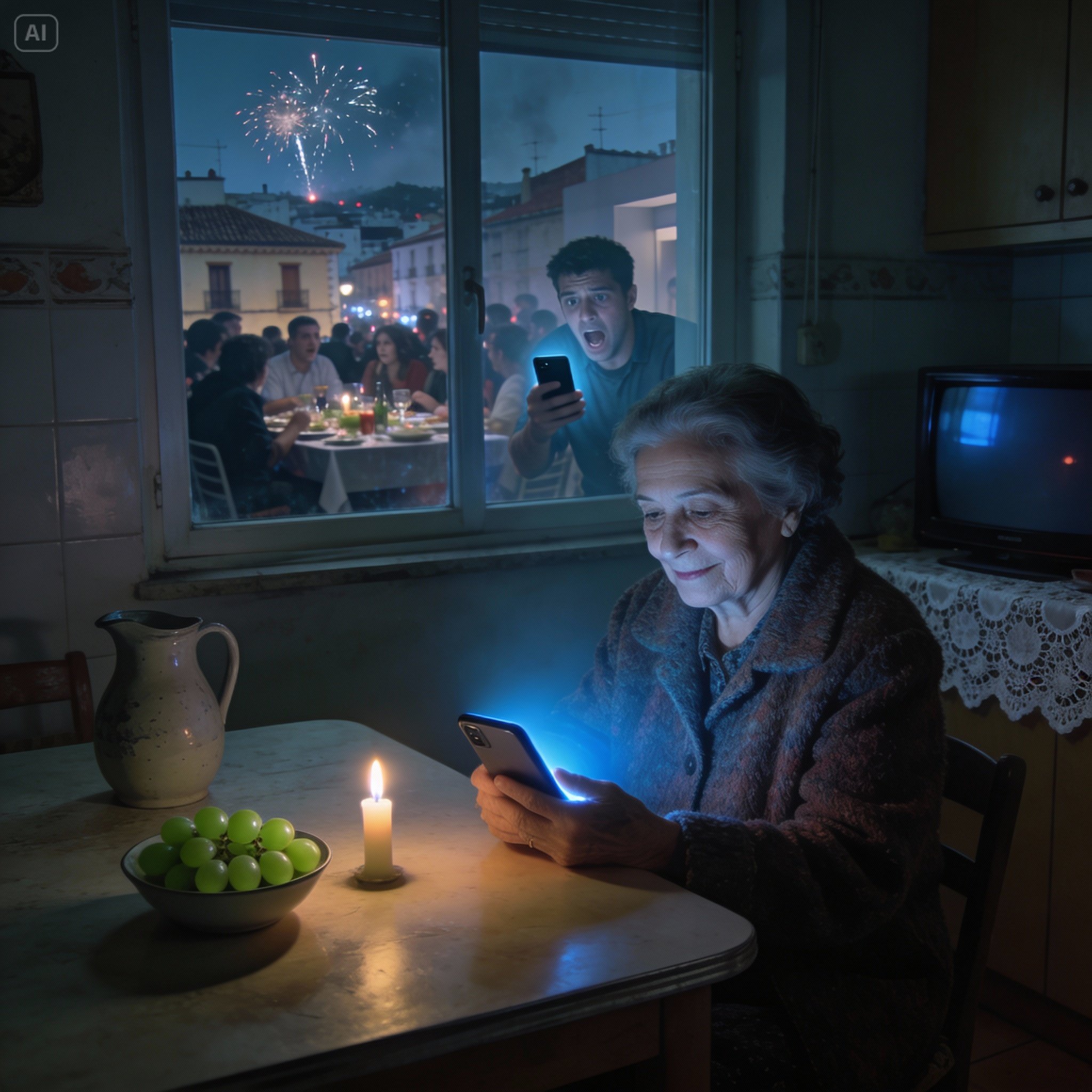
New Year’s Eve arrived. I didn’t light the candles I usually placed in the window to guide those who were missing, an old tradition of my mother’s. I didn’t put out the best tablecloth. I didn’t bring out the crockery from the Carthusian monastery. I ate a simple, hot, picadillo soup in silence. The house was so still my ears were ringing.
On television, with the volume low, formally dressed presenters were explaining how the clock at the Puerta del Sol worked. I prepared my twelve grapes. I peeled them and removed the seeds, one by one, with the patience of someone in no hurry.
Midnight. The bells rang. One, two, three… I ate the grapes mechanically. No wishes, no toasts. Twelve chimes that marked the end of one year and the beginning of another in absolute solitude.
And then, at exactly 12:01 am, my phone rang.
I stared at it for a few seconds, glowing in the darkness of the table. Esteban .
I swiped to answer.
—¿Esteban?
“Mom!” Her voice broke, sharp, filled with a panic I’d never heard from her before. “What on earth is on the news?”
I got up slowly, my joints creaking slightly from the night’s chill, and walked to the window. I pulled back the curtain. The street was empty, lit by the yellowish lampposts, but I could feel the change in the air. It wasn’t fireworks. It was something more seismic.
It had begun.
Six months ago, I stood outside Conference Room B at the University Hospital, ID badge in hand, waiting for the annual technical review to begin. I had sat in that room every year for more than two decades, presenting updates, reviewing trends in diagnostic imaging, suggesting protocol improvements that no one else seemed to notice. It was routine. It was my life. It was what gave me purpose after my husband passed away and my children left home.
But that morning, my card didn’t open the door. The red light flashed with a rejection sound.
Linda, my section head, came out into the hallway a moment later. Her eyes avoided mine, blinking with that corporate apology I hated so much.
“Marisa, I’m sorry…” she began, lowering her voice. “This year’s review is very tight. It’s only for leadership positions and… well, with the cutbacks and your age, HR assumes you’re taking early retirement anyway, right?”
I didn’t argue. I nodded as if it made perfect sense, as if it were the logical thing to do. The truth was, I hadn’t filled out any retirement paperwork. I hadn’t even thought about it. I loved my job. I loved finding the hidden patterns in the gray tones of an X-ray. But there I was, being gently pushed out, made obsolete before my time.
I walked back to the break room, sat at the far end of the table, and opened my notebook as if I still had something important to do. My hands trembled slightly, not from fear, but from a cold, suppressed anger.
That night at home, I reread the draft of a proposal I had written months before. It was simple, built on thousands of hours of observation staring at screens: early micro-shifts in lung images could predict critical changes days, even weeks, before clinical symptoms appeared. It was a pattern. It had always been there, invisible to the untrained eye, but screaming to those who knew how to look.
A small project, perhaps, but it had potential.
The next morning, I called Lucía, an old friend from my residency days who now worked in bioinformatics in Barcelona. I asked her for a contact in software modeling.
—Marisa, what are you up to? —he asked me curiously.
—I just want to test a theory, Lucia. Nothing important.
By the end of the week, I had liquidated my life savings and deposited my severance pay into a clean, new business account: Ventner Diagnostics SL . A quiet, small name, just like me.
I didn’t tell anyone in the family. Not Esteban, not Renata. Especially not Esteban. He already had his opinion of me.
On All Saints’ Day, when I timidly mentioned that I was “working on something new,” he smiled with that half-mocking tone he reserved for children and the elderly.
“I mean, Mom,” he said between bites of the fritters Elena had brought, “do you really think you’re going to be the next Zuckerberg with hospital scanners at your age? You should relax, enjoy your grandchildren, join aquagym.”
Renata giggled as she looked at her phone.
“Leave her alone, Esteban, if she’s entertaining…” she said, without looking up.
Someone changed the subject. They talked about the ski vacation in Baqueira, the children’s grades, Esteban’s new electric car. I smiled through it all. Afterward, I washed the dishes by myself, scrubbing the grease stains with unnecessary force. That night I stayed up until two in the morning, writing lines of notes in the margins of my old diary, circling in red the patterns I’d always noticed but no one had ever asked about.
By the end of that week, I booked the first meeting at a coffee shop.
The café was halfway between the hospital and Retiro Park. I chose it for its tranquility, not for the coffee. No trendy music, just the hum of the espresso machine and the hissing of steam. It was the kind of place people forgot about unless they were looking for somewhere to think or hide away.
Sara, Lucia’s contact, arrived at exactly 10:00. Her coat was still damp from the Madrid rain, but her eyes lit up when she saw the tablet I had placed on the marble table.
“Are these the real results?” he asked, dragging his chair unceremoniously.
I nodded and swiped the screen towards her.
For twenty minutes, he didn’t speak. He just scrolled , zoomed in on images, tilted the screen to avoid glare. I could see his pupils dilate, his breathing change. Then he lay back and exhaled through his teeth with a hiss.
—Marisa… this could change everything.
Her voice carried weight. She didn’t speak like a former colleague. She spoke like someone who now worked with Venture Harvest , an investment fund that rarely gave a second glance to solo founders over forty, let alone a woman over sixty who came from the public sector.
“It’s early,” I said cautiously, stirring my iced tea. “It’s still in beta. But I’ve mapped it through six years of comparative scans of the hospital archives. The data doesn’t lie.”
His hands were already searching for his phone.
—I want you to meet someone. Discreetly.
The next meeting was with someone named Jonah, a man who wore gold cufflinks and didn’t smile. He listened. He nodded. He asked two razor-sharp questions about scalability and data protection. Then he slipped a one-page confidentiality agreement across the table.
I read every word. I signed.
By January, we had a timeline. By February, an offer—not for sale, but for expansion. Data security infrastructure and clinical trials in rural hospitals across three autonomous communities, places forgotten by mainstream medicine.
I didn’t post it on Facebook. I didn’t mention it at the next birthday dinner. When Renata asked what I’d been up to lately, I said, “Just reading and taking walks.” They didn’t press me. They rarely did. They’d spent years molding me to be a background accessory in their lives: present, polite, invisible, the grandmother who makes croquettes and doesn’t bother anyone.
But in that coffee shop, I realized I didn’t need noise to matter. I didn’t need permission, applause, or even a seat at their designer table.
By March, I had a prototype name and a quiet transfer of funds for operations. And in late spring, an unexpected message lit up my phone.
The message arrived at 6:14 a.m. on December 23, Christmas Eve. I was rinsing my breakfast mug when the screen lit up.
URGENT: Confirm Marisa Velasco’s identity for transfer authorization.
At first, I thought it was spam or some kind of bank scam. Then I remembered PulseScan AI , the acquisition. The meetings I hadn’t physically attended, where Sara had managed the dotted lines I’d signed weeks before while cooking lentils on the stove.
I tapped the link, entered my verification code with shaky fingers, and saw the final number.
1.420.000.000 €
One billion four hundred and twenty million euros.
I didn’t blink. I didn’t gasp. I simply closed the browser and finished making my tea.
Sara had told me the PR launch would happen after Christmas. Discreet, professional. A brief line in the technology summary of Expansión or Cinco Días , a few investor blogs, nothing flashy, just enough to meet European market disclosure standards.
I didn’t call Esteban. I didn’t text Renata. I knew they didn’t read the financial magazines that reported on biotechnology. My name wouldn’t be trending on any platform they used to look at cat pictures or debate politics. That suited me.
On December 28, April Fools’ Day, the announcement was made official. It was a small headline buried halfway down the homepage of a biotechnology news site.
PulseScan AI acquires predictive imaging tool for over €1 million to expand access to rural diagnostics.
Below the article was a short paragraph:
“The tool, developed by Marisa Velasco, a retired radiology technician from Soria, uses data-based pattern recognition to flag early-stage organic distress in resource-poor medical settings.”
That was it. No photo, no quote, but the footnote said it all: Founder: M. Velasco .
I reread that line three times. Later that night, I sat by the window as it began to snow, something rare in Madrid lately. I watched the streetlights flicker in the cold. No calls came. No one in the family said a word. I suppose they had erased me so thoroughly from their minds that they no longer looked for signs of my existence beyond familial obligation.
But I knew it wouldn’t last. I knew that, eventually, someone would realize. Not because they cared about me, but because I would touch something they thought belonged to them: status, money, inheritance.
I placed my phone on the table and turned it face down. New Year’s Eve was approaching, and this time, I didn’t need an invitation.
New Year’s Eve settled over the house like a blanket someone forgot to warm. I lit the single candle on the kitchen table. The soup was good. Carrots, leek, a ham bone for flavor. I stirred it slowly, savoring the tranquility.
I pictured Esteban on the other side of town, standing near a patio heater at a trendy bar, a glass in one hand and the other on his wife’s back. Champagne glasses clinking, a toast to health, to goals, to new beginnings. I pictured him laughing, that loud laugh he used to impress business partners. I felt no bitterness. Not anymore. There’s something clean about being alone when no one thinks you should be there. You begin to see the architecture of your own life more clearly, without the distractions of trying to please those who don’t want to be pleased.
I browsed the headlines on my tablet, not really expecting anything. Then, it appeared.
BREAKING NEWS: PulseScan AI confirms €1.4 billion acquisition.
The subtitle was more direct, impossible to ignore even for a casual reader:
Created by retired Spanish radiologist Marisa Velasco.
I stared at it for a long moment. Then I put the device down, finished my soup, and blew out the candle.
At 12:01 am, the phone vibrated. Esteban .
I let it ring once. Twice. Three times. Then I picked up.
“Mom?” she said, her voice rising immediately, almost hysterical. “Have you sold anything? People are tagging me. Clients, former colleagues, everyone. My boss even sent me a WhatsApp message! What on earth is going on?”
I stood by the window, watching the flash of a firecracker from some neighbor in the distance.
“Do you remember those scribbles from the scanners that you said were a phase, an old lady’s nonsense?” I said calmly, my voice as soft as the snow falling outside.
He didn’t respond immediately. I could only hear his ragged breathing.
—They were worth something —I continued—. Apparently.
The silence stretched on so long I thought the call had been cut off. Then, softly, in a tone that mixed disbelief and reproach:
—Why didn’t you tell me?
I rested my forehead against the cold glass of the window.
—Because you wouldn’t have asked if it hadn’t been in the headlines, Esteban.
I could hear his breath catch in his throat. I expected anger or an apology. Instead, his lawyer’s instincts took over.
—We need to talk.
“I’m free tomorrow,” I told him.
And I knew the conversation wouldn’t be about me. It would be about control.
At 12:05 a.m., my phone vibrated again, this time with a familiar sound I hadn’t heard in months. The family WhatsApp group, “Velasco Family,” which had been silent for me except for the occasional photo of the grandchildren, suddenly lit up.
Emergency call at 9:00 am at mom’s house.
Esteban had sent him. Without greeting, without explanation, assuming his order was law.
Seconds later, a message from Renata:
Mom, please don’t say anything on social media yet. Don’t talk to anyone.
And then another one from Esteban:
We need to control the narrative. Don’t ruin this for us.
I read the messages twice. Controlling the narrative . As if my life had been a draft they’d been editing the whole time. As if my work, my silence, my patience had just been placeholders until they decided how the story should end.
I didn’t answer. Instead, I turned my phone face down and opened my email. It was constantly updating, requests piling up. Journalists from El País , El Mundo , medical boards, conference organizers, someone from a German diagnostics firm asking for a private conversation, another from Complutense University wanting to award a scholarship.
I skimmed it without replying. The attention felt distant, almost theoretical, like weather reports from places I had no intention of visiting.
Then, one line of inquiry stopped me.
Main invitation: Rural Medical Alliance of Castilla y León.
I opened it slowly. They wrote about clinics closing in rural Spain, about technicians working double shifts in remote villages, about elderly patients having to travel two hours by bus to the nearest specialist. They wrote about how PulseScan AI could mean earlier detection, fewer emergency transports, and more time to live.
They didn’t ask about my family. They didn’t mention money. They asked if I would talk about building something meaningful without being seen. About the dignity of invisible work.
I answered with a single word: Yes .
The chat group buzzed again. Esteban typing… Renata typing… They were deleting, typing. I didn’t look.
I got up from the table and rinsed my mug. The sound of the running water grounded me. For the first time that night, I felt certain of something. Whatever plan they had for the morning, whatever version of me they wanted to present to the world to save face, would proceed without my permission. And that was exactly how I intended it to stay.
We met at a small café on Serrano Street, a neutral location, far from my neighborhood and far from their offices. I chose that place because we had no history there. No birthdays, no missed Mother’s Days, no memories they could use to warm up the conversation.
Renata arrived first. She hugged me stiffly, one of those hugs that doesn’t touch, and then sat down opposite me, her designer coat still buttoned up to the neck. Her lips were pressed together in a polite smile that never reached her eyes.
“You’ve embarrassed us,” she said, disregarding formalities. “Do you have any idea how I feel?”
I stirred my coffee with milk gently. I didn’t say a word.
“The article didn’t even have a picture, but people know about it,” she snapped, lowering her voice as the waiter approached. “It’s all over LinkedIn. You know how it looks when your mother suddenly becomes a billionaire and her own children are completely out of the loop? We look like incompetents or monsters.”
Esteban walked in mid-sentence. His eyes scanned the room as if we were being watched by industrial spies. He was wearing his “deal-closing” suit.
“Mom,” she said, sliding into the seat next to her sister. She smelled of expensive perfume and stress. “You could have told us. We could have helped you handle this.”
“Manage what?” I asked.
“Your own job,” he blinked, as if it were obvious. “Your assets. Your tax structure. Mom, this is serious. The IRS is going to come down on you hard if we don’t do this right.”
Renata shifted uncomfortably in her chair. I watched as they recalibrated their strategy in real time. They went from insult to seduction in seconds.
“Look,” Esteban said, his voice softening, adopting that conciliatory tone he used with judges. “This could be great for all of us. You know, a family business. We can talk about how to structure things so everyone benefits. The grandchildren, their future…”
“There’s still time to bring us in,” Renata added quickly, her eyes gleaming with greed disguised as concern. “Public image, messaging, legacy planning. I can handle communications, Esteban the legal stuff. We’ll take the weight off your shoulders.”
I placed my spoon on the plate. It made a crisp, metallic sound. The cafeteria was noisy behind them, forks clinking and soft jazz playing in the background, but all I could hear was the moral silence that stretched between their words.
There was no surprise in her eyes. There was no pride that her mother had achieved something incredible. There was calculation. There was fear of missing out on the distribution.
I got up.
“It was already a family business,” I said quietly, but clearly enough to make them both freeze. “Only you two never showed up for work.”
I didn’t wait for their reactions. I grabbed my coat, put on my scarf, and walked past the line of people waiting for a table.
Outside, the January air stung my face, sharp and clean. Madrid shimmered in the winter sun. By the time I reached the corner, my phone was buzzing again. A new number, a new offer. But it was the next email that really stopped me in my tracks.
I almost canceled the interview. The producer of a very popular morning show had called twice, then left a message that sounded more hopeful than professional.
“Human angle ,” she had said. “The story of the woman behind the algorithm . ”
I checked my voicemail while my coffee got cold and told myself I didn’t owe anyone an explanation.
In the end, I showed up anyway.
The presenter was younger than Esteban. Younger than Renata, too. He wore a suit that seemed too big for him, and when he smiled, it was with an honesty that disarmed me. He thanked me for coming as if I had done him a personal favor. We sat under bright lights.
The questions were predictable at first: background, technology, what it felt like to see years of quiet work suddenly recognized. I answered carefully, keeping my voice steady, speaking about the importance of preventative medicine.
Then he asked:
—Ms. Velasco, did your family support your trip? It’s an inspiring story, a woman your age starting a business… were your children there?
I sensed the pause before allowing it. The entire studio held its breath. I could have lied. I could have protected her image, as I had done all my life.
“Not enough to be dramatic. Just enough to be honest,” I said, looking into the camera. “They supported my silence. When I started talking in code and data instead of recipes, they left the room.”
The presenter blinked. He nodded slowly and carried on, respectfully. But I knew the moment had already escaped the studio. It was a potential viral clip.
By the time I got home, my phone was buzzing nonstop. I didn’t check it. I left it on the counter and turned it face down, like I had done on New Year’s Eve.
Later, Sara texted me: “It’s everywhere. You’re trending . ”
Esteban’s law firm had apparently been receiving calls ever since the clip aired. Clients asking awkward questions, colleagues forwarding links with shocked emojis. Renata, I heard through a mutual acquaintance, had made her Instagram accounts private.
I didn’t look for any of that. Instead, I sorted through the mail. Bills, supermarket flyers, and an envelope from the Spanish Association Against Cancer, the same one that arrived every quarter with a handwritten note and a list of needs they were never quite able to meet.
I sat down at the kitchen table, reread the letter, and opened my laptop. I increased the donation a thousandfold without a second thought. It felt right, grounded, like giving something back to the world instead of taking from it.
When I shut down my computer, the house was quiet again. And for the first time in days, that quiet didn’t feel like absence. It felt like space. The kind of space that allows room for unhurried decisions.
Esteban sent me a message the next morning.
Can we come by this weekend? I’ll bring the kids.
I read it once, then again, noticing how carefully the sentence avoided anything resembling an apology. There was no “I’m sorry.” There was no “Are you okay?” Just logistics, and the use of my grandchildren as human shields, as if proximity could reset everything.
I wrote back: “I will be traveling . ”
He wasn’t. But he would be soon.
That afternoon, I put the kettle on the fire and let it whistle longer than necessary. I chose a cup I liked, a plain ceramic one with a small crack near the handle, and went out into the small backyard of my ground-floor garden. The ground was lined with frost that hadn’t yet melted in the sun. I walked slowly around the perimeter, my hands wrapped around the warmth, watching my breath rise and disappear.
For years, I had measured my days by interruptions: calls, requests, petty demands disguised as concern. Now there was nothing pressing on the edges of my time, no one knocking at the door, no one expecting me to solve their problems.
I realized I hadn’t looked at my phone in hours.
Inside, I sat at my desk and opened a folder I’d created weeks earlier but hadn’t yet explored. Grant proposals from small-town clinics, places with names that rarely made headlines: Soria, Teruel, rural areas of Galicia. One needed imaging upgrades to avoid sending patients two provinces away. Another wanted training funds for technicians who had never been formally certified but showed up every day anyway.
I read each proposal carefully. These people didn’t know my story. They didn’t know my children’s names or what had happened at brunch or on New Year’s Eve. They weren’t interested in the angles or the positioning or who was with me in the photographs. They believed in results, in attention to detail, in being present when it mattered.
Late in the afternoon, the light had changed. I closed the folder, unfinished, but satisfied for now. My phone remained untouched on the counter. No follow-up from Esteban, no ringing.
I thought about how many times in the past I’d waited by the window, by the phone, by the door, hoping someone would remember to include me. This time, I didn’t wait. I poured myself another cup of tea and sat back down, now aware that the next call I answered wouldn’t be about reconciliation, but about something much more lasting.
It was late in the afternoon when the phone rang. A real call, not a text message, not an email. I barely answered. But then I saw the name: Clara .
Renata’s daughter. Twelve, maybe thirteen years old now. We hadn’t spoken in months, not directly.
Even so, I picked up.
“Hello, Grandma,” she said, her voice bright but a little nervous. “Is this a good time?”
“Of course, darling,” I said, leaning back in my chair. “What do you have in mind?”
“I have a school project,” she said. “We’re supposed to choose someone we know for the topic.”
—What’s the topic?
—People who change things quietly.
I didn’t speak for a moment. My throat closed up. Clara continued.
—I asked Mom if I could call you. She said it was up to me. She was… acting strange.
I could just imagine Renata’s expression when I said that. I let it go.
“Well,” I said gently, “that’s a lovely topic. So, do you want to write about me?”
I looked out the window. The sky was a soft gray, fading to pink at the edges. Somewhere in the neighborhood, a dog barked once, then stopped. The world felt paused.
“Of course you can,” I said. “What would you like to know?”
Clara hesitated.
—I guess… why did you do it? The job, the company, everything. Why didn’t you tell anyone, just to brag?
I took a breath, one that settled in my chest before reaching my voice.
“Tell them I didn’t do it to become famous, Clara,” I said. “I did it because I was curious. And I did it so that people like you could have better tools, better opportunities. That’s all. Noise… noise doesn’t help plants grow, only water and silence do.”
There was a long pause. Then he said:
—I already wrote the title.
—Oh, really?
—It’s called: The Billionaire in the Backyard .
I laughed loudly and deeply, the kind of laugh I hadn’t let out in months.
“I like that,” I said. “But make sure you tell them I still pull weeds and burn toast.”
She laughed.
-I will do that.
We talked a little more about her science fair, her favorite teacher. No one else called that night. No one needed to. When we hung up, I stood by the window, watching the light change through the trees. And then, in that stillness, I opened my notebook and began to write something new.
It wasn’t code. It wasn’t a patent. It was a list of names. Names of hospitals, scholarships, foundations. And at the bottom of the page, I wrote a single note for my lawyer:
“Clara Trust. Access at age 25. Condition: Must be used to create something of your own.”
I smiled. Esteban and Renata wanted the inheritance. Well, they’d get what they were legally entitled to, their strict legal share, not a penny more. But the legacy… the legacy would go to whoever had the courage to ask.
I looked at the calendar. January 6th, Three Kings’ Day, was just around the corner. Normally, I would bake the Roscón and buy the gifts. This year, my gift would be different. This year, my gift to them would be the most precious lesson of their lives: that respect isn’t inherited, it’s earned. And that you should never, ever underestimate a woman who has learned to be happy in silence.
PART 2: THE WAR OF THE THREE WISE MEN
January 6th dawned with a cold, brittle light over Madrid. Three Kings’ Day. In any other year of the last three decades, my kitchen would have been a war zone by six in the morning. I would have been baking the second Roscón (because the first was never enough for Esteban’s appetite), preparing liters of thick hot chocolate, and making sure the gifts for my grandchildren were organized by size and color in the living room.
This year, however, the only sound in my apartment was the hiss of steam from my Italian coffee maker.
I poured myself a cup and went over to the living room table. There, on the crocheted doily my mother had made forty years ago, lay a small Roscón de Reyes (Three Kings’ Cake) from the neighborhood bakery, filled with cream. It was for one person. I cut a generous slice. I got the bean. I smiled. According to tradition, it was my turn to pay for the cake, but considering I had just sold my company for a sum that made my head spin just thinking about it, I figured I could afford it.
My phone, which I’d kept on “Do Not Disturb” overnight, displayed a series of blocked notifications. Three missed calls from Esteban. Two from Renata. And a voicemail from Elena, my daughter-in-law, which I decided to listen to while dipping the pastry in my coffee.
“Marisa, my dear, Happy Three Kings Day!” Her voice was shrill, with that saccharine insincerity that always made my skin crawl. “Listen, the children are asking for you. They say the Three Kings left a present for Grandma at our house. Why don’t you come over for lunch? I ordered catering from Lhardy , Madrid stew, just the way you like it. Come on, don’t be spiteful, it’s a day for family.”
I deleted the message. “Don’t hold a grudge.” That woman’s audacity knew no bounds. It wasn’t resentment; it was dignity. There was a world of difference that they, in their world of appearances and social status, were incapable of discerning.
At eleven in the morning, the doorbell rang. Not the one for the building’s entrance, but the one for my apartment. They had bypassed the intercom, probably taking advantage of a neighbor leaving the building.
I adjusted my wool robe, checked myself in the hall mirror to make sure I didn’t have crumbs on my face, and opened the door.
Esteban was there. He was wearing a camel-colored cashmere coat and a perfectly knotted plaid scarf. He looked like a walking advertisement for a “troubled success story,” with dark circles under his eyes and a familiar tension in his jaw. He hadn’t brought the children. He was alone.
“Mom,” he said, attempting a smile that fell short. “Aren’t you going to invite your son in?”
I stepped aside, leaving just enough room for him to enter.
—Hello, Esteban.
She entered the living room and her eyes scanned the space. She was probably looking for signs of senile dementia or, perhaps, bank statements lying around. She saw the single-serving cake and the silence of the house.
—Sad, isn’t it? —she commented, pointing to my breakfast—. Spending Three Kings Day alone.
“On the contrary,” I replied, sitting down in my armchair and gesturing to the sofa. “It’s the most peaceful Reyes I’ve had since 1985. Would you like some coffee? There’s still a little left.”
“I didn’t come here for coffee, Mom.” He sat on the edge of the sofa, still wearing his coat, as if he were ready to run away. “I came here to fix this. This… situation.”
“There’s nothing to fix, son. I’m fine. You’re all fine. Everyone in their own home and God in everyone’s, as the saying goes.”
Esteban sighed, that theatrical sigh he used in court to show exasperation with a difficult witness.
“Mom, please. Let’s be serious. You have 1.4 billion euros.” She said the figure in a low voice, as if it were an obscenity. “And you have no idea what that entails. The tax authorities are going to take almost half if we don’t structure this now. There are wealth taxes, future inheritance taxes, gift taxes… My firm has specialists in international taxation. We can set up a SICAV, or a holding company in Luxembourg. Legal, of course. But you need advice. And, frankly, you need protection.”
“Protection from whom?” I asked, looking him in the eyes.
“From the vultures,” she replied quickly. “From the people who will come crawling out of the woodwork asking you for money. Fake foundations, opportunistic boyfriends, con artists. Mom, you’re an old woman. You’re not used to this world.”
I got up slowly, walked to the bookshelf, and took out a navy blue folder. I came back and placed it on the table in front of him.
—Abrela.
Esteban looked at it suspiciously, then opened it. His eyes scanned the first document. He stopped. He read the letterhead.
“Garrigues?” he asked, surprised. “You’ve hired Garrigues?”
“Not just them,” I said calmly. “That’s the legal representation agreement with the most prestigious law firm in Spain. And the second page confirms that my taxes have already been provisioned and paid in advance to the Spanish Tax Agency. No Luxembourg, Esteban. No creative tax engineering. I’m going to pay every cent I owe this country. Thanks to this country’s public healthcare and education system, I was able to get where I am. So I’m going to pay back my share.”
Esteban turned pale.
“Are you crazy?” she whispered. “You could have saved hundreds of millions. That’s… that’s family wealth you’re throwing away.”
—It’s my property —I gently corrected—. And I do with it what I consider ethical.
“Ethical!” Esteban jumped up, his facade of calm shattering. “Mom, for God’s sake! Renata and I are drowning! Do you know how much the mortgage on the house in La Moraleja costs? The kids’ private school? The car lease? We live paycheck to paycheck, Mom. Paycheck to paycheck. And you’re sitting there, playing Mother Teresa with the money that should be securing your grandchildren’s future.”
There she was. The truth. Naked and ugly on Three Kings’ Day morning.
I sat there, watching my son. I remembered the little boy who had once given me a necklace of macaroni painted with gold and told me I was a queen. Now, that man looked at me with a mixture of desperation and greed that chilled me to the bone.
“If you’re drowning, Esteban, it’s because you’re living beyond your means,” I said, my voice trembling slightly. “You have good jobs. You’re healthy. If you need help reorganizing your finances, I can pay for a financial advisor to teach you how to live within your means. But I’m not going to finance a lifestyle you can’t afford.”
Esteban looked at me with a coldness I had never seen before.
“This isn’t going to end like this,” she said, buttoning her coat. “If you think you can leave us out, you’re very wrong. There are laws, Mom. The law.”
“The inheritance is a third, Esteban,” I reminded him, having done my legal homework the previous week. “And you’ll only see it when I die. And I assure you, son, I intend to live for many years. And I intend to spend the other two-thirds on things that truly matter.”
Esteban left my house slamming the door so hard the glass in the display case rattled.
I was alone again. The silence returned, but this time it wasn’t peaceful. It was heavy. My hands were trembling. I picked up the phone and dialed a number I had recently saved.
—Carmen? It’s Marisa. Yes, sorry to bother you on a holiday. You were right. She’s here. Yes… I need us to speed things up with the Foundation. I want it established before February. Thank you.
I hung up. I felt exhausted, as if I’d run a marathon. But I also felt liberated. The band-aid had been ripped off. There were no more secrets, no more false politeness. We were at war.
The following days were a media frenzy. Despite my attempts to keep a low profile, the “Algorithm Grandma” story was too juicy for the press. Reporters camped outside my door for three days. I had to sneak out in a neighbor’s car to buy bread.
Renata tried a different tactic than Esteban: the victim tactic.
She posted on Instagram, an old photo of the two of us hugging (I looked twenty years younger), with a long text about how difficult it is to see parents grow old and “lose their way,” subtly implying that my sudden wealth and erratic decisions were the result of cognitive decline.
“My mother has always been my rock, but lately she hasn’t been herself. We’re worried about her vulnerability. Money changes people, but family love should be unconditional. We miss you, Mom. Come back to us.”
The comments were a mix of support for her and criticism of the “selfish old woman.” It hurt. Of course it hurt. It was my daughter, my little girl, using my mental health as a weapon to gain public sympathy and pave the way for a possible legal incapacitation.
Carmen, my lawyer, a fifty-year-old woman with impeccable gray hair and a steely gaze, called me as soon as she saw the publication.
“Marisa, this is defamation,” said Carmen, sitting across from me in her office on Velázquez Street, a week after Three Kings Day. “We can send a formal demand for them to retract it. Or we can have a full psychophysical evaluation done before a notary to certify your full capacity and shut them up for good.”
“Do the evaluation,” I said without hesitation. “I want an expert to certify that I’m saner than all of them put together.”
That afternoon, I decided I needed some air. I needed to remember why I had done all this. I hailed a taxi and headed to the University Hospital, my old workplace.
I didn’t tell anyone. I walked in through the outpatient clinic entrance, blending in with the other people. The smell of disinfectant and machine-made coffee hit me with a wave of nostalgia. I walked through the familiar corridors, watching the nurses rushing about, the orderlies pushing gurneys, the relatives with worried faces waiting for news.
Nobody recognized me. To them, I was still invisible. Just another elderly woman in a hospital corridor.
I arrived at the Radiology department. I stopped in front of the waiting room door. There it was, the new screen they had installed thanks to the trial funds we had sent months before. It wasn’t showing the news, but an explanatory graphic about early detection.
I saw a young woman leaving a doctor’s office, crying. But it wasn’t a cry of utter devastation. She was on the phone.
—They caught it in time, Mom. They say it’s very small. The doctor said the new system detected a shadow they wouldn’t normally have seen for another six months. They say a simple surgery will be enough.
I was stunned. The new system . My system.
I felt a hand on my shoulder. I turned around, startled.
It was Dr. Garrido, the head of Pulmonology. A man with whom I had argued a thousand times about shifts and protocols.
“Marisa?” he asked, squinting. “I thought I saw you on the news, but… with that elegant coat I almost didn’t recognize you.”
I smiled, touching the lapel of my new coat, the first real treat I had given myself.
—Hello, Doctor. I was just stopping by to… say hello.
He looked at me, then at the girl who was still talking on the phone about the miracle of her early detection. He understood. His eyes softened, losing that usual arrogance of veteran doctors.
“It’s yours, isn’t it?” he asked quietly. “The PulseScan software . Rumors said it was a technician from here, but nobody believed it was you.”
“It’s mine,” I confirmed.
Dr. Garrido shook his head, an incredulous laugh escaping his lips.
—Marisa, you’ve saved more lives this past week with that code than I have in thirty years of my career. That girl over there… she’s twenty-five years old. Without your algorithm, she would have reached us in stage IV.
The tears that I hadn’t shed on New Year’s Eve, nor when Esteban yelled at me, nor when I saw Renata’s post, threatened to come out then.
“That’s all I needed to know,” I said, my voice choked with emotion.
“Are you coming in?” he asked. “The guys would love to see you. Linda’s at the control desk.”
I shook my head.
—No. Not today. I just needed to see that it was real. That it’s not just numbers in a bank account.
I left the hospital with a full heart. The money from the sale gave me security, yes. But that moment in the hallway, that overheard conversation, gave me something my children could never take away: a legacy.
That night, I called Carmen again.
—Get the papers ready—I told him. —I’m leaving Madrid for a while.
—Where are you going, Marisa?
“To the source,” I replied. “To the people. I want to see how this plays out in the real world. And I want to do it before my children try their next move.”
—Be careful, Marisa. They won’t give up easily.
“I know,” I said, looking at my open suitcase on the bed. “But neither do I.”
PART 3: EMPTY SPAIN AND A FULL HEART
The drive to Soria was a meditation in motion. I was driving a new car, a hybrid SUV, safe and sturdy, nothing flashy but infinitely more comfortable than my old hatchback. As I left behind the pollution and noise of Madrid, the landscape opened up into ochre plains and skies of an almost insulting blue.
“Empty Spain.” That’s what they called it on the news. Villages where only the elderly remained, where the doctor came once a week, and the nearest pharmacy was thirty kilometers away. That was my destiny.
My first stop was in a small town called San Pedro Manrique. I had arranged with the mayor, a young and energetic woman named Beatriz, to visit the local clinic, which had received one of the first PulseScan portable units .
There was no marching band or red carpet, and I was grateful for that. Beatriz waited for me in the town square, in front of the stone town hall.
“It’s an honor, Mrs. Velasco,” he said, shaking my hand firmly. His hands were rough, the hands of someone who works. “You don’t know what this means to us.”
—Call me Marisa, please. And I want to see it working.
The office was a small, clean but old room with faded health posters on the walls. The rural doctor, a man named Don Andrés who looked as old as the surrounding hills, showed me the device. It was a tablet connected to a portable scanner.
“Look at this,” said Don Andrés, pointing at the screen. “Uncle Paco, the shepherd. Seventy-eight years old. A lifelong smoker. He came in yesterday coughing. Normally I would have just given him some cough syrup and sent him home. But the machine flagged a red alert in his lower right lobe. We sent him by ambulance to Soria immediately. They called me today. They’re operating on him. If we had waited…”
I nodded, running my fingers along the edge of the device.
“It works,” I whispered.
“It works wonderfully,” said Don Andrés. “But Marisa, we have a problem. The machine detects the location, but the ambulance takes an hour and a half to arrive. The roads are in bad shape. If there’s snow, they can’t get through.”
I turned towards Beatriz and Don Andrés.
—How much does a fully equipped 4×4 ambulance cost for the region?
They looked at each other.
“A lot of money,” Beatriz said. “The town hall budget isn’t even enough to fix the leaky roof at the school.”
I took out my checkbook. Yes, I still used a checkbook. It seemed more formal to me than a mobile transfer.
—Find the model. Buy two. And hire two local drivers. I’ll cover the salaries for the next five years.
The silence in the room was absolute, broken only by the buzzing of a winter fly. Don Andrés took off his glasses and wiped his eyes. Beatriz simply hugged me, an impulsive and genuine hug that warmed me more than the heating.
I spent the next few weeks traveling through Castile and León, Aragon, and parts of Galicia. I slept in paradores and rural hotels. I ate migas, torreznos, and Galician broths. I talked to people. Not as the “tech billionaire,” but as Marisa. I listened to stories of loneliness, of institutional neglect, but also of fierce resistance.
In every town, he left something behind. Not charity, but tools. A new ultrasound machine here, a scholarship for a medical student there, the repair of a nursing home’s roof.
I felt alive. I felt useful.
But the past has a curious way of finding you, even in the middle of nowhere.
I was in a charming little hotel in Albarracín, Teruel, having breakfast by a window overlooking the medieval walls, when I saw a car pull up that was completely out of place. A black Porsche Cayenne, dirty with dust from the road, parked abruptly in front of the entrance.
My heart skipped a beat. I recognized that license plate.
Esteban burst into the lobby like a whirlwind. He was wearing jeans and an expensive sweater, but he looked like he hadn’t slept in days. He asked something at reception, the receptionist pointed toward the dining room, and our eyes met.
He approached my table. There was no anger this time. There was defeat.
“I’ve been looking for you,” he said, plopping down in the chair in front of me without asking permission.
“It wasn’t very difficult,” I replied, spreading butter on my toast with a calmness I didn’t feel. “I’ve been posting updates on the new Foundation’s blog.”
—I don’t read blogs, Mom.
—I know. What are you doing here, Esteban?
He ran his hands over his face.
—Elena has left me.
I left the knife on the plate. I hadn’t expected that. Or maybe I had. Elena was a woman who loved success as much as her husband, perhaps even more.
—I’m so sorry, son.
“He’s taken the children to his mother’s. He says I’m a failure. That I’ve jeopardized our status by not knowing how to… ‘manage’ you.” He made air quotes with his fingers on the last word. “The bank called me. They’re going to foreclose on the mortgage at La Moraleja if I don’t pay three overdue installments before Friday. I’m ruined, Mom. Completely ruined.”
He looked at me with red, pleading eyes. The great lawyer, the successful man, reduced to a frightened child.
—I need half a million euros. Just to plug the holes, stop the foreclosure, and… get my family back. Please. I’ll pay you back. I swear.
I looked out the window. The walls of Albarracín had withstood sieges, wars, and the passage of centuries. They were strong because they were built on rock, not sand.
—No—I said.
Esteban appeared to have received a physical slap.
—What? Mom, please… they’re going to take my house. My children…
“Your children will be fine. Elena has money from her family, and you have a law degree. They won’t be sleeping on the streets. But you, Esteban, need to hit rock bottom.”
“How can you be so cruel?” she hissed, tears of rage welling up.
“It’s not cruelty, it’s love. The kind of tough love I should have given you twenty years ago instead of paying your down payment and co-signing your car loan. You’ve built a life of cardboard cutouts, son. And now it’s raining. If I give you the money, you’ll save the house, Elena will come back for the interest, and in two years you’ll be here again asking for more. I’m not going to finance your self-destruction.”
I leaned forward and took her hand. It was cold.
—But I offer you something else.
He withdrew his hand, offended.
—What? A sermon?
—A job.
He looked at me, confused.
“The Foundation needs a legal director. Someone to review donation agreements, social security contracts, and equipment purchases. It’s a real job, Esteban. With a real salary. One hundred thousand euros a year. It’s a good salary, but it’s not enough to maintain a Porsche or a mansion in La Moraleja. You’ll have to sell the house, move to a normal apartment, sell the car. But you’ll have dignity. And you’ll be working for something that helps people, not for banks and corporations.”
Esteban remained silent, processing the offer. It was a brutal demotion for him. From a law partner on the Golden Mile to an employee of a charitable foundation. But it was a lifeline.
—And what if I say no?
—Then I’ll invite you for this coffee and wish you luck with the bank.
He stood up, trembling with indignation.
—I can’t believe it. You’re… you’re incredible.
He turned around and left the hotel. I heard the roar of the Porsche’s engine as it drove away.
I stayed there, heartbroken but with a clear conscience. I knew he would return. Not today, not tomorrow. But when the bank sealed the door and reality finally hit him, he would return. And then, perhaps, I could begin to reclaim my real son, not the persona I had created.
Two days later, I received a different call. It was Renata.
“Mom…” Her voice was small, without a trace of her usual haughtiness. “Clara showed me her project. The one about ‘The Billionaire in the Backyard.'”
-AND?
—They won the regional competition. They’re going to the national final in Madrid.
—That’s wonderful, Renata. Clara is a brilliant girl.
There was silence on the other end of the line.
—At the presentation… she talked about you. She showed a video of you teaching her to cross-stitch, mixed with photos from press articles about your algorithm. She said… she said that her hero wasn’t an influencer, but her grandmother.
I heard a muffled sob.
“I realized something, Mom. Clara admires you. And me… she just tolerates me. Sometimes she’s even afraid of me. I don’t want that. I don’t want to be like Elena. I don’t want to end up alone in a house full of beautiful things.”
—It’s never too late to change course, daughter.
—I deleted the Instagram post. And I apologized publicly. People are tearing me apart in the comments for being a hypocrite, but… I don’t care. I want to see you. I don’t want money. I just want Clara to see that her mother and grandmother can be in the same room without it being a cold war.
I smiled, and this time the smile reached my eyes.
—I’m in Teruel, Renata. But I’m coming back to Madrid next week for the final of Clara’s competition. See you there.
—Thank you, Mom.
I hung up the phone and gazed at the arid landscape of Teruel. The land was hard here, but if you cared for it, if you gave it time and water, it bore fruit. My children were like hard earth. But perhaps, just perhaps, it was starting to rain.
PART 4: THE LEGACY OF LIGHT
Six months passed. Spring burst forth in Madrid with that floral violence that makes the city seem reborn. The almond trees of the Quinta de los Molinos blossomed, and with them, my new life finally settled.
The Marisa Velasco Foundation for Rural Innovation was no longer just a project on paper. We had an office in a modest but bright building in Chamberí. No glass skyscrapers here. Wooden floors, open windows, and lots of activity.
Esteban worked in the fund’s office. He had accepted the offer three weeks after our meeting in Albarracín, the same day he handed over the keys to his villa to the bank. He was divorced. He lived in a two-bedroom apartment in Arturo Soria. He had lost fifteen kilos (from stress and heavy business dinners) and drove a Toyota.
We still had our disagreements. Sometimes he’d get that arrogant lawyer streak, but then he’d remember who he worked for and tone it down. The most important thing was that he’d started to genuinely smile. A smile that wasn’t trying to sell anything.
Renata had taken an even more drastic turn. She quit her job at the fashion marketing agency (“selling smoke,” as she now called it) and was studying cultural management. She helped me organize events for the Foundation, but without pay. She said it was her “penance.” Our relationship was cautious, like two wounded animals learning to coexist again, but it was genuine.
And today was the big day. Not a formal gala, but the official inauguration of our flagship project: a telemedicine network connecting three hundred villages in rural Spain with the best specialists in Madrid and Barcelona.
The event was held in the courtyard of the Madrid slaughterhouse. There was press, yes. There were politicians wanting their picture taken, too. But the front rows were reserved for rural doctors, nurses, village mayors, and patients like Uncle Paco, who had come all the way from Soria, fully recovered, to give me a hug that nearly broke my ribs.
I was backstage, nervous. I hated public speaking.
—Grandma, you look gorgeous.
Clara appeared beside me. She was wearing a simple dress and a “Staff” badge around her neck. At thirteen, she had a wisdom in her eyes that reminded me of my own mother.
—I’m afraid of tripping, Clara. Or of saying something stupid.
—Just tell the truth. That always works. Besides, I’ve reviewed your speech and removed the boring adjectives.
I laughed and kissed his forehead.
—Thank you, my girl.
I stepped onto the stage. The spotlights blinded me for a moment, but then my eyes adjusted. I saw the crowd. I saw Esteban in the second row, applauding with genuine pride. I saw Renata beside him, holding her young daughter’s hand. And I saw hundreds of people who were there not for the money, but for hope.
I approached the microphone.
“Good evening,” I said. My voice cracked a little, but then steadyed. “A year ago, my biggest worry was whether the price of a Three Kings’ Day cake would rise enough and whether my children would have time to call me. I felt invisible. I felt like my useful life was over, like I was just a spectator in a world of the young and the fast.”
I paused. The silence was respectful.
—But invisibility has one advantage: it allows you to observe. It allows you to see problems that others overlook because they’re moving too fast. I saw patterns in X-rays that computers ignored. And I saw patterns in my own life that I needed to break.
I looked at my children.
—We often think that success is noise. The “likes,” the headlines, the overflowing bank accounts. But I’ve learned that true success is quiet. It’s a timely diagnosis in a remote village. It’s an ambulance that arrives when needed. It’s a family dinner where no one looks at their phone and everyone looks each other in the eye.
—This foundation was born out of that silence. From the work of thousands of professionals who sustain this country without asking for applause. I only provided the tools and the capital. They provide the heart. So please, don’t applaud me. Applaud the rural doctors, the night-shift nurses, the caregivers. They are the true innovators.
The applause was thunderous. People stood up. I saw Uncle Paco raising his beret in the air.
When I came down from the stage, Esteban came towards me. He hugged me. A strong, bear hug, like the ones he used to give me when I was ten years old and afraid of the storm.
—You did great, Mom.
—Thank you, son. How’s the contract with the Ministry of Health going?
“Signed this morning.” He smiled. “No unfair terms. I’ve been a real stickler for them.”
—That’s my boy.
The evening ended with a simple cocktail. Spanish wine, ham, cheese. No nitrogen foams or dishes that looked like they weren’t there. I sat at a secluded table for a moment to rest my feet.
Clara sat down next to me.
—You know what, Grandma?
—Dime.
—When I grow up, I want to start a company.
-About what?
—I don’t know yet. But I want it to be useful. And I want to call it “Velasco,” like you.
I stroked her hair.
—It will be an honor. But remember the terms of the trust.
—I know, I know—she rolled her eyes—. “Create something of your own.” Living off past glories isn’t worth it.
-Exact.
That night, I went back to my old apartment. I could have bought a penthouse on the Paseo de la Castellana, or a country house. But I liked my neighborhood. I liked my baker, my newsstand owner, my neighbors who now looked at me with reverential respect but still greeted me with a simple “Hello, Marisa.”
The house was quiet. But it was no longer an empty quiet. It was full of projects, papers on the table, and new photos of my grandchildren (real, printed photos, not on a screen) in frames.
I went to the kitchen. I made myself some chamomile tea.
I went to the window and looked out at the street. It was almost midnight. It wasn’t New Year’s Eve, but I felt the urge to celebrate.
I took a candle from the drawer. I lit it and placed it on the windowsill.
Not to guide those who were absent, because I no longer felt their absence. But as a lighthouse. A small light in the Madrid night to remind anyone passing by that, sometimes, the most powerful things are those that shine in silence, without pretension, waiting for the right moment to change the world.
My phone vibrated on the table. It was a message in the family group chat.
Esteban: Mom, are you making paella on Sunday? The kids say the restaurant one doesn’t taste the same.
Renata: I’ll bring dessert. And I promise not to buy it, I’ll try to make it myself. (Pray for us.)
Clara: I’ll set the table!
I smiled, blew out the candle, and turned off the light.
I had a lot of work to do tomorrow. And for the first time in my life, I couldn’t wait for the day to begin.
END