I became a widow and my brothers-in-law banished me to a ruin in a lost village in Zamora without knowing that under the ground was hidden a millionaire inheritance that would change my destiny.
PART 1: THE EXILE
I will never forget the sound of my suitcases scraping across the gravel that Tuesday in October. It was a dry, harsh sound, as if the very earth of Zamora were warning me that there was nothing there for me. The wind from the plateau blew with a force that cut through the skin, but even more cutting was the pain I felt in my chest, an immense emptiness left by Javier’s death six months earlier.
I stopped in front of the door. It hung by a single hinge, twisted, like a mouth gaping open in a silent scream. The roof was sunken in the middle, as if a giant had crushed the house with his fist. Broken tiles, weeds growing between the cracks in the stone, and a deathly silence. That was my “inheritance.” That was the great compensation my husband’s family, the Duartes, had seen fit to give me.
“No one in their right mind would want that pile of rubble, Rosa,” Amparo, my sister-in-law, had told me just a few days before in the notary’s office in Madrid. Her dry laugh still echoed in my ears. She was dressed in immaculate black, with pearls around her neck and that superior look she always gave me. “You should thank us. At least you’ll have a roof over your head, if it doesn’t collapse on you.”
I accepted because I had no choice. Javier had died of a sudden heart attack, without warning, and with him went our savings, invested in a business that went bankrupt just before his death. The rent in Madrid became unaffordable. At 52, an unemployed nursing assistant and a widow, I found myself alone in the world. So there I was, in Villar de los Olmos, a town that barely appeared on maps, facing a ruin that was now my entire fortune.
I pushed the door open with my shoulder. The smell hit me immediately: a thick mixture of dampness, rotting wood, and neglect. It was the smell of a house slowly dying. The interior was dimly lit, illuminated only by beams of light filtering through holes in the ceiling, where specks of ancient dust danced.
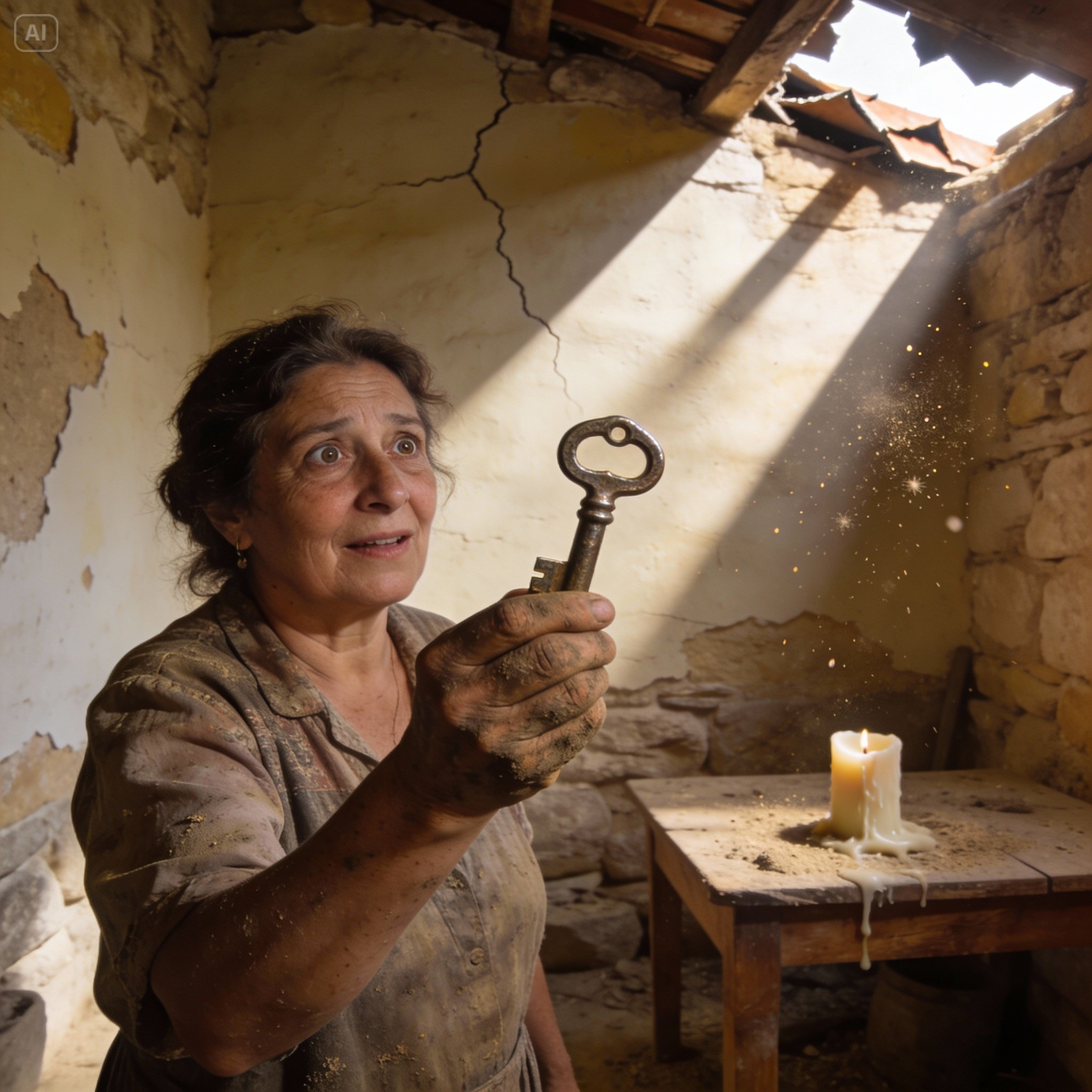
I set the suitcases on the floor, kicking up a small cloud of dust. I sat on one of them, not daring to touch anything else. I looked at my hands, calloused from years of work at the hospital, from years of caring for Javier during his final months of anguish. And then, I broke down. It wasn’t a soft cry, like the ones you see in movies. It was a howl. I cried with rage, with helplessness, with fear. I cried because I felt my life had been a cruel joke. I had been a devoted wife, a tireless worker, and my reward was to freeze to death in a house that was falling apart.
The first night was hell. There was no electricity, no running water, and certainly no heating. I wrapped myself in all the blankets I’d brought, curled up in a corner of what seemed to be the living room, trying to get away from the leaks. Every creak of the floorboards made my heart leap. I thought of Amparo and her son Sergio, sleeping in their warm beds in Madrid, probably laughing at “poor Rosa.” That night, I swore I would survive, if only out of spite.
The next day, my body aching and my eyes swollen, I went out into the village. Villar de los Olmos was a ghost town. Stone houses boarded up tight, empty streets, and the constant whistling of the wind. Barely thirty inhabitants remained, most of them elderly, who stared at me from behind their curtains. I went to fetch water from the fountain in the plaza and tried to strike up a conversation, but distrust hung heavy in the air. To them, I was a stranger, a crazy woman who had come to occupy the Duartes’ “cursed house.”
“Are you looking for something?” an elderly man in a beret, leaning on a cane, asked me without even saying hello.
“I’m just trying to fix up the house at the edge of town,” I replied, trying to smile.
The man spat on the ground.
“That house has been dead for fifty years. You’d be better off letting it fall into ruin and going back the way you came.”
Only one woman took pity on me. Her name was Emilia. She lived two houses down and saw me trying to pull the weeds from the driveway with my bare hands. She came out with a pitcher of water and two glasses.
“If you keep this up, you’ll ruin your hands before noon, child,” she said gently. Her face was lined with deep wrinkles, but her eyes were lively and curious.
I drank the water as if it were the finest wine in the world.
“Thank you,” I whispered. “I’m Rosa.
” “I know. News travels faster than the wind here. I know who you are and I know which house you’re in. Gonzalo’s house.”
Emilia invited me to sit on her bench and told me the story. The house had belonged to Gonzalo Duarte, a distant great-uncle of my husband. According to her, they had been an important family before the war, landowners. But Gonzalo, the last of the line to live there, died alone and childless.
“He was a strange man,” Emilia said, lowering her voice. “A loner. They said he had money, lots of money from the land, but when he died, they didn’t find a single peseta. The villagers searched the house; they say they even tore up the floorboards, but nothing. In the end, they assumed he had spent it all or that the rumors were just lies.”
I returned to my ruined home with my head full of questions. If Javier’s family had bought that property at a judicial auction, as I’d been told, why had they let it rot for years? Why were they giving me something that clearly had no value to them? Was it just cruelty, or was there something more to it?
PART 2: THE DISCOVERY
The following days were a struggle against the elements. I became a bricklayer, carpenter, and cleaner. With what little cash I had left, I bought basic tools and nails in the next town over. I cleared debris until my fingers bled. I patched holes with old boards. Every small victory, like getting the door to close, gave me a glimmer of hope.
One afternoon, the sky turned black and a storm threatened. A beam in the main roof looked ready to give way. If it fell, the whole roof would come crashing down. I climbed onto a wobbly chair, trying to secure the wood with a makeshift prop. I was straining, gritting my teeth, when a group of tiles suddenly came loose.
I jumped back, falling to the ground and getting covered in dust. Tiles crashed down where I’d been standing just a second before. My heart was pounding. I lay there on the dirty floor, staring at the hole in the roof. A ray of sunlight pierced through the opening, illuminating the dust in the air.
And then I saw it.
In the gap left by the tiles, wedged between the wood and the stone, something gleamed. It wasn’t stone. It was metal.
I stood up slowly, dusting myself off, and carefully climbed back onto the chair. I stretched my arm out as far as I could. My fingers brushed against something cold. I grabbed it and pulled. It landed in my hand with a surprising weight.
It was a key. But not just any key. It was wrought iron, old, long, and heavy, with a head adorned with filigree. I wiped it with my sweater sleeve. Beneath the layer of grime, two letters appeared, engraved in the metal: GD
Gonzalo Duarte.
A chill ran down my spine. Why would anyone hide a key among the roof tiles? What was so important that it had to be hidden up there, where no one would ever look?
That afternoon I forgot about the cold and the hunger. I searched the house like a madwoman. I looked for locks on the doors, on the remaining old wardrobes, on moth-eaten trunks. Nothing. The key didn’t fit anywhere. I tried the shutters, the floorboards, looking for loose boards. Nothing.
Frustrated, I placed the key on the kitchen table and stared at it by candlelight. I felt as if Gonzalo Duarte were challenging me from beyond the grave. “Here’s the key,” he seemed to be saying, “now find the door.”
I couldn’t sleep. The next morning, I went to see Emilia. I showed her the key. The old woman took it with trembling hands and held it up to her eyes.
“Good heavens…” she whispered. “I haven’t seen anything like this in seventy years.
” “Do you know what it’s for?” I asked eagerly.
Emilia looked at me intently.
“My grandmother used to tell me stories. She said that Gonzalo didn’t trust banks, that the land was the only safe haven. And that he had a place… a place where he kept what truly mattered. But no one ever knew where it was. They only said it was ‘under the protection of the earth.'”
“Under the protection of the earth.” The phrase stuck with me. I went back home and out into the back garden. It was an impenetrable thicket. There was an old, half-collapsed shed, covered by years of overgrown vegetation. I had been afraid to go in there before, in case there were snakes or rats, but now I had a mission.
Armed with an old sickle I found, I cut my way through the brambles. It took me hours to reach the shed door. Inside, the smell of damp was unbearable. There were rotten burlap sacks, rusty tools, and mountains of trash. I started moving things around, shifting heavy boxes, sweeping the packed-earth floor.
In one corner, almost invisible under a layer of dirt and straw, I saw a metal ring.
My heart leapt. I knelt down and frantically wiped the dirt off with my hands. It was a thick wooden trapdoor, reinforced with iron. I pulled the ring with all my might. The wood creaked, protesting, but it didn’t open. It was locked.
I searched for the lock. It was hidden beneath a sliding metal plate. I took the key from my pocket. My hands were shaking so much I almost dropped it. I inserted it into the keyhole. It went in smoothly, as if it had been waiting for this moment. I turned it.
Clac.
The sound was sharp, definitive. I pulled the ring again, and this time the trapdoor lifted, revealing a stone staircase that descended into absolute darkness.
I turned on my phone’s flashlight and went downstairs. The air down there was stale and cold. At the bottom of the stairs was a small stone room, dry and clean, incredibly well-preserved. There was no pile of gold, no glittering jewelry. Just a wooden shelf at the far end. And on it, three objects: a metal box locked with a padlock (the key was taped to the side), a thick, yellowed, sealed envelope, and a black-covered ledger.
I felt my legs give way and I sat down on the last step. I knew, without even opening anything yet, that my life had just changed.
PART 3: TRUTH AND WAR
I carried the items up to the kitchen and sat down to examine them with the reverence of someone handling sacred relics. I opened the envelope first. The sealing wax broke with a snap. Inside were old notarial documents, but perfectly legible.
The first was a property deed. Gonzalo Duarte not only owned the house; the papers certified his ownership of more than fifty hectares of farmland, forests, and pastures surrounding the town. Lands I thought were abandoned or unclaimed.
The second piece of paper was a handwritten letter. The writing was sharp and firm.
“To whoever finds this:
If you are reading these lines, it is because you have had the courage to live under my roof and the good fortune to find my key. My name is Gonzalo Duarte. I had no children, no wife, and my family was only waiting for my death to tear apart what I worked so hard to build. That is why I hid everything. Not out of greed, but for protection.
This land is my life. If you have come this far, I bequeath it to you. In this box you will find the means to defend it. Do not let the vultures take it. Fight. Make it bear fruit again.
Gonzalo.”
Tears fell onto the paper as I read. A man I never knew, dead for decades, was speaking to me, giving me the dignity my own in-laws had denied me.
I opened the metal box. Inside were bundles of old peseta banknotes—worthless now—but underneath there was something else: silver and gold coins. Lots of them. And a savings account book from a bank in Zamora with meticulous entries and an account number that, according to an attached note, had a standing order not to be touched until someone presented the key and the holographic will included in the box.
It wasn’t enough to buy a palace, but it was enough. Enough to hire the best lawyer in the province. Enough to fix the roof. Enough to start over.
But the peace was short-lived.
The following week, while I was still lost in thought, planning how to contact the bank, a high-end black car pulled up in front of my door, kicking up a cloud of dust. I recognized the Madrid license plate.
It was Amparo and her son Sergio.
They got out of the car, looking at the house with disgust, but also with a strange curiosity. I went out onto the porch, drying my hands on my apron. I felt different. I was no longer the frightened widow. I had Gonzalo’s key in my pocket.
“Well, Rosa,” Amparo said without taking off her sunglasses. “I see you’re still alive. We thought you’d have run away two days later.”
“I’m still alive, Amparo. And this is my house. What do you want?”
Sergio lit a cigarette and looked at me with that arrogance he’d inherited from his mother.
“We’ve come to do you a favor, girl. We’ve received an offer for the land. A solar energy developer wants to buy all this to install panels. It’s not much, but we’ll give you 5,000 euros so you can leave and find a decent place to rent. We’ll take care of the paperwork.”
My blood boiled. 5,000 euros? For fifty hectares? They knew something. Or suspected something. Or they just wanted to scam me again, thinking I didn’t know what I had.
“No,” I said firmly.
Amparo took off her glasses. Her eyes were two pools of coldness.
“What do you mean, no? You have no money, Rosa. You have nothing. We’re doing you a favor. That house is going to collapse and kill you. Sign the papers and leave.”
“I said no. And get off my property. Now.”
Sergio took a step toward me, intimidating.
“Listen, you wretch. That house belonged to my family. We let you have it out of pity. If we want, we can kick you out tomorrow.”
“Try it,” I challenged him, feeling a strength I didn’t know I had. “But bring lawyers, because you’re going to need them.”
They sped off, skidding in the car. I knew then that the war had begun. I quickly contacted Ernesto Campos, a lawyer from Zamora with a reputation as a relentless, honest, and tough enforcer. I took everything to him: the key, the letter, the deeds, the holographic will.
Ernesto reviewed the papers silently for almost an hour. When he looked up, he was smiling.
“Rosa, this is dynamite. The judicial auction through which your in-laws acquired the property was… irregular. They only registered the house and a small orchard, deliberately ignoring the 50 hectares listed in Gonzalo’s original deeds. And this will… since it was written in his own hand and meets the legal requirements of the time, and has surfaced now, it prevails. But they’re going to fight it. They’re going to say you’re crazy, that you forged this.”
“Let them say what they want,” I replied. “I’m not moving from here.”
PART 4: THE REBIRTH OF VILLAR DE LOS OLMOS
While the lawyers were busy filing briefs and lawsuits, I focused on the house and the land. With some of the money from the silver coins, which I sold to a trusted numismatist, I hired Teo, a bricklayer from the neighboring town who was unemployed. Teo was a man of few words, but he worked like a mule.
Together we fixed the roof. We installed new pipes. I put in double-glazed windows to insulate against the cold. For the first time in months, the house began to feel warm and cozy.
The neighbors, seeing the commotion and knowing I’d stood up to “those from Madrid,” began to change their attitude. I was no longer the outsider; I was the woman who stood up for herself. Manuel, the old man in the beret who’d spat at me the first day, showed up one morning with a basket of fresh eggs.
“They say you’ve found Gonzalo’s papers,” he grumbled. “They say you’re going to stay.
” “That’s right, Manuel.”
“That man, Gonzalo… he was a good man. If he left you this, it must be for a reason. If you need help with the vegetable garden, let me know. My knees are useless, but I know when to plant.”
Little by little, Villar de los Olmos adopted me. Emilia would bring me stews. Manuel taught me how to prune the old fruit trees in the back. Teo brought his electrician cousin. A small community formed around my house, united by the desire to see something they thought was dead reborn.
But the fear remained. Ernesto called me with worrying news. Amparo and Sergio had contested the will. They claimed Gonzalo wasn’t in his right mind when he wrote it. They had hired an expensive law firm in Madrid and were pulling strings. A city hall employee, a distant cousin of Amparo’s, had “lost” certain records that favored us.
The day of the trial arrived eight months later. I entered the Zamora courtroom with my head held high, dressed in my best suit, flanked by Ernesto. On the other side, Amparo and Sergio glared at me with pure hatred. They seemed certain of their victory.
The judge, a serious man with thick glasses, listened to the arguments. Amparo’s lawyer tried to ridicule me, portraying me as an opportunist taking advantage of a local legend. I felt small in the dock, but then I remembered Gonzalo’s letter. I remembered the cold, the hunger, and the key in my hand.
When Ernesto presented Gonzalo’s accounting ledger and the evidence that the auction had been rigged by the official (whom Ernesto had investigated and caught accepting bribes in other cases), Sergio’s face changed color. It went from the red of anger to the white of fear.
The judge took his time. It was the longest two hours of my life.
Finally, he issued his ruling.
He declared Gonzalo Duarte’s holographic will valid. He declared Amparo’s claim regarding the unregistered lands null and void. And not only that: he ordered a criminal investigation into the fraud at the original auction.
I won.
Amparo stormed out of the room shouting that this wouldn’t be the end of it, but Sergio dragged her out, knowing they were defeated. I hugged Ernesto and cried, but this time they were tears of relief, of liberation.
PART 5: THE HARVEST AND THE LEGACY
With the property secured and full access to Gonzalo’s bank account (which had more money than I ever dreamed of, accumulated through interest over decades), I didn’t buy a sports car or go on vacation.
I invested in the land.
I hired an agricultural engineer, Alberto, a young man with brilliant ideas about organic farming. I bought a tractor. I hired people from the village and the surrounding area to work. We cleared the fields that had lain fallow for fifty years. The land, rested and fertile, was eager to produce.
We planted wheat, barley, and sunflowers. But my big bet was on the vineyards. Zamora has wine country, and Alberto assured me that the slopes of the property were perfect.
That first year was exhausting, but beautiful. Seeing life sprout where there had only been weeds healed my soul. The town revived with us. With work available, two young families moved into empty houses and renovated them. The bar in the square, which had only been open on Sundays, started opening daily to feed the workers.
Villar de los Olmos was waking up.
Two years after I arrived, I received an unexpected call. It was Sergio. His voice sounded subdued.
“My mother has died, Rosa,” he said. “Pancreatic cancer. It was very quick.”
I felt a pang of sadness, not for her, but for the sadness of a life consumed by bitterness.
“I’m sorry, Sergio.”
“Before she died… she wanted you to know that she regretted it. Not wanting the house, that’s just how she was… but how we treated you and Javier when she was alive. I found a letter on her nightstand for you. I’ll send it to you. And Rosa… congratulations on the wine. I saw the bottles in a gourmet shop here in Madrid. ‘Tierras de Gonzalo.’ A good name.”
I hung up the phone and looked out the window. The sunflowers were in full bloom, a yellow sea swaying in the breeze.
A few months later, a young woman arrived in the village with a backpack. Her name was Lucía. She was the granddaughter of a second cousin of Gonzalo’s, from a branch of the family that had long since abandoned the village. She had read about my story in a newspaper. She was an agronomist and fed up with the city.
“I haven’t come to ask for anything,” she said shyly. “I just want to see what you’ve done.” My grandfather spoke of these lands with nostalgia.
I saw in her eyes the same sparkle that Gonzalo must have had. I hired her. Lucía turned out to be a tireless worker and, over time, became the daughter I never had. Together we expanded the business, exporting our wine and olive oil throughout Europe.
Today, as I write this sitting on the porch of my house—no longer a ruin, but a warm, vibrant stone mansion—I look back and smile. I am 60 years old. My hands are more wrinkled, but my heart is full.
I have Emilia (who at 90 years old still gives me orders), Teo, Lucía, and a whole town that is my family. Javier is gone, yes, but he left me the path to my true destiny, even if it was through pain.
Gonzalo’s key didn’t just open a basement. It opened my life. And I learned that sometimes, when you think you’ve been buried, you’ve actually been planted.
If you too are going through a dark time, where it seems like everything is falling apart, remember my story. Search among the rubble. Perhaps, just perhaps, your key is waiting there, gleaming beneath the dust, ready to unlock the door to the life you deserve.