I arrived at my apartment in the center of Madrid after a twelve-hour shift and found it ransacked by my own sister, who left a note saying that she needed it more than I did, without knowing that this robbery would be the beginning of my rebirth.
THE GOLDEN GIRL
To understand why I didn’t call the police right then and there, you have to understand who Elena is. Or who she was to my father and me.
When our mother died of a sudden aneurysm when I was nineteen and Elena was twelve, my life stopped so that hers could continue. I was in my second year of nursing school. I worked nights as a bartender in Malasaña and studied in the mornings. My father, devastated by grief, threw himself into his work and, shortly after, into the arms of Pilar, his new wife.
Elena became my mission. I made her breakfast, checked her homework, bought her the designer clothes she asked for so she wouldn’t feel inferior to her friends at the private school. I was the one who went to her parent-teacher meetings. I was the one who comforted her when a boy broke her heart.
Elena grew up believing the world owed her something. And I, unwittingly, fed that beast.
When she met Javier, her husband, I thought she’d finally settle down. Javier was charming, one of those guys with an easy smile and the smooth talk of an insurance salesman. They got married two years ago. A wedding at an estate in the mountains near Madrid that cost a fortune. Dad paid part of it, but when they ran short, who chipped in the remaining five thousand euros for the catering? Carmen. The older sister. The one who’s always saving. The one who doesn’t have children or a husband and, therefore, “has money to burn.”
That was the family narrative. Carmen is strong. Carmen gets things done. Elena is fragile. Elena needs help.
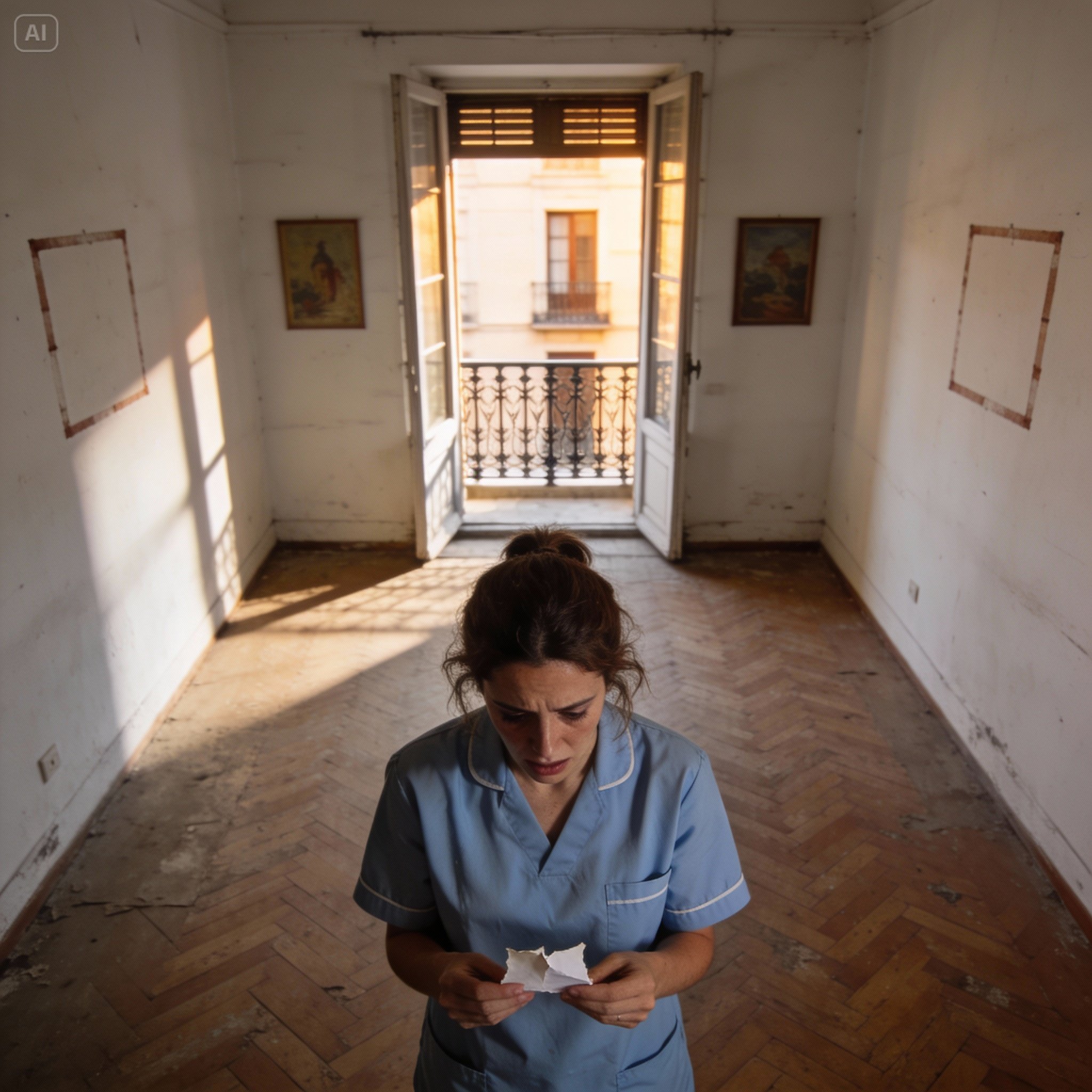
Three months ago, they came to our house for dinner. Well, to the house that had furniture back then. Elena was crying. Javier was staring at the floor.
“They’re going to repossess us, Carmen,” she said, taking my hands. “Javier’s had some bad luck with investments. We need three thousand euros. Just to get back on our feet. We’ll pay you back as soon as Javi’s new project comes through.”
I gave them to her. They were my savings to replace my old Seat Ibiza, which wouldn’t pass the MOT anymore. But she was my sister. What was I going to do? Leave her out on the street?
They never returned them. Every time I asked, there was an excuse: the car had broken down, an unexpected fine, a dental problem. I stopped asking so as not to create tension at Sunday lunches.
And now, sitting on the floor of my empty living room, I understood that the three thousand euros had not been enough.
THE VOID
I spent the first night sleeping on my hospital coat, curled up on my bedroom floor. They had taken the bed, the mattress, the sheets, the pillows. They had taken my entire wardrobe. All I had left were the clothes I was wearing: my blue scrubs and slippers.
Sunrise in Madrid is beautiful, but seeing it from the ground, with an aching body and a broken soul, is a life-changing experience.
I got up, washed my face with cold water (they had taken the towels and hand soap) and looked at myself in the bathroom mirror, the only thing they hadn’t been able to take. I had dark circles under my eyes. I looked ten years older.
“You’re not going to cry,” I told myself. “Carmen, you’re not going to cry for people who don’t love you.”
I left the house and went to the Carrefour that opens early. I bought the essentials: an inflatable mattress, a pillow, a cheap sheet set, a plate, a glass, a fork, and a knife. I also bought underwear and a couple of T-shirts and jeans. I spent almost three hundred euros. I had forty-five euros left in my account until the end of the month.
I went to work. Nobody noticed anything, except Maite, my coworker and best friend.
—Carmen, you look unwell. Are you incubating something? —she asked while we were preparing the plant’s medication.
“I’m fine,” I lied. I couldn’t say it out loud. Saying it made it real. Saying “my sister has stolen everything, even the baseboards” sounded so pathetic it made me cringe.
That day, my mobile phone, which had been in “Do Not Disturb” mode, started vibrating.
It was Elena.
“Little sister, I hope you’re not too angry. It really was an emergency. We love you very much.”
Then Javier.
“Thank you for being so understanding, sister-in-law. You’re a saint.”
I deleted the messages without replying. I felt a physical nausea, a burning sensation in my stomach that rose to my throat. It wasn’t just the material theft. It was the violation of my sanctuary. They had entered my privacy, touched my things, decided what had value and taken it, leaving me like an empty shell.
That night, back in the apartment, I inflated the air mattress. The sound of the electric pump echoed off the empty walls like a wail. I sat down to eat a sad sandwich, staring into space.
And then, the sadness transformed.
It ceased to be a heavy ball in his chest and became fire. A cold, lucid fire.
I remembered all the times I sacrificed vacation time to lend them money. I remembered taking care of Elena when she had the flu while Javier went out partying. I remembered my stepmother Pilar’s superior look when she’d say, “Oh, Carmen, you’re so frugal, Elena likes to live well.”
I took out my phone. I looked in my contacts. I didn’t call Elena.
I called Pablo.
Pablo had been my boyfriend in college, years ago. We broke up because he went to do a master’s degree in London and I stayed behind to take care of my family. Now he was a criminal lawyer at a prestigious firm on Paseo de la Castellana.
—Carmen? —her voice sounded surprised but warm—. It’s been so long! Is something wrong?
—Pablo, I need legal help. Urgent.
I told him everything. At first there was silence on the other end of the line. Then, a muttered curse.
“Carmen, listen to me carefully,” he said, in that professional tone I hadn’t seen before. “This isn’t a family dispute. This is grand theft, possibly burglary if they had keys but no authorization. How much are we talking about?”
I did a quick mental calculation. Furniture, appliances, clothes, grandma’s jewelry, electronics…
—About twenty-five or thirty thousand euros. Maybe more.
—That’s a serious crime. Prison sentences. Are you prepared to report your sister?
I closed my eyes. I pictured Elena in her prison uniform. Then I pictured my empty house. The note. “We need him more than you do . “
—Yes —I said—. I’m willing.
THE COMPLAINT
The next day, I went to the National Police station in my district. I was attended to by an inspector named Laura, a woman in her forties with a tired but intelligent look.
When I showed him the photos of the empty apartment and the note, he raised an eyebrow.
“In my twenty years of service, I’ve seen it all,” he said, “but leaving a thank-you note after robbing a house… that’s new. It’s psychopathic coldness.”
I filed a complaint. I provided invoices, serial numbers for the television and laptop, and the statement from the neighbor on the fifth floor, Mrs. Rosa.
Mrs. Rosa, bless her, had intercepted me on the stairs that morning.
“Oh, dear, what a strange move you had the other day,” she told me. “I saw your sister and her husband loading the truck at three in the afternoon. They were sweating like crazy. I asked them if they needed water, and she said, ‘Don’t worry, Rosa, Carmen is moving in with us unexpectedly.'”
Inspector Laura took note of everything.
“We’re going after them, Carmen. You have evidence, witnesses, and a written confession. It’s a textbook case.”
I left the police station trembling, but for the first time in three days, I was breathing better.
The phone started ringing. It was my father.
I didn’t pick it up.
Then Pilar, my stepmother.
“Carmen, pick up the phone. Elena is hysterical. She says the police have come to her house. What have you done?”
I smiled. A small, sad smile, but mine nonetheless.
THE FAMILY WAR
The following week was hell. My whole family turned on me. Uncles I hadn’t seen since Christmas ’98 called to tell me that “dirty laundry should be aired at home.” My father showed up at the hospital in the middle of my shift.
“Withdraw the complaint!” he shouted at me in the waiting room, red with anger. “She’s your sister! You’re going to ruin her life!”
“She’s ruined her own life, Dad,” I replied, managing to stay calm with superhuman effort. “She robbed me, Dad. She left me sleeping on the floor. Do you know what the police told me? They found my jewelry at a pawn shop in Vallecas. Mom’s jewelry.”
My father went white.
“I’m sure he had a good reason…” he stammered.
“The reason is that Javier is a gambling addict, Dad. They’ve spent everything on sports betting and online poker. The police have traced the accounts. They’ve been stealing for months to pay off debts.”
My father collapsed into a plastic chair. I didn’t know. Nobody knew. Elena had maintained the facade of a perfect life while her husband gambled away everything.
But not even that softened my heart. Because instead of asking for my help, instead of coming to me with the truth, they chose to prey on me. They decided I was expendable.
I continued with the process.
Pablo was my rock. He accompanied me to every statement, protected me from the harassing calls from Javier’s family, and invited me to dinner when he saw that I was only eating instant noodles.
“You’re being incredibly brave,” she told me one night, as we had a glass of wine on a terrace in La Latina. “Most people would have backed down because of family pressure.”
“I’m not that Carmen anymore,” I told her. “That Carmen stayed in the empty apartment. The one here now loves herself enough to say enough is enough.”
THE REBIRTH
Months passed. Elena and Javier tried to reach an agreement to avoid going to trial, but the prosecution saw the recidivism (they had also robbed Javier’s mother, an elderly woman with dementia) and was relentless.
They were convicted. Elena to two years in prison, Javier to a little more.
The day the verdict came out, I didn’t feel joy. I felt peace. A deep, pure peace.
With the insurance compensation and what little they recovered from the auction of my belongings (because they had sold everything for next to nothing), I started to redecorate my apartment.
I didn’t buy expensive things. I went to El Rastro flea market one Sunday with Pablo. We bought an old wooden table that we restored together, sanding and varnishing it in my living room, eating calamari sandwiches and laughing with paint smears on our faces. I bought plants. Lots of plants. I filled the empty spaces with green life.
I put up new pictures. New photos. There were no more photos of Elena. There were photos of me with my friends from the hospital, photos from a trip I took alone to Granada, and one small, discreet photo of Pablo and me smiling.
Yes, Pablo and I. What started as legal help turned into endless coffees, walks in the Retiro Park, and discovering that love doesn’t have to be sacrifice and pain. Love can be a team. A lawyer and a nurse against the world.
I recently received a letter from Alcalá-Meco prison. It was from Elena.
“Carmen, I have plenty of time to think here. I’m sorry for what I did. I don’t expect you to forgive me, but I want you to know that Javier and I are getting a divorce. When I get out, I want to try to be the person you thought I was.”
I put the letter in a drawer. I didn’t reply. Maybe someday I will. Maybe someday I can have coffee with her and not feel pain. But not today.
Today is Sunday. I’ve made a potato omelet (with onion, of course) and set the table. My new table.
The doorbell rings. It’s Pablo, bringing the wine and dessert. Maite and her husband are also there.
I look at my living room. It’s no longer the picture-perfect display it once was. It’s a home. My home. Every object here I’ve chosen, paid for, and that has meaning for me.
Nobody gave it to me. And nobody’s going to take it away from me.
I go to the window and look at the streets of Madrid, full of life, noise, and light. I take a deep breath.
I lost all my things, it’s true. I was left with nothing material. But in that emptiness I found something I had lost a long time ago: my dignity.
And I assure you that the change has been very profitable for me.
Because now, when I look in the mirror, I no longer see the sad, self-sacrificing sister. I see Carmen. And Carmen is happy.
So, thank you, Elena. Thank you for leaving me that note. You were right about one thing: you needed it more than I did. Because I don’t need things to be who I am. But you needed to hit rock bottom to start becoming someone.
I close the window, smile, and go to open the door to my new life.