Between Trash and Sky: The Night I Rescued a Dying Stranger in the Madrid Rain and Discovered a Million-Dollar Secret That Threatened to Destroy Us.
THE PROMISE OF RAIN: CHAPTER ONE
I never imagined my salvation would come disguised as someone else’s tragedy. They say Madrid is a city that never sleeps, but that’s a lie. Madrid sleeps, and snores, and sometimes has nightmares. I lived in one of those nightmares, on the margins, where the lights of the Gran Vía don’t reach and the glamour of the Castellana is just a bedtime story we tell ourselves to keep from losing our minds.
My name is Elena García. I’m twenty-six years old, though my hands say I’m fifty, and my eyes sometimes seem to have witnessed a century of solitude. That night, the storm wasn’t just rain falling from the sky; it was a punishment. The wind howled among the abandoned buildings of the San Lázaro industrial park, south of the city, pushing my scrap metal cart as if it wanted to knock me over. My boots, two sizes too big and stuffed with newspaper, slosed through the oily mud of the road.
“Come on, Elena, just two more blocks,” I whispered to myself, my teeth chattering. The steam from my breath mingled with the cold mist.
My routine was sacred. Going out when the “upstanding citizens” slept, rummaging through what the world discarded, finding value where others saw only trash. I was an archaeologist of misery. But that night, the air weighed differently. There was a static electricity, a metallic omen on my tongue.
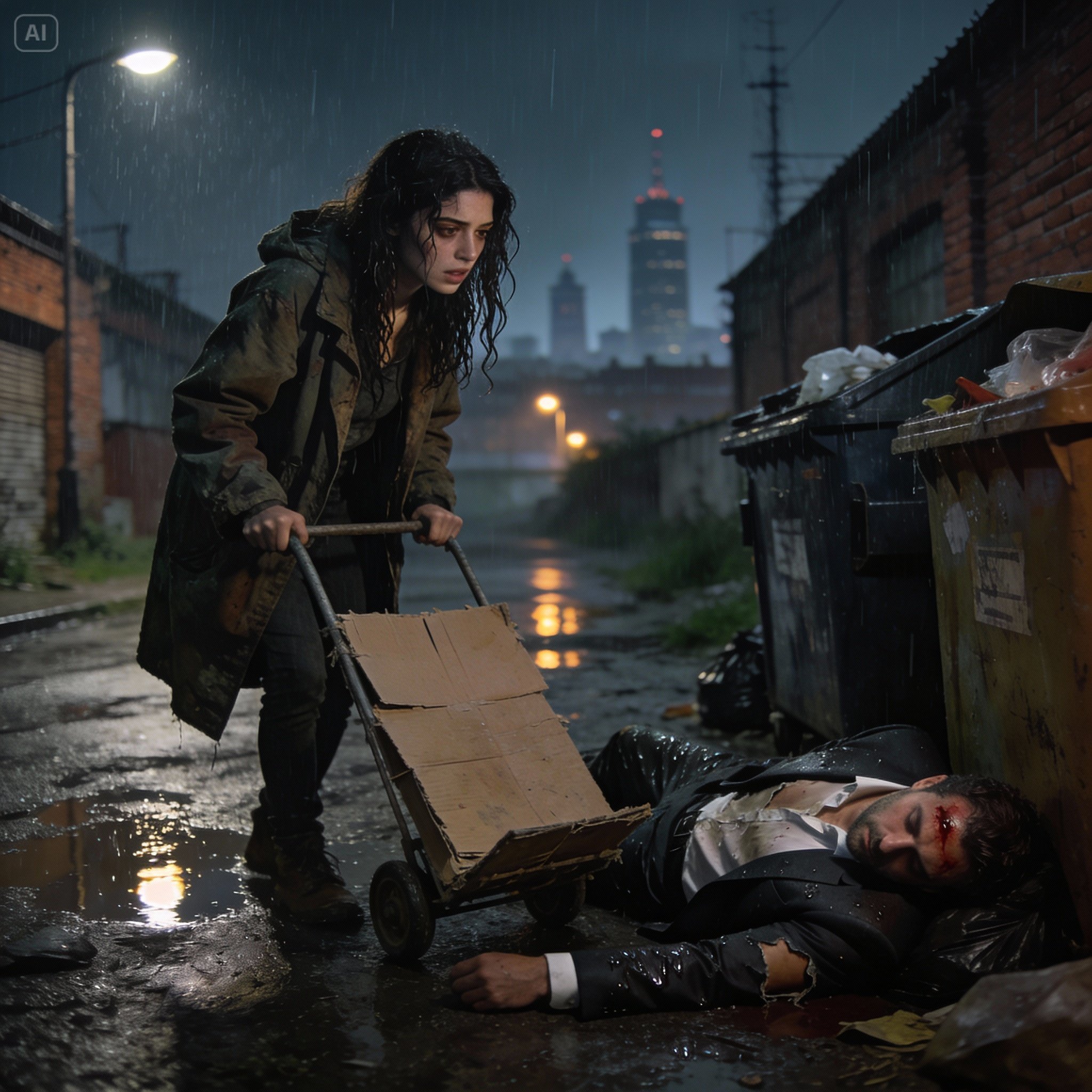
As I turned into the back alley of the old tannery, the cart got stuck in a pothole. I cursed under my breath, pulling hard on the wire handle that dug into my cracked palms. That’s when I saw him. Or rather, I smelled him before I saw him.
It didn’t smell of urine, or rotten food, or the stale dampness typical of that alley. It smelled of old wood, of leather that was already somewhat sweet and strong. Cognac. The good kind. The kind my father said the powerful people in the world drank while we drank tap water.
There, between two overturned green bins and a pile of broken pallets, was a bundle. At first, I thought it was a pile of old clothes someone had thrown away—a fortune for someone like me. I approached with the caution of a stray cat, hoping it was a wool coat or a thick blanket.
A flash of lightning ripped through the leaden sky, illuminating the alley for a fraction of a second. My heart stopped in my chest. It wasn’t clothes. It was a man.
He was curled up in the fetal position, half-submerged in a pool of black water. He was wearing a suit, or what was left of it. Navy blue, impeccably tailored, soaked almost to the point of being black. His shoes gleamed with that understated shine of Italian leather that costs more than everything I owned in the world.
“Hey!” I shouted, my voice small against the roar of thunder. “Hey!”
He didn’t move.
The survival instinct, that animal that lives in my stomach and tells me, “Run, Elena, run,” started screaming. This is trouble. This is the police. These are questions you can’t answer. If they found him dead and I was nearby, who would they blame? The girl in the shack. The “nobody.”
I took a step back, gripping the handle of my shopping cart. Go away. Leave it. Someone will find it tomorrow.
But then, he made a sound. A guttural, stifled groan of pure pain. It was such a human sound, so broken, that it shattered my barrier of fear. It reminded me of Javi, my little brother, the night he had that high fever before… before everything fell apart.
I dropped the cart. I ran toward him, my knees hitting the wet asphalt as I bent down beside him.
“Sir, can you hear me?” I touched his shoulder. It was freezing, but under the cold rain, his skin was burning.
I carefully turned his face. My God. He had a gash on his left temple, ugly and deep, from which a trickle of blood oozed, washed away by the rain and spread across his white collar and designer shirt. He was young, maybe in his early thirties. He had strong, aristocratic features, a square jaw now covered with stubble and dirt.
“Help…” she whispered. It wasn’t a plea, it was a final breath.
Her eyes flickered open for a second. They were dark, deep as oil wells, and filled with utter terror. Not the fear of dying, but the fear of something worse.
“Don’t leave me… here…” he stammered, and his head fell back, unconscious again.
I looked around. The street was deserted. Just the rain, the thunder, and us. I couldn’t call an ambulance; I didn’t have a phone. I couldn’t go to the police; they’d arrest me for being a vagrant before they’d even listened to me.
“Shit, Elena. Shit, shit, shit,” I muttered, running my hands through my wet hair.
I looked at him again. Sometimes, the person on the ground hasn’t fallen; they’ve been pushed. My brother’s words echoed like a bell. This man wasn’t a drunk who had tripped. Someone had done this to him.
I made a stupid, dangerous, and human decision.
“You’re not going to die today, posh boy,” I growled, grabbing him under his armpits.
He weighed a ton. My boots slipped in the mud as I pulled him along. I felt a strain in my lower back, my muscles protesting the Herculean effort. With a maneuver that cost me half my life and three broken fingernails, I managed to get him onto my cart, settling him on the wet cardboard as best I could. I covered him with my own jacket, a military parka I found in a Humana dumpster two years ago, and started pushing.
The drive back to my “home” was an ordeal. Every pothole was torture, every distant siren made my blood run cold. He wasn’t moving. Only his ragged breathing told me he wasn’t transporting a corpse.
My home wasn’t a house. It was a makeshift structure illegally erected in a vacant lot hidden behind the commuter rail tracks, made of corrugated metal sheets, wooden pallets, and stolen advertising banners. But it was mine. It was dry. It was safe.
I unlocked the rusty padlock on the door, which was actually a reinforced piece of particleboard, and pushed the cart inside. The smell of dampness, burnt wood, and dried herbs greeted me. I lit the butane gas lamp, which hissed and cast a flickering, bluish light over my little kingdom.
I dragged him to my mattress, the only luxury I had, raised off the ground on bricks to avoid dampness.
“Come on, big guy, help out a little,” I panted, letting him fall onto the threadbare blankets.
Now, in the light, the damage was more visible. The head wound needed stitches, or at least a good cleaning. His clothes were ruined. I began to undress him, not with lust, but with the clinical efficiency of someone who has had to care for the poor. I took off his jacket, his silk tie (which was worth more than my roof over my head), his soaked shirt.
It was when I took off his shirt that I saw the ring. It was on his left hand. Solid gold, heavy. It had a coat of arms engraved on it: two rampant lions and a sword. And inside, a tiny inscription that I could barely read in the gaslight: Non Ducor, Duco . “I am not led, I lead.”
“Who are you?” I whispered, wiping the mud off his chest with a damp cloth. He had the body of someone who took care of himself, defined muscles, not an ounce of fat, but he also had old scars.
I cleaned the wound on his head with the little alcohol I had left and bandaged it with strips from an old but clean t-shirt. He groaned in his sleep, muttering names I didn’t understand. Miguel… betrayal… don’t do it…
I covered him with all the blankets I had. I sat on the floor, hugging my knees, watching his breathing, listening to the rain pounding against the tin roof like a thousand accusing fingers.
I didn’t sleep that night. I spent the hours watching that strange intruder in my sanctuary, wondering if at dawn I would find a dead body or an even bigger problem.
The sun didn’t come out the next day. Madrid awoke under a gray layer of low clouds, the kind that promise more rain. I was awakened by a sharp sound. A knock.
I opened my eyes with a start, jumping up from my corner on the floor. The man was awake. He had tried to sit up and had knocked over my small table of fruit crates, spilling my metal cup.
He stared at me with wide, panicked eyes. He was breathing heavily, like an animal in a cage.
“Relax!” I raised my hands, palms facing out. “You’re safe. You’re in my house.”
He looked around frantically. The corrugated iron walls, the low ceiling, the filth, the utter poverty. Then he looked at himself, bandaged, covered with coarse wool blankets. He put his hand to his head and winced in sharp pain.
“Where…?” Her voice was like sandpaper. “Where am I? Who are you?”
—I’m Elena. You’re in San Lázaro, near the train tracks. I found you last night lying in the trash, half dead.
He frowned, as if trying to solve an impossible mathematical equation.
“In the trash?” he repeated, as if the words had no meaning. “I…”
—Yes, you. You had a gash on your head. Do you remember what happened? Did someone attack you?
She closed her eyes tightly, squeezing her eyelids shut until they hurt. There was a long, tense silence. When she opened them again, the panic had given way to a terrifying emptiness.
“I don’t know,” she whispered.
“What’s your name?” I insisted, moving a little closer, like someone approaching a frightened horse.
He looked at me. His black eyes searched mine for some answer, but only found his own lost reflection.
“I don’t know,” she said, and the despair in her voice broke my heart. “I don’t know my name. I don’t know who I am. I don’t remember… anything. It’s like a blank wall. I try to look back and there’s only fog.”
Amnesia. I’d heard about it in the soap operas my mother and I watched, but seeing it in real life was chilling. He was a man without a story, a ship without an anchor.
“Okay, calm down,” I said, trying to sound more confident than I was. “You’ve had a bad stroke. Sometimes memory takes a while to return. You… you look like someone important.”
He looked at his hands. He saw the ring. He turned it over, confused.
” Non Ducor, Duco,” he read aloud. He looked at me questioningly. “What does that mean?”
“I have no idea, I dropped Latin in high school,” I lied. I didn’t want to tell him I knew what it meant because it would reveal that I hadn’t always been homeless. “Look, you need to eat. You don’t look well.”
I got up and went to my small camping stove. I had two eggs, a piece of stale bread, and some Serrano ham that the butcher at the market had given me because it was going to spoil. A feast for me, a pittance for him. But it was all I had.
As I beat the eggs, I felt him watching me. He was assessing me. Not with disgust, surprisingly, but with curiosity.
“Thank you,” he said suddenly.
I turned around, frying pan in hand.
-Because?
—For not leaving me there. You could have robbed me and left me for dead. I have… I suppose this ring is worth something.
I smiled, a crooked, cynical smile.
—I thought about it, don’t get me wrong. But my mother taught me that what isn’t yours burns your hands. And besides, you were too heavy to just steal the ring, so I took the whole package.
He let out a short, dry laugh that turned into a grimace of pain.
“I’ll call you Rafa,” I decided as I poured the scrambled eggs onto my only chipped earthenware plate. “You look like Rafael. My grandfather was called that, and he was as stubborn as you.”
“Rafa,” he tasted the name in his mouth. “It sounds… foreign. But it’ll do.”
I handed him the plate and a plastic fork. He ate with ravenous hunger, devouring the eggs and bread as if it were the best meal he had ever tasted.
“This is incredible,” he murmured with his mouth full.
—It’s hunger, Rafa. Hunger is the best sauce in the world.
During the following days, my shack became a strange field hospital. The rain didn’t stop, turning the open field into an impassable mud pit, which kept us isolated.
“Rafa” turned out to be a quiet but grateful tenant. Despite remembering nothing, his hands recalled things his mind couldn’t. He could fold clothes with military precision. He knew how to fix things. On the second day, while I went out to fetch water from the public fountain, he found my toolbox (a screwdriver and an old hammer) and fixed the wobbly leg of my table and sealed a leak in the roof with a piece of plastic and tar he found outside.
—You’re quite clever for a gentleman—I joked that night, as we shared a can of coastal bean stew heated over the fire.
“I don’t know if I’m a gentleman, Elena,” he replied, looking at his hands covered in new calluses and dirt. “I feel… comfortable doing this. Maybe I was a carpenter.”
—Yes, of course. A carpenter in silk suits and gold rings. Sure.
But there was something more. In the way he spoke, in his vocabulary. He used words like “efficiency,” “structure,” “optimization” to talk about how to organize my junk. He spoke with perfect diction, the Castilian Spanish of central Madrid, without any accents or slang.
Little by little, the initial fear dissipated, giving way to a strange intimacy. Living in ten square meters with a stranger forces you to break down walls. He saw me washing my hair in a basin; I saw him having nightmares where he screamed and sweated profusely.
“Tell me about yourself,” she asked me one night, by candlelight. The rain had subsided, leaving a heavy silence in the air.
—There’s not much to tell. I’m a survivor.
—That’s not true. I see you looking at the books you bring back from the trash. I see you stopping to look at the pastry shop window when we come back from the market.
I sighed, defeated by her wit.
—I wanted to be a pastry chef. My dream was to open my own pastry shop. “La Dulce Vida” (The Sweet Life). I had notebooks full of recipes, ideas for cakes that weren’t just sugar, but… experiences. I wanted people, when they ate one of my pastries, to forget for a moment that life is hard.
“And what happened?” he asked gently.
“Life went on. My mother died of cancer when I was twenty. My father turned to drink. Javi, my little brother… he…” My voice broke. I hadn’t spoken about Javi to anyone in years. “Javi got into trouble. Bad company. One day he went out to buy cigarettes and never came back. I looked for him everywhere. Police stations, hospitals, morgues. Nothing. I lost my apartment, I lost my job, I lost the will to live. And I ended up here.”
Rafa came closer. We were sitting on the floor, shoulder to shoulder. He reached out and covered mine. His skin was rough now, but his touch was incredibly soft.
—I’m sorry, Elena. I really am.
“Don’t feel sorry for me,” I said, abruptly withdrawing my hand. “Pity doesn’t put food on the table.”
“It’s not pity,” he said, turning to face me. His eyes shone with an intensity that took my breath away. “It’s admiration. You’re the strongest person I’ve ever known, no matter who I can think of. You saved my life without asking for anything in return. You’ve given me a home when you barely have one yourself. That’s not survival, Elena. That’s nobility.”
We stared at each other. The air between us changed. It was no longer the stale air of a shack; it was charged with electricity. He leaned in slowly, giving me time to back away, to run, to hit him. But I didn’t move.
When his lips touched mine, there were no fireworks. There was something better: there was warmth. There was recognition. It was a tentative kiss, tasting of stew and despair, but it was the most real kiss of my life. I clung to him, to his neck, to his warmth, like a shipwrecked sailor clinging to a plank in the middle of the ocean. And he responded with a restrained, desperate passion, as if I were the only solid thing in his foggy world.
We made love that night on the old mattress, with the sound of rats scurrying outside and the wind whistling through the corrugated iron. It didn’t matter who he was, or who I was. We were just two lonely souls who had found each other in the darkness.
The days turned into weeks. A month. Rafa was no longer the stranger in the suit. He wore old clothes I’d gotten him at the flea market, he’d grown a beard, and he worked with me. He learned to tell copper from brass, to negotiate with the Gypsy scrap metal dealers who tried to rip us off, to push the cart with pride.
He seemed happy. Sometimes I’d catch him looking at me with a silly grin while I was cooking or mending clothes.
“We could stay like this forever,” he told me one afternoon, as we sat under a dry tree in the open field, eating some apples. “You and me. No past. Only the present.”
—Don’t talk nonsense, Rafa. You have a life. You have a family, I’m sure. Someone is looking for you.
“If they wanted me, they would have found me,” he replied bitterly. “No one has looked for me, Elena. Maybe my previous life was a mess, no matter how fancy my shoes were. Here… here I’m useful. Here I’m real. And I’m with you.”
He gave me something that day. He had found a polished metal plate and, with a nail, had spent hours engraving something on it. He gave it to me shyly.
It said: Elena & Rafa. Partners.
I hung it around my neck with a string. I cried. I cried because I knew it was a lie. I knew this was just a brief interlude, a soap bubble about to burst. Princes don’t stay in shacks with Cinderellas. Princes remember their castles and leave.
And the bubble burst two nights later.
Rafa woke up screaming.
—MIGUEL! —The scream tore through the early morning.
I woke with a start, turning on the flashlight. He was sitting there, drenched in sweat, his eyes wide open, but he didn’t see the shack. He saw something else.
“Mateo, no! Let go of that!” he shouted, protecting his head with his arms.
“Rafa! Rafa, it’s me, Elena!” I shook him hard.
He blinked, slowly returning to reality. His breathing slowed, but his gaze had changed. The fog was gone. And in its place was a sharp pain, cutting like broken glass.
He looked at me, and for a second, he didn’t recognize me. I saw the stranger in the suit again. I saw the arrogance, the power, the distance.
“Miguel…” he whispered. “My name is Miguel. Miguel de la Vega.”
I felt an icy chill in my stomach. De la Vega. I knew that name. Everyone in Spain knew that name. “De la Vega Group.” Construction, energy, telecommunications. They owned half the country.
“Do you remember?” I asked in a whisper.
He nodded slowly, running his hands over his face.
—Everything. I remember everything. My brother… Mateo. He… we were arguing in the office. About the merger. He was embezzling funds. I found out. He threatened me. There was a fight. He hit me with a bottle. I thought… I thought he was going to kill me. They dragged me outside. They threw me out… they threw me out like trash.
She turned towards me. Her eyes filled with tears.
—Elena… My God. You… you saved me.
“Yes,” I said, suddenly feeling small, dirty, unworthy. I was no longer Rafa, my fellow scrap metal collector. I was Miguel de la Vega, one of the richest men in Europe.
“I have to go back,” he said, jumping to his feet. The energy in him had changed. Now it was pure tension, pure fury. “Mateo thinks I’m dead. He’s going to keep everything. I have to stop him.”
“Of course,” I said, swallowing my tears. “Of course you have to leave.”
He grabbed me by the shoulders.
“No, you don’t understand. I’m coming back, I’ll fix this, and I’ll come back for you. I’m not going to leave you here, Elena. Never. I swear. I’ll get you out of this mess. I’ll give you that pastry shop. I’ll give you the world.”
—Don’t promise things you can’t deliver, Miguel.
“I love you,” she said. It was the first time she’d said it in words. And it sounded like a sentence. “I love you. Wait for me. I just need a few days.”
He wrote a note on a dirty piece of paper. He left me his ring.
—So you know I’m going to come back for him. And for you.
He left the shack at dawn, walking towards the main road to find a phone or a taxi. I watched him walk away, his silhouette etched against the gray Madrid sky. He didn’t look back.
I was left holding the ring in my hand, feeling that it weighed more than all the gold in the world.
Wait.
One day. Two days. One week.
Every time I heard a car approaching the vacant lot, my heart leaped. But it was never him.
I continued with my routine, but now the cart weighed twice as much. Loneliness, which had once been my companion, was now my tormentor. I looked at the engraved plaque: Elena & Rafa. Partners. And I felt like the stupidest woman on the face of the earth.
“I’ll be back.” Lie. Everyone lies.
Two weeks later, I walked past an appliance store on Avenida de la Albufera. The news was playing on the televisions in the window.
I stopped dead in my tracks. The shopping cart slipped out of my hands and crashed into a lamppost.
There he was.
Miguel de la Vega. Clean-shaven, impeccably dressed, in a dark gray suit that would have cost more than my entire life. He stood at a lectern, surrounded by microphones. Behind him was the logo of the De la Vega Group. Beside him was a man who looked very much like him, but with a viper’s smile: Mateo.
I turned up the volume of my imagination, pressing my ear to the glass.
“…after a brief spiritual retreat to refocus my energies, I’ve returned stronger than ever,” Miguel said in that confident, powerful voice I knew, but without a trace of Rafa’s warmth. “I want to thank my brother Mateo for keeping the fort running in my absence. Family comes first.”
They shook hands. They smiled at the cameras.
I felt as if my heart had been ripped out and trampled on the sidewalk.
Spiritual retreat. That’s what he called lying in the garbage and living in a shack with me. That’s what he called our nights sharing cold and dreams. A retreat. An exotic experience for the rich kid.
Not a mention of an accident. Not a word about an attempted murder. He was protecting his brother. He was returning to the fold.
And I… I was the dirty secret that gets swept under the rug.
I looked at the ring in my pocket. I felt an overwhelming urge to throw it against the glass, to shatter that perfect screen. But I didn’t. Cold, hard hatred replaced the pain.
“Very well, Miguel,” I whispered to the cold glass. “You wanted to play house. Well, the game is over.”
I turned around and kept pushing my cart. But something had changed in me. Elena, the frightened girl who used to hide in the shadows, had died that afternoon. And in her place, someone was born, ready to collect the debts.
What I didn’t know was that he hadn’t forgotten me. And that the war between the De la Vega brothers had just begun, and I was going to be the main weapon.
Three days later, a black car, a Mercedes with tinted windows, stopped in front of the entrance to the vacant lot. It wasn’t the police.
A uniformed driver got out. He approached me, who was sorting aluminum cans.
“Miss Elena Garcia?” he asked disdainfully, wrinkling his nose at the smell.
—It depends on who asks.
—Mr. Miguel de la Vega requests your presence. Immediately.
I wiped my hands on my dirty pants. I looked him in the eyes.
—Tell Mr. de la Vega that if he wants to see me, he should come and find me. I am not his servant.
The driver seemed puzzled. He made a call. He waited. He nodded.
Ten minutes later, the back door of the Mercedes opened. And there he was. Miguel. But it wasn’t Rafa. His eyes were hard, tired, surrounded by dark circles.
She walked through the mud in her shiny shoes until she reached me.
“You’re as stubborn as I remembered,” he said, but he didn’t smile.
—And you’re as much of a liar as I feared—I retorted, crossing my arms. “Spiritual retreat.” Nice way of saying half-dead on my mattress.
“I had to do it. If I told the truth, the stock would plummet. Mateo has me tied down… for now. I need time.”
—Time? You told me you’d come back. Weeks have passed. I saw you on TV hugging the man who tried to kill you.
“I didn’t hug anyone, Elena. It’s political. Listen, I can’t explain everything here. It’s dangerous. Mateo knows I disappeared, but he doesn’t know where or with whom. If he finds out about you… he’ll kill you.”
—Then go away. Leave me alone. I was fine before you showed up.
—No, you weren’t. And I’m not going to let you. I told you I’d get you out of here.
He took an envelope from the inside pocket of his jacket.
—Here. This is money. Enough to rent an apartment, buy clothes, start over.
I looked at the envelope. It was thick. There were probably thousands of euros in there. More money than I’d ever seen in my life. I could solve all my problems. I could find Javi with the resources. I could open the pastry shop.
But it burned me up. It was money bought with silence. Money that meant “get lost and forget I exist.”
“Are you paying me for services rendered?” I asked, my voice trembling with rage. “Do nursing and sex have separate rates, or is it all included in the ‘poverty experience’ package?”
Miguel shuddered as if he had been slapped.
—No. Never. This is to make sure you know. Elena, I love you. But I can’t be with you right now. My world… is a viper’s nest. They’ll tear you apart.
—I’m already broken, Miguel. I don’t need your charity.
—It’s not charity. It’s…
“Go away!” I yelled, throwing the envelope at his chest. The bills didn’t fly out because the envelope was sealed, but it landed in the mud, getting dirty. “I don’t want your dirty money. If you really loved me, you wouldn’t hide me. If you were really the man I knew here, you’d fight. But Rafa’s dead, right? All that’s left is that coward Miguel.”
He looked at me with a mixture of pain and frustration. He bent down, picked up the muddy envelope, and put it away.
“You’re right,” she said, her voice turning cold and professional. “Rafa doesn’t exist. He was a fantasy. This is the real world, Elena. And in the real world, princes don’t marry beggars without heads rolling. I was just trying to make sure yours wasn’t one of them.”
He turned around and walked towards the car.
“Keep the ring!” I yelled from behind him. “Sell it and buy yourself a conscience!”
He stopped for a second, but didn’t turn around. He got in the car and drove off, leaving me alone again in the mud.
I thought it was the end. I cried with rage that night, smashing things in my shack. But the next day, I made a decision. I wasn’t going to accept being the victim. I wasn’t going to be just another anecdote in the millionaire’s life.
If he thought I didn’t fit into his world, I was going to prove him wrong.
A week later, I saw an ad in the newspaper that someone had left on a park bench. Grupo De la Vega is looking for cleaning staff for its headquarters.
I smiled. A dangerous smile.
I spent my last savings on a shower at a cheap hostel and decent secondhand clothes. I went to the interview. I didn’t say who I was. I didn’t say I knew the CEO. I was just Elena, the woman who needed a job. They hired me on the spot. Nobody even looks at the cleaning lady. We’re invisible.
And that’s how I infiltrated the lion’s den.
THE SHADOW IN THE GLASS TOWER: THE GHOST OF CLEANING
The Torre de la Vega wasn’t a building; it was a monolith of arrogance planted in the heart of Madrid’s financial district. Forty stories of steel and tinted glass that seemed to say, “Look at us, but don’t touch us.” For the rest of the world, getting in there required platinum access cards, Harvard master’s degrees, and hyphenated surnames. For me, it only required a light blue polyester uniform that itched against my skin, a cart full of chemicals that smelled like fake lemons, and the ability to turn myself invisible.
My name on the cheap plastic ID card read “Elena G.” No last name. No story. Just an initial that could mean anything. To the executives who walked past me talking on their state-of-the-art cell phones, I wasn’t a person; I was part of the furniture, an automated mechanism that emptied wastebaskets and wiped the traces of their expensive coffees off the mahogany tables.
My first day was a lesson in humility and espionage. The head of cleaning, a robust woman named Doña Carmen, with hands like sandpaper and a heart of gold buried under layers of workplace bitterness, gave me the basic instructions.
“Rule number one, girl: don’t look the people upstairs in the eye,” she told me as she handed me the master keys to floors 35 through 40, the executive area. “They don’t want to know you exist. If you walk into a meeting room and they’re talking, pretend you can’t hear them. If you see a piece of paper on the floor that looks important, don’t read it; throw it away or put it on the table, depending on whether it has a coffee stain. And above all, never, under any circumstances, bother the De la Vega brothers.”
“Are they very demanding?” I asked, trying to sound casual, even though my heart was pounding against my ribs at the mention of the name.
“The eldest, Don Mateo, is a tyrant. If the coffee isn’t exactly 80 degrees, he’s capable of firing you. The other one, Don Miguel…” Doña Carmen sighed and lowered her voice, glancing around. “Don Miguel has come back acting strange. They say he was sick, on a retreat or something. Before, he was the friendly one, the one who’d say good morning. Now… now he looks like a ghost. He has the look of someone who’s seen the devil.”
I nodded, treasuring that information like a treasure. A ghost. That’s what we were.
My routine began at six in the evening, when most of the employees started to leave and the building entered that state of electric lethargy, where only the ambitious and the desperate remained. I mopped the endless corridors with their pearl-gray carpeting, cleaned the windows of the boardrooms that offered spectacular views of a Madrid I only knew from the ground, and waited.
I was hoping to see him.
The first time I saw him was three days after I started. I was cleaning the restrooms in the executive corridor on the 40th floor. The door to the main office opened. The sound of heavy footsteps on the carpet made my mop freeze. I peeked discreetly through the half-open restroom door.
There he was. Miguel.
He wore an impeccable dark gray suit, tailored to accentuate his broad shoulders. But Doña Carmen was right. He looked thinner than when he lived in my shack eating canned beans. His skin, once weathered by the sun and the elements of our wasteland, had regained that aristocratic, office-like pallor. But it was his eyes that pained me. They were dull, surrounded by violet shadows. He walked with his head down, reading a tablet, lacking the vital energy that Rafa possessed.
Mateo walked beside him. Seeing him in person made my stomach churn. He was a distorted version of Miguel: the same height, the same dark hair, but his face had a predatory quality. He smiled too much, a shark-like grin that didn’t reach his eyes.
“The merger with the Asian group is imminent, Miguel,” Mateo said, his voice dripping with a false sense of camaraderie. “We just need your signature on the risk assets. You know, to protect your personal wealth in case something goes wrong. I’m doing this for you.”
Miguel stopped right in front of where I was hiding. He looked up and gazed out the window at the rainy city.
“I’m not going to sign anything until I’ve reviewed the subsidiary audits, Mateo,” Miguel said. His voice sounded tired, but firm. “I know something doesn’t add up in last year’s accounting books. Those ‘holes’ you call administrative errors… they smell fishy to me.”
Mateo let out a dry laugh, patting his back too hard.
—You’re still paranoid, little brother. That blow to the head left its mark. Maybe you should go back to your “retirement.” Weren’t you better off there, disconnected from the world?
Miguel tensed up. I saw his fists clench at his sides.
“Don’t provoke me, Mateo. I’m back to stay. And I’m going to clean up this company, even if I have to start with my own blood.”
Mateo stopped smiling. He leaned close to Miguel’s ear, but I, used to hearing the rats’ whispers in the silence of the night, heard every word.
“Be careful, Miguel. Last time you were lucky it was just a hit. Next time, I’ll make sure I get it right. And remember… nobody knows where you’ve been. If you start talking about conspiracies, I’ll have you locked up in a psychiatric hospital. I have the doctors on my payroll.”
Miguel didn’t answer. He pulled away abruptly and went into his office, slamming the door behind him. Mateo stood there for a moment, adjusting his shirt cuffs, and then took out his cell phone.
“Yes, it’s me,” Mateo said quietly. “Keep an eye on him. I want to know if he’s contacting anyone outside the circle. And find that woman. The one who helped him. If she exists, she’s a loose end. Found and eliminated.”
I covered my mouth with my yellow rubber-gloved hand to stifle a scream. Terror washed over me like ice water. “Eliminated.” They didn’t want to pay me to keep quiet; they wanted to wipe me off the map.
Mateo walked away toward the private elevator. I stood trembling in the bathroom, staring at my reflection in the spotless mirror. A frightened cleaner. A nobody. But then I remembered the phrase Rafa had said to me one stormy night: “You are the strongest person I know . ”
If they looked for me outside, they’d never find me inside. I was in the lion’s den, yes, but the wolf doesn’t usually look at the fleas living on its back.
That night, I decided to stop being a spectator.
I waited for Miguel to leave his office for an eight o’clock meeting. I went in with my shopping cart, my heart pounding in my throat. The office was immense, minimalist, and cold. There were no personal photos, only abstract art and crystal awards. It smelled like him, like his sandalwood and citrus cologne, but mixed with the sterile smell of the air conditioning.
I approached his desk. It was covered in legal documents. I began dusting them, my eyes scanning the papers. “Project Icarus.” “Offshore Transfers – Cayman Islands.” I didn’t understand the financial details, but I knew Mateo was moving money.
So, I did something risky. Something stupid and romantic.
In my pocket I carried a stone. Not just any stone. It was a small, smooth, gray river stone that Rafa and I had found one afternoon when we dared to walk to the Manzanares River. He had played with it for hours, saying it gave him peace. He had left it in the shack when he left.
I took out the stone and placed it on top of his keyboard, right next to his three-hundred-euro wireless mouse.
It was a message. A silent cry: I’m here. You’re not a hallucination. Rafa existed.
I left the office just as I heard the elevator. I hid in the cleaning closet, leaving the door a crack open.
Miguel came in. I saw him walk to his chair, defeated. He loosened his tie. He sat down and rubbed his temples. Then he went to pick up the mouse and stopped.
Her hand froze in mid-air.
He picked up the stone. He held it up to the halogen lamp. He turned it between his fingers. I saw his back straighten. I saw him look around the room, his eyes scanning the shadows, the corners, with a mixture of disbelief and wild hope.
“Elena?” he whispered into the void.
His voice broke my heart, but I didn’t go out. Not yet. If I went out now, I would jeopardize everything. I needed proof against Mateo before I revealed myself. I needed to be his invisible guardian angel a little longer.
For the next two weeks, I played cat and mouse with the man I loved. I became his shadow.
When Mateo would switch his headache pills for others that, as I found out by reading the bottles in Mateo’s trash, were strong sedatives to keep him docile, I would go into Miguel’s office and switch them for regular aspirin that I bought at the pharmacy.
When Mateo hid urgent financial reports, I would take them out of the shredder before it was too late, piece them back together with tape at my house (a cheap boarding house I paid for with my salary) and leave them “forgotten” in Miguel’s signature folder the next morning.
Miguel was going crazy, or so he thought. I saw him constantly looking around. He started refusing the coffee that Mateo’s secretary brought him (because I once “accidentally” spilled one and saw that it had a strange residue at the bottom).
But the crucial moment came on a Tuesday of torrential rain, very similar to the night we met.
I was cleaning the archive room in basement level 2. It was a gloomy place, full of old boxes that hadn’t been digitized. Mateo came downstairs. He wasn’t alone. He was with the head of security, a guy named Roco, who had a bull’s neck and dead fish eyes.
I hid behind a metal shelf full of 1990 tax filing cabinets.
“The Council meets on Friday for the 50th Anniversary Gala,” Mateo said, his voice echoing off the concrete. “That’s the moment. I’ll announce Miguel’s mental incapacity. I’ll say the trauma of his ‘kidnapping’ has left him unstable. I’ll present the falsified medical reports.”
“And what if he protests?” Roco asked in a grave voice.
“He won’t be able to protest. By then, the dose we’re giving him will make him babble or become violent on the stand. It will be a sorry sight. The Board will have no choice but to appoint me permanent CEO.”
“And the girl? The detective can’t find any trace of her in the shacks. They say she disappeared.”
“Keep looking. If Miguel is caught, she’s the only witness who can contradict the story of his disappearance. I want her to turn up in a ditch before Friday.”
They laughed. A laugh that chilled the blood.
When they left, I waited ten minutes, trembling. I had to warn Miguel. But I couldn’t just leave him a note. I had to see him. I had to break my invisibility.
I went up to the 40th floor. It was eleven o’clock at night. The building was empty, except for the security guards in the lobby and Miguel, who was still in his office, obsessed with the stone he still kept on his desk.
I went in. I didn’t knock.
He had his back to him, watching the rain hit the window.
—Excuse me, sir, I have to empty the trash can—I said, using my “nobody” voice, but with a tremor that I couldn’t hide.
Miguel didn’t turn around at first.
—Leave her alone. Go home. It’s late.
—I can’t leave, sir. There’s a lot of… garbage to clean up in this company.
He turned around slowly. The phrase had caught his attention. It was something he used to say to me when we were sorting scrap metal: “We have to separate the valuable stuff from the garbage, Elena . ”
She looked at me. Her hair was tied back in a hairnet, she was wearing a uniform two sizes too big, and she wasn’t wearing makeup. But my eyes were the same.
Her eyes widened so much I thought they would burst. She stood up from the chair, pulling it back.
—Elena?
I took off my rubber glove.
“Hi, Rafa,” I said, and a single tear escaped down my cheek. “I told you I didn’t accept tips, but I do accept cleaning jobs.”
He crossed the office in two strides. I thought he was going to shake me off, but he hugged me. He hugged me with desperate force, burying his face in my neck, inhaling the smell of bleach and my own cheap perfume as if it were oxygen.
“You’re here,” she sobbed against my shoulder. “Oh my God, you’re here. I thought I was going crazy. The crack… the pills… it was you. It was always you.”
“I had to come,” I whispered, stroking his soft hair, so different from the dirty hair he had in the shack, but beneath which lay the same stubborn mind. “Mateo is poisoning you, Miguel. He wants to have you declared insane this Friday.”
He stepped back a little to look me in the face, cupping my face in his large, warm hands.
—I know. Or I suspected it. But I had no proof. And I was afraid… afraid that if I made a wrong move, they would come after you.
“They’re already looking for me, Miguel. They want to kill me. The only way to save ourselves is to attack first.”
Miguel’s jaw tightened. The gleam of Rafa, the survivor, returned to his eyes, mingling with the cunning of Miguel, the CEO.
“So, the game of shadows is over, partner,” he said, and kissed me. A kiss that tasted of war and promise. “We’re going to take back my company. And we’re going to destroy Mateo.”
ALLIANCE IN DARKNESS: THE VESSEL
The kiss was brief, urgent, more a seal of agreement than an act of lust, though the desire was there, latent, burning beneath the surface. We broke apart when we heard the elevator chime at the end of the hall.
“Security,” Miguel whispered. His mind shifted gears instantly, from lover to strategist. “They can’t see you here with me, not like this.”
“I’m the cleaner,” I said, picking up my mop. “Nobody sees the cleaner.”
Miguel nodded, understanding my role. He sat down at his desk, pretending to read a report, while I began furiously rubbing an imaginary stain on the glass coffee table.
The door opened. It was Roco, the head of security. His dead-fish eyes scanned the room, pausing for a second on me and then moving on to Miguel.
—Mr. De la Vega, it’s almost midnight. Don Mateo suggested we remind you that you need to rest. You have your medical check-up tomorrow.
It was a veiled threat. Go home or we’ll drug you.
Miguel didn’t even look up from his paper.
“Thanks, Roco. I’m leaving in ten minutes. Tell my brother I appreciate his motherly concern, but I’m not a child. And Roco…” Miguel looked up then, his coldness chilling the air. “Tell your team to stop going through my trash. It’s pathetic.”
Roco’s jaw tightened, but he nodded stiffly and left, giving me one last contemptuous look. When the door closed, I released the breath I hadn’t known I’d been holding.
“We don’t have much time,” Miguel said, lowering his voice. “Mateo keeps the real accounting records on a physical server, disconnected from the network so it can’t be hacked. It’s his insurance policy and his downfall. If we get hold of that hard drive, we can prove the embezzlement and his plan to disqualify me.”
“Where is it?” I asked.
—In his office. He has a biometric safe. It requires his fingerprint and iris scan. Impossible to open without him.
I smiled, that crooked smile I learned on the streets of San Lázaro negotiating with thieves.
—Impossible for Miguel de la Vega. But Rafa and Elena have opened worse things with a paperclip and a bit of ingenuity. Does he have any habits? Does he clean the box?
—He’s a clean freak. He always wipes the reader with a microfiber cloth after using it.
“So we can’t copy the reader’s fingerprint…” I thought quickly. “But if we get the disc… when does it open?”
—Every Thursday night, before sending the false reports to the auditor. Tomorrow is Thursday.
“Tomorrow night,” I said. “I’ll be there. I have the master cleaning keys. I can get in before he arrives, hide…”
“No,” Miguel cut me off sharply. “It’s too dangerous. If he finds you there…”
“If we don’t do this, they’ll declare you insane on Friday and find me in a ditch, Miguel. We have no choice. You have to distract him. Get him out of his office, make him lower his guard. I’ll take care of the rest.”
We discussed the plan until the early hours. It was crazy. It required perfect timing and a suicidal dose of courage. But we had nothing to lose. Before I left, Miguel grabbed my hand.
—Elena, if this goes wrong… run. Don’t try to save me. Go far away. You have the money I gave you… well, the money you refused, but I’ll give you more.
—If this goes wrong, we go down together, partner. Non Ducor, Duco , remember? We’re not led, we drive. Even towards the abyss.
Thursday was a day of nerves of steel. I scrubbed the same floors three times just to burn off the adrenaline. At seven in the evening, the building began to empty. Mateo was still in his office, like a dragon guarding his gold.
At 7:45 p.m., Miguel’s plan was set in motion.
Downstairs, a silent fire alarm went off on the main server. It wasn’t a real fire; Miguel had remotely triggered an overheating in the cooling system by logging in with his administrator credentials, the few that Mateo hadn’t yet revoked.
The controlled chaos began. The IT technicians were running around. Roco went down to the basement with his team. And Mateo… Mateo had to leave his office to supervise, because his network of digital lies was on that server.
I saw him leave, shouting into his cell phone, his face red with anger.
—Useless! If that server burns down, I’ll fire you all!
As soon as she turned the corner toward the elevators, I left the cleaning closet. I wasn’t carrying the cart. I had a black backpack and my gloves.
I swiped the master card. The red light flashed… and turned green. Thank God, Doña Carmen had full access to clean.
I went in. Mateo’s office smelled of expensive leather and stale tobacco. I went straight to the painting that concealed the safe: an original Goya. What irony, “The Sleep of Reason Produces Monsters.”
I moved the picture aside. There was the box. Reinforced steel. Fingerprint reader and retina scanner. Impossible.
But we weren’t going to open the box. We were going to steal what Mateo would take out of it.
The plan was risky. We knew Mateo would take out the hard drive to make the weekly backup while the main system was down due to the fire. He didn’t trust the cloud. He was old-school criminal.
I hid. Not under the table—that’s something out of a cheap movie, and it’s the first place they look. I hid inside the coat closet, behind a row of long trench coats and spare suits. It was cramped, smelled of mothballs, and I could barely breathe. I left the closet door a crack open to peek.
Ten minutes later, Mateo returned. He was furious.
“False alarm… damn it… incompetents,” he muttered, locking the door.
He went to the painting. He moved it. He put his thumb on it. Beep . He zoomed in. Beep . The sound of the hydraulic pistons opening was music to my ears.
Mateo took out a black external hard drive. He sat down at his desk, connected the drive to his personal laptop (not the company one), and began to type.
Here came the suicidal part.
I had to create a distraction inside the office so that he would step out for a second, or turn around, long enough to change the disk for an identical one that Miguel had given me.
I took out of my pocket a small device that Miguel had assembled from old electronic components. It was a high-frequency ultrasonic emitter, capable of shattering light bulbs or thin glass.
I pointed it at the liquor cabinet on the other side of the room, away from me. I pressed the button.
CRASH!
A bottle of 50-year-old whiskey spontaneously exploded, spraying glass and alcohol everywhere.
Mateo jumped out of his chair as if he had been shot.
—What the hell?!
He approached the display case, incredulous, looking at the mess.
—How the hell…?
It was my chance. I had three seconds.
I left the closet silently, barefoot (I had taken off my shoes so as not to make any noise). I ran across the Persian rug. Mateo was crouched down with his back to me, touching the glass.
I reached the desk. I disconnected his hard drive with a firm hand. I connected the fake one (which contained a virus that would slowly corrupt his data, making it look like a technical glitch). I tucked the real hard drive into my uniform belt.
And then, the horror.
The wooden floor creaked. A tiny creak, almost imperceptible. But in the tense silence of the office, it sounded like a gunshot.
Mateo turned around.
Our eyes met. He was crouched by the windows. I was standing next to his computer, my hand still near the USB port.
His face went from confusion to understanding, and from there to homicidal fury in less than a second.
“You…” he whispered. “The cleaning lady.”
I didn’t wait. I ran to the door.
“ROCO!” Mateo shouted, lunging towards me.
He was quick for a businessman. He grabbed my ankle just as I reached the door. I fell flat on my face, the air escaping from my lungs. The hard drive pierced my ribs.
He kicked me in the side so hard I saw stars.
“You whore!” he shouted, grabbing my hair and lifting my head. “Who sent you? Miguel? Give me that!”
I fought back. Years of fighting for scrap metal in the streets of San Lázaro had taught me to fight dirty. I didn’t try to break free. I turned and gouged his eyes with all my might.
Mateo howled in pain and let go of me, putting his hands to his face.
I stumbled to my feet, opened the door, and ran out into the hallway.
“SECURITY! INTRUDER ON FLOOR 40!” Mateo shouted from behind me, blind with pain and rage.
The emergency lights started flashing. The elevator doors locked. I was trapped on the floor.
“Elena, stairs!” Miguel’s voice crackled over the PA system. He’d been monitoring the cameras.
I ran toward the emergency exit. I could hear the guards’ boots coming up the stairs. They were going to intercept me.
“Up there!” Miguel shouted over the loudspeaker. “Go up to the roof!”
I didn’t question it. I went up. My lungs were burning. My legs felt like lead. 41st floor. 42nd floor (maintenance). I pushed the panic bar on the roof door and the cold wind and rain hit my face.
I was at the top of Madrid. Below, the city lights looked like an ocean of indifferent stars.
The door burst open behind me. Roco and two guards came out, guns drawn (yes, they were armed; this wasn’t normal corporate security, they were mercenaries).
“That’s it, kid,” Roco said, pointing at my chest. “Give me the disc and maybe we’ll throw you over the edge fast instead of slow.”
I stepped back to the edge. Vertigo was pulling me down. A 40-story drop.
“Don’t come any closer!” I yelled, pulling out the hard drive and holding it over the void. “One more step and I’ll drop it! If I fall, the evidence falls with me!”
Roco hesitated. He knew how important that record was to Mateo.
—Don’t be stupid. Give us the record. We’ll pay you. We’ll let you go.
“Lies,” I said.
She was cornered. There was no way out. She was going to die there.
Then, a deafening noise filled the air. A roar of engines. A hurricane-force wind hit us all, almost knocking us to the ground.
A black helicopter, without navigation lights, emerged from the abyss, rising in front of the rooftop.
The side door opened. And there, hanging from a harness, soaked by the rain and with his face contorted by terror and determination, was Miguel.
“ELENA! JUMP!” he shouted over the noise of the blades.
Roco fired. The bullet hit the cement floor at my feet.
I didn’t think about it. I didn’t look down. I looked into Miguel’s eyes, the only eyes that had ever truly seen me.
I ran towards the abyss and jumped.
It was a second of absolute weightlessness, a second where I was a bird, a ghost, a madwoman. And then, the brutal impact against Miguel’s body. His arms closed around me like steel pincers. The harness creaked, the helicopter shook violently from the extra weight, but it held.
“I’VE GOT YOU!” Miguel shouted in my ear, as the helicopter veered sharply and took us away from the tower, leaving Roco and his men firing uselessly into the air.
I clung to him, crying, laughing, hysterical. We hung over Madrid, two tiny dots suspended in nothingness, joined by a cable and by a love that defied gravity.
“You’re crazy,” he shouted at me, kissing my wet forehead. “You’re completely crazy.”
“You rented a helicopter,” I yelled back. “You’re even crazier.”
“I bought it,” he corrected with a wild grin. “Perks of being a millionaire. Now let’s go. We have a gala to ruin.”
THE WALTZ OF THE MASKS: THE FALL OF AN EMPIRE
The helicopter dropped us off at a private airfield on the outskirts of town, in Cuatro Vientos. When my feet touched the ground, my legs gave way. Miguel held me up. We were soaked, freezing cold, my cleaning uniform was torn and dirty, and he looked like a shipwrecked executive. But we had the record.
“Are you okay?” she asked, examining me as if I were made of porcelain. She saw the bruise that was beginning to form on my face where Mateo had hit me. Her expression darkened, becoming terrifying. “I’ll kill him. I swear I’ll kill him.”
“No,” I said, placing my hand on his chest. “If you kill him, you win, but you lose your soul. We’re going to destroy him, Miguel. But we’re going to do it with the law and the truth. We’re going to do it your way, Rafa’s way.”
We took refuge in a safe house Miguel owned in the mountains, a wooden cabin that no one, not even Mateo, knew about. We spent the night analyzing the hard drive. A cybersecurity expert, an old friend of Miguel’s from university whom he trusted implicitly, came to decrypt it.
What we found was pure dynamite.
It wasn’t just embezzlement. There were bribes to politicians for land rezoning, money laundering for Eastern European mafias, and emails detailing the plan to drug Miguel and cause him to suffer a permanent nervous breakdown. It was the end of Mateo. It was the end of the De la Vega Group as they knew it.
“This will destroy the family’s reputation,” said Miguel, looking at the screen sadly. “My father’s legacy… will turn to ashes.”
—Your father’s legacy is already rotten, Miguel. You can build a new one. A clean one. New grass grows best on ashes.
He looked at me and nodded.
—Tomorrow is the Gala. Mateo is expecting to announce my downfall. We’re going to surprise him.
Friday night. Ritz Hotel, Madrid.
The De la Vega Group’s 50th Anniversary Gala was the event of the year. Ministers, bankers, celebrities, and Madrid’s high society filled the ballroom beneath Bohemian crystal chandeliers. Champagne flowed freely, and jewels sparkled brighter than the stars.
Mateo was in his element. He was wearing a black velvet tuxedo, greeting everyone with that charming, fake smile. He was accepting preemptive condolences about his brother’s “delicate health.”
“It’s a tragedy,” I heard a reporter say. “Miguel has suffered a lot. His mind… it’s not what it used to be. Tonight I will announce that he is retiring to receive the care he needs.”
I was there. But not as Elena the cleaner. And not as Elena the scrap dealer.
Thanks to a team of stylists Miguel hired (who signed draconian confidentiality agreements), I was unrecognizable. I wore a floor-length, blood-red dress with an open back that revealed my skin, now clean and perfumed. My hair was styled in an elegant updo. I wore professional makeup that concealed the bruise on my cheekbone. And around my neck, Miguel’s ring hung from a gold chain, visible to anyone who knew how to look.
I walked in arm in arm with a supposed foreign investor (Miguel’s IT friend). Nobody recognized me. For them, poverty is invisible, and if you dress it in silk, they assume you’re “one of them.”
Miguel wasn’t with me. He had his own ticket arranged.
At ten o’clock sharp, the lights dimmed. A spotlight illuminated the stage. Mateo stepped up to the lectern.
“Ladies and gentlemen, friends, family,” he began solemnly. “Today we celebrate 50 years of history. But it is also a night of sadness. As you know, my brother, my partner, my other half, Miguel… is not well. The aftermath of his recent passing has been devastating. With great sorrow, I must announce that the Board has decided to accept his forced resignation for mental health reasons…”
A murmur of pity rippled through the room. Mateo paused theatrically, wiping away a nonexistent tear.
—Therefore, I humbly assume full leadership of the Group…
“How touching, brother!” a powerful voice boomed from the main entrance of the hall.
The double doors swung wide open.
Miguel entered. He wore a classic, impeccable tuxedo. He walked with a confident stride, head held high, radiating an authority that made the room hold its breath. He didn’t seem crazy. He looked like a king returning from war.
Mateo paled. He clung to the lectern as if it were a life preserver.
“Miguel…” he stammered, forgetting the microphone. “You should be at the clinic… you… you’re sick.”
Miguel went up on stage. The people parted before him like the waters of the Red Sea. He climbed the steps and stood in front of his brother.
—I’m more sane than ever, Mateo. And I’ve come to accept your resignation.
“What are you talking about? Security!” Mateo shouted, losing his composure. “Get this madman out of here!”
Roco and his men advanced from the sides. But before they could reach the stage, the giant screens behind Mateo, displaying the company logo, flickered.
The image changed.
It wasn’t just the logo anymore. It was documents. Bank statements. Emails. And a video. A video recorded with a hidden camera in Mateo’s office (courtesy of my previous incursion that I didn’t mention), where he was seen talking to Roco about “eliminating the girl” and “drugging Miguel.”
The room erupted in chaos. Murmurs turned into shouts. The photographers’ flashes were blinding.
“What is this?” Mateo shouted, trying to cover the screen with his body, to no avail. “It’s fake! It’s a hoax!”
“It’s not a setup,” I said, raising my voice from the center of the dance floor.
Everyone turned towards me. The woman in red.
I walked toward the stage. I climbed the steps. Mateo looked at me, and for the first time, he recognized me. He saw the cleaning woman. He saw the homeless woman. He saw her end.
“You…” he whispered. “You should be dead.”
“Bad weeds never die, Mateo,” I said, standing next to Miguel. He took my hand in front of the entire Madrid elite. A defiant gesture. The Prince and the Beggar, united against the world.
The police entered the living room. Not Mateo’s private security, but the National Police, the UDEF (Economic and Fiscal Crime Unit). Miguel’s friend had sent them the entire data package an hour earlier.
“Mateo de la Vega,” said an inspector, stepping onto the stage. “You are under arrest for fraud, money laundering, attempted murder, and conspiracy.”
Roco tried to flee, but was tackled by two officers near the exit. Mateo was handcuffed right there, under the spotlights, shouting threats, cursing Miguel, cursing me.
When they dragged him away, silence fell over the room. A heavy, uncomfortable silence. High society didn’t know how to react to the harsh reality bursting into their bubble.
Miguel approached the microphone. He looked at me, and then he looked at the audience.
“I’m sorry I ruined the party,” she said with a tired but genuine smile. “The De la Vega Group is going to change. The secrets are over. The corruption is over. We’re going to pay what we owe, we’re going to cooperate with the justice system, and we’re going to start from scratch. And I’ll do it—” she squeezed my hand—“with the best partner I could ask for.”
We left the stage together. We didn’t stay for explanations. We didn’t stay for canapés. We left the hotel, passing through the throng of journalists, into the fresh air of the Madrid night.
THE SWEET LIFE
Six months later.
The Lavapiés neighborhood smelled of freshly brewed coffee and cinnamon. On a sunny corner, a shop with large windows and blue and white striped awnings had a line of people waiting to get in.
The hand-painted wooden sign above the door read: “La Dulce Vida – Pastry Shop and Coffee” .
Inside, I was taking a tray of “Miguelitos” (cream-filled pastries, my specialty) out of the industrial oven. The smell of butter and sugar was the best perfume in the world. The place was packed. Not with executives in a hurry, but with locals, students, grandmothers, and curious tourists.
The kitchen door opened and Miguel came in. He was wearing a white apron stained with flour over a black t-shirt and jeans. He had left the board of directors. Well, he was still the majority owner and oversaw the charitable foundation we had created to help homeless people (Project San Lázaro), but the day-to-day management was handled by honest professionals.
He preferred to be here. Kneading bread. Learning to make the perfect glaze.
“We have a problem, boss,” he said, wiping the sweat from his forehead with his forearm. He looked happy. Younger. Alive.
—What’s wrong? Did the cake burn?
—No. A customer is complaining that the doughnuts are too addictive and says he’s going to sue us for making him fat.
I laughed. I went up to him and put my arms around his neck.
—Oh, really? And who is this demanding client?
—A guy named Javi. He says he’s the owner’s brother and demands free doughnuts for life.
My heart skipped a beat.
—Javi?
I looked towards the room. At a table in the back, a young boy, thin but healthy-looking, with clean clothes and a shy smile, was waving.
Miguel had found him. He had used his resources, his detectives, all his money, for months. And he had found him in a shelter in Valencia. He had brought him home.
—Surprise— Miguel whispered in my ear. —Happy birthday, Elena.
Tears blurred my vision. Not from sadness, but from such immense gratitude that it couldn’t be contained in my chest. I had my life back. I had my brother back. And I had the love of my life by my side.
“I love you,” I said, kissing him amidst the flour and the heat of the ovens.
—And I to you, partner. Non Ducor, Duco .
—No—I corrected, smiling. —Amor Vincit Omnia . Love conquers all. Even garbage.
And as the Madrid sun streamed through the windows, illuminating my small pastry shop and my gathered family, I knew that finally, after so much rain, spring had arrived.
END