“BANISHED IN THE SNOW: HOW A REPUDIATED WOMAN DEFIED DEATH TO SAVE THE CHILD NO ONE WANTED AND FIND HER OWN REDEMPTION”
PART 1: THE COLDNESS OF THE SOUL
The first thing I learned about rejection, up here in the mountains where the air is so thin it cuts your lungs, is that it comes in layers, like a rotten onion.
The first layer was being born an “Omega” in El Cortijo de Hierro. We weren’t real wolves, even though we liked to call ourselves “the pack.” We were a closed community, tough mountain folk, clinging to old and brutal traditions where physical strength was the only currency. If you couldn’t carry a log or hunt a wild boar, you weren’t worth the bread you ate. I, Maite, was born at the very bottom: I waited tables, scrubbed the stone floors, and bowed my head when the clan men passed by.
The second layer was being myself. A 28-year-old woman, stubborn as a mule, with too many opinions and a big mouth. My mother always told me, “Maite, daughter, silence is golden,” but I never learned. I couldn’t stay silent when I saw how they treated the weak, how they despised the elderly.
The third layer, the one that completely broke me, was betrayal. Or what they called betrayal. They caught me stealing antibiotics and bandages from the clan dispensary. For whom? For a fifteen-year-old girl, a “rogue” (a clanless vagrant) who had stumbled onto our lands, half-dead with fever from an infected wound.
Don Torcuato, our “Alpha” —or the Boss, as he liked to be called by outsiders—, looked at me from his old leather chair with that coldness that only men who have forgotten what pity is possess.
“Exile is an act of mercy, Maite,” he said, his voice echoing off the stone walls of the main farmhouse, while the winter wind howled outside like a wounded animal. “You should be grateful we aren’t executing you for treason.”
Betrayal? For spending clan resources on someone who wasn’t “one of us”? It didn’t matter that she was a child. It didn’t matter that I had used my own savings, those few pesetas I kept in a tin under my bed, to replace what was spent. The details don’t matter when a powerful man has already decided you’re disposable.
And that’s how I ended up here. Expelled.
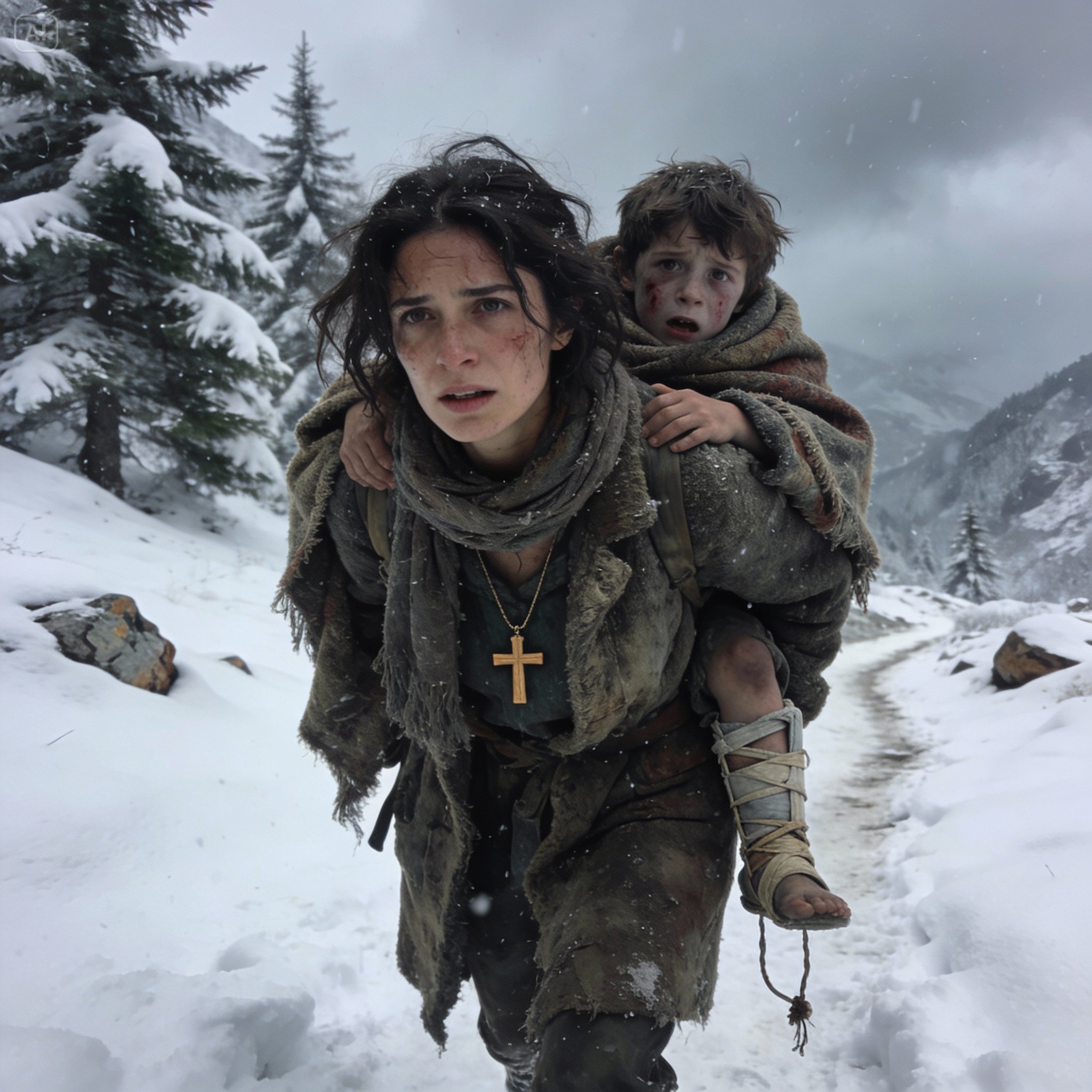
I walked through snow that reached almost to my knees, in the middle of a blizzard of the kind that makes shepherds pray to the Virgin Mary and pen up their livestock. I carried a backpack with supplies for three days—a little cheese, stale bread, a canteen, and matches—a coat that was more hope than wool, and a burning resentment in my chest that, unfortunately, did nothing to warm my feet.
“This is fine, Maite,” I murmured to myself, watching my breath turn into a white cloud in the frigid air. “This is perfectly fine. It’s just a winter walk. It builds character. Very healthy. Fresh mountain air.”
The wind howled in response, lashing my face with a flurry of slushy snow that felt like needles. It seemed as if the mountain were judging me. I had been walking for perhaps six hours, trying to find my way toward the territory of Valle de la Esperanza. It was said that there, on the other side of the pass, the people were different. “Progressives,” they were called with disdain in my old clan. They said they accepted outsiders, the broken, those who had nowhere else to go.
I was betting my entire life on some old wives’ tales, which was either incredibly brave or stupidly suicidal. Probably the latter. But there was no turning back now.
The storm was worsening by the minute. Visibility had dropped to barely three meters. My fingers, inside my threadbare wool gloves, were beginning to lose feeling. I needed to find shelter—a cave, a rocky outcrop, anything—or I would wake up as an ice statue, a monument to stubbornness.
That’s when I heard it.
A sound that made me freeze in the middle of the pass, with my boot sunk into the virgin snow.
A cry.
It wasn’t the howl of the wind, nor the creaking of pine branches giving way under the weight of the snow. It was a human cry. Sharp, desperate, broken. Definitely not something that should be heard in this white hell.
“This has to be a joke,” I said to the universe, staring at the leaden gray sky. “Seriously? Now?”
The universe, as usual, remained silent.
I adjusted my scarf and followed the sound, pushing aside frozen branches and sinking into the snow until I found it.
There it was.
A child. A little boy, for God’s sake. He couldn’t have been more than four or five years old. He was huddled against the trunk of a fallen pine tree, trying to curl up into a ball to keep warm. He was tiny; you could see the bones of his face beneath his pale skin, and he was trembling so violently that his teeth were chattering like castanets.
But what stopped my heart, what made my stomach drop, was seeing her leg.
His left leg was twisted at an unnatural angle, a clear birth defect, a clubfoot that had never been treated by a doctor. That child couldn’t have walked far with that leg. He couldn’t run. He could barely crawl.
And he was alone. In the middle of a blizzard in the mountains.
“Hey…” I said softly, approaching slowly so as not to frighten him, like you do with scared foals. “Hey, honey, what are you doing out here?”
The boy’s head jerked up. His eyes were huge, dark, and filled with utter terror. His lips were purple. He tried to crawl backward, away from me, and let out a cry of pain when his bad leg struck a root.
“Okay, okay, calm down,” I said, falling to my knees in the snow, not caring that the cold instantly soaked through my pants. “I’m not going to hurt you. I’m Maite. What’s your name?”
The boy stared at me, trembling uncontrollably. Up close, I could see he’d been crying for a long time. His face was red and chapped from the cold and tears. His small hands were blue.
—Fran —he managed to say between the chattering of his teeth.
“Fran… Francisco. It’s a strong name, a good name.” I took off my backpack and pulled out my emergency blanket, that silver sheet that looked like aluminum foil. It wasn’t much, but it kept me warm. “Can I put this over you? You’re freezing.”
Fran nodded slightly. Carefully, I wrapped his small body in the thermal blanket. He was so light… Too small to be here.
“Where are your people, Fran? Where are your parents?” I asked, looking around, hoping to see someone desperately searching for him.
“I have no one,” her voice was a broken thread. “I have no parents. They abandoned me.”
My blood ran cold, and it had nothing to do with the outside temperature.
—Did they… did they leave you? Here? In the storm?
Fran nodded miserably, his chin pressed to his chest.
“They said I was a lot of trouble. They said my leg makes me useless. They said no clan would want me and I’d only hold everyone back”—her voice broke into a dry sob—”They said… they said it was kinder to leave me here, where I wouldn’t suffer for long.”
Rabies.
It was an incandescent, pure, white blaze that flooded my chest. Someone, some monster, had looked at this defenseless child, this small human being with a disability, and decided he was better off dead. They had brought him to the mountain, in the middle of a snow alert, and abandoned him like someone discarding an old dog.
“Well, they were wrong,” I said fiercely, clenching my fists. “They were wrong about everything, Fran. You’re not useless. Your leg doesn’t define your worth. And I swear, on my grandmother’s memory, you’re not going to freeze to death today. Do you hear me?”
Fran looked at me with those big, incredulous eyes.
—Aren’t you… aren’t you going to let me?
—Not a chance.
My mind was already racing. The boy was too weak and injured to walk. The storm was getting worse. We were maybe four or five kilometers from the edge of Hope Valley, but in this weather, that was hours of walking. We wouldn’t get there before nightfall if we kept up with his pace.
I would have to charge it.
“Okay, Fran. Here’s the plan,” I said, trying to sound confident. “I’m going to give you a piggyback ride to the nearest town. It’ll be uncomfortable, it’ll be cold, but I promise I won’t let go until we’re somewhere with a fireplace and hot soup. Deal?”
“Are you going to give me a ride?” Fran’s voice was filled with disbelief. “But… I weigh a lot. Everyone says I weigh a lot, that I’m a burden.”
“They’re all idiots,” I said, shifting my backpack to my chest to free my back. “Get in and hold on tight.”
Fran hesitated for a second, then clumsily climbed onto my back. He wrapped his good leg around my waist and let his bad one dangle. He weighed less than I expected, which broke my heart again; he was clearly malnourished.
I stood up slowly, adjusting my weight. My legs protested immediately. The snow was soft and deep. This was going to be brutal.
“Okay,” I said, starting to walk. “Let’s find that warmth. Can you handle it up there?”
“Yes,” Fran whispered against my shoulder, burying her face in my neck. “Maite…”
-That?
—Thank you for not leaving me.
I got a lump in my throat.
—Thank me when we’re not suffering from hypothermia. Now, hold on tight and try to think about warm things. Churros with chocolate. A wood-burning stove. The August sun.
The storm seemed determined to kill us both. The wind whipped against my face, stinging my eyes and making it nearly impossible to see beyond my own nose. My calves burned with the exertion; the extra weight made every step a conscious battle against gravity and the snow. The cold seeped through my cheap coat, settling into my bones.
But I kept walking. Because the alternative was unthinkable.
“Tell me about yourself, Fran,” I said, partly to keep him awake and partly to distract myself from the fact that I could no longer feel my toes. “What do you like? What makes you happy?”
“I like stories,” Fran said, her voice muffled by my scarf. “Stories about knights and adventures. My mother used to tell me stories before…” Her voice trailed off.
“Before I leave you to die in the snow”—my voice came out sharper than I intended—”I’m sorry, sweetheart. That was harsh. I’m just really angry with your parents right now.”
—Okay. I’m angry too.
There was a silence, broken only by the crunch of the snow.
“Are you really taking me to a new town?” he asked. “Won’t they kick me out too?”
—Not if I have something to say about it.
—But what if they do? What if nobody wants a child with a bad leg?
“Then we’ll keep walking until we find someone who doesn’t have a heart of stone,” I adjusted my grip when I felt Fran slip a little. “Besides, your leg doesn’t make you undesirable. It makes you different. And being different can be a good thing.”
—That’s not what my clan said.
“Your clan was wrong, and besides, they were bad people. Seriously, what kind of people abandon a child?”
—Those who think that weak wolves don’t deserve to eat—Fran said matter-of-factly, as if reciting a lesson she had heard a thousand times.
I felt like screaming. Or turning around, tracking down Fran’s old clan, and giving them a detailed lesson in basic human decency—preferably with a big stick. But I settled for just moving forward, one agonizing step after another.
Two hours later, my legs were screaming in pain, and Fran had become worryingly silent. The storm had intensified, turning the world into a white and gray whirlwind.
—Fran, are you still with me?
—Mmm… —it was barely a sound.
—Hey, no falling asleep. I need you to be awake. Tell me more of those stories. Which one is your favorite?
“The one about the shepherd who tricked the wolf…” Fran’s voice was slurred, thick with cold and exhaustion. “But I’m… so sleepy…”
Panic ran down my spine like a chill. Hypothermia. We needed shelter now.
Through the curtain of snow, I made out a darker shadow. It could be a rock formation, a cave, or perhaps a hallucination because my brain was freezing. There was only one way to find out.
I changed direction, pushing into the shade with the last of my strength. My legs gave way twice, sending us both tumbling into the snow. Each time, I forced myself to my feet, dusted Fran off, set him back on his feet, and kept going.
The shadow turned out to be a rocky overhang, a kind of natural shelter beneath a large granite crag. It wasn’t a cave per se, but the overhang blocked the worst of the wind, and the snow hadn’t reached the bottom.
I staggered under the bed and carefully lowered Fran onto the dry ground. He was pale, too pale. His lips were a grayish blue, and he was barely trembling anymore, which was a terrible sign.
“Okay, okay, we’re fine,” I said, more to myself than to him. My hands were shaking so much I could barely open my backpack.
I took out the matches. Thank God, I had gathered some dry tinder before leaving, and in the corner of the shelter there were some old, dry branches from a dead bush. I managed to light a small fire. The flame caught, small and flickering, but alive.
I wrapped Fran in everything I had. I took off my own coat and put it on top of the thermal blanket. I was left only in my thick wool sweater, shivering violently, but I hugged the child to my chest, using my own body to keep him warm.
—Stay with me, Fran. Come on, champ. Don’t give up now.
Fran’s eyes blinked.
“You’re cold,” he murmured. “You gave me your coat.”
“I’m fine. Northern women are like stoves, didn’t you know that?” I lied shamelessly. I was freezing.
“You’re a very bad liar,” he whispered, but snuggled closer to my warmth.
“Yes, well, it’s one of my many flaws, along with being stubborn and having opinions about everything,” I rubbed Fran’s arms, trying to get her circulation going. “But at least I’m consistent.”
—Thank you… —Fran whispered—. For not leaving me… even though I’m broken.
“You’re not broken, Fran. You’re just made differently. There’s nothing wrong with you that needs fixing. Your leg works differently, that’s all. That doesn’t make you any less valuable. It just makes you you.”
—My father didn’t think that.
—Your father was an idiot. We’ve already made that clear.
I fed the fire with another branch.
—We’re going to find a better place. A place where they understand that a person’s worth isn’t measured by how fast they run or how hard they hit.
—What if we don’t find him? What if everyone rejects me like they did?
—Then we’ll make our own pack. A pack of two. The most stubborn misfits in the mountains. We’ll be legend.
Fran let out a weak giggle that ended in a cough. The sound tightened my chest with worry. We couldn’t stay there much longer. As soon as the storm subsided, we had to move.
“Rest a little,” I said, cradling him. “I’ll keep watch. When it gets light, we’ll go to the Valley of Hope. They’re good people. They’ll help us.”
-Promise?
—I promise to do everything in my power to get us to a safe place.
—How is that?
“Enough,” he murmured, closing his eyes.
I sat there in the cold, hugging a child I’d only known for a few hours, and wondered how my life had become a series of increasingly questionable decisions. But looking at Fran’s face, now peaceful in sleep, I couldn’t regret it. There were some things worth freezing for.
The storm broke just before dawn. I’d managed maybe an hour of sleep, waking every time Fran moved or the fire needed tending. My whole body ached, my fingers were stiff, and I was pretty sure I’d never get warm again. But we were alive. That mattered.
—Fran. Hey, Fran. Wake up.
I shook him gently. He slowly opened his eyes.
—I dreamed you were real.
—Surprise! I’m real, and we’re still in a giant freezer. But the good news is, it’s stopped snowing. So now we just have to wade through waist-deep snow for several kilometers. Pure fun.
Fran let out a weak giggle. I rationed some of the dried meat I had brought—a piece of hard chorizo—and we shared a few sips of water from my canteen.
“Ready?” I asked, bending down to let him climb in.
“You don’t have to carry me the whole way,” Fran said quietly. “I can try walking a little.”
—With a leg like that and a meter of snow… I don’t think so. Besides, I’ve already brought you this far. I’ve already committed to this madness.
Fran went upstairs and I got up with a groan that I tried to disguise as a stretch.
The landscape in daylight was both breathtaking and terrifying. Endless white, broken only by the dark pines. I began walking northeast, guided by the pale sun. The territory of the Valley of Hope must be near.
“What’s that place like?” Fran asked after a while.
—Honestly, I’ve never been. But they say they don’t follow the old rules of the Cortijo there. They say they value people for who they are, not for their blood.
—It sounds made up.
—Maybe. I’m literally betting our lives on a piece of gossip.
We walked in silence for a long time. My legs were burning. My back was screaming. But then I saw the markers: piles of stones stacked in a specific way and markings on the trees.
“We’ve arrived,” I said, feeling a wave of relief. “This is Valley territory.”
We crossed the invisible line. We had barely advanced a hundred meters when they found us.
Four men emerged from the trees. They were armed with hunting rifles and had dogs with them. They weren’t fantastical wolves; they were country men, tough and weathered.
“Stop right there!” shouted one, a gray-haired man with a scar on his cheek. “You’re trespassing on private property.”
“I’m seeking asylum!” I shouted, raising a hand. “I’m Maite, banished from Cortijo de Hierro. This is Fran. We’re wounded and freezing.”
The man with the scar lowered his weapon slightly, looking at Fran, who was peeking over my shoulder, small and scared.
—Exiled?
—Yes. And he… abandoned.
The man looked at Fran’s crooked leg, which was visibly dangling. His expression hardened, but not towards us.
—Abandoned? In the storm?
—Yes. Because his leg made him “useless”.
I saw a flash of fury in the man’s eyes.
—I’m Marcos, the foreman. Come with me. Doña Elvira will want to see this.
My legs almost gave way with relief.
-Thank you.
“Don’t thank me yet. The lady is tough. If your story doesn’t add up, we’ll send you packing.”
—Our story is sadly true, believe me.
They took us to the village. The Valley of San Gabriel (or of Hope, as I called it) was a collection of stone houses with slate roofs, smoke rising from the chimneys. It seemed warm. It smelled of woodsmoke and stew.
People stopped to stare at the disheveled woman carrying a disabled child. I stared back. I was too tired to feel ashamed.
They took us to the “Big House,” a stately mansion in the center. Doña Elvira was waiting for us in her office. She was a woman of about fifty, with black hair streaked with silver and a presence that made you straighten your back.
“Refugees, Marcos?” he asked without looking up from his papers.
—A woman and a child, ma’am. Troubling stories.
—Sit down. You look like you’re about to faint.
I’ve never been so grateful for an order. I left Fran in one chair and collapsed into another.
I told them everything. My exile, finding Fran, the walk. I didn’t leave anything out. Not even my theft of medicine.
When I finished, Doña Elvira remained silent for a long time.
—You carried it twelve kilometers in a blizzard.
—I got a little lost, so there might have been more.
“Why? You were already an outcast. Adding a disabled child to your burden only made your survival more difficult. Why didn’t you give it up?”
The question made me want to overturn his solid oak desk.
“Because he’s a child. Because no child deserves to die alone from the cold. Because his leg doesn’t make him disposable”—I leaned forward—”And because I’ve spent my life being rejected for not being ‘good enough,’ and I wasn’t going to do the same to him.”
Doña Elvira’s expression changed. It softened.
—Fran —she said softly—. Is what he says true?
Fran, who had been silent, spoke in a small but clear voice.
—My parents said I was a burden. That I would never amount to anything. They took me to the woods and left me there.
Doña Elvira’s jaw tightened.
—What clan did you come from?
—From the ones at Death Peak.
—I know those people. They’re barbarians.
Doña Elvira got up and looked out the window.
“This is what’s going to happen, Fran. You’re staying here. Permanently. You’re part of the Valley now. We have doctors, good doctors. They can’t ‘fix’ your leg to make it new, but they can help you walk better. You’ll go to school. You’ll be treated like any other child.”
Fran’s eyes widened in shock.
—Really? Even with my leg?
—Especially with your leg. We don’t judge people by how they run here.
Fran burst into tears. Happy tears. I hugged him tightly and looked over his head at Doña Elvira.
—If he’s lying to you, I swear I’ll burn this town down.
“I don’t lie to children,” she said, looking at me. “As for you, Maite… You carried a child twelve kilometers to save him. You had nothing to gain and everything to lose. That speaks volumes about your character.”
—I did it because it was the right thing to do.
—I know. That’s why I’m offering you a place to stay too. Full membership in the community if you want it.
My brain stopped.
-That?
—You heard me. You’re exactly the kind of person we value here. Brave, stubborn, and willing to fight for the weak. Even if you do have a bit of a loose tongue.
—Was that in Marcos’ report?
—It’s obvious. What do you say, Maite? Do you want to join a family that deserves you?
I looked at Fran, who was crying and smiling at the same time. I thought about the Iron Farmhouse.
—Yes—I said—. We’re staying. The two of us. Together.
“Together,” Fran repeated, grabbing my hand.
“Good,” Doña Elvira smiled. “Marcos will take you to your rooms. You need food, warmth, and twelve hours of sleep. We’ll take care of the paperwork.”
As we were leaving, she called me.
—Maite. What you did… most people wouldn’t have done it. Thank you for bringing him home.
I got a lump in my throat.
—Thank you for being a home worthy of him.
PART 2: THE WARMTH OF HOME AND THE FIRST SHADOWS
The rooms Marcos assigned us were better than anywhere I’d ever lived. We had a small sitting room with a fireplace, two clean beds, and, miracle of miracles, a bathroom with hot water.
“The doctor will be here in an hour,” Marcos said. “The food will arrive soon. Try not to set anything on fire.”
—Why do you all think I’m an arsonist?
“You have that energy,” he said very seriously, and left.
Fran was standing in the middle of the room, lost.
—Is this ours?
-Apparently.
I lit the fireplace. Fran remained motionless.
“Hey,” I said gently. “What’s wrong?”
—What if they change their minds? What if they decide I’m too much work?
—They won’t.
—Everyone changes their mind about me.
“Not me.” I crouched down to his level. “Look at me, Fran. I carried you halfway up the mountain. Do you think I’m going to give up now that we have heating? We’re here. We’re safe. And Doña Elvira doesn’t seem like the type to break promises. Besides, they’d have to get through me first.”
That brought a little smile to his face.
The food arrived. Thick Galician broth, rustic bread, and something that looked like a pastry. We ate like there was no tomorrow. It was delicious.
The doctor arrived, a woman named Clara with soft hands. She examined Fran.
“It’s a congenital condition,” he said. “Severe clubfoot. Never treated. With a brace and therapy, you could greatly improve your mobility, Fran. And reduce the pain.”
“Could I walk better?” he asked.
-Far better.
That night, Fran fell asleep on the sofa, exhausted. I covered him with every blanket I could find. I sat on the floor and cried for a minute, just to let it all out. We had survived.
The following days were a whirlwind. Fran had a leg brace made at the village workshop. He started therapy. I began working at the clinic with Clara, since my history of “stealing medicine” demonstrated an interest in healthcare. It turned out I was good at it.
But not everyone was happy.
Three weeks later, I was returning with Fran from her therapy session when a group of teenagers blocked our path. There were four of them, led by a guy named Damian, the son of one of the wealthy foremen.
—Look, there goes the cripple— said Damian, loud enough for Fran to hear. —The one Doña lets stay out of pity.
“It looks like a waste of food,” said another.
I saw red.
-Sorry?
Damian smiled smugly.
—I’m just telling the truth. The kid can barely walk. What’s he going to contribute to the town?
“More than you, who only contributes hot air and stupidity,” I said, stepping in front of Fran. “Do you have anything else to say, or can we leave?”
—You are the outcast— said Damian. —The thief.
—I was fired for having compassion, something you lack.
—Compassion does not protect the people. Strength does. And you are weak.
“Funny, because I carried this kid twelve kilometers through the snow while you were probably at home warm and cozy eating buns.” I smiled. “Tell me more about strength, kid.”
Damian turned red. He took an aggressive step toward me.
—Don’t talk to me like that, maid.
“I’m a mother protecting her son. That’s above your rank, your name, and your stupidity.” I lowered my voice. “Touch a hair on his head and I swear you’ll regret it.”
For a moment, I thought he was going to hit me. But then Marcos appeared.
—Is there a problem here?
Damian and his friends turned pale.
—Nothing, Marcos. We were just talking.
—It sounded like harassment. And harassing a disabled child is a serious offense here. Get out.
They left, but Damian gave me a look of pure hatred.
“Are you okay?” Marcos asked.
“Fine. Furious, but fine.” I looked at Fran. “Are you okay, sweetie?”
“Why do you hate me?” her voice was small. “I haven’t done anything to you.”
“They don’t hate you,” Marcos said, crouching down. “They hate that your existence challenges what they’ve been taught. Some believe that only physical strength matters. You prove them wrong simply by being alive, and that scares them. It’s not your fault. It’s because they’re idiots.”
Fran nodded, but I could see that she didn’t quite believe it.
That night, while Fran was sleeping, I spoke with Clara at the clinic.
“Damián and his group have always been trouble,” she said. “They follow the ‘old ways.’ They think the weak are superfluous. Doña Elvira is trying to change that, but there’s resistance.”
—I’m not going to let them hurt him.
—I know. That’s what worries me. If you get into a physical fight, you could have legal problems. Be careful, Maite.
—I’ll be careful. But if they touch Fran, legality will be the least of my worries.
PART 3: ROOTS IN STONE AND THE BLOOD SIGNATURE
Spring arrived in the Valley of Hope not with the delicate beauty of postcards, but with the force of the thaw. Streams roared down from the peaks, mud clogged the cobblestone paths, and the air smelled of damp earth, cow dung, and wild thyme. For Fran and me, that spring brought a routine that, for the first time in my life, didn’t feel like a burden, but a gift.
However, peace is a skittish animal in a small town.
Despite Doña Elvira’s protection and the foreman Marcos’s kindness, we were the “outcasts.” I was the single woman who had arrived with nothing but the clothes on her back; Fran was the boy who shuffled along with an iron brace that creaked as he moved. The metallic squeak of his orthosis became the soundtrack of our lives, a sound that for me meant hope, but for others, like Damián and his gang of privileged pups, was the signal for cruelty.
The incident that changed everything happened two months after our arrival, during the preparations for the San Isidro pilgrimage.
The whole village was immersed in the festivities. The women were kneading doughnuts in the communal bakery, the men were preparing the carts, and the children… the children were playing in the threshing floor, a clearing of tall grass behind the Romanesque church.
I was at the clinic helping Clara inventory some boxes of gauze when I heard the screams. They weren’t playful screams. They were those high-pitched, cruel screams children make when they sense weakness, like wolf cubs cornering a hare.
“Maite!” Clara’s voice pulled me out of my concentration.
I didn’t need her to say anything more. My mother’s instinct, the kind that comes not from blood but from fear, made me drop the box and run. My boots pounded on the cobblestones of the main street as my heart pounded against my ribs.
Upon arriving at the threshing floor, the scene chilled my blood more than that winter blizzard.
Fran was lying in the mud. His brace had come loose from one of the straps and hung grotesquely. He was covered in mud from head to toe, trying to get up, but every time he put his hands down, someone kicked him in the rear to knock him down again.
There were four of them. Damian, the son of the local landowner, led the group. He was fourteen years old, tall, strong, and possessed that stupid wickedness of someone who had never heard the word “no.”
“Come on, cripple!” Damian shouted, laughing as his friends joined in. “If you want to go to the pilgrimage, you have to learn to crawl better. That’s how your kind get around, isn’t it? Like worms.”
“Leave me alone!” Fran’s voice was a choked sob. “I’m not a worm!”
—Of course you are. Your foster mother picked you up from the trash, didn’t she? That’s what you are. Trash.
Damian raised his foot, ready to step on Fran’s hand, which was looking for his fallen crutch.
I didn’t think. I didn’t reason. The world became a red tunnel.
I crossed the distance between us in three strides and lunged at Damian with the fury of a mother bear defending her cub. I didn’t use words. I grabbed him by the collar of his designer shirt and threw him backward with a force I didn’t know he possessed. The boy, surprised, stumbled and fell backward into a puddle of dirty water.
The silence that followed was absolute. Damian’s friends backed away, pale. Damian looked up at me from the ground, his eyes wide, gasping like a fish out of water.
“Play it again,” I said, my voice so low and guttural it didn’t sound like my own. “Dare to play it one more time, you spoiled brat, and I swear on my life that no name or money will save you from me.”
“You… you’re crazy,” Damian stammered, trying to crawl back. “My father will find out about this! You’re a savage! A wild animal!”
I turned to Fran. He was trembling, covered in mud, his eyes filled with tears and shame. I bent down, ignoring the group of idiots, and lifted him into my arms, not caring that I was getting my nurse’s uniform dirty.
“It’s over,” I whispered in his ear, pressing him to my chest. “It’s over, my love. Let’s go home.”
“I’m sorry, Maite,” he sobbed against my neck. “I’m sorry, I’m weak, I couldn’t defend myself…”
—You don’t have to apologize for the evil of others. Never.
I walked back to the village with my head held high, feeling the stares of the neighbors who had come out after hearing the commotion. I didn’t look down. Let them look. Let them see the “wild” woman and her son.
That same afternoon, as expected, we were summoned to the Big House.
Doña Elvira’s courtroom smelled of old wax and fine wood. Seated in a velvet armchair was Don Aurelio, Damián’s father, a man with a gray mustache and a face that looked like he’d just sucked on a lemon. Beside him, Damián, clean and with a victim’s expression, was rubbing his neck exaggeratedly.
“This is intolerable, Elvira,” Don Aurelio roared. “That woman assaulted my son! A physical attack on a minor! She’s a beast! I demand she be expelled from the Valley immediately. She and that cripple she brought with her. They’re a danger.”
I stood with my hands clasped in front of me so they wouldn’t see how they were trembling. Marcos, the foreman, stood beside me, silent, but I felt his presence as solid as a wall.
Doña Elvira looked at all of us over the top of her reading glasses.
“Maite,” he said calmly. “Is it true that you threw Damian to the ground?”
—Yes, ma’am.
“You see it! Confess!” shouted Aurelio.
“And why did you do it?” Elvira continued, ignoring the man.
“Because he was trampling Fran in the mud. Because he was calling him a worm and trash. Because he took his crutch and watched him crawl.” I looked up and met Don Aurelio’s gaze. “Your son, sir, is lucky I only pushed him. If it had been a dog attacking my son, I would have cracked his skull open with a rock. And Damian was behaving worse than a rabid dog.”
“How dare you…!” Aurelio stood up, red with anger.
“Sit down, Aurelio,” Doña Elvira’s voice cracked like a whip. The man sat down abruptly. “Marcos, do you have any witnesses?”
“Half a dozen, ma’am,” Marcos said in his deep voice. “The baker, the priest, and three day laborers saw everything. Damian and his friends harassed the boy for ten minutes before Maite arrived. They threw stones at him. They mocked his disability. It was… cruel, ma’am. Very cruel.”
Silence fell over the room. Aurelio looked at his son. Damián shrugged, unable to meet his father’s gaze.
“Harassment of a vulnerable minor,” Elvira said slowly. “That violates the fundamental laws of our community, Aurelio. Force is used to protect, not to humiliate. Your son has dishonored your family, not Maite.”
“It’s… it’s just kids being kids,” Aurelio stammered, losing breath.
“No. That’s bully behavior.” Elvira stood up. “Damián will be excluded from the San Isidro festivities and will spend the next month cleaning the communal stables under Marcos’s supervision. And if he goes near Fran again, the consequences will be yours, Aurelio.”
Aurelio grabbed his son by the arm and left the room cursing, but without daring to reply.
When the door closed, I collapsed into a chair. The adrenaline left me abruptly, leaving me dizzy.
“You’ve been good,” Marcos said, putting a hand on my shoulder.
“I was terrified,” I confessed. “I thought they were going to kick us out.”
“Never,” Elvira said, sitting back down. “But this raises a problem, Maite. Fran is vulnerable. You’re vulnerable because legally you’re not related to him. You’re his caregiver, but if something happens to you tomorrow, the state or any distant relative of that barbarian clan could claim him. Or worse, the social services system could take him to a shelter outside the Valley.”
The cold returned to my stomach.
—What can I do? He’s my son. In every way but blood.
“Then make it official,” Elvira said, taking a folder from her drawer. “I’ve prepared the paperwork. Full adoption. Legalize your situation with the district court and the Valley’s statutes. If you sign this, and if he agrees, he will be Francisco, with your surname. He will be your heir, and you will be his mother before God and before the law. No one will be able to touch him without going through you legally.”
I looked at the papers. The letters danced before my eyes, blurred by the tears I was holding back.
That night, after dinner, I sat with Fran in front of the fireplace. He was quiet, drawing intently in a notebook.
—Fran—I said, stoking the fire—. I need to talk to you about something important.
He looked up, frightened. The fear of abandonment never completely went away.
—Are we leaving? Is it because of Damian?
“No, honey. Quite the opposite.” I took a deep breath. “Doña Elvira has prepared some paperwork. She says that… well, if we want, I can adopt you. Legally. So that I can be your real mother, with all the paperwork. So that you can have my last name and no one can ever separate us.”
Fran dropped the pencil. He stood very still.
—A real mother? Like the ones in fairy tales?
“Better. Because I chose you. Mothers in fairy tales get the child they’re born with. I saw you in the snow, I saw you broken and scared, and I said, ‘That’s the one for me.’ But only if you want me to be. I know you had other parents and…”
Fran lunged at me before I could finish my sentence. She crashed into my chest so hard we almost fell backward. Her skinny arms wrapped around my neck, squeezing with desperate force.
“Yes,” she sobbed against my sweater. “Yes, yes, yes. I want you to be my mother. I don’t want the others. They threw me away. You carried me. You are my mother.”
We both wept there on the ground, in front of the crackling fire. There were no cameras, no audience, no grand speeches. Just a woman in exile and a broken child piecing himself back together to form something new, something indestructible.
We signed the papers three days later. It was a simple ceremony in Elvira’s office, with Marcos and Clara as witnesses. When the justice of the peace affixed the final seal, Fran looked at me and smiled. Not the shy smile from before, but a full, radiant smile, missing a baby tooth.
“Hi, Mom,” she said, tasting the word in her mouth.
“Hello, son,” I replied, and felt that, for the first time in 28 years, I had reached my destination.
PART 4: THE APPRENTICE AND THE GIRL WITH THE WITHERED ARM
Time in the mountains is strange; the days can be long and hard, but the years pass in a flash. Five years have flown by since that signing.
Fran was no longer the timid boy who hid behind my legs. He was ten years old now. His limp was still there, of course; his left leg would always be shorter and weaker, and he depended on his leg brace and, sometimes, a cane on rainy days when the dampness seeped into his bones. But he had grown. His eyes were bright and his curiosity insatiable.
I had thrived as a nurse in the Valley. Clara had taught me everything she knew about herbs, sutures, and childbirth. And Fran… Fran was always there.
While other children played football in the square, Fran sat in the back room of the clinic, grinding rosemary for ointments or reading old anatomy manuals that Clara treasured. He had a gift. It wasn’t just intelligence; it was empathy. He knew when a patient’s fear hurt more than the wound itself. He had “hands of a saint,” the old women of the village would say when he changed their ulcer dressings.
One November afternoon, when the wind began to smell of snow again, we had an argument.
—Mom, I want to leave regular school—Fran said, as we peeled potatoes for dinner.
“No way,” I replied without looking up. “You need to know math and language.”
—I already know math. And I can read better than the teacher. I want to be Clara’s apprentice full-time. I want to be a healer.
—Fran… it’s hard work. It’s sad. You see people suffering. And with your leg… standing for so many hours…
—You’re on your feet for so many hours.
—I am as strong as a mule.
“Me too,” he said, dropping the knife. “Mom, look at me. I can’t run after sheep. I can’t carry sacks of cement like Damian. I’m no good at what men do here. But my hands work. My mind works. Clara says I have talent. Why do you want to protect me from the only thing I’m good at?”
I was stunned. She was right. My fear that he would suffer, that he would burn out, that he would feel “less than,” was holding him back.
“Fine,” I sighed, putting down the potato. “I’ll talk to Clara. But you’ll still be going to school in the mornings. Deal closed.”
Fran smiled, that smile that lit up the dark kitchen.
—Deal, boss.
But the ultimate test of his vocation came two weeks later, in a way that painfully reminded us of our own past.
A Civil Guard patrol arrived at the clinic one stormy night. They were carrying something wrapped in a dirty blanket that smelled of wet dog and squalor.
“We found her on the old road near the port,” said the officer, a young man with a disgusted expression. “She was hitchhiking alone. She says she ran away from an orphanage in the city, but she doesn’t have any papers. She’s malnourished and… well, she has something on her arm.”
Clara wasn’t there. It was my turn.
“Leave her on the stretcher,” I ordered.
When I pulled back the blanket, I saw a little girl. She looked about six years old. Her hair was matted and infested with lice. Her eyes were wild and terrified, scanning the room for a way out. But what was most striking was her right arm. It hung limply at her side, withered and much thinner than her left. Brachial plexus palsy, probably from a difficult and poorly attended birth.
The girl, upon seeing my white uniform, began to scream and kick with animal fury.
—No! Don’t touch me! I don’t want to go! Leave me alone!
I tried to hold her to examine her, but she bit my hand. The Civil Guard officer made a move to intervene and restrain her by force.
“Stop!” a calm voice cut through the air.
Fran came out of the back room. He was leaning on his cane. He walked slowly, ignoring the chaos, until he was standing in front of the girl. She stopped screaming for a second, surprised to see another child there.
Fran didn’t look at her with pity. She looked at her with recognition.
“Hi,” he said. “My name is Fran. That guard is ugly, but he doesn’t bite. My mother, the one you’re trying to bite, is a great cook, even though she has a bad temper.”
The girl blinked, confused.
“What’s wrong with your leg?” she grumbled, pointing at Fran’s cane.
“I was born with my foot on backwards.” Fran shrugged and nodded at her arm. “And you? Is your arm asleep?”
“He’s dead,” she said defiantly. “He’s no good. They were going to send me to a special center for ‘defective’ people. That’s why I ran away.”
Fran moved closer. He rolled up his trousers and showed her the iron and leather device that held his calf.
—Look at this. It looks like armor, doesn’t it? I was defective too. They left me in the snow to be eaten by wolves. Really.
The girl’s eyes widened in shock. The hostility began to melt away, revealing the pure fear that lay beneath.
—And what happened?
“She,” Fran pointed at me, “carried me. She got me out of there. And now I’m learning how to heal people. Your arm isn’t dead, it’s just lazy. Clara, my teacher, knows how to give massages. And my mother knows how to make hot chocolate. Do you like chocolate?”
The girl nodded, very slowly.
“My name is Elena,” she whispered.
“Nice name,” Fran said. “Elena, welcome to the misfits’ club. We don’t send anyone to special centers here. We keep the weirdos.”
Fran extended his good hand. Elena hesitated, looked at her own useless arm, then looked at Fran. With her left hand, her good one, she took my son’s.
That night, while Elena slept sedated in the guest bed (after a bath, a haircut to get rid of lice, and three cups of hot chocolate), Fran sat with me in the kitchen. I was treating the bite on my hand.
“You did very well,” I told him, proud to the point of hurting.
“She’s just like us, Mom,” Fran said. “She has that look. The ‘I’m not needed in this world’ look.”
-I know.
“We can’t let social services take her, Mom. They’ll put her in the system. They’ll separate her from them. Nobody will want her with that arm and that temper.”
I sighed, feeling the weight of the years and the responsibility. But I also felt that old stubbornness, that flame that ignited in the blizzard five years ago.
—Are you asking me to adopt another wild child? Do you know how much it costs to raise one? Look at you, you know-it-all and smart aleck.
Fran smiled.
—It went well, didn’t it?
“It turned out perfectly,” I admitted, kissing her forehead. “I’ll talk to Doña Elvira tomorrow. Get the guest room ready. It seems the family is growing.”
Elena’s adoption was more difficult. She had deep traumas. She would scream at night, break things when she was frustrated because she couldn’t tie her shoes with one hand. But Fran had infinite patience. He taught her to use her teeth to help herself, to use adapted tools. He was her anchor. And I… I was the mother who never gave up, the one who set firm boundaries but held her tight when the storm passed.
PART 5: THE PERFECT STORM AND THE VALUE OF USELESSNESS
Another six years passed. The Valley had changed, and we with it.
Fran was sixteen. He was a slender young man with an intelligent gaze and measured movements. His limp was part of him, but it didn’t define him. He was Clara’s official apprentice, and the villagers were beginning to call him “the young healer.” Elena was eleven, a whirlwind of energy with short hair and a booming laugh. Her right arm was still weak, but she had developed astonishing dexterity with her left and used a special splint Fran had designed for her so she could grasp things.
But in the village, old grudges don’t die, they just hibernate. Damian, now a young man of twenty, was still the leader of the “tough guys.” He would taunt Fran as he passed by, calling him “doll nurse” or “half-man.” Fran never responded. He said that silence was the best answer to stupidity.
Until the winter of the Great Snow arrived.
It was worse than the one that brought us here. It started on a Tuesday and didn’t stop for four days. The snow covered the roofs, blocked the roads, and cut off the electricity. The Valley was cut off from the world.
On the third day, panic spread. A group of young men, led by Damian, had gone out to hunt wild boar before the storm worsened, ignoring the warnings of the elders. They hadn’t returned.
“They’re in the Wolf Ravine,” said Marcos, brushing himself off as he entered the clinic. “We heard gunshots, but the snow is too deep for the tractors. We can’t get up there.”
“They’ll die if we don’t get them out tonight,” Clara said, worried. “The temperatures are going to drop to fifteen below zero.”
“I’ll go,” Fran said. She was organizing first aid kits.
“You can’t go, boy,” Marcos said gruffly. “You can barely walk on level ground. In that snow… you’ll sink. We need strong men.”
“The strong men are either trapped or scared,” Fran replied calmly. “I know the ravine. I’ve been there for arnica and medicinal herbs a hundred times. I know where the caves are. And I know how to move around without triggering avalanches. Besides…” Fran pointed to some modified snowshoes he had in the corner. “I’ve adapted these for my device. I can do it.”
“I’m going with you,” I said immediately, putting on my old coat, the same one that saved us years ago.
—And me —said Elena, adjusting her splint.
“You stay here to look after the fire and the clinic, Elena,” Fran ordered. “Mom’s coming. Marcos, we need ropes and sleds.”
The climb was hell. The snow lashed at us like whips. Fran, however, moved with a frightening determination. His stride was uneven, arrhythmic, but constant. He knew the mountain better than anyone because he had spent years studying it, not to conquer it like Damián, but to understand it.
We found them on a rocky ledge, halfway up the hillside. They were in a desperate situation. Damian had slipped and fallen about ten meters. He was unconscious, with a broken leg—a nasty, open fracture—and bleeding profusely. His friends, those “tough” and arrogant boys, were paralyzed with panic, crying, unable to do anything, and showing signs of hypothermia.
When they saw us appear through the blizzard, they didn’t see the “crippled man” or the “maid.” They saw angels.
“Fran!” shouted one of Damian’s friends. “Help us! He’s dying!”
Fran didn’t waste a second. She dropped down next to Damian. Her hands, those hands that had ground herbs and comforted children, moved with surgical precision.
—Mom, give me the tourniquet. You, hold his head. Don’t move his neck.
Fran cleaned the wound, reduced the fracture with a crack that made my stomach churn but saved Damian’s leg, and splinted the limb using branches and bandages.
“We have to move him,” Fran said, looking up at the dark sky. “He won’t survive here.”
“It’s too heavy,” one of the friends whined. “We can’t carry it.”
“We’re not going to carry him on our shoulders,” Fran said. “We’re going to use the sled. And you guys are going to pull it. I’ll guide the descent to avoid the crevasses. Mom, you keep an eye on his vital signs.”
The descent was a slow nightmare. Fran was in the lead, limping, planting his trekking pole to test the terrain, shouting orders to the stronger guys who now obeyed the “cripple” without question. Fran was the alpha on that mountain. Not because of his muscles, but because of his knowledge, his calmness, his unbreakable spirit.
We arrived in the village at dawn. Half the village was waiting with torches. When they saw the procession appear, there was a shout of relief.
They pulled Damian from the sled and rushed him to the warm clinic. Don Aurelio, Damian’s father, was there, pale as wax. He saw his son alive, in a splint, breathing. Then he saw Fran.
Fran was exhausted. He leaned heavily on me, trembling with fatigue, his bad leg dragging along the ground. He was covered in snow, blood, and sweat.
Don Aurelio approached. The man who had demanded our expulsion, who had called my son trash. He took off his hat.
“You…” Aurelio’s voice trembled. “You brought him.”
“He was hurt,” Fran said simply, without resentment. “Anyone would have done it.”
“No,” interjected one of Damian’s friends, who was drinking hot broth. “We didn’t know what to do. We would have died there. Fran took charge. He saved him. He saved us all.”
Aurelio looked at Fran’s crooked leg, then at his eyes. And for the first time, he saw the man, not the defect.
“Thank you,” Aurelio said, his voice breaking. “Thank you, Francisco. You owe my family a debt of honor. Anything you need.”
Fran smiled, tired.
“I just need to sleep, Don Aurelio. And maybe someone should tell Damian that when he wakes up, he owes me a box of chocolates.”
The town erupted in laughter and cheers. Pats on the back, hugs. Elena ran and hugged her brother and me.
“You are heroes,” she said.
That afternoon, when the storm passed and the sky turned violet and orange, I sat on the porch of our house with my two children. Fran had his leg up, resting. Elena was practicing knots with a rope using both her “weak” and her “good” hand.
“Mom,” Elena said suddenly. “Can I ask you something?”
-Always.
“Why did you save Fran that day? You didn’t know him. You could have left.”
I looked at Fran, who returned my gaze with that quiet love that we had built brick by brick.
—Because he needed help. Because no child deserves to die alone. Because I had spent my life hearing that I was worthless, that he was worthless… and I refused to accept that.
—Even if it was difficult? Even if you could have died?
“Even if I could have died,” I said, hugging them both. “There are things, Elena, worth freezing for. There are things worth everything for.”
—We’re lucky you found us—Fran said softly.
—I’m lucky you let me be your mother—I corrected. —You taught me that family isn’t blood. It’s choosing each other. Every day.
“We chose you,” Elena said.
“We chose you,” Fran repeated.
“Good,” I said, my voice thick with emotion, watching the sun set over the snow-capped mountains. “Because you’re trapped with me forever. No returns.”
“Forever sounds perfect,” Fran said.
“Forever sounds like home,” Elena added.
And sitting there, with my children, my chosen ones, my impossible and wonderful children, I thought that perhaps, at last, I had understood what strength meant.
It wasn’t about never falling. It wasn’t about being perfect. It wasn’t about having the biggest muscles or the loudest voice. It was about getting up when everything told you to stay down. It was about carrying others when they couldn’t walk. It was about choosing love when the world chose cruelty.
It was like looking at a broken child in the snow and deciding no, that he wasn’t going to die today.
It was like walking twelve kilometers through hell to find heaven.
Years later, when Fran was already the head healer of the Valley and teaching a new generation, he always told the story of how his mother carried him through the blizzard. And he always ended by saying:
—My mother taught me the most important lesson. That our worth isn’t in what our bodies can do, but in who we choose to be. Oh, and she also taught me to be incredibly stubborn and to threaten anyone who hurts the people you love. But that’s another story.
And from the back of the clinic, I smiled. Because my children, those whom the world wanted to throw away, were changing the world. One stubborn act of love at a time.
Just as I taught them. Just as someone should have taught me. But better late than never.
When everyone else turned their backs, when his own parents left him to die, a dispossessed woman saw a child who deserved to live. He had no resources, no status, no guarantees. He had only boundless determination and twelve kilometers of white hell ahead of him.
And sometimes, that’s enough. Sometimes, that’s everything.
END