“100,000 Euros at Stake in the Plaza Mayor: The Day a Barefoot Pawn Overthrew the King of Finance and Conquered the Heart of Spain”
PART I: THE BROKEN BOARD AND THE SILENT PROMISE
The heat in the Plaza Mayor isn’t just temperature; it’s a physical presence. It rises from the cobblestones worn smooth by centuries of footsteps, seeps into the soles of tourists’ shoes, and, in my case, burns the calloused skin of my bare feet. But at eleven years old, you learn to negotiate with pain. You learn which granite stones retain the August sun’s heat the most and which, under the shade of the arcades, offer a cool respite. My world shrinks to this quadrangle of history and stone, to the smell of fried calamari wafting from the nearby bars, and, above all, to the sixty-four squares of my own personal universe.
—Joaquín, son, have you eaten anything today?
Don Ernesto’s voice snapped me out of my trance. I looked up from my cardboard board. Don Ernesto, with his back curved like a question mark and his hands perpetually stained with newspaper ink, was my guardian angel on earth. His kiosk, a small green booth crammed with magazines and newspapers, was my headquarters.
“I’m not hungry, Don Ernesto,” I lied. My stomach growled at that precise moment, betraying my pride with a dull rumble that seemed to echo throughout the plaza. “Well, maybe a little.”
The old man sighed, a rasping sound coming from tired lungs, and pulled out half a tortilla sandwich wrapped in aluminum foil.
—Here. At my age, eggs make me feel heavy in the afternoon. Please don’t let it go to waste.
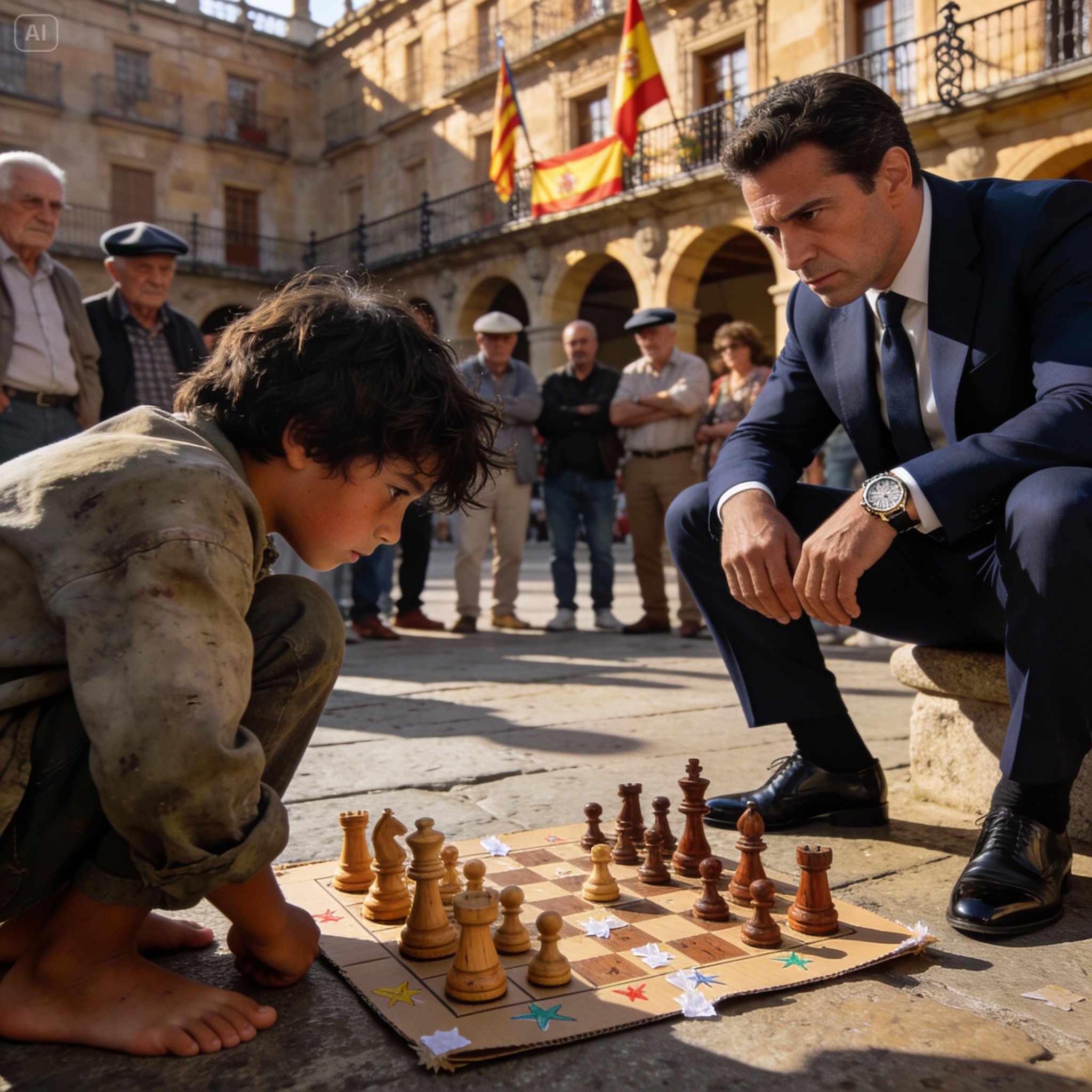
I knew it was a lie. I knew Don Ernesto was buying that extra sandwich thinking of me, but my grandfather had taught me that accepting charity with dignity is also an art. I took it with trembling hands. The first bite tasted heavenly, like egg, potato, and onion, like home, like something that had become scarce lately in my house, a windowless basement apartment where the dampness was eating away at the walls.
As I ate, my eyes returned to the pieces. They weren’t ordinary pieces. They were my inheritance. My grandfather, an old-fashioned carpenter, one of those who sanded wood until it felt like silk, had carved them during the last months of his life, when cancer had confined him to his bed. “Life is like chess, Joaquincito,” he would tell me in a weak voice. “If you lose your queen, don’t give up. If you’re cornered, find a way out. And remember, the pawn is the only piece that can’t move backward, it only moves forward, always forward, and if it reaches the end, it can become anything it wants.”
I was engrossed, moving my black horse—my favorite piece, with its intricate mane and noble bearing—when a shadow fell upon me. It wasn’t an ordinary shadow, but a dark, hurried presence.
“Get out of there, brat! Can’t you see you’re in the way?” The shout was like a whip crack.
Before I could react, I felt the impact. An expensive leather boot, polished to a mirror shine, slammed against the edge of my board. It was a gesture of contempt, swift and brutal. My board went flying. The pieces, my treasures, exploded in the air like wooden shrapnel.
Time seemed to stand still. I saw the king tumble tragically into a storm drain grate. I saw the queen crash into the stone base of a lamppost and split in two. And I saw my horse, my noble black horse, land violently beneath the sole of the man who kept walking.
“Watch out!” I shouted, but my voice caught in my throat.
The man, tall and impeccably dressed in his designer suit despite the thirty-degree heat in the shade, didn’t even turn around. He was impatiently adjusting his tie, talking into a wireless earpiece.
“This square is full of rats,” he spat into the air, not addressing anyone in particular, but clearly referring to me. “I don’t know why the city council doesn’t clean this area. There are shelters for these people.”
He walked away toward the more prestigious area of the square, where official cars and luxury taxis were allowed to park. I froze, my hands outstretched, staring into nothingness. The pain of seeing my world destroyed was sharper than hunger, sharper than the shame of my dirty feet.
I ran to pick up the fragments. My knees hit the hard ground.
“Oh, my boy!” Don Ernesto came out of his kiosk as fast as his rheumatic legs would allow. “What a wretch! What an animal!”
He helped me pick up the pieces. The queen was decapitated. Several pawns had deep notches. But when I picked up the black knight, I felt something break inside me. The head was severed from the body. The splintered wood revealed the fresh, white wound at the heart of the dark piece.
“I’m sorry, Don Ernesto,” I whispered, wiping away a furious tear with the back of my dirty hand, leaving a trail of mud on my cheek. “I should have moved. I was distracted.”
“It’s not your fault that monsters in suits exist, Joaquín,” the old man said, his voice trembling with anger. “That man… that guy is Maximiliano Torres. He’s on the papers I’m selling. A real estate shark. He thinks the city is his Monopoly board.”
We sat down on the stone bench. I took out a small pot of glue I kept in my pocket, an almost dried-out remnant that my father used to mend his work shoes.
“It can be fixed,” I said, more to convince myself than Don Ernesto.
“Everything can be fixed except death and a guilty conscience,” he declared.
We spent the next hour in silence, rebuilding my army. The glue held the horse’s head together, but the scar remained visible, an irregular line across the neck of the piece like a war collar. As I blew on the glue to dry it, I thought of my mother. She would be scrubbing stairwells right now in the Salamanca district, miles away, her hands red from bleach. And my father… my father would be trying not to scream in pain as he carried sacks of cement with his herniated disc, all to bring home a few euros that barely covered the rent.
I was here, playing. I felt guilty. I should be collecting cardboard, or helping out at a market. But chess… chess was the only thing that made me feel like I had control over my destiny. On the board, it didn’t matter that my shoes had fallen apart three months ago. On the board, I was the general, the strategist, the king.
“Do you think anyone will want to play today?” I asked, looking at my imaginary clock. It was almost six in the evening. The magic hour.
“There’s always someone who thinks they can beat a kid,” Don Ernesto winked. “Arrogance is your best ally, boy.”
We didn’t know how much truth there was in those words.
Two blocks away, inside the air-conditioned luxury black sedan, Maximiliano Torres was reading a message on his state-of-the-art cell phone. His brow was furrowed.
“Main Square. Stone bench in front of the kiosk. Find the boy. If you beat him, the port land is yours for the base price. If you lose, forget it. I want to see if your intellect is as big as your ego. – Master Linares.”
Linares. The eccentric owner of the land Maximiliano had been trying to buy for years to build his luxury hotel. A crazy old chess fanatic who refused to sell on “principle.” And now, this absurd challenge.
—Veronica? —he called to his assistant, who was frantically typing on a tablet next to him.
—Tell me, Mr. Torres.
“Are we sure this is it? A child? This seems like a bad joke. Linares is laughing at me.”
—Coach Linares was very specific. He said that the best player in the city is usually on this bench at this time.
Maximiliano let out a dry, joyless laugh.
“The best player? It’s probably some geeky college student or some old retiree. Let’s get this over with quickly. I have a dinner party at nine.”
The car glided silently into the pedestrian zone, ignoring the prohibition signs thanks to a municipal authorization card that money and influence could easily obtain.
I was arranging the repaired pieces on the cardboard when I saw the car. It was black, shiny, like a giant, menacing beetle. It stopped right in front of us. The driver opened the back door, and to my horror, I saw the same shiny leather shoes that had destroyed my game a few hours earlier roll out.
Maximiliano Torres got out of the car, adjusting his jacket. He looked around with disgust, as if the air in the plaza were polluted. His eyes fell on me, but there was no recognition. To him, I wasn’t the boy he had kicked; I was simply a new obstacle, or in this case, a means to an end.
“You,” he said, approaching. His voice was commanding, used to giving orders. “Do you play chess?”
I stood up slowly. Don Ernesto tensed up beside me.
“Yes, sir,” I replied. My voice came out firmer than I felt.
“Are you good?” he asked, looking me up and down with a mocking grin as he saw my dirty feet.
“I can defend myself,” I said, using the phrase my grandfather always used. “Never say you’re the best, Joaquín, prove it.”
Maximiliano turned to his assistant, a young woman with a chronically tired face.
“This is ridiculous. Linares is sending me to play against a beggar. But anyway, let’s get this over with.” He turned to me. “Sit down, kid. Let’s play.”
She sat on the bench opposite me, invading my space, her expensive cologne battling the afternoon’s ozone scent. She looked at my dashboard with genuine revulsion.
“What is this junk?” he said, pointing at the pieces patched together with glue. “How do you expect me to play with this? Veronica, get my dashboard from the car.”
“It’s not necessary,” I said quickly, protecting my horse with my hand. “This board will do. The squares are the same.”
—Don’t be insolent. If I’m going to waste my time, I’ll do it with class.
The assistant brought in a leather briefcase. From it, she took out a board made of ebony and maple, polished to perfection, and pieces that looked like ivory and obsidian. They were heavy, they shone, they were cold and perfect. She shoved my cardboard box aside without a second thought, almost knocking it to the floor again.
I felt the blood rush to my face. Not for myself, but for my grandfather. His work, his love, despised like garbage. But I swallowed the anger. I turned it into focus.
“Good,” said Maximiliano, placing his white pieces with quick, aggressive moves. “Let’s make this interesting. Linares wants me to beat you, but I don’t play for free. I need an incentive.”
He looked at me like a predator looks at a wounded rabbit.
—Do you have any money, kid?
Don Ernesto intervened, putting a hand on my shoulder.
—Mr. Torres, he’s just a child. Play for the joy of the game or leave.
Maximiliano laughed.
“Pleasure is for those without ambition, grandpa.” He looked at me intently. “Look, let’s make a deal. If I win—and I’m going to win—you leave this square. You and your friend the newsstand owner. You’ll stop spoiling the view for the tourists. I want this bench free.”
It was cruel. It was unnecessary. But I saw in his eyes that he meant it. He had the power to have the police throw us out for being “vagrants.”
“What if I win?” I asked. Silence fell around us. Several onlookers had stopped. Tourists, neighbors, people leaving work. The tension was palpable.
Maximiliano let out a laugh that echoed through the arcades.
“You? Beat me?” He wiped away a tear with laughter. “Kid, I was captain of the chess team at boarding school in Switzerland. But okay, let’s go along with your fantasy. If you beat me…” He looked at the crowd, seeking approval, seeking a show. “If you beat me, I’ll give you one hundred thousand euros.”
The crowd gasped. One hundred thousand euros. I heard the murmur spread like wildfire.
“One hundred… thousand?” I stammered. One hundred thousand euros wasn’t money; it was an abstraction. It was my father’s back surgery. It was no longer cleaning stairwells for my mother. It was a house with windows. It was shoes for life.
“Cash. Or a check. Whatever you prefer,” he said dismissively. “But since that’s not going to happen, don’t worry about the details. Deal?”
I looked at Don Ernesto. He was pale, shaking his head slightly. I knew it was a trap. I knew these men never lose, and if they do, they don’t pay. But then I looked at my bare feet. I looked at the broken horse on the bench. And I thought of my father coming home tonight, doubled over in pain.
—I accept —I said.
—Okay. I’ll start. King’s pawn to e4.
The game began.
Maximiliano played fast, aggressively. He used the Scotch Opening, trying to unsettle me from the start. He wanted to intimidate me, to make me make a mistake out of fear. His perfectly manicured hands moved the pieces, banging them against the board, making noise, marking his territory.
I played in silence. My world shut down. I no longer heard the traffic, nor the murmurs of people who were starting to take out their phones to record. “Look, it’s Torres.” “Is he betting with the kid?” “This is going on TikTok.”
I only saw lines of force. Diagonals. Weak squares.
At first, it seemed he had me under control. He captured two of my pawns quickly. He smiled at his assistant every time he captured one of my pieces.
—I told you, Veronica. A waste of time.
But I had a plan. My grandfather had taught me the Sicilian Defense, Dragon variation. It’s risky, sharp, dangerous. You have to let the enemy get overconfident, advance, think they have you cornered, while you prepare your counterattack from the shadows.
On move 18, he sacrificed his bishop to break my castling position.
“Check!” he exclaimed triumphantly. “You’re finished, kid. Surrender and save me ten minutes.”
People were holding their breath. Don Ernesto was squeezing my shoulder so hard it hurt.
I looked at the board. I took a deep breath. The smell of ozone and sweat filled my nostrils. I saw the move. It was there, hidden behind the smoke of his direct attacks. He was so obsessed with hunting down my king that he had left his rear unprotected.
I moved my horse. That black horse he had scorned on my cardboard chessboard, now embodied in his obsidian piece.
“I’m not giving up,” I said softly.
Maximiliano frowned. He captured my tower. He thought it was a beginner’s mistake.
—Poor deluded man.
But then, I moved my queen. A sacrifice. I placed her directly in front of their king.
“What are you doing?” He laughed. “You’ve made a mistake. You’ve handed it to them on a silver platter.”
My lady ate with her king.
And then, silence fell over the square like a granite slab. Because by moving his king to capture my queen, he had opened the diagonal. The diagonal controlled by my “sleeping” bishop. And the square I had to flee to was controlled by… my knight.
I lifted my horse. I felt it vibrate in my fingers. I gently placed it on f3.
—Checkmate—I whispered.
Maximiliano froze. His hand stopped halfway to reach his water glass. He looked at the chessboard. He blinked. He looked at it again. He searched for a way out. He searched for an empty square.
There weren’t any.
His king, the mighty white king, was trapped between his own pawns and my minor pieces. He had been defeated not by a superior force, but by his own arrogance in underestimating my defenses.
The crowd erupted. It wasn’t polite applause. It was shouts, whistles, cheers. “He’s beaten him!”, “The kid beat him!”, “Pay up, Torres, pay up!”
Maximiliano turned red. A violent red that rose from his neck to his ears. He stood up abruptly, knocking the chair back.
“That… that’s cheating,” he stammered. “You’ve distracted me. You’ve done something.”
“No, sir,” said Don Ernesto, taking a step forward, his chest puffed out with pride. “He played fair. We all saw it. You lost.”
Maximiliano looked around. He saw the phones recording. He saw the mocking, astonished faces. His ego, that inflated balloon that kept him floating above us, had just been punctured.
“Well, you got lucky,” he said contemptuously, starting to gather up his expensive pieces. “Enjoy your minute of fame.”
He gestured to Veronica to leave.
“And the money?” I asked. My voice trembled. I stood up, blocking his path. I was small, barely reaching his waist, but I felt gigantic. “You promised one hundred thousand euros.”
Maximiliano stopped. He looked at me with a coldness that chilled me to the bone. He leaned towards me, invading my personal space, and whispered so only I could hear:
“Do you really think I’m going to give a fortune to a starving wretch like you? It was just a figure of speech, stupid. Hyperbole. Learn your place.”
He straightened up and spoke loudly to the people.
—The bet was symbolic, of course. Child’s play. Here’s enough for an ice cream.
He took a fifty-euro note from his wallet and threw it at me. The note hovered in the air and fell to the ground next to my bare feet.
—Let’s go, Veronica.
“But he promised!” shouted a woman in the audience. “It’s on record!”
“You scoundrel!” shouted another.
But Maximiliano Torres was already walking toward his car, surrounded by his invisible bodyguards of money and power. He got into the vehicle, closed the door, and the car started, leaving us enveloped in a cloud of exhaust fumes.
I stood there, staring at the fifty-euro note on the ground. I felt tears sting my eyes. Not because of the lost money, but because of the humiliation. It had made me believe, for a second, that the world could be fair.
Don Ernesto hugged me. I felt his fragile bones against mine.
—Don’t cry, Joaquín. Don’t cry. You’ve won. You’re better than him.
“What’s the point of winning if the rules don’t matter?” I sobbed. “What’s the point of being good if they always have the power?”
I picked up my cardboard board. The patched-up horse seemed to be looking at me sadly. That night, the walk home was the longest of my life.
We lived in a basement illegally converted into a dwelling in the Lavapiés neighborhood. As soon as I walked in, the smell of dampness and lentil stew—our dinner for the last three days—hit me. My mother was sitting on the edge of the bed, massaging her swollen feet. My father was lying face down on the floor, the only position that relieved his back pain.
—Hello, son—my mother said, trying to smile, although tiredness pulled the corners of her lips downwards. —How was the plaza?
I couldn’t hold back. I told them everything. The broken board, the challenge, the game, the promise of one hundred thousand euros, the final betrayal. As I spoke, I saw my father’s eyes go from astonishment to fury and then to a painful resignation.
“Damn them,” my father muttered. “They play with us like we’re toys.”
“One hundred thousand euros…” my mother whispered, her gaze distant. “We could have…”
“Don’t think about that, Carmela,” my father interrupted. “That money never existed. It was just talk. They just wanted to humiliate the boy.”
“But I won, Dad,” I insisted, sitting down next to him on the floor. “I beat him in 24 moves. He didn’t see the checkmate.”
My father reached out and ruffled my hair.
—That’s what matters, son. That you’re worth more than their money. That you have a gift. Nobody can take that away from you.
We ate dinner in silence. Helplessness sat at the table with us, an uninvited fourth guest.
But while we slept—or tried to sleep—something was happening out there. In the digital ether, on the glowing screens of thousands of phones, the story was taking on a life of its own. The video of the departure, recorded by a passing film student, had been uploaded to Twitter and TikTok.
The headline was simple: “Billionaire scams child prodigy in the Plaza Mayor” .
And Spain, a country that forgives many things but never arrogance or abuse against the weak, began to burn.
The next morning, I was awakened by knocking on the door. It wasn’t the soft knocking of the neighbor asking for salt; it was urgent knocking.
My mother opened the door, startled, thinking it was the police or the landlord trying to kick us out. It was Don Ernesto, and with him were the owner of the mechanic’s shop, the lady from the fruit stand, and three neighborhood boys who were always on their cell phones.
“Turn on the TV!” shouted Don Ernesto, barging in almost without asking permission. “Turn on the news!”
We didn’t have a TV; it had broken down months ago.
“Look here,” said one of the boys, putting his mobile phone in our faces.
It was a national morning news program. The presenter, with a serious face, was speaking with an image in the background: my face focused on Maximiliano Torres.
“…viral outrage on social media. Businessman Maximiliano Torres has become public enemy number one after refusing to pay a €100,000 bet to an eleven-year-old boy he publicly challenged. The hashtag #PagaTorres is trending worldwide…”
I was speechless.
“World Cup?” I asked.
“Son, this is huge,” said Don Ernesto, laughing and crying at the same time. “They’ve found their company. People are canceling accounts, their partners are issuing statements distancing themselves. You’ve hit them where it hurts most: their image.”
—But… what now? —asked my mother, frightened by the magnitude of the mess.
“Now,” my father said, getting up from the floor with a groan of pain but with a new determination in his eyes, “we’re going to go see him.”
—To see him? —I asked.
—Yes. To his office. Not to beg. To demand that he keep his word. A man is his word, Joaquín. And you won.
“It’s dangerous, Armando,” my mother said. “He has security, lawyers…”
“We have something better,” the guy on the phone said, smiling. “We have the people. There’s a demonstration. Hundreds of people are gathering in front of Torre Torres right now. They want to see you, Joaquín. They want justice.”
I looked at my bare feet. I looked at my father, bent over but standing firm. I looked at my mother, who was nervously drying her hands on her apron but nodding slowly.
“I have to put on shoes,” I said, suddenly feeling embarrassed.
“No,” said Don Ernesto. “You’re going to go like this. You’re going to go exactly as you are. Let him see who he tried to step on. Let him see that dignity doesn’t need Italian soles.”
We went outside. And what I saw took my breath away. It wasn’t just us. The whole neighborhood was there. The woman who sold lottery tickets, the baker, the kids from the park. When they saw us come out, they started to applaud.
“Come on, champ!” someone shouted.
We walked towards the financial center. It was a strange procession. A barefoot boy with a chessboard under his arm, flanked by his parents and an elderly newsstand owner, followed by a tide of working people.
When we arrived at Torre Torres, a glass and steel skyscraper that seemed to pierce the Madrid sky, the plaza in front of the building was packed. There were television cameras, journalists, and hundreds, perhaps thousands, of people with banners.
“Checkmate to Greed ,” one said. “I’m Joaquín too ,” said another.
When they saw me, the crowd parted. A respectful, almost reverential, silence fell. I walked through the human corridor to the building’s revolving door. The security guards were nervous, talking on their radios, but they didn’t dare stop us. They knew that if they touched a single hair on my head, the crowd would erupt.
I stood in front of the glass. I looked up, towards the 40th floor, where I imagined he was.
“Mr. Torres,” I said, though I knew he couldn’t hear me. The cameras zoomed in. “I’ve come to finish the game.”
Upstairs in his panoramic office, Maximiliano Torres stared at the screens. He was pale. His phone kept ringing. His press officer was having an anxiety attack on the sofa.
“Sir, you have to bring it down,” said Veronica, his assistant, the only one who remained calm. “The stock has fallen 15% in two hours. American investors are threatening to pull out if you don’t ‘fix the public relations problem.’”
“Solve it?” Maximiliano ran his hand through his hair, disheveling it for the first time in years. “How? By giving them the money? That’s admitting defeat. That’s telling them they were right.”
“They were right, sir,” Veronica said gently. “You lost. And what’s worse, you lost your honor.”
Maximiliano turned around furiously.
-You too?
“I was there, sir. I saw how you treated the boy. I saw how you smashed his board. That boy… that boy has more class in his dirty pinky finger than we do in this entire building.”
Maximiliano remained silent. He looked out the window, at the small speck that was me, down below. He remembered the look on his own mother’s face, a woman who had scrubbed floors like mine, when he earned his first million. “Never forget where you come from, Max. Money is paper, people are gold . ”
She had forgotten. She had built an armor of euros and pride to forget the smell of bleach on her mother’s hands.
He took a check from his drawer. He wrote a number. His hand was trembling.
“Let’s go,” he said.
When the building doors opened, the crowd gasped. Maximilian stepped out. He wasn’t wearing a jacket. He had removed his tie. He looked smaller, more human.
He walked toward me. He stopped about six feet away. He looked at my bare feet. He looked at my parents, who were holding my shoulders. And then he did something no one expected.
He knelt down.
The great Maximiliano Torres, on the ground, at my height.
“Joaquín,” he said. His voice was amplified by the press microphones. “Yesterday I made a mistake. Not a chess mistake. A life mistake.”
He took out the check.
—Here you go. One hundred thousand euros. It’s yours. You earned it fairly.
He extended his hand. I didn’t take it.
“I don’t want your money if it’s to shut me up,” I said.
Maximiliano smiled sadly.
—This isn’t to silence you. It’s to apologize. And to ask you for something else.
-That?
—Give me a rematch. Not today. Whenever you want. But this time, I want you to teach me. I want you to show me how you saw that checkmate in three moves when all I saw was my own ego.
I looked at my father. He nodded, his eyes shining. I looked at Don Ernesto, who was smiling from ear to ear.
I took the check.
“I accept,” I said. “But on one condition.”
—Whichever one you want.
—He should fix up the park in my neighborhood. And put in chess tables. Stone tables, so they don’t blow away when someone kicks them.
Maximiliano lowered his head. I saw a tear, just one, fall onto the asphalt.
-Made.
The crowd erupted in cheers. But I no longer heard the noise. I only felt the weight of the paper in my hand, and I knew it wasn’t just paper. It was my father’s healed back. It was my mother’s resting hands. It was new shoes. But above all, it was the certainty that, sometimes, pawns can bring kings to their knees.
PART II: DESTINY’S MASTERPIECE
The camera flashes were blinding, like artificial lightning in the middle of a sunny Madrid morning. I held the check in my hand, a piece of paper that weighed less than a feather but carried the weight of a thousand lives like mine. Yet something was missing. Movie scripts say that when the hero receives the treasure, the story ends and the credits roll. But real life is more complicated. Maximiliano Torres was still there, kneeling, the knee of his thousand-euro trousers stained with dust, and I felt that the game wasn’t over yet. The final move was still to come.
The crowd started chanting my name, but I raised my hand. A small gesture I learned watching football referees on TV at the corner bar. Incredibly, three hundred people fell silent.
“Mr. Torres,” I said, and my voice sounded strange in my own ears, older, more husky. “You have paid your debt. But money is spent. My grandfather used to say that money is like water in your hands; it slips through your fingers if you don’t have a bowl to hold it in. And that bowl is respect.”
Maximiliano looked up. His eyes, once as cold as blue ice, were now red. He looked like a lost child trapped in the body of a corporate giant.
“What more can I do, Joaquín?” he asked, and for the first time, it didn’t sound like a demand, but like a genuine plea. “I’ve lost credibility with my partners, with the city… with myself.”
I looked at my mother. Carmela. The woman who had spent her youth scrubbing the floors that men like him walked on without a second thought. She was there, her coat patched and her hands clasped, weeping silently.
“This isn’t about me,” I said, pointing at my mother. “It’s about her. And my father. And everyone here. You said yesterday that people like us are superfluous. That we’re in the way.”
Maximiliano swallowed. He nodded, embarrassed.
—I said it. And I regret it every second since.
“Then prove it,” my mother interjected. Her voice trembled, but she stepped forward, standing beside me like a lioness protecting her cub. “We don’t want charity, Mr. Torres. We want opportunities. You have a huge company. You have hundreds of employees who are invisible to you.”
Maximiliano stood up slowly, dusting himself off. He turned to my mother, and for a moment, time seemed to stand still. The great tycoon and the cleaning lady.
“Madam… Carmela, isn’t it?” he said, recalling the name he’d probably heard on the news. “You’re right. My mother… my mother’s name was Elena. She cleaned offices for thirty years to pay for my boarding school in Switzerland. When I became successful, I was ashamed of her. I hid her away. I stopped taking her to formal dinners because her hands were rough and she didn’t know how to use fish cutlery.”
A murmur of astonishment rippled through the crowd. That confession was pure dynamite for his public image, but he blurted it out like someone shedding a weight that was suffocating them.
“She died five years ago,” Maximiliano continued, his voice breaking. “And I never told her how proud I was of her. I just gave her money. I thought that was enough. Seeing you yesterday with Joaquín, defending him, sacrificing yourself… I saw my mother.”
He reached into the inside pocket of his jacket and pulled out a card.
“At my company, we have an internal training program. Scholarships for employees and their families. I’ve never promoted it. Honestly, I created it just to save on taxes. But that’s going to change today. I want to offer you the top spot. You can study whatever you like: administration, human resources, management… You’ll keep your current salary while you study, and when you finish, you’ll have a position in my offices. Not cleaning the offices, but actually occupying one.”
My mother’s eyes widened in shock. She put her hands to her mouth.
—Are you serious?
“As seriously as this check,” he assured him. “But it’s more than that. I want you to help me redesign the program. Nobody knows better what the workers need than someone who’s been on the ground. Do you accept?”
My father, Armando, who had been silently enduring the pain in his back, put a hand on my mother’s shoulder.
—It’s your decision, darling. You deserve it.
My mother looked at the crowd, looked at the glass building that loomed above us like a monster that suddenly seemed less frightening, and then looked Maximiliano in the eyes.
“I accept,” he said firmly. “But on one condition.”
—Another one? —Maximilian smiled slightly, a smile that transformed his tense face into something more human.
“This shouldn’t be just for me. It should be for everyone. The cleaners, the guards, the maintenance staff. Everyone should have the same opportunity to move up. Otherwise, I don’t want anything.”
“Done,” he said without hesitation. “You have my word. And this time, I’ll keep it.”
They shook hands. The flash of the cameras immortalized the moment: the pact between two worlds that should never have been separated.
Just as the tension began to dissipate and the crowd started to celebrate, a figure made its way through the people. It was an older man, dressed with understated elegance, wearing a Panama hat and carrying a cane with a silver handle.
Don Ernesto let out a low whistle.
—My God… it’s him.
“Who?” I asked.
—The Master Gustavo Linares.
The man stopped in front of us. He looked at Maximiliano with an unreadable expression and then turned to me. He had eyes the color of old steel, intelligent and penetrating.
“Good game, Joaquín,” he said softly. “Your grandfather Jorge would be proud. I recognized that queen sacrifice. It was his favorite move. He called it ‘The Vain Man’s Trap.'”
“Did you know my grandfather?” I asked, feeling a lump in my throat.
“We were rivals and friends for forty years,” Linares smiled. “He had more natural talent than me, but less free time. Life forced him to work with his hands, while I could dedicate myself to studying openings. Before he died, he asked me to keep an eye on you. I’ve been watching you in the square for years, waiting for the right moment.”
He turned towards Maximiliano, who seemed to want the earth to swallow him up.
—And you, Torres. I see you’ve finally learned your lesson.
“You… you planned all of this,” Maximiliano said, putting two and two together. “The message. The challenge. You knew I would come. You knew my ego wouldn’t let me refuse.”
“I knew you needed a dose of humility, and there’s no better doctor than chess,” Linares replied calmly. “I could have sent you a Russian Grandmaster, and you would have lost with honor. But sending you against a barefoot child… that forced you to look in the mirror. Do you like what you see now?”
Maximiliano lowered his gaze, contemplating his shoes, which no longer seemed so shiny under the dust of the street.
—Not much, really. But I’m starting to work on it.
“Fine. Because I accept your offer to buy the port land,” Linares said, leaving everyone speechless. “But the price has gone up.”
“How much?” Maximiliano asked, instinctively reverting to his business mode.
“I don’t want any more money. The price is that you finance Joaquín’s chess career. Tournaments, travel, coaches. And I want you to personally take lessons with him. Once a week.”
“Me?” Maximiliano looked at me. “He should teach me?”
—Exactly. You know how to move the pieces, Torres, but you don’t know how to play. Joaquín will teach you that chess isn’t about destroying your opponent, but about understanding them. Deal?
Maximiliano looked at me. I held his gaze. I no longer saw the monster. I saw a man who had just been demolished and was ready to rebuild himself.
“Deal,” he said, and extended his hand. This time, I shook it.
The walk home was surreal. We walked the same streets as always, but everything felt different. People waved to us, cars honked in support. I clutched the check to my chest, inside an envelope Don Ernesto had gotten for me.
As we entered our small basement, silence fell over us. My father sat down with difficulty in the plastic kitchen chair. He placed the envelope on the table, next to the empty fruit bowl.
“One hundred thousand euros…” he whispered. “That’s more money than I’ve earned in my entire life, Joaquín.”
“We can operate on you, Dad,” I said quickly, sitting down next to him. “Don Ernesto told me there’s a private clinic that specializes in spine surgery. They say you’ll be walking out in three days.”
My father smiled, but his eyes filled with tears.
“And you, Mom,” I continued, excitedly. “You won’t have to clean for others anymore. You’re going to study. You’re going to be a boss.”
My mother hugged us both. We cried. We cried not from sadness, but from relief. It was like letting go of a backpack full of stones that we’d been carrying for years. The fear of not making ends meet, the fear of eviction, the fear of illness. All of that dissolved with that piece of paper.
But that night, before going to sleep, I did something important. I took out my black horse, the one Maximiliano had broken and we had glued back together. The line of glue was still there, visible and ugly.
—Mom—I said—, do you have black thread?
—Of course, son. Did your pants rip?
—No. It’s for the horse.
I sat in the dim light of the bulb. With a hot, fine needle, I made small holes on either side of the crack in the horse’s neck. Then, with infinite patience, I threaded the black needle through, stitching the wood as if it were skin. “Scars make us stronger,” I thought. “They remind us that we survived.”
When I finished, the horse had a visible seam, like a battle collar. It wasn’t perfect anymore, but it was unbreakable. It was like us.
Three weeks passed. Three weeks that felt like three years because of how quickly everything changed.
We moved. Not to a mansion, not to a fancy neighborhood. We didn’t want to leave our people. We rented an apartment on the third floor of a building with an elevator on the next street over. It had large windows that let in the sun. My room had its own desk. For the first time in my life, I could see the sky from my bed.
My father had the surgery. It was a success. He was still in rehabilitation, walking with crutches, but the chronic pain, the pain that soured his mood and robbed him of sleep, was gone. He was telling jokes again. He was laughing again.
My mother started the course at Torres’s company. She would come home tired, but with a sparkle in her eyes that I had never seen before. She talked about “synergies,” “efficiency,” and “work environment.” She felt important, and she was.
And I… I had a date.
It was Tuesday afternoon. The place: the Parque del Oeste, not the Plaza Mayor. Maestro Linares had suggested a change of venue to avoid the media circus. There were stone tables under the cedar trees.
I arrived five minutes early. Maximiliano Torres was already there.
I almost didn’t recognize him. He wasn’t wearing a suit. He had on dark jeans and a navy polo shirt. No tie. No gold watch that looked like it weighed a kilo. He was sitting in front of a chessboard, nervously moving a pawn.
“You’re late, teacher,” he told me, trying to joke, although he seemed nervous.
“I’m on time. Chess requires punctuality, but not haste,” I replied, sitting down opposite him. I took out my pieces. My old set. He looked at it, and his eyes lingered on the stitched knight.
“You’ve fixed it,” he said gently.
“We fixed it,” I corrected. “My mother gave me the thread. My father heated the needle. I sewed. That’s how it works.”
Maximiliano nodded, absorbing the metaphor.
—Okay. Where do we start? Openings? Rook endgames?
“No,” I said, setting the pieces aside. “Let’s start with the basics. Why do you play chess, Mr. Torres?”
He blinked, surprised.
—Why? To win. To demonstrate intelligence. Strategy.
“Incorrect,” I said. “If you play to win, you’ve already lost before you even begin. Chess is a conversation. You talk to your pieces, and they respond. You talk to your opponent without saying a word. Up until now, your conversation has been shouting. ‘Look at me! I’m rich! I’m clever!’”
I placed a white pawn in the center of the board.
“This pawn is you. You’re alone. If you advance too quickly without the support of the other pieces, you’ll be captured. You’ve always played alone, Mr. Torres. You think the other pieces are expendable.”
Maximiliano looked at the small wooden pawn. He remained silent for a long time. The wind moved the leaves of the trees.
“You’re right,” he finally admitted, his voice hoarse. “I’ve been so obsessed with being the King that I forgot the King is the weakest piece if he has no one to protect him. My wife left me two years ago. My children barely speak to me. My employees are afraid of me. I’m all alone in the middle of the chessboard.”
“Well, that’s over,” I said, placing the other pawns beside him, forming a chain. “Today we’re going to learn about the structure of pawns. How they protect each other. If one falls, the other covers for him. It’s called solidarity. In my neighborhood, we know a lot about that.”
The lesson lasted two hours. We didn’t play a single full game. We only talked about positions, support, and sacrifice. I saw how Maximiliano’s brilliant and quick mind began to grasp concepts that went beyond pure tactics. He was beginning to understand the philosophy of the game.
When we finished, as we were putting the pieces away, he cleared his throat.
—Joaquín, I wanted to ask you something. I’ve seen your bank account activity. My bank informs me… confidentially, of course.
I tensed up.
-Something wrong?
—No, on the contrary. Something’s going on… inexplicable. You’ve hardly spent anything. Your father’s operation, the rent, your mother’s tuition. But 80% of the money is still untouched. Why? Why haven’t you bought a game console, designer clothes, taken trips? You’re a kid.
I smiled. I took out my new mobile phone—the only expensive thing they’d forced me to buy to be reachable—and showed him a photo.
—See this? It’s a place in my old neighborhood. It used to be an abandoned warehouse. We’ve rented it out.
-So that?
—For the “Jorge Silva Chess School.” It’s named after my grandfather. Don Ernesto will be the manager. Master Linares will give master classes. And I… I’ll teach the children who can’t afford it.
Maximiliano looked at the photo of the dilapidated building.
—Are you going to spend your prize money on… setting up a free school?
“It’s not spending, it’s investing,” I corrected him, using his own words. “There are many children like me, Mr. Torres. Children who are geniuses but no one sees them because they wear worn-out shoes. If I can give them a chessboard and a safe place, perhaps the next world champion will come from Lavapiés. Or the next doctor. Or the next engineer. Chess teaches you to think. And thinking sets you free.”
Maximiliano was speechless. He stood up, took a few steps away, turning his back on me. I saw him run his hand over his face. When he turned around, there was a new determination in his eyes.
“That place,” he said, pointing at the mobile phone. “It’s small. It’s old. The electrical wiring will be a disaster.”
“That’s what we can pay to make it last for several years,” I said defensively.
—Forget it. Cancel the rental.
—What? But we’ve already paid the bail…
“I told you to forget it.” Maximiliano took out his own phone and dialed a number. “Verónica, I want you to look in our portfolio of assets. The commercial space on Embajadores Street, the one that used to be a bank branch. Yes, that one. Take it off the rental market. Some painters and electricians are coming tomorrow. I want it ready in a week. For what? For a school. No, it’s not ours. It’s a donation.”
He hung up and looked at me.
“You bring the talent, Joaquín. I’ll bring the bricks. Save your money for college and to help your family. The school is on me. And I want it to have the best tables, the best lighting, and air conditioning.”
I felt my legs give way. I slumped down on the bench.
“Why are you doing this?” I asked.
Maximiliano sat down next to me. He looked at the empty board between us.
“Because you told me that a pawn can become anything it wants if it reaches the end. I reached the end of the board years ago, Joaquín. I became rich. I was crowned. But I became a cruel Queen who devoured everyone. Now… now I want to see if I can transform myself into something better. Perhaps into a Knight, capable of leaping over obstacles to help others.”
He extended his hand to me.
—Partners?
I looked at her hand. I no longer saw a perfect manicure, I saw a hand ready to work.
—Partners.
[ONE YEAR LATER]
On opening day, the street was blocked off. Not by the police, but by the people. There were black and white balloons everywhere. The sign above the entrance shimmered in the spring sunshine: “JORGE SILVA CHESS FOUNDATION – Sponsored by Torres Corp.”
Inside, the space was incredible. Wooden floors, natural light, fifty professional tournament tables. There were children running around, laughing, touching the pieces with reverence.
I saw my father, walking upright without crutches, carrying a tray of soft drinks. He was now working as the building’s maintenance manager. He had a decent salary and a straight back. I saw my mother, dressed in a simple but elegant suit, organizing the journalists with a tablet in her hand. She had passed her first year with top honors.
And I saw Maximiliano. He was in a corner, playing with a little girl who couldn’t have been more than six years old. The girl was mercilessly eating his pawns, and he was laughing his head off. He was really laughing, with crinkled eyes and his mouth wide open.
Master Linares approached me.
—You’ve done it, kid. You’ve changed the world one piece at a time.
“It wasn’t me,” I said. “It was the game.”
—The game is just wood and rules, Joaquín. It’s the people who make the magic happen.
Maximiliano stood up when he saw us and came over. He gave me a hug. A strong hug, like an uncle’s, like a friend’s.
“Ready for the speech, director?” he asked me.
—I’m nervous.
—Remember what you taught me. Pawn structure. You’re not alone. We’re all here protecting you.
I climbed onto the small stage. I adjusted the microphone. I looked out at the sea of faces. I saw the neighborhood children, I saw the neighbors, I saw my parents, I saw Don Ernesto crying with happiness in the front row.
“A year ago,” I began, my voice ringing clear, “someone told me I was in the way. That this city wasn’t for people like me. Today, we’re here to show that in chess, as in life, it doesn’t matter where you’re born, but how you play. It doesn’t matter if you’re a pawn or a king. What matters is that when the game is over, all the pieces—white and black, rich and poor—go back into the same box. So, while we’re on the board… let’s make the game worthwhile. Let’s play with honor. Let’s help our partner. And never, ever give up.”
The applause was deafening. But I only had eyes for one thing. On the central table, there was a glass display case. Inside, rested an old cardboard board and some hand-carved wooden pieces. And in the center, presiding over everything, a black horse with a thread scar on its neck.
It was proof that what breaks can be fixed, and sometimes, it ends up stronger than before.