The Christmas Eve Miracle in Burgos: I Sacrificed My Father’s Medicine Savings for Two Hungry Elderly People and the Surprise I Received Changed Our Destiny.
(PART 1: The Cold in the Bones)
They say the cold in Burgos isn’t just about temperature, it’s a state of mind. It’s an invisible blade that slips under doors, pierces coats, and settles in your chest. But that Christmas Eve, the cold I felt didn’t come from the street. It came from fear.
My name is Noemí. I’m twenty years old, although if you look into my eyes, you might see forty. I work at “Café El Candil,” one of those old-fashioned cafes near the Cathedral, where the smell of burnt coffee mixes with the grease from churros and the dampness of wool coats wet from the snow.
That night, the place was decorated with sad garlands that flickered whenever they felt like it, as if even the electricity was exhausted from pretending to be cheerful. I moved between the tables like an automaton. Clean, serve, smile. Clean, serve, smile. I had a practiced smile, glued to my face, but inside I was doing calculations that never worked out.
My father, Don Ernesto, had always been a rock. The kind of man who could fix a plug with a rusty screwdriver and convince you that life is simple. But even oaks get sick. His lungs, the ones that had breathed sawdust and construction dust for thirty years to feed me, had finally given out. It wasn’t sudden, like in the movies. It was slow. A dry cough, shortness of breath when climbing the stairs, skin turning grayish.
The National Health Service covered a lot, thank goodness, but there was a specific treatment, a new-generation inhaler and some booster pills that weren’t included in the regular prescription due to some bureaucratic issue I never understood. All I knew was the price: sixty euros.
Sixty euros. For some, that’s a weekend dinner or a new pair of shoes. For me, it was the difference between watching my father slowly drown or seeing him sleep peacefully.
I’d been saving every penny for five months. I had an empty jam jar hidden inside a wool sock under my bed. That’s where I put the tips from tourists, the coins I found on the floor, and what I saved by eating leftovers from coffee instead of buying fresh food.
—Noemí, wake up!—Rogelio, the manager, barked at me, snapping his fingers in front of my face.
Rogelio was a short man, wearing a red Christmas sweater that squeezed his belly, and he had the demeanor of a frustrated army general. He loved to remind us that he was doing us a favor by letting us work on holidays.
“I’m working on it, Rogelio,” I said, lowering my head. Rigidity is a luxury we poor people can’t afford.
—You’d better. We need to make some money tonight. People are being generous with the wine, take advantage of it to sell the expensive tapas. And smile, damn it, you look like you’re at a funeral.
I smiled. A mechanical grimace.
But my mind was on the bottle. That morning, before coming in for my shift, I’d counted it three times. Fifty-eight euros and fifty cents. I was a euro and a half short. Just a euro and a half. I knew today’s tips would be enough. Tomorrow, Christmas Day, I’d go to the on-call pharmacy. I promised my father as I tucked him in before leaving. He looked at me with those sunken eyes and said, “Don’t worry, daughter, I’m fine.” But his chest was whistling. It sounded like a broken kettle.
The clock struck nine at night. Outside, the snow was beginning to settle on the cobblestones. Inside the café, people laughed, toasted with cider, and complained about the government or football. Everything was noise, warmth, and normality.
Until the door opened.
A gust of icy wind blew in, silencing the tables closest to the entrance. And with the wind, they came in.
They were two elderly people. They didn’t look like the kind of homeless people who sleep in ATMs, but neither did they look like people out for Christmas Eve dinner. They were in that painful limbo of the middle class that has silently crumbled away. Their coats were of good quality, but thirty years old, worn at the cuffs. The man’s scarf had a visible mend. The woman clung to his arm not just out of affection, but for balance.
They advanced slowly, with the hesitation of someone who is used to being told “no” before even asking.
Rogelio scanned them with his prejudice radar. I saw his eyes go to the man’s old shoes and then to the woman’s empty hands.
“We’re all here,” Rogelio said from behind the bar, without even coming closer. His voice was loud and sharp.
That’s a lie. There were three free tables by the window, which nobody wanted because they let in the cold.
The woman opened her mouth to say something, perhaps to beg for a hot coffee, but closed it instantly. The man nodded, with a dignity that broke my heart, and began to turn toward the door, toward the snow.
A customer at the bar muttered something about “what a shame,” but continued eating his slice of tortilla.
I felt a sharp pain in my stomach. Physical. Painful. It reminded me of my father’s cough. It reminded me of all the times I’d been hungry and pretended not to be.
Without thinking, without consulting my brain that was yelling at me “don’t get into trouble”, I came out from behind the bar.
“Wait,” I said. My voice sounded firmer than I felt.
The old men stopped. Rogelio turned to me, his eyes wide with shock.
“Noemí, what are you doing?” he hissed.
I ignored it. I approached the couple. Up close, their exhaustion was more apparent. Their skin was as thin as paper, and their lips were purple from the cold.
“I have a free table in the back,” I told them, forcing my warmest smile, a genuine one. “Near the radiator. Please.”
The woman looked at me as if I had offered her a gold ingot. Her eyes filled with tears.
—Daughter… we just wanted some broth… but we don’t know if we’ll get any…
“Don’t worry about that now,” I interrupted gently. “Come in. It’s Christmas Eve.”
Rogelio intercepted me in the hallway while I was guiding them. He grabbed my arm tightly.
“Don’t even think about inviting them,” she whispered venomously in my ear. “We don’t give anything away here. If that order isn’t paid for, it’ll come out of your paycheck. And you know you don’t have much to spare.”
He let go of me with a shove.
I stood still for a second, feeling the heat of the kitchen behind me and the cold of his threat on my face. “It comes out of your paycheck.”
My salary was a pittance. My tips were my salvation. The bottle. The inhaler. Dad.
I glanced at the table in the back. The man was helping the woman take off her coat with infinite gentleness. They sat down and placed their hands on the radiator, closing their eyes as they felt the warmth.
How could I kick them out? How could I tell them, “If you don’t have twenty euros, go out into the cold”?
I went to the kitchen.
—Give me two bowls of Castilian garlic soup, piping hot. And a portion of ham. And bread. Lots of bread—I told the cook.
The cook, a young guy who was always winking at me, looked at me worriedly.
—Did the boss authorize it?
“I authorize it,” I said.
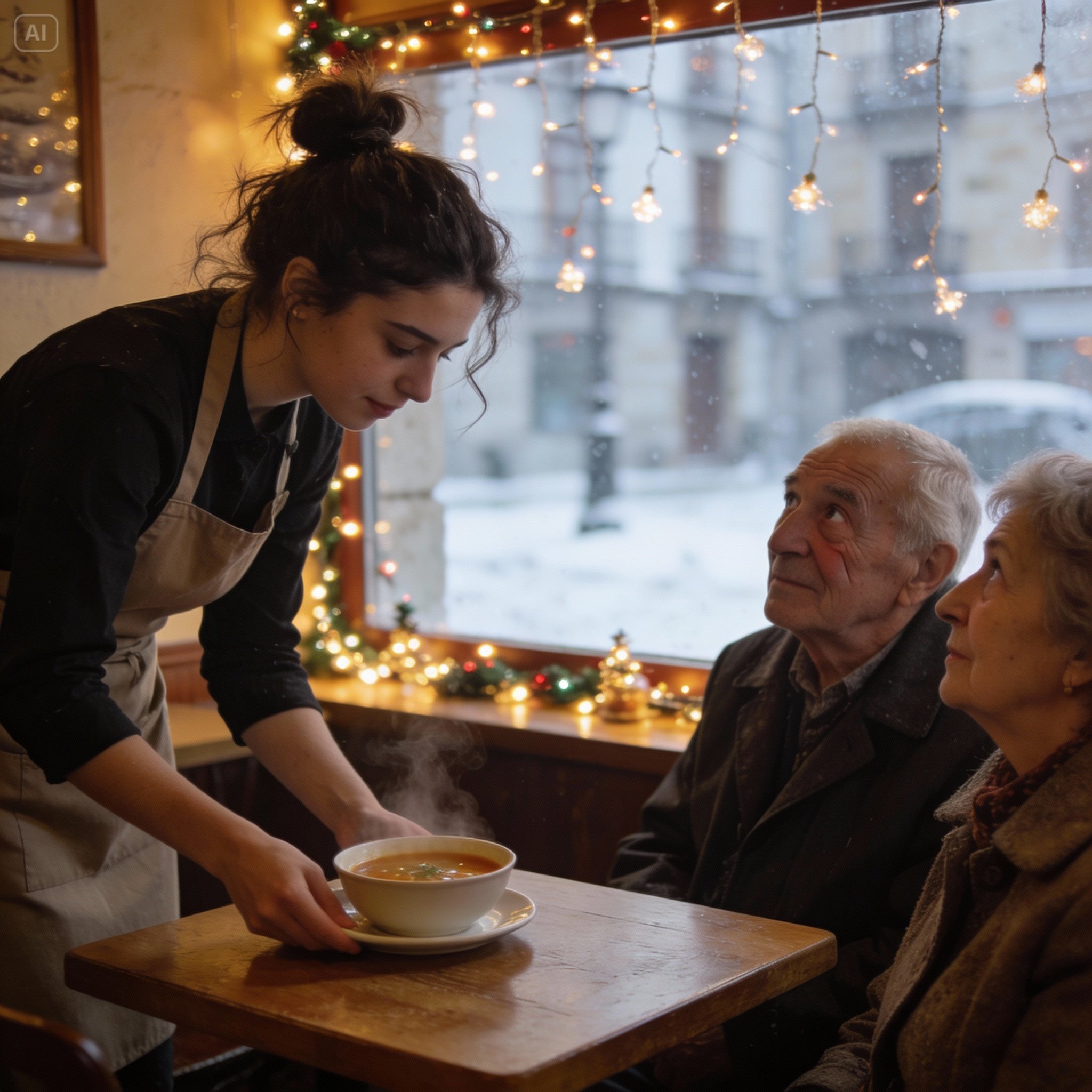
I served dinner. Watching them eat was… devastating. They didn’t eat anxiously, but with reverence. They broke the bread into small pieces, blew on their soup, looked at each other, and smiled faintly. It was love. Love in times of misery.
When they finished, the lady called me over. I approached.
“Thank you, darling,” she said, squeezing my hand. Her skin was rough. “It was delicious. How much is it?”
She took out a small cloth purse. She opened it. Inside I only saw penny coins and a couple of loose euros. I knew it.
“It’s nothing,” I said quickly, before he could take out those sad coins.
“What?” The man frowned, his pride wounded. “No, miss. We have to pay.”
“It’s… it’s on the house,” I lied. Rogelio, from the bar, was glaring at me. I knew he was listening or sensing something.
I went to the cash register. I printed the receipt. Twenty-two euros and fifty cents.
My hands trembled. I went to my locker at the end of the hall, where I kept my purse. I took out my wallet, which contained today’s earnings and some of the money from the bottle I’d brought “just in case.”
I counted. Ten, twenty… the coins.
If I paid this, I’d be left with less than forty euros. Goodbye to my inhaler tomorrow. Goodbye to peace of mind. I’d have to wait another week, maybe two, to scrape together the money again.
I imagined my father coughing. I imagined the sound of him running out of air.
But then I imagined those two old people going out into the snow on empty stomachs.
“God will provide,” my mother thought before she died. I was never very religious, but that night, I closed my eyes and asked for a sign. There was no sign. Only the sound of the coffee maker.
So I had to be the sign.
I put my money in the box. I slammed the drawer shut, a sound that hurt me to the core.
I went back to the table.
“Everything’s sorted,” I said. “Merry Christmas.”
They left the café walking a little more upright, the warmth of the soup still warming their bodies. The woman turned before going through the door and blew me a kiss.
I stood there, empty. Rogelio walked past me and let out a cruel chuckle.
—You’re stupid, Noemí. You’re so naive. You’re going to die poor.
That night, I walked home to save myself the bus fare. The Burgos cold stung my face, but I was already numb.
When I arrived, my father was asleep in the armchair, the plaid blanket pulled up to his chin. He was breathing heavily, a high-pitched, constant whistling sound. I sat on the floor beside him and wept silently. I wept from fear, from anger, from helplessness.
“I’m sorry, Dad,” I whispered. “I’m so sorry.”
(PART 2: Waiting and Doubt)
The following days were a silent hell. Christmas at home was austere. I made broth with the bones the butcher gave me and pretended everything was fine. Dad, luckily, had a couple of stable days, although I didn’t sleep, constantly watching his chest rise and fall.
I looked at each tip that fell into my hand as if it were water in the desert. One euro. Fifty cents. Two euros. I kept adding them up in my head, but the number climbed too slowly. The inhaler was still a long way off.
I started to doubt myself. Had I done the right thing? Was it selfish to prioritize strangers over my own flesh and blood? Guilt is a beast that eats you from the inside. When I saw my father stop to catch his breath in the hallway, I hated myself. I thought about those twenty-two euros and fifty cents I’d given away. They could have been half the cost of the medicine.
Rogelio wasn’t helping. He spent the week making jokes about my “charity” and assigning me the worst shifts.
“Here comes Mother Teresa of Burgos,” she would say as I entered. “Careful, hide the box.”
I lowered my head and continued cleaning.
New Year’s Day passed. Three Kings’ Day arrived. The city was beautiful, full of parades and shouting children, but I lived in shades of gray.
It was January 7th. A gray, leaden Tuesday. The café was quiet after the holiday madness. I was behind the bar, drying glasses, my mind blank from exhaustion.
The doorbell rang. Not the usual sound, but a clear, crisp one.
I looked up.
It was them.
But it wasn’t them.
I mean, they had the same faces, the same wrinkles, but everything else had changed. They weren’t wearing those threadbare coats anymore. The gentleman was wearing an immaculate navy blue wool coat with a cashmere scarf. The lady was wearing a camel-colored coat and carrying a leather handbag that I’d only ever seen in magazines.
They didn’t flaunt wealth. They exuded dignity and, above all, power. They didn’t walk with fear. They walked as if they owned the place.
Rogelio, who was counting the cash register, looked up. He froze. His shark-like instinct detected the money instantly, but his brain took a while to process that it was the Christmas Eve “beggars.”
He hurried out of the bar, smoothing down his sweater (now a blue one, just as tight).
“Good morning, gentlemen!” she said in that honeyed voice she used for wealthy tourists. “Welcome to El Candil. Table for two? I have a lovely one by the window.”
The man didn’t even look at him. His eyes scanned the place until they found me, hidden behind the tower of glasses.
—We’ve come to see Naomi —the man said. His voice was deep and authoritative.
Rogelio blinked, confused.
—To the girl? Uh… yes, of course. But if you want to be served by someone with more experience…
“We want to talk to her,” the lady interrupted, with a gentleness that cut more than a shout.
I stepped away from the bar, drying my hands on my apron. My heart was racing. What was going on? Had they forgotten something? Were they coming to give me my money back?
I approached them.
—Hello… —I said shyly.
The lady smiled at me, and that smile was indeed the same as on Christmas Eve. Tender, maternal.
—Hello, dear. Can we sit down for a moment? We won’t take up much of your work time.
I looked at Rogelio. He was pale, his mouth agape. He nodded frantically, giving me permission.
We sat at the same table in the back, next to the radiator.
“I don’t know if you remember us,” said the man, taking off his leather gloves.
—Of course. Garlic soup.
“Exactly. The garlic soup.” The man took a leather folder from his briefcase. “You see, Noemí, we owe you an explanation. And an apology for the whole charade.”
“Theater?” I asked, frowning.
The lady took my hand on the table.
—My husband, Don Aurelio, and I don’t have financial problems. Thank God we have plenty of work; life has treated us well in that respect. But we do have a problem with our faith.
“Of faith?” I repeated like a parrot.
“It’s about faith in humanity,” Aurelio explained. “We run the ‘Horizons’ Foundation. We’re dedicated to helping people who have fallen through the cracks of the system. But for some time now, we’ve felt… disillusioned. We saw a lot of people who only help when there are cameras around, or when they have money to spare, or when they want a tax break.”
“So every Christmas Eve we do this,” the woman continued. “We dress in our old clothes, the ones we kept from when we were young and had nothing, and we go out looking. We look for humanity. We look for someone who will look us in the eye and not see poverty, but people.”
I swallowed hard. I was beginning to understand, and I felt a mixture of relief and a strange anger.
“Was it a test?” I asked.
“It was quite a search,” he corrected himself. “We visited three restaurants before coming here. At one, they told us the kitchen was closed. At another, they offered us leftovers to take through the back door. And here… well, your boss was straightforward.”
Rogelio, who was pretending to clean the table next to him, turned the color of wax.
“But you,” the woman continued, squeezing my hand, “you didn’t just feed us. You paid. We saw the gesture at the register. We saw your worried face when you took out your own money. And we saw your shoes, honey. They have holes. We knew you didn’t have that money to spare.”
“Why did you do it?” Aurelio asked, looking at me intently. “Knowing that your boss would hate you for it.”
I shrugged, feeling my eyes fill with tears.
—Because my father always says that hunger hurts more than the cold. And because… I couldn’t let them go. I just couldn’t.
Aurelio nodded, satisfied. He opened the folder.
—We’ve done some research on you, Noemí. I hope you’ll forgive our intrusion. We know who your father is, Ernesto Salgado. We know about his lung condition. And we know that the medication he needs is expensive.
I felt like I was running out of air.
“Here you go,” he said, slipping me an official document.
I read it. It was a document from a prestigious private clinic in Burgos, specializing in pulmonology.
“The complete treatment is covered for life,” the woman explained. “It includes checkups, the latest medication, and, if necessary, a transplant. They already have your medical records. You just need to call to schedule your first appointment.”
I put my hands to my mouth. I couldn’t breathe. I started crying, right there in the middle of the café, sobbing like a little girl.
“Why?” I managed to say through tears. “It was just soup…”
“It wasn’t soup,” Aurelio said firmly. “It was dignity. And dignity is priceless, but we try to reward it.”
“Furthermore,” the lady added, taking out another envelope, “we know that you left your nursing career to take care of your father and work here.”
It was true. He had dropped out in the second year.
“This is a scholarship from the Foundation. It covers tuition, books, and a monthly stipend so you don’t have to work while you study. We want you to be a nurse, Noemí. The world needs more people with your hands and your heart.”
She couldn’t speak. She just cried and nodded.
Rogelio then approached, unable to contain himself any longer, trying to save face.
“Wow, Noemí, what news!” she said with a fake smile. “I always knew this girl was worth a lot. That’s why I have her here; she’s the best.”
Don Aurelio stood up slowly. He was tall. Much taller than Rogelio. He looked down at him with absolute coldness.
“Yes, she’s worth a lot,” Aurelio said. “You, on the other hand, have a poor business. And I’m not talking about money. I’m talking about spirit.”
“Sir, I was just following the rules of the business…” Rogelio stammered.
“The rules,” Aurelio repeated contemptuously. “I’ll give you some advice from one businessman to another: if you treat people like garbage, in the end your business will smell like garbage. Noemí doesn’t work here anymore. She starts studying on Monday.”
Rogelio was speechless.
The lady stood up and hugged me. She smelled of expensive perfume and lavender.
—Go to your father, daughter. The pharmacy at the clinic has already received the notice. You can pick up the medicine today.
(PART 3: The Return of the Light)
I left that café without looking back. I left my folded apron on the bar and stepped out into the Burgos cold, but this time I didn’t feel it. I ran. I ran to the clinic, where they gave me a bag with brightly colored boxes and a new inhaler. I ran home.
When I walked in, my father was coughing, slumped over the kitchen table.
“Dad!” I shouted, dropping the bags.
“What’s wrong, daughter? Why are you here so early?” He looked at me, startled.
I put the inhaler in her hand. I showed her the papers. I told her everything, hurriedly, between laughter and tears.
That night, for the first time in months, the house was silent. There were no whistles. No sounds of distress. My father slept soundly, breathing in clean, fresh air.
I sat down on the floor, holding the empty jam jar. I no longer needed to fill it with desperate coins.
Two years have passed since then.
Today I am a senior nursing student. My father has regained weight and color; he has even started repairing radios and toasters for the neighbors again, just for fun.
Sometimes I walk past Café El Candil. Rogelio is still there, bitter, watching life go by behind the glass. The place always seems half empty.
I still visit Aurelio and his wife, Carmen. They’re my adoptive grandparents. We eat together one Sunday a month. And we always, without fail, order garlic soup.
I learned that kindness is a high-risk investment. Sometimes you lose. Sometimes you’re left with nothing in your pocket and feeling cold. But other times… other times, a simple bowl of hot soup is enough to change the whole world. Or at least, your world.
And if you’re reading this and you’re cold, or afraid, or feel like no one sees you: hang in there. Keep being good. Keep giving even if it hurts. Because you never know who’s on the other side of the door, waiting to return the light you lit.