Kicked out of the table by my own father in our house in Toledo: How a single gesture of contempt towards my daughter unleashed a family revolution and gave us the best Christmas of our lives.
PART 1: THE PRELUDE TO THE STORM
The three-hour drive from our apartment in Madrid to my parents’ estate outside Toledo had always been the prelude to a performance, not the start of a party. As the car devoured kilometers on the highway, the landscape growing more arid and ochre, I felt that familiar knot forming in my stomach, a mixture of childlike anxiety and adult dread. But this time was different. This time, Lucía, my twelve-year-old daughter, was sitting next to me in the passenger seat, and she wasn’t looking at the scenery. She was rehearsing.
“I can talk about my science fair project on renewable energy,” she read aloud from a small white card, her brow furrowed with concentration, “or about the book I’m reading in English. Mom, do you think Grandpa would be interested to know that my math grade has gone up?”
My heart sank with a physical violence. My daughter wasn’t preparing to see her grandparents; she was preparing for a high-stakes job interview. The De la Vega gatherings weren’t celebrations; they were performance reviews disguised as festive meals with Iberian ham and reserve wine.
“Honey,” I said, trying to sound relaxed, even though my hands gripped the steering wheel tightly, “you don’t need to impress anyone. You’re wonderful just the way you are. Just be yourself.”
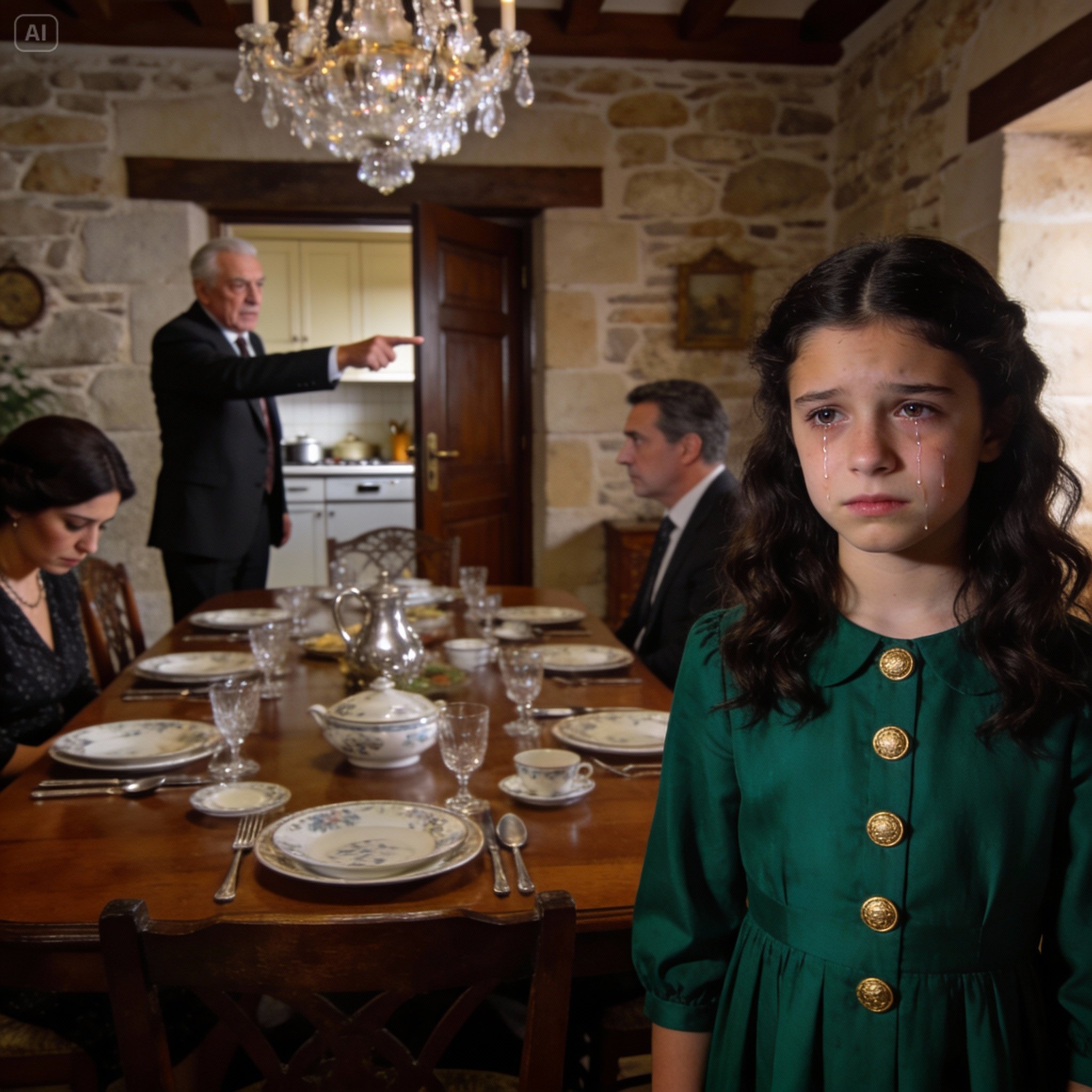
Lucía nodded, but didn’t put her cards away. She nervously smoothed the hem of her emerald green dress. We’d bought it the week before at a boutique downtown, and she’d fallen in love with the gold buttons because she said they made her look “older.” She wanted to fit in. She desperately wanted the stern man presiding over the table to look at her and smile, even just once.
Upon arriving at the estate, the house stood imposingly against the gray December sky. It was an old building, solid stone, that smelled of history and old money. Everything was, as always, painfully perfect. The hedges trimmed to the millimeter, the gravel path raked. My mother, Doña Carmen, came out onto the porch to greet us. She offered us that rehearsed smile that never quite lit up her eyes, always watchful, always fearful of a scream that had yet to be uttered.
“Elena, what a joy!” she said, blowing me two kisses so as not to smudge my makeup. Then, she absentmindedly ruffled Lucía’s hair, messing up the hairstyle we’d worked so hard on. “Come in, come in.” Javier was just telling us about his promotion at the firm.
The mere mention of my brother Javier was enough to establish the day’s hierarchy. We entered the grand hall, where the scent of oak firewood and antique furniture wax permeated the air. The room revolved, like a solar system around a black sun, around my father. Don Arturo sat in his wingback leather armchair near the fireplace, like a king on his throne, holding a glass of brandy.
Javier stood by the mantelpiece, wearing an impeccable three-piece suit, trying hard to look modestly successful while his wife, Beatriz, clung to his arm as if it were a trophy won at a vanity fair.
“Congratulations, Uncle Javier,” chirped Lucia in her most cheerful voice, bravely taking a step forward. “Mom’s been promoted too! She’s now the regional manager of your company.”
The room went cold. It was an instant, absolute silence. Beatriz let out a short laugh, as sharp as broken glass, and adjusted her cashmere shawl.
“How sweet,” he said, looking at Lucía like one looks at a clumsy puppy. “Although, of course, Javier’s promotion means coming in as a senior partner. We’re talking about different leagues, my dear. But good for your mother.”
Lucía blinked, confused, but tried again, lowering her voice. “I… wrote an essay for the Community of Madrid’s school competition… and I came in third.”
Silence. That damned silence again. Javier suddenly found himself completely fascinated by the toes of his Italian shoes. My mother felt an urgent need to check if the candles were straight. No one looked at her. No one said, “Well done.”
“How kind, my dear,” Beatriz finally said, her tone dripping with a cloying, sweet condescension, like poisoned honey. “Now, if you’ll excuse us, Javier was explaining to your grandfather the tax implications of his new position.”
As my cousin Teodoro, who had just arrived, launched into a prepared speech about his master’s degree in finance, I saw my daughter physically shrink. It was subtle, but devastating. Her shoulders slumped, the light in her eyes dimmed, and with a slow, defeated movement, she tucked her talking cards into the hidden pocket of her dress. They were useless to her now.
When Doña Carmen announced that the meal was served, I breathed a sigh of relief. I thought that, at least, the food would bring the distraction of the dishes and the wine. But as I crossed the threshold of the main dining room, under the light of the immense chandelier, I saw him.
The table, a magnificent mahogany piece dressed in white linen and silver, was set for nine people. There were ten of us.
PART 2: THE LAST STRAW
I stopped dead in my tracks. I counted again, hoping my eyes were deceiving me with stress. One, two… nine. Nine chairs. Nine sets of cut-crystal glasses. “Mom,” I said, my voice sounding strangely high-pitched in my own ears, “I think there’s a mistake. There’s one seat missing.”
My mother wrung her hands, a nervous gesture I’d seen a thousand times. “Oh… well, you see, Elena…” she began, glancing towards the sideboard.
That’s when my father’s voice sliced through the air of the room like a rusty guillotine. “There’s no mistake.”
Don Arturo turned slowly, leaning his weight on his silver-handled cane. His gaze swept around the room and settled on Lucía. There was no warmth in those eyes, only a cold, pragmatic assessment. “The dining room is reserved this afternoon for adult conversations,” he said, enunciating each syllable precisely. “We have important matters to discuss regarding the family’s estate and future. It is not a place for children or childish interruptions.”
He raised his hand, that heavy hand with the gold ring, and pointed toward the dark hallway that led to the service area. “You,” he said, turning to my daughter, “can eat in the kitchen. Mrs. Rosa has set a tray for you on the side table in front of the television. You’ll be more comfortable there. Adults only at this table.”
Time seemed to stand still. I saw my daughter’s face, my brave and sweet Lucia, crumble. The humiliation wasn’t just the banishment; it was the way it was said, as if she were a broken piece of furniture that had to be hidden away when important visitors came.
Lucía’s voice trembled, barely a whisper, but filled with a dignity none of those adults possessed. “But I’m part of the family too, aren’t I?”
The question hung in the air like a biblical accusation. It should have been met with an immediate protest. My mother should have rushed to find a chair. My brother Javier should have stood up, furious, offering his seat. Beatriz should have shown a shred of humanity.
But nothing happened.
The nine adults stood around the gleaming table. My mother gazed at the china as if it held the secrets of the universe. Javier adjusted his tie, avoiding my gaze. Beatriz examined her perfect manicure. My aunt Francine and uncle Leonardo stared at the ceiling. They all waited for the awkward moment to pass, for me, docile Elena, to do what I always did: lower my head, pick up the baby, and take her to the kitchen so as not to disturb the patriarch.
I looked at my daughter and saw something break deep behind her dark eyes. It wasn’t just disappointment. It was the sudden, brutal realization that these people—who signed birthday cards with “Kisses from the family,” who posted photos of her on social media showing off their “niece”—would let her be trampled on without lifting a finger as long as they didn’t lose their status or their inheritance.
At that moment, something broke inside me too. But it wasn’t my heart. It was the chains. The reverential fear I had felt for my father for forty years evaporated, replaced by a clarity as cold and hard as diamond.
I did what any mother should do, what I should have done years ago. I crouched down to Lucia’s eye level, ignoring everyone else, and took her cold, trembling hands in mine. “You’re absolutely right, my love,” I said, making sure my voice carried to every corner of that stone room. “You’re the family. And real family doesn’t make a twelve-year-old girl eat alone in the kitchen like she’s a leper.”
I stood up, straightening to my full height, and without letting go of his hand, I turned toward the door. “Let’s go.”
My father let out a disbelieving snort, a sound that mixed mockery and surprise. “Don’t be so dramatic, Elena. It’s just a meal. Sit down and stop making a fool of yourself.”
I turned slowly. My eyes met his, and for the first time in my life, I didn’t look away. “No, Dad. It’s not just one meal,” I said, with a calmness that surprised me. “It’s all the times you’ve silenced her. Every photo you’ve excluded her from. Every party where her accomplishments are ignored while we celebrate the mediocrity of others just because they have a degree or money. It’s a pattern of cruelty that I’ve been too cowardly to stop. Until today.”
Javier, feeling uneasy, took a step forward. “Come on, Elena, don’t exaggerate. Don’t ruin the meal. The lamb’s going to get cold.”
“That’s precisely the problem, Javier,” I snapped, looking at him with profound disappointment. “You’re more concerned about the roast lamb than your niece’s dignity. You all accept things this way because it’s more convenient. Well, I’ve finally accepted it.”
I turned to my mother, whose facade of the perfect hostess was beginning to crack, revealing the frightened woman underneath. “Mom, you made those croquettes that Lucía loves so much on purpose, didn’t you? So you could let her eat them all by herself in front of a microwave while you sit here pretending we’re a happy family?”
“Elena, please,” my mother whispered, her eyes filled with tears she was holding back. “Don’t make a scene. What will the neighbors say?”
—I don’t care about the neighbors, Mom. I care about my daughter.
Don Arturo’s face turned red, a vein throbbing dangerously in his temple. He struck the floor with his cane. “If you cross that door, Elena, don’t bother coming back for Christmas! Neither you nor the child!”
The silence fell again, thick and heavy. Everyone looked at me, waiting for the threat to work, as it always had. But I looked at Lucía, who was squeezing my hand tightly, looking at me as if I were a superhero. And I knew I had already won.
“It won’t be a problem, Dad,” I said in a firm, clear voice, feeling lighter than ever. “Because after tonight, you won’t be invited to ours.”
I took our coats from the coat rack in the hall. As we opened the heavy oak door and the cold mountain air hit our faces, I heard my mother’s broken voice following us: “Elena, please… she’s my granddaughter.”
I paused for a second, without turning around, and delivered my last words like a sentence: —Then you should have treated her as such.
The door slammed, echoing throughout the estate, closing a chapter of our lives forever.
PART 3: THE RECONSTRUCTION
The silence in the car lasted the first ten minutes of the return trip. Lucía was crying silently, wiping her tears with the back of her hand. I was driving, a mix of adrenaline and terror building. What had I just done? I had blown up my relationship with my immediate family.
Then I saw a neon sign on the road. A simple, mundane McDonald’s. “Are you hungry?” I asked. Lucia looked at me, surprised, and nodded shyly. “What if we have our own celebration?” I suggested, forcing a smile. “A meal where no one tells us where to sit.”
Ten minutes later, we were sitting at a red plastic table, eating chicken nuggets, fries, and ice cream for dessert. Lucia, still in her elegant green dress, looked like a princess out of place, but for the first time all day, she smiled. A real smile. “Thanks, Mom,” she said, dipping a potato in barbecue sauce. “For standing up for me. I thought… I thought you’d leave me there.” “Never again, Lucia,” I promised, taking her hand on the sticky table. “I’ll never let anyone make you feel less than again.”
As we ate, my initial anger transformed into determination. My father had banished us from his Christmas, believing it would punish us. He thought that without his money, his estate, and his prestige, we would be alone and sad. “We’re going to do something, Lucía,” I said, pulling out my phone. “We’re going to have the best Christmas Eve ever.”
For the next three weeks, I became a family history detective. I broke the De la Vega family’s unwritten rule: “Don’t talk to the exiles.” I started calling all the relatives who had stopped coming to the family gatherings at the estate years ago, those my father had crossed off the list as “unworthy.”
I called my cousin Janet, whom I hadn’t seen for ten years because she’d married an artist instead of a banker. “Elena?” she said, surprised. “I thought you were forbidden to speak to me.” “The rules have changed,” I told her. “I’m organizing a Christmas. And I want you to come.” Janet was silent for a moment, then said softly, “Your father did the same thing to my children years ago. He said they were too noisy for his table. We haven’t had a family Christmas since.”
I called Aunt Patricia, Arturo’s sister, who lived up north. “I haven’t spoken to Arturo in five years,” she told me, her voice breaking. “He said my divorce was a stain on the family name and that he didn’t want to see a failed woman at his table.” “Well, the only failure at my table is not being happy,” I replied. “Auntie, come to Madrid.”
The stories came one after another, like a torrent. I uncovered a pattern of cruelty, control, and elitism that had decimated our extended family. My father’s “perfect family” was just a skeleton, a small group of those willing to endure his tyranny for the sake of inheritance. There was a whole network of wonderful, fun, and loving relatives who had been cut off.
On December 20th, I sent a group email. The subject line was: “De la Vega Family Christmas: New Traditions.” I included everyone: distant cousins, estranged aunts, close friends who were like family. And yes, I copied my father, my mother, and Javier, just so they would know.
In the email I wrote: “Dear family: Lucía and I are hosting Christmas Eve this year at our apartment. We may not have a country estate in Toledo, or 19th-century silver cutlery, but we have something better: room for everyone. Here, the children don’t eat in the kitchen; in fact, the children eat first because they are the joy of the house. There’s no dress code, no forbidden topics of conversation, and the only requirement is to bring a sense of laughter. The budget for Secret Santa is 20 euros, because love can’t be bought.”
The response was overwhelming. My phone wouldn’t stop buzzing. Janet and her husband confirmed. Aunt Patricia booked train tickets. Cousins I didn’t even know lived in Madrid signed up. By the deadline, I had 23 confirmations. Everyone was coming. Everyone, that is, except Arturo, Carmen, Javier, and Beatriz.
Two days before Christmas Eve, Javier called me. His tone was aggressive. “What are you trying to prove, Elena?” he demanded. “You’re destroying this family. Dad is furious. He says you’re staging a rebellion.” “I’m not destroying it, Javier,” I replied calmly as I wrapped cheap, colorful gifts. “I’m rebuilding it. I’m picking up the pieces Dad threw away. And if he wants to come, the door is open. But he’ll have to sit wherever there’s room, like everyone else.” Javier hung up without saying goodbye.
PART 4: THE REAL CHRISTMAS EVE
Christmas Eve arrived, and with it, the magic. My apartment in Madrid wasn’t a palace, but that night it shone brighter than any castle. We had moved all the furniture to the bedroom to make room in the living room. We rented long tables and folding chairs. There weren’t linen tablecloths, but red and gold table runners covered in glitter. There wasn’t a quiet caterer, but a buffet table overflowing with food that everyone had brought: Galician empanadas from Aunt Patricia, potato omelets from my cousins, and huge platters of seafood and sweets.
The air smelled of cinnamon, mulled wine, and above all, freedom.
When the guests started arriving, the house filled with wonderful noise. Laughter, hugs from people who hadn’t seen each other in years, the sound of children running down the hall. I saw Lucía at the center of it all. My cousin Janet’s children, two teenagers with dyed hair and piercings, treated her like a queen. “Did you really stand up to Grandpa Arturo?” the older one asked her admiringly. “You’re a legend! We were afraid to even breathe near him.” Lucía laughed, her eyes sparkling, as she served them drinks. She was wearing jeans and a ridiculous Christmas sweater with a reindeer on it, and I’d never seen her look so beautiful. She didn’t need gold buttons to shine; she just needed to be loved.
At eight in the evening, while we were serving dessert, my phone rang. It was my mother. I went to a quiet room to answer it. “Elena…” Her voice was small, hollow, with a background echo. “Merry Christmas, Mom.” “Here… it’s very quiet here,” she said, and I could hear the sadness dripping from every word. “It’s just the four of us. Your father insists on playing classical music, but… the table looks so big. So empty. Javier and Beatriz are arguing about something at work.” There was a painful pause. “I miss you, daughter. And the baby.” “You’re welcome, Mom. There’s still time. Take the car. There’s plenty of food here.” I heard a trembling sigh. “Your father won’t allow it. He says that if we go, it would be admitting defeat.” I felt a pang of pity, but no longer guilt. “Then it’s his choice, Mom. He’s chosen his pride over his family. But Lucía and I have chosen happiness.”
In the background, I could faintly hear my father’s voice complaining about the quality of the wine. In my living room, on the other side of the door, a collective burst of laughter erupted when someone told a bad joke. The contrast was stark. They had wealth, history, and “properness,” but they were alone in a stone mausoleum. We had chaos, noise, and love.
“I have to hang up, Mom,” I said softly. “They’re waiting for me to open the presents. I love you all, but I’m not going back to that table.” I hung up and went back to the party.
PART 5: THE LEGACY
Five years have passed since that night. Everything changed. That “rebellious” Christmas Eve became a sacred tradition. Our gatherings have grown so much that we now rent a community center every year. We are more than forty people.
Lucía is now seventeen. She is a confident, strong, and compassionate young woman. She will start university next year to study Biochemistry. That day in Toledo is no longer a painful memory for her, but a foundational lesson. “You taught me never to accept less than I deserve, Mom,” she told me recently, as we looked at photos from our last party. “You chose me when it cost you your inheritance and your ‘good family.’” “I didn’t lose my family, darling,” I corrected her, stroking her cheek. “I discovered who my family really was. Family isn’t blood, it’s loyalty.”
The cycle of exclusion at the Toledo estate continued, but it gradually faded. My father, Don Arturo, aged rapidly, embittered by what he called our “betrayal.” Javier and Beatriz divorced two years ago; it turns out that success and status aren’t enough to keep a loveless marriage together.
Last month, at our Halloween party, the doorbell rang. When I opened it, I found Javier. He was thinner, without his three-piece suit, and looked tired. “Hi, Elena,” he said, standing on my doormat. “Is there room for one more? I’m all alone. Dad… Dad is unbearable. I can’t spend another night listening to his monologues.” Before I could answer, Lucía appeared beside me. “Hi, Uncle Javier,” she said with a calm smile. Javier looked at her, and his eyes filled with tears. “I’m sorry, Lucía,” he whispered. “For not speaking up that day. For all the days I didn’t speak up. I was a coward.” Lucía opened the door for him. “Come in, Uncle. Mom always says that family are the ones who stand up for you. And you’re here now.”
My mother sometimes calls, behind my father’s back, sending envelopes with money for Lucía’s studies and trembling notes about how proud she is. She wants to come and see us, to meet the woman her granddaughter has become “before it’s too late.” “You’re always welcome, Mom,” I tell her every time. “But you have to come through the front door. Lucía deserves better than a grandmother who’s ashamed to love her.”
Sometimes people ask me if I regret what I did, if I miss the luxury of the estate or the security of belonging to the De la Vega clan. I answer that it was never about a place at the table or a plate of lamb. It was about what that place represented: my daughter’s worth. It was about teaching her that she should never, ever, shrink herself to fit into someone else’s limited world. Sometimes, the best gift you can give a child isn’t a toy or an expensive dress, but showing them that they deserve a better place at the table, even if you have to build it yourself with four planks and a lot of love.
That Christmas Eve we lost an inheritance, but we gained a life. And that, without a doubt, was the best deal I’ve ever made.