She destroyed my home in the Sierra de Sevilla out of pure malice! My wealthy sister-in-law demolished the house that my late husband built with his own hands, unaware that by breaking down those walls she was releasing a fortune that changed our lives forever.
The Andalusian sun doesn’t warm, it punishes. And that afternoon, barely three days after burying my Javier, I felt that the sun and life itself had conspired to crush me against the dry earth of our farm.
From the small kitchen window, the one Javier had framed with flat stones that looked like slate slabs, I saw the car arrive. It wasn’t just any car; it was a black Mercedes, shiny like a poisonous beetle, a stark contrast to the dusty road and the ancient olive trees surrounding our house. My heart lurched painfully. I knew who it was.
It was Leticia, my husband’s older sister. The woman who had fled this Sevillian village twenty years before, renouncing her roots, the smell of the countryside, and her father’s calloused hands. She had triumphed in the capital, or so she said, marrying well and forgetting that she had once run barefoot on this very ground.
Javier had just died. A swift and brutal illness took the strongest man I’ve ever known in a matter of weeks. He left asking my forgiveness for not giving me a palace, not understanding that this house, this strange structure he built stone by stone with his own hands, was my palace because it was made of his love and his sweat.
I went out to greet her, drying my hands on my apron, trying to keep my composure. Mateo, my six-year-old, hid behind my skirts, sensing the tension in the air like animals sense a storm before it arrives.
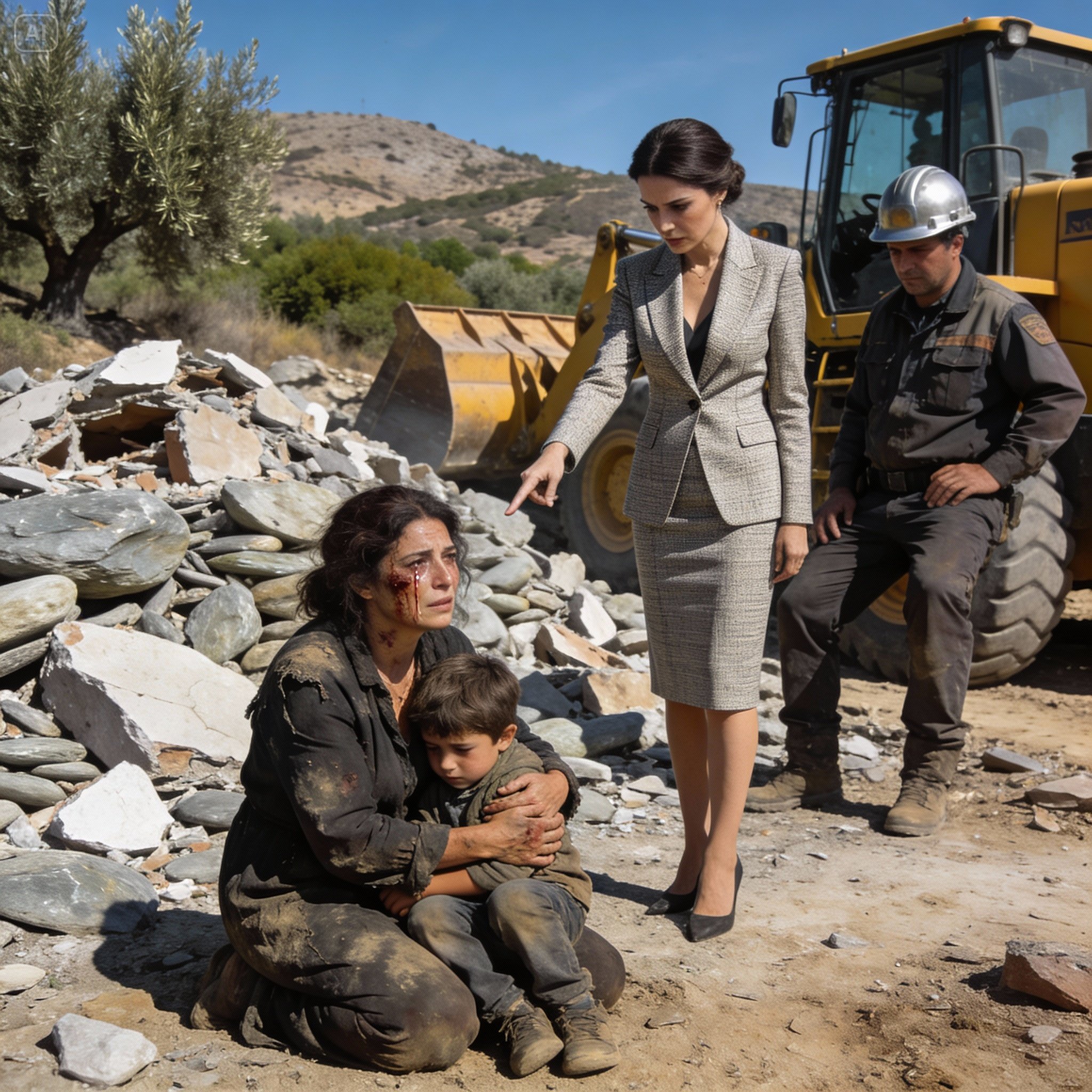
Leticia got out of the car. She wasn’t dressed in full mourning, but in an impeccable navy blue tailored suit, heels that sank into the ground, and enormous sunglasses that hid any trace of humanity in her eyes. There was no hug. There was no “I’m sorry, Carmen.”
“Save your tears, Carmen,” she said before I could even greet her. Her voice was cold, metallic. “I didn’t come to the funeral because I was closing an important deal, and frankly, seeing Javier in a coffin wasn’t going to solve anything. I’ve come to talk about reality.”
“What reality, Leticia?” I asked, feeling my legs tremble. “We just buried him.”
Leticia took off her glasses and looked at me with that disdain she always reserved for us, the “poor in spirit,” as she called us. She looked at the house. Our house. An organic structure, without perfect straight lines, built with river rocks of all sizes and colors that Javier had obsessively collected for years. Some were greenish, covered with a patina that looked like eternal moss; others were reddish, as if they bled rust. To the untrained eye, it was a crude construction. To me, it was Javier’s soul made flesh.
“I’m talking about this… thing,” she said, pointing at the facade with a perfectly manicured finger. “As you know, our parents died without leaving a will. The land was in Dad’s name. Javier, with that head of his own that was always full of dreams, never legalized anything. He built recklessly on land that wasn’t his. Legally, as the older sister and sole heir, this is mine.”
The world stopped. The buzzing of the cicadas in the olive trees became deafening.
—But… Javier lived here his whole life. He built this for us, for your nephew Mateo.
Leticia looked at the child as one looks at an unavoidable nuisance.
“It’s sad, I know. But the law is the law. I have plans for this property. I’m going to sell the whole lot to a luxury home construction company. They pay very well for land in this area now. But there’s a problem, Carmen. A big, ugly problem.”
He pointed at our house again with a theatrical gesture of repulsion.
“This house is an abomination. It’s hideous. Look at those stones, they look like they were taken from a landfill. Rusty colors, stones that look diseased. Nobody will want to buy the land with this monstrosity on it. It depreciates the property’s value.”
I felt a surge of indignation rise in my chest, displacing for a second the pain of grief.
“Don’t you dare speak like that!” I shouted, surprising myself. “Javier loved these stones. He chose them one by one from the river. It’s his art, it’s his legacy!”
Leticia let out a dry, joyless laugh that echoed cruelly in the silence of the afternoon.
“Art? Please, Carmen. Javier was a bricklayer with delusions of grandeur. He filled our parents’ property with geological garbage. Dirty, heavy rocks, that’s what they are. And I’m going to clean up this mess.”
“Clean?” I asked, feeling like I couldn’t breathe.
Leticia looked at her gold watch.
“The machinery is coming first thing tomorrow. I’m going to demolish this shack. You have until dawn to get your belongings and the child out. I want the land flat and clear for sale.”
I fell to my knees. It wasn’t a dramatic decision; my legs simply refused to support me under the weight of so much cruelty. Mateo burst into tears, clinging to my neck, terrified.
“You can’t do that!” I begged, crawling almost to Leticia’s feet, forgetting all dignity. “Please, Leticia, we have nowhere to go. I have no money. All Javier left us is this house. If you tear it down, you’ll kill us. It’s your own blood you’re leaving in the street!”
Leticia looked down at me, impassive as an ice statue.
“Javier should have thought about that before playing architect. I’ll give you an option, Carmen, because I’m generous all things considered. Take out whatever you can carry: furniture, clothes, whatever. But the structure will come down.”
Having said that, he turned around and got into his luxury car, leaving us stranded in the dust, with the death warrant for our home signed.
The night was agonizing torture. I didn’t sleep. I spent the hours packing our life into garbage bags: Mateo’s clothes, a few plates, our wedding photos. Every object I packed was a goodbye. I caressed the rough walls, whispering forgiveness to the stones. “Forgive me, Javier, I couldn’t defend your castle.”
Dawn brought no hope, only the roar of the beast. The ground trembled before we could see anything. A deep, mechanical noise, a growl of metal and diesel. Mateo woke up screaming.
I picked him up and went out to the yard. There it was. A huge yellow backhoe with a metal bucket that looked like a hungry jaw, positioning itself in front of the building. Behind it, in her car, Leticia watched with her arms crossed, overseeing the operation like a ruthless general.
I tried to run towards the machine, waving my arms, but the foreman stopped me.
—Ma’am, back off! Get out of the security perimeter or I’ll call the Civil Guard!
I stumbled backward, pushing Mateo toward the edge of the property, where the scrubland began. From there, we witnessed the martyrdom.
The first blow was the worst. The metal arm shot up and crashed violently against the corner of the room, the very corner where Javier and I used to sit and enjoy the cool air. The sound was atrocious. A crack of stone against metal that made me ache in my bones. The wall, so solid, so lovingly built, groaned before giving way in a cloud of white and gray dust.
“Dad!” Mateo shouted, trying to run, but I held him tight, burying his little face in my chest so he couldn’t see. But he could hear. He could hear his world shattering.
I couldn’t close my eyes. I had to see it. He saw the shovel pounding again and again. He saw the greenish stones roll across the ground, broken. He saw the reddish rocks, which Javier called “fire,” being ripped out and falling like broken teeth. “My stones,” he sobbed on his deathbed. Now they were rubble.
In less than two hours, years of sacrifice, of Sundays at the river, of back pain, turned into a misshapen mountain of ruins. The house was gone.
The silence that followed when they turned off the machine was worse than the noise. Leticia got out of the car and walked carefully through the dust, approaching us. She looked at the mountain of ruins with satisfaction.
—Much better. Now we can really see the potential of the land. That horrible thing is no longer in the way.
I looked up. My eyes must have been bloodshot from crying and dust, but I felt a spark of pure hatred that I had never experienced before.
—You’ve got your land all cleared. Now what? Are you going to throw us out on the road like dogs?
Leticia sighed, taking out a handkerchief to cover her nose from the dust that was still floating around.
“Technically, they can’t stay here. But look at all this mess,” he said, gesturing to the pile of rubble. “The contractor is charging me a fortune to remove all this rubble and useless stones.”
A malicious smile crossed his face. He had just thought of the final humiliation.
—Let’s make a deal, sister-in-law. You cried so much over my brother’s “precious stones.” Well, I’ll give them to you. They’re all yours. I don’t want to pay to have them taken to the landfill.
He pointed to the far end of the land, a muddy corner near the ravine.
“You can move your ‘inheritance’ over there. I’ll let you stay in that corner of the lot, among your trash, until you manage to get all of it out of here. I’m giving you a week. If in a week there’s even one of those horrible rocks left on my clean lot, I’m calling the police.”
Leticia left in her immaculate car, leaving me, a recent widow, and my six-year-old son, facing tons of destroyed rock, without shelter, without food, and with the Andalusian night rapidly falling upon us.
I looked at Mateo. His face was dirty, streaked with tears that had formed muddy paths on his cheeks. He was trembling.
—Mom, I’m cold. Where are we going to sleep? Dad’s bed is broken in there.
My heart shrank, like a raisin, but then I looked at the stones. Those stones that Javier had loved so much. They were lying there, piled up, dirty, broken. “They’re strong, Carmen, like us,” he had told me so many times.
Wiping away my tears in anger, I bent down and tried to lift one of the medium-sized rocks. It was incredibly heavy. My still-delicate hands felt the brutal roughness of the surface.
“We’re not going anywhere, Mateo,” I said, my voice coming from deep within me. “Your aunt says this is trash. She says we’re worthless. But Dad built this for us, and if I have to rebuild it stone by stone so you won’t be cold tonight, I will.”
I began dragging the stones toward the corner Leticia had pointed out. It was slave labor, work for oxen, not for a woman alone, grieving and hungry. But rage is a powerful fuel. I felt that if I stopped, I would die of grief right there, so I carried on. I carried the weight of injustice on my back.
As I moved one of the greenish rocks that the machine had split in half, something strange happened. The last ray of the setting sun struck the fractured surface of the stone. For a second, I thought I saw a flash. It wasn’t the wet sheen of the river, nor the reflection of ordinary quartz. It was a green flash, intense, deep, that seemed to emanate from the very heart of the broken rock.
I blinked, shaking my head. “It’s the tiredness,” I thought. “It’s the hunger and the sun making me see things.” I threw the stone onto the new pile without giving it another thought.
—Come on, Mateo, help me with the small ones. We have to build a wall so the wind doesn’t freeze us.
Darkness swallowed us. The wind from the mountains rose up, aggressive, chilling us to the bone. I spent hours moving stones like an automaton, building a miserable U-shaped parapet, barely half a meter high. It was pathetic compared to the house Javier had built, but it was all we had.
“Mom, my hands hurt,” complained Mateo, who was trying to help me by dragging pebbles.
—I know, my love. We’re almost done.
When the full moon rose, it illuminated the desolate landscape with a silvery, spectral light. We huddled inside the small stone shelter, on top of garbage bags to insulate ourselves from the damp ground. I hugged Mateo tightly, trying to be his blanket and his roof.
The boy fell asleep from sheer exhaustion, but I couldn’t. My eyes, accustomed to the darkness, fixed on the main pile of rubble, that mountain Leticia had left as a monument to her cruelty.
The moonlight fell on the broken stones. And then, I saw it again.
On one of the reddish rocks a few meters away, I saw a deep glow, as if a burning ember were inside the stone, pulsating with an intense red. Further on, among the fragments of greenish stones, I saw flashes that looked like cat’s eyes in the darkness, a vivid, crystalline green.
I closed my eyes tightly and opened them again. The sparkles were still there.
—Damn stones—I whispered bitterly—. Even broken they deceive me.
I thought I was going crazy. I thought they were pieces of glass, or some cheap mineral like pyrite, “fool’s gold.” I sat up carefully so as not to wake Mateo and went over to my own low wall. I touched one of the green stones I had used to build it. It was cracked. I ran my fingertip along the crack. It wasn’t rough like the outside; it was strangely smooth, cold, almost soapy to the touch.
I scratched it with my fingernail. Under the layer of dust and the gray crust, the stone seemed to have a dense, glassy texture.
Exhaustion overcame my curiosity. I hugged my son again and fell into a restless sleep, filled with nightmares of yellow machines and cruel laughter.
I didn’t know that that night I was literally sleeping on top of a fortune. I didn’t know I was using rough emeralds and rubies to protect myself from the wind, believing they were the remnants of my misfortune.
The next day, the awakening was brutal. We were covered in a fine layer of white dust, the dust from our own demolished house. Mateo was coughing. We were thirsty, hungry, and our bodies ached.
Mid-morning, the sound of the Mercedes engine announced the arrival of the storm. Leticia got out of the car, impeccably dressed, wearing sunglasses that hid her eyes and a scarf covering her nose, as if our presence stank.
“Well, well,” he said mockingly. “I see you’re still here. I thought the cold would have given you some common sense and you’d have left.”
I stood up, dusting myself off with dignity.
—I am following your order, Leticia. I am moving the stones.
He pointed at my ridiculous little wall with a contemptuous chuckle.
“Is that all you’ve done? Pathetic. You play house with trash, just like my brother. You’re two of a kind. You’re like lizards hiding under hot rocks.”
The insult hurt me more than hunger. “Lizards.” That’s how he saw his own blood.
Leticia approached the low wall and, with the tip of her very expensive shoe, kicked one of the upper stones, knocking it to the ground near Mateo’s feet, who jumped in fright.
“Hey! Don’t do that!” I shouted, stepping in front of them.
She looked at me with disgust and bent down slightly to pick up a fist-sized stone. It was one of Javier’s favorites, a dark, almost black rock with a bright reddish stain on one side.
—Look at it, Carmen. What did Javier see in this? It’s deformed, it’s opaque. And that red color looks like old, dirty blood. It’s a rotten stone. Trash!
With a gesture of supreme disdain, Leticia hurled the stone far away, toward the mountain, with all her might. The rock struck another large boulder and broke with a sharp crack.
“I’m sending the foreman with the trucks tomorrow. If I see that pile of garbage hasn’t gone down”—he pointed to the main mountain—”I’ll make sure they clean everything up, including your rat’s nest.”
He got into his car and left, leaving us humiliated once again.
I stared at the spot where I had thrown the stone. Rage consumed me. But then, my gaze shifted to the main pile of rubble. There, towering above the chaos, was the “Master Stone.”
It was a gigantic rock, oval-shaped and a humble grayish color, which Javier had spent weeks hauling from the river to use as a lintel over the entrance. It was the heart of the house. Now it lay tilted, half-buried, untouched.
If Leticia brought the trucks tomorrow, that rock would be the first one to go to the landfill because of its size. A crazy determination took hold of me. I couldn’t save the house, but that rock, that stone where Javier used to sit and rest, I had to save it.
“Mateo, stay here,” I told my son, a feverish gleam in my eyes. “Mom’s going to do a man’s job. I’m going to save your dad’s heart.”
I grabbed a twisted iron bar from the rubble to use as a lever and headed toward the mountain. It was a suicide mission. Moving that half-ton boulder by myself was impossible. But the word “impossible” didn’t exist for me that day.
I jammed the bar under the Master Stone and pushed. I pushed with all the rage, all the pain, all the love I felt for Javier. My muscles burned, my hands bled, but I didn’t stop.
“Move it!” I shouted to the sky.
And the stone moved. It tilted slowly and then, with a dull thud, tipped over. But it didn’t roll as I expected. It struck a piece of concrete column and rebounded violently, changing direction. It rolled downhill, gaining speed, straight toward the bottom of the ravine where there were some enormous granite boulders.
“No!” I shouted, watching my effort turn into a disaster.
The impact was brutal. A CRACK that sounded like a cannon shot echoed throughout the valley. The Master Stone split in two exact halves, opening like a book.
I fell to the ground, crying in frustration. I had broken it. I had destroyed the only thing I wanted to save.
I got up unsteadily, limping into the cloud of dust to see the wreckage. I expected to see the ugly, gray interior of the shattered stone.
But when the dust settled and I drew closer, I stopped dead in my tracks. The afternoon sun beat down directly on the open heart of the broken stone. And what my eyes saw was not gray.
It was a flash. A blinding, deep violet, almost electric glow that emanated from the depths of the rock.
I approached, incredulous, thinking that the heatstroke or the pain was making me hallucinate. The enormous gray stone, so ugly on the outside, was hollow on the inside. It was a cavity completely lined with perfect geometric crystals, sharp points that caught the sunlight and broke it into a thousand purple flashes.
It wasn’t a rock. It was a geode. A colossal amethyst geode, the size of a small bathtub.
I fell to my knees, breathless. I reached out with a trembling hand and touched one of the panes. It was cold, smooth, perfect. It was the most beautiful thing I had ever seen.
And then, it clicked in my mind. I looked around at the thousands of fragments of broken stones covering the ground. The green stones that Leticia called “rotten,” the reddish ones that looked rusty.
A shiver ran down my spine. I jumped up like a madwoman, ignoring the pain in my ribs, and ran toward a medium-sized greenish rock nearby. I grabbed Javier’s old hammer, which I had salvaged from the tools, and struck the rock with all my might.
Crack . The stone split.
It wasn’t moss. It wasn’t mold. The interior was a glassy mass, a translucent emerald green, that shone like the eye of an ancient reptile. Raw emeralds.
I dropped the hammer and clapped my hands to my mouth to stifle a hysterical scream. I looked around. I was surrounded by “garbage,” or so everyone thought. But the truth hit me with the force of a tsunami: I was standing on top of an open-pit mine.
Javier hadn’t built a crooked house. Javier, with his artist’s instinct, perhaps unknowingly, had been collecting raw geodes and mineral nodules from the river for years. He had built a safe, a treasure vault disguised as poverty. Every wall Leticia had knocked down was a chest full of riches.
“Mateo!” I shouted, my voice making the boy jump. “Mateo, come and see! Dad wasn’t crazy! Dad left us a real castle!”
Mateo ran and stood petrified when he saw the enormous open amethyst.
—Mom… what is that? Is it magic?
—It’s better than magic, my love. It’s your father’s gift.
Then the irony of the situation hit me. If Leticia hadn’t been so wicked, if she hadn’t demolished the house out of envy, the stones would never have cracked. We would have lived and died poor within those walls, never knowing the secret they held. It was Leticia’s hatred that unleashed the richness. She broke the shell for me.
But terror gripped me suddenly. Leticia had said she was coming tomorrow with the trucks to “clean up the trash.” If she saw this, if the foreman saw it, everything would be lost. Leticia, with her money and her lawyers, would claim the land was hers and everything on it belonged to her.
Then I remembered his exact words, the ones he spat out with such contempt in front of the witnesses: “I’m giving you this garbage. It’s all yours. Take your horrible stones.”
“It’s mine,” I whispered, clutching a green crystal in my fist. “She gave me the trash. And this… this is the trash.”
But I had to hide it. If she arrived and saw the floor glittering with rubies and emeralds, greed would drive her mad and she’d take it from me by force.
—Mateo, listen carefully. This is a secret. No one can see the sparkles. We need soil!
As if possessed, we began gathering handfuls of dust and mud. I ran toward the enormous amethyst and started smearing the purple crystals with dirt, covering its beauty.
“Forgive me, pretty ones, forgive me,” he murmured. “You have to be ugly again for a little while longer.”
We spent the afternoon camouflaging our fortune, turning the broken stones on the ground, covering them with old rags. When night fell, I was exhausted, but I no longer felt cold or afraid. I felt an inner fire. That night, I watched over my pile of rubble, clutching the hammer as if it were a royal scepter. I was not a destitute widow; I was the guardian of a temple.
Dawn brought back the stark reality of the danger. At eight in the morning, the ground trembled with the arrival of the machinery: a huge dump truck, a backhoe, and Leticia’s black Mercedes.
The convoy of destruction stopped. I stood in front of my low wall, legs spread, ready for war.
Leticia got out of the car, triumphant.
—Good morning, dear sister-in-law. I see you’re still here and haven’t made any progress. You’re useless, just like my brother. Time’s up. I’m going to clear my land today.
He turned to the foreman, a robust man named Ramirez.
—Ramírez, start loading everything. I want this flat land by noon. Take all this garbage to the landfill.
“Wait!” I shouted, taking a step forward. “You said yesterday, in front of witnesses, that these stones were mine! You gave them to me!”
Leticia burst out laughing.
“Oh, please! Are you going to cling to that? Of course I gave you the trash, but since you haven’t been able to take it, I’m reclaiming my right to clean my property. They’re just dirty stones, Carmen. Why do they matter so much to you?”
Leticia took a few steps toward the mound, her heels sinking into the earth. She was dangerously close to one of the green stones that Mateo had poorly covered with mud.
A treacherous ray of sunlight slipped through the clouds and struck right at that spot. A pure, brilliant, emerald-green flash shot up from the ground, reflecting directly into Leticia’s eyes.
She stopped dead in her tracks. “What is that?” she asked, frowning.
My heart stopped. Leticia bent down, driven by the curiosity that is the mother of greed, and reached out toward the muddy stone.
“Don’t touch that!” I yelled, lunging at her, losing my composure.
“Back off!” she barked. “Ramírez, hold this crazy woman back!”
The foreman stepped in. I had to watch helplessly as my sister-in-law ran her finger along the stone, cleaning off the mud. The green shone with all its brilliance. Leticia, who loved jewelry, recognized it instantly.
She froze. Her eyes widened. She looked at the green stone, then saw another reddish one beside it, she wiped it a little… Ruby.
Leticia stood up slowly. She was pale. She looked at the mountain of rubble, the tons of rock that filled the ground. She looked at the enormous Master Stone, half-covered with earth at the top.
He turned his head toward me. His expression had changed. There was no more mockery. There was a ravenous, demonic greed.
“This… this isn’t rubble,” he whispered, his voice trembling. “Ramírez! Stop the machines!”
The secret was out. Leticia smiled, and it was a shark’s smile.
—Forget what I said, Carmen. You’re not taking anything. Everything on this land is mine. Get out of my mine right now!
The air in the vacant lot crackled with electricity, charged not with a storm, but with the human greed that had just erupted on Leticia’s face. The elegant woman who, minutes before, had gazed with disgust at the rubble, now behaved like a ravenous beast.
Her eyes darted from stone to stone, shining with feverish desire at the glimpses of green and red glimmering through the mud. She forgot her expensive shoes and her dignity; she threw herself to the ground, falling to her knees on the sharp gravel, clawing at the earth.
“They’re mine!” he shrieked, frantically digging up a stone. “They were in my father’s land! They’re mine!”
I took a step back, frightened by his madness, but I grabbed Mateo and put him behind me.
“They were yours, Leticia!” I said firmly, though I was trembling inside. “They were yours until yesterday when you told me to my face, ‘I’m giving you this filthy garbage, take it all.'”
“It was just a figure of speech!” she shouted, leaping to her feet, her hands covered in mud and her face contorted in disbelief. “I didn’t know there were precious stones inside! That’s a hidden vice! It’s a scam! Nobody gives away rubies!”
He turned towards the workers, who had turned off the machines and were watching the scene in astonishment.
“You! Don’t just stand there! Load these rocks into my car! Right now! They’re mine!”
Foreman Ramirez, a country man with tanned skin and a calm gaze, adjusted his helmet.
—Ms. Leticia, my work order says “debris removal to the landfill.” It says nothing about transporting valuables or mining.
“I don’t give a damn about the order!” she interrupted hysterically. “I pay, I’m in charge!”
Leticia ran towards my small stone shelter and tried to grab one of the rough emeralds that formed the headboard.
“Don’t touch her!” The shout came from my soul.
I lunged at her and, in an instinctive act of self-defense, pushed her. It wasn’t a hard push, but Leticia, surprised by my reaction and unbalanced by her heels on the loose ground, stumbled and fell hard onto a pile of gravel.
The silence was absolute. Leticia looked up at me from the floor, her mouth agape. Humiliation rose up her throat like fire.
“Did you dare to hit me?” she whispered in a voice that promised eternal vengeance. “You just assaulted me on my own property.”
She pulled out her phone with trembling hands.
“You’re going to jail, Carmen. And your son will end up in an orphanage. I’m going to call the Civil Guard right now. I’ll tell them you attacked me and that you’re stealing valuable private property.”
I felt the chill of fear. We poor people are always afraid of authority, because we know that justice sometimes comes at a price we can’t afford.
“Call whoever you want,” I said, keeping my head high. “God saw what you did, and so did these men.”
Twenty minutes later, two Civil Guard patrol cars entered the area, kicking up dust, their blue lights flashing. Leticia ran towards them, putting on a perfect victim mask.
“Officers, thank God! That woman”—he pointed an accusing finger at me—”is an illegal occupant. She physically assaulted me when I tried to get my belongings back. Look at my clothes! What’s more, she’s trying to steal precious minerals from my land.”
The sergeant in charge, a serious man with a thick mustache, looked at both of us.
—Let’s take it one step at a time. Whose land is it?
“Mine,” Leticia said, showing the deed on her phone. “I inherited this from my father. She’s my brother’s widow, but she has no rights to the land.”
The sergeant addressed me.
—Ma’am, is it true that you assaulted this citizen?
“I didn’t attack her, officer. She tried to take my son’s shelter from me, and I stopped her. She tripped. And on the land… yes, the land is hers. I’ve never denied it.”
“There you have it! Confess!” Leticia shouted. “Arrest her and get those stones out of here!”
—But the stones are not yours—I continued, raising my voice. —The stones are mine.
The sergeant looked at the pile of rubble, confused.
—Madam, normally what is attached to the ground belongs to the owner of the ground.
“Exactly!” Leticia interrupted. “They’re geodes, semiprecious stones. My brother brought them. They’re in my soil. They’re mine!”
The sergeant looked with interest at one of the broken rocks that shone with a violet light. He whistled softly.
“Officer,” I said, “yesterday this woman demolished my husband’s house because she said it was a ‘horrible monstrosity.’ She gave me a week to leave, and in front of this foreman and his men, she pointed to this rubble and said, ‘This garbage is yours. I’m giving it to you. Take it all because I don’t want to pay to have it thrown away.’”
Leticia blushed. “That’s not a contract! I was angry! I didn’t know what was inside!”
The sergeant scratched his chin. The situation was complex.
“It’s his word against hers, ma’am,” he told me. “If there’s no signed document… the law tends to favor the landowner. I’m sorry to tell you, but you have to leave the stones.”
Leticia smiled cruelly. “Thanks, officer. See, Carmen? I told you so. Get out of here.”
I felt like my world was collapsing for the second time. I was going to lose.
“Excuse me, boss,” a gruff voice broke the silence. It was Ramirez, the foreman.
He approached slowly, taking off his helmet.
—I was here yesterday, and my workers were too.
The sergeant turned to him. “And what did you see?”
“Look, boss, I’ve been in construction for thirty years. Yesterday, Mrs. Leticia ordered a complete demolition. We told her the stone looked good for resale. And do you know what she said? She said it was ‘filthy garbage’ and that it disgusted her. And then, shouting, she told the widow, ‘All this rubble is yours. I’m giving it to you right now so I don’t have to pay for shipping. If you find a single penny in all this filth, it’s yours.’”
Leticia opened her mouth to protest, but Ramírez raised his hand showing an old mobile phone.
—And as per company protocol, when a client declines the cleaning service, we record the audio to avoid lawsuits for illegal dumping. I have the recording here. You can clearly hear him donating all the material to Mrs. Carmen.
The color drained from Leticia’s face. The sergeant took the phone and played the audio. Leticia’s shrill voice filled the silence: “Take that trash, I’ll give you every last stone. It’s all yours, Carmen. Do whatever you want with your rotten rocks.”
The sergeant looked at Leticia sternly.
—Ms. Sandoval, the law is very clear regarding verbal donations made before witnesses. You not only relinquished ownership of these materials, but you explicitly transferred it to this woman to obtain a financial benefit: to avoid paying for retirement.
“But they’re jewels!” she squealed. “I didn’t know they were jewels!”
“That’s not Mrs. Carmen’s problem,” the relentless agent replied. “You called this garbage. One person’s garbage is another person’s treasure.”
I turned to Mateo and squeezed his hand, feeling my legs give way with relief.
—So… is it mine? —I asked in a whisper.
—That’s right, ma’am. Everything that’s been demolished is legally yours. And I suggest Ms. Sandoval not interfere, or I’ll arrest her for coercion.
Leticia let out a pathetic cry of frustration, turned around and ran to her car, speeding away from the property, defeated by her own greed.
I cried, but this time tears of victory. I thanked foreman Ramirez, who, with a knowing smile, told me: “My father was a bricklayer, ma’am. I know how to recognize a good stone, and a bad person too.”
Ramirez and his men, using the truck that Leticia had paid for, carefully loaded all the geodes, treating them like babies, and took them to a safe place in the village.
That night, sleeping under the safe roof of a neighbor’s house, I couldn’t close my eyes. My mind wandered to the future, grasping the magnitude of the gift Javier had left for me, hidden in plain sight.
The following days were a whirlwind, which I experienced as if in a golden haze. With the help of foreman Ramírez and some good people from the town, we contacted an expert geologist from Seville. When the man arrived and saw the dirty stones piled up in a yard, he was skeptical. But the moment I cleaned the mud off the first green geode with a hose, his knees nearly buckled.
“Good heavens!” he whispered, falling to the ground before the rock. “Madam, do you know what you have here? This isn’t ordinary quartz. These are volcanic geodes from the earliest stages of formation. Look at the purity of these emeralds in their matrix. And those… those are crystallized pigeon’s blood rubies.”
The expert spent three days cataloging the treasure. Javier’s “ugly” house held more than just sentimental value; geologically, it was a miracle. Javier had unknowingly discovered an unknown river vein carrying minerals from some deep cavern in the mountains. With his artist’s eye, he had selected only the heaviest and most uniquely colored stones.
“Mrs. Carmen,” the expert finally told me, his hands trembling over his notebook, “the centerpiece alone, the giant amethyst, could fetch a price you wouldn’t earn in ten lifetimes. The entire lot… well, let’s just say your son and your grandson will never have to worry about the price of bread again.”
When I received the first bank check for the sale of some minor pieces, I literally fainted. When I woke up, I cried for hours. I cried for the hunger we had endured, for the humiliations, and because Javier wasn’t there to see it. And I cried because, finally, the fear of tomorrow had vanished forever.
And what happened to Leticia? Divine justice is sometimes slow, but it comes.
Leticia tried to sue, of course. She hired the most expensive lawyers in town, alleging error, fraud, and bad faith. But every time they appeared before a judge, they ran into an insurmountable wall: the evidence. The recording of foreman Ramírez went viral in the town and on social media. Everyone heard his shrill voice disparaging his brother’s inheritance and giving away the “garbage.” The judges were unforgiving: no one can plead their own ineptitude and greed to gain an advantage. Case closed.
Leticia kept the land. A plot of barren earth. But the curse of her greed didn’t end there. Blinded by the idea that there might be more, she spent her own fortune hiring excavators to dig into the bare soil, desperately searching for more veins, more millions. She devastated the property, digging deep pits until the place resembled a battlefield.
And what did she find? Dirt, ordinary stones, and dry roots. Javier had already cleaned the river years before, stone by stone, with love and patience. All that remained for Leticia was the empty hole of her ambition. Over time, legal debts and the costs of fruitless excavations ruined her. Shame in the town consumed her, isolating her in her bitterness.
Two years later, a safe, new family van pulled up in front of a beautiful building on the outskirts of town, on high ground overlooking the same river where it all began.
I got out of the car. I was no longer wearing rags, nor were my hands cut by the dirt. I wore a simple lavender linen dress, and in my eyes, though they held the longing for lost love, shone an unshakeable peace. Mateo, now eight years old and in perfect health, skipped out with his new school backpack.
The house across the street wasn’t a lavish mansion. I didn’t want Italian marble or Greek columns. I had hired the best architects with a single instruction: “I want it to feel like a hug, and I want to use stone.”
The new house was solid, bright, with large windows. But what made it unique was the front garden. In the center, on a pedestal protected by safety glass, but visible to all, stood the Master Stone. Half of the amethyst geode that had almost killed me that tragic day shone in the sun, violet and eternal.
Below, on a bronze plaque, it read: “The House of Javier. Because true wealth is not seen with the eyes, it is felt with the heart.”
I walked over to the plaque and ran my fingers over my husband’s name.
“We did it, old man,” I whispered, feeling his warmth in the afternoon breeze. “Mateo goes to the best school. We helped Rosa fix her roof, and Ramírez has his own construction company thanks to the interest-free loan we gave him. Your ‘trash’ blessed the whole town.”
We had saved the most beautiful stones not to sell them, but to incorporate them into the new house. The fireplace was inlaid with rough rubies; the master bathroom featured details of that emerald green that Leticia had scorned. We were literally living inside the jewel that Javier had dreamed of, but this time with a safe roof over our heads and without fear.
Sometimes they told me that Leticia would drive by in her old car, glancing sideways at the house, seething with anger. I no longer felt hatred for her, only immense pity. Leticia had all the money in the world and lost it because she didn’t know how to love. I had nothing and gained everything because I knew how to see beauty where others saw ugliness.
Mateo ran towards me with a flower from the garden.
—Look, Mom. This one has pretty colors too. Do you think Dad painted it?
I bent down and hugged my son, breathing in his happy childlike scent.
—Of course, my love. Dad paints everything that is beautiful in our lives.
I sat on the porch as the sun set, painting the sky with colors that rivaled the jewels of my house: oranges, pinks, purples. I had been through the fire of humiliation, slept on the ground amidst rubble, been called “rat” and “lizard.” But, like coal that under pressure transforms into a diamond, suffering had made me unbreakable.
Javier had built me a crooked house, yes. But the foundations of that house weren’t made of stone; they were made of pure love. And love, my friends, is the only currency that doesn’t lose its value in life or in death.
Sometimes, you have to break the stone to find the jewel. And sometimes, God uses the hands of our enemies to bless us in ways we could never imagine.