TIED TO AN OLIVE TREE AND ABANDONED BY MY SON: HOW THE DAY THEY LEFT ME TO DIE WAS THE DAY I TRULY STARTED TO LIVE
PART 1: THE BETRAYAL OF BLOOD
Dust rose from the dirt road, an ochre, suffocating cloud hanging in the hot November air, even though the sun beat down as if it were the middle of August. It was the dust kicked up by my son’s silver Volkswagen Golf as it drove away. Doña Cecilia, I said to myself, feeling reality hit me harder than the heat: sixty-eight years of life to end like this.
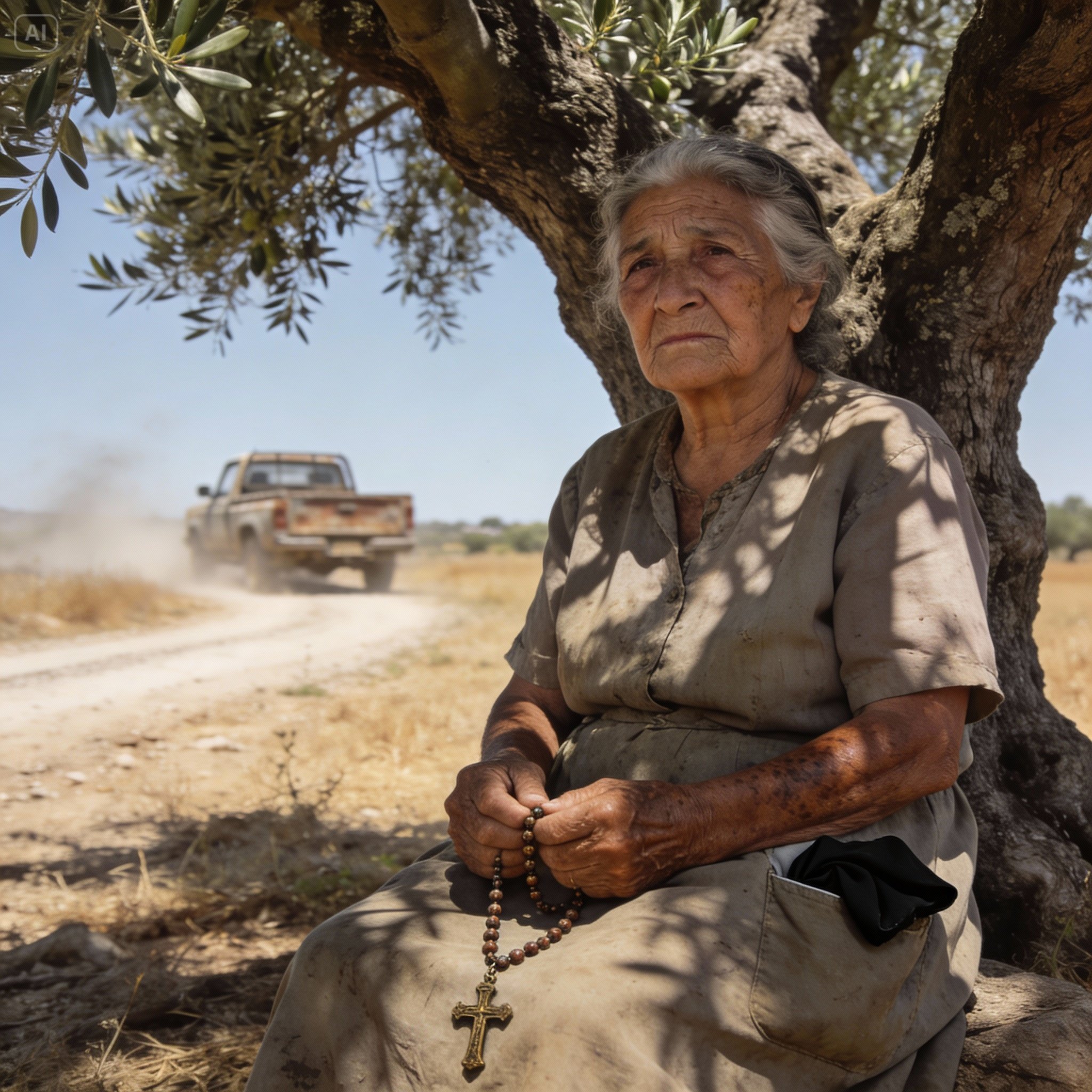
I felt the knot of the rope tighten against my wrists. It was a rough, yellow nylon rope, the kind they use on construction sites. It cut off my circulation and pressed my skin, as thin as cigarette paper, against the rough, ant-ridden bark of that old tree. The midday sun in the Sevillian countryside beat down mercilessly, burning my forehead, my arms, my very soul. I blinked several times, trying to wipe away the tears that, mixed with sweat, blurred my vision. But no matter how much I blinked, the image didn’t change: the car was shrinking on the horizon, taking with it the last person I called family.
Three hours earlier, everything seemed to have a patina of normalcy, that tense calm that precedes storms. I was in the small prefabricated house at the back of my son Carlos Eduardo’s property. That’s where he had “placed” me to live after his wife, Mariana, complained that my presence in the main house “disrupted” the family’s routine and robbed them of their privacy. I woke up early, at six, as usual. The habit of years of working cleaning offices and stairwells doesn’t disappear even with retirement. I made my coffee, black, strong, and without sugar, and swept the small cement patio that surrounded my little house. The chickens, my only friends in that solitude, pecked around me, and I threw them some kernels of corn. “Eat, pretty ones, eat,” I whispered to them. It was a simple life, reduced to its bare essentials, but it was my life.
Around nine in the morning, Carlos Eduardo appeared at my door. His face was tense, his jaw clenched like it was when he was drowning in debt. His eyes avoided mine, staring at the floor, the walls, anywhere but his mother. “Mom, pack your things. Let’s go for a walk.”
I was surprised. Carlos never took me out. In the last two years, since I sold my apartment in the Triana neighborhood to help him pay off the debts of the bar that went bankrupt, Carlos barely spoke to me. His visits were quick, cold transactions always accompanied by requests for money or complaints about how much electricity, water, and food I used. “A walk? Where to?” I asked, drying my hands on my apron. “Don’t ask so many questions. We’re going to sort some things out. Take your bag.”
I obeyed. A mother always wants to believe her son has good intentions. I went to my room, grabbed my worn faux-leather bag, put in my ID, a handkerchief, and, instinctively, made sure to bring the mother-of-pearl rosary my mother had given me decades ago. I crossed myself in front of the image of Our Lady of El Rocío on my nightstand and left.
Carlos drove in silence, his fingers white from gripping the steering wheel. Mariana sat in the passenger seat, engrossed in her cell phone, typing furiously with her acrylic nails, not deigning to look back even once. The air conditioning was so strong it made me shiver, but I didn’t dare ask them to turn it down. “Where are we going, son?” I asked again when I saw we were leaving the city behind and heading onto the highway toward the countryside. “This is so far.” “To take care of some business, Mom. Shut up.” His tone was harsh, sharp as broken glass.
I felt a tightness in my chest, a dark premonition, but I didn’t say anything more. I knew that mood. When Carlos got like that, it was best not to push it. The car left the highway and turned onto a bumpy country road. The landscape changed: from buildings and industrial warehouses to fields of withered sunflowers, endless olive groves, and scorched earth. I started to get really worried. “Carlos, where are you taking me? There’s nothing here.” “I said shut up!” he shouted, slamming his fist on the steering wheel, making the car lurch. Mariana didn’t even flinch; she was still on her phone, indifferent, as if I were just a lump in the back seat.
The car stopped on a dirt road, far from any house, any gas station, any sign of civilization. Just a solitary tree, twisted by the years, and tall bushes. Carlos got out, dust crunching under his expensive shoes. He opened my door and grabbed my arm with unnecessary force. “Get out.” “Son, you’re hurting me. What’s wrong?” “I said get out!”
He dragged me to the tree. He opened the trunk and took out the yellow rope. I started trembling, a trembling that originated in my bones and had nothing to do with the cold. “Carlos, for God’s sake, for your father’s memory… what are you going to do?” “What I should have done a long time ago,” he said, avoiding my gaze as he looped the rope around the trunk. “You’re a burden, Mom. A dead weight I can’t stand anymore. You’ve ruined my life. You ate my money, you meddle in everything, you bother Mariana. That’s it.”
The words hurt more than the grip on my arms. They were like daggers to the heart. “I raised you alone, Carlos! I worked as a cleaner on my knees my whole life so you could go to a private school! I sold my house, my only asset, to pay for your financial losses! How could you do this to me?”
He didn’t answer. He tied my hands tightly, tightened the knots angrily, and turned his back on me. “You’ll stay there. Let’s see if someone finds you, or let’s see if the sun does the job.” Mariana glanced once in the rearview mirror as he got into the car. There was no compassion in that look, only annoyance, like someone staring at a bag of trash they forgot to throw away. The engine roared, they reversed, kicking up stones, and disappeared around the bend.
I was left alone. The silence of the countryside was terrifying. Only the deafening song of the cicadas and the hot wind rustling the dry leaves could be heard. The sun began to burn my skin. I tried to scream, but my voice broke into a stifled sob. No one heard me. The hours passed slowly, agonizingly. Thirst began to dry my mouth until my tongue stuck to the roof of my mouth. Flies buzzed around my face, and I couldn’t shoo them away. I thought about my whole life. I thought about Antonio, my husband, who died of a heart attack when Carlos was five. I thought about the sleepless nights sewing clothes for others to earn extra money. I thought about the pride I felt when Carlos graduated, even though he never held a job for long. “Where did I go wrong, Lord?” I whispered to the hot wind. “Have I sinned so much to deserve to die like this, abandoned by the son I nursed?”
The sun began to set, painting the sky a violent orange. I was dizzy, on the verge of fainting. I closed my eyes and prayed the rosary with numb fingers, counting the beads without being able to move my hands. “Holy Mary, Mother of God, pray for us… now and at the hour of our death.” And I felt that hour had arrived.
But then, a sound broke the silence. A heavy, noisy diesel engine. I opened my eyes. An old, open-bed truck was coming down the road, kicking up dust. I gathered the last of my strength, gasped for air, and shouted, “Help! Here! Please!”
PART 2: THE ANGEL WITH MUD BOOTS
The truck screeched to a halt, skidding slightly on the gravel. The door opened and a man got out. He was tall, dark-haired, wearing a faded plaid shirt and boots caked with dried mud. He looked to be in his mid-forties. “Good heavens!” he exclaimed when he saw me.
He ran toward me, pulled a knife from his pocket, and cut the ropes with swift, precise movements. When my arms were free, I fell to the ground like a sack of potatoes. My legs could no longer support me. He caught me before I hit the earth. “Relax, ma’am, relax. I’ve got her.”
He ran to the truck and brought a large bottle of water. He held it to my lips. “Slowly, drink slowly.” The water was lukewarm, but it tasted like heaven. I drank desperately, the liquid trickling down my chin and soaking my blouse. “Who did this to you? Who was the animal?” he asked, looking at the purple marks on my wrists. I couldn’t answer. I just cried. I cried the deep, guttural cry of someone who has seen hell.
The man introduced himself as Joaquín. He worked on a nearby olive grove and was heading home after his shift. He helped me into the cab of his truck, which smelled of tobacco and diesel, and turned on the air conditioning. “I’m taking you to the hospital. And to the Civil Guard. This is a crime.” “No… not the police,” I begged. Shame was stronger than justice. I didn’t want the world to know my son had tried to kill me. I didn’t want to see him in handcuffs. Even then, my stupid motherly instinct was protecting him. “Just take me far away, please.”
Joaquín looked at me with a mixture of pity and anger, but respected my decision for the time being. He drove to the Virgen del Rocío Hospital in Seville. He went into the emergency room with me, never letting go of my arm for a moment. They treated my severe dehydration, cleaned the wounds on my wrists, and gave me an IV. Joaquín didn’t leave. He stayed all night sitting in a hard plastic chair in the hallway, watching over my intermittent sleep.
The next morning, the doctor discharged me, but she looked at me with concern. “Mrs. Cecilia, you’re physically stable, but… do you have anywhere to go? Do you have family?” I lowered my head. “I have no one. I have no home. My home was… over there.” Joaquín, who was standing in the doorway, stepped forward. “You’re coming with me.” The doctor and I looked at him in surprise. “Sir, we barely know each other…” I began. “Mrs. Cecilia, you’ve been abandoned like a dog. I live with my daughter; we’re humble people, we live in a working-class neighborhood, but we have a roof over our heads, we have hot food, and we have respect. I’m not going to leave you on the street. I wouldn’t be able to sleep peacefully if I did.”
There was such firmness in his voice, such kindness in his dark eyes, that I accepted. I had no other choice, it’s true, but I also felt that this man was a lifeline God was throwing me in the midst of the shipwreck.
PART 3: A FAMILY AT HEART
The truck rattled through the streets of the Cerro-Amate neighborhood. Joaquín stopped in front of a low house with a slightly peeling white facade and a green-painted iron gate. “Welcome home, Cecilia.”
As we walked in, a little girl came running out of the kitchen. She was about twelve years old, with messy curly hair and huge, bright black eyes. “Dad! You took so long, I was worried sick!” Joaquín hugged her and kissed her forehead. “I’m sorry, honey. I had to help a friend. Look, this is Doña Cecilia. She’s going to stay with us for a while.”
Leticia, that was the girl’s name, looked at me. I felt small, dirty, ashamed. I expected her to ask what that old woman was doing there. But children have a sixth sense for pain. She saw my bandages, she saw my swollen eyes. “Hello,” she said sweetly. “Are you hungry? I’ve made some sandwiches.” “Thank you, honey… just a little water.”
They put me in Leticia’s room. She insisted, with adorable stubbornness, on sleeping with her father on the sofa bed in the living room so I could have her bed. “You need to rest, Grandma,” she told me. The word “Grandma” came out of her mouth so naturally that it broke my heart and mended it again in the same instant.
The first few days were strange. I felt like an intruder. I got up before everyone else, trying not to make a sound. But little by little, routine brought us closer. Joaquín left at dawn. Leticia went to school. To keep from going crazy thinking about Carlos, I started doing what I knew best: taking care of him. I cleaned the house from top to bottom. I mopped the floors, cleaned the windows, tidied the kitchen. When Joaquín came home exhausted from the fields, he found the house sparkling clean and dinner hot: lentils, stew, whatever was in the pantry, but cooked with love. “Doña Cecilia, you don’t have to do this. You’re here to recover,” he’d chide me, but I could see the gratitude in his eyes. “Work chases away sorrows, son. Let me be useful.”
Leticia and I became inseparable. In the afternoons, I helped her with her Spanish and History homework. She taught me how to use the remote control for the modern TV and played music for me on her phone. One afternoon, while we were peeling potatoes, she told me her story. “My mother left five years ago. She said she was too young to be tied to a house, just a child. She went to the coast with a man and never came back.” I felt a pang of shared pain. “My son kicked me out. It seems we’re made of the same stuff, you and I, Leticia. We’re the ones who stay behind.” “Well, it’s their loss,” she said, giving me a hug that felt like heaven.
PART 4: THE LEGAL STORM
But happiness, when you’re poor, always seems fragile. A month after I arrived, one Tuesday afternoon, the doorbell rang. I went to open it. It was a blonde woman, wearing tight clothes and high heels, with a sour expression. She was chewing gum with her mouth open. “Who are you?” she snapped. “I’m Cecilia. What do you want?” “I’m Vanessa. Leticia’s mother. I want to see my daughter.”
My world stopped. That was the woman who had abandoned that little girl. “Leticia isn’t here. She’s at school. And Joaquín is at work.” “Tell that wretch I’m back. And I want my rights. He’s going to hear about it.”
When Joaquín arrived and I told him, he turned white. “She’s back for the money. She heard I was promoted to foreman on the farm and she wants a cut.”
Vanessa made good on her threat. A few days later, a court summons arrived. It demanded immediate visitation rights and, worse, threatened to seek full custody, claiming that Joaquín was living in an “irregular” situation with an “unknown elderly woman who could be dangerous to the child.” She was using me to take Joaquín’s daughter away! “It’s my fault,” I cried in the kitchen. “I’m in the way. I’ll leave, Joaquín. I’ll leave so they don’t take your daughter away.” Joaquín slammed his fist on the table. “You’re not going anywhere! You’re family. And you defend your family. We’re going to fight.”
The war was dirty. Vanessa would go to the school gates and cause scenes, shouting that I was a crazy woman who had stolen her daughter’s affection. Leticia would come home crying, terrified. “I don’t want to go with her, Grandma. I don’t know her. She scares me.”
We hired a public defender, Dr. Paula, a young woman with a real knack for it. She told us we needed proof. Proof that the home environment was healthy. We had to undergo psychological evaluations. It was humiliating, having to prove we were good people. But we did it. I had to testify. I told my story, how Joaquín saved me, how Leticia gave me a reason to live. “Your Honor,” I said to the judge, an older man with glasses, “I’m not related to her by blood, but I would give my life for that girl. Her mother abandoned her for five years. I’m here every day, making her a snack, listening to her problems. Who’s more of a mother?”
And then the miracle happened. The judge listened to Leticia. The girl, with a bravery beyond her 13 years, said, “My mother is Vanessa, but my family is my dad and my grandmother Cecilia. If they force me to go with that woman, I’ll run away.” The judge ruled against Vanessa. He denied her custody and imposed a very strict, supervised visitation schedule, which, of course, she never followed. Seeing that she wasn’t going to get any money, Vanessa disappeared as quickly as she had come. That night, we celebrated our victory with a chocolate cake. We were invincible.
PART 5: THE FOUNDATIONS OF A NEW LIFE
With peace restored, we focused on the future. Joaquín continued to advance at work. He was a hardworking and honest man, and his employer knew it. I, despite my age, started taking on some cleaning jobs in the neighborhood. I wanted to contribute. “Let’s buy a piece of land,” Joaquín said one day, spreading a plan on the kitchen table. “We’re going to build our own house. A house for the three of us.”
It took us four years to save. Every spare euro went first into a tin of biscuits, and then into the bank. We bought a cheap plot of land, overgrown with weeds, on the outskirts of town. And we started building. By ourselves. The three of us went on weekends. Joaquín did the bricklaying, building walls brick by brick. I mixed the cement, carried buckets of water, and made tortilla sandwiches. Leticia, who was already a teenager, helped with painting, sanding, and cleaning.
I remember the smell of wet cement and the satisfaction of watching the walls rise. “This room is yours, Mother,” Joaquín told me, pointing to the largest room, the one with a huge window facing east. “So the sun will wake you up gently, not like that day in the countryside.” I cried. I cried tears of joy.
We moved two years later. The house wasn’t luxurious, but it had gleaming floors, spotless white walls, and a garden where I planted rose bushes, geraniums, and an olive tree. Yes, an olive tree. I wanted to look at that tree every day and remember that it didn’t kill me, but made me stronger.
PART 6: THE IMPOSSIBLE FORGIVENESS
Life went on peacefully. Leticia started university; she wanted to be a psychologist to help broken children. Joaquín found a good woman, Elena, a widow from the village who perfectly understood that I was part of the package. I was already 78 years old. My bones ached, but my heart was at peace. Until the phone rang.
It was Roberto, Carlos’s brother, my other son who lived up north and with whom I barely spoke. “Cecilia… you have to come. It’s Carlos.” My heart leapt. “What happened?” “He’s in the hospital in Seville. He has very serious pneumonia. His lungs are full of fluid. And… well, the doctors say his liver is ruined by alcohol. He’s dying, Mom. And he’s all alone. Mariana left him years ago, took everything from him. He lives in a seedy boarding house.”
I hung up the phone, trembling. Joaquín looked at me. “What’s wrong, Mom?” “Carlos is dying.” “You don’t have to go,” Joaquín said, with that fierce protectiveness he always had for me. “After what he did to you… let him rot.” “I have to go, son. Not for him. For me. If I don’t go, hatred will win. And I don’t want to die with hatred.”
We went to the hospital. The smell of disinfectant made my stomach churn. I went into the ICU room. There he was. The man who tied me to the tree. But he wasn’t that strong, cruel man anymore. He was a skeleton. He was yellow, wasted away, connected to tubes and machines that beeped rhythmically. I went over to the bed. He opened his eyes. They were sunken, glassy. “Mom…” His voice was a whisper, a gurgle. “I’m here, Carlos.” He started to cry. Tears ran down his temples to the pillow. “Forgive me… I’m a monster… forgive me, Mom… I was scared… I was a coward…”
I looked at him. I searched inside myself for anger, for the desire for revenge. But I found nothing. Only sorrow. An infinite sorrow for that boy I raised with so much effort, who had been lost to ambition and wickedness. I took his hand. It was cold. “It’s okay, Carlos. It’s okay.” “Do you forgive me?” he asked, squeezing my hand with what little strength he had left. I took a deep breath. “I forgive you, son. I forgive you because I have peace now. God gave me another family. He took one son from me, but He gave me another, and a granddaughter. You chose your path and you have paid for it. But don’t take my resentment to the grave. Go in peace.”
Carlos died that same morning. I paid for a proper burial with my savings. I was the only one at the cemetery, along with Roberto. Joaquín waited for me in the car, respectful. When they lowered the coffin, I felt the circle close. The pain went with him into the earth.
EPILOGUE: THE LEGACY OF LOVE
I’m 82 now. My legs don’t allow me to walk much anymore; I spend my days on the porch of our house, gazing at my olive tree and watching the sunset. Leticia is now a psychologist; she works at a juvenile detention center. She’s married a wonderful man and is pregnant. She’s having a girl. “We’re going to name her Cecilia,” she told me yesterday, stroking her belly. “What an old-fashioned name!” I joked. “It’s a queen’s name, Grandma. The name of the queen of this house.”
Joaquín has retired, but he’s always around the orchard. Every now and then, he comes, sits beside me, takes my wrinkled hand, and says, “Blessed be the day I drove that truck down that road, Mother.” “Blessed be it, son. Blessed be it.”
Sometimes I think about that day. The dust, the thirst, the rope. It was the worst day of my life, but it was also the day I was truly born. Because blood makes you related, but only love, the love you choose and nurture every day, makes you family.
If you’re reading this and you feel alone, or betrayed, or hopeless… don’t give up. God works in mysterious ways. Sometimes, He has to tie you to a tree so you learn to put down roots in the right soil.