Betrayal in the Salamanca District: The day my brother-in-law mistook my sister for a doormat and sealed his own total ruin.
The frigid Madrid air seeped into my lungs that November night, but it wasn’t the cold that made me shiver, but rather the premonition of what I was about to discover. My name is Clara Moura, and for years I trained in the strictest laws to protect the innocent, never imagining that the most heartbreaking victim of a crime of the soul would be my own flesh and blood, my little Helena. She, who had always been the light of our family, the prodigious architect who designed structures capable of touching the sky, had become a shadow, an echo of her former self. All for “love,” or for what that monster named Ricardo sold her as such.
I walked down Jorge Juan Street, my heart pounding against my ribs. I knew something was wrong. Helena’s calls had become infrequent, her messages were timid monosyllables, and her laughter—that laughter that filled our Sunday dinners in Segovia—had completely disappeared. Ricardo always made excuses: “She’s tired,” “She has a migraine,” “She’s become very withdrawn since the pregnancy that never happened.” Lies. All lies from a man who fed off other people’s light to hide his own mediocrity.
When I arrived at the door of that ostentatious villa that I myself had helped to legally manage, the neighborhood’s silence was broken by the din of a party going on inside. Laughter, jazz music, the clinking of Bohemian crystal glasses in hypocritical toasts. And then, I saw her.
My world stopped. My breath caught in my throat like a shard of glass. There, on the coconut fiber doormat, was Helena. She wasn’t the elegant architect I remembered. She was curled up in the fetal position, wearing a torn nightgown, stained with what looked like mud and neglect. Her hair, that silky brown she always wore in a perfect ponytail, was tangled and knotted. Her face, pale and gaunt, betrayed weeks of hunger and sleepless nights, sleeping exposed to the contempt of her own husband.
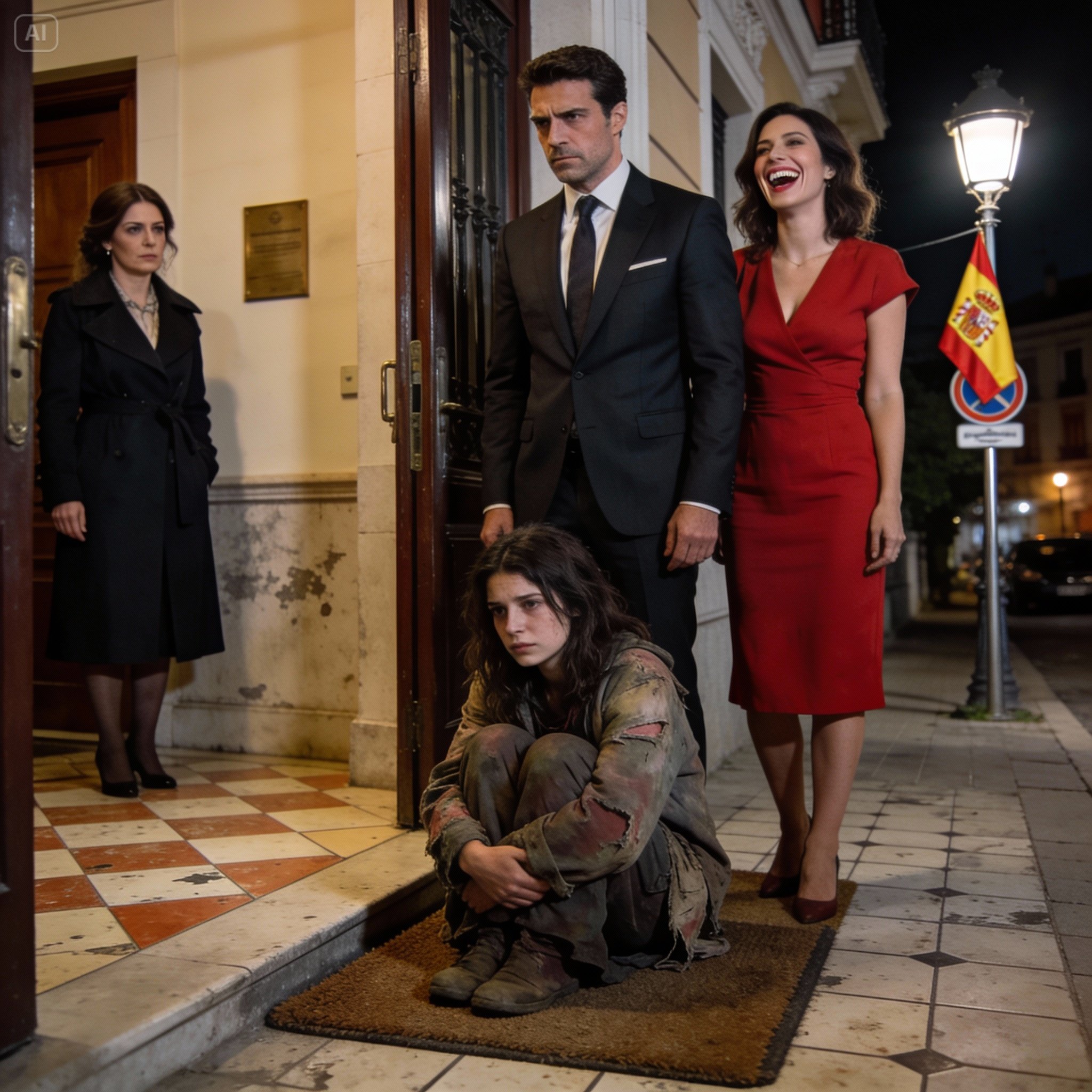
I stayed in the shadows, protected by the darkness of the front garden, watching as the front door opened. The warm light from inside cast a silhouette upon my sister’s body. It was Ricardo. He wore an impeccable tailored suit, with a glass of red wine in his right hand. Behind him, a young woman, clad in a red dress as provocative as her cynical smile, leaned on his shoulder.
“Ricardo, what is that?” asked the woman in the red dress, pointing with disgust at my sister’s body.
Ricardo lowered his gaze. There wasn’t a trace of remorse, not a sliver of humanity in his eyes. With a coldness that chilled me to the bone more than the mountain wind, he lifted his Italian leather shoe and, with slow, deliberate movements, rubbed the dirty sole against Helena’s back. He used her like a rag. Like an inanimate object to dust his shoes before leaving.
“Relax, darling,” Ricardo said to his lover in a syrupy voice that made me nauseous, “she’s just our crazy maid. She thinks she owns the place, but you see, she’s only good for keeping the floor from getting too hard.”
The lover let out a shrill laugh, a sound that tore through the night air like a knife. Helena shuddered slightly, a stifled sob escaping her chapped lips, but she didn’t even have the strength to get up. She was broken. They had broken her inside, leaving her convinced that she was worth no more than the dust Ricardo rubbed on her.
It was at that precise moment that Clara Moura the lawyer stepped back, giving way to Clara Moura the sister, a force of nature fueled by the purest rage and the most implacable sense of justice. I didn’t scream. I didn’t cry. The pain was too great to be expressed with a sound. I took a step forward, emerging from the shadows, my leather briefcase clutched to my side and a wool coat that weighed like armor.
The world seemed to freeze. Ricardo, noticing my presence, turned pale, a grayish hue reminiscent of the ash from the cigars he used to smoke. The woman in the red dress opened her eyes wide, her laughter dying instantly in her throat.
“Good evening,” I said. My voice was deathly calm, that terrifying calm that precedes a storm that devastates entire cities. “You’re Ricardo, aren’t you? The man who promised before God and our family to take care of Helena in sickness and in health.”
He swallowed hard; the sound was audible in the silence of the street. His hands began to tremble, making the red wine dance precariously in his glass.
“W-who are you?” he stammered, though deep down in his twisted mind, he knew perfectly well who I was. He had avoided meeting me for years, dreading the day someone with clear eyes would see through his facade.
I took a deep breath, filling my lungs with the strength of my ancestors, with the dignity of a family that never allowed itself to be trampled on.
— My name is Clara Moura. I’m Helena’s older sister. And most importantly for you right now, Ricardo: I’m the lawyer who drafted every single clause in the contract for this property and the company that finances your nouveau riche lifestyle.
I took out my mobile phone and turned on the screen, displaying a digital document stamped by the Madrid property registry. The white light illuminated his cowardly face.
“This house isn’t in your name, and it never will be,” I continued, taking another step toward him, forcing him back into the foyer. “This property belongs to the investment firm that rescued your failing business three years ago. And do you know who the majority shareholder of that firm is? My sister Helena. In her boundless generosity and blind love, she used her inheritance to save your skin. But the contract I drew up had a clause for immediate termination due to ‘unworthy conduct and mistreatment of the benefactor.’”
Ricardo tried to recover some of his arrogance; a nervous laugh escaped his lips as he sought support from his lover, who was already retreating into the shadows of the hallway.
“You’re exaggerating, you two-bit lawyer,” he spat, though his voice lacked conviction. “Helena is sick. She has mental problems. I’m the one who takes care of her, the one who keeps her here out of pure charity. She doesn’t even know what day it is.”
“Care?” I repeated the word with utter disgust. I knelt on the cold floor, completely ignoring that wretch, and covered Helena with my wool coat. When I touched her, I felt how much she was trembling. Her eyes opened, and when she recognized me, a spark of life, a glimmer of the old Helena, shone through her tears. “Is this what you call caring, Ricardo? Leaving her sleeping on the floor like an animal while you get drunk on the money she earned with her talent?”
The lover whispered, her voice heavy with fear and selfishness: “Ricardo… you told me everything was settled… you said she had no one…”
I glared at them both with a contempt that made them flinch. “It isn’t. In fact, today is the day your charade ends. Today is the day I get my sister back, and you find out what it means to be left in utter poverty, because from this moment forward, you are legally evicted from this house, and your bank accounts have been frozen on suspicion of administrative fraud.”
I took a brown leather folder from my bag, bearing the official seal of the Plaza de Castilla courts. I placed it on the console table in the entryway, right next to a wedding photo that now seemed like an insult to human intelligence.
“Here are the documents for the immediate restraining order, the divorce petition for extreme cruelty, and the audit proving how you’ve been diverting funds from Helena’s company to pay for your ‘friend’s’ luxuries,” I said, gesturing to the woman in red. “You have ten minutes to collect your personal belongings. Everything purchased with company money stays here. Including that watch you’re wearing, Ricardo.”
Ricardo was speechless. His crystal world was shattering at his feet. Helena, leaning on my shoulder, began to get up. She was weak, but when she saw the papers and felt my firm hand, her back began to straighten.
“Helena,” I whispered in her ear, with a tenderness I reserved only for her, “look at me. It’s over. From now on, no one will ever treat you like this again. You are the master of your life, of this house, and of your future. I am here, and I’m not going anywhere.”
It was a long process. The following hours were a whirlwind of police officers, on-call lawyers, and the pathetic weeping of a man who, finding himself penniless, realized he was nothing. Ricardo left the house with a small suitcase, booed by neighbors who had come out to witness the commotion. His mistress left long before, disappearing in a taxi without looking back, proving that her “love” was as volatile as a bank balance.
We were left alone in the great room. I ordered every corner cleaned, that cursed doormat burned, and the locks changed. I prepared a hot broth, like the one our grandmother used to make for us in the village, and sat Helena down in front of the fireplace.
“Clara…” she whispered, her voice breaking but clear. “I thought I’d forgotten who I was. He made me believe I was nothing without him. He told me every day that I was worthless, that my career had been a fluke, and that he was my only savior.”
“I know, little one. That’s what parasites do. They try to convince the host that they can’t live without them. But you are the structure, Helena. You are the architect. He was just a bad tenant we’ve already evicted.”
Months passed. Recovery wasn’t easy. There were nightmares, days when Helena didn’t want to get out of bed, overwhelmed by guilt for having allowed so much pain. But Spain has something that heals the soul: the sun, family, and that indomitable strength we carry in our blood. We went to our house in the mountains, surrounded by pine trees and fresh air. Helena started drawing again. At first, the strokes were erratic, but little by little, the lines became firm and confident.
A year later, Helena opened her own architecture studio in the heart of Madrid. At the entrance to her office, there are no coconut fiber doormats. Instead, there’s a gleaming marble floor that reflects the light streaming in through the large windows. And most importantly, her face no longer bears any trace of weariness, but rather the determination of someone who has descended into the depths of despair and returned with the blueprints to build her own paradise.
Ricardo tried to contact her several times, begging for forgiveness, asking for money, groveling like the miserable creature he always was. Helena never responded. Not out of hatred, but for something much more powerful: indifference. He no longer occupied even a millimeter of her thoughts.
The day I saw him cleaning his shoes on her, he thought he was demonstrating his power. He didn’t know he was lighting the fuse of his own destruction. Because in this life, you can deceive many, you can trample on some, but never, ever, underestimate the power of a woman who has a sister willing to do anything for justice.
Justice in Spain is slow, some say, but when it arrives hand in hand with truth and sisterly love, it is relentless. Helena became Helena again. And I, Clara Moura, learned that the most important contract I’ve ever written wasn’t the one for that house, but the silent promise I made to my sister that night: “You will never be alone again.”
Today, as we walk through El Retiro Park, watching the leaves fall and create a golden blanket, Helena stops, looks at me, and smiles. It’s a full, genuine smile. There’s no more fear. No more cold. Only the warmth of someone who knows that her home isn’t a building, but the respect and dignity that no one will ever take from her again.
Abuse sometimes leaves no visible bruises, but it leaves scars on the spirit that only the truth can heal. If you ever feel like Helena, curled up on an emotional doormat waiting for someone to stop trampling on you, remember that there’s always a Clara nearby, or better yet, remember that within you lives an architect capable of rebuilding her world from the ground up. Don’t let anyone wipe their malice on your back. Stand up, walk, and reclaim what is yours by birthright: your freedom.
And so, in the stillness of a night that began as a tragedy and ended as a rebirth, we understood that true love doesn’t humiliate, doesn’t trample, and above all, doesn’t need to wipe its shoes on anyone’s soul. Helena’s story isn’t just a story of betrayal; it’s the manifesto of all those who decided enough was enough. And in that “enough,” we found the strength to change the world, one law and one heart at a time.
Because at the end of the day, after the darkest storms and the harshest winters, the sun always rises over Madrid, illuminating not only the cobblestone streets, but also the paths of justice we chose to walk together. Helena is safe. Ricardo is a bitter memory fading into oblivion. And I’m still here, with my briefcase and coat, ready for any battle, because I know that sisterly love is the most sacred law on earth.
Life gives us second chances, but it’s up to us to have the courage to open them when they knock, even if that door is guarded by monsters. Helena opened it. I held it. And together, we walked toward the light of a new dawn in our beloved Spain, where dignity is worth more than any fortune and where family is the only refuge that will never fail us.
Don’t scream, don’t cry if you don’t have the strength, but never stop taking that step forward. The world may freeze for a second, but when the ice breaks, what remains is the purity of your own strength. And that, dear reader, is something no Ricardo in the world can ever take from you. Justice always arrives, sometimes dressed as a lawyer, sometimes dressed as a sister, but always, always, with truth as its banner.