I discovered that my husband and mother-in-law were planning to empty my savings account at an ATM in Madrid while I slept, but my silent revenge with three euros and a PIN change taught them the lesson of their lives.
CHAPTER 1: THE CAFE OF SUSPICION
Behind the bedroom wall, my husband’s muffled voice reached me like a dirty echo in the middle of the Madrid night. Involuntarily, my ears picked up the frantic whisper he uttered into the phone: “Get everything out, Mom. She has more than one hundred thousand euros there.”
Ricardo was giving him his own birthdate as the code for my card, completely unaware that I was awake, staring blankly into the darkness of the ceiling. My heart should have been pounding in my chest. I should have felt panic, nausea, or that uncontrollable urge to cry that hits you when your world is falling apart. But instead of tears, a faint, almost imperceptible smile touched my face. I calmly closed my eyes and stayed there, lying down, breathing in time with his betrayal.
My name is Marina, I’m 37 years old, and I’ve never considered myself a paranoid person, more of an observant one. Life, and especially my job as an accountant in a consulting firm in downtown Madrid, had taught me a simple and absolute truth: people don’t lie with words, they lie with their eyes, with their hands, and with those awkward silences when they’re asked a direct question and have to make up an answer on the spot.
Ricardo had been lying, or at least acting strangely, for almost two weeks. I first noticed it one ordinary Wednesday, a gray October morning when the rain beat against the windows with that melancholic insistence typical of autumn in the capital. I opened my eyes and saw my husband standing by the bed, a steaming mug in his hand.
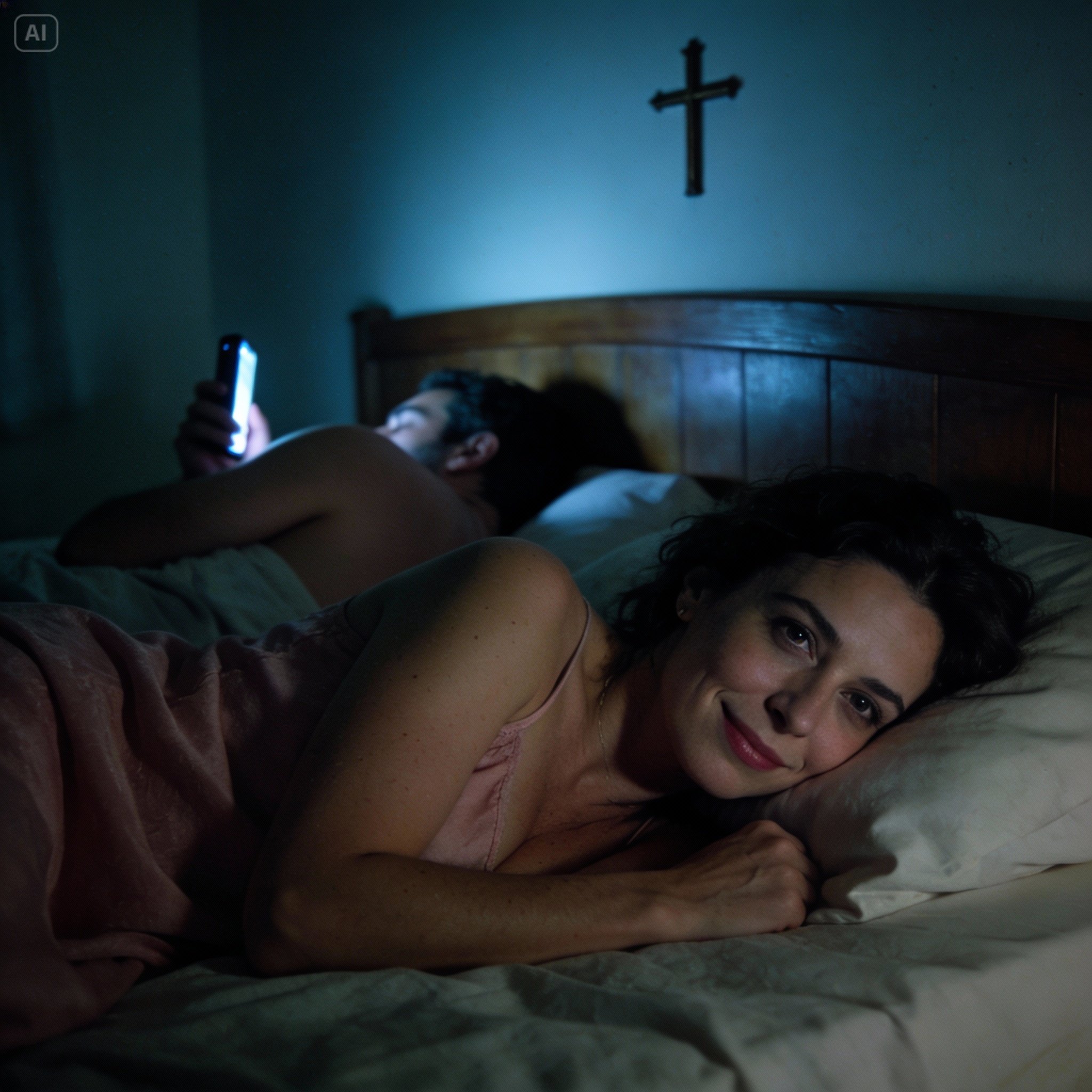
I felt something tighten inside me, like a violin string about to snap. Ricardo never brought coffee to bed. Not even in our first year of marriage, when we still played at being lovebirds and strolled hand in hand through the Retiro Park. At most, he’d grunt from the doorway: “Get up! I’ve put the coffee on.”
“Why did you get up so early?” I asked, propping myself up on my elbows, scrutinizing his face.
He smiled, but it was too wide a smile, too artificial.
—Nothing, I slept well. I just wanted to… make you happy.
It was that pause before “making you happy.” A one-second pause, barely perceptible to anyone who didn’t live with him, that gave him away. I picked up the cup and took a sip. The coffee was sweet, cloying, even though he knew perfectly well that I hadn’t had sugar in five years.
“Thank you,” I said, swallowing the syrupy liquid. “It’s… delicious.”
She went to the kitchen whistling a cheerful little tune, while I sat there, staring out the window at the wet street. Outside, Madrid was dawning under a fine, gray drizzle, as murky as the anxiety that was beginning to stir in my stomach.
At work, I tried to distract myself all day with numbers. Accounting is the perfect refuge for those who don’t want to think about real life; columns, Excel spreadsheets, bank reconciliations… the important thing is not to look up. But the thoughts kept creeping in like persistent flies in summer. Ricardo was acting strange. Not just strange, suspicious.
He’d become too attentive, too affectionate. It was unusual and, frankly, more frightening than if he’d suddenly become rude. On Friday, he showed up with flowers. A bouquet of yellow and white chrysanthemums, wrapped in that noisy plastic you get at gas stations or cheap street stalls. Just like that, for no reason.
I took the bouquet and thanked him, then went to find a vase to hide my trembling hands. In five years of marriage, Ricardo had given me flowers twice: once for my birthday and once for International Women’s Day, and always because he felt obligated to.
“Do you like them?” he asked, peeking his head into the kitchen while I was cutting the stems.
“Very much so,” I lied. “They’re beautiful.”
She stood in the doorway, hands in her pockets, with that expression of someone who wants to say something but doesn’t dare, until finally she nodded and went into the living room. I placed the vase on the windowsill. Something was brewing. I felt it in my skin, in every nerve, that ancient feminine intuition that screams “run” before you even see the wolf.
As night fell, Ricardo began with the questions. We were having dinner in the kitchen, a quick omelet and some cold cuts. He was looking at his phone, scrolling endlessly , when he blurted out without looking up:
—Hey Marina, how much have you already set aside for the kitchen renovation?
I froze, with the fork halfway to my mouth.
—Why do you ask?
—Out of curiosity. You wanted to renovate the whole thing, didn’t you? Do you have enough money?
—It resonates with me. Definitely.
—Perhaps you should save a little more. Don’t rush into anything. Materials have gone up a lot.
I put my fork down on the plate and stared at him.
—Ricardo, I’ve been saving for three years. I have enough.
He nodded, but it was clear my answer didn’t satisfy him. He was expecting something else. Numbers, concrete figures, data.
—And how much do you have in total? I mean, just curious.
—Well, in the account… —I raised my eyes to him, defiant—. Enough.
He made a forced grimace, a crooked smile.
—Okay, okay. You don’t want to say it, fine. I just wanted to help.
“Help.” Coming from Ricardo, who in five years of marriage had never offered to pay half the grocery bill without my asking, the word sounded like a bad joke. I finished my dinner in silence. Inside, everything had gone cold, but my face remained calm. That was my greatest talent: never showing the storm raging inside me.
Money. So that’s what it was all about.
Indeed, there was a substantial sum in my personal account, a little over one hundred thousand euros. It wasn’t money earned from my salary as an accountant, although I saved every penny I could. It was my inheritance from my grandmother Julia, the only person who had ever loved me unconditionally in this world. My grandmother had passed away two years earlier in her village in Segovia, leaving me her old apartment and the savings from a lifetime of hard work in the fields.
I sold the apartment, added the money to my own savings, and decided to put it aside. It was my safety net, my fund for renovations, or maybe for that trip to Japan I’d always dreamed of, or simply for rainy days. Ricardo knew about the inheritance. Two years ago, when I received the money, he tried to suggest we invest in a friend’s “sure thing”—a cocktail bar that closed after six months. I refused, gently but firmly. Since then, money had been a taboo subject between us. Until this week.
On Saturday, Ricardo started showing an unusual interest in my purse. First, casually: “Did your phone ring?” Then, he needed a charger, claiming his was broken, and I saw him rummaging around near my wallet. On Sunday, he dropped the bombshell: he asked if I wanted to open a joint account. Supposedly, it would be “more convenient” to save together, spend together. “After all, we’re family,” he said.
I stood before the mirror, braiding my hair, watching my reflection. He sat on the edge of the bed, still sweet, still “concerned,” and lying in a way that was almost painful to watch.
“I’m fine with mine,” I said calmly. “I’m used to my bank.”
He frowned.
“That’s nonsense. We’ve been together for so many years and you still act like we’re strangers when it comes to money. I’m not a stranger, I’m your husband.”
—I’m just used to managing my own things, Ricardo.
He didn’t insist, but he hung like a dark cloud over the house for the rest of the day. While he watched football, I thought, remembered, analyzed.
Five years ago, I married Ricardo almost on autopilot. He was charming, easygoing, full of life, always knowing exactly what to say at the right time. I was 32, tired of being alone in a city as big and sometimes as lonely as Madrid, and everyone around me kept repeating the mantra: “Your time is running out, Marina. It’s time, it’s time.” So I gave in.
The first two years were normal. He worked in sales, I worked at the accounting firm. Afternoons were for watching series on Netflix, and weekends… ah, weekends were the price to pay: visiting his mother, Carmen.
Carmen. My mother-in-law. The true driving force behind all the misfortunes in our marriage. Carmen appeared in our lives with enviable regularity. Help with a repair, money lent that she never repaid, or simply the cutting remark: “I’m bored on my own, son.” I tolerated it, first out of politeness, then out of habit and resignation.
Carmen was a tall, robust woman with hair always dyed a deep mahogany and a perpetually disapproving gaze. She firmly believed that the world owed her something, that Ricardo owed her his life, and that I, her daughter-in-law, owed her servitude.
Two years ago, when I received my inheritance, my mother-in-law suddenly became affectionate. She’d come over with Tupperware containers of croquettes (which she usually criticized), ask about my health, and compliment my hair. But I noticed how she eyed my new things: the leather handbag, the new sofa, my phone. She started making snide remarks about how difficult it was for a “poor pensioner” to make ends meet. I sympathized, but I didn’t give her any money. Carmen got offended and stopped calling for three months.
Now, it seemed, he had decided to change his strategy and act through his son.
I went to bed late that night. Ricardo was already snoring, sprawled across half the bed. I lay staring at the ceiling, knowing something was about to happen. A strange calm was growing inside me. It wasn’t fear, it wasn’t panic. It was a firm coldness, like ice.
I had learned this as a child, in a house where shouting was the usual soundtrack. I learned then: “Don’t cry, don’t scream, just wait. Wait for the storm to pass and then do what you have to do.” Now, the storm was coming, and I knew I had to be ready.
CHAPTER 2: THE MASTERPLAY
The next morning I woke up before my alarm went off. I dressed quietly and left the house without waking my husband. It was cold outside, a mountain wind seeping through my coat. I walked quickly to my bank branch, located three blocks away.
The bank opened at 8:30. I was third in line. When it was my turn, the manager, a young woman with a tired face who already knew me by sight, listened to me and nodded.
—Yes, of course, Marina. We can change the PIN on your main card right now. It’ll only take a moment.
—And please— I added, lowering my voice—, could you activate the maximum alert service? I want any attempt to withdraw cash over 50 euros to trigger an immediate alert to security and block the transaction until I confirm it by phone.
The girl looked at me attentively, perhaps sensing a problem with domestic violence or fear of scammers.
—Of course. Have you noticed any suspicious activity?
—Let’s just say I prefer to be safe.
Twenty minutes later, it was done. The PIN on the main card, that black card where Grandma Julia’s one hundred thousand euros rested, had been changed. The old PIN, 3806 (Ricardo’s birthday, how ironic), remained active… but on the backup card.
That backup card was an old account I’d opened years ago for small online purchases and had forgotten about at the bottom of a drawer. Yesterday, discreetly, I’d slipped it into my wallet and transferred exactly 3 euros. Not a penny more, not a penny less. Now that card, with the PIN Ricardo knew, was in plain sight in my wallet, while the “good” card was hidden in the lining of my purse.
I left the bank and stood for a moment on the sidewalk, breathing in the cool air of the Castellana. People hurried around me. Ordinary Madrid on an ordinary morning. Yet, inside me, the tectonic plates of my life had shifted. I was ready.
That night, Ricardo brought up the subject of money again. This time more cautiously, skirting around the sharp edges.
“Hey, have you thought about opening a fixed-term deposit?” he asked, listlessly spearing his macaroni. “Interest rates are rising. It’s worth it.”
I shrugged, pouring myself some water.
—I’ve thought about it, but I can’t decide. I prefer to have the money available.
—What if your card gets stolen or your account is hacked? There are a lot of scammers these days, Marina.
I smiled slightly, without looking at him.
—They’re not going to steal it from me.
—How can you be so sure?
“I know because the only thief I have nearby sleeps in my bed, and his mother is the mastermind behind the operation,” I wanted to say. But I kept quiet. I just gave him a long, calm look. He looked away first.
The night passed in tense calm. I knew he wasn’t asleep. I could feel his uneven breathing beside me. I knew that very soon, everything would change.
The next morning, the phone rang early. I had just gotten out of the shower when I heard Ricardo’s phone vibrating in the hallway. He answered it quickly, too quickly, and his voice sounded tense.
—Yes, Mom. Hello.
I wrapped myself in my bathrobe and strained to hear.
“Today… I don’t know.” Ricardo paused, listening. “Okay, fine. Come around six.”
I came out of the bathroom drying my hair with a towel. Ricardo was standing in front of the mirror, buttoning his shirt, pretending not to notice me.
“Is your mother coming?” I asked casually.
She shrugged, avoiding my eyes in the mirror.
—Yes. She wants to talk about some things about herself. She feels lonely.
-I understand.
I went to the kitchen to boil some water. My hands were steady, but I had a tight knot in my stomach. Let the show begin.
CHAPTER 3: THE LUNCH OF GREED
That afternoon I arrived home at six o’clock sharp. I went up to the fourth floor, opened the door, and immediately heard their voices. Ricardo and his mother were in the kitchen. On the table was a box of pastries from an expensive bakery, the kind filled with cream and chocolate.
“Oh, Marina, come in, come in!” Carmen waved her hand as if inviting me into her own home. “Ricardo and I are having tea. Join us.”
I hung up my coat and went inside. My mother-in-law looked impeccable. Silk blouse, dark trousers, her hair perfectly styled in stiff waves, and that French manicure that looked like claws. A classic 65-year-old lady who takes great care of herself and desperately wants to appear wealthier than she actually is.
—Hello, Carmen—I said, sitting on the edge of a chair.
“How are you, my dear?” He smiled, but his eyes were cold scanners. “Working hard, I suppose.”
—Yes, tax season is coming.
—Sure, sure. Ricardo tells me you’re planning to renovate the kitchen.
I looked up. There he was.
-That’s how it is.
—It must be incredibly expensive now. Everything is sky-high.
—I manage.
Carmen shook her head, with that air of being an expert on life that irritated me so much.
“Good for you, of course. But you know, Marina… maybe you shouldn’t rush into anything. Having money in the account provides security. And the kitchen is fine as it is. You could wait. Imagine you need the money for something more important. For your health, or… for your family.”
Ricardo sat in silence, staring at his teacup, as if he could read the future in the tea leaves.
“If I need it, I’ll use it,” I replied flatly. “But I don’t need it for emergencies right now.”
Carmen sighed theatrically.
—I, for example, have been saving all my life. Penny by penny. And now what? I’m retired and I can barely make ends meet. Electricity, gas, medicine… Thank goodness Ricardo helps.
I raised an eyebrow.
-Aid?
Ricardo shifted in his chair.
—Well… sometimes I give him something. I do his shopping.
“Interesting,” I murmured. I knew Ricardo barely made ends meet with his own expenses. If he gave money to his mother, he was either taking it from somewhere he didn’t have it, or going into debt.
“I’m thinking,” Carmen continued, inspecting her fingernails, “that maybe I should sell my apartment. My apartment in Chamberí is worth a lot. I could sell it, move to something cheaper in the suburbs, and live off the difference.”
I took a sip of tea. It burned.
“That’s not a bad idea,” I said. “It’s an expensive area. You’d make good money.”
My mother-in-law’s eyes widened in shock. Clearly, that wasn’t the answer she’d been expecting. She’d been hoping for, “No, Carmen, for God’s sake! We’ll help you, I have money saved.”
“Yes… that’s what I thought,” she said with a crooked smile. “But it’s my lifelong home. Perhaps there’s another way.”
Silence fell. They both waited. I finished my tea, stood up, and said:
—I’m going to change my clothes. I’m exhausted.
I left the kitchen feeling two pairs of eyes fixed on my back: one pair furious, the other frightened. In the bedroom, I closed the door, but not completely. I sat on the bed and strained to hear.
The voices sounded again, now whispering, hissing.
—…she’s selfish, I told you. She’s got the money sitting there laughing at me while I’m having a hard time.
—Mom, lower your voice. She’s going to hear us.
“Let her hear us! I raised you alone, Ricardo. You owe me everything. And now you’ve married this cheapskate who won’t even offer to help. One hundred thousand euros, son. One hundred thousand!”
—I know, Mom. But…
—But nothing. We have to act. If she doesn’t give it up willingly, we’ll take matters into our own hands. She won’t even notice at first. She has so much she won’t realize if part of it is missing. And then… we’ll say it was a bank error, or that her card was cloned. Those kinds of frauds happen every day.
—I don’t know, it’s risky.
—What risk? You know the PIN, right?
—Yes… the 3806.
—That’s it. Tonight, when she’s asleep, take the card from her purse. Go down to the ATM on the corner. Withdraw the maximum amount it lets you. And we’ll do it again tomorrow.
I closed the door gently.
I didn’t feel pain. I felt disgust. A deep, heavy disgust. They wanted to rob me. My husband and his mother were conspiring in my own kitchen, eating expensive cakes, planning to rob me.
CHAPTER 4: THE CASHIER OF DISCORD
Night fell on Madrid. Ricardo tossed and turned in bed for hours. I pretended to sleep, breathing slowly and deeply.
Finally, around three in the morning, I heard the mattress creak. Ricardo got up with exaggerated stealth. I heard him tiptoe to the chair where I’d left my bag. The sound of the zipper was like thunder in the silence of the room. Then, footsteps toward the hallway. The front door opening and closing with an almost inaudible click.
I opened my eyes in the darkness. My heart beat calmly, almost sluggishly. I got up, went to the window, and pulled back the curtain just a centimeter.
Our building faces a quiet street. Directly opposite, illuminated by a flickering greenish light, is the ATM of an old savings bank.
I saw Ricardo cross the street, huddled inside his jacket, looking around like a criminal in a cheap movie. He stopped in front of the machine.
I saw him take out the card. The backup card, the one I’d left visible in my wallet. He inserted it.
He entered the PIN. 3-8-0-6.
Wait.
From my window, I couldn’t see the screen, but I could perfectly imagine it: AVAILABLE BALANCE: 3.00 EUROS.
I saw Ricardo bang his open hand against the side of the ATM. I saw him try again. He was typing furiously. Probably trying to withdraw 600 euros, then 300, then 50. Nothing. Insufficient funds.
At that moment, my phone, which was resting on the nightstand, vibrated. Just once. A notification from the bank’s app.
Security alert: Attempted cash withdrawal with secondary card. Insufficient funds. Is that you?
I ignored the message.
Downstairs, Ricardo was panicking. He pulled out his phone and called someone. His mother, no doubt. I saw him gesticulating wildly, waving his arms around. He was desperate.
Then he did something stupid. He put the card back in. He tried another PIN. Maybe he thought I’d changed it. He tried my date of birth. He tried his own again.
And then, the cashier did what cashiers do when they detect suspicious behavior and repeated incorrect PINs at three in the morning: it swallowed the card.
I saw Ricardo freeze in front of the empty slot. He slammed his fist on the screen once more, defeated, and crossed the street back home.
I went back to bed and closed my eyes. When he came into the bedroom, he smelled of cold sweat and tobacco. He got into bed, trembling.
“Ricardo?” I murmured, pretending to wake up. “What are you doing? You’re freezing.”
“Nothing… I went to the bathroom,” she whispered in a strangled voice. “Go to sleep.”
CHAPTER 5: THE OUTCOME
The next morning, the atmosphere in the kitchen was funereal. Ricardo had dark circles under his eyes that reached the floor and looked at his coffee as if it were poison.
“I’m going to work,” he said without looking at me.
“Wait,” I said. I took out my phone and put it on the table. “I have a curious notification from the bank.”
Ricardo went as white as a sheet.
—Oh, really?
—Yes. He says that at 3:14 in the morning, someone tried to withdraw money with my backup card at the ATM across the street. And that because they entered the PIN incorrectly several times after seeing there was no balance, the machine swallowed the card.
I looked up and stared at him.
—Ricardo, do you know anything about this?
He opened his mouth, then closed it. He began to stutter.
—I… no… it must be… maybe they cloned…
—Don’t insult me, Ricardo. I saw you through the window.
The silence that followed was absolute. You could have heard a pin drop.
“Marina, I can explain it to you…” he began, crocodile tears welling up in his eyes.
—No. You can’t. I know you spoke to your mother. I know you wanted to rob me. I overheard your conversation yesterday. And last night, while you thought I was asleep and were on the phone in the bathroom giving her instructions, I was awake.
Ricardo collapsed into the chair, hiding his face in his hands.
—It was her idea… she pressured me… she said you were selfish…
—And you, like a good, obedient son, decided to steal your wife.
—We needed the money!
“You had a job! We had a life!” I shouted for the first time, releasing my rage. “But greed got the better of you. You wanted the easy way out.”
At that moment, her phone rang. It was Carmen.
“Take it,” I ordered.
Ricardo put it on speakerphone with trembling hands.
“Ricardo!” Carmen’s voice shrieked. “I went to the bank first thing this morning with my passbook to see if I could sort things out between us, and they told me there’s an investigation into attempted fraud with your card! They say there are cameras at the ATM! They’re going to see it was you! What do we do?”
I went to the phone.
—Hello, Carmen.
There was a gasp on the other end of the line.
-Marine?
—Yes. Listen carefully, both of you. I’m not going to report you to the police, even though I have more than enough evidence. The cameras, the seized card, the bank records. I could get you into a legal mess that would cost you much more than one hundred thousand euros.
“Marina, my dear, please…” the mother-in-law began to whimper. “It was a moment of weakness…”
“Shut up. I won’t press charges, but on one condition. Ricardo, you’re packing your bags right now. You’re going to your mother’s. And I’m going to file for divorce. You’ll sign everything without a word. You won’t ask for a single euro. If you try to argue about anything, if you try to contact me, I’ll go to the police with everything.”
—But… —Ricardo sobbed.
—Deal?
Silence. Then, Carmen’s defeated voice:
—Deal.
CHAPTER 6: THE REBIRTH IN MADRID
Ricardo left that very morning. He took his clothes and his debts. I kept my apartment, my savings, and, most importantly, my dignity.
The following weeks were strange. I went through the grieving process, of course. Five years don’t just vanish in an instant. But every time I felt sadness, I looked at my bank account, untouched, and remembered the night I saw my husband banging on an ATM for three euros. And the sadness turned into relief.
The divorce was quick. Ricardo, terrified of a potential criminal complaint, signed everything. Apparently, living with his mother in a tiny 40-square-meter apartment wasn’t the paradise they’d hoped for. I heard from a gossipy neighbor that they were shouting at each other every day. Poetic justice.
Months later, with spring bursting forth in Madrid, I renovated the kitchen. It turned out beautiful, white, and bright. I signed up for English classes and started going out more with my friends.
One Friday night, at a company dinner, I met David. He was an architect, had a contagious laugh, and when the bill arrived, he not only insisted on paying his share, but didn’t even ask how much I earned.
We’ve been dating for six months. I don’t know what the future holds, but I know one thing: I’ll never again let anyone make me feel guilty for protecting what’s mine.
Sometimes, the best revenge isn’t shouting or insults. Sometimes, justice is three euros on a forgotten card and the wisdom to know when to change your PIN.