“DON’T CRY, HONEY” — A WOMAN HELPED A LOST GIRL EVERYONE IGNORED, UNAWARE SHE WAS THE CEO’S DAUGHTER
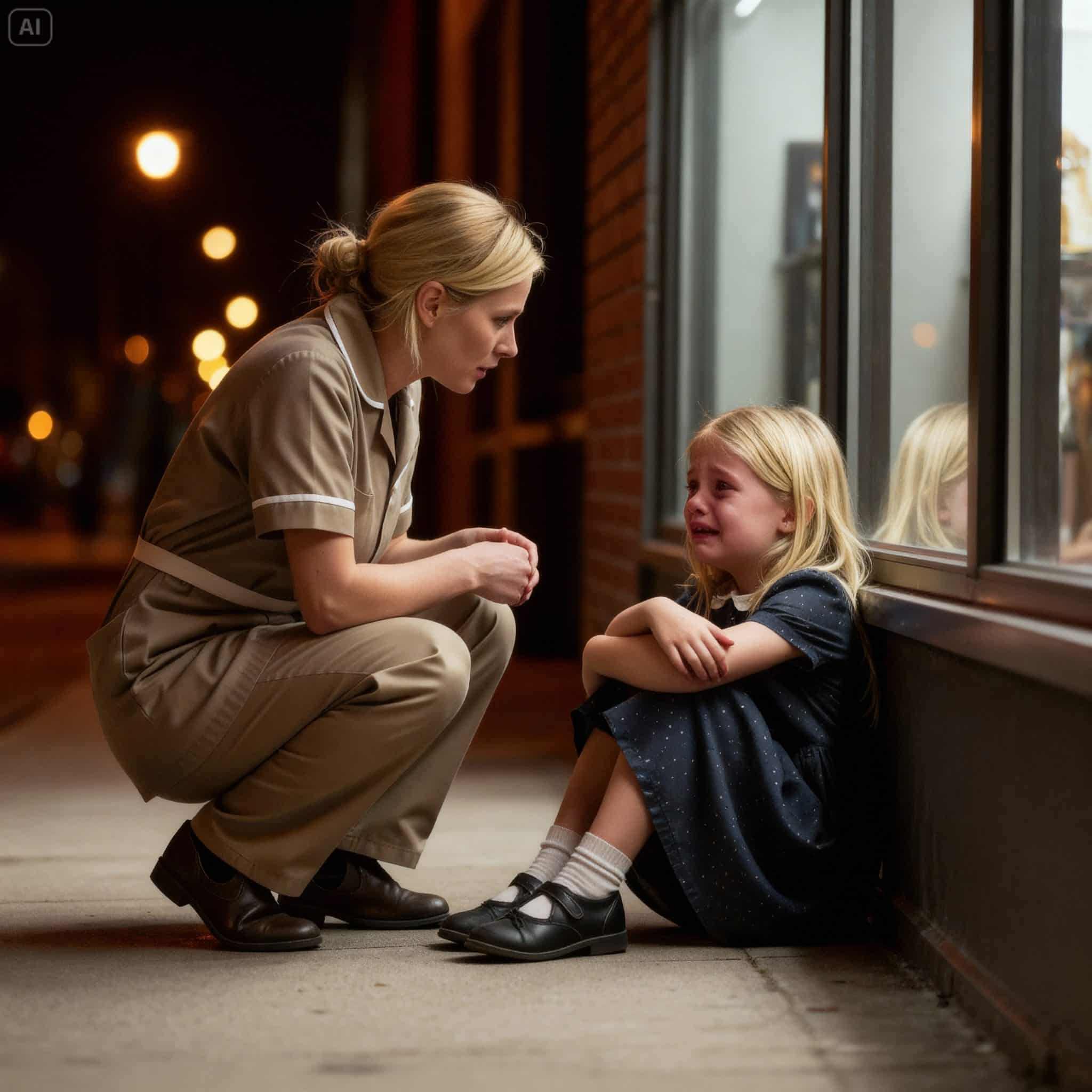
Don’t cry, honey. I’ll help you find your daddy.” The words came out softly, almost a whisper amid the chaos of Michigan Avenue. Rosa knelt on the cold ground, ignoring the grit staining her already worn cleaning uniform. In front of her, a blonde little girl, no more than seven years old, was huddled against a storefront window, trembling.
Her navy blue dress was too expensive for that sidewalk, her blue eyes too swollen for someone so small. Dozens of people rushed past—men in suits, women in high heels—all in a hurry, all looking through the child as if she were invisible. No one stopped. No one cared. But Rosa stopped. “Are you lost, sweetheart?” Rosa asked gently, taking off her own jacket, the only one she owned, and placing it over the girl’s shaking shoulders.
“I—I ran away from home,” the little girl sobbed, her voice broken. “My daddy yelled at me and I just wanted my mommy. But mommy’s not here anymore. She’s gone forever.”
Rosa’s heart shattered. She knew that pain, that emptiness of losing someone loved.
“What’s your name?”
“Janine,” the girl answered, wiping tears with her small hands.
Rosa had no idea she was about to meet the man she’d loved desperately at seventeen. She didn’t know that this little girl crying on the sidewalk was the daughter of a millionaire CEO. She couldn’t imagine that one simple act of kindness would change three lives forever. All Rosa knew was that she couldn’t leave this child alone in the cold. “Let’s get you home, honey,” Rosa said, extending her hand. And when Janine held her fingers with absolute trust, as if Rosa were the answer to all her prayers, something impossible began to happen. A love story that Destiny had written twelve years ago, but was only now ready to be told.
The Cold Chicago Evening
The October wind cut through the streets of Chicago like a cold knife, carrying with it the scent of rain and fallen leaves. Rosa Townsend, twenty-nine years old, pulled her thin jacket tighter around her shoulders as she stepped out of the Willis Tower’s service entrance. Her feet ached with that deep, bone-tired pain that came from standing for eight hours straight, scrubbing floors and wiping down windows on the forty-second floor. Her hands, rough and reddened from chemicals, trembled slightly as she checked her phone: 5:45 PM. If she hurried, she could catch the 6:00 bus and be home by 7:30, maybe grab something cheap for dinner, collapse into bed, and do it all over again tomorrow.
Some days, she felt twice her age. Her blonde hair, usually tied back in a practical ponytail, had strands escaping around her face. Her green eyes, once bright with dreams, now carried the weight of too many disappointments. Too many bills, too many nights wondering if this was all life had to offer. But even in her exhaustion, there was something unbreakable in Rosa. She kept moving forward, kept fighting, kept believing things had to get better.
She began her walk toward the bus stop on Michigan Avenue, navigating the evening rush of business people, tourists, and street musicians. The city hummed with life and energy, everyone moving with purpose, everyone belonging somewhere. Rosa sometimes felt like a ghost moving through their world, invisible, insignificant.
But then she saw something that made her stop dead in her tracks.
An Invisible Child
On the cold sidewalk, pressed against a storefront window, sat a little girl. She couldn’t have been more than seven, with blonde hair catching the fading light and the most heartbreaking blue eyes Rosa had ever seen. The child wore a navy blue dress that looked expensive, the kind you’d see in boutique windows on the Magnificent Mile. She was hunched over, arms wrapped around her knees, shaking—not just from the cold, Rosa realized as she watched. The little girl was crying, silent tears streaming down her pale cheeks.
Rosa looked around, expecting to see a frantic parent searching, calling out, but the crowd just kept flowing past the child like water around a stone. Businessmen with briefcases, women in heels clicking urgently toward their destinations, couples laughing. Everyone saw the little girl. Rosa was certain of that, but no one stopped. No one helped.
Something in Rosa’s chest tightened painfully. She thought of all the times in her own life when she’d felt invisible, when she’d needed help and no one had noticed. She thought of the little girl she’d been once, full of dreams before life taught her the world could be cruel and indifferent.
Without conscious thought, Rosa’s feet carried her toward the child. She approached slowly, crouched down to the girl’s level. Up close, she could see the child had been crying for a while. Her eyes were red and swollen.
“Hi there, sweetheart,” Rosa said softly, her voice gentle. “Are you okay? Are you lost?”
The little girl’s head jerked up, eyes wide with fear. But then something shifted. Maybe it was the genuine kindness in Rosa’s face. The child’s lower lip trembled.
“I—I ran away from home,” Janine whispered. “Daddy got really mad at me because I spilled juice on his important papers in his office. He yelled so loud and I was scared and I just—I just wanted my mommy. But mommy isn’t here anymore. She’s gone. She’s been gone for so long and I miss her so much.”
The words tumbled out in a rush, mixed with hiccuping sobs. This wasn’t just a lost child; this was a brokenhearted little girl carrying a grief too heavy for her small shoulders. Without hesitation, Rosa shrugged out of her jacket, the only one she owned, and draped it around the child’s trembling shoulders. The October evening was already cold, but the little girl needed it more.
“What’s your name, honey?” Rosa asked, gently rubbing the child’s arms. “I’m Rosa. Rosa Townsend.”
“Janine,” the girl sniffled, pulling Rosa’s jacket tighter. “Mommy bought it for me,” she said, her voice catching. “Before the accident. I thought maybe if I wore it today, it would make daddy nicer, but he was just mad anyway.”
Rosa’s heart clenched. A mother lost to an accident. A father buried in grief and work. A little girl caught in the middle, desperate for love. “I’m sure your daddy loves you very much,” Rosa said carefully. “Sometimes when grown-ups are sad or stressed, they don’t always show their love the right way.”
“No, he’s not,” Janine said with sad acceptance. “He’s probably still in his office. He doesn’t even know I left. Margaret, the lady who takes care of me, might notice when it’s dinner time. But daddy won’t. He never does.”
A Journey Home
“Well, it’s getting dark and cold,” Rosa said, making a decision that would change all their lives. “And I can’t leave you here alone. How about we get you home safely? Where do you live, sweetheart?”
Janine rattled off an address that made Rosa’s eyebrows rise. Gold Coast—one of the wealthiest neighborhoods in Chicago, where homes cost millions and you needed a gate code just to walk down the street. Rosa mentally calculated the bus routes; it would take at least an hour and a half with transfers, and she’d have to use money budgeted for groceries. But looking into Janine’s hopeful blue eyes, Rosa couldn’t walk away.
“All right, then,” Rosa said, standing and offering her hand. “Let’s get you home.”
Janine looked at her outstretched hand for a long moment, then placed her small hand in Rosa’s with a trust that made Rosa’s throat tight. They walked toward the bus stop, hand in hand. On the bus, Rosa guided Janine to a window seat.
“Tell me about your mommy,” Rosa said gently.
Janine’s face lit up. “She was the most beautiful person in the whole world. She always smelled like vanilla and flowers. She made pancakes every Sunday in the shape of hearts, and she sang all the time in the car, while cooking, when she tucked me in bed.”
“She sounds absolutely wonderful,” Rosa said, picturing this woman, this Eleanor, filling a house with love and music.
“She was,” Janine whispered. “And then one day when I was four, there was an accident, a car accident, and she didn’t come home… I miss her so much, Rosa. It hurts all the time.”
Rosa wrapped her arm around Janine and pulled her close. “I know, baby. I know it does. I lost my parents, too, a few years ago. But you know what helps? Remembering the good things. The pancakes, the songs… Your mommy lives on in your memories and in your heart.”
They talked the whole way—Janine about art class and glowing stars on her ceiling, Rosa about her dream of teaching. For those precious minutes, neither felt quite so alone.
When they finally reached the Gold Coast address, Rosa stared. It wasn’t a house; it was a mansion, three stories of stone and glass with a fountain in the circular driveway. Several cars were parked haphazardly, including a police SUV with lights flashing silently.
“Your father must be very worried,” Rosa said, her heart pounding.
Before she could say more, the front door burst open. A woman in her late fifties, Margaret, ran out, tears streaming down her face. “Janine! Oh my god, Janine!” Margaret swept the girl into her arms.
Margaret turned to Rosa, her eyes red but filled with profound gratitude. “Thank you. Thank you so much. Please come inside. Mr. Constantino will want to thank you personally.”
Rosa wanted to flee. She felt completely out of place in her stained uniform, but Janine grabbed her hand again, and Rosa couldn’t leave.
They walked into a foyer larger than Rosa’s entire studio apartment. Marble floors gleamed under a crystal chandelier. In the center of the grand living room, pacing while holding a phone to his ear, was a man. He was tall, handsome, with dark brown hair slightly mussed.
“…Yes, my daughter, she’s seven years old, blonde hair, blue eyes, wearing a navy blue dress,” he was saying urgently into the phone.
Margaret interrupted gently. “Mr. Constantino…”
The man spun around. His eyes immediately found Janine. The phone dropped from his hand, clattering on the marble floor. He moved in three long strides and dropped to his knees in front of his daughter.
“Janine,” he breathed, his voice cracking as he pulled her into a fierce hug. “I was so scared.”
“I’m okay, Daddy,” Janine said into his shoulder. “Rosa found me. She helped me.”
At the mention of her name, the man looked up, and his eyes met Rosa’s. The entire world seemed to stop spinning. Rosa felt the air leave her lungs. That face—older, harder, but unmistakable.
“Rosa,” the man whispered, his face going white as chalk. “Rosa Townsend.”
Rosa’s legs felt weak. “Alan,” she managed to choke out. “Alan Constantino.”
Time folded in on itself. Rosa was seventeen again, remembering the ambitious boy who left for MIT, the promises they made, the slow drift apart after her father got sick and her mother had a stroke, forcing her to drop out of college. She’d heard he’d married, had a baby, and that his wife, Eleanor, had died tragically. But she never imagined seeing him again, certainly not like this.
“How is this possible?” Alan asked, still holding Janine with one arm, staring at Rosa as if she were an apparition. “You brought Janine home?”
“She was alone and scared on Michigan Avenue,” Rosa said, aware of how she must look next to the impeccably dressed CEO. “I couldn’t just leave her.”
“Anyone would have,” Rosa said, though they both knew dozens of people had walked right by.
“Rosa’s my friend,” Janine announced, oblivious to the tension. “She gave me her jacket. Can she stay for dinner, please?”
Alan looked at his daughter, then back at Rosa, and something in his expression softened. “Please,” he said quietly. “Stay. It’s the least I can offer. And I… I’d like to talk, if you’re willing.”
Rosa knew she should leave, but Janine’s hopeful eyes and Alan’s pleading gaze held her. “Okay,” she whispered. “I’ll stay.”
Boundaries and Beginnings
Dinner was surreal. Sitting at a twelve-person table, eating food prepared by a private chef, Rosa listened as Janine chattered, telling her father about being scared and how Rosa had comforted her. Alan listened with an intense focus Rosa remembered well, his face growing more pained with each revelation of his daughter’s loneliness.
“I’m sorry, Janine,” Alan said finally. “I’ve been stuck since mommy died. I tried not to be sad by working all the time, but that meant I wasn’t being a dad either. I promise things are going to change.”
After dinner, alone on the back terrace overlooking the glittering Chicago skyline, the true history spilled out. Rosa explained sacrificing her education for her parents; Alan admitted he’d been a coward for not returning when she’d stopped answering his calls, believing she simply moved on. He admitted he fell for Eleanor because she was “a less painful version” of Rosa. He confessed that Eleanor died three years ago in a car crash, leaving him completely broken, throwing himself into work, and abandoning Janine emotionally.
“You’re not a bad father, Alan,” Rosa said, placing her hand over his on the railing. “You’re a grieving man who made mistakes. But you’re trying to fix them.”
“My world is empty and cold,” Alan said, finally turning to face her fully. “You fit in Janine’s world. You fit in my heart. I’m falling for you again, Rosa. I don’t think I ever stopped.”
“I love you, too,” Rosa whispered, the carefully constructed boundaries of thirteen years crumbling. “I’ve been fighting it, but I love you, Alan. I always have.”
He asked permission to kiss her, and when she nodded, the kiss was tentative at first, then urgent—a desperate attempt to make up for lost time.
Alan asked her to stay, not just as a nanny, but as Janine’s companion, her partner. He offered a salary so she could quit both her jobs and finally finish her degree. Rosa accepted, but with clear conditions: a professional boundary, time for her online classes, and open communication.
Fighting for Family
Two weeks later, Rosa moved into the mansion. Janine greeted her with a joyous hug, shouting, “You’re real!” Alan, his sleeves rolled up, looked at Rosa with a smile that transformed his face. “Welcome, Rosa.”
The first few weeks were a blur of adjustment and happiness. Rosa found she was good at explaining math, and she and Janine built a loving routine. She gently pushed Alan to be present. He started making those heart-shaped pancakes, attending school plays, and becoming the father Janine desperately needed.
But their happiness drew unwanted attention. Vivian Ashford, a sophisticated woman Alan had politely rebuffed for two years, saw Rosa as an obstacle. After a tense business dinner where Vivian made pointed digs at Rosa’s background, Vivian confronted her.
“Allan is a prize,” Vivian sneered. “Don’t think your little small-town charm and your convenient friendship with his daughter are going to win you a permanent place here. You belong scrubbing floors.”
Devastated, Rosa found Alan on the terrace. He fiercely defended her, revealing Vivian was only interested in his money and status, and that he wasn’t interested in her.
“You don’t need to fit in my world, Rosa,” Alan insisted, his voice rough. “You fit in Janine’s world. You fit in my heart. I love you, Rosa.”
They confessed their love fully, solidifying their commitment. But Vivian escalated. She hired an investigator, then launched a vicious blog post: “Billionaire CEO Under the Influence,” suggesting Rosa was a gold digger manipulating him and his daughter.
“I have to leave,” Rosa cried, seeing the damage to Alan’s reputation and the company’s stability.
“Absolutely not,” Alan roared, pulling her close. Just then, Janine appeared in her star-covered pajamas. “Don’t cry, honey,” she said, using Rosa’s own first words to her. “Whatever’s wrong, we’ll fix it together, because that’s what families do.”
That was the deciding factor. The next day, Alan walked into an emergency board meeting with Rosa by his side. Armed with evidence provided by his friend, David Brennan, Alan revealed Vivian was behind the malicious campaign, violating company policy. He threatened to take his top clients and patents if they didn’t support him. Vivian was fired, and while the board remained wary, they backed down.
A Real Family
Months later, the scandal faded. Rosa finished her degree online while Alan worked beside her. Janine thrived, her walls now covered with new drawings of Rosa, Alan, and Janine together.
Alan proposed on Christmas Eve at a restaurant atop the Willis Tower. Janine, bouncing with excitement, presented the ring. When Rosa said yes, Janine shouted, “We’re going to be a real family!”
They married six months later. Janine was the flower girl, wearing the same navy blue dress from the day they met. As Rosa walked down the aisle toward Alan, her simple white dress felt more meaningful than any gown.
Two years after that cold October evening, Rosa stood in the kitchen making heart-shaped pancakes. Alan wrapped his arms around her waist. “Good morning, Mrs. Cosantino Townsend,” he murmured.
“Good morning, Mr. Cosantino Townsend,” Rosa replied, turning to kiss him.
“You guys are always kissing,” Janine announced from the doorway, grinning.
“Get used to it, kiddo,” Alan laughed. “You’re stuck with us.”
“Good,” Janine said, hugging them both. “Because you’re stuck with me, too.”
Looking at her family, Rosa felt overwhelming gratitude. She thought of the little girl on the sidewalk, and the simple act of stopping. She hadn’t just found her destiny; she’d found a second chance at happiness, built on struggle, forgiveness, and choosing love even when it was terrifying. This wasn’t a perfect fairy tale; it was better—it was real. They were a family that healed each other, honoring the memory of Eleanor while building a vibrant, messy, wonderful future together.
We’d love to hear your thoughts on this beautiful love story. Let us know what you thought of this tale full of emotions and surprises. Tell us your name, where you’re watching from, and rate this story from 0 to 10 if it touched your heart. And if you enjoyed the plot, don’t forget to leave a like and subscribe to the channel so you don’t miss the amazing new stories coming soon. See you next time.