The Silent Heirs: They hadn’t spoken in two years. Until they saw me.
Chapter 1: The Trigger
The tray in my hands wasn’t heavy, but my arms were shaking so hard the silverware chattered like teeth in a blizzard.
“Don’t look him in the eye,” Marco, my floor manager, hissed into my ear, his face the color of old mozzarella. “Drop the appetizers, refill the water, and vanish. If those kids throw anything, catch it. Do not let a drop of sauce hit his suit.”
“I get it, Marco,” I whispered, though my throat felt like I’d swallowed sand.
“You don’t get it, Allesia. That is Eduardo Zatici. If he’s unhappy, the restaurant closes. If he’s very unhappy, people disappear.”
He shoved me toward Table Seven.
The air in the restaurant changed as I crossed the dining room. The usual hum of Manhattan’s elite—the clink of crystal, the low murmur of business deals—died away the closer I got to the back booth. It was a vacuum of silence, centered around one man and three high chairs.
Eduardo Zatici.
I’d seen his picture in the papers, usually accompanying headlines about federal investigations or “alleged” racketeering. In person, he was terrifyingly beautiful. He looked like violence wrapped in Armani. He sat with his back to the wall, eyes scanning the exits, radiating a cold, coiled tension that made the hair on my arms stand up.
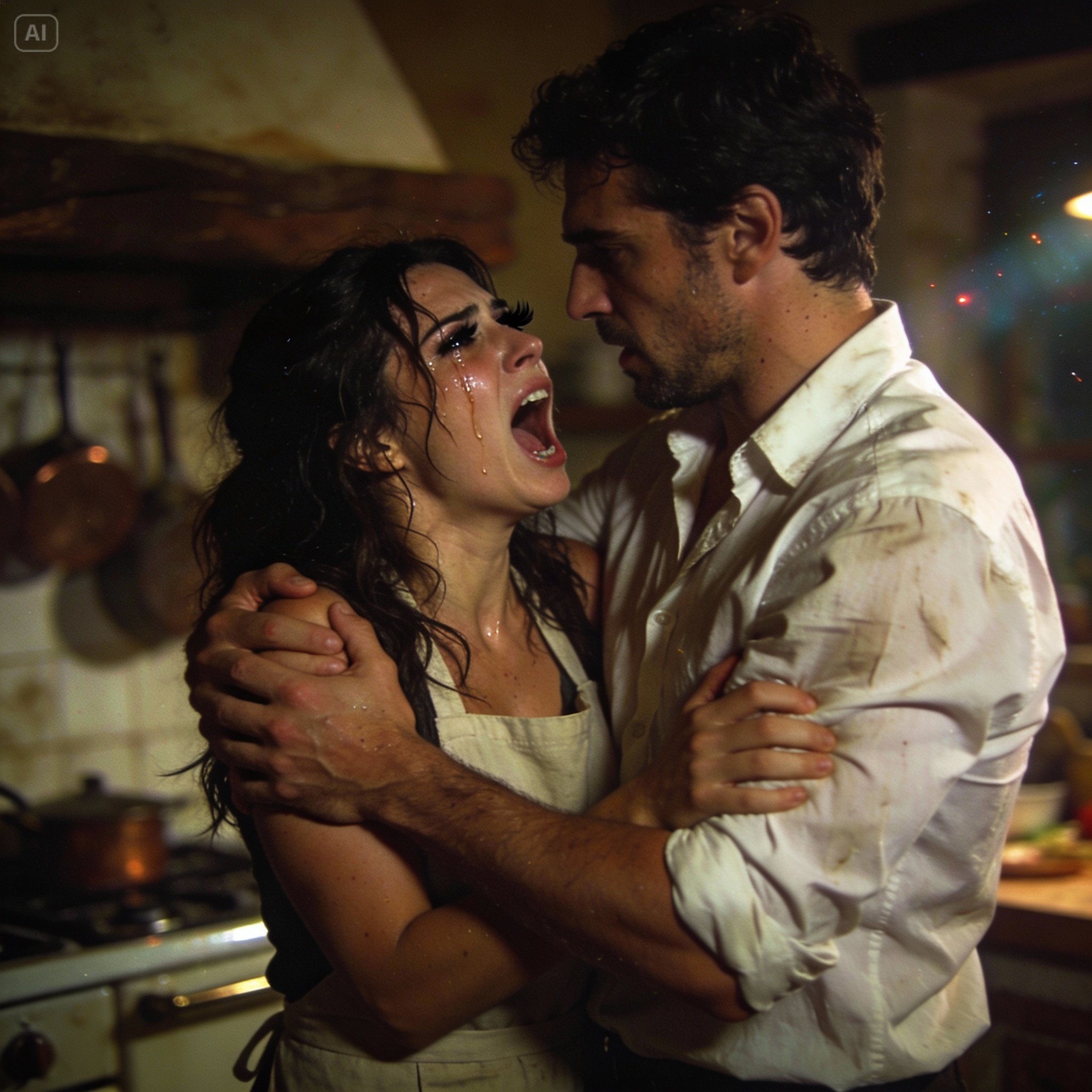
But the scene in front of him was pure chaos.
Three identical two-year-old girls sat in a custom triple high chair that probably cost more than my entire life’s earnings. They were blonde, angelic, and currently destroying the table. One was weeping silently, tears streaming down her face. Another was banging a silver spoon against the mahogany with a rhythmic, deafening thud-thud-thud. The third was systematically flinging peas at her father’s chest.
And Eduardo Zatici, the King of New York, looked completely defeated.
I stepped into the line of fire. “Evening, sir. The truffle arancini.”
I reached over to place the plate down. That’s when it happened.
The girl with the spoon stopped banging. The weeping one went still. The pea-thrower froze, her tiny hand suspended in mid-air.
The silence that fell over the table wasn’t the silence of fear. It was the silence of recognition.
Six brown eyes locked onto my face.
I froze, the water pitcher hovering over a glass. “Is… is everything okay?”
The middle girl, the one who had been crying, reached out. Her fingers were sticky with jam, and she grabbed the hem of my cheap, stained apron like it was a lifeline. She pulled hard, nearly dragging me off balance.
Then, she opened her mouth.
According to the tabloids, the Zatici triplets had never spoken a word. Doctors called it trauma; therapists called it a developmental delay. Eduardo called it his curse.
But looking at me, her eyes wide and desperate, she screamed.
“Mama!”
The word hit the room like a gunshot.
“Mama! Mama!” the other two joined in, a chorus of high-pitched, desperate need. They were straining against their straps, reaching for me, their faces crumbling into fresh sobs—not of sadness, but of relief.
The pitcher slipped from my hand. It shattered on the floor, sending ice water soaking into the expensive carpet.
I didn’t breathe. I couldn’t.
Eduardo stood up slowly. He didn’t look at the mess. He didn’t look at his screaming daughters. He looked at me. His eyes were black pits, void of anything human, filled only with a sudden, lethal calculation.
“Who sent you?” His voice was low, a rumble of thunder that vibrated in my chest.
“I—I don’t—” I stammered, backing away, but the little girl still had a death grip on my apron. “I’m just a waitress. I’ve never seen them before.”
“Liar.”
He moved faster than a man that size should be able to move. His hand clamped around my wrist—not painful, but absolute. An iron shackle.
“Marco!” he barked, never breaking eye contact with me.
The manager appeared instantly, trembling. “Mr. Zatici, I am so sorry, she’s new, I’ll fire her immediately—”
“Clear the room,” Eduardo said calmly. “Now.”
“Sir?”
“Get everyone out. Tell them there’s a gas leak. Tell them there’s a bomb. I don’t care. You have sixty seconds.”
Chaos erupted as Marco began shouting orders. Diners scrambled, grabbing coats and purses. But I couldn’t move. Eduardo was reeling me in, pulling me closer until I could smell him—expensive scotch, gunpowder, and the terrifying scent of a predator.
“My daughters haven’t made a sound in two years,” he whispered, his face inches from mine. “Two years of specialists. Two years of silence. And you walk up with a plate of rice balls, and they find their voices?”
“I don’t know why!” tears pricked my eyes. “Please, you’re hurting me.”
“I haven’t even started hurting you yet.”
He dragged me toward the back exit. The triplets were already being unbuckled by two massive bodyguards who had materialized from the shadows. The girls were screaming, arms reaching backward, desperate fingers clawing the air toward me.
“Mama! Mama!”
It tore something open in my chest. A weird, biological ache I couldn’t explain.
“Let me go!” I dug my heels into the carpet. “You can’t just take me!”
Eduardo didn’t even break stride. He kicked the back door open, revealing a rain-slicked alley and a waiting black SUV with tinted windows.
“I own the police captain in this precinct,” he said, his voice flat. “I own the building inspector. I own the judge who would hear your case. I can do whatever I want.”
He shoved me toward the open car door. The rain soaked my uniform instantly, plastering my hair to my face.
“Get in the car, Allesia.”
I froze. “How do you know my name?”
“I know everything about threats to my family,” he said, and for the first time, I saw the gun holstered beneath his jacket as he reached to push me inside. “And until I figure out how you brainwashed my children, you belong to me.”
The door slammed shut, locking me in the dark.
Chapter 2: The Hidden History
The rain hammered against the roof of the armored SUV, a rhythmic, deafening drum solo that tried to drown out the sound of my own heartbeat.
I sat pressed against the cold leather of the passenger door, my hands trembling in my lap. Next to me, Eduardo Zatici was a statue carved from granite and fury. He hadn’t looked at me since he shoved me into the backseat. He just stared out the tinted window at the blurring lights of the Taconic Parkway, his jaw set so hard a muscle feathered beneath his ear.
In the third row of seats behind us, the crying had finally stopped, replaced by the wet, hitching sounds of exhausted sleep. The girls—his girls—had screamed for the first twenty minutes of the drive, a raw, synchronized wailing that made my stomach twist into knots. Every time I had tried to turn around, to offer a hush or a soothing word, Eduardo’s hand had shot out to grip my forearm.
“Don’t,” he had said, his voice devoid of emotion. “Don’t look at them. Don’t speak to them. You’ve done enough damage.”
Now, the silence in the car was heavier than the screaming had been. It was a thick, suffocating thing that smelled of damp wool, expensive cologne, and the metallic tang of fear.
I watched the seconds tick by on the dashboard clock. 9:42 PM. 9:43 PM. Every minute took me further away from my life—from my shift at the coffee shop tomorrow morning, from the stack of overdue medical bills on my kitchen counter, from the safety of being a nobody.
“Where are you taking me?” I whispered. I needed to break the silence before it crushed me.
Eduardo didn’t turn. “To the truth.”
The SUV slowed, turning off the highway onto a private road lined with ancient oaks that looked like skeletal fingers clawing at the storm. We approached a gate that was less of an entrance and more of a fortification—twelve feet of wrought iron and stone, flanked by cameras with red blinking eyes.
The gates swung open. We wound up a long driveway until the house loomed out of the darkness.
It wasn’t a home. It was a fortress of modern architecture, all sharp angles, slate-gray stone, and bulletproof glass. It looked like a mausoleum for the living. There were no warm lights in the windows, no welcoming porch. Just a sleek, dark beast crouching in the rain.
The car stopped. The doors unlocked with a heavy thunk.
“Out,” Eduardo commanded.
I stepped into the downpour, instantly soaked again. Two men were already extracting the sleeping triplets from the back, carrying them like precious, volatile packages. One of the girls—the one with the jam on her face—stirred and whimpered, her hand reaching out blindly into the rain.
“Mama?” she murmured, a sleepy, broken sound.
My body reacted before my brain could stop it. I took a step toward her.
Eduardo blocked my path. He was a wall of black wool and menace. “Inside. Now.”
He marched me through the front doors into a foyer that was impressive and utterly soulless. The floors were black marble, polished to a mirror shine that reflected our wet footprints. The walls were hung with abstract art—violent splashes of red and black that looked disturbingly like crime scenes.
He didn’t take me to a dungeon. He took me to a study that smelled of old paper and cigars. He shoved me toward a leather chair in the center of the room.
“Sit.”
I sat. I was shivering, partly from the cold rain clinging to my uniform, but mostly from the way he was looking at me. Like I was a puzzle he couldn’t solve, and he was considering breaking the pieces to make them fit.
A man in a white coat was waiting for us. He was setting up a silver case on Eduardo’s massive mahogany desk. He looked tired, with the gray complexion of a man who got called out to mob boss mansions in the middle of the night far too often.
“Dr. Maro,” Eduardo said, stripping off his wet suit jacket and tossing it onto a sofa. “Do it.”
The doctor approached me with a plastic-wrapped swab. “Open your mouth, please, miss.”
I recoiled, pressing my back against the chair. “What? No. What is this?”
“It’s a DNA test,” Eduardo said from the wet bar, where he was pouring amber liquid into a crystal glass. The clink of the decanter was sharp in the quiet room. “You claim you’re not their mother. The girls claim you are. Science doesn’t lie.”
“I told you,” I said, my voice rising in panic. “I’ve never met you. I’ve never met your wife. I’ve never been to this house. This is insane.”
“Open,” Dr. Maro said gently, holding the swab like a weapon.
I looked at Eduardo. He took a sip of his drink, his eyes locked on mine over the rim of the glass. “If you’re innocent, Allesia, this proves it. If you’re lying…” He let the sentence hang there, heavy with implied violence.
I opened my mouth.
The cotton swab scraped the inside of my cheek, invasive and dry. Dr. Maro sealed it in a tube, labeled it with a sharpie, and then packed his bag.
“I’ll run it in the mobile lab in the van,” Maro said. “Give me twenty minutes.”
He left. The heavy oak door clicked shut.
Now it was just us.
The silence returned, amplified by the ticking of a grandfather clock in the corner. Tick. Tock. Tick. Tock. Each second felt stretched, dilated, agonizing.
Eduardo walked around the desk and sat on the edge of it, looming over me. He placed the glass of whiskey on the coaster.
“Tell me a story, Allesia,” he said softly.
“I don’t have a story.”
“Everyone has a story. Tell me yours. Who are you? Really.”
I wrapped my arms around myself, trying to stop the shivering. “I’m nobody. My name is Allesia Angelo. I live in Queens. I work three jobs. I waitress at Rosso, I open the coffee shop on 4th in the mornings, and I do data entry on weekends.”
“Why?”
“Why what?”
“Why three jobs? You’re young. You’re… distinct.” His eyes flicked over my face, analyzing. “Why run yourself into the ground?”
“Because debt doesn’t sleep,” I snapped, a spark of anger cutting through the fear. “My father got sick three years ago. Pancreatic cancer. Do you know how much a round of chemo costs without good insurance? Do you know how much a hospital bed costs per night?”
Eduardo’s expression didn’t change, but his fingers tightened slightly on the edge of the desk. “He died?”
“Last year.” I looked down at my hands. They were red and chapped from washing dishes. “He left me the house, and about two hundred thousand dollars in medical bills. I’m drowning. That’s my story. I’m just broke. I’m not some… spy.”
“Broke,” Eduardo repeated. He stood up and walked to the window, staring out at the rain-lashed gardens. “Desperation makes people do things. Dangerous things.”
“I serve pasta,” I said. “That’s as dangerous as I get.”
He turned back to me, his eyes narrowing. “Then explain it. Explain why my daughters—who have never spoken, who scream if a stranger touches them—looked at you and saw safety. Explain why they knew you.”
“I can’t!”
“Think!” He slammed his hand against the window pane, the sound making me jump. “Five years ago. Four years ago. Did you work at a daycare? A hospital? Did you meet my wife, Valentina?”
“No! I told you, I—”
I stopped.
The memory hit me like a physical blow. It rose up from the deep recesses of my mind, something I hadn’t thought about in years because I had signed a mountain of non-disclosure agreements to make sure I never did.
My face must have changed. The blood must have drained out of it, because Eduardo crossed the room in two strides, grabbing the arms of my chair, trapping me.
“What?” he demanded. “What did you remember?”
“It… it can’t be that,” I whispered. “It was anonymous. They said it was completely anonymous.”
“What was?”
I looked up at him, my heart hammering against my ribs like a trapped bird. “Five years ago. My dad’s first diagnosis. We needed cash, fast, for an experimental treatment in Switzerland. I didn’t have the credit for a loan.”
Eduardo leaned closer, his scent enveloping me. “Go on.”
“I went to a clinic. In Manhattan. The reproductive center on 5th Avenue. They… they pay for egg donors. High premiums for specific profiles. College educated, Italian descent, clean medical history.”
The room went deadly still. Even the clock seemed to hold its breath.
“You donated eggs,” Eduardo said. His voice sounded hollow.
“Yes. They paid me twenty thousand dollars. I signed the papers. They told me the eggs would be harvested and I would never know what happened to them. They said… they said it was a blind donation.” I swallowed hard. “But they told me later that the cycle failed. They said no viable embryos were created.”
Eduardo straightened up. He looked like he’d been punched in the gut. He backed away from me, running a hand through his dark hair, disrupting the perfect style.
“Twenty thousand,” he muttered. “The exact amount…”
The door opened.
Dr. Maro stepped back in. He held a tablet in his hands, his face pale. He looked from me to Eduardo, and then cleared his throat.
“Sir,” Maro said quietly. “The results.”
Eduardo didn’t move. He stood by the fireplace, staring at the flames that weren’t there. “Read it.”
“It’s a match,” Maro said. “99.99% probability. Maternity confirmed. She is… biologically, she is their mother.”
The words hung in the air, heavy and irrevocable.
I closed my eyes. The world tilted on its axis. Maternity confirmed.
“That’s impossible,” Eduardo whispered.
He wasn’t looking at me anymore. He was looking through the wall, looking at a ghost.
“Get out,” he said to the doctor.
Maro fled.
Eduardo turned to me. The violence was gone from his face, replaced by a confusion so raw it looked like pain. “My wife… Valentina. She was pregnant. I watched her stomach grow. I felt them kick. I was in the delivery room.”
“I don’t know what to tell you,” I said, my voice shaking. “I just know what I did. I sold the eggs. I never… I never thought…”
“She lied.”
The realization seemed to shatter him. He walked over to the desk, picked up the whiskey glass, and hurled it into the fireplace. It exploded in a shower of crystal and amber liquid.
“She lied about everything.”
He turned to me, his eyes wild. “Come with me.”
“Where? I want to go home.”
“No!” He grabbed my hand again, pulling me up from the chair. “You don’t get to leave. Not now. You’re the only real thing in this entire house.”
He dragged me out of the study, past the terrified guards, and up the grand staircase. We bypassed the nursery where the girls were sleeping and went to the east wing—a hallway that felt colder than the rest of the house, the air stagnant and dusty.
He stopped in front of a set of double doors. He hesitated, his hand hovering over the handle. I could see the tremor in his fingers.
“This was her room,” he said. “I haven’t been inside since the funeral. Eighteen months.”
He threw the doors open.
The room was a shrine. It smelled of stale perfume—Chanel No. 5—and preserved vanity. Racks of clothes, shelves of shoes, a vanity table cluttered with powders and creams. It was the room of a woman who loved herself fiercely.
Eduardo didn’t look at the clothes. He went straight to the antique writing desk by the window. He began tearing through the drawers.
“Eduardo, stop,” I whispered. I felt like an intruder in a tomb. “Please, let’s just go.”
“I need to know,” he snarled, tossing a stack of society magazines onto the floor. “I need to know how she did it. How she fooled me for nine months.”
He ripped the bottom drawer out, dumping its contents onto the plush white carpet.
There, amidst old receipts and jewelry boxes, was a leather-bound journal.
Eduardo froze. He fell to his knees, his breathing ragged. He picked up the book.
I stood by the door, hugging my arms, watching a powerful man break apart. He opened the book. He flipped through the pages, his eyes darting back and forth.
“March 15th,” he read aloud, his voice cracking. “Eduardo wants heirs. He talks about legacy like it’s a religion. But I will not ruin my body for his vanity. I will not get fat. I will not get stretch marks.”
He flipped the page, his knuckles turning white.
“April 3rd. I found a clinic. They can arrange a donor. Someone who looks like me. A surrogate to carry the implantation? No, too risky. I’ll wear the padding. I’ll fake the symptoms. I’ll hire a private doctor for the ‘birth’. Eduardo will never know. He sees what he wants to see.”
He looked up at me. The devastation in his eyes was absolute.
“She bought you,” he whispered. “Like you were livestock. She bought your genetics because she didn’t want to ruin her figure.”
He looked back at the book. “September 8th. The donor profile came back. Young. Poor. Desperate. Perfect.”
He slammed the journal shut. The sound echoed like a gunshot in the silent room.
I felt a tear slide down my cheek. I wasn’t crying for him, or for his dead wife. I was crying for the girl I had been five years ago—scared, broke, trying to save her dad, signing away pieces of herself for a check that hadn’t even been enough in the end.
“I didn’t know,” I said. “I swear to you, Eduardo. I didn’t know.”
Eduardo stood up slowly. He looked at the journal in his hand, then at the bed where he must have slept beside a lie for years. Then he looked at me.
The anger was gone. In its place was a terrifying resolve.
“My daughters,” he said, his voice dropping to a whisper that sent a shiver down my spine. “They knew. They knew they were living with a ghost. That’s why they never spoke.”
He walked toward me, closing the distance until I had to tilt my head back to look him in the eye.
“But you,” he said, reaching out. His thumb grazed my cheek, wiping away the tear. His skin was rough, calloused, hot against my cold face. “You are real.”
“Eduardo…”
“You can’t leave, Allesia,” he said. “Not now. Not ever.”
“That’s kidnapping,” I breathed.
“No,” he said, and the darkness was back in his eyes, swirling and deep. “It’s restitution. She stole your children. She stole my trust. Now? Now we fix it.”
He stepped past me, blocking the doorway, locking us into the reality of what we were.
“Welcome home, Allesia.”
Chapter 3: The Awakening
I woke up in a bed that cost more than my father’s life insurance payout.
The sheets were Egyptian cotton, cool and impossibly smooth against my skin, smelling faintly of lavender and starch. For a confusing, heavy second, I thought I was back in the hotel room I’d booked for Dad’s last birthday—a one-night extravagance we couldn’t afford.
Then I opened my eyes, saw the twelve-foot ceilings and the crown molding that looked like it belonged in a museum, and the memory of the night before crashed down on me.
The restaurant. The rain. The DNA test. The journal.
Welcome home, Allesia.
I sat up, my heart doing a frantic gallop in my chest. I wasn’t a guest. I was a prisoner in a five-star hotel.
I slid out of bed. I was still wearing my waitress uniform from yesterday, wrinkled and stiff with dried rain and sweat. It smelled like stale fryer grease—a sharp, pungent reminder of who I really was in this house of marble and ghosts.
I walked to the floor-to-ceiling window. The storm had broken. The morning sun was weak and watery, illuminating the grounds of the Zatici estate. It was terrifyingly beautiful. Manicured hedges, a fountain that looked like a Renaissance sculpture, and walls. High, stone walls topped with something that glinted in the light. Cameras. Or spikes.
I checked the door. Unlocked.
I stepped out into the hallway. It was silent, that heavy, insulated silence of extreme wealth. The carpet runner swallowed my footsteps. I didn’t know where I was going, but a sound pulled me down the corridor.
Crying.
Not the terrified screaming from the restaurant, but the low, miserable whimpering of waking up in a strange place.
I followed the sound. It led me to a set of double doors painted a soft, creamy white. The nursery.
Two men in dark suits stood guard on either side of the door. They were massive, their hands clasped in front of them, eyes hidden behind sunglasses even indoors.
“Miss Angelo,” the one on the left nodded. He didn’t move to stop me. ” The boss said you have free roam of the second floor.”
“I hear them crying,” I said, my voice raspy.
He opened the door for me.
The nursery was a war zone of pastel chaos. It was bigger than my entire apartment. Toys were scattered everywhere—expensive wooden blocks, imported dolls, soft plush animals that looked untouched.
In the center of the room, three cribs formed a triangle.
And there they were. The reason my life had imploded.
Bella. Elena. Sophia. I knew their names now. Eduardo had said them like prayers in the car.
They were standing in their cribs, gripping the bars, their faces wet and red. A woman—Giana, the nanny Eduardo had mentioned—was trying to soothe Sophia, but the little girl was thrashing, arching her back, rejecting the comfort.
“No, no, shhh,” Giana murmured, looking exhausted. She was older, with kind eyes surrounded by deep lines of stress.
Then, Elena saw me.
The change was instantaneous. It was like a current snapping through the room. She went still, her breath hitching. Her little hands tightened on the white bars of the crib.
“Mama,” she whispered.
It wasn’t a question this time. It was a claim.
Giana froze and turned around. “Oh. You’re… you’re her.”
I didn’t answer. I walked past the guards, past the nanny, straight to the cribs. My legs felt weak.
“Hey,” I said softly. “Hey, it’s okay.”
I reached out. Elena grabbed my hand instantly, her fingers incredibly small and hot, wrapping around my thumb with a strength that shouldn’t have been possible. Bella began to bounce, reaching her arms up. Sophia stopped crying and just stared at me with those solemn, ancient brown eyes.
“They’ve been awake for an hour,” Giana whispered, stepping back as if realizing her place had been usurped. “They wouldn’t eat. They wouldn’t let me change them.”
“They’re scared,” I said. I lifted Elena out of the crib. She was heavier than I expected, a solid, warm weight that fit against my hip like a missing puzzle piece. She buried her face in my neck, smelling of baby powder and tears, and let out a long, shuddering sigh.
I picked up Bella next, balancing her on my other hip. Sophia was waiting, looking dejected, so I sat down on the plush rug and pulled her into my lap.
Immediately, they swarmed me. Six hands touching my face, my hair, the rough fabric of my uniform. It was overwhelming. It was terrifying.
It was right.
I sat there for ten minutes, just breathing, letting them map my face with their sticky fingers. I closed my eyes. The biological pull Eduardo had talked about… it wasn’t a myth. I felt it in my marrow. These were mine. I had sold them to save my father, but the universe had refunded the transaction.
“You’re good with them.”
The voice came from the doorway.
Eduardo stood there. He had changed into a charcoal suit, crisp and immaculate, his dark hair slicked back. He held a mug of coffee in one hand. He looked like he owned the world, but he was standing on the threshold of the nursery like he was afraid to cross the invisible line.
The girls tensed in my arms.
“They’re children, Eduardo,” I said, not looking up from Sophia, who was busy trying to unbutton my collar. “I’m not ‘good with them.’ I’m just holding them. Something you should be doing.”
He stepped into the room. The air temperature seemed to drop. “I tried. Before you woke up. Sophia screamed until she threw up.”
“Because you approach them like you’re negotiating a hostage exchange.”
His jaw tightened. He walked over, towering above us. “I am their father. They should know me.”
“Being a father is a verb, not a noun,” I snapped. I looked up at him. “It’s something you do. Not something you are.”
Eduardo stared at me. For a second, I thought he might hit me, or call the guards. No one spoke to the Don of the Zatici family like that.
Instead, he crouched down. His expensive suit fabric strained at the knees. He was eye-level with us now.
“Show me,” he said.
“What?”
“Show me what to do. You said I treat them like assets. Teach me to treat them like daughters.”
I hesitated. I looked at this man—this killer, this kidnapper—and saw the desperation bleeding through the cracks in his armor. He was terrified.
“Sit,” I said, gesturing to the rug. “Not in a squat. Sit down. Get on their level.”
He hesitated, eyeing the floor like it was lava, then awkwardly lowered himself onto the rug. He sat cross-legged, his coffee mug balanced precariously on his knee.
“Now what?”
“Put the coffee away. You need your hands.”
He set the mug on a nearby table.
“Don’t reach for them,” I instructed. “Let them come to you. You’re too big, too loud. You smell like…” I sniffed the air. “Cedar and gunpowder. It’s intense. Just be still.”
We sat in silence. The grandfather clock in the hall ticked. Tick. Tock.
Bella, the brave one, was the first to move. She crawled off my lap, clutching a wooden block. She took two wobbly steps toward Eduardo.
He flinched. Just a micro-movement, a tightening of his shoulders.
“Don’t move,” I whispered. “Breathe.”
Bella stopped in front of him. She stared at the tattoos peeking out from his cuffs—the dark ink that marked him as a criminal king. She reached out and touched the spiderweb on his wrist.
Eduardo held his breath. He looked at her hand on his skin like it was a burning coal.
“Hi, Bella,” he choked out.
Bella looked up at his face. She held out the block. It was red.
“She’s offering it to you,” I said. “Take it.”
Eduardo reached out slowly. His hand, which I had seen crush a man’s windpipe in my imagination a dozen times, trembled as he took the small wooden cube.
“Thank you,” he said seriously.
Bella beamed. A smile that lit up the gloomy room.
Then, she turned to me, pointed at Eduardo, and said a word that wasn’t “Mama.”
“Happy.”
The air left the room.
Eduardo froze. “Did she…”
“Happy,” Bella repeated, patting his knee.
Eduardo looked at me. His eyes were wide, unguarded, stripped of all the artifice and menace. They were wet.
“She spoke,” he whispered. “Another word.”
“She did.”
“Because of you.”
He looked back at his daughter, and for the first time, he didn’t look like a Don. He looked like a man who had just witnessed a miracle. He reached out and, very gently, tucked a curl of blonde hair behind Bella’s ear.
“Papa is happy,” he murmured. “Yes. Papa is happy.”
The moment stretched, fragile as glass. Then Sophia crawled over to join them, and Elena followed. Suddenly, the most feared man in New York was covered in toddlers.
He looked over their heads at me. The vulnerability vanished, replaced by that intense, calculating stare.
“We need to talk,” he said. “In the library. Giana will watch them.”
“I’m not leaving them.”
“Ten minutes, Allesia. Please.”
The “please” was what did it. It sounded foreign on his tongue.
I stood up, untangling myself from the girls. “Ten minutes. If I hear one cry, I’m coming back, and your guards can’t stop me.”
“I know,” he said. And he sounded like he believed it.
The library was down the hall, a cavernous room smelling of leather and old money. Rain lashed against the windows again, darkening the sky.
Eduardo walked behind his desk. He didn’t sit. He stood with his hands resting on the back of his leather chair, putting the barrier of authority between us again.
“You can’t leave,” he said. No preamble. No softness.
“I have a life, Eduardo. I have jobs. I have bills.”
“Your bills are gone.”
I blinked. “What?”
“Your father’s medical debt. The mortgage on your house in Queens. Your credit cards. I had my accountant liquidate them this morning. You have zero debt as of 9:00 AM.”
My knees felt weak. Two hundred thousand dollars. Gone. Just like that. It was the weight that had been crushing me for three years, the reason I worked eighteen-hour days, the reason I never slept.
“You can’t just pay my debts,” I said, my voice shaking. “That’s… that’s control. That’s buying me.”
“It’s a retainer,” he corrected. “For your services.”
“I’m not a hooker.”
“You’re a mother.” He walked around the desk, closing the distance. “Look at the facts, Allesia. You saw what happened in that nursery. For two years, they were ghosts. You walk in, and they wake up. They speak. They smile.”
He stopped three feet from me.
“I have money. I have power. I can buy countries. But I couldn’t buy that.” He gestured toward the nursery. “I can’t be what they need. I tried. God knows I tried. But I am death, Allesia. I bring coldness into rooms. You… you bring the sun.”
“So what?” I crossed my arms. “You want to hire me as a live-in nanny?”
“No. I want to hire you as their mother.”
He paced to the window, watching the rain.
“I’m offering you a deal. Stay here. Live in the estate. You’ll have your own suite. A salary of twenty thousand a month. You raise them. You be the light they need. And in exchange, you never have to worry about money again. You never have to scrub a table or serve a coffee.”
“And if I say no?”
He turned. The shadows cut across his face. “I told you last night. You don’t get to say no. You’re a security risk. If you leave, my enemies will find you. They’ll use you to get to the girls. I can’t allow that.”
“So it’s a gilded cage,” I said bitterly. “Golden bars, but still bars.”
“It’s a sanctuary.”
I looked at him. I thought about the girls. Bella’s smile. The way Elena gripped my thumb. The way Sophia smelled like milk and trust.
And I thought about my apartment in Queens. The drafty windows. The stack of red envelopes. The exhaustion that lived in my bones.
“I have conditions,” I said.
Eduardo raised an eyebrow. “You’re in no position to negotiate.”
“I’m the only one who can make them speak,” I said, stepping forward. I felt a sudden surge of power. He needed me. The King of New York needed the waitress. “That makes me the most important person in this house. So yes, I am negotiating.”
His eyes flared with something—amusement? Respect?
“Name them.”
“One,” I held up a finger. “I am not a prisoner. I want to be able to leave the grounds. With guards, fine. But I need fresh air. I need to see the city.”
“Agreed. With a security detail.”
“Two. No more secrets. If I’m raising your daughters, I need to know what threatens them. I need to know who you are. All of it.”
He hesitated. “That is dangerous knowledge.”
“I’m already in danger. You dragged me into it.”
“Fine. Full disclosure.”
“And three,” I said, my voice dropping. “If I stay, I have authority. Over their schedules, their diet, their lives. You don’t override me in front of them. We are partners in this, or I walk out that door and you can drag me back kicking and screaming every time.”
Eduardo studied me. He looked at my chin, held high. He looked at my clenched fists.
Slowly, a smile spread across his face. It wasn’t a nice smile. It was the smile of a wolf seeing another wolf.
“Done,” he said. He extended his hand.
I looked at it. The hand that held the gun. The hand that held the block.
I took it. His grip was warm and rough.
“Deal,” I said.
CRASH.
The sound of shattering glass exploded from the floor below.
The floor shook. Alarms began to wail—a high-pitched, piercing shriek that drilled into my skull.
Eduardo ripped his hand away, his gun already in his palm before I even registered he had moved. He shoved me behind him, his body becoming a human shield.
“Stay down!” he roared.
“What is it?” I screamed over the alarm.
“Perimeter breach.”
The door to the library burst open. Not an attacker, but his head of security, Vincent.
“Boss! The East Wing. Someone threw a package through the solarium window.”
“Status?”
“No explosion. It’s a message.”
Eduardo grabbed my arm, dragging me toward the door. “The girls. Now.”
We sprinted down the hallway. The illusion of safety—the marble, the money, the deal—shattered with the glass.
We burst into the nursery. Giana was on the floor, covering the girls with her body. The triplets were screaming again, that high, terrified wail that haunted my dreams.
“Clear!” the guard at the window shouted.
Eduardo scanned the room, gun raised. When he saw the girls were safe, he lowered the weapon, but the tension didn’t leave his shoulders.
Vincent ran in behind us, holding a plastic bag. Inside was a brick wrapped in a newspaper clipping.
Eduardo snatched the bag.
I looked over his shoulder. My stomach dropped.
It was a copy of the New York Sentinel. The headline screamed in bold black letters:
ZATICI’S SECRET SIN: THE WAITRESS AND THE BASTARD HEIRS.
There was a photo. Grainy, taken from a distance through the restaurant window yesterday. Me. Holding the girls.
And wrapped around the brick was a handwritten note in red marker.
False Queens Bleed.
Eduardo stared at the note. The paper crinkled in his fist.
“Who?” I whispered.
He looked at me. The awakening was complete. The soft father on the rug was gone. The monster was back.
“Marco,” he spat. “My underboss.”
He turned to Vincent. “Lock the estate down. No one in, no one out. And get the priest.”
“The priest, sir?”
Eduardo looked at me, and his eyes burned with a cold, terrifying possession.
“Yes. We’re getting married.”
“What?” I choked out.
“It’s the only way to protect you,” he said, turning back to the screaming children. “If you’re my wife, you’re untouchable. If you’re just the nanny… you’re a target.”
He looked at the brick again.
“And Marco just declared war.”
Chapter 4: The Withdrawal
The basement of the Zatici estate didn’t smell like a home. It smelled like sulfur, cold concrete, and the metallic tang of violence waiting to happen.
We were three floors underground, in a soundproofed shooting range that hummed with the low vibration of the ventilation system. The air was recycled, scrubbed clean of the rain and the roses upstairs, leaving only the sterile chill of preparation.
“Again,” Eduardo said.
My arms were screaming. The Glock 19 in my hands felt like it weighed fifty pounds, not two. My shoulders burned, a hot, lactic fire spreading down my spine, but I didn’t lower the weapon.
I couldn’t.
Not after the brick. Not after the note. False Queens Bleed.
“I said again, Allesia. Focus.”
Eduardo stood behind me. He wasn’t touching me, but I could feel the heat radiating from his chest, a solid wall of pressure against my back. He had shed his suit jacket hours ago, rolling up the sleeves of his white dress shirt to reveal the ink crawling up his forearms—vines and thorns that disappeared into the fabric.
“My hands are shaking,” I whispered. The paper target hanging fifteen yards away was a blur. It was a silhouette of a man. A faceless, paper ghost.
“Let them shake,” Eduardo’s voice was low, vibrating through the noise-canceling earmuffs I wore. “The adrenaline isn’t going away. You have to learn to shoot through it.”
He stepped closer. The space between us vanished.
His chest pressed against my shoulder blades. His hands, rough and warm, slid down my arms to cover mine. He didn’t take the gun from me; he fortified my grip. His fingers were calloused, the skin rough against my knuckles, locking my trembling hands into a vice.
“Breathe,” he commanded. His breath ghosted against the sensitive skin of my neck, smelling of espresso and that dark, woodsy cologne. “In through the nose. Hold it.”
I inhaled. The scent of him filled my lungs, pushing out the smell of gunpowder.
“Now,” he murmured. “Squeeze. Don’t pull. Squeeze like you’re trying not to wake the girls.”
The girls.
The image of Sophia’s tear-streaked face flashed in my mind. The way Elena had clutched my thumb. The way Bella had whispered Happy.
Marco Russo wanted to erase that. He wanted to turn my daughters into orphans and me into a headline.
The anger flared, hot and sudden, overriding the fear.
I squeezed.
CRACK.
The recoil jolted through my elbows, shocking my bones, but Eduardo’s body absorbed the blow, keeping me upright. The casing pinged off the concrete floor, spinning like a golden coin.
“Center mass,” Eduardo said, his voice devoid of praise, just stating facts. “Again.”
“I’m tired, Eduardo.”
“Marco isn’t tired. Marco is counting on you being tired. He’s counting on you being a waitress who cries when she drops a plate. He thinks you’re nothing.”
He stepped back, leaving me cold in the recycled air.
“He thinks I picked you up off the street to play house. He thinks you’re weak. And because he thinks you’re weak, he’s going to come for you. Tonight.”
I lowered the gun. The silence of the room pressed in on my ears. “Tonight?”
“The engagement party is in four hours. The wedding is tomorrow morning. But tonight… tonight is when he’ll test us. He’ll be there. Smiling. Drinking my champagne. Looking for cracks.”
I turned to face him. Under the harsh fluorescent lights, Eduardo looked exhausted. There were dark circles under his eyes, bruises of fatigue that money couldn’t hide. He looked less like a king and more like a man holding up the sky with cracked pillars.
“You’re teaching me to kill him,” I said. It wasn’t a question.
“I’m teaching you to survive him.” Eduardo took the gun from my limp hand. He ejected the magazine with a fluid, practiced motion, checked the chamber, and set it on the table. “I have guards, Allesia. I have walls. I have money. But if a man like Marco wants to get close, he will. And if he gets past me…”
He didn’t finish the sentence. He didn’t have to.
If he gets past me, you are the last line of defense.
I looked at the gun on the table. It was black, ugly, and heavy. It was the antithesis of everything I had ever been. I was a girl who rescued spiders and cried during diaper commercials. I was a healer, a provider, a server.
But I wasn’t just Allesia Angelo anymore. I was the mother of the Zatici heirs.
“Show me how to reload,” I said.
Eduardo watched me for a long moment. His eyes searched my face, looking for the waitress, but I made sure he only found the mother.
“You sure?”
“He called them bastards,” I said, the word tasting like acid. “He called my daughters bastards and he threatened to make them bleed. Show me how to reload the damn gun.”
Something flickered in Eduardo’s eyes. A spark in the charcoal darkness.
He picked up a fresh magazine. “Thumb on the release. Hard.”
We spent another hour in that concrete box.
Time dilated. The world outside—the rain, the luxury, the impending party—ceased to exist. There was only the rhythm of the weapon. Load. Rack. Sight. Breathe. Squeeze.
My thumb blistered. My shoulders ached with a dull, throbbing misery. But I didn’t stop. And Eduardo didn’t let up.
He was ruthless. He was exacting. He corrected my stance with shoves to my hips. He lifted my chin with a rough finger. He wasn’t treating me like a fiancée; he was treating me like a soldier.
And yet, in the spaces between the gunshots, there was an intimacy that terrified me more than the bullets.
When I missed a shot, frustration making me curse, he didn’t scold me. He just stepped into my space, his hand settling on the small of my back—a heavy, grounding weight.
“Frustration makes you sloppy,” he murmured, his thumb tracing the curve of my spine through my uniform. “Ice in the veins, Allesia. Be the ice.”
When a hot casing flew back and burned my neck, making me hiss in pain, he was there instantly. He brushed the metal away, his fingers lingering on the red mark, his touch impossibly gentle against the violence of the room.
“Sorry,” he whispered, looking at the small burn.
“It’s fine.”
“I hate this,” he admitted, his voice rough. He wasn’t looking at the burn anymore; he was looking at my eyes. “I hate that you have to learn this. I hate that I dragged you into the mud.”
“You didn’t drag me,” I said, realizing it was true. “I walked in. I walked in the moment I took that check five years ago.”
“You were a child saving a parent. That’s not a sin.”
“And now I’m a parent saving children.” I reached out, my hand trembling slightly, and took the gun from the table. “So let’s finish this.”
By the time we left the basement, my hands were covered in lead residue and gun oil. I felt heavy. Solid.
We took the service elevator up. As the numbers climbed—B3, B2, B1, G—I felt the shift. The Withdrawal was ending. We were surfacing.
The elevator doors opened onto the ground floor hallway. The house was transformed.
While we had been underground, an army of florists and planners had invaded. The stark, cold hallway was now lined with massive vases of white hydrangeas and blood-red roses. Waiters in white jackets were moving trays of crystal glasses. A string quartet was tuning up in the ballroom.
It was a beautiful, expensive facade. A stage set for a play called “The Happy Couple.”
“Go upstairs,” Eduardo said, checking his watch. “The stylists are waiting in your suite. You have two hours.”
“Eduardo.”
He stopped, turning back to me. He looked composed again, the mask of the Don firmly in place. “Yes?”
“Marco,” I said. “He’s coming tonight?”
“He’s on the guest list. He has to be. If I excluded him, it would look like fear.”
“Okay.” I took a breath, smelling the flowers that masked the scent of gunpowder on my skin. “Then let’s make sure he sees what he needs to see.”
“And what is that?”
“That I’m not a waitress anymore.”
Eduardo’s lips curved. It wasn’t a smile; it was a weapon. “Wear the blue dress. The one Giana picked. It matches your eyes.”
He turned and walked toward the ballroom, barking orders at a passing security guard.
I went upstairs.
My suite was full of strangers. Three women with makeup kits and garment bags descended on me the moment I walked in. They stripped me of my uniform—my last connection to Allesia the waitress—and shoved it into a hamper.
They scrubbed the gun oil from my hands with exfoliants that smelled of lemon and sugar. They painted my nails a deep, blood red. They pulled my hair up into an intricate twist, securing it with pins that felt like tiny daggers against my scalp.
I let them do it. I was a doll being dressed for the shelf.
But inside, my mind was still in the basement. Breathe. Squeeze.
“The dress is magnificent, signora,” the stylist gushed, zipping me into the gown.
It was midnight blue silk, strapless, fitting like a second skin. It pooled around my feet and shimmered under the lights. I looked in the mirror.
The woman staring back wasn’t me. She was taller in the heels. Her skin was flawless, masked by foundation. Her lips were painted crimson.
But her eyes… her eyes were different. They were harder. There was a shadow in them that hadn’t been there yesterday.
“Where are the girls?” I asked.
“In the nursery with the nanny,” the stylist said, adjusting a diamond necklace around my throat. “Mr. Zatici said they are to remain locked down during the party.”
“Good.”
I walked out of the suite.
I didn’t go downstairs immediately. I went to the nursery.
The guards at the door nodded to me. They looked at me differently now. With respect. Or maybe just fear of the woman who was about to marry their boss.
I slipped inside.
The room was dim, lit only by the starlight projector spinning galaxies on the ceiling. The triplets were in their cribs, but they weren’t asleep.
Bella was standing up, clutching the red block. When she saw me—this strange, glittering version of her mother—she tilted her head.
“Mama?” she whispered, uncertain.
The doubt in her voice hurt more than the recoil of the gun.
I walked over, the silk of my dress rustling like dry leaves. I reached through the bars and took her small hand.
“It’s me, baby,” I whispered. “It’s just a costume. Like Halloween.”
She squeezed my finger. The connection sparked, grounding me.
“Mama pretty,” she decided.
“Mama is dangerous,” I corrected softly, kissing her knuckles. “For you.”
I checked Elena. I checked Sophia. I checked the window locks. I checked the monitor cameras.
Satisfied, I turned to leave.
I paused at the door. I could hear the music starting downstairs. Vivaldi. The Four Seasons. Winter.
I took a breath. In through the nose. Hold it.
I wasn’t withdrawing anymore. I was advancing.
I walked to the top of the grand staircase.
Below me, the foyer was filling with people. Men in tuxedos who looked like sharks in human skin. Women in diamonds that glittered like broken glass. The air buzzed with gossip and the undercurrent of power.
Eduardo was at the bottom of the stairs.
He was talking to a man—a man with slicked-back hair and a smile that looked like a scar. Marco.
Marco was laughing, his hand on Eduardo’s shoulder, playing the part of the loyal lieutenant. But his eyes were scanning the room, dissecting the security, looking for weakness.
Then, he looked up.
He saw me.
For a second, the smile faltered. Just a fraction. A glitch in the matrix.
I didn’t look away. I didn’t lower my eyes. I didn’t do the waitress thing—the shrinking, the apologizing, the blending in.
I gripped the marble banister. I thought of the gun. I thought of the weight of it.
Ice in the veins.
I began to descend.
Every head turned. The conversation died, rippling outward from the staircase until the whole room fell silent, save for the weeping violins.
I locked eyes with Marco. I let him see the coldness. I let him see that the girl who dropped the water pitcher was dead.
Eduardo looked up. His expression was unreadable to the room, but I saw it. I saw the heat. I saw the pride.
He stepped away from Marco and held out his hand to me.
I reached the bottom step. I placed my hand in his. His fingers closed over mine—the same grip from the basement. The grip that said I have you.
“Ready?” he murmured, low enough that only I could hear.
I looked at Marco, who was now bowing his head in a mock display of respect.
“False queens bleed,” I whispered to Eduardo, repeating the threat back to him.
Eduardo’s thumb pressed into my palm.
“Then let’s make sure we’re the ones holding the knife.”
We turned to face the room together.
“Ladies and gentlemen,” Eduardo’s voice boomed, silencing the last whispers. “My fiancée. Allesia.”
The applause started. It was polite. It was rhythmic. It sounded like gunfire.
And I smiled.
Chapter 5: The Collapse
The champagne in my glass was warm. I hadn’t taken a sip in forty minutes, but I held onto the flute like a weapon, my knuckles white against the delicate crystal.
The ballroom was a suffocating ocean of perfume, forced laughter, and the heavy, metallic scent of judgment. Two hundred of the city’s most dangerous predators were circling us, dressed in tuxedos and couture gowns, waiting for a drop of blood in the water.
“Smile,” Eduardo murmured against my ear. His hand rested on the small of my back, his thumb rubbing slow, soothing circles against the silk of my midnight-blue dress. “You look like you’re waiting for a firing squad.”
“I think I am,” I whispered back, not moving my lips. “That woman in the red velvet has been staring at my stomach for ten minutes. She thinks I’m pregnant.”
“That’s Aunt Maria. She thinks everyone is pregnant. Ignore her.”
“And the man by the shrimp tower? The one with the scar on his neck?”
Eduardo glanced over effortlessly, sipping his scotch. “Capo from Jersey. He’s harmless unless you owe him money. Do you owe him money?”
“No.”
“Then relax. You’re doing fine.”
He was lying. I wasn’t doing fine. I was vibrating. The adrenaline from the basement shooting range hadn’t faded; it had just curdled into a sick, anxious knot in my gut. Every pop of a champagne cork sounded like a gunshot. Every sudden movement made my hand twitch toward a holster that wasn’t there.
We were standing near the center of the room, holding court. Eduardo played the part of the besotted fiancé perfectly. He touched me constantly—a hand on my arm, a brush of his shoulder against mine—marking his territory. But I could feel the tension radiating off him like heat from a furnace. His eyes never stopped moving, scanning the perimeter, checking the exits, watching his men who were stationed like statues along the walls.
Then, the shark swam closer.
Marco Russo separated himself from a group of laughing associates and glided toward us. He moved with a liquid, serpentine grace that made my skin crawl. Up close, he smelled of mint and rot.
“Eduardo,” Marco said, spreading his hands. “A beautiful party. Truly. You’ve outdone yourself.”
“Marco,” Eduardo nodded, his voice dropping ten degrees. “I’m surprised you came. I thought you had… other business tonight.”
“And miss the unveiling of the bride?” Marco turned his gaze to me. His eyes were pale blue, dead things that looked at me and saw nothing but an obstacle to be removed. “Allesia. You look stunning. A transformation.”
“Thank you,” I said. My voice was steady. Ice in the veins.
“It’s amazing what a little polish can do,” he continued, his smile not reaching his eyes. “From the kitchen to the throne room in three weeks. It’s a Cinderella story. Let’s just hope the clock doesn’t strike midnight, yes?”
“I don’t believe in fairy tales, Mr. Russo,” I said coldly. “I believe in consequences.”
Marco’s smile tightened. “Is that so? Well. We all have to pay the piper eventually.” He raised his glass in a mock toast. “To family. And the purity of the bloodline.”
He took a sip, his eyes locking onto mine over the rim. It was a declaration of war, spoken in the polite code of monsters. Purity of the bloodline. He was calling my daughters bastards to my face.
Eduardo took a step forward, his body shifting into violence, but I put a hand on his chest.
“Enjoy the party, Marco,” I said. “Try the arancini. They’re dying to be eaten.”
Marco laughed—a dry, rasping sound—and melted back into the crowd.
“I’m going to kill him,” Eduardo whispered, his hand tightening on his glass until I thought it would shatter. “Tonight. After the last guest leaves. He doesn’t leave this estate alive.”
“Don’t,” I said. “Not here. Not now.”
“He threatened you.”
“He’s baiting you. Don’t take it.”
Before he could respond, a shadow fell over us. It was Giana, the nanny. She shouldn’t have been downstairs. She was supposed to be in the nursery, behind a locked door, guarding the girls with her life.
My heart stopped.
“Signora,” Giana whispered, her face pale and shiny with sweat. She looked terrified to be interrupting, but even more terrified of whatever was happening upstairs.
“What is it?” I demanded, forgetting the hushed tones of the party.
“It’s Sophia. She’s… she’s hysterical. I can’t calm her down. She’s throwing herself against the crib bars. She’s making herself sick.”
“Is she hurt?” Eduardo asked sharply.
“I don’t think so, sir. But she’s screaming for her mother. She won’t stop. I tried everything.”
I could hear it now—or I imagined I could. A faint, high-pitched wail cutting through the floorboards, bleeding into the Vivaldi. The sound triggered that biological wire in my chest, the one that pulled tight every time they cried.
“I’m going up,” I said, already lifting the hem of my gown.
“I’ll come with you,” Eduardo said. He signaled to Vincent, his head of security.
“No,” I stopped him. “Look around, Eduardo. Half these men are waiting for a sign of weakness. If the Don leaves his own engagement party because a toddler is crying, they’ll laugh. Marco will use it.”
“I don’t care about Marco.”
“I do. Stay here. Keep them occupied. Keep him occupied. I’ll be ten minutes.”
Eduardo hesitated. He looked at Marco across the room, then at me. He hated it. I could see the conflict warring behind his eyes.
“Take Vincent,” he ordered.
“Fine.”
I turned and walked toward the grand staircase, trying not to run. Vincent fell in step behind me, a silent, hulking shadow.
We ascended. The noise of the party faded with every step, replaced by the quiet hum of the house. By the time we reached the second-floor landing, the music was just a distant vibration in the floor.
“Wait here,” I told Vincent at the end of the hallway. “I don’t want to crowd them.”
“Boss said I stick to you,” Vincent grunted.
“Stand outside the door. Please. If she sees a giant with a gun, she’ll never calm down.”
He nodded reluctantly and took up a position by the nursery door.
I pushed the door open.
“Giana?” I called out softly.
The room was dark. The nightlight—a spinning constellation of stars—was off. The heavy velvet curtains were drawn tight.
And it was silent.
Deadly silent.
“Sophia?”
I stepped fully into the room. My eyes adjusted to the gloom. I saw the outlines of the three cribs. I saw the shapes of the girls, curled up under their blankets.
They were asleep.
All three of them.
My blood ran cold. I froze, my hand still on the doorknob.
If they were asleep… then who was crying?
She’s hysterical, Giana had said. She’s screaming for her mother.
“Giana?” I whispered again.
No answer.
Then I heard it. A soft, static hiss coming from the baby monitor on the changing table. And then, abruptly, a sound tore through the speaker.
Waaah! Mama! Mama!
It was Sophia’s voice. But it was tinny. Electronic. Distorted.
It was a recording.
The trap snapped shut in my mind a fraction of a second before the reality hit me.
I spun around to leave, but the door slammed into my face.
Vincent wasn’t there. Or maybe he was, and he was already dead.
The lock clicked. A heavy, mechanical sound.
“Hello, Cinderella.”
The voice came from the shadows in the corner of the room, near the rocking chair.
I backed up until my legs hit the cribs. I could hear the girls stirring now, waking up to the presence of a stranger.
A figure stepped into the sliver of light from the hallway gap.
It wasn’t Marco. It was one of his men—a brute I recognized from the periphery of the party. And behind him, another. Two men. In my children’s nursery.
“Where is Giana?” I asked. My voice was trembling, but my hands… my hands were remembering the basement.
“The old lady?” The first man smirked, pulling a suppressor from his jacket pocket and screwing it onto his pistol. “Taking a nap in the linen closet. Don’t worry. She’ll wake up. You won’t.”
“Marco sent you,” I said. I was stalling. I needed time. I needed a weapon.
“Marco sends his regards. He said to make it look like a robbery gone wrong. Tragic. The fiancée interrupts a thief, gets panicked, gets shot.” He shrugged. “The kids… well, collateral damage. Witnesses.”
The threat to the girls flipped a switch in my brain. The fear evaporated, burned away by a white-hot rage that tasted like copper.
Collateral damage.
I remembered the bookshelf.
Eduardo had told me. Every room. Hidden but accessible.
The bookshelf was to my right, five feet away.
“Please,” I said, putting a tremble into my voice, playing the part they expected. The terrified waitress. “Please, take the jewelry. Take the necklace. It’s diamonds. It’s worth millions.”
I reached up to unclasp the necklace, taking a step toward the bookshelf as I did.
“We’ll take the necklace off your corpse, sweetheart,” the second man grunted. He moved toward the cribs. toward Bella.
“No!” I screamed.
I lunged.
Not at him. At the bookshelf.
My hand swept across the row of leather-bound classics, finding the spine of The Prince. I yanked it down. The false back of the shelf clicked open.
Cold steel.
My fingers wrapped around the grip of a Sig Sauer P365. It was smaller than the Glock I’d trained with, but it was loaded. I knew it was loaded.
“She’s got a gun!” the first man shouted, raising his weapon.
I dropped to the floor, the silk of my dress sliding over the carpet, just as a bullet thwipped into the plaster where my head had been.
The suppressor made it sound like a harsh cough, not a bang.
I rolled onto my back, bringing the gun up with two hands.
Breathe. Sight. Squeeze.
I didn’t have ear protection. The sound of my own gun was deafening. CRACK.
I missed. The bullet shattered the window, letting the rain and wind howl into the room.
But it made them flinch. They dove for cover behind the heavy armchair.
The girls were screaming now—real screams, terrified and piercing.
“Mama! Mama!”
“Stay down!” I shrieked at them. “Get down!”
I scrambled on my hands and knees, ignoring the tearing of my dress, positioning myself between the gunmen and the cribs. I was the wall. I was the shield.
“Finish her!” the first man yelled.
He popped up from behind the chair.
I saw him. I saw the black circle of his barrel. I saw his sneer.
Time didn’t slow down. It sped up.
I fired again. And again. Pop. Pop.
One bullet hit the chair. The second hit him in the shoulder. He spun back with a grunt of pain, dropping his gun.
The second man charged. He was big, rushing me before I could re-aim. He didn’t shoot; he wanted to crush me.
He slammed into me. The impact knocked the wind out of my lungs. My gun skittered across the floor, sliding under a dresser.
He grabbed me by the throat, pinning me to the carpet. His hands were massive, cutting off my air. I clawed at his face, my nails digging into his eyes, but he just shook his head like a bear.
“Die, you little bitch,” he snarled, his spit hitting my face.
Black spots danced in my vision. The sound of the girls screaming sounded far away, underwater.
This is it, I thought. I’m going to die here. And then they’re going to kill them.
No.
My hand scrabbled on the floor, searching for anything. My fingers closed around something hard and sharp.
A wooden block. A toy. One of the expensive, artisan blocks Bella loved.
I gripped it. And with every ounce of strength left in my starving body, I swung it upward.
I smashed the corner of the block into his temple.
It wasn’t a killing blow, but it was enough. He roared and loosened his grip for a fraction of a second.
I bucked my hips, throwing him off balance. I scrambled out from under him, gasping for air, crawling toward the gun under the dresser.
“You’re dead!” he screamed, reaching for his ankle holster.
I grabbed the gun. I rolled onto my back.
But before I could pull the trigger, the nursery door exploded inward.
It wasn’t opened. It was kicked off its hinges.
Eduardo Zatici stood in the doorway.
He looked like a demon. His tuxedo was torn, his hair wild, his face a mask of pure, unadulterated slaughter.
He didn’t speak. He didn’t hesitate.
He saw the man reaching for his ankle.
Eduardo raised his arm. Bang. Bang.
Two shots. precise. Clinical.
The man collapsed backward, a red ruin where his chest used to be.
The other man—the one I’d shot in the shoulder—tried to crawl toward the window.
Eduardo crossed the room in three strides. He grabbed the man by the back of his neck and slammed his face into the wall. The sound of breaking bone was louder than the gunshot.
Then, silence.
Except for the wind howling through the broken window and the sobbing of the triplets.
Eduardo stood over the unconscious man, his chest heaving. He looked wild, terrifying. He turned slowly, his gun still raised, searching for more threats.
Then he saw me.
I was sitting on the floor, my dress ripped, my hair coming down, holding a gun with a shaking hand.
He dropped his weapon.
“Allesia,” he choked out.
He fell to his knees beside me, his hands hovering over me, afraid to touch, checking for blood. “Did they… are you hit?”
“I’m okay,” I wheezed, my throat burning where the man had strangled me. “I’m okay.”
“The girls?”
“They’re okay. They’re safe.”
He pulled me into his arms. It wasn’t a gentle embrace; it was crushing. He buried his face in my neck, shaking uncontrollably. I could feel his heart hammering against my ribs, a frantic, terrified rhythm.
“I heard the shots,” he whispered into my skin. “I thought I was too late. God, I thought I was too late.”
“You weren’t,” I said. I dropped the gun on the carpet and wrapped my arms around him. “You came.”
“I will always come.”
We stayed like that for ten seconds. Just breathing. Just surviving.
Then, reality crashed back in.
“Marco,” I said, pulling back. “Marco is downstairs.”
Eduardo’s face changed. The fear evaporated, replaced by a cold, desolate calm that was infinitely more frightening.
“Yes,” he said. He stood up and pulled me with him. “He is.”
“What are you going to do?”
“I’m going to finish the party.”
He walked over to the man with the broken face—the one still breathing—and dragged him up by his collar. The man groaned.
“Vincent!” Eduardo roared.
Vincent appeared in the doorway, looking dazed, blood trickling from a cut on his forehead. “Boss. I got jumped. Two of them.”
“Clear the trash,” Eduardo said, gesturing to the dead man. “And bring this one.”
“Where?”
“To the ballroom.”
Eduardo turned to me. He smoothed my hair, though his hands were stained with the gunman’s blood. He looked at my torn dress, the bruises forming on my neck.
“Stay here,” he said. “Lock the door. Don’t open it for anyone but me.”
“No,” I said.
He blinked. “Allesia, you’re hurt.”
“I’m coming with you.”
“You can’t. Look at you.”
“Exactly,” I said. I picked up the gun from the floor and tucked it into the back of my ruined dress. “Let them see me. Let them see what he did.”
“Allesia…”
“He tried to kill our children, Eduardo. I’m not hiding in the nursery while you handle him. We do this together. Or not at all.”
Eduardo stared at me. He looked at the fire in my eyes, the steel in my spine. He nodded once.
“Together.”
We walked out of the nursery, leaving Giana—who had stumbled out of the closet, weeping—to guard the girls.
We walked down the hallway. Down the grand staircase.
The music had stopped. The guests were murmuring, confused by the sound of gunshots from upstairs.
When we appeared at the top of the stairs, the silence was absolute.
We must have looked like a nightmare. Eduardo, disheveled and covered in blood. Me, with my dress torn at the shoulder, bruises darkening on my throat, barefoot, holding a pistol at my side.
And behind us, Vincent dragging the moaning, broken gunman.
Marco Russo was standing by the bar, a glass of champagne halfway to his mouth.
He froze.
His eyes went wide. For the first time, the mask slipped completely. He looked at the gunman. He looked at me—alive.
He realized he had failed.
And in the world of the Zatici family, failure was a terminal condition.
Eduardo didn’t shout. He didn’t make a speech. He just walked down the stairs, step by step, the sound of his shoes echoing like judgment day.
The crowd parted. A path cleared straight to Marco.
“You,” Eduardo said. His voice was quiet, but it carried to every corner of the room. “You broke the only rule that matters.”
Marco set his glass down. His hand was shaking. “Eduardo. Listen. This is… this is a misunderstanding. A rogue element.”
Eduardo gestured to Vincent.
Vincent threw the battered gunman at Marco’s feet.
“Tell them,” Eduardo commanded the gunman. “Tell everyone who paid you.”
The gunman coughed blood. He looked up at Marco, then at Eduardo. He knew who was going to win this.
“Russo,” he rasped. “Russo paid us. Fifty grand. To kill the girl. And the kids.”
A gasp rippled through the room.
Marco backed up, bumping into the bar. “He’s lying! He’s trying to save his own skin!”
“Look at her,” Eduardo pointed at me.
I stood there, letting the light catch the bruises on my neck. I raised my chin.
“He sent men into the nursery,” I said, my voice ringing clear. “Into a room with sleeping toddlers. He ordered them to kill my daughters.”
The mood in the room shifted instantly. These were criminals, yes. Murderers, thieves, racketeers. But they were Italians. They had a code. You kill the soldier. You kill the boss.
You do not touch the children.
The glares turned on Marco. He was alone. Isolated. The collapse was total.
“Take him,” Eduardo said.
Marco’s own men—his bodyguards—stepped away from him. They didn’t draw their weapons. They just stepped aside, leaving him exposed.
Two of Eduardo’s guards grabbed Marco by the arms. He didn’t fight. He just sagged, the arrogance draining out of him like water from a cracked jar.
“Eduardo, please,” Marco begged. “We’re family. Cousins.”
“Not anymore,” Eduardo said.
He turned to the room. To the shocked, silent guests.
“The party is over,” he announced. “My fiancée needs to rest.”
As the guests began to scramble for the exits, terrified and whispering, Eduardo turned back to me. He took my hand—the one holding the gun—and gently pried my fingers loose. He handed the weapon to Vincent.
Then he lifted my hand to his lips and kissed the bruised knuckles.
“It’s done,” he whispered.
I looked at Marco being dragged out the back door into the rain. I looked at the blood on the marble floor. I looked at the man I was going to marry.
“No,” I said, leaning my head against his chest, listening to the steady, powerful beat of his heart. “It’s just beginning.”
Chapter 6: The New Dawn
The sun came up over the Zatici estate like a promise we hadn’t earned.
I stood on the balcony of the master suite, wrapped in a silk robe that felt too soft against my battered skin. The morning air was crisp, smelling of damp earth and the heavy sweetness of the rose garden below. It washed over me, cleansing the scent of gunpowder and fear that had clung to my hair for twelve hours.
I touched the bruise on my neck. In the mirror earlier, it had been a mottled canvas of purple and yellow—a fingerprint of violence left by Marco’s man. But it didn’t hurt anymore. It felt like a badge. Proof of what I was willing to do.
Behind me, the room was quiet. Eduardo was still asleep—or pretending to be.
I turned to look at him. He lay sprawled on the bed, one arm thrown over his eyes, the sheet pooled at his waist. His chest rose and fell in a slow, steady rhythm. He looked younger in the sleep of the just. The hard lines of the Don were smoothed out, leaving only the man.
Marco Russo was gone.
I didn’t need to ask the details. I didn’t want to know which river or which foundation now held the man who had threatened my daughters. I just knew that when Vincent had returned to the house at 4:00 AM, he had nodded once at Eduardo, and the tension that had gripped this house for a month had finally broken.
The door to the suite opened quietly.
It wasn’t an assassin. It was Giana. She was smiling, her eyes crinkling at the corners, carrying a garment bag that looked like a cloud of white lace.
“It’s time, signora,” she whispered.
I looked back at Eduardo. He was awake. He was watching me from the bed, his dark eyes clear and alert. He didn’t look like a man who had ordered an execution a few hours ago. He looked like a groom.
“Ready?” he asked, his voice rough with sleep.
“I think so.”
He sat up, the sheet falling away to reveal the fresh bandage on his shoulder where a stray piece of glass had cut him during the fight. He walked to me, ignoring Giana’s presence, and wrapped his arms around my waist from behind. He buried his face in the crook of my neck, right over the bruise.
“You don’t have to do this,” he murmured against my skin. “Marco is gone. The threat is neutralized. You could take the money and go. I wouldn’t stop you.”
I leaned back into him, feeling the solid, dangerous warmth of his body. “And leave my girls? Leave you?”
“We’re monsters, Allesia. You saw that last night.”
“I saw a father,” I said, turning in his arms to face him. I reached up and traced the line of his jaw. “I saw a man who burned the world down to keep his family safe. I can live with that. Because I’m pretty sure I’m a monster now, too.”
He smiled—a real smile, small and private and devastating. “Then let’s get married.”
The garden was transformed.
The blood had been scrubbed from the marble floors inside, but out here, everything was pure. The storm had stripped the trees of their dead leaves, leaving everything bright and green.
There were no guests this time. No sharks in tuxedos. No judging aunts. No hidden agendas.
Just Vincent standing guard by the fountain, looking uncomfortable in a fresh suit. Giana holding a basket of petals. And a priest who looked like he knew better than to ask why the bride had bruises on her arms.
I walked across the grass. I wasn’t wearing the midnight blue gown of a warrior queen today. I was wearing white. Simple, elegant, and clean.
Eduardo stood beneath the arbor. He watched me walk toward him with a reverence that made my breath catch. He didn’t look at me like an acquisition anymore. He looked at me like I was the oxygen in the room.
But something was missing.
“Where are they?” I whispered as I reached him.
Eduardo grinned. “Look.”
The French doors of the solarium opened.
Three small figures stepped out into the sunlight.
They were wearing matching pale yellow dresses, their blonde curls bouncing as they ran. They didn’t walk; they charged. A stampede of joy.
“Mama!” Sophia shrieked, leading the pack.
“Papa!” Elena followed, her voice strong and clear.
They hit us like a wave. The ceremony was forgotten. The priest stepped back with a smile as Eduardo and I dropped to our knees in the grass, catching them.
Bella, always the observer, hung back for a second. She held a flower—a single white rose she must have pulled from a bush. She walked up to us, solemn and serious.
She looked at Eduardo. Then at me.
She handed me the flower.
“Happy,” she said.
My eyes filled with tears. “Yes, baby. Mama is happy.”
Bella shook her head. She reached out and patted Eduardo’s cheek, right over the faint scar on his jaw.
“Papa,” she said firmly. Then she pointed to me. “Mama.”
Then she brought her two tiny index fingers together, touching them tip to tip.
“Love.”
The word hung in the morning air, heavier than gold, stronger than steel.
Eduardo let out a breath that sounded like a sob. He pulled Bella into the pile, wrapping his massive arms around all four of us. We were a tangle of limbs and lace and tears in the wet grass.
“I promise,” Eduardo whispered, not to the priest, but to us. “I promise to protect this. Every day. Until I die.”
“I promise,” I whispered back, kissing the top of Sophia’s head. “To stay. To fight. To be the mother you need.”
We stood up, lifting the girls with us. Eduardo held Bella and Elena; I held Sophia. We faced the priest, who looked slightly bewildered but continued with the rites.
But I wasn’t listening to the Latin. I was listening to the heartbeat of the man beside me, and the giggles of the girls in our arms.
I had been a waitress drowning in debt. I had been an egg donor trying to save a father. I had been a captive in a gilded cage.
Now, standing in the garden of a crime lord, with a gun strapped to my thigh beneath my wedding dress and three miracles in my arms, I was finally something else.
I looked at Eduardo. He squeezed my hand.
“One family,” he said softly.
“One family,” I repeated.
And for the first time in my life, the silence wasn’t empty. It was full.
THE END