A supermarket owner throws a mother and sick child out onto the street for a glass of water, unaware that a mysterious protector will reveal his past and change his destiny forever.
PART 1
The asphalt in Seville in August doesn’t burn; it bites. It’s an invisible beast that clings to the soles of your shoes, creeps up your ankles, and envelops you in a suffocating embrace from which there is no escape. I was walking along Avenida de la Constitución, or perhaps it was already a side street in the Triana neighborhood; I wasn’t sure. My mind was clouded, as if a thick fog had descended upon my thoughts, disconnecting me from reality, leaving only a mother’s most primal instinct active: to protect.
My mouth was dry, parched like wheat fields after the harvest. My tongue felt stuck to the roof of my mouth, a useless piece of leather that prevented me from swallowing. My lips, chapped from days of sun exposure and dehydration, bled slightly, leaving a metallic, rusty copper taste in my mouth. But my thirst didn’t matter. Nothing about me mattered.
The only thing that existed in my universe at that moment was the small bundle I held in my arms. Lucía. My little girl. Three years of innocence and light now fading like a candle at the end of the night. Her skin, normally soft and cool, burned against my chest. It wasn’t the warmth of life; it was the fire of fever, an internal blaze slowly consuming her. She was almost unconscious, her little head falling languidly onto my shoulder, her tiny arms hanging limply.
“Hold on, my love. Please, hold on a little longer,” I whispered, but my voice came out like a broken croak.
I stopped in front of a grocery store. The sign, new and gleaming in the bright sunlight, read: Ultramarinos San Miguel . Through the spotless glass, I could feel it, almost taste it: the air conditioning. That promise of coolness, of relief. I saw the refrigerators in the back, filled with water bottles with droplets of condensation sliding down the plastic.
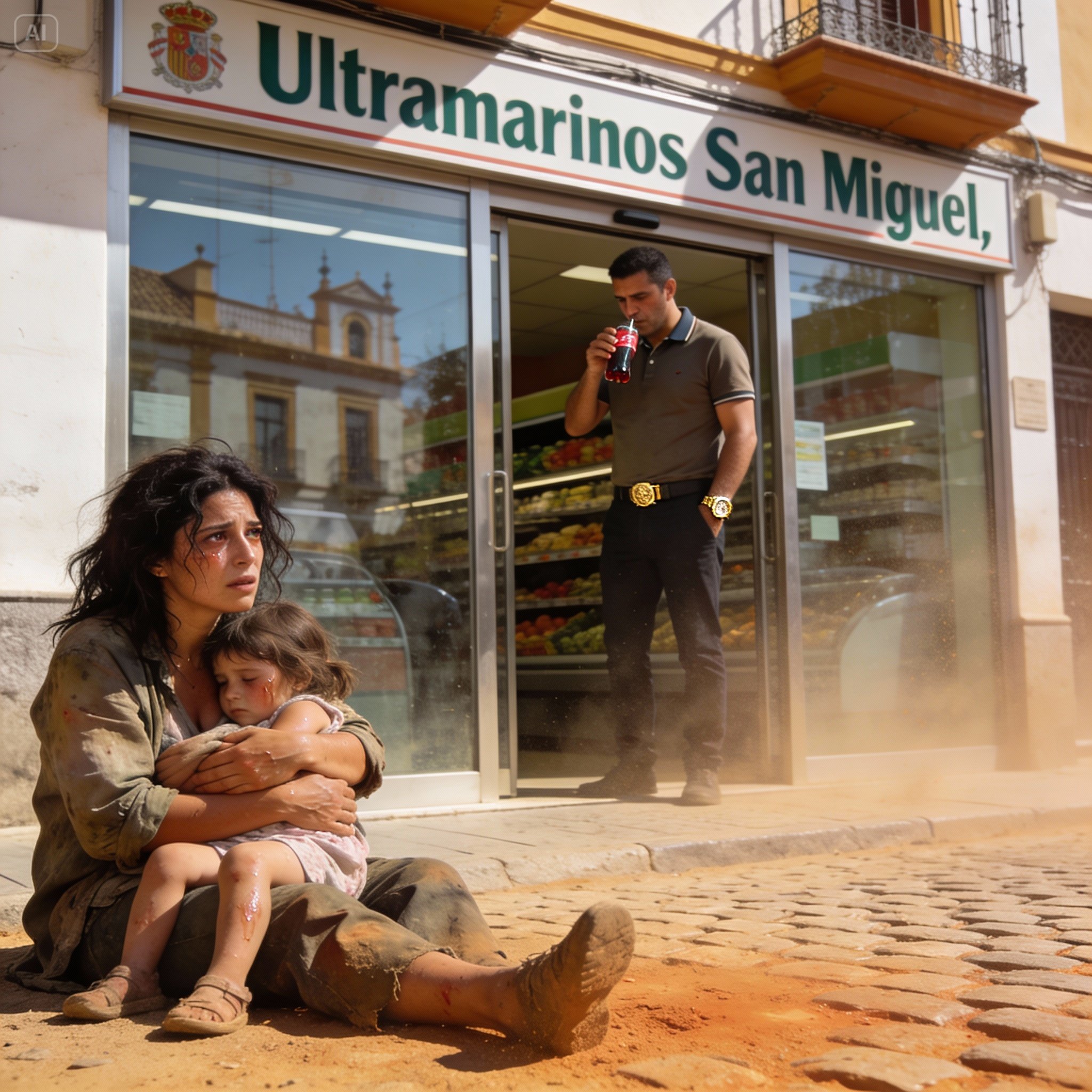
I went inside. The doorbell rang with a cheerful tinkling sound that contrasted cruelly with my despair. The blast of cold air was a blessed balm, but it also made me realize how soaked my clothes were, clinging to my body with the cold sweat of fear and the heat of the street.
“Please,” my voice trembled, barely audible. “A glass of water for my daughter. She’s getting dehydrated.”
The man behind the counter looked up from his mobile phone. He was about forty, well-groomed, with the complexion of someone who’d never worked in the sun. He wore a designer blue polo shirt, his hair was slicked back with not a hair out of place, and a gold Rolex on his wrist gleamed under the fluorescent lights.
His dark eyes scanned me from head to toe. I didn’t see compassion in them. I saw scrutiny. I saw judgment. He saw my threadbare dress, the one that had once been sky blue and was now grayish with dust. He saw my shoes, the soles peeling away at the toes. He saw the dirt mixed with sweat on my face. To him, I wasn’t a mother in distress; I was a stain on his immaculate shop.
“Water is for sale,” he said in a flat voice, pointing to the refrigerators. “Two euros for a bottle. Eighty cents for a small one.”
I felt the ground open up beneath my feet. Two euros. A fortune.
“I have no money, sir,” I admitted, and shame burned me more than the sun outside. “But my daughter is very ill. Please look at her. She’s burning up. Just one glass. From the tap. I’m not asking for the bottle. Just tap water, please.”
The man let out a short laugh, a nasal exhalation laden with contempt.
“Do you think this is Caritas or a shelter?” he said, leaning his elbows on the counter. “Tap water costs money too. I pay water bills, electricity bills, rent for the business. The service isn’t free.”
“Sir, she’s a girl…” I pleaded, taking a step towards him.
“If you can’t pay, leave,” she cut me off, her tone hardening. “I don’t want any trouble.”
My legs began to tremble. It wasn’t just physical weakness; it was absolute terror. Lucia whimpered weakly in my arms, a sound so fragile it broke my heart in two.
“We’ve been walking since six in the morning,” I insisted, tears beginning to well up in my eyes, blurring my vision of the man and his Rolex. “He’s only had a little water from a fountain they gave us, but it was warm. Please, sir. I beg you, for the love of God. For your mother. For God.”
“Are you deaf?” The man stepped out from behind the counter. He was taller than he looked, imposing. “I told you to leave. You’re scaring away customers with that look and that smell.”
I looked around. There was no one else in the store. We were alone. There were no customers to scare away, only their lack of humanity.
—Please… —I tried to approach, to extend my hand in supplication.
He didn’t let me finish. He grabbed my shoulder with unnecessary force and pushed me towards the door.
“Get out! Beggars like you only bring lice and filth to my business. If your daughter is sick, it’s your fault for being irresponsible and penniless. Go away!”
He shoved me violently. My feet stumbled on the doormat. The world spun. I fell into the street, into that open oven that was Seville at two in the afternoon.
Instinctively, I twisted my body in the air. I didn’t care about breaking myself; Lucía couldn’t touch the ground. My knee hit the rough cement of the sidewalk with a sharp crack. I felt my skin tear, the immediate sting of the open wound against the hot stone, but Lucía remained safe against my chest, cushioned by my own body.
“Mom!” she cried, waking up startled, but her crying was weak, without tears.
The man slammed the glass door shut. I heard the click of the lock.
From the ground, with blood staining the cement and pain throbbing in my leg, I looked up. Through the glass, I saw him return to the counter. I saw him with a clarity I’ll never forget. He opened one of the coolers, took out a can of ice-cold Coca-Cola, pulled the ring with a hiss I could almost hear, and drank. He took long, refreshing gulps, looking straight into my eyes as I lay in the street with my dying daughter.
Then, with a coldness that chilled my blood despite the heat, she lowered the metal shutter of the shop window, leaving us outside, as if we were trash being swept into the street.
I hugged Lucia to my chest, rocking my body back and forth.
“It’ll be alright, my love,” I whispered, lying to her. Lying to myself. “It’ll be alright.”
I struggled to my feet. My knee burned as if embers were embedded in my skin. I looked around. The street was deserted. It was siesta time in August; no one with any sense was out. Not a soul. Not a single patch of shade to take refuge in that didn’t smell of urine or garbage.
I started walking again. One step. Another step. I just had to keep moving. If I stopped, I felt that death would catch up with us both.
My name is Beatriz Elena Morales. I am thirty-two years old, although if you had seen me that day, you would have sworn I was fifty. Suffering is a cruel sculptor; it carves wrinkles where there should be smiles and darkens the gaze with shadows that the sun cannot dispel.
My daughter’s name is Lucía. She just turned three. She has the same honey-colored eyes as her father, the same black, wavy hair that gets tangled in the easterly wind.
Just a year ago, I was a different person. I wasn’t rich, we never were, but I had dignity. I had a home. I worked cleaning houses in the Los Remedios and Nervión neighborhoods, the affluent areas of Seville. I earned about 900 euros a month. It wasn’t much, but it was enough for us to live on. We lived in a small rented apartment in La Macarena, a third-floor walk-up, with old furniture we had restored ourselves and a kitchen that always smelled of coffee and toast in the morning. It was our palace.
Until Manolo got sick.
Manolo, my husband. The love of my life since we were fifteen. He worked in construction, like so many other strong and good men in this land. One day, at a construction site on the outskirts of town, near Dos Hermanas, he climbed onto scaffolding. Someone hadn’t properly secured the clamps. Someone wanted to save time or money.
The scaffolding gave way.
Manolo fell from a height of four meters. His spine snapped like a dry branch.
The construction company washed their hands of it. They said it was his negligence, that he wasn’t wearing the harness correctly, even though I knew Manolo was the most cautious man in the world. We didn’t have private insurance. Social Security covered the emergency, but the complications… Oh, the complications! He needed specialized rehabilitation, home modifications we couldn’t afford, and medications that weren’t covered by insurance.
We spent everything. Five years’ savings, the money from selling the car, my wedding ring, even the little gold chain my grandmother gave me for my First Communion. It’s all gone.
Manolo was bedridden for three months, paralyzed from the waist down. The man who used to lift me in his arms and twirl me around while flamenco played on the radio, now cried with helplessness at night because he couldn’t go to the bathroom alone.
Pneumonia took him one February morning. His lungs, weakened by years of construction dust and immobility, filled with fluid. He left in silence, squeezing my hand, asking my forgiveness for leaving me alone.
“Take care of the girl, Bea. Take care of her,” were his last words.
The funeral was the cheapest we could find, and even then I had to borrow from Doña Remedios, a widowed neighbor who lived on her meager pension. I owed her 500 euros, which I swore to pay back.
Lucía was two and a half years old then. She didn’t understand why her father wasn’t coming back, why her mother was crying in the bathroom with the tap running so she wouldn’t be heard.
I tried to go back to work harder than ever. I was cleaning three houses a day. But misfortune, when it strikes, likes to invite its friends over. Lucía started getting sick constantly. Bronchitis, high fevers. The daycare called me every single day to come and pick her up.
“Mrs. Morales, the girl has a fever. She can’t be here; she’ll infect the other children.”
I lost one house. Then another. The ladies of Los Remedios wanted someone reliable, not a mother who was absent twice a week.
—I’m sorry, Beatriz, but I need someone to come every day.
I lost my job. My unemployment benefits ran out. I tried selling sandwiches and homemade tortillas outside the university, but the police kicked me out because I didn’t have a license.
The rent piled up. One month. Two months. Three months. The landlord, a man who owned twenty apartments in the city and lived off the rent, refused to listen to pleas.
—Business is business, Beatriz. If you don’t pay, you’re out.
The eviction took place one morning in May. They took us out with only the clothes on our backs. Two black garbage bags with clothes and a box with Lucia’s toys.
We had been on the streets for two months. We slept wherever we could. Sometimes under the Triana Bridge, listening to the Guadalquivir River flow by, indifferent to our misery. Sometimes in ATMs until security came. Sometimes in María Luisa Park, hidden among the bushes so the tourists wouldn’t see us.
People were looking at me, of course they were looking at me. But they weren’t seeing me . They saw a dirty woman, with matted hair, smelling of sweat and despair, and they looked away. They crossed the street. Nobody wanted to look into the eyes of someone who reminded them how fragile their own luck was.
And now, Lucía was worse than ever. Her fever had spiked to 39 degrees yesterday. I tried to bring it down with wet cloths in the public restrooms at the market, but this morning she was burning up. She needed to get to the emergency health center, but it was far away, and the heat… Oh my God, the heat.
And that man, that demon with a Rolex, had denied me a glass of water.
I kept walking. My thoughts were becoming muddled and confused. The sun beat down on my skull. My mouth tasted like sand. Lucía wasn’t crying anymore, and that terrified me more than her crying. The silence of a sick child is the loudest sound in the world.
I walked past a house with a beautiful Andalusian patio, full of geraniums. I saw a green hose coiled up next to the gate. I stopped. I looked at the windows, which were tightly shut. I approached the gate and stretched out my hand, trying to reach the tap. My fingers brushed against the cold metal.
—Hey! Get out of there!
A voice from a balcony. An older man was shouting at me.
—I’m going to call the police! Thief!
I pulled my hand away as if I had been burned.
“I just wanted water…” I murmured, but he was already dialing on his phone.
I kept walking, dragging my feet. A block further on I saw a small, old church. The Parish of San Roque. The heavy wooden door was ajar.
I stumbled in.
The change was instantaneous. The silence. The dimness. The smell of stale incense, melted wax, and old wood. And the coolness. Those centuries-old stones held the cold like a treasure.
It was empty. Dark wooden pews lined up facing a simple altar with a crucified Christ and a sorrowful Virgin dressed in black velvet.
I slumped down on the first bench, unable to take another step. I laid Lucía on my lap. The girl’s eyes were closed, sunken in their sockets, her grayish skin making her black eyelashes stand out.
“My God…” I whispered, my voice shattering into a thousand pieces in the vastness of the empty church. “I’m not asking for riches. I’m not asking for my house back. I’m not asking for anything for myself. I know I’ve made mistakes. I know I’m not perfect. But she… she’s innocent.”
Tears began to fall on Lucia’s little face, dampening her fever.
“I only ask that you save her. She’s all I have left. Manolo is gone. My home is gone. My dignity is gone. If you take her from me, I’ll have nothing left. Please… please, Lord. Don’t take her from me. Take me if you want, but not her.”
I wept silently, a deep, heart-wrenching cry that came from the depths of my being. I rocked Lucía, humming a lullaby my mother used to sing to me, though my voice failed me.
—To the little nanny nana, to the little nanny ea…
I didn’t hear the footsteps. I didn’t hear anyone approaching.
-Lady.
I raised my head abruptly, startled, and hugged Lucia tightly in a defensive manner.
A man was standing next to the bench, in the central aisle.
He didn’t look like a priest. He wasn’t wearing a cassock or a clerical collar. He was dressed in worn jeans and a simple white linen shirt, the sleeves rolled up to his elbows. He looked to be in his mid-thirties. His face was… ordinary. He wasn’t particularly handsome, nor was he ugly. If you saw him on the subway, you wouldn’t turn around.
Except for the eyes.
She had dark, deep eyes, an unfathomable shade of brown. Eyes that seemed to hold an ancient calm, an absolute focus. She didn’t look at me with disgust. She didn’t look at me with pity. She looked at me with… recognition.
“Is your daughter all right?” he asked. His voice was soft, but it carried with an eerie clarity in the empty church.
“She has a fever,” I replied, wiping my tears with the back of my dirty hand, suddenly ashamed. “A really high fever. And we’re dehydrated. We’ve been walking for hours and…”
My voice broke.
—But I don’t have any money. I can’t…
The man raised a hand, stopping me with a gentle gesture.
—Wait here for a moment. Don’t move.
He turned around and walked toward the sacristy, or perhaps toward the side exit. His footsteps on the stone slabs were silent, almost imperceptible.
I stood there, stunned. Who was he? The sacristan? A parishioner? Why hadn’t he kicked me out? Usually, when I went into churches to rest, someone would come and tell me that I couldn’t sleep in the pews, that I disturbed others’ prayers.
The man returned just three minutes later. He was carrying two large bottles of cold mineral water and a paper bag from a nearby bakery.
He sat down on the bench opposite us, turning to look at us.
“Here,” she said, opening one of the bottles. The sound of the cork breaking the seal was music to my ears. “Slowly. Have him drink it in small sips. If he drinks too fast, he’ll throw up.”
He handed me the bottle. My hands were trembling so much I almost dropped it. He held the bottle firmly until my fingers gripped it securely. His fingers brushed against mine. They were warm, alive, comforting.
I took a sip. The cold water running down my burning throat was the most glorious sensation I had ever experienced. I felt life returning to my veins.
Immediately, I wet my fingers and moistened Lucia’s lips.
—Lucía, darling, water. Look, some cool water.
The girl opened her eyes slightly. Feeling the moisture, she instinctively stuck out her tongue. I carefully brought the bottle closer. She drank. One sip. Two. She coughed a little, and then drank more, eagerly.
“Slowly, my love, slowly,” I told him, crying with relief.
The man watched us silently, with a half-smile on his lips, patiently.
When Lucia had drunk enough and lay back down, breathing a little better, the man opened the paper bag.
“Here’s a tortilla sandwich and a banana,” he said. “Eat slowly. Your stomach needs to get used to it again.”
The smell of the potato omelet made me dizzy with hunger.
“Thank you,” I whispered, taking the sandwich. I tore off a small piece and gave it to Lucía. She chewed it slowly. “Thank you, sir. God bless you. You don’t know… you don’t know what this means. You’ve saved our lives.”
He shook his head gently.
—It wasn’t me. I was just in the right place.
“What’s your name?” I asked, eating a piece of bread. I felt energy slowly returning to my body.
“That doesn’t matter,” he said. “What matters is that you’re all right.”
“How much do I owe you?” I insisted. “I… I can work. I clean very well. If you need me to clean the church, or your house… I swear I’ll pay you back every penny when I get a job.”
The man stared intently into my eyes. There was a moment of silence, a heavy silence, laden with meaning.
—Beatriz—he said.
I froze. The sandwich stopped halfway to my mouth.
—How… how does he know my name?
She didn’t remember telling him. She was sure she hadn’t told him.
The man smiled, and that smile seemed to illuminate the gloom of the church more than the candles on the altar.
“I heard it,” he said simply. “Sometimes, the walls of this place speak if you know how to listen.”
It didn’t make sense, but at that moment, with a full stomach and my thirst quenched, I didn’t want to question him. Maybe he’d heard me praying aloud before he approached. Yes, that must have been it.
“I swear you don’t owe me anything,” he continued. “Just take care of your daughter. She has a great purpose. She’s strong, like her mother.”
“I’m not strong,” I said, looking down. “I failed. I couldn’t protect her. I let her go hungry. That man in the store… he humiliated me, and I couldn’t do anything.”
I felt the anger return, mixed with shame.
“The man from the store,” he repeated. His voice changed subtly. It wasn’t anger, it was something more… solemn. “Rodolfo Maldonado.”
I looked up abruptly.
—Do you know him?
—I know many people in this neighborhood. I know their names and I know their stories. Even the ones they try to hide.
He stood up.
—Rest here a little longer, Beatriz. No one will kick you out. The parish priest is a friend of mine. When the sun is less strong, go to the San Vicente Municipal Shelter on Pagés del Corro Street. Ask for Sister María. Tell her you’re there on behalf of “The Carpenter.” She’ll find you a bed for a few days.
“The Carpenter?” I asked, confused. “Is that his nickname?”
“It’s a noble profession,” he smiled. “Now rest.”
He walked towards the exit.
“Wait!” I called. I wanted to ask him more. I wanted to know why he was helping me, who he was, how he knew where I should go.
But when I reached the central aisle to see him come out, the church door was already gently closing.
I ran after him, carrying Lucía in my arms, ignoring the pain in my knee. I pushed open the heavy door and went out into the square.
The square was empty. Completely empty.
I looked to the right, toward the wide street. I looked to the left, toward the alleyways. There was no one there. In the ten seconds it took me to get outside, it was impossible for him to have disappeared. There was nowhere to hide that fast.
“Sir?” I called to the hot air.
Only the song of the cicadas answered me.
I went back inside the church, dizzy with the mystery, but for the first time in months, I didn’t feel that crushing weight on my chest. I sat down on the pew and finished feeding Lucia.
The girl’s fever began to subside half an hour later. Her skin felt cooler. Her breathing was more rhythmic, less labored.
“An angel,” I thought. “It had to be an angel. Or a very kind madman.”
But something in those eyes… something in the way she said “Beatrice”…
I did as he told me. I waited until evening, when the shadows lengthened and the heat subsided. I walked to the hostel on Pagés del Corro Street.
I rang the bell nervously. These places are usually packed; there are waiting lists of weeks.
A nun opened the door. She was elderly, with a face wrinkled like a prune, but with a sweet smile.
—Good afternoon, daughter. What do you need?
—I’m looking for Sister Maria—I said timidly. —The Carpenter sent me… he sent me.
The nun stopped. Her eyes widened slightly. She looked at me with a mixture of surprise and deep warmth.
—Come in, daughter. Come in right away. We were waiting for you.
—Were you expecting me?
“There’s always room for His friends,” she said mysteriously. “I’m Sister Maria. Come, let’s bathe that little girl and treat your knee. You look unwell.”
They gave us a small room with two clean beds. White sheets that smelled of lavender. A hot shower. Donated clean clothes. That night, Lucía slept for eleven hours straight. I lay awake most of the night, staring at the ceiling, thinking about the man from the church and the man from the shop.
One had given me life with a sandwich and a bottle of water. The other had pushed me to my death for two euros.
I felt a deep anger toward Rodolfo Maldonado. It wasn’t fair. How could someone have so much and give so little? How could he sleep at night knowing he had let a little girl suffer?
But alongside the anger, I felt a small spark of hope. The “Carpenter” had said I was strong. He had said Lucia had a purpose. And Sister Maria had taken us in without asking questions, simply because we mentioned that name.
The next morning, I felt like a new woman. Clean, fed, rested. Sister Maria told me we could stay for a week while she looked for something.
I had a plan. I wasn’t going to stand idly by.
I headed to the Triana Market. It’s the heart of the neighborhood, a place full of life, with the aromas of spices, fresh fish, and seasonal fruit. I looked for Doña Remedios, my old neighbor, the one who had lent me money for Manolo’s funeral. I knew she had a vegetable stall there.
I found her arranging tomatoes in a perfect pyramid.
—Doña Remedios!
The woman turned around. At first she squinted, then she put her hands to her mouth.
—Beatriz! Holy Virgin! Child, I thought the earth had swallowed you up!
She came out of her stall and hugged me. She smelled of basil and damp earth. I cried on her shoulder.
—I’m sorry, Doña Remedios. I’m sorry I haven’t paid you yet. I swear…
“Shut up, silly girl!” she scolded affectionately, turning away to look at me. “Money comes and goes. What worried me was you and the baby. Where’s Lucia?”
—At the hostel, with the nuns. It’s better there.
—You’re skin and bones, woman.
—Doña Remedios, I need a job. Anything. Carrying boxes, cleaning the floor, swatting flies. I need to get up. I can’t go on like this.
The old woman looked at me tenderly. She sighed and looked at her stall.
“Look, daughter, my bones aren’t what they used to be. The arthritis is killing me. I need someone to help me with the errands and take care of the business. I can’t pay you much, but I’ll give you a percentage of the sales, and you can take some fruit and vegetables for the baby.”
“Yes!” I exclaimed. “Yes, please!”
“And there’s something else. I have a little corner over there,” she said, pointing to a corner of the stall. “My grandson used to sell lemonade in the summer, but now he’s on his PlayStation all day. If you want, I’ll buy lemons and sugar from you. You can make homemade lemonade, nice and cold. Tourists pay well for that in this heat. Everything you make from the lemonade is yours.”
I felt like my heart was going to explode.
—Thank you, Doña Remedios. Thank you.
I started that very day. I worked like a mule. I arrived at six in the morning to help unload the truck. I cleaned every tomato, every pepper until they shone. I prepared liters and liters of mint lemonade, following my grandmother’s recipe.
“Homemade lemonade, the best in Seville!” I shouted with a smile, although inside I was still scared.
People started buying. One euro for a glass. Two euros for a large glass. On the first day I earned 30 euros. I cried when I saw the coins in my hand. It was the first honest money I’d earned in months.
I bought milk for Lucía. I bought a notebook and colored pencils. I paid Doña Remedios 10 euros towards my old debt.
“Don’t be silly, keep it,” she told me.
—No. Debts of honor are paid first.
Days passed. We moved from the hostel to a very cheap rented room in a shared apartment with two other immigrant women. It was small, hot, and noisy, but we had a key. We had a roof over our heads.
One morning, while walking to the market, I passed a newsstand. I stopped dead in my tracks.
On the front page of a local newspaper, El Correo de Andalucía , there was a photo.
It was him. Rodolfo Maldonado.
The headline read: “Model entrepreneur opens his third supermarket downtown. Rodolfo Maldonado, an example of entrepreneurship and success in times of crisis.”
In the photo, Rodolfo was smiling that same smug grin, cutting a red ribbon with golden scissors. He was wearing an impeccable suit. Beside him, the mayor was shaking his hand.
I felt nauseous. Bile rose in my throat.
That man, that “example of entrepreneurship,” was the same monster who had denied me water. The world was upside down. The wicked prospered, grew rich, appeared in the newspapers, and received applause. And the good, like my Manolo, died in preventable accidents. And mothers like me had to beg.
I tore the page out of the newspaper in anger, crumpled it into a ball, and threw it in a trash can.
—Enjoy it while you can—I murmured, remembering the Carpenter’s words. —Justice will come.
But deep down, I had my doubts. Was it really coming? Or was it just a story we poor folks tell ourselves to keep from going mad with despair?
I kept working. Lucía would come with me to the market in the afternoons, after she got out of the public school where I’d managed to enroll her thanks to the address of the shared apartment. She’d sit on a fruit crate with her pencils, drawing. Everyone at the market knew her. The butcher, Don Marcos, would give her pieces of ham. The fishmonger would save the prettiest shellfish for her.
Seville has a big soul, despite people like Rodolfo.
But Rodolfo wasn’t just a bad memory. He was a real presence in the neighborhood. His shop was only three blocks from the market. And I soon discovered that his influence reached even further.
One afternoon, I heard shouts near Don Marcos’ butcher shop.
Don Marcos was a good man, a giant with the hands of a bear and the heart of a child. He always gave meat on credit to grandmothers who couldn’t make ends meet.
I approached, curious and worried. There was a group of people surrounding the stall.
Rodolfo Maldonado was in the center.
He wasn’t alone. He was accompanied by two men who looked like built-in wardrobes, wearing sunglasses and cheap suits that were too tight at the shoulders.
Rodolfo was yelling at Don Marcos, pointing at him with a manicured, accusing finger.
—Time’s up, Marcos! I told you the deadline was today.
Don Marcos, who was a head taller than Rodolfo but seemed shrunken with fear, wiped his bloody hands on his apron.
—Rodolfo, please. I’ve had a bad week. The walk-in cooler broke down and I had to pay for the repair. Give me two days. Just two days.
“I won’t give you two hours,” Rodolfo spat. “You owe me five thousand euros. I bought your debt from the supplier, remember? Now the promissory note is mine. And I’m not as patient as they are.”
“I’ve paid you the interest!” Don Marcos shouted in despair. “I’ve paid you more in interest than the original debt! That’s usury!”
“That’s business,” Rodolfo said coldly. “You signed the paper. If you don’t pay today, I’ll keep the job. I’ll keep the cameras. I’ll keep everything. And you’ll be out on the street.”
People were murmuring.
“Abuser!” someone shouted from behind.
“Leave him alone!” said a woman.
Rodolfo turned towards the crowd, grinning like a shark.
“Does anyone want to pay this useless guy’s debt?” he asked. “No? Then keep quiet.”
Don Marcos was crying. A fifty-year-old man, strong as an oak, weeping with helplessness in front of all his neighbors.
I couldn’t bear it any longer. I saw Don Marcos and I saw my Manolo. I saw injustice crushing kindness once again.
Without thinking, without remembering that I was “nobody”, I dropped the ladle of lemonade and made my way through the crowd.
“Leave him alone!” My voice came out louder than I expected, echoing under the market’s high ceiling.
Rodolfo turned slowly. He looked at me. At first, I saw the confusion on his face. He didn’t recognize me. I was clean, my hair was done, and I was wearing an immaculate white apron. I wasn’t the dusty beggar woman I’d been a few weeks ago.
But then his eyes fell on Lucía, who had peeked out from behind my legs. And something clicked in his memory.
He smiled. That crooked, cruel smile.
“Well, well…” he said, approaching me. “If it isn’t the mother of the year. The one who prefers begging to working. I see you’ve managed to trick someone into giving you a job here.”
“I work honestly,” I said, keeping my chin up, even though my heart was pounding like a drum. “Not like you, who lives by sucking the blood of others. Don Marcos is a good man. He’s already paid you enough.”
“And what do you know about money, you starving wretch?” he laughed. “Two weeks ago you were crawling on my sidewalk. You should be ashamed to talk to me like that. I’m a pillar of this community.”
“You are a disgrace to this community,” I replied.
Rodolfo took a step toward me. His gorillas moved as well. The physical threat was palpable.
“Shut your mouth, or I’ll have you thrown out of here too. I have friends at City Hall. I can have your daughter taken away because you’re homeless. Is that what you want?”
Fear paralyzed me. Lucia. My weak spot. I knew where to strike.
“What’s going on here?” a calm voice cut through the tension like a hot knife through butter.
We all turned around.
There he was.
The man of the church. The carpenter.
He stood in the doorway of the hall, wearing the same simple clothes, his hands in his pockets, but his presence filled the space in a way that Rodolfo and his expensive suits never could.
He walked towards us. People instinctively moved aside to let him pass, as if an invisible force were gently pushing them.
“Who are you?” Rodolfo barked, annoyed by the interruption.
The man didn’t answer immediately. He stopped beside Don Marcos, placed a hand on his shoulder, and the butcher instantly stopped trembling. Then he looked at me and winked discreetly.
Finally, she fixed her dark eyes on Rodolfo.
“I am someone who remembers,” the man said.
“What do you remember?” Rodolfo tried to maintain his arrogant posture, but I saw a flicker of doubt in his eyes.
“I remember a boy named Rodolfito,” the man said calmly. “A twelve-year-old boy who lived in the Polígono Sur. A boy who cried because his father had gone out for cigarettes and never came back.”
Rodolfo’s face visibly paled.
—What are you talking about? I’m from Los Remedios, born and bred.
“You’re lying,” the man said, not aggressively, but with an undeniable truth. “You lived in a damp, basement apartment. Your mother, Mrs. Carmen, ruined her knees scrubbing stairs so you could have new shoes.”
The silence in the market was absolute. Not a fly was to be heard.
“I remember,” the man continued, taking a step toward Rodolfo, “when you were fourteen and they caught you stealing at the neighborhood supermarket. The owner wanted to call the police. You were going to reform school. But your mother knelt down. She cried. She begged. And a neighbor, a butcher, paid for what you had stolen so they would let you go.”
Rodolfo took a step back. His eyes darted from side to side, searching for a way out, searching for who had told this stranger.
—Shut up! You don’t know anything!
“That butcher saved your future,” the man’s voice rose, ringing with authority. “And now you come here to destroy another butcher. Is this how you repay the mercy shown to you? With cruelty?”
“That’s a lie!” Rodolfo shouted, but his voice sounded high-pitched and hysterical. “This guy’s crazy! Get him out of here!”
He gestured to his thugs. The two big men took a step toward the Carpenter.
The man from the church didn’t even flinch. He just looked at them. A serene look, but with an intensity that seemed like liquid fire.
“You don’t want to do this,” he said gently.
The thugs stopped. They looked at each other, confused. One of them lowered the hand he had raised. It was as if they had suddenly forgotten why they were there or remembered something more important: the fear of God, or perhaps the memory of their own mothers.
“And there’s something else, Rodolfo,” the man said, lowering his voice to a whisper that, nevertheless, we all heard. “Something no one knows. The night your mother died.”
Rodolfo froze. His skin turned from pale to ashen gray.
“You were in Marbella, partying with some investors,” the implacable man continued. “She called you. She said her chest hurt. You told her not to be a nuisance, that you were risking an important business deal.”
“No…!” Rodolfo covered his ears. “Shut up!”
“She died alone, Rodolfo. With the phone in her hand, waiting for her son to call her back. And you’ve never forgiven yourself for that. That’s why you hoard money. That’s why you crush others. Because you think that if you’re rich and powerful enough, you can silence your mother’s voice calling you in your head. But it doesn’t work, does it? The cold water you denied me… through this woman… won’t quench your thirst.”
Beatriz felt a chill. The cold water you denied me… What did she mean?
Rodolfo was trembling violently. Tears of rage and shame streamed down his face. He had broken down in front of the entire neighborhood. His mask of success had shattered, revealing the frightened, guilty child beneath.
“Who are you?” Rodolfo whispered hoarsely. “Who the hell are you?”
The man smiled, but this time it was a sad smile.
“I’m just a carpenter building bridges where others build walls. You have a chance, Rodolfo. One last chance. Change. Or the loneliness you feel now will be your only companion for eternity.”
The man turned around and started walking towards the exit.
“Let’s go!” Rodolfo shouted to his men, his voice breaking, and ran off in the opposite direction, almost tripping over his own expensive feet, fleeing from the truth that had just been revealed.
The people in the market all burst into conversation at once, an excited and amazed murmur.
I didn’t stay to listen to the gossip. I ran after the man from the church. I had to know.
I caught up with him at the market door, right where the sunlight was hitting hard.
“Sir!” I grabbed his arm.
He stopped and turned around. His arm under his shirt felt solid, real.
—Beatriz.
“Who are you?” I asked, breathless. “How did you know all that? Are you a detective? A prophet?”
He looked at me tenderly and stroked Lucia’s head, who had followed me.
—Beatriz, there are many things in this world that are not seen with the eyes, but with the heart.
—You said… you said “the water you denied me.” But you denied it to my daughter. To Lucía.
The man leaned slightly toward me. His eyes shone with a golden light.
— What you did for one of the least of these brothers and sisters of mine, you did for me .
The phrase echoed in my head. I had heard it before, years ago, in my childhood catechism classes.
I put my hand to my mouth.
-You…
He put a finger to his lips, smiling.
“I’m a friend. And you, Beatriz, have work to do. Don Marcos needs help organizing his accounts. You’re good with numbers, aren’t you?”
—I… yes, I was good at them in high school.
—Help him. And don’t worry about Rodolfo. The seed has been planted. Now we’ll see if wheat or weeds grow.
“Will I ever see him again?” I asked, feeling a lump in my throat. I didn’t want him to leave. I felt safe with him.
—I am always near—he said. —In the bread you share, in the water you give. I am there.
He took a step into the blinding light of the street. I blinked for a second at the glare of the sun in the rearview mirror of a passing car.
And when I opened my eyes, he was gone.
There was only the bustling Triana street, the tourists, the cars, and the heat. But the air… the air felt different. It felt full of hope.
I returned to the market dazed, but with a newfound certainty in my heart. We weren’t alone. We never had been.
PART 2
The silence that followed the disappearance of the churchman was dense, almost tangible, like the heavy air that precedes a summer storm in the Guadalquivir Valley. However, it wasn’t a storm of water that was brewing, but one of conscience. I walked slowly back to the market, Lucía holding my hand, feeling each cobblestone of San Jacinto Street resonate beneath my worn soles. My mind was a whirlwind. The stranger’s words echoed in my head: “Whatever you did for one of the least of these brothers and sisters of mine, you did for me .” It wasn’t a line from a book, nor a Sunday sermon delivered out of obligation; it had sounded like a universal law, an absolute truth uttered by one who has the authority to dictate the movement of the tides.
Upon re-entering the Triana Market, the atmosphere had changed dramatically. The usual murmur of haggling and superficial gossip was gone. There was a palpable static electricity in the air. The vendors spoke in hushed tones, forming small groups. Don Marcos, the butcher, sat on a folding stool behind his counter, his head in his hands. He looked like a man who had just survived a shipwreck, drenched in cold sweat and trembling with lingering adrenaline.
I approached him. Doña Remedios was already by his side, offering him a linden tea in a thick glass.
“Take it, Marcos, son, or you’ll have a fit,” said the old woman, her trembling hand resting on the butcher’s robust shoulder.
“Beatriz,” Don Marcos said when he saw me, looking up. His eyes were red. “Did you see that? Did you see it too?”
—I saw him, Marcos. And I heard him —I replied gently, sitting Lucía down in her usual fruit crate and giving her her sketchbook.
“That man… he knew things,” Marcos’s voice broke. “He knew about Rodolfo. About his mother. Things that had been rumored in the neighborhood for twenty years, but that no one dared to say out loud. How could he have known about the phone call? That’s… that’s impossible.”
“Many impossible things happen every day, Marcos,” I said, feeling a strange calm. “It’s just that sometimes we’re too busy looking at the ground to notice.”
Doña Remedios crossed herself.
—I say he was a saint. Or a spirit. My grandmother told stories of apparitions like that during the war, people who saved you from a bombing and then left no trace in the mud.
“Whatever it was,” I interjected, remembering the mission the stranger had entrusted to me, “he’s given us a chance. Marcos, that man said you needed help with the accounts. He said I should help you.”
The butcher let out a bitter, humorless laugh.
“Help me… Beatriz, I’m ruined. Rodolfo is right about one thing: the numbers don’t lie. I signed papers I didn’t understand out of desperation. The interest has eaten away at the profit, the capital, and even my soul. There’s nothing to organize, just certify my commercial demise.”
“Let me see them,” I said firmly. A firmness I hadn’t known I possessed until that moment. “I was good at math. My father, may he rest in peace, wanted me to be an accountant before… well, before life passed me by.”
Marcos hesitated, but then pulled a dented shoebox from under the counter. It was full of crumpled invoices, delivery notes stained with calf blood, and open envelopes with payment demands.
“That’s where my shame lies,” he murmured.
That afternoon, while Doña Remedios looked after Lucía and taught her to distinguish between a pear tomato and a Raf tomato, I sat in a corner of the butcher’s stall. I smoothed out each piece of paper. I took out a pen and an old notebook. I began to organize the chaos.
What I discovered chilled my blood, but it also ignited a flame of righteous indignation.
Rodolfo didn’t just charge high interest rates; he practiced illegal usury. He had applied compound interest to overdue payments, charged nonexistent “management fees,” and levied penalties that doubled the original debt without any clear contractual justification. It was theft disguised as legality, taking advantage of the fact that Don Marcos could barely read the fine print and trusted the word of a neighbor.
I worked until the market closed. My eyes burned, but my mind was clear.
“Marcos,” I said as we were lowering the metal shutter, “you don’t owe him another five thousand euros. According to my calculations, and if we apply the current usury law, he’s actually the one who owes you almost three hundred euros for improper charges.”
Marcos looked at me as if I had spoken to him in Chinese.
—What are you saying, little girl?
“I say we’re going to fight. Not with fists, like he wanted, but with this.” I held up my notebook. “Tomorrow we’ll go to the City Hall’s free legal aid office. With these figures, Rodolfo won’t dare take you to court. He’d risk a tax audit. And believe me, someone who steals from his neighbors like this is sure to steal from the tax authorities too.”
For the first time in months, I saw Don Marcos truly smile. It was a shy, toothy smile that lit up his face.
—Beatriz, if you get me out of this, you and the girl will have free meat for the rest of your lives.
“I’m happy if Lucía has a steak once a week,” I smiled.
That night, in our small rented room, I felt exhausted but strangely fulfilled. Lucía slept beside me, breathing peacefully. The Seville heat was still stifling, but it no longer seemed like a mortal enemy.
I approached the open window, looking up at the starry sky that was barely visible due to the city’s light pollution.
“Thank you,” I whispered to the wind. “I don’t really know who you are, though I’m beginning to suspect. But thank you.”
There was no audible response, but a cool breeze, inexplicable on a Sevillian August night, moved the curtains and caressed my face.
The following days were a whirlwind. Rodolfo Maldonado had disappeared. His store, Ultramarinos San Miguel , remained closed. A sign reading “Closed for family matters” hung on the glass door, right where, days before, I had seen my own misery reflected in it.
Rumors spread through the neighborhood like wildfire. They said he’d been seen crying in a bar. They said he’d gone to confession at the Basilica of La Macarena and that the priest had been with him for three hours. They said he was liquidating assets. No one knew the truth, but everyone felt that the balance of power in the neighborhood had shifted. The fear was dissipating.
However, my own struggle was not over. The owner of the apartment where we rented the room, a sour woman named Señora Paca, was waiting for me in the hallway on Thursday morning.
—Beatriz, we need to talk.
My stomach clenched. Those three words never bring good news for the poor.
—Tell me, Doña Paca.
—The electricity bill has gone up. The water bill has gone up. And you and the girl use a lot. I see you washing clothes by hand every day.
—I wash the girl’s clothes because she only has two outfits, ma’am. And I use cold water.
“I don’t care. If you want to stay here next month, the rent goes up by fifty euros. And I want the advance payment by Monday.”
Fifty euros. She could have asked for a million. What I earned selling lemonade and helping Doña Remedios barely covered food and my current rent. Fifty euros more meant going hungry so Lucía could eat.
—Doña Paca, please, I can’t…
“If you can’t, there are plenty of people looking for a room. Immigrants who pay without complaint and cram five into one room. I’m doing you a favor by letting you be alone with the baby. Monday, Beatriz. Or your things are out on the street.”
She turned around and went into her living room, turning up the volume on the television.
I stood in the dark hallway, feeling panic, that old acquaintance, rise again in my throat. What good was it to have defeated Rodolfo if poverty still had a thousand faces? Paca wasn’t a movie villain with a gold Rolex; she was an ordinary woman, a neighbor, who had simply decided that her profit was worth more than our survival.
I went outside, holding back tears. I couldn’t cry in front of Lucia.
“Mom, are you sad?” the little girl asked as we walked towards the market.
—No, my love. I’m just… thinking.
“Think about the good man,” she said with that crushing simplicity of children. “He said I had a purpose. And that you were strong.”
I stopped and hugged her in the middle of the sidewalk. She had more faith than I did. She remembered the promise better than I did.
That afternoon, after work, I felt an overwhelming need to visit Manolo. I hadn’t been able to go to the cemetery for weeks because the bus cost money and it was far away, in San Fernando. But today, with the threat of eviction hanging over my head, I needed to talk to him. I needed to feel that I wasn’t alone in this fight.
I spent my last coins on the bus ticket. I left Lucía with Doña Remedios, who insisted on staying with her so I could have a moment of peace.
The San Fernando cemetery is a city of silence within the noisy city. The heat reflected off the white marble of the gravestones. I walked to the area of the common niches, where Manolo rested. He didn’t have a polished granite headstone, just a small plaque with his name and a photo that I had laminated so it wouldn’t get damaged by the rain.
I placed some wildflowers that I had picked from the side of the road in a plastic cup of water.
“Hello, my love,” I whispered, touching his name. “Things are tough, Manolo. They want to fire me again. I’m tired. I swear I’m so tired that sometimes I want to close my eyes and never open them again. But then I look at Lucía and I see you, and I know I can’t give up.”
I told him everything. I told him about the man from the church. I told him about Rodolfo. I told him about my fear. Talking to him calmed me, even though only the wind through the cypress trees answered me.
As I turned to leave, the sun was beginning to set, tinting the sky with shades of orange and purple, colors of bruise and fire.
That’s when I saw him.
About fifty meters away, in the older section of the cemetery, where the family mausoleums and the more well-kept graves are located, a man sat on the ground. He wasn’t standing, nor was he kneeling piously. He was sitting directly on the earth, his legs stretched out and his back hunched, as if his spine had been removed.
He was wearing a wrinkled white shirt, unbuttoned at the neck, and the sleeves were stained with dirt.
It was Rodolfo Maldonado.
I stopped dead in my tracks. My first instinct was to run. To hide behind a cypress tree. That man was dangerous. That man hated me.
But something held me back. Perhaps it was the posture of utter defeat. Perhaps it was the fact that she was crying. They weren’t quiet sobs; they were audible moans, the sound of a mortally wounded animal.
I stood before a simple but well-maintained grave. Carmen Maldonado. Beloved mother.
I remembered what the Carpenter had told her: “She died alone… waiting for her son to call her back . ”
Curiosity and a strange compassion that I didn’t know where it came from drew me toward him. My footsteps crunched on the gravel.
Rodolfo raised his head. His eyes were swollen, his face red and dirty. When he saw me, there was no immediate recognition, only the empty stare of someone in hell. Then he blinked.
“Did you come to mock me?” His voice was hoarse and raspy. “Did you come to see the big businessman wallow in the mud?”
“No,” I said, keeping a safe distance. “I’ve come to see my husband. He’s over there, in the niches at the back. He died because we didn’t have the money for private treatment and social security took too long. He died working for people who didn’t insure his scaffolding.”
Rodolfo lowered his gaze towards his mother’s grave.
“She died because I was selfish,” he said, the words seeming to tear a piece of his throat. “I had the money for the best hospital in the world. I could have bought the whole hospital. But I didn’t have time. Time… that’s the one thing I couldn’t buy.”
“The man from the church was right then,” I said gently.
Rodolfo let out a hysterical laugh.
“Reason? That man… that man has destroyed me. I can’t sleep, Beatriz. I close my eyes and I see her. I close my eyes and I see your face when I pushed you. I see Marcos’s face. I see every person I’ve stepped on to climb one more step. It’s as if my skin has been peeled off and every touch of the air burns me.”
He put his hands to his face.
—Who was he? Tell me. You spoke to him. Is he a demon? Is my conscience gone mad?
“I think he’s the complete opposite of a demon, Rodolfo. I think he’s someone who loves you enough to hurt you like this.”
“Love me?” she looked at me incredulously. “He’s humiliated me. He’s destroyed me.”
“Sometimes you have to demolish a rotten building to build a new one that won’t collapse,” I said, surprised by my own wisdom. They weren’t my words; I felt someone whispering them in my ear. “You built your life on money and contempt. That has no foundation. It’s crumbled. Now you have to decide whether you stay among the rubble or start laying real bricks.”
Rodolfo remained silent, staring at his mother’s gravestone. He violently pulled a weed from the ground.
“I’m scared,” he confessed, and at that moment I didn’t see the arrogant businessman, I saw the twelve-year-old boy from the Polígono Sur neighborhood. “I’m scared it’s too late. I’ve done so much damage…”
“As long as I’m breathing, it’s not too late,” I said. “But forgiveness isn’t asked for with words, Rodolfo. It’s asked for with actions. Spilled water can’t be gathered up, but the earth can be watered so that something new can grow.”
I turned to leave. I had nothing more to say to him. He had his own demons to fight.
—Beatriz— she called to me as I was walking away.
I turned around.
—Is your daughter… better?
I hesitated for a second.
—She’s alive. And she’s better. Despite everything.
Rodolfo nodded slowly, as if absorbing crucial information. He looked again at his mother’s grave.
I returned home with a racing heart. I had seen the monster bleed and had discovered that its blood was red, like mine.
The weekend passed with unbearable tension. Monday was approaching. Doña Paca glared at me like a vulture every time we crossed paths in the kitchen. I counted my money ten times. I was forty euros short. There was no way I could get that much selling lemonade in two days.
On Sunday morning I went to mass at the Parish of Saint Anne. I didn’t go to ask for money. I went to ask for the strength to sleep on the street again if necessary.
—If it is your will, Lord, that we return to the park, give us warmth at night and protect Lucia from the bad guys—I prayed.
As I left mass, with the midday sun beating down on the white facades of Triana, I saw a black car parked in a double row in front of the market, which on Sundays only opened a few stalls selling flowers and prepared food.
It wasn’t a flashy luxury car, but it was good.
Rodolfo Maldonado stood beside the car. He wore jeans and a simple shirt, no tie, no jacket. He had shaved, but dark circles were still visible under his eyes. He looked ten years younger and, at the same time, infinitely older.
I was talking to a group of people. I recognized Don Marcos, Doña Remedios, and several other neighbors.
I approached slowly, with the instinctive fear of someone expecting a blow.
Rodolfo saw me. He stopped talking to Marcos and walked toward me. People parted to form a corridor. There was no fear on their faces, but a strange anticipation.
“Beatriz,” he said. His voice was firm, but it lacked the metallic arrogance of before.
—Mr. Maldonado.
—Please, just Rodolfo. “Mr. Maldonado” died a few days ago in the cemetery.
He put his hand in his pocket. I tensed up. He took out an envelope.
“I know I owe you much more than this,” he said, handing me the envelope. “But this isn’t charity. This is justice. I’ve reviewed my accounts. Or rather, I’ve reviewed the accounts you gave Marcos. You were right. I’ve been stealing. Legally, perhaps, but morally I’ve been stealing from this community for years.”
I looked at the envelope. I didn’t take it.
-What is this?
“It’s the end of my stupidity,” he said. “And there’s something else.”
He turned towards the car and took out a folder.
—I have an apartment on Alfarería Street. It belonged to an aunt of mine who passed away. I was going to renovate it to rent it to tourists for a fortune. But… last night I had a dream.
He stopped, swallowing hard. The mention of the dream made the hairs on my arms stand on end.
“What did he dream about?” I whispered.
—I dreamed about him. About the Carpenter. He was building a table. A huge, endless table. And he said to me: “Rodolfo, there’s room for everyone at my table, but you have to bring your own chair. And your chair is built with the wood of your sacrifice.”
Rodolfo looked at me with moist eyes.
—That apartment is empty. It’s furnished. It has electricity and water. I want you to live there with Lucía. For free. For as long as you need. Until you’re back on your feet, until Lucía finishes university if necessary. It’s yours.
The world stopped. The noise of traffic disappeared. I could only hear the beating of my heart in my ears.
“Why?” I asked, trembling.
“Because I need to know I can be good,” he replied, and a single tear rolled down his cheek. “Because I need my mother, wherever she is, to stop being ashamed of me. And because you… you showed me mercy in the cemetery when you could have spat on me.”
I looked at Marcos. He nodded, smiling. I looked at Doña Remedios. She was crying openly.
I took the keys Rodolfo handed me. They were cold and heavy. They were the keys to my life.
“I accept,” I said, and my voice sounded loud and resonant. “But on one condition.”
Rodolfo seemed surprised.
-Whatever.
“Don’t let it be just for me. You have power, Rodolfo. You have resources. Use that business acumen to help others. There are many Beatrizes in this city. There are many Lucías with fevers. Promise me you won’t stop with me.”
Rodolfo stared at me. A new determination shone in his eyes, a light that came not from greed, but from purpose.
“I swear to you,” he said, extending his hand. “I swear to God.”
I shook his hand. His grip was firm, warm, human.
That night we didn’t sleep in Doña Paca’s room. That night, Lucía and I slept in an apartment with large windows, cool hydraulic tile floors, and a refrigerator full of food that Rodolfo had bought himself.
And when I laid Lucia in her new bed, she looked up at the ceiling and smiled.
—Mom, will the good man come to visit us?
“He’s here now, my love,” I said, kissing her forehead. “I think he lives here with us now.”
And as I turned off the light, I knew the real story had only just begun. Redemption isn’t a single act; it’s a long, dusty road, but for the first time in years, I had new shoes to walk it.
Continued…
PART 3
Moving to Alfarería Street wasn’t just a change of address; it was like transplanting a withered plant from toxic soil to rich, fertile, black earth. The house smelled clean, of furniture polish, and, oddly enough, of orange blossom, even though it wasn’t the season for orange trees to bloom. Perhaps it was the scent of hope, which has its own unmistakable fragrance.
The first few days I’d wake up startled, my heart pounding, instinctively searching for my shoes so I could run out before someone kicked us out. But then my eyes would focus on the wooden beams of the ceiling, on the soft light filtering through the Venetian blinds, and I’d remember: no one was coming to kick us out. Rodolfo had kept his word. He hadn’t just given us the keys, he’d put the utilities in his name so I wouldn’t have to worry about the bills for the first six months. “Until your business takes off,” he’d said.
And my business took off.
With the stability of a roof over my head, my mind stopped being in survival mode and started creating. Doña Remedios’ lemonade was just the beginning. I started making gazpacho, salmorejo, shrimp fritters. Simple, home-style food, but made with the love of someone who cooks to give thanks for life.
Rodolfo, for his part, was undergoing his own metamorphosis. It wasn’t easy. People don’t forgive overnight. When Ultramarinos San Miguel reopened , many neighbors crossed the street to avoid walking past it. They didn’t trust him. They thought it was a tactic, a marketing strategy to clean up his image.
“The goat always heads for the mountain,” said the baker on the corner.
But Rodolfo endured. He withstood the distrustful glances, the whispers behind his back. And he began to make changes that no one expected.
First, he removed the “Right of Admission Reserved” sign. Then, he installed a free cold water fountain at the store entrance. A simple dispenser, with paper cups, and a handwritten sign: “Free water for anyone who’s thirsty. No one leaves here without a drink . ”
I remember the first time I saw him. I stopped in front of the store with Lucía. Rodolfo was inside, restocking cans. He saw me looking at the sign. He came out, drying his hands on a rag.
“It’s not much,” he said, almost ashamed. “Compared to what I did, it’s a drop in the ocean.”
“The ocean is made of drops, Rodolfo,” I replied, smiling. “That’s a good start.”
But the real change happened a month later. One October afternoon, when the heat was beginning to give way to that soft, golden autumn of Seville, Rodolfo came to find me at the market.
—Beatriz, I need your help. And Marcos’s. And Doña Remedios’s.
“Why?” I asked, cleaning the counter of my stall, which was now called “Beatriz’s Flavors” and had a queue every day at lunchtime.
“I want to open up the back storage room of the store. It’s a big, useless space. I use it to store old boxes. I want to… I want to turn it into a dining area.”
I froze.
—A dining room?
—A soup kitchen. But not just any soup kitchen. I don’t want it to be a place where people go to receive leftovers with their heads down. I want it to be a decent place. With tablecloths. With proper cutlery. With hot, good food. The same food I sell in the shop, not expired canned goods.
Her eyes shone with a feverish intensity.
—I’ve done the math. If I reduce my profit margin to the minimum in the store, and if I get volunteers… I can feed fifty people a day.
“Why are you doing this, Rodolfo?” I asked him, although I already suspected the answer.
“Because he visited me again in my dreams,” he confessed softly, looking around as if afraid they would think him mad. “Last night. He told me that building a long table is useless if no one is sitting at it. He told me that my mother used to give sandwiches to the workers who labored in the street, even when we barely had enough for supper. I had forgotten, Beatriz. I had forgotten who she was.”
I felt a deep emotion, a mixture of pride and awe at the power of human transformation.
“Count me in,” I said. “And count on Marcos. He’ll provide the meat. You’ll see.”
And so the project “Carmen’s Table” was born .
The opening had no mayors, no red ribbons, no press photographers. It was a silent affair. We opened the doors on a rainy Tuesday. At first, people were afraid to come in. The homeless of the neighborhood, the elderly with meager pensions, the single mothers… they all knew the old Rodolfo and feared it was a trap.
I was the one who went out into the street.
“Antonio!” I called to a man who usually slept in the ATM vestibule on the corner. “Come on in! Today we have potato and meat stew! And it’s hot!”
Antonio looked at me, hesitant.
—How much does it cost, Beatriz?
—Nothing. It just costs you to wash your hands and sit down to share with us.
Antonio came in. Then Maria, the lady with the coupons, came in. Then a family of immigrants who lived in a van came in.
Rodolfo waited tables. He, the man with the Rolex (which he no longer wore, by the way; he had sold it to buy the industrial kitchen for the dining room), wore a white apron and served the dishes with a disarming humility.
—Enjoy your meal, sir. Would you like more bread, ma’am?
I saw Don Marcos in the kitchen, cutting meat with a huge grin on his face. I saw Doña Remedios peeling potatoes despite her arthritis, telling risqué jokes that made everyone laugh.
And in the midst of that chaos of dishes, laughter and the smell of homemade food, I felt a presence.
I didn’t see it. Not with my physical eyes. But I felt it.
It was a warmth that embraced my shoulders. It was a peace that silenced the background noise. I looked toward the open door, where the rain fell softly on the sidewalk.
For a second, just a fraction of a second, I thought I saw a figure leaning against the doorframe. A man in jeans and a white shirt, watching the scene with a smile of utter satisfaction.
I blinked and it was gone. But the aroma… that smell of cut wood, of clean, fresh sawdust, filled the dining room entrance, overpowering the smell of the stew.
Rodolfo stopped abruptly, a tray in his hand. He raised his head, sniffing the air. He looked around the room for me. Our eyes met. He smelled it too. He knew it too.
She nodded slightly, her eyes filled with tears, and continued serving.
That night, after closing the dining room, we were all exhausted but euphoric. Rodolfo brought out a bottle of cheap wine and some glasses. We sat down at one of the tables we had just cleaned: Marcos, Doña Remedios, Rodolfo, and me. Lucía was asleep in two chairs pushed together, covered with Rodolfo’s coat.
“You know,” Rodolfo said, turning the glass in his hands. “All my life I thought success was about having things. Cars, watches, houses. I thought if I had more than other people, I’d be safe. That no one could ever hurt me again.”
He looked around the empty dining room.
—But today… when Antonio thanked me and shook my hand… I felt richer than the day I opened my third store. It’s strange, isn’t it? Emptying your pockets to fill your soul.
“It’s not strange, son,” said Doña Remedios. “It’s the oldest secret in the world, we just forget it.”
“I’ll drink to the Carpenter,” said Don Marcos, raising his glass. “Whoever he is.”
“By the Carpenter,” we all said in unison.
Months turned into years. Life went on, with its ups and downs, but the paralyzing fear of poverty never again gripped me. My business prospered so much that I was able to rent my own place, a small home-style restaurant I called “Lucía’s Miracle .” I hired three women from the neighborhood who were in difficult circumstances. I paid them well, registered them with social security, and, above all, treated them with the dignity that had been denied me.
Lucía grew up. She became a bright, intelligent, and compassionate girl. Sometimes, I would find her talking to herself in her room.
“Who are you talking to, darling?” he asked her.
—With Jesus’ friend —she said matter-of-factly—. He tells me stories before I go to sleep.
I didn’t correct her. I knew they weren’t imaginary friends. I knew she had a special connection, a direct line that adults lose with cynicism and worries.
Five years after that fateful day in August, Seville was experiencing another historic heat wave. The asphalt was like lava once again. The streets were deserted at midday.
I was closing the restaurant after the lunch shift. Rodolfo came in, looking for some air conditioning. We were good friends now. He was like Lucia’s eccentric but kind uncle.
“It’s unbearably hot,” he said, wiping his forehead. “It reminds me of… well, you know.”
—Yes—I said, pouring him a glass of cold lemonade.—To that day.
“Do you think he’ll come back?” he asked suddenly. We had never stopped talking about him, the man from the church. He was our recurring theme, our shared mystery.
—I don’t think he’s ever left, Rodolfo. He just doesn’t need to show up in person if we’re doing his job.
We went outside. The sun beat down on us, but I wasn’t afraid anymore. I had water. I had a home. I had friends.
We walked towards the square where the church of San Roque stood. The church was open. We went inside, looking for a moment of silence.
It was empty, just like that day. I sat on the same bench. Rodolfo sat next to me.
“Thank you,” Rodolfo said, looking at the altar. “For breaking me. Thank you for destroying me so you could make me again.”
At that moment, the light streaming through the stained-glass windows changed. It became more golden, denser. The dust particles floating in the air seemed to stop, suspended in time.
We hear footsteps.
They didn’t come from the entrance, nor from the sacristy. They came from everywhere and nowhere.
A figure emerged from the shadows of a side column.
My heart skipped a beat.
It was him.
He hadn’t aged a day. He wore the same clothes: jeans, a white shirt. The same deep eyes that held entire galaxies.
He came closer to us. He wasn’t walking; he seemed to be gliding across the stone floor.
Rodolfo jumped to his feet, trembling. I remained seated, unable to move, weeping silently with pure joy.
“Hello, friends,” he said. His voice was music. It was the sound of the river, the wind in the olive trees, a child’s laughter.
“It’s you…” Rodolfo stammered. “It really is you.”
The man smiled and placed a hand on Rodolfo’s shoulder.
“You’ve built a fine table, Rodolfo. My mother is proud. And so am I.”
Rodolfo fell to his knees, sobbing, hugging the stranger’s legs.
—Forgive me. Forgive me for how long it took me to understand.
“You were forgiven before you even asked for forgiveness,” the man said, gently lifting him up. “Love keeps no record of wrongs.”
Then he turned towards me. He crouched down to be at eye level with me.
—Beatriz.
“Sir…” I whispered.
—I asked you to be strong. And you have been. You have turned your pain into bread for others. There is no greater magic than that.
“I was afraid,” I confessed. “Sometimes I’m still afraid of losing everything.”
“You can’t lose what’s eternal,” he said, touching my chest, right over my heart. “Everything else—the houses, the money, the success—is dust. But the love you’ve given, the hope you’ve sown in Lucía and your people—that’s a fire that never goes out. You take that with you forever.”
“Why us?” I asked, the question that had haunted me for years. “Why did you come to us? So many people are suffering…”
“I go to everyone,” he replied. “I knock on every door. But not everyone opens. You opened. You opened out of necessity, and Rodolfo opened out of brokenness. But you opened. And that’s all I need to come in and have dinner with you.”
She stood up. The light around her intensified, becoming almost blinding, but it didn’t hurt her eyes. It was a warm, loving light.
—I have to go. There are other paths, other thirsts to quench, other hard hearts to soften.
“Don’t go!” Rodolfo pleaded. “Stay with us. We have room in the dining room. We have…”
The man laughed softly.
“Rodolfo, I’m in every bowl of stew you serve. I’m in Lucía’s smile. I’m in the forgiveness you gave Marcos. Don’t look for me here”—she pointed to her body—”Look for me in your brother’s face. That’s where I live now.”
He began to back away towards the light in the stained-glass window.
“Remember,” he said, his voice ringing like a bell. “You are never alone. I am with you every day, until the end of the world.”
And then, in the blink of an eye, it dissolved into the light. It became golden dust, the scent of orange blossom and wood, a peace that filled the church to overflowing.
Rodolfo and I stayed there in silence for a long time. There was no need to speak. What we had just experienced was beyond words.
When we left the church, the world seemed freshly washed. The colors were brighter. The noise of the city sounded like a symphony.
Lucía was running through the square, with her school backpack.
—Mom! Uncle Rodolfo!
She threw herself into my arms. I hugged her tightly, smelling her hair, feeling her life beat against mine.
“You know what, Mom?” she said excitedly. “Today at school I drew a picture of a good man. And the teacher said he looks like someone in the history books, but I told her no, he’s my friend and he lives in Seville.”
Rodolfo and I looked at each other and smiled.
“You’re right, Lucía,” Rodolfo said, ruffling her hair. “She lives in Seville. She lives in Triana. And she lives in this house.”
The three of us walked back to the restaurant. There was much work to be done. Potatoes to peel, tables to set, people to feed. The world kept turning, with its injustices and sorrows, but we were no longer victims or perpetrators. We were workers on a much larger project, employees of an invisible Carpenter who had taught us that the only remedy against death is not life, but love.
And as we walked under the sun of my homeland, I knew with absolute certainty that, whatever happened, I would never thirst again. For within me, a fountain of living water sprang forth, welling up to eternal life.
END