I ENTERED SEEKING REVENGE AND FOUND MY SALVATION: THE DAY I DISCOVERED MY DEAD SON’S SIX SECRET HEIRS HIDDEN IN MY OWN HOUSE.
THE LEGACY OF GREEN EYES: MEMOIRS OF A REGRETFUL GRANDFATHER
CHAPTER 1: The Echo of Silence
They say money doesn’t make a sound, but that’s a comforting lie we rich people tell ourselves to justify our loneliness. Money has a very particular sound: it sounds like the crunch of my Italian leather shoes as I walk down empty hallways, it sounds like the clinking of a silver spoon against Limoges china at a table set for twelve where only one sits, and above all, it sounds like the unbearable echo of a telephone that never rings because the only people who called you out of love are already dead.
My name is Ignacio Borja. If you live in Spain and have read the business pages of the newspapers in the last forty years, you know my surname. Borja Industries. Construction, shipping, private banking. I’ve built empires with the same ease with which others raise a glass of wine. I’ve negotiated with ministers, dined with royalty, and destroyed competitors without batting an eye. They called me “The Shark of the Manzanares.” How ironic. Sharks, at least, have a pack. I had nothing but an accounting report in my right hand and a volcanic fury in my chest.
It was two o’clock on a dreary Tuesday afternoon in Madrid. The summer storm threatened to break over the mountains, staining the sky that purplish-violet color that precedes disaster. I paced the entrance hall of my house—a mansion in La Moraleja that seemed more like a museum than a home—looking for blood.
“Rocío!” I shouted. My voice echoed off the stucco walls, getting lost among the 19th-century paintings that no one was looking at.
I crumpled the papers in my hand. Money was missing. Not large sums, not the millions I moved through my Swiss bank accounts. Ridiculous amounts, almost insulting: fifty euros here, one hundred euros there, strange charges on the supermarket bill. “Formula,” “diapers,” “fruit purees.” Items that had no place in a house inhabited by a seventy-year-old man and his ninety-year-old mother.
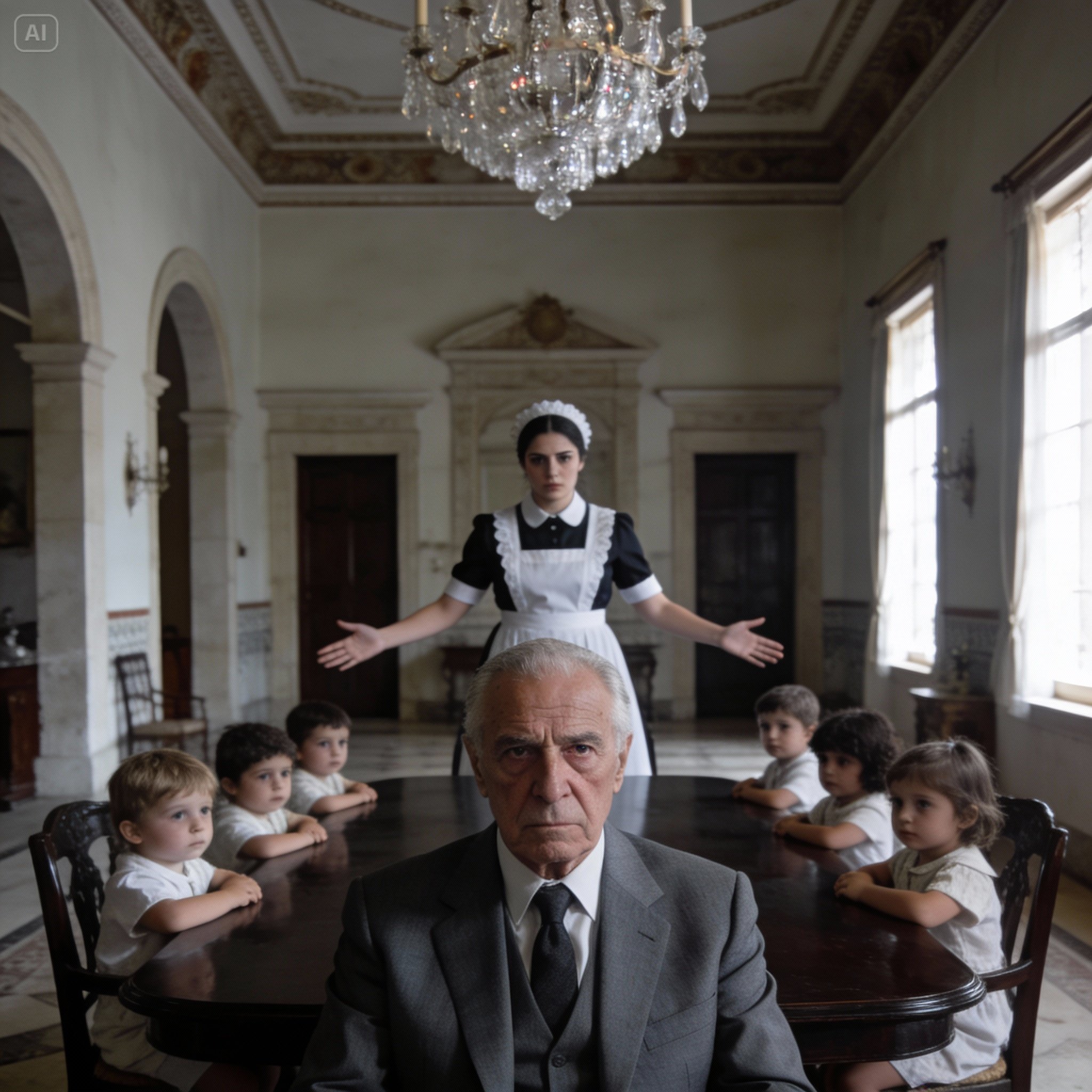
Rocío Ibarra, the girl I’d hired two years ago to take care of the house and my mother, was stealing from me. That was the only logical conclusion my mind, warped by distrust, could reach. She was efficient, quiet, and respectful, but in my world, loyalty has a price, and everyone ends up selling out.
“Get out of here right now!” I roared again, feeling the vein in my temple throb dangerously. The doctor had forbidden me from upsetting anyone, but anger was the only fuel that had kept me going for the past three years.
Three years. Three years, two months, and four days since the phone rang in the early hours and a metallic voice informed me that Alejandro’s car, my only son’s, had gone off the road on a secondary road in Galicia in the rain. Alejandro, my pride, my disappointment, my everything. He died without speaking to me. He died estranged from me because I, in my boundless arrogance, refused to accept that he had fallen in love with a “nobody,” a girl with no last name, no dowry, no class. I threw him out of the house. I told him that if he crossed that threshold, he would cease to be a Borja. And he, with the same stubbornness he inherited from me, crossed it and never returned.
—Ignacio, son, please…
My mother’s voice, Doña Mercedes’s, reached me behind me like a weary whisper. I turned around. At ninety years old, my mother maintained that aristocratic elegance that is no longer manufactured. She walked leaning on her ebony cane, her face pale and her eyes watering with fear.
“Calm down, Ignacio,” she pleaded, trying to reach for my jacket sleeve. “Perhaps there’s been a mistake. Rocío is a good girl. She reads to me at night, she lovingly combs my hair… She can’t be a thief.”
“The numbers don’t lie, Mother,” I replied, gently but firmly pulling away from her grip. “No one steals from a Borja and gets away with it. Today she’s out on the street. And if a single piece of Grandma’s silverware is missing, I’ll call the Civil Guard and have her taken away in handcuffs.”
I walked toward the double doors of the large guest dining room. It was a forbidden room. We had celebrated our last Christmas there with Alejandro before the fight. Since then, I had ordered that the doors remain closed, the curtains drawn, and the furniture covered with white sheets. It was my sanctuary from grief. But today, I heard a noise on the other side.
A murmur. It wasn’t the sound of a vacuum cleaner, nor the sound of cleaning. It was an organic, soft, almost… musical sound.
I placed both hands on the carved wood. I felt the cold varnish. I took a deep breath, bracing myself for the possibility of finding the employee loitering, napping, or looting the display cases.
“Game over!” I shouted as I pushed the doors wide open.
The doors slammed against the stops with a bang that must have been heard throughout the neighborhood. I burst in, index finger raised in accusation, the word “fired” on the tip of my tongue.
But time stood still.
The universe, with its strange sense of humor, decided at that precise moment to give me the biggest slap of my existence.
The dining room wasn’t dark. The blue velvet curtains, which I had ordered to be kept closed, were wide open, letting the grayish light of the storm flood the room. The white sheets were gone.
In the center, my immense mahogany table, that table where bank mergers and political pacts had been signed, was transformed.
There were six high chairs. High chairs. Six wooden high chairs adapted with makeshift cushions.
And in them, six children.
My brain, trained to process complex data in milliseconds, collapsed. I stood petrified, mouth agape, unable to comprehend the geometry of what I was seeing.
On the left, three boys. On the right, three girls. They all wore simple, clean clothes, but clearly hand-me-downs or mended. They were eating pasta with tomato sauce. There were red stains on the linen tablecloths, crumbs on the Persian floor, and a smell… a smell of warm food, of talcum powder and life that hit me like a physical punch.
At the head of the table, standing like a conductor caught red-handed, was Rocío. She had a spoon in her hand and her face was contorted with absolute terror.
The sound of my entrance acted as an exit shot.
All six pairs of eyes rose in unison and stared at me.
And then I felt the marble floor open up beneath my feet. They weren’t ordinary eyes. They were green. A deep, intense green, with golden flecks around the pupils. They were my mother’s eyes. They were my eyes.
They were Alexander’s eyes.
“Oh my God…” My mother’s whisper behind me sounded like thunder.
Mercedes staggered forward, her trembling hands covering her mouth.
—Ignacio… look at them.
I couldn’t breathe. My heart, that old, hardened muscle, began to pump with a violence that ached in my ribs. I looked at the nearest child, a boy with messy brown hair. The boy didn’t cry. He frowned. He stared at me with a defiant intensity, clutching his spoon like a weapon. That gesture… that damned gesture of frowning when something bothered him. Alejandro did the exact same thing. I did the same thing.
Rocío reacted. Her survival instinct overcame her fear. She dropped the spoon, which fell with a metallic clinking, and ran to stand between me and the table. She stretched her arms out in a cross, trembling like a leaf, but planted firmly on the ground like a wall.
—Mr. Borja… —Her voice was a broken thread—. I didn’t know you were coming today.
“What does this mean?” My voice came out hoarse, unfamiliar to myself. “Who are you? What’s an illegal daycare doing in my house? Answer me!”
“It’s not a daycare,” she said, and I saw her swallow hard, trying to gather her courage. “They’re… they’re guests.”
“Guests?” I took a step forward. Fury was beginning to mix with panic. What kind of macabre joke was this? Six identical children? Clones? A stress-induced hallucination? “You’re fired! I want these intruders off my property right now! I’m calling the police for trespassing!”
I clumsily pulled out my mobile phone. I was going to dial 091. I was going to end this. But my mother grabbed my wrist with a strength that didn’t match her age.
“Hang up that phone, Ignacio!” Doña Mercedes ordered. Her voice had the same commanding tone she used when I was a child and broke a vase. “Look at them! Look at her!”
I looked at one of the girls. Her ash-blonde hair was pulled back in a ponytail. She’d been startled by my shouts and was wiping a tear with the back of her hand. As she turned her head, the light from the window illuminated her neck.
There, just below her right ear, was a mark. A dark, crescent-shaped birthmark.
The phone slipped out of my hand and fell onto the carpet with a thud.
The world went silent. I could only hear the deafening thump of my own blood in my ears. I remembered that mark. I had kissed it a thousand times when I changed Alejandro’s diapers. I had watched it grow with him. It was his mark.
I looked at Rocío. She didn’t lower her gaze. Her eyes were full of tears, but there was a fierce dignity in her posture.
“Tell me,” I whispered, feeling a metallic taste in my mouth. “Tell me and face the consequences if you lie to me.”
Rocío took a breath.
—They are yours, Don Ignacio. They are Alejandro’s children.
“You’re lying!” The roar burst from my throat before I could process it. “Alejandro died three years ago! He had no children! I would have known!”
“You kicked him out,” she retorted, each word a stab wound. “You told him you didn’t want anything to do with his life. He… he used to come to see me. We were together.”
“Together?” I looked at her with disgust, reverting to my classist armor. “My son with the maid? With a gold digger? It’s impossible! Six children! That’s biologically ridiculous. It’s a trick to get money out of me!”
“They’re sextuplets!” she cried desperately. “They were born six months after the accident. They’re premature! Miracles!”
I advanced toward the table, blinded by rage. The children, seeing my abrupt movement, burst into tears. It was a heart-wrenching chorus. The boys climbed down from their chairs with surprising agility and ducked under the table, hiding among the mahogany legs and the long tablecloth. The girls huddled together.
Rocío grabbed a table knife. It had a rounded tip, harmless, but she held it as if it were a Toledo sword.
“Don’t come any closer!” she shrieked. “If you touch even one of them, I swear to God I’ll forget who you are.”
I stopped. Not because of the knife, but because of her gaze. That woman was ready to kill me. And worst of all, I saw in her eyes the same fire that Alexander had when he defended what he believed was right.
“I’m going to destroy you,” I hissed. “I’m going to call my lawyers. I’ll take the air you breathe. Proof? Where’s the proof?”
“I have a letter,” she said, without lowering the knife.
“A letter?” I laughed, a dry, cruel laugh. “Written by whom? By you, imitating their handwriting?”
—For him. The night before his trip to Galicia. He told me: “If anything happens to me, if my father tries to hurt you, give him this.”
—Give it to me.
—No. She will read it here. In front of her mother. In front of her grandchildren.
Rocío pulled a crumpled envelope from her apron. I recognized the paper. It was cream-colored laid paper with my office letterhead. Alejandro used to steal sheets of paper from me when he came to see me before… before the end.
He handed it to me with a trembling hand. I snatched it from his fingers.
I broke the seal. My hands were shaking so much I almost tore the paper. I unfolded the sheet.
The handwriting. That cramped, nervous handwriting, slanted to the right. My son’s handwriting.
I read the first few lines and felt my knees give way. I had to lean on the back of an empty chair to keep from falling to the floor.
“Dad, if you’re reading this, it’s because I’m no longer here. And if you’re reading it, you’re probably furious, looking for someone to blame, looking for someone to destroy with your pain. I ask you to stop. I ask you, for once in your life, to listen with your heart and not with your wallet.”
“What is she saying?” my mother asked, approaching and stroking the blonde girl’s arm.
“He says…” I swallowed. I had a lump in my throat the size of a walnut. “He talks about the clock.”
“What watch?” Rocío asked, confused.
I looked up. Rocío didn’t know about the watch. Nobody knew.
—The Patek Philippe—I read aloud, my voice breaking. — “I swear to you on the watch I buried under Mom’s rosebush when I was ten, because I was afraid you’d yell at me for breaking it, that these children are my blood. They are my life. There are six of them, Dad. Six chances for you to do things right this time.”
The paper fell from my hands.
Nobody knew about the watch. I fired two gardeners thinking they’d stolen it. Alejandro confessed it to me years later, in a whisper, ashamed. It was our secret.
If this letter said that… then it was real.
I looked down. A child had emerged from under the table. He was clinging to my mother’s leg. He was looking at me. He had Alejandro’s nose. He had my chin.
“It’s them,” my mother whispered, crying openly. “Ignacio, it’s them.”
Reality hit me like a tsunami. I had six grandchildren. Six grandchildren who had been living… where? How?
“Why?” I asked, looking at Rocío. I no longer saw her as an enemy, but as an enigma. “Why did you wait three years? Why did you let me live in this hell of loneliness?”
“Because I was afraid,” she replied, lowering the knife. “You said you wished Alexander had died childless. You said it at the funeral. I was three months pregnant. I had no money, no family. I thought he would take them from me. I thought he would reject them.”
“And now?” I asked, feeling such deep shame that it burned my skin.
“I ran out of money,” he confessed with brutal honesty. “I’ve sold everything. I’ve worked from dawn till dusk. I came here under a false name just to be near you, to see if… to see if you had a heart.”
—And what did you see?
—I saw a sad man.
The silence grew thick and heavy. I was about to say something, perhaps even apologize, when the sound of the front door opening broke the silence.
Quick steps. Expensive heels. A shrill voice.
—Uncle Ignacio! Grandma! I’m here!
Fabian.
My nephew. The son of my deceased sister. The man who had occupied Alejandro’s office, who drove his cars, who expected to inherit my empire. Fabián, with his shark-like smile and his plastic soul.
Rocío tensed up. I saw panic in her eyes. She grabbed the children and pushed them behind her.
Fabián entered the dining room as if he owned the place. He was wearing a beige linen suit and sunglasses. He stopped dead in his tracks when he saw the scene. His smile froze.
“But what the hell…?” Fabián looked at the food on the floor, at Rocío with her stained uniform, and at the six children. “Dude, have you gone mad? Have you set up a charity daycare in the dining room? It smells… it smells like poverty.”
That comment. “It smells like poverty.”
Something clicked inside me. For three years, I had tolerated Fabián’s arrogance because he was “family.” Because he was all I had left. But seeing my grandchildren, my own flesh and blood, hiding from him, I saw Fabián for who he truly was: a parasite.
“Shut your mouth, Fabián,” I said. My voice was low, but full of threat.
Fabian laughed nervously.
—Come on, man. Fire this girl. Look what she’s done. It’s unhygienic. These… these rats are touching the table.
She walked towards the blonde girl, the one with the mark on her neck, and made a gesture as if to push her away in disgust.
—DON’T TOUCH HER!
My scream rattled the windows. Fabián froze, his hand in the air. He turned slowly toward me, pale. I had never yelled at him like that before.
“The only one who doesn’t belong here is you,” I said, walking toward him. My joints ached, my soul ached, but I felt stronger than ever. “You just called my grandchildren rats.”
“Grandchildren?” Fabián blinked, confused. His vulture-like eyes scanned the room, settling on the letter on the table. His expression changed. Cold calculation replaced surprise. “What are you talking about? Alejandro is dead. This is… this is a scam. That bitch must have told you a tall tale!”
Fabián lunged for the letter. Rocío tried to stop him, but he pushed her violently. She fell to the ground. The children screamed.
“Enough!” I went to my desk and took out the emergency satellite phone. I dialed the number of Dr. Alarcón, the family doctor who had been with us for years.
“Nobody leaves here,” I declared, looking Fabián in the eye. “The doctor is coming. We’re going to do DNA tests. Right now.”
Fabian loosened his tie. He was sweating. He knew that if those children were legitimate, his inheritance would vanish.
“Fine,” Fabian said with a venomous smile. “Take the test. But when it comes back negative, I want this woman in jail, and I want you to beg my forgiveness on your knees for doubting me.”
“Done,” I replied. “But if it comes back positive, Fabián… if it comes back positive, you’ll wish you’d never been born.”
The storm raged outside, rattling the windows with fury. But the real storm was raging inside. The war for the Borja legacy had just begun, and I, for the first time in my life, knew which side I had to fight on.
CHAPTER 2: Blood and Ink
The wait was torture designed in hell. Dr. Alarcón arrived half an hour later, soaked to the bone and carrying his leather briefcase. He took saliva samples from the six children and compared them with Alejandro’s genetic profile, which we kept at the private clinic.
Fabián never took his eyes off the doctor for a second, hurling hurtful comments, calling the children “bastards” and “starving.” I remained silent, sitting in my armchair, watching. Watching Rocío comfort the children. Watching my mother, Doña Mercedes, secretly give them cookies. Watching a family being formed before my very eyes.
Night fell on the mansion. The results would arrive the following morning.
Rocío and the children stayed in the guest wing. They had no clothes, so Rocío, in an act of bravery that astonished me, tore down the velvet curtains from the windows to make them blankets and ponchos. When my mother saw it, far from being angry, she joined her. I watched them together, the aristocrat and the servant, sewing to protect my children from the cold. And I, locked in my study with a bottle of whiskey, cried for the first time in three years.
But evil never sleeps.
At three in the morning, a noise woke me up. I went downstairs. Rocío was in the hallway, pale as a ghost.
“Don Ignacio,” he whispered. “Fabián… is in the garage with the doctor.”
I went down to the garage with the stealth of a hunter. I hid behind a column. There was my nephew, cornering poor Doctor Alarcón against his car.
“I have money, Arturo,” Fabián said, waving a wad of bills. “And I know things about your granddaughter. If that test comes back positive, I’ll ruin you. I need you to say it’s negative. That it’s a mistake. Do it!”
I felt a violent nausea. My own blood, trying to buy the truth, trying to erase the children of his cousin out of greed.
I was going to go out, I was going to kill him with my own hands, but Rocío stopped me. She put a hand on my arm.
“No,” he whispered. “Let the doctor decide. If he’s a man of honor, he’ll tell the truth. If you intervene now, Fabián will say you coerced the witness.”
She was right. That girl had a natural intelligence that amazed me.
We went back to bed, but nobody slept.
The following morning brought radiant sunshine and an unbearable tension. We were all in the lobby. Dr. Alarcón arrived accompanied by two Civil Guard officers.
Fabian smiled triumphantly. He believed his bribe had worked.
“Doctor,” said Fabian. “Tell my uncle the truth. Tell him they’re imposters.”
Dr. Alarcón looked at Fabián, then at me, and finally at the children. He took out a sealed envelope.
“The results indicate a 99.8% match,” the doctor said firmly. “They are the biological children of Alejandro Borja. And, therefore, the legitimate grandchildren of Don Ignacio.”
The world stopped. Fabián turned pale until he looked like a corpse.
“You’re lying!” he shouted. “I paid you! I told you that…!”
He fell silent suddenly, realizing his mistake. The Civil Guard officers stepped forward.
“What did you say, sir?” one of the officers asked.
“Fabián tried to bribe me last night,” the doctor declared, pulling out his cell phone. “And I have it recorded.”
Chaos erupted. Fabián tried to flee, but the officers restrained him. He was shouting, hurling insults, and spewing venom.
But I wasn’t listening anymore. I only had eyes for Rocío and the six children who were looking at me curiously.
I approached them. My ribs ached—I’d had a minor mishap on the stairs trying to protect one of the children who tripped, a story for another time—but the physical pain was irrelevant.
I remembered my promise. “If it comes back negative, you go to jail. If it comes back positive…”
I knelt down.
I, Ignacio Borja, the man who never bowed to anyone, knelt on my right knee on the marble floor. The pain was sharp, but necessary.
“Don Ignacio, no…” Rocío tried to help me up.
“Shut up,” I said, my eyes filled with tears. “I have a debt.”
I looked at Rocío. I looked at my grandchildren.
“I failed you,” I said, my voice echoing in the hall. “I was a blind, stupid old man. I denied you. I insulted you. And you, Rocío… you’ve cared for the most precious thing I have with the strength of a lioness, while I wallowed in my own misery. I ask your forgiveness. Humbly. For your sake and for the memory of my son.”
Rocío cried. She knelt beside me and hugged me. And then Mateo, the boy with the mark on his neck, came over and placed his small hand on my cheek.
“Grandpa, you’re a pain,” he said, touching the bandage on my forehead.
—Yes, son —I laughed between sobs—. Grandpa has a boo-boo, but he’s going to get better soon.
The guards led Fabián away in handcuffs. As they dragged him, he shouted threats, but it was just background noise. The mansion, for the first time in years, wasn’t empty.
A month later, the garden of the house was unrecognizable. There were swings where there had once been statues. There were tricycles in the driveway.
We organized a lunch. A giant paella. Doña Mercedes, looking rejuvenated, laughed with the girls. Rocío, dressed no longer as a maid but as the lady of the house—although she insisted on pouring her own water—presided over the table.
I raised my glass. I looked towards the old rosebush, where we had found the rusted remains of the Patek Philippe watch, the final proof that Alejandro had always loved me, despite everything.
“For the family,” I said.
“For grandpa!” shouted the six children in unison, their mouths stained with chocolate.
I smiled. My fortune was no longer in the bank. It was sitting at my table, eating ice cream and staining the linen tablecloths. And for the first time in my life, I felt like the richest man in the world.
Fabián would rot in jail. My company would continue, but now it had a purpose: the Alejandro Borja Foundation. And me… I had a new job. Being a full-time grandfather.
I looked up at the blue sky of Madrid.
“Thank you, son,” I thought. “Message received.”
THE LEGACY OF GREEN EYES: CHRONICLES OF A HOUSE TAKEN OVER
CHAPTER 3: The Logistics of Chaos
Peace is a relative concept. For a Tibetan monk, peace is the silence of the mountains. For me, Ignacio Borja, peace used to be a perfectly balanced account and a single malt whisky at nine o’clock at night in a library where you could hear a pin drop. But that peace, I discovered in the days following Fabián’s arrest, was actually the peace of cemeteries.
Now, my concept of peace had mutated. Peace was getting Mateo to stop painting the 18th-century walls with permanent markers. Peace was getting Sofía to fall asleep without pulling her sister Lucía’s hair. Peace was those five minutes, between seven and seven-thirty in the morning, before the “barbarian invasion”—as I affectionately called my six grandchildren—wore up and claimed the territory.
It had only been a few weeks since the Civil Guard took my nephew out of my hallway in handcuffs, but the transformation of the Borja mansion had been so radical that sometimes, when I woke up, I didn’t recognize my own ceiling.
That first official morning of “coexistence” is etched in my memory.
I woke up to the familiar sound of my biological alarm at six-thirty. I showered, dressed in my usual dark gray suit—because a Borja doesn’t relax even in the apocalypse—and went downstairs. The pain in my ribs, a reminder of my heroic fall, had become a dull ache, a constant reminder that I wasn’t thirty anymore.
Upon arriving in the kitchen, I expected to find the usual silence, the smell of coffee freshly made by Esteban, and the Expansión newspaper ironed on the table.
What I found was a war zone.
The kitchen, an industrial-style stainless steel space designed for banquets, looked as if it had been raided by a regiment of hungry goblins. There was flour on the floor. There were eggshells on the counter. And in the midst of the chaos, Rocío was trying to cook pancakes in four pans at once, while Esteban, my unflappable butler who had never lost his composure, not even when the west wing burned down in ’98, held two children, one in each arm, with an expression of barely contained panic.
“Watch the milk, Leo!” Rocío shouted, turning around to prevent another child from knocking over a jug.
I stood in the doorway, watching. Esteban saw me and his eyes pleaded for help.
“Good morning, sir,” said Esteban, attempting to bow while little Lucas playfully pulled his ear. “Breakfast… has gotten a little complicated.”
“I see,” I said, moving forward. My shoes crunched on spilled cereal.
Rocío turned around, her face smeared with flour and her hair disheveled. When she saw me, she tensed up. The habit of servitude was slow to die.
—Don Ignacio, I’m sorry, I didn’t mean to… I tried to keep them quiet, but they’re hungry and the kitchen is new to me and…
I raised a hand to stop her apology. I went over to the counter. I looked at the pancake batter. I looked at Rocío, who had dark circles under her eyes from not sleeping because she’d been watching over six children in a strange environment.
—Rocío—I said in a deep voice.
-Yes sir?
—Those pancakes are burning.
She turned with a stifled gasp and rescued the breakfast just in time. I took off my suit jacket, hung it carefully on the back of a chair, rolled up the sleeves of my Italian silk shirt, and picked up a spatula.
—Esteban, let the children loose in the makeshift playground in the living room and bring coffee. Lots of coffee. Rocío, you take care of the fruit. I’ll handle the ironing.
Rocío looked at me as if I had grown a second head.
—But… you don’t cook. You are… you are Ignacio Borja.
“I’m a man who wants to have breakfast before the Stock Exchange opens,” I replied, flipping a pancake with a dexterity I didn’t know I possessed. “And I’m a grandfather. Apparently, that includes emergency cooking skills.”
That morning, we had pancakes for breakfast that were burnt around the edges and raw in the center, but no one complained. It was the first lesson of my new life: perfection is overrated.
However, love doesn’t fill pantries or clothe bodies. That same afternoon, I faced the logistical reality. My grandchildren had nothing. The clothes they wore were old, worn, insufficient. They slept on makeshift beds. They had no toys, except for those their imaginations created with my glass paperweights (something I had to strictly forbid after Esteban’s second heart attack).
I called my personal secretary, Carmen.
—Carmen, cancel my afternoon meetings.
—But Don Ignacio, you have the videoconference with the investors in Tokyo at four o’clock.
“Let them wait. Or invest in something else. I need you to come to the mansion and bring the big car. We’re going shopping.”
—Out shopping, sir? What do you need? Suits? Office furniture?
“No, Carmen. I need diapers. I need clothes for two-year-olds. I need…” I looked around at the empty, colorful living room, “…I need everything.”
The expedition to the shopping center was an event that deserves its own chapter in the history books of Madrid. Imagine the scene: Ignacio Borja, followed by his secretary, his daughter-in-law (I still found it hard to use that word, but I forced myself to think of it) and six children tied with safety straps so they wouldn’t scatter like marbles.
We entered a luxury children’s clothing store on Serrano Street. The saleswomen, used to high-society ladies buying a single dress for a christening, paled when they saw us enter.
“Good afternoon,” I said, planting myself in the middle of the store. “I need clothes.”
“Of course, sir,” said the clerk, scanning my expensive suit and sniffing out the commission. “For what occasion? A gift?”
“To live,” I replied. “I need clothes for six children. Winter, summer, spring, and autumn. Pajamas, street clothes, Sunday best, shoes, coats.”
The shop assistant blinked.
—For… for the six of them?
—Yes. And I want everything to be of the highest quality. Organic cotton, virgin wool. Nothing itchy. Nothing synthetic.
Rocío came closer to me and whispered, tugging at my sleeve:
“Don Ignacio, this is very expensive. I’ve seen the labels. A pair of pants costs what I used to earn in a week. We can go to a cheaper chain store, or a regular shopping mall…”
I looked into her eyes. In them, I saw the humility of someone who had counted every penny to survive. It broke my heart to remember that this woman had raised my children in poverty while I swam in abundance.
“Rocío,” I said softly, so only she could hear. “For three years, my money has bought me loneliness. It’s bought me silence. Today, my money will ensure that my grandchildren never have to suffer a single scratch. It’s not an expense, it’s a way of repairing the damage. Let me do it. Please.”
She nodded, her eyes glassy, and proceeded to try coats on the children.
It was in that store that I discovered something about myself. I enjoyed it. I, who hated shopping, who sent the tailor to my office to save time, found myself arguing with Mateo about whether he preferred light-up sneakers or Velcro ones. (The light-up ones won, of course.) I found myself holding up two pink dresses in front of Sofía and Lucía, seriously debating which pastel shade was most appropriate for the season.
We left there with twenty bags and a bill that would have paid the mortgage on a modest apartment. But seeing the children walking down Serrano Street in their new coats, their dignity restored, I felt that every euro had been the best investment of my career.
When I got home, Carmen, my secretary, sat with me in the car.
“Sir,” he said, checking his tablet, “there’s something you should know.”
-Tell me.
—Fabián’s lawyer called. They are requesting bail. They argue that there is no flight risk and that the arrest was… “theatrical and disproportionate.”
The good humor vanished in an instant. Reality bit again.
“Which judge is handling the case?” I asked, my voice returning to its steely tone.
—Judge Garzón. He’s tough, but he upholds due process. Fabián has resources, sir. He has hidden money we haven’t found. And he has allies. There are people on the board of directors who still owe him favors.
I looked out the window. Madrid was passing by quickly, blurry.
“Call an extraordinary board meeting first thing tomorrow,” I ordered. “We’re going to clean house. If Fabián thinks he can use my own company to finance his defense, he’s sorely mistaken. I’m going to cut him off financially.”
“And Rocío?” Carmen asked. “The press is starting to investigate. There are rumors. They say she’s an ‘opportunistic Cinderella.’ They say you’ve lost your mind.”
“Let them say what they want,” I replied, clenching my fist. “Tomorrow, Carmen, we’re not just going to clean up the company. We’re going to protect this family. I want 24-hour security at the mansion. I want chauffeurs and bodyguards for the children. And I want you to find the best image consultant in Spain.”
—For you?
—No. For Rocío. They’ll tear her apart if we don’t prepare her. And I won’t allow anyone to look down on her. She’s the mother of the Borja heirs. And she’s going to learn to walk, talk, and look like one.
CHAPTER 4: The Purge
The boardroom of Industrias Borja, located on the 45th floor of the Torre Picasso, offered a panoramic view of Madrid that used to make me feel like a god observing his creation. Today, however, I felt like a general reviewing troops before an execution for treason.
I entered the room at nine o’clock sharp. Silence fell instantly. The twelve members of the board of directors sat around the oval table. Men and women in dark suits, with leather briefcases and shifty glances. Many of them had been appointed by Fabián during the years I delegated responsibilities, too preoccupied with my grief to keep an eye on the back doors.
I walked slowly to the head of the table. I didn’t sit down. I leaned my cane against the table and placed both hands on the cold glass surface.
“Good morning,” I said. There was no response, only nervous murmurs. “I suppose everyone has read the news. My nephew, Fabian, has been arrested on multiple charges, including fraud, embezzlement, and coercion.”
“It’s a regrettable situation, Ignacio,” said Alberto, the finance director, a man with a weasel-like face who had always been Fabián’s shadow. “But we must remember the presumption of innocence. Fabián has done so much for this company. The markets are nervous. If we turn our backs on him now…”
“Turn your back on him?” I interrupted gently. “Alberto, you’ve authorized transfers to accounts in the Cayman Islands under the guise of ‘external consulting’ that doesn’t exist. Do you think I’m stupid?”
Alberto turned pale.
—I… was following orders. Fabián was the acting CEO.
—And I’m the owner—I snored, banging on the table. —I’m the name on the door. I’m the capital.
I took out a blue folder that Carmen had prepared for me during the night. I threw it onto the table. It slid like a sled on ice until it stopped in front of Alberto.
“There’s your dismissal letter,” I said. “And the complaint my lawyers will file with the Anti-Corruption Prosecutor’s Office if you don’t cooperate and tell us where Fabián has hidden the rest of the money. You have five minutes to gather your things and leave my building.”
Alberto looked at the folder, then at me, and saw that there was no bluff. He stood up trembling, gathered his things, and left the room without saying a word.
The rest of the council held their breath.
“Does anyone else want to defend the ‘presumption of innocence’ of a man who stole from this company and tried to sell out his own flesh and blood?” I asked, scanning the room.
Nobody moved.
—Good. Starting today, Industrias Borja is changing course. No more shady dealings. No more under-the-table kickbacks. We’re going to audit every penny from the last five years. And if I find anyone else who helped Fabián plunder my assets, I won’t just fire them. I’ll make sure they never work again, not even delivering flyers.
I sat down, feeling the weight of the years on my shoulders, but also a strange lightness.
“And one more thing,” I added, changing my tone to a more personal one. “It’s being said in the press that I’ve acknowledged six illegitimate grandchildren. I want to correct that term. They aren’t illegitimate. They are Borja. And they are the future of this company. Any employee, manager, or partner who makes a single disparaging comment about them or their mother, Rocío Ibarra, will be summarily dismissed. Is that clear?”
—Crystal clear, Don Ignacio —said the vice president, a sensible woman named Elena, nodding respectfully.
I left the meeting feeling like I’d regained control of my ship. But I knew Fabián wouldn’t stay still. Prison doesn’t stop desperate men; it only makes them more creative.
When I got home, I found a scene that disarmed me.
In the living room, Doña Mercedes sat at the grand piano, a Steinway that hadn’t been played for a decade. Her arthritic, but still agile, fingers played a Debussy melody. And around her, the six children danced.
It wasn’t a coordinated dance. It was pure chaos. They jumped, twirled, fell, and laughed. Rocío sat on the floor, clapping.
I leaned against the doorframe, watching. Esteban approached with a tray and a glass of water.
“Sir,” he whispered, “the criminal lawyer, Mr. Valdemar, is on the phone. He says it’s urgent.”
I sighed. The peace had been short-lived. I picked up the cordless phone and went out into the hallway so as not to break the spell of the musical moment.
—Tell me, Lucas.
“Bad news, Ignacio,” Lucas Valdemar said, his voice tense. “The judge has granted bail. It’s a high amount, two million euros, but Fabián has paid it.”
“What?” I asked, feeling a chill in my stomach. “We froze his personal accounts.”
“It wasn’t him. Someone paid for it. A transfer from a shell company in Luxembourg. We don’t know who’s behind it, but Fabián is out on the street. His passport has been confiscated, and he has to appear in court every two days, but he’s free.”
I closed my eyes. Fabián was free. Fabián was wounded, humiliated, and eager for revenge.
—When does it come out?
—He’s already out. An hour ago. And Ignacio… made statements to the press at the entrance to Soto del Real.
—What did he say?
“She said she’s going to contest Alejandro’s will. She says the letter is fake, that the DNA was manipulated, and that you…” Lucas hesitated. “She says you suffer from senile dementia and that you’re being manipulated by ‘the maid.’ She’s going to request your legal incapacitation so she can take control of the company and custody of the children.”
I felt a bitter laugh rise in my throat.
—Disqualification? Me? I’m going to show that kid who’s disabled. Lucas, get ready. We’re not going to wait for him to attack. We’re going to invite him to the dance.
—What did you say?
—Next week is the Red Cross Charity Gala. All of Madrid will be there. Fabián will try to go to show he’s still someone. Well, we’ll be there too. And Rocío will come with me. We’re going to introduce her to society. If they want trouble, they’ll get it under the spotlights and in a tuxedo.
I hung up the phone. I looked toward the living room, where the music was still playing. Fabián wanted to declare me crazy. He wanted to take my new family away from me.
I went back into the living room, walked over to the piano, and kissed my mother’s forehead. Then I bent down and picked Mateo up in my arms.
“Grandpa?” the boy asked, touching my face. “Are you angry?”
“No, son,” I said, looking into his green eyes, so full of hope. “Grandpa is concentrating. We’re going to play a new game. It’s called ‘Defend the Castle.’ And I promise you, no one’s going to cross the drawbridge.”
THE LEGACY OF GREEN EYES: THE DANCE OF THE MASKS
CHAPTER 5: Pygmalion in La Moraleja
Rocío Ibarra’s transformation wasn’t a matter of magic, nor of fairy godmothers with glittering wands. It was a matter of hard work, pent-up tears, and the relentless intervention of Clara de la Vega, Madrid’s most feared and respected image consultant.
Clara was a fifty-year-old woman who always dressed in strict black, smoked fine cigarettes (although never inside the house, out of respect for the children) and had a sharp opinion on absolutely everything, from foreign policy to the length of skirts.
“She has good raw material,” Clara declared on the first day, pacing around Rocío as if she were inspecting a racehorse. “Good posture, long neck, expressive eyes. But she walks as if she’s apologizing for existing. That has to be erased, Ignacio.”
We were in the library, temporarily converted into the headquarters of “Operation Debut”. Rocío was standing in the center, visibly uncomfortable, wearing a simple cotton dress.
“I don’t want you to turn her into a doll, Clara,” I warned from my armchair. “I want her to be herself, but in armor.”
“My dear, in high society, clothes are armor,” Clara replied. “And etiquette is the sword. Rocío, my dear, do you know the difference between a fish fork and a dessert fork?”
“Yes,” Rocío replied firmly. “I’ve been cleaning this cutlery for two years. I know what each piece is for. What I don’t know is how to use it while ten people are watching me, waiting for me to make a mistake.”
Clara smiled. It was a smile of approval.
—Good. You have character. I like that. Technique can be learned. Attitude is something you either have or you don’t. Let’s begin.
The following week was a whirlwind. While I was busy protecting the company against Fabián’s legal attacks—he had filed a lawsuit for incapacitation alleging that I was spending the family fortune on “irrational whims”—Rocío was undergoing intensive training.
She learned to walk in ten-centimeter heels without wobbling. She learned to greet people without looking down. She learned to deflect impertinent questions with an icy smile. She learned the history of the Borja family, the names of associates, alliances, and enmities.
But the hardest part wasn’t the protocol. The hardest part was the guilt.
One night, I found her in the kitchen, drinking a glass of milk in the dark. The children were asleep.
“Can’t you sleep?” I asked, coming in with my cane.
She shook her head.
—I feel… fake, Don Ignacio. I’m wearing dresses that cost thousands of euros, learning to speak French… while my friends from the neighborhood are still scrubbing stairs. I feel like I’m betraying who I am. I feel like I’m putting on a disguise.
I sat down opposite her.
“Rocío, do you think I was born knowing how to run a multinational corporation? My father was a bricklayer. He started out laying bricks. I inherited his company when it was already big, but he… his hands were calloused until the day he died. Class isn’t where you’re born, it’s how you treat others and how you face life. You raised six children alone, in poverty, and you didn’t give up. You have more class in your little finger than all the marchionesses we’ll be having dinner with on Saturday.”
“I’m afraid,” she confessed. “Afraid they’ll laugh at me. Afraid they’ll laugh at Alejandro for choosing me.”
—Alejandro chose you because he saw in you what I see now: truth. And if anyone laughs, Rocío… remember you’re on Ignacio Borja’s arm. And nobody laughs at Jaws without losing an arm.
She smiled, a sad but grateful smile.
—Thank you, father-in-law.
It was the first time he’d called me that without the “Don.” I felt a warmth in my chest that no bank account could buy.
CHAPTER 6: The Red Cross Gala
On the night of the gala, Madrid’s Teatro Real shone like a jewel. The red carpet was rolled out, photographers crowded behind velvet barriers, and the crème de la crème of Spanish society paraded, displaying their finest attire and their worst intentions.
We arrived in the classic Bentley. The chauffeur opened the door. I got out first, adjusting my tuxedo. Flashes went off. “Don Ignacio! Don Ignacio, over here!” they shouted.
I turned around and reached inside the car.
Rocío left.
There was a moment of silence, the kind of silence that comes when something unexpected and beautiful happens. She was wearing an emerald green silk dress, the same shade as her eyes and mine. It was an exclusive design, simple, without a plunging neckline, but with a drape that made her look like a Greek statue. Her hair was pulled back in a low bun, and around her neck, the only piece of jewelry: the diamond and emerald necklace that had belonged to my late wife.
A collective murmur arose. “Is that the maid?” they whispered. “Is that the mother of the bastards?”
Rocío squeezed my hand. I felt it tremble slightly.
“Hold your head high,” I whispered. “You’re the mother of my grandchildren. You’re untouchable.”
We walked down the red carpet. Rocío walked with natural elegance, smiling just enough, without looking directly at the cameras. She seemed to have been born for this.
We entered the main lobby. Eyes pierced us like pins. I saw old associates, rivals, women who had been trying for years to marry me off to their daughters. They all looked at us with a mixture of curiosity and disdain.
“Ignacio, my dear,” the Countess of Montarco approached, a woman with more cosmetic surgeries than years of service. “What a surprise to see you. And… accompanied.”
The Countess looked Rocío up and down, pausing to notice the necklace.
—Oh, Maria’s necklace. How brave of her to take it out of the safe to… lend it to the staff.
The insult was subtle, but venomous. Rocío stiffened. I opened my mouth to reply, to tear the Countess apart with one sentence, but Rocío beat me to it.
“Good evening, Countess,” Rocío said in a soft, perfectly modulated voice. “It’s an honor to wear a piece with such a rich history. Don Ignacio told me that his wife was a woman of great heart and generosity. I hope to live up to her memory, not her jewelry. Because jewels adorn, but values define.”
The Countess blinked, stunned. She hadn’t expected an articulate response, much less a moral lesson.
—Ah… yes, of course. Enjoy the evening.
The Countess withdrew, defeated on her own turf. I looked at Rocío and winked at her.
“1 to 0,” I murmured.
We went into the ballroom. Everything was fine, until I saw him.
Fabian was there.
He stood on the other side of the room, wearing a white tuxedo that made him stand out. He was surrounded by a group of flatterers and onlookers. He held a glass of champagne in his hand and laughed loudly, too loudly.
He saw me. His smile turned into a grimace. He put down his glass and walked toward us, pushing his way through the crowd like an icebreaker.
The tension in the room rose tenfold. The music seemed to have lowered in volume. Everyone knew about the Borgia civil war. Everyone wanted to see blood.
“Uncle,” Fabián greeted, slurring his words. He was drunk, or high, or both. “And Cinderella. What a sweet family picture. How much did the dress rental cost, Rocío? Do you have to return it by midnight before it turns into a pumpkin?”
“Fabián,” I said, stepping between us. “You’re making a fool of yourself. Go home before I violate your probation for public disturbance.”
“Scandal?” Fabián laughed. “You’re the scandal, old man. Parading this… this opportunist around with Aunt Maria’s jewels. It’s an insult. Alejandro must be turning in his grave.”
Rocío let go of my arm and took a step forward. She came face to face with Fabián.
“Alejandro rests in peace because he knows his children are safe from you,” she said, without raising her voice, but with a coldness that chilled the air. “You didn’t know Alejandro. You only knew his inheritance. He felt sorry for you, Fabián. He told me so many times. ‘My cousin is a poor man who only has money.’”
Fabian’s face turned red. Public humiliation was his worst nightmare.
“You’re nobody!” Fabian shouted, losing his temper. “You’re a mop! Those kids are a mistake! I’m going to prove my uncle’s crazy and send you back to the sewer you crawled out of!”
He raised his hand. It was an instinctive, violent gesture. He was going to grab her, or perhaps hit her.
But he didn’t get to touch her.
My ebony cane moved faster than his hand. I struck his wrist with a sharp, precise movement. CRACK!
Fabián screamed and grabbed his hand. The cane returned to its resting position in a second.
“Nobody touches my family,” I said, my voice echoing throughout the room. “Nobody.”
Event security appeared at that moment. Two enormous men grabbed Fabián, who was still shouting insults as they led him away.
—You’re crazy! I’m going to destroy you! This isn’t over!
The silence in the room was absolute. Everyone was looking at me. They were looking at old Ignacio Borja, the man who had just defended the mother of his grandchildren with the ferocity of a young lion.
I turned to Rocío. She was pale, but composed.
“Are you okay?” I asked.
“Yes,” she said, and then, looking at the people who were staring at us in amazement, she lifted her chin. “Shall we dance, Grandpa?”
The orchestra, understanding the signal, began to play a waltz. I took Rocío in my arms and we began to spin.
—You did very well —I told him.
“You have an impressive right hand with that cane,” she replied, smiling.
We danced while Madrid watched. That night we won the battle of public opinion. No one who saw us could doubt that we were a close-knit family. But I knew that Fabián’s wound was deep, and a wounded animal is the most dangerous of all.
CHAPTER 7: The Invisible Threat
The days following the gala were marked by a tense calm. The press had crowned us the new “royal family” of the social pages. Photos of Rocío and me dancing were on every front page. Fabián, on the other hand, appeared in the crime section, described as “the unbalanced nephew.”
But Fabian was not still.
A week later, I received a court notification. The guardianship petition had been accepted. The judge had ordered a forensic psychiatric evaluation for me. Fabián alleged that my recent behavior—taking in strangers, spending exorbitant sums, the violent incident at the gala—was evidence of frontotemporal dementia.
It was a dirty trick, but a clever one. If I were declared unfit before the final custody hearing, my acknowledgment of the children could be overturned.
I was in my office, reviewing papers with Lucas Valdemar, when the intercom rang. It was Esteban. His voice sounded terrified.
—Sir… it’s Mateo.
My heart stopped.
-What’s happening?
—She fainted in the garden. She’s not breathing well.
I threw away the papers and ran. I ran like I hadn’t run in years, ignoring the pain, ignoring my age.
I arrived at the garden. Rocío was on the grass, giving Mateo mouth-to-mouth resuscitation. The boy was blue. Doña Mercedes was crying, hugging the other children.
“An ambulance!” I shouted.
“He’s coming!” Esteban replied. “I think it’s an allergic reaction!”
“Why?” I asked, kneeling down. “He hasn’t eaten anything unusual.”
Rocío looked up for a second, desperate.
—He gave her a treat… a man on the fence.
—What man?
“I didn’t see him clearly… he was wearing a cap. Mateo approached the fence and…”
I froze. The security. We had security, but the perimeter was large.
The ambulance arrived. The paramedics worked quickly. Adrenaline. Oxygen.
“Severe anaphylaxis,” the doctor said. “What is he allergic to?”
“Nuts,” Rocío said, crying. “But he knows. He never eats nuts.”
“The candy must have had traces of something or be pure concentrate,” said the doctor, carrying the stretcher. “We’re going to the hospital.”
I got into the ambulance with Rocío. Mateo was unconscious, with an oxygen mask on. I took his small, cold hand.
“You’re going to be alright, Captain,” I whispered. “Grandpa’s here.”
At the hospital, the hours dragged on. Finally, the doctor came out.
“He’s stable. It was very serious, but we caught it in time. He’ll spend the night under observation.”
Rocío collapsed in my arms. I hugged her, looking out the hospital window into the Madrid night.
This hadn’t been an accident. A man on the fence. A nut candy to a child who knew he shouldn’t eat them, but who would trust a stranger if he said it was a gift.
Fabian. Or someone he sent. He couldn’t attack me directly, so he attacked what hurt me most. He was trying to prove that I was incapable of protecting them. Or worse, he was trying to eliminate the heirs.
I took out my mobile phone. I dialed the number of an old contact from my construction days, a man who moved in the shadows that I used to avoid.
“Paco,” I said, my voice trembling with grief. “I need you to find someone. And I need you to keep an eye on my nephew. I don’t want him to go to jail yet. I want to know who he’s talking to, who he’s eating with, and who’s paying for it.”
—Done, Don Ignacio.
I hung up. I went back to the room. Mateo was asleep. Rocío was stroking his hair.
“Who did it?” she asked, without looking at me. I knew she suspected it too.
—I don’t know. But I swear on Alexander’s tomb that whoever touched this child will wish they had never been born.
Legal warfare was one thing. But this… this was dirty warfare. And in dirty warfare, Ignacio Borja was unrivaled. Fabián had just crossed the final red line. And I was prepared to burn the world down to defend my pack.
THE LEGACY OF GREEN EYES: THE TRIAL OF BLOOD
CHAPTER 8: Defense Strategy
The day of the court hearing dawned gray and rainy, as if the Madrid sky understood that what was about to unfold in the Plaza de Castilla courthouse was a modern Greek tragedy. It wasn’t just about money, or surnames. It was about the sanity of my mind and the fate of six innocent souls.
Two weeks had passed since Mateo’s “incident.” The boy had physically recovered, but the carefree joy had vanished from his eyes. Now he wouldn’t go near the garden fence. Now he eyed strangers suspiciously. This change in his innocence fueled my hatred for Fabián like gasoline on a fire.
My private investigators had found the man in the cap. A petty criminal, a junkie paid five hundred euros to give us “a scare.” We couldn’t directly link him to Fabián—the payment was in cash, leaving no digital trace—but we all knew who was pulling the strings. Knowing wasn’t enough, though. We needed to win in court.
The trial had two parts: in the morning, the hearing on my mental capacity (Fabián’s lawsuit to have me declared legally incompetent). In the afternoon, the final hearing on custody and the challenge to the will.
We arrived at the courthouse in a convoy of armored cars. Rocío was beside me, dressed in navy blue, sober, strong. Doña Mercedes had stayed with the children, guarded by four ex-military men she had hired.
“Are you ready, grandpa?” Rocío asked, squeezing my hand.
—I was born ready for this, daughter.
As we got out of the car, the press surrounded us. Shouts, microphones. I didn’t say a word. My face was like a mask of stone.
We entered the room. Fabián was already there, sitting next to his lawyer, a guy named Garrido, known as “the Doberman” for his lack of scruples. Fabián looked at me and smiled. It was a confident, arrogant smile. He thought he had an ace up his sleeve.
The judge, a stern man with round glasses, called for order.
—The hearing regarding the training of Mr. Ignacio Borja begins. The plaintiff has the floor.
Garrido stood up and began his act.
“Your Honor, with a heavy heart, my client, Mr. Fabián Borja, has been forced to request this measure. His uncle, a once brilliant man, has shown unequivocal signs of cognitive decline. He has brought six strangers into his home based on a letter of dubious origin. He has publicly assaulted his nephew. He has squandered the family fortune on compulsive purchases of children’s items and absurd donations. This is a classic case of senile dementia exploited by malicious third parties.”
Garrido pointed at Rocío, who kept her gaze forward, stoic.
Then they called in their “expert”, a paid psychiatrist who, without having personally examined me, testified that my actions were “impulsive and irrational”.
When it was my lawyer’s turn, Lucas Valdemar, he was brief.
—Your Honor, instead of paid experts, we would like to call Don Ignacio Borja himself to the stand. Let his mind speak for itself.
I went up to the stand. I sat down. The judge looked at me.
—Mr. Borja —said the judge—, do you understand why you are here?
“I understand perfectly, Your Honor,” I said in a clear and powerful voice. “I am here because my nephew, seeing his inheritance threatened by the appearance of my legitimate grandchildren, has decided that the only way to win is to destroy me.”
—Your nephew claims that you are acting irrationally.
—Your Honor, is it irrational to protect my family? Is it irrational to spend my money, money I’ve earned, on clothing and feeding my grandchildren? If that’s being crazy, then declare me crazy and lock me up, but I won’t stop doing it.
—And what about the attack at the gala?
—Self-defense, Your Honor. Not physical, but moral. My nephew was verbally assaulting the mother of my grandchildren. In my time, and I hope in yours as well, defending the honor of the family is not madness, it is duty.
The judge nodded slightly.
—Attorney for the plaintiff, you may question.
Garrido approached me like a predator.
—Mr. Borja, let’s talk about the company. Is it true that you fired half the board of directors in one morning? Isn’t that a paranoid purge?
“I fired those who were stealing, Mr. Garrido. I have here the forensic audits that prove the misappropriation of funds authorized by your client and covered up by those board members.” I took out a thick dossier and placed it on the table. “It wasn’t paranoia. It was a clean sweep. And thanks to that ‘madness,’ Borja’s shares have risen 4% this week. The markets prefer honesty to corruption.”
Garrido hesitated. Fabián became nervous.
—But… you believe those children are your grandchildren based on… a feeling?
“I’m basing this on a DNA test with a 99.8% match, conducted by a certified laboratory and kept under the custody of the Civil Guard. Do you have any evidence to refute this science, lawyer? Or do you only have conjectures and insults?”
Garrido looked at Fabián. They had nothing. Just smoke.
The judge reviewed the audits I submitted.
—Mr. Borja, you can come down.
The verdict on the training was quick.
—This court finds no evidence whatsoever of cognitive impairment in Mr. Ignacio Borja. On the contrary, he demonstrates enviable lucidity and management skills. The claim for incapacitation is dismissed, with costs to the plaintiff.
First victory. Fabián slammed his fist on the table.
CHAPTER 9: The Last Letter
But the war wasn’t over. The difficult part was coming in the afternoon: the custody battle and the contesting of the will. Fabián played his last card: attacking Rocío.
If I couldn’t be disqualified, I would try to prove that Rocío was a criminal unfit to raise children, and that Alejandro’s letter was false, invalidating his will.
Garrido changed his strategy. He called Rocío to the stand.
“Mrs. Ibarra,” she began in a venomous tone, “is it true that you falsified birth certificates three years ago?”
—Yes —Rocío said in a trembling but audible voice—. I did it out of fear.
—Fear… how convenient. Wasn’t it more likely to hide the fact that you didn’t know who the father was? You had… many relationships during that time, didn’t you?
“Objection!” cried Lucas Valdemar. “Irrelevant and insulting!”
“It is admitted,” said the judge. “Mr. Garrido, stick to the facts.”
“The fact is, this woman hid the children. And now she appears when money is tight. Your Honor, these children shouldn’t be with her. And the letter… that supposed letter from Alejandro is a crude forgery. Alejandro Borja hated this woman.”
Fabian smiled. He believed that if he sowed enough doubt about the letter, he could overturn the post-mortem recognition.
That’s when the doors to the room opened.
“Your Honor,” said Lucas Valdemar, “we have some last-minute evidence. A surprise witness who flew in from Switzerland this morning.”
Fabian frowned.
An older man, who looked Swiss, entered the room carrying a briefcase.
“Who is this man?” the judge asked.
—I am Hans Muller —said the man with a strong German accent—. Notary of the Canton of Zurich.
The silence was deafening.
—Mr. Muller, why are you here?
—Three years ago, Mr. Alejandro Borja came to my office in Zurich. He deposited a sealed envelope and a video. The instructions were clear: if he died, I was to keep it safe until his children turned 18, or until there was a legal dispute regarding his paternity. I have read in the international press about this case and I believe that the condition of a “legal dispute” has been met.
Fabian turned as white as a sheet. He stood up.
—That’s a lie! Alejandro never went to Switzerland!
—Sit down, Mr. Borja —ordered the judge.
The notary handed a USB drive to the court officer. It was connected to the screen in the courtroom.
The image flickered and appeared.
It was Alexander.
My son.
He looked younger, tired, but with that smile I missed so much. He was sitting in an office.
“Hi, Dad. If you’re seeing this, things have gotten bad. I know my cousin Fabián, and I know that if anything happens to me, he’ll try to go after Rocío.”
Ignacio felt tears burning his eyes. Rocío covered her mouth to stifle her sobs.
On the screen, Alejandro pulled out a piece of paper.
“I wrote a handwritten letter to Dad, the one about the watch, but just in case that letter ‘disappears’ or Fabián says it’s fake, here I am, Alejandro Borja, in full possession of my faculties, declaring before a notary that I am the father of the children Rocío Ibarra is expecting. They are my sole heirs. And Fabián…”
Alejandro looked at the camera, his gaze hardening.
“Fabián, I know you’ve been stealing from me. I know about the accounts in Panama. I didn’t report you because you’re family and I didn’t want to upset Dad, but if you lay a finger on my children, I’ve instructed Mr. Muller to hand over all the evidence of your embezzlement to Interpol.”
The video ended.
The room fell into absolute silence. You could hear Fabián’s labored breathing.
“Your Honor,” said Lucas Valdemar gently. “I believe this concludes our case.”
Fabián tried to run. I don’t know where he thought he was going. Maybe to the door, maybe out of Spain. But the Civil Guard officers were faster. They intercepted him before he left the bench.
“No! It’s a trick! It’s a deepfake!” Fabian shouted as they handcuffed him. “Uncle, help me! I’m your blood!”
I stood up slowly. I leaned on my cane and looked at my nephew.
“You stopped being my blood the day you called my grandchildren rats,” I said coldly. “And now, you’re going to pay for every tear you’ve made this family shed.”
The judge banged the gavel.
—Case submitted for judgment. The children’s parentage is confirmed. Full and shared custody is granted to the mother, Ms. Rocío Ibarra, and the paternal grandfather, Mr. Ignacio Borja. And I order the unconditional provisional detention of Mr. Fabián Borja due to risk of flight and obstruction of justice, in addition to opening proceedings for the crimes mentioned in the video.
Rocío hugged me. We were crying. We had won. Alejandro, from beyond the grave, had delivered the final blow.
EPILOGUE: Villa Los Seis
One year later.
The mansion is no longer called “Finca Borja”. The wrought iron sign at the entrance now reads: “Villa Los Seis”.
It’s Saturday. According to the house rules, we don’t work on Saturdays.
I’m in the garden. The spring sun warms my old bones. I’m sitting on a bench, watching Mateo and Leo try to teach the dog we adopted (a clumsy Labrador named “Bono,” after the Stock Exchange, my only allowed corporate joke) how to play football.
Rocío is on the porch, reviewing the Foundation’s paperwork. She’s done a magnificent job. She’s opened three orphanages and a support center for single mothers. Madrid society, the same society that once despised her, now adores her, though she couldn’t care less. She’s still the same woman who cooks pancakes (now without burning them) and makes sure the children say “please” and “thank you.”
Doña Mercedes, at 91 years old, continues at the piano, teaching scales to Sofía.
I feel tired, but it’s a happy tiredness. I’ve spent the last forty years building steel and glass buildings that will one day be demolished. But what I’ve built this past year… this family… this will last forever.
Mateo runs towards me with the ball.
—Grandpa, it’s your turn to be goalkeeper!
—Mateo, grandpa has rusty knees.
—Come on, grandpa! Dad would like you to play!
That emotional blackmail… he’s just like his father.
I get up. I leave my walking stick on the bench. I take off my jacket.
—Okay. But if I save your penalty, you’re eating broccoli for dinner.
—Deal!
I position myself in the makeshift goal between two trees. I look up at the blue sky. I smile.
Life gave me a wrong number, a tragedy, immense pain. But in the end, it hung up and called me back with the best news in the world.
Six times.
“Hey, kid!” I shouted. “Borja the Shark is here, and he doesn’t let anything slide!”
The ball flies towards me. And I, Ignacio Borja, the happiest man on earth, dive to stop it.
END