He offered me the milk that would save my baby in exchange for a wedding ring: The desperate proposal that saved us both from ruin.
CHAPTER 1: The Road of Dust and Tears
The sun on the Spanish plateau is unforgiving. It beats down relentlessly, heavy and silent, on the dry earth, raising a fine dust that gets in your throat and eyes. But that day, the heat was the least of it. What truly burned me from within, what made me feel as if my heart had been ripped out and was being trampled on the gravel, was Valentina’s crying.
She was three months old. Three months old and she already knew hunger.
“It’s okay, my love, it’s okay… Daddy’s going to get you something, I promise,” I whispered, holding her close to my chest, trying to calm her anxiety with the pounding of my heart, even though mine was racing.
I was walking along the dirt path that bordered the San José Estate, a stretch of miles separating the old rented house where we lived from the only town with a supermarket. My car, an old Seat that had seen better days, had decided to give up the ghost that very morning. And the powdered milk… My God, the milk had run out the night before. I’d turned the can upside down, scraping the edges with the spoon, praying for even one more gram, but all I found was the metallic echo of my own negligence.
What kind of father lets this happen? The voice of Patricia, my late wife, echoed in my head. Not as a reproach, because she never reproached me for anything, but as a painful reminder of her efficiency, her love, her ability to foresee everything. Patricia, who had left three and a half months ago on that damned operating table, leaving me alone in a world that had lost all its color.
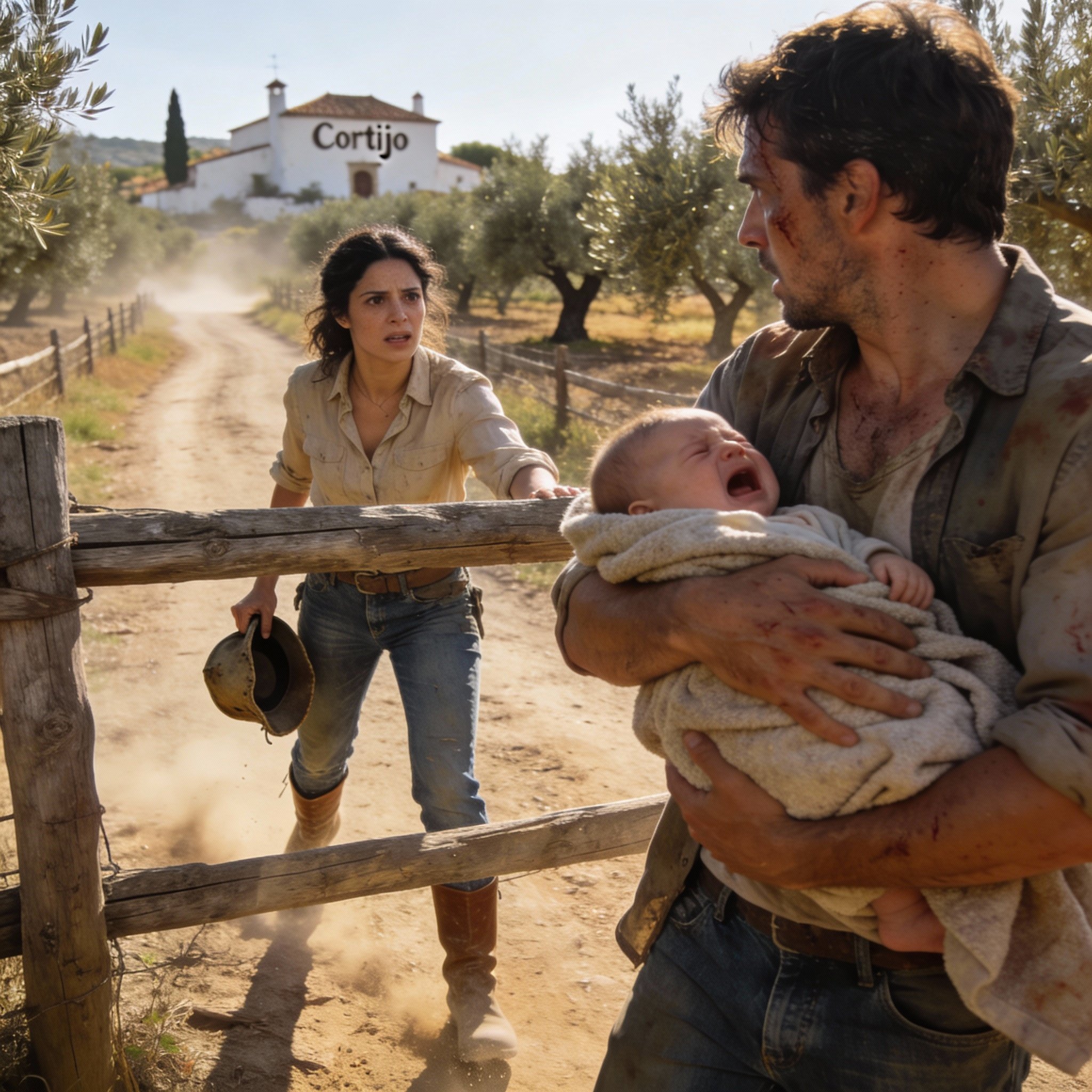
I fled Madrid. I fled the memories, the apartment we had decorated together, the noise of the Castellana that reminded me that life went on while mine had stopped. I came to this forgotten corner of Spain, looking for peace, looking for cheap prices, looking… I don’t know, to forget. But a daughter’s hunger doesn’t let you forget.
My boots kicked up clouds of ochre dust. Valentina let out a sharp moan, too weak to scream anymore.
That’s when I saw her. Or rather, heard her.
—Hey! You! Wait!
The sound of boots hitting dry wood made me turn around. A woman was running from inside the property, leaping over the fence that marked the boundary with surprising agility for someone wearing heavy work clothes. She landed on the path kicking up dust, panting, her cheeks flushed from the exertion and the heat.
She took off the beige cap she was wearing, letting a slightly tousled chestnut-brown mane fall over her shoulders. Her dark, deep eyes scanned me with a mixture of recognition and urgency.
“Wait,” he said, catching his breath. “You’re Diego, right? The city boy who rented Don Esteban’s house last week.”
I instinctively went on guard, turning my body to protect the girl. In small towns, curiosity can sometimes be poison.
“Yes, it’s me. What do you want? I’m in a hurry.”
She ignored my harsh tone. She took a step toward me, but stopped when she saw my stiffness.
“My name is Carmen Torres. I own this estate.” She nodded toward the vast olive groves and the cows grazing in the distance. “Listen, Diego. Everyone in town knows everything. I know your situation is… complicated. I know you lost your wife and that you’re raising the baby alone.”
I felt a pang of anger and pain in my chest. I hated being the talk of the bars, the “poor widower of the town.”
“And what does my life have to do with you?” I snapped, more abruptly than necessary. Valentina shifted in my arms, uncomfortable. “If you’ll excuse me, my daughter needs…”
“Milk,” she interrupted. Her voice changed, becoming softer, but still firm. “I know you’re walking to town because your car broke down and the pharmacy closes in half an hour. You’re not going to make it, Diego.”
I glanced at my watch. He was right. Panic, cold and sticky, began to creep up my spine.
“Shit…” I whispered, forgetting all manners.
“I have a proposition for you,” Carmen said, taking a deep breath, like someone about to jump off a cliff. “I have dairy cows. The best in the region. I have fresh milk, pasteurized right here. I can give you all the liters you need for your daughter. Today, tomorrow, and every day. Free.”
I froze. Free? Nobody gives anything away for free in this world. But I looked at Valentina, her little hands clenched into fists, and my pride crumbled.
“Free?” I asked, suspicious. “What for?”
Carmen bit her lower lip. She glanced around, as if making sure no one else was listening on that deserted road, and then dropped the bombshell on me.
—In exchange for you marrying me.
I almost tripped over my own feet. If I hadn’t been holding the baby, I think I would have fallen. I stared at her, searching for the hidden camera, the joke, the madness.
“What did she say?”
—Marry me, Diego.
“You’re crazy,” I muttered, taking a step back. “We don’t even know each other. I don’t know who you are.”
“I know. I know it sounds crazy,” she spoke quickly, stumbling over her words, desperate to explain before I ran away. “But listen. My grandfather passed away two months ago. He was a man from another era, a stubborn one. He left a clause in his will: if I don’t get married within fifteen days, Finca San José, this land that has been in my family for four generations, will pass to my cousins. And they… they just want to sell it to build housing developments or tear it up.”
I looked around. The olive trees looked ancient, silent witnesses to centuries of history. The cattle looked healthy. The farm exuded hard work and care.
“That doesn’t make sense,” I said, trying to process the information. “Why would your grandfather do something like that?”
Carmen let out a bitter, humorless laugh.
“Because he thought a woman alone couldn’t run a business. I’m 32, Diego. I’ve never been married. For him, that was a failure. He thought I needed a ‘man of the house’ to keep things in order. It’s sexist, it’s archaic, it’s unfair… but it’s legal.”
“Why me?” I asked, feeling the situation was surreal. “There are plenty of men in town. Surely one of them would want to inherit all this.”
Carmen looked me in the eye, and for the first time I saw the vulnerability behind that facade of a strong landowner.
“Because you need help just as much as I do. I’ve heard you don’t have any family here, that you came fleeing Madrid. And this little girl…” She looked at Valentina with a tenderness that disarmed me, “…this little girl needs care, she needs a stable home, not a rented house that’s falling apart.”
I felt a lump in my throat. She was right. I was failing. I was working remotely doing accounting at night, barely scraping by, and my daughter was paying the price.
“It wouldn’t be a real marriage,” she continued, seeing my hesitation. “It would just be a piece of paper. You’d stay in your room, I’d stay in mine. Prenuptial agreement if you like. I just need the certificate to shove it in the faces of my cousins’ lawyers. You’d live here, you’d have food, shelter, and milk for the baby. And then… if living together is a disaster, we’ll get divorced once the inheritance is settled.”
Valentina let out a louder cry, a cry of pure hunger. That sound broke my rational resistance.
“I need… I need to think about it,” I stammered.
“Of course, I understand. But don’t be long. The deadline is approaching.” Carmen reached into her jeans pocket and pulled out a crumpled piece of paper and a pen. She scribbled a number. “This is my cell phone number. And Diego…” She paused before turning away. “About the milk. Even if you say no, come to the main house now. I’ll give you as many bottles as you need. Children aren’t to blame for adults’ problems.”
Having said this, he jumped over the fence again and ran towards the white house that could be seen in the distance, among the trees.
I stayed there, in the dust, with my daughter crying and a marriage proposal in my pocket.
That night was hell. Valentina finally calmed down after I swallowed my pride and went to the farm. I didn’t see Carmen; an older employee, Doña Concepción, handed me four bottles of fresh, boiled milk, looking at me with a curiosity she tried to hide.
Back in my cold, damp house, while Valentina slept soundly with a full tummy for the first time in days, I couldn’t close my eyes. Carmen’s offer kept spinning in my head like a macabre merry-go-round.
A marriage of convenience. It sounded like something out of a 19th-century novel. But I looked at the moldy walls of my rental, at my bank account, which was dwindling dangerously, and then I looked at my daughter. Patricia always said I was too idealistic, that I had trouble coming down to earth. “Sometimes you have to be practical, Diego,” she would tell me.
What could be more practical than securing my daughter’s future?
The next morning, with dark circles under my eyes that reached the floor, I decided to go back to Finca San José. Not to say yes, I told myself, but to see if that woman was completely crazy or if this was real.
The property was even more impressive up close. Stepping through the main gate was like entering another world. The driveway was lined with cypress trees, and the main house was a beautiful whitewashed Andalusian farmhouse, with wrought-iron grilles on the windows and pots of vibrant red geraniums. Peace, order, and prosperity permeated the air.
Carmen greeted me on the porch. She was wearing her usual work clothes, but this time she had braided her hair.
“I didn’t think you’d come so soon,” she said, drying her hands on a rag.
“Me neither,” I admitted. Valentina was asleep in the stroller I was pushing. “Can I… see the place?”
—Sure. Come on.
She gave me a tour of the facilities. It wasn’t just a farm; it was a business. There was a modern milking parlor, immaculate grain storage facilities, and hectares of meticulously cared-for olive groves. ”
You learned all this on your own,” I remarked, impressed by her technical knowledge as she explained the irrigation system.
—My grandfather taught me the basics, but I went to study Agricultural Engineering in Valencia. I came back to modernize everything. My parents died in a car accident when I was eight. My grandfather raised me. He always told me this would be mine… until dementia and his old prejudices made him change his will at the last minute.
There was pain in her voice. An old pain, from someone who has had to fight twice as hard to prove half as much.
“Can I ask you a personal question?” I said, stopping in front of a corral where some calves were playing.
—Shoot.
—Why didn’t you ever get married? Really. A woman like you… with all this…
Carmen leaned against the fence and gazed at the horizon. The morning sun illuminated her profile, softening her features.
“I had relationships. But when men found out I was the heiress to all this, two things happened: either they got a huge crush and wanted to control everything, or they felt intimidated because I earned more and had more power than they did. I never found anyone who wanted to be with me, Carmen, the woman. They only wanted Carmen, the owner of the estate.”
He turned to me and stared at me.
“And you think I’ll be any different?” I asked.
“You’re broken, Diego,” she said with brutal frankness. “I see it in your eyes. You’re not looking for money, or power. You’re looking for shelter. And you seem like a decent man. A man who walks miles under the sun for his daughter is a good man. That’s more than I can say about my cousins or my ex-boyfriends.”
Her words hit me hard. “Broken.” Yes, that’s how I felt. But the idea of being a refuge for each other… it made sense.
We walked back to the house in silence. The scent of jasmine and damp earth brought me a feeling of home I hadn’t felt in a long time.
“If I accept…” I began, and I saw her tense up, “I have conditions.”
-Tell me.
—First: Valentina is my responsibility. I’m not looking for a mother for her, I’m looking for security. You have no obligation to take care of her.
—Accepted.
—Second: If this becomes unbearable, if there’s shouting or a bad atmosphere, I’m leaving. I don’t care about the inheritance; my daughter’s peace comes first.
—Absolutely. I want peace, not war.
—And third… —I hesitated—. No “marital rights”. We sleep separately.
Carmen burst out laughing, the first genuine laugh she’d ever heard from her.
“Please, Diego. Don’t take offense, but I have no intention of sleeping with you just for a contract. Deal.”
He extended his hand. It was a strong hand, calloused from work, but warm. I shook it. At that moment, I felt a strange electric current, as if fate were closing a circuit that had been open for years.
“Deal,” I said.
And so, I sold my single life for milk and a roof over my head.
The following days were a bureaucratic whirlwind. I discovered that the legal situation was more precarious than Carmen had admitted. Her cousin, Rodrigo Torres, was a shark. He had already preemptively contested the will and had lawyers snooping around town.
“We have to get married now,” said Carmen’s lawyer, Don Enrique, an elderly gentleman with thick glasses, as he reviewed my papers in the kitchen of the estate. “And Diego has to move out today. If Rodrigo finds out you’re living separately after the wedding, he’ll claim fraud.”
So I moved in three days before the wedding. Carmen gave me a spacious room downstairs, “so you don’t have to carry the baby upstairs,” she said. It was bright, clean, and, for the first time in months, didn’t smell of damp.
The first morning there was strange. I woke up to the smell of coffee and toast. I went down to the kitchen with Valentina in my arms and found Carmen pouring freshly squeezed orange juice.
“Good morning,” she said, without looking at me much, focused on the coffee maker. “I’ve made coffee. How did the little one sleep?”
“Better than ever,” I admitted. And so did I.
Doña Concepción, the employee who had been there her whole life, glanced at us out of the corner of her eye as she washed the dishes. I knew she suspected something, but she didn’t say anything.
“If you’re going to pretend to be boyfriend and girlfriend, you should start talking to each other a little more affectionately,” the old woman grumbled without turning around. “You look like two strangers in an elevator.”
Carmen and I looked at each other and, for the first time, shared a knowing smile.
“She’s right,” Carmen said. “Tell me something about yourself, Diego. Something that isn’t sad.”
We sat down to breakfast and I told her about my passion for early music, about how I used to play guitar before… well, before. She told me about her horses, about how she loved to climb the mountain to watch the sunrise. It was a civilized, pleasant conversation. Nothing extraordinary, but for two castaways, it was like finding an island.
The wedding day was… functional. The town hall, two witnesses (Don Enrique and his secretary), and a judge in a hurry.
Carmen wore a simple white linen dress and espadrilles. She looked stunning, in a natural and effortless way that made me feel a little guilty for noticing. I wore my only decent suit, the one I used for meetings in Madrid.
—I now pronounce you husband and wife— said the councilman. —You may kiss the bride.
Panic flashed across Carmen’s face. We hadn’t rehearsed this. I moved closer to her, noticing how she was trembling slightly.
“It’s just theater,” I whispered so only she could hear me.
I leaned in and brushed my lips against hers. It was a chaste, dry, quick kiss. But when I pulled away, I noticed her cheeks were burning. And, to my horror, so were mine.
Upon returning to the farm, the workers had prepared a small surprise party in the courtyard. There was wine, ham, cheese, and music.
“Long live the newlyweds!” shouted Juan, the foreman, raising a glass.
I felt like a complete fraud. An imposter drinking the wine of a sham celebration. But then I looked at Carmen. She was talking to some farm laborers, smiling, but her eyes were scanning the perimeter with concern. Rodrigo could appear at any moment.
I went over to her and put my arm around her shoulders. She tensed up for a second and then relaxed, leaning against me.
“Relax,” I whispered in her ear. “We’re doing fine.”
“Thank you, Diego,” she whispered. “Thank you for this.”
That night, I put Valentina to bed in her new crib. I watched her sleep, so peaceful, oblivious to her father’s lies. I went out onto the porch to smoke a cigarette (a habit I was trying to quit) and found Carmen sitting in the rocking chair, gazing at the stars.
“Do you regret it?” he asked without looking at me.
“Not yet,” I replied, sitting down on the step. “And you? You’ve married a stranger with a heavy burden.”
—Valentina isn’t a burden. She’s… she’s light. It’s been years since there was a baby in this house. She changes the energy.
We remained silent, listening to the crickets.
“Rodrigo’s lawyers are coming tomorrow,” she said suddenly, breaking the peace. “They’re going to interrogate us. They’re going to look for weaknesses.”
“Let them come,” I said, feeling a sudden surge of protectiveness toward this woman who had saved me from hunger. “We’ll tell them it was love at first sight. That love is blind and crazy.”
—Do you think it will work?
I looked at her. The moonlight gave her an ethereal air.
“You’re an incredible woman, Carmen. Any man would fall in love with you in five minutes. It won’t be hard to believe.”
She turned sharply, surprised by the compliment.
“Good night, husband,” she said with a half-smile, and went inside.
The problems started two days later. A shiny, expensive black car drove up the dirt road, kicking up a cloud of dust that soiled the geraniums. A stern-faced, impeccably dressed man got out, carrying a leather briefcase. Behind him was Rodrigo Torres.
Rodrigo was the antithesis of Carmen. Where she was land and work, he was hair gel and speculation.
“Cousin!” she exclaimed with a nauseating falseness. “I’ve come to meet the lucky man. Or should I say, the hired actor.”
I stepped off the porch, drying my hands after changing a diaper.
“I’m Diego Ramírez. Carmen’s husband. And I would appreciate it if you lowered your voice; my daughter is sleeping.”
Rodrigo looked me up and down, assessing my simple clothes, my tired appearance.
“Well, well. A single father and recently widowed. How touching. My lawyer has a few questions for you. If it’s a real marriage, you won’t have any problem answering intimate details, will you?”
We sat down in the living room. The questioning was brutal. They asked about dates, favorite colors, side of the bed, toothpaste brands. Carmen and I had studied, we had made flashcards, but there were still things we didn’t know.
“What is your husband’s favorite food?” asked the lawyer, a guy with a reptile-like face.
Carmen hesitated. We hadn’t talked about it.
“Diego eats everything,” she improvised. “But… he loves lentils.”
I held my breath. I hated lentils. Patricia made them and I ate them out of love, but I hated them.
“Is that true, Mr. Ramirez?”
I looked at Carmen. Her eyes were pleading with me.
“I love them,” I lied. “Especially the way Carmen makes them.”
Rodrigo chuckled.
“Funny. Because Carmen can’t cook. She even burns the water.”
The atmosphere grew tense until it broke.
“Carmen doesn’t cook much,” I interjected quickly, improvising on the spot, “but she tries for me. And that’s what counts, isn’t it? Love is in the effort, not the taste.”
Carmen looked at me gratefully. Rodrigo stood up, frustrated.
“This is a farce. And I’m going to prove it. I’m going to request constant surveillance. One slip-up, one night you don’t sleep together, one day I see you falter, and this estate is mine.”
When they left, Carmen collapsed on the sofa. She began to cry, a silent, desperate cry.
“We’re going to lose everything. He’s figured it out. He knows we’re lying.”
I sat down next to her. Without thinking, I took her hand.
“She doesn’t know. She only suspects.”
—Diego, I don’t know how to cook lentils. I don’t know anything about you. I don’t even know how you take your coffee.
“Black and without sugar,” I said gently. “And I know you bite your thumbnail when you’re nervous. I know you talk to cows as if they were people. I know you get up before the sun.”
She looked up, her eyes red.
“Have you noticed that?”
“I notice everything. It’s my job as an accountant, and now… as your husband. We’re going to win this, Carmen. But we have to stop pretending.”
-What do you mean?
“We need to really get to know each other. Not as lovers, if you don’t want that, but as partners. I need to know who you are, and you need to know who I am. From now on, we’ll have dinner together, talk, and spend time together. If they’re watching us, let them see a family.”
And so our real story began. Not with fireworks, but with a plate of cheese, a bottle of wine, and hours of conversation under the dim light of the kitchen.
I discovered that Carmen had a sharp sense of humor. I discovered that she liked Lorca’s poetry and hated horror movies. She discovered that I was afraid of not being enough for Valentina, that I missed intellectual conversations, and that, deep down, I was an optimist disguised as a cynic.
Valentina, for her part, adored Carmen. It was instinctive. When Carmen entered the room, the baby stopped crying.
“She has a way with her,” I said one day, watching her rock the baby.
“I never thought I’d like children,” Carmen confessed. “I thought my only ‘daughter’ would be the farm. But this little one… she gets under your skin.”
Months passed. The inheritance trial was approaching. Rodrigo had gathered testimonies from people in the town who said they had never seen us together before the wedding. The pressure was suffocating.
One afternoon, while we were reviewing the farm’s accounts (which, by the way, desperately needed my accounting skills), the power went out. A summer storm descended upon us with fury. Thunder crashed, rattling the windows.
Valentina woke up crying uncontrollably. I went to her, but I couldn’t calm her down. Carmen appeared in my bedroom doorway with a candle.
“May I?” she asked.
I handed it to her. She began to hum an old lullaby, a melody her grandmother used to sing to her. Valentina calmed down little by little, grasping Carmen’s finger with her tiny hand.
We sat on my bed, with the little girl between us. The candlelight cast dancing shadows on the walls.
“You know,” Carmen whispered. “Sometimes I forget this is a contract.”
My heart skipped a beat.
—Me too.
—Diego, if we lose the case… if they take the farm from me… I want you to know that I don’t regret getting you into this. These past few months… for the first time in my life, I haven’t felt alone.
I looked at her. I no longer saw the desperate landowner, nor the boss. I saw a brave, sweet, and terribly beautiful woman.
“We’re not going to lose,” I said firmly. “But if we lose… I won’t leave either.”
She looked at me, surprised.
“What?”
—We made a deal. For better, for worse, right? Even if it was a lie. Well, now it’s true. We’re a team. You, me, and Valentina. If they fire us, we all go.
Carmen left the sleeping child in bed and came over to me.
“Are you serious?”
—I have never been more serious.
She stroked my face. Her hand was trembling.
“I think… I think I’m falling in love with my fake husband, Diego.”
—I think so too, Carmen.
There was no need for more words. I kissed her. And this time it wasn’t a kiss for show, or for a judge, or for an envious cousin. It was a kiss born of hunger, of thirst, from two people who had found each other in the middle of the desert.
CHAPTER 2: Under the Microscope
The dawn after the storm brought a deceptive calm over Finca San José. The sky was an insultingly clear, bright blue, as if the world hadn’t nearly ended the night before. I woke up with a numb arm, not because Valentina was on it, but because Carmen had fallen asleep with her head on my shoulder.
For a few seconds, in that limbo between sleep and wakefulness, I forgot about the contract, the inheritance, and Rodrigo. I only felt the warmth of his body, the scent of lavender soap and hay emanating from his hair, and a peace I thought I had lost forever in that hospital room in Madrid.
Carmen stirred and opened her eyes. There was a moment of panic, that split second when reality hits, but then her eyes softened. She didn’t move away.
“Good morning, Diego,” she whispered, her voice hoarse with sleep.
“Good morning, Carmen.”
There was no time for romance. The sound of a car approaching on the gravel road broke the spell. We both tensed.
“That must be Don Enrique,” she said, sitting up and smoothing her wrinkled clothes. “We have the pre-trial meeting today. The trial is tomorrow.”
The rest of the morning was a whirlwind of stress. Don Enrique, the family’s longtime lawyer, had spread an absurd amount of documents on the oak kitchen table. Doña Concepción served us strong coffee while shaking her head and muttering prayers to Saint Anthony.
“Listen, you two,” Enrique said, cleaning his glasses with a cloth handkerchief. “Rodrigo is going to play dirty. He’s hired a Madrid law firm that specializes in destroying reputations. They’re going to allege ‘fraud of law.’ They don’t just want to annul the will; they want to accuse you of procedural fraud. If we lose, Carmen won’t just lose the estate; you, Diego, could face serious legal problems for complicity.”
I felt a chill in my stomach.
“Jail?” I asked.
“Unlikely, but fines and a criminal record, for sure. And that won’t help you if you ever want to apply for scholarships or aid for Valentina.”
Carmen slammed her hand on the table.
“That’s not going to happen. I won’t let them touch Diego.”
“Then you have to be convincing,” Enrique said, peering at us over his glasses. “Rodrigo has witnesses who say Diego was sleeping in the guest room until two days ago.”
“That’s not true anymore,” I said, looking at Carmen. “My things are in the master bedroom.
” “Good. But they need more. They need privacy. They need a story. Where did you meet?”
“On the road,” Carmen said.
“No, no, no. That’s what happened. We need the ‘emotional truth.’ You met when your eyes met and you knew you were soulmates.” Enrique gestured dramatically. “Judge Don Braulio is a traditional man, a hopeless romantic at heart, even if he has a bulldog face. You have to sell him a love story, not a business contract.”
We spent the day rehearsing. It was exhausting, but also revealing. To construct a believable lie, we had to dig into our own truths. I told Carmen about the scar on my knee (from a bike fall when I was 12), and she told me about her irrational fear of lizards. I explained that Patricia loved daisies, and she listened with a respect that made me love her even more. There was no jealousy of the past, only acceptance.
—Diego—she told me mid-afternoon, as we strolled through the olive grove to relax before the trial—, if tomorrow they ask us why we got married so quickly… what are you going to say? The truth of the will isn’t enough to justify “passion.”
I stopped and plucked a small olive branch, toying with it.
“I’ll tell the truth, Carmen.
” “What truth?
” “That you saved me. That I was drowning and you were my lifeline. And that sometimes, you cling to that lifeline and realize you never want to let go, not just to avoid drowning, but because you like the feel of it.”
Carmen blushed, a deep color creeping up her neck to her cheeks.
“If you say that in court, I think even Rodrigo will burst into tears.”
Judgment Day
The court of first instance was in the provincial capital, a forty-minute drive away. The building was old, made of gray stone, with high ceilings that echoed with every footstep. It smelled of old wax, stale paper, and fear.
Rodrigo was there with his lawyer, a slicked-back-haired guy named Mr. Velasco who was wearing a suit that cost more than my broken-down car. Rodrigo looked at us with a smug smile, like a cat that’s already eaten the mouse.
“I hope you’ve packed your bags, cousin,” she whispered as she passed by us. “I’ve already found a buyer for the land. They’re going to build a beautiful golf course where your cows graze now.”
Carmen tensed up like a violin string. I squeezed her hand tightly.
“Just ignore it,” I told her. “She’s just trying to make you nervous.”
We entered the courtroom. Judge Braulio was an imposing man, wearing a robe that seemed to weigh him down, and with thick, gray eyebrows that he constantly furrowed.
The trial started badly. Mr. Velasco was a pit bull. He called the owner of the village store to the stand, and she testified that I had desperately asked for powdered milk the day before I moved to the farm.
“Your Honor,” Velasco said, pacing theatrically, “this man was a functional pauper. An opportunist. He saw a rich, single woman with a pressing testamentary clause and saw the opportunity of a lifetime. This isn’t love; it’s parasitic survival.”
I felt the bile rise in my throat. “Parasite.” That’s how I saw myself.
Then he called over a former stable boy whom Rodrigo had bribed (or so we suspected). The man swore he had heard us arguing about “the contract” and “the separate rooms.”
“That’s a lie!” Carmen shouted, standing up.
“Sit down, Mrs. Ramirez, or I’ll throw you out for contempt,” the judge thundered.
When it was my turn to testify, my hands were sweating. I stepped onto the stand. I swore to tell the truth. Mr. Velasco approached me like a predator.
—Mr. Ramirez, do you deny that your financial situation was critical when you met Doña Carmen?
—I don’t deny it.
—Do you deny that you knew about the clause in the will before getting married?
—I don’t deny it.
—Then you admit that you married for money.
—No.
Velasco let out a mocking laugh.
“Please, Mr. Ramírez. Don’t insult the intelligence of this court. You needed money, she needed a husband. 1+1 equals 2. It’s a business.”
I took a deep breath. I looked at Carmen, who was sitting on the bench, pale, wringing a handkerchief. Then I looked at Valentina, who was in Doña Concepción’s arms at the back of the room (the judge had allowed her in because she was still in the mixed breastfeeding period and got nervous around strangers).
“Your Honor, may I explain myself?” I asked, ignoring the lawyer and addressing the judge.
Don Braulio looked at me over the top of his glasses.
“Be brief.”
“It’s true it was a business venture at first,” I admitted. A murmur rippled through the room. Enrique put his hands to his head. Carmen’s eyes widened. “Yes, I needed milk for my daughter. Yes, she needed to save her land. We signed a paper thinking we’d be partners.”
I paused, searching for the right words.
“But love doesn’t always begin with fireworks and violins, Your Honor. Sometimes it begins with a glass of warm milk when you have nothing. Sometimes it begins with seeing a strong woman, who could be in Paris spending her inheritance, get up at four in the morning to help a cow give birth. Sometimes it begins when that woman takes your daughter in her arms, a daughter who isn’t hers, and looks at her as if she were the greatest treasure in the world.”
I looked directly at Rodrigo, whose smile had vanished.
“They say I’m an opportunist. Maybe I was that first day. But today… today I’m a man who admires his wife more than anyone in the world. I’m a man who has found a home. And I’m not talking about the walls of the estate, I’m talking about her. She is my home. If you decide to take the estate from us, Your Honor, it will hurt, because it’s your family’s history. But we’ll leave together. And we’ll start over somewhere else. Because what we’ve built in these weeks is more real than any property deed.”
There was a deathly silence in the room. Only the hum of a ceiling fan could be heard. Carmen was crying openly, not caring about her smeared makeup.
Judge Braulio cleared his throat, a sound that echoed like thunder.
“Mr. Velasco, do you have any further questions?”
“No, Your Honor,” the lawyer muttered, visibly taken aback.
Then it was Carmen’s turn. She was briefer, but just as powerful. She spoke of her loneliness, the pressure from her grandfather, and how my arrival had filled voids I didn’t know I had.
“My cousin Rodrigo says Diego is a gold digger,” she said, looking at the judge. “But Diego works more hours on the farm than anyone. He’s sorted out the accounts, repaired the barn roof, and all without asking for a penny. If that’s what being a gold digger is, then he’s the worst gold digger in history, because he’s only giving, not receiving.”
Judge Braulio banged his gavel.
“There will be a two-hour recess for deliberation.”
Those two hours were the longest of my life. We sat on a bench in the hallway, eating vending machine sandwiches that tasted like cardboard. Rodrigo would occasionally walk by talking on his cell phone, agitated, shouting at someone.
Finally, they called us.
—Stand up—ordered the sheriff.
Judge Braulio checked his notes one last time. He adjusted his glasses.
“This court has reviewed the evidence presented by the plaintiff. It is clear that the circumstances of the marriage were… unusual and rushed.”
My heart stopped. Carmen squeezed my hand until it hurt.
“However,” the judge continued, and that word sounded glorious, “Spanish law does not require a marriage to be based on years of courtship. It requires free consent, capacity, and the will to build a life together. The spouses’ testimonies have demonstrated, in this magistrate’s opinion, a genuine marital affection . I see no fraud. I see two people who found a solution to their problems and, in the process, found themselves.”
Rodrigo turned as red as a tomato.
—Therefore, I rule in favor of the defendants. The marriage is valid for all legal purposes. The testamentary clause has been fulfilled in due time and form. The San José Estate legitimately belongs to Ms. Carmen Torres. The plaintiff is ordered to pay costs due to recklessness and procedural bad faith.
Bang! The mallet struck the wood.
Carmen let out a strangled cry and threw herself into my arms. I hugged her, lifting her off the floor, spinning her around in the middle of the courtroom as she laughed and cried at the same time.
“We did it, Diego! It’s ours! The farm is ours!”
Rodrigo stormed out of the room, slamming the swinging door. Don Enrique approached, grinning from ear to ear. ”
Congratulations, boys. It was… moving. Diego, you should have been a lawyer; you’ve got the gift of gab.”
We left the courthouse under the afternoon sun. The air seemed lighter, sweeter. Valentina, in her stroller, looked at us with big, curious eyes. I bent down and kissed her forehead.
“Your mom and dad did it, sweetie,” I said.
Carmen stopped when she heard the word “mom.” She looked at me, with a mixture of fear and hope.
“Did you say…?”
“Well, technically you’re her stepmother, but… she doesn’t know any other. And I don’t want her to know any other.”
Carmen crouched down beside me and stroked the baby’s cheek.
“Let’s go home, family.”
The return to the farm was triumphant. The workers were waiting for us at the gate. They had hung a spray-painted banner that read “WELCOME BOSS.” There was wine, there was cheese, and there was music until late into the night.
But the real change came when the lights went out and the guests left. We were left alone in the living room, surrounded by empty glasses and the remnants of the party. The adrenaline of the trial was dissipating, giving way to a new and dizzying reality. There was no longer an external enemy. Rodrigo was out of the picture. The estate was safe.
So what now?
Carmen looked at me from across the room.
“We don’t need to pretend anymore,” she said softly. “We already have the role. If you want… if you want to go back to your room… I’ll understand.”
I approached her slowly, savoring the moment.
“Carmen, I told the judge my things were in the master bedroom. And I don’t like to lie.”
She smiled, a shy smile that lit up her face.
“I don’t like liars either.”
That night, there were no closed doors between us. And as the moon illuminated the olive groves that were now safe, we discovered that the passion we had feigned before the judge was only a pale shadow of what we could create in the privacy of our room.
CHAPTER 3: The Taste of Cheese and the Bitterness of Envy
The first few months of our “real” marriage were a strange honeymoon, spent amidst bills, baby bottles, and tractors. We didn’t go to Paris or Venice; our romantic getaway consisted of walking the boundaries of the farm at dawn, checking the condition of the fences, with Valentina strapped to my back in a baby carrier. And, honestly, I wouldn’t have traded it for anything.
Living together, however, brought its share of friction. Carmen was a whirlwind of intuition and chaos; I was a man of spreadsheets and schedules.
“Diego, you can’t plan a cow’s calving in Excel,” she’d say, laughing, watching me try to organize the veterinarians’ shifts. “Nature has its own rhythm.
” “Nature does, Carmen, but the bank’s cash flow doesn’t. If we don’t organize our feed expenses, we’ll be in the red next month.”
That was my contribution. While she was the heart and soul of the farm, I became its financial mastermind. I discovered that my grandfather’s management had been disastrous in his later years: money leaking out, suppliers overcharging, outdated machinery consuming excessive amounts of fuel. I got to work. I renegotiated contracts, digitized management, and optimized the milk delivery routes.
But my big project, my professional baby, was cheese.
“We have premium quality milk,” I told her one night at dinner, while I was feeding fruit puree to Valentina, who was six months old and just starting to babble. “Selling it as liquid milk to the cooperative leaves us with a ridiculously small profit margin. We have to process it.”
“Make cheese?” Carmen raised an eyebrow. “My grandmother made cheese, but it was just for herself. It’s a lot of work, Diego. We need aging chambers, health permits…”
“I’ve already done the math,” I said, pulling out my tablet and showing her the projections. “If we create our own brand, ‘Quesos San José’ or something more modern… ‘Rancho Esperanza.’ Artisan cheese, aged in oil from our own olive groves. We can sell it in gourmet shops in Madrid and Barcelona for three times the price of milk.”
Carmen looked at the numbers, then at me. Her eyes shone with that mixture of admiration and desire that still made me feel like a teenager.
“Rancho Esperanza,” she repeated. “I like it. Let’s do it.”
The investment was significant. We had to take out a loan (something that terrified Carmen), but I was confident. We converted an old warehouse into a modern cheese factory. We hired a retired cheesemaker from the neighboring village, Mr. Paco, to teach us the secrets of aging.
The first batch came out six months later. It was a semi-cured, buttery cheese with a hint of wild herbs. When we tasted it in the kitchen, cutting a thin wedge, Carmen closed her eyes and moaned with pleasure.
“My God, Diego. This is… sinful.”
“It’s the future,” I corrected, kissing her nose.
We started selling at local markets. Valentina, who was already crawling at lightning speed, was our best public relations representative. People would come up to the stall to see the smiling little girl and leave with two cheeses under their arm. Business was booming. Life was good.
But happiness in small towns attracts envy like honey attracts flies. And Rodrigo hadn’t disappeared; he was just waiting in the shadows.
It started with rumors. Little poisonous lies spread in the village bar. That our cheeses didn’t pass health inspections, that I mistreated the animals, that the marriage was in crisis. We ignored them. “They bark, then we ride,” Carmen would tell me, quoting Don Quixote.
But then they moved from words to action.
One cold, foggy November morning, Juan the foreman entered the kitchen, his face contorted with worry.
“Madam, Don Diego… you have to come to drying shed number 3.”
We rushed over. The smell hit us before we even stepped inside. A pungent, chemical odor. Someone had broken in during the night and doused hundreds of cheeses that were aging with diesel fuel. Months of work, thousands of euros, ruined.
Carmen brought her hands to her mouth, fighting back tears. I felt a cold, murderous rage. On the wall, spray-painted in red, it read: “OUT, STRANGER.”
“It was him,” Carmen whispered. “It was Rodrigo. He wants to ruin us so we can’t pay the loan and the bank will take the property. He’ll buy the debt and keep everything for next to nothing.”
I went up to the wall and touched the paint, still wet.
“He’s not going to win, Carmen. Call the Civil Guard. I’ll call the insurance company. And then… then we’ll be working twice as hard.”
That day I saw the true strength of the community. News of the sabotage spread through the village. In the afternoon, neighbors began to arrive. They weren’t there to gossip; they were there to help. They brought buckets, rags, and cleaning supplies.
“That Rodrigo is a scoundrel,” said the baker, rolling up her sleeves. “But don’t worry. We’ll clean this up and make more cheese.”
Even the priest came to lend a hand. It was moving to see how that “stranger” who had arrived with nothing was now being defended by the locals. Rodrigo had miscalculated: he thought that by attacking us he would isolate us, but he only succeeded in uniting the town in our favor.
We salvaged what we could, cleaned up the mess, and started again. We installed security cameras and hired night watchmen. Rodrigo was never charged due to a lack of direct evidence, but the social stigma fell upon him. In the village, they stopped serving him coffee in the bars. He became an outcast and, shortly afterward, he moved to the capital, defeated by the silence of his neighbors.
The crisis brought us closer together, if that was even possible. That night, exhausted from the cleaning and the tension, Carmen and I showered together, washing away the smell of diesel and sadness.
“I thought you’d leave,” she confessed under the hot water. “I thought you’d say this is too dangerous for Valentina.”
“Valentina’s safe. And I’m a stubborn man, Carmen. I’m not scared of thugs with pepper spray.”
Weeks later, the real miracle arrived. Or the scare, depending on how you look at it.
Carmen had been acting strangely for days. She was more tired than usual, felt dizzy at the smell of coffee (which she adored), and was in a foul mood.
“You must be coming down with the flu,” I told her one morning, as she pushed the toast away in disgust.
“It’s not the flu, Diego. I know my body.”
She went to the bathroom with a little box she’d bought at the pharmacy in the next town over (to avoid gossip). I stayed behind playing with Valentina on the rug, building towers of blocks, my heart pounding.
Ten minutes later, Carmen came out. Her face was pale and her eyes were full of tears. She didn’t say anything, she just showed me the test.
Two lines. Positive.
I froze. We were careful, but… well, passion can be reckless.
“Pregnant?” I asked, my voice trembling.
“I’m 34, Diego. The business is just starting. We have Valentina. Rodrigo is still a looming threat… It’s not the right time. It’s crazy.”
I stood up and hugged her tightly. I felt her fear, but I also felt a wild, primal joy bubbling in my chest.
“This is the perfect time,” I whispered in her ear. “Valentina needs a brother. And we… we need to celebrate life. Rodrigo brought destruction and diesel. We bring life and milk. This is our ultimate victory, Carmen.”
She looked at me, seeking reassurance in my eyes.
“Do you think we can handle two?”
“We handled a ruined farm, a rigged trial, and criminal sabotage. One more baby will be a piece of cake. Besides, we already have experience changing diapers.”
Carmen smiled through her tears and touched her flat stomach.
“One of our children, Diego. Half you, half me.”
“And one hundred percent Rancho Esperanza.”
The Birth of a New Era
Carmen’s pregnancy was different from what I had experienced with Patricia. Patricia had had a high-risk pregnancy, full of fears and hospital visits. Carmen, true to her nature, had an active pregnancy. She worked until her eighth month, overseeing cheese production, giving orders from the tractor (even though I forbade her from driving it).
“You’re so big, my love,” I’d say affectionately, massaging her feet, which were swollen from nightly sprains.
“I’m a beached whale,” she’d complain. “And your son kicks like he’s playing in the Champions League final.”
We decided to name him Mateo, which means “gift from God.” Because that’s what he was to us: an unexpected gift in the midst of struggle.
Valentina, who was almost two, eyed Carmen’s belly suspiciously. We explained that a little brother was coming, but all she said was “Mine” and she hugged Carmen possessively. ”
She’s going to be jealous,” Carmen said, laughing.
“She’ll get over it when she has someone to play pranks with.”
The birth came on a stormy night, bringing the cycle full circle. It seemed that the major events in our lives were always accompanied by thunder. Her water broke in the kitchen while we were making dinner.
“Diego!” she shouted. “He’s coming!”
The race to the hospital was like something out of a movie. I was driving in the rain, Carmen was breathing like she’d been taught in the preparation classes (which I couldn’t attend because of work, but which she would summarize for me at night), and Doña Concepción was in the back, loudly praying the rosary.
Mateo was born at 3:00 in the morning. A robust baby, with lots of black hair and the lungs of an opera tenor. When they placed him in my arms, I felt that familiar and sacred weight. I looked at Carmen, sweaty, exhausted, but radiant in the hospital bed.
“It’s perfect,” I whispered.
“He looks just like you,” she said. “He has your chin.”
At that moment, in that sterile hospital room, I felt Patricia’s presence. Not like a sad ghost, but like a warm breeze. I felt that, wherever she was, she was giving us her blessing. She loved life, and here there was new life.
Returning home with Mateo marked the beginning of the most chaotic and happiest period of our lives. There were four of us. A “patched-up” family, as I jokingly called it: a widower, a confirmed spinster turned mother, an adopted daughter of the heart, and a biological son. But the seams of those patches were stronger than the original fabric.
The cheese business really took off. We won a regional award for “Best Young Artisan Cheese.” Orders multiplied. We had to hire more people from the village. Finca San José ceased to be just a farm and became the economic engine of the region.
And I, Diego Ramírez, the city accountant who came fleeing from pain, found myself one day, with my boots full of mud, teaching my son Mateo to distinguish the footprints of a fox in the wet earth, while Valentina ran after the chickens under the watchful eye of Carmen.
I realized I wasn’t running from anything anymore. I had arrived.
CHAPTER 4: The Legacy of Rancho Esperanza
Time in the countryside is measured differently. It’s not measured in hours or minutes, but in seasons, harvests, the height of the children, and the wrinkles the sun etches around their eyes.
Ten years passed. Ten years that slipped through our fingers like water, but left a fertile sediment in our lives.
Valentina turned twelve, a curious, intelligent preteen with a temperament that, ironically, she’d inherited from Carmen, not me. She had the same stubborn determination, the same way of crossing her arms when she disagreed with something.
“Dad, I don’t want to go to school on the bus. I want you to take me,” she complained one morning in the kitchen, devouring her toast with olive oil.
“The bus is eco-friendly and you socialize, Vale. Besides, I have to go over the accounts with Mom.”
Eight-year-old Mateo was the very picture of peace. While his sister was fire, he was water. He loved music, spending hours playing an old guitar I had rescued from the attic, and he had an almost magical connection with animals. Cows approached him without fear, and the farm dogs slept at his feet.
That afternoon, I had a difficult conversation with Valentina. She had found an old photograph of Patricia in a box I kept in my office.
“Dad…” she said, coming in with the photograph in her hand. “This is my real mother, isn’t it?”
My heart stopped. We’d always been open with her about her story, but seeing her with the photo, looking for similarities in her own face in the mirror, was a real eye-opener.
“Yes, darling. Her name was Patricia.
” “Was she pretty?
” “She was gorgeous. And very smart. You were the most important thing in the world to me.”
Carmen walked in at that moment. She stopped when she saw the scene. Far from feeling left out, she approached and sat next to Valentina.
“You know, Vale?” Carmen said gently. “Your mother, Patricia, gave you life and those beautiful eyes of yours. I’ve only been lucky enough to take care of you and watch you grow. You have two mothers who love you. One in heaven watching over you from above, and another down here making you tidy your room.”
Valentina let out a tearful giggle and hugged Carmen.
“I love you, Mom.”
“And I love you too, you little rascal.”
That weekend we all went together to the Madrid cemetery where Patricia was buried. It was the first time we’d been there in years. Carmen cleaned the gravestone respectfully, and Mateo left a drawing he’d made. It was a moment of closure, of integrating the past into our present. There were no ghosts, only gratitude.
The Giant’s Temptation
When the estate celebrated its twentieth anniversary under our joint management, the final test arrived. It wasn’t a plague, nor an evil cousin (Rodrigo had died a couple of years earlier of a heart attack, alone and bitter), but a purchase offer.
A multinational agribusiness wanted to buy “Rancho Esperanza.” They wanted the brand, the land, and the prestige we had built. The figure they put on the table was obscene. There were so many zeros that I felt dizzy reading the email.
“With this money,” I said that night, the paper trembling in my hands, “we could retire. Buy a house on the beach. Travel the world. Secure the future of our children and their children. We’d never have to get up early again. We wouldn’t have to worry about hail or drought.”
Carmen was silent, gazing out the window at the silvery olive trees under the moon.
“Is that what you want, Diego? To retire at 55 and live on a golf course?”
—I don’t know, Carmen. It’s absolutely certain. It’s… tempting.
She turned around.
“And what will happen to Juan? And to Doña Concepción, who, although retired, still lives in the caretaker’s cottage? What will happen to the twenty families in the village who work for us? That company will bring in machines, automate everything, and lay people off. They’ll turn our artisan cheese into soulless, mass-produced pasta.”
I felt ashamed. My accountant’s mind had seen the money; my farmer’s heart had been momentarily blind.
“You’re right. Selling would be betraying everything we’ve done.
” “It would be selling ourselves. Our story is priceless, Diego. You don’t sell the place where our lives were saved.”
The next day, I rejected the offer. The multinational insisted, raising the price. I told them not to call again. That night, we had fried eggs with potatoes from our garden and toasted with cheap wine. I’d never felt so good.
The Circle Closes
Twenty years after that dusty day on the road, we celebrated with a big party in the courtyard of Finca San José.
Valentina, now 23, had just graduated in Veterinary Medicine and had decided to return to the village to work at the local clinic and help out on the farm. Mateo, 19, was studying Agronomy and Music, combining his two passions.
The house was full of people. There was music, laughter, and long tables laden with our cheese, our wine, and our olive oil.
Carmen and I escaped the hustle and bustle for a moment. We walked slowly, arm in arm, to the dirt road, right to the spot where the old wooden fence stood (which we had now repaired and painted).
The sun was setting, tinting the sky orange and violet, the same colors as that desperate afternoon two decades ago.
“Do you remember?” Carmen asked, leaning against the post.
“Like it was yesterday. I was sweating, Valentina was crying, and you jumped that fence like an Olympic athlete.
” “I was terrified,” she confessed. “I thought you’d say no. I thought I was some crazy old woman proposing to a bum.”
I laughed and kissed her temple, where there were now a few silvery gray hairs that she wore with pride.
“Blessed madness, Carmen. Blessed be your madness.”
“Would you do it again?” She looked into my eyes, those dark eyes that now had crow’s feet at the corners, marks from a thousand shared smiles.
“Marry you for milk?” I joked. “I’d do it for water, for air, or for nothing. I’d do it a thousand times.”
We looked toward the house. We could hear Mateo’s guitar playing a rumba and Valentina’s infectious laughter as she danced with her friends. We saw Doña Concepción, now very old, sitting in a queen’s chair, giving orders to the waiters. We saw the light on in the cheese shop, a symbol of our hard work.
“We didn’t just save the farm, Diego,” Carmen said. “We saved ourselves. You taught me to trust and to share. You gave me a family when all I had was land.
” “And you gave me roots when all I had was wind. You gave me a purpose. And you gave me the best love, the kind that’s built brick by brick, day by day.”
We stayed there a while longer, in silence, simply being. Words weren’t necessary. We were two survivors who had won the lottery of life without buying a ticket.
“Let’s go inside,” she finally said, pulling on my hand. “Dinner’s going to get cold, and you know I hate eating cold food.”
“Come on, wife.”
We walked back toward the light of the house, leaving the dusty road behind. There was no more dust, no more thirst, no more loneliness. There was only hope. Rancho Esperanza.
END