The millionaire invited me to his most exclusive gala to make fun of me, but I arrived dressed as a queen and revealed a family secret that destroyed his ego and changed my destiny forever.
PART 1
The smell of window cleaner and furniture polish has always held ambivalent meaning for me. On the one hand, it’s the scent of my livelihood, the honest smell of the work that pays the bills for my small apartment in Vallecas and allows me to religiously send half my salary to my grandmother in the village down south. But on the other hand, it’s a smell that marks an invisible boundary, an olfactory line separating my world from theirs. I smell of hard work and chemicals; they smell of designer perfumes, Italian leather, and that unwavering confidence that only comes from having a bank account overflowing since the day you were born.
My name is Patricia Salazar. I’m twenty-three years old and I’m invisible. Or at least, that’s what I usually think as I pull the cleaning cart through the marble corridors of the Vargas building, right in the heart of Madrid’s financial district. I’m the girl who empties the wastebaskets, the one who removes fingerprints from the glass tables, the one who erases the day’s traces so that the executives can start fresh the next morning, immaculate, perfect.
That Tuesday morning seemed no different from any other. The autumn sun streamed slantingly through the enormous windows on the thirtieth floor, painting the airborne dust I was diligently trying to remove with a golden hue. The office of Sebastián Vargas, the CEO and heir to the empire, was my last stop. I always left it for last, not because it required more work, but because going in there gave me a knot in my stomach that I needed to postpone as long as possible.
Sebastián was… complicated. Handsome, yes, in that obvious and almost insulting way that some wealthy men in Spain have: chestnut hair always perfectly slicked back, tailored suits that looked like a second skin, and a smile that rarely reached his eyes. At thirty, he had Madrid at his feet, and he knew it. But beneath that layer of success and superficial charm, there was something rotten, a latent cruelty that I had the misfortune of witnessing firsthand.
I entered his office cautiously, hoping it would be empty, as it usually was at that time of day. I began to clean the enormous mahogany table, carefully moving the silver paperweights and leather folders. That’s when I saw him.
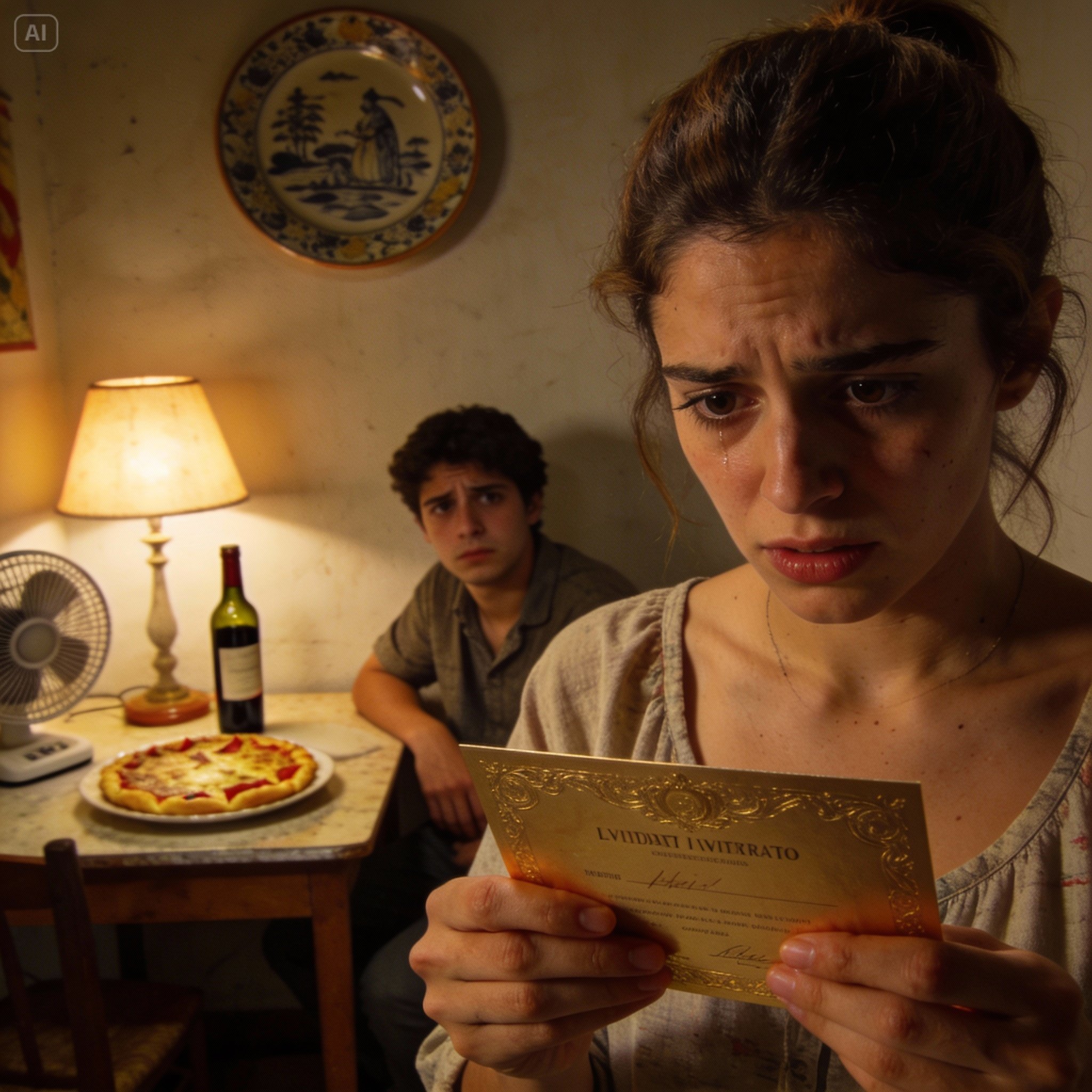
An envelope.
It wasn’t just any envelope, the kind that usually rolled around the office with invoices or contracts. This one was made of thick, cream-colored paper with a gold border and my name, “Patricia Salazar,” written in impeccable, almost artistic calligraphy. I stopped, the rag in one hand and the spray can in the other. My heart gave a strange lurch. A termination letter? No, nobody fires you with wedding-style handwriting. A bonus? Impossible. Sebastián didn’t give bonuses, not even if the company’s revenue doubled.
—I see that curiosity isn’t just a flaw of cats, Patricia.
The voice sent a chill down my spine. I whirled around, nearly dropping the cleaner. Sebastian was leaning against the doorframe, watching me with that look predators have when they spot a limping gazelle. He was wearing a blue silk tie that probably cost more than I earned in three months.
“Mr. Vargas… I’m sorry, I was just cleaning the table and…” I stammered, feeling the heat rise to my cheeks. I hated stuttering in front of him. I hated giving him that power.
He moved away from the door and walked towards me with that calculated slowness, enjoying my discomfort.
“Don’t apologize. In fact, that envelope is for you,” she said, stopping about a meter away. Her cologne, a blend of sandalwood and expensive citrus, invaded my personal space.
“For me?” I asked, confused. My hands, rough from work, gripped the rag as if it were a life preserver.
“Open it,” he ordered, in a soft but commanding tone.
I placed the rag on the cart and picked up the envelope. My fingers trembled slightly. Tearing open the paper, I pulled out a stiff card, embossed with gold lettering.
“The Villa de Madrid Country Club has the honor of inviting you to the Stars’ Charity Gala. Gala dinner, auction and dancing. Formal attire.”
I stared at the card, unable to process the information. The Country Club. The Gala of the Stars. Everyone in Madrid knew what that was. It was the event of the year. Where the aristocracy, the IBEX 35 businessmen, and celebrities gathered to drink champagne and pretend they were saving the world while wearing jewels that could feed an entire village for a year.
“Mr. Vargas, I don’t understand…” I looked up, searching for a logical explanation.
Sebastian smiled, and for a second, that smile seemed almost human. Almost.
“It’s a personal invitation, Patricia. I’ve been thinking… you’ve been working here for two years. You’re efficient, quiet. I think it would be an enriching experience for you to see how the other side of the world works. How successful people live.”
Her words sounded kind, but there was a poisonous subtext in every syllable. “Successful people.” As if I, by cleaning up her mess, was a failure.
—That’s very generous of you, sir, but I have no business being in a place like this—I tried to give him back the card, but he raised a hand, rejecting it.
“Nonsense. I insist. Besides”—she took another step closer, invading my personal space again—”it’s a once-in-a-lifetime opportunity. Of course, if you have the courage to show up. It’s strict dress code, you know. Long dresses are mandatory. I’m sure you’ll find something… suitable… in your closet.”
There it was. The sting. His eyes scanned my gray cleaning uniform, my worn sneakers, my hair pulled back in a messy bun. He wasn’t inviting me out of kindness. He was inviting me to laugh.
“Thank you, Mr. Vargas,” I said, forcing my voice to keep from breaking. I kept my chin up, looking him in the eye. “I’ll consider it.”
“Do it. It’ll be fun,” he said, turning to sit in his leather armchair and ending the conversation.
I left the office with my heart pounding in my throat, a mixture of fury and shame burning in my chest. I locked myself in the service bathroom, leaned against the cold tiles, and looked at the invitation again. As I read the fine print, the tears I’d been holding back began to flow.
“Coverage: 150 euros per person. Charity auction with minimum bids of 5,000 euros.”
One hundred and fifty euros just for dinner. That was my food shopping for two weeks. Sebastian knew I couldn’t afford that. He knew I didn’t have a ball gown. He knew I wouldn’t know which fork to use. This was all a cruel trap, a charade designed to publicly humiliate me.
And I knew exactly why.
My mind drifted back three months. The company Christmas party. I was working an extra night shift so I could buy my grandmother a new coat. I ran into Sebastián in the elevator. He was coming from a business dinner, his tie undone and smelling strongly of whiskey.
—Patricia, right? —he had said, looking me up and down with an intensity that made me feel dirty.
—Yes, Mr. Vargas.
“You’re pretty for a cleaner,” he said, slurring his words. “You should leave that cart for a while and come to my office. We could… find a more comfortable position for you.”
The insinuation was as clear as it was disgusting. I pressed myself against the elevator wall, feeling nauseous.
—Mr. Vargas, thank you, but I’m happy with my job. And I don’t mix my personal and professional life.
—Come on, don’t play hard to get. I know you need the money. You all need it.
He tried to touch my arm. I slapped him away, instinctively, hard. The sound echoed in the metal cabin. The elevator stopped instantly. I ran out before the doors fully opened, leaving him there, his hand in the air and his ego bruised. From then on, his gaze toward me had changed. It was no longer indifference; it was hatred. The hatred of a powerful man who had been rejected by a nobody.
And now this. The invitation. Her perfect revenge.
That afternoon, the subway ride to Vallecas felt endless. The carriage was packed with tired people: construction workers, students, mothers with crying children. The noise, the human heat, the smell of exhaustion… it all contrasted starkly with the memory of Sebastián’s quiet, air-conditioned office. I clutched the gold envelope in my cheap handbag as if it were radioactive material.
I arrived at my apartment, a third-floor walk-up in an old brick building. I opened the door and the smell of garlic and onion sofrito greeted me like a warm embrace. Sofía, my roommate and best friend, was in the small kitchen, moving among the stovetop with the grace of someone who loves what she does. Sofía worked as a kitchen assistant in a tapas restaurant in La Latina and dreamed of becoming a chef.
“Patri! You’re just in time, I’m trying out a new ratatouille recipe,” she shouted without turning around.
I left the keys in the bowl by the entrance and sank down onto the sagging sofa we had rescued from the street two years ago.
—Sofi, you have to see this —I said, my voice muffled.
Sofia peeked her head out from the kitchen, a dish towel slung over her shoulder and a wooden spoon in her hand. When she saw my face, her smile vanished. She turned off the stove and came over to me.
—What’s wrong? Did they fire you? Tell me that idiot Vargas didn’t do anything to you.
—No, he hasn’t fired me. Look.
I handed her the envelope. Sofia dried her hands on her apron and took it. She examined it with wide eyes, whistling at the quality of the paper.
—My goodness, Patri… this is pure gold. The Country Club? Did they invite you to the star-studded ball?
—Yes. To humiliate me.
I told her everything. The conversation in the office, the cruel smile, the memory of the elevator. Sofia listened, and as I spoke, her expression shifted from surprise to furious indignation, very Spanish, very visceral.
“What a jerk!” she exclaimed, throwing the invitation onto the coffee table. “He’s a complete idiot! He wants you to go so you’ll feel small, so all his posh friends can laugh at ‘the Cinderella of Vallecas.'”
—Exactly. That’s why I’m not going. Tomorrow I’ll tell him I have a family commitment or that I’ve fallen ill.
I hugged my knees, feeling defeated. Sofia remained silent for a moment, staring at the glittery invitation that seemed to mock us from the scratched Ikea table. Suddenly, her expression changed. It was no longer one of anger, but of calculation.
“Wait a moment,” he said slowly. “What if you go?”
I looked at her as if she had gone crazy.
—What? Didn’t you hear me? I don’t have a dress, I don’t have money for the meal, I don’t know how to behave around those people. It would be social suicide.
“No, listen to me.” Sofia sat down next to me and took my hands. “He hopes you won’t go, and that way he wins because he’s intimidated you. Or he hopes you go looking a mess, and that way he wins because he can laugh at you. But what if you go and you’re the most stunning woman in the room? What if you turn the tables?”
—Sofi, this isn’t a Disney movie. This is real life. Where am I supposed to get the money to buy a dress that will outshine the women on Serrano Street? I have seventy euros in my account to get me through the month.
Sofia bit her lip, thinking at top speed.
—You have your mother’s chain.
Instinctively, I reached for my neck. Under my cotton t-shirt, I always wore a thin gold chain with a small medal of the Virgin Mary. It was all I had left of my mother, Carmen. She had died when I was fifteen, leaving me alone in the world, except for my grandmother in the village. That chain wasn’t just a piece of jewelry; it was my connection to her, my talisman.
“No!” I said, horrified. “Absolutely not. I’m not selling Mom’s necklace.”
“Don’t sell it, pawn it. Take it to the pawnshop. They’ll give you money, you buy the dress, go to the party, make connections. Patri, you’re smart, you’re studying Business Administration at night, you’re worth a thousand times more than that idiot. If you go there and meet the right people, you could get a better job. With your first paycheck, you can get the necklace back.”
The idea was insane. It was risky, painful, and terrifying. But as I touched the hot metal against my skin, I remembered the stories my grandmother told me about my mother. Mom had also worked as a maid in wealthy homes in Madrid before I was born. She always told me, “Patricia, never bow your head to anyone but God. Dignity isn’t in your pocket, it’s in your eyes.”
What would Mom think if she saw me cowering over a man like Sebastian?
“It’s very risky, Sofi. If I can’t get the money back…”
—You’ll get it. I’ll help you with your makeup and hair. My cousin works at a salon in Chueca, I’ll ask her. Patri, you have a beauty that those surgically enhanced women can’t buy. You have a genuine look.
I got up and went to the window. Down below, in the street, life in the neighborhood went on. Children shouting as they played ball, a bus honking, neighbors chatting in doorways. It was my world. A harsh world, but real. Sebastián Vargas thought he could play with me like a pawn on his chessboard. I imagined his smug face if I didn’t show up, or his mocking laugh if I did, poorly dressed. Rage, hot and powerful, began to replace fear.
“Okay,” I said, turning to Sofia. “Let’s do it. Let’s shut them up.”
The next day, I asked for the morning off work, claiming I had a doctor’s appointment. With a heavy heart, I headed to the pawnshop, near the Plaza de las Descalzas. The building was imposing, ancient, a place where the hopes and despairs of Madrid had intersected for centuries.
I entered the appraisal room. There was a silent queue. No one spoke. Everyone stared at the floor or at their own valuables, clutching them one last time. When my turn came, I unfastened the chain around my neck. I felt naked without it.
The appraiser, an older man with thick-framed glasses, examined the piece with a monocular magnifying glass. The silence stretched out, tense.
“It’s eighteen-karat gold. Antique. Fine goldsmithing,” he murmured. “I can give you three hundred euros.”
Three hundred euros. It wasn’t a fortune, but added to my small emergency savings, I’d have about three hundred and fifty for everything.
“Deal,” I said, signing the receipt with a firm hand but with a heavy heart. “I’ll come back for you, Mom,” I promised silently as I left with the bills in my pocket.
Now the impossible mission began: to find a haute couture dress for that price.
I steered clear of the Golden Mile. In the shops on Serrano and Ortega y Gasset, three hundred euros wouldn’t even buy you a scarf. I went to Malasaña, to those vintage and secondhand shops where you sometimes find forgotten treasures. I visited five shops without success. Everything was either too modern, too hippie, or in bad condition.
I was about to give up and try a rental shop when I spotted a small, almost hidden storefront on a side street. The window was dusty, but something on the mannequin in the back was gleaming. I went in. The owner, an Argentinian woman named Valeria, was vaping behind the counter.
“I’m looking for a dress for a gala. I’m on a tight budget,” I said directly.
Valeria looked at me, put out her cigarette and smiled.
“I have just what you need, baby. It arrived yesterday. From a lady in the Salamanca district who got divorced and sold everything that reminded her of her ex-husband.”
She pulled a dress from a plastic bag. It was a deep purple, almost eggplant, made of a fabric that draped heavily and fluidly like mercury. It had a discreet but elegant neckline and an open back. There was no visible brand, but the quality of the stitching screamed “designer.”
—Try it on.
I went into the fitting room. When I zipped up the dress and looked at myself in the mirror, I gasped. The dress seemed to have been made for me. It hugged my curves without being vulgar, enhanced my tan, and gave me a height and presence I didn’t know I possessed.
“How much?” I asked, stepping out of the fitting room.
—Three hundred and fifty.
My heart sank. It was my entire budget. I wouldn’t have anything left for shoes, or a taxi, or for unexpected expenses.
“I only have three hundred,” I said, feeling my voice crack. “And I need something for shoes.”
Valeria looked at me for a long time. She looked at my calloused hands, my pleading eyes, and then at the dress.
—Give me two hundred and fifty. And with the fifty you have left over, go to the shoe store on the corner, they’re having a sale. But on one condition.
-Which?
—So that when you put on that dress, you feel like you own the world. Because with that figure, darling, you certainly do.
I left the store feeling like I was floating. I bought some simple gold sandals with thin straps for thirty euros and had twenty left over for the taxi there. As for the return trip… we’d see. Maybe I’d have to walk back or wait for the first train in the morning, but I didn’t care.
The night of the dance arrived with a full moon that seemed like an omen. In our small bathroom, Sofia worked her magic. She gathered my hair into a low bun, elegant yet relaxed, leaving a few loose strands to frame my face. My makeup was subtle: a touch of foundation to even out my complexion, plenty of mascara to accentuate my brown eyes, and a dark red lipstick that matched my dress.
When I went out into the living room, Sofia put her hands to her mouth.
“Damn, Patri!” he whispered. “You look… incredible. You look like a classic movie star.”
I looked at myself in the full-length mirror we had in the hallway. The cleaning lady had disappeared. The woman who looked back at me had straight shoulders, a long neck, and a fiery gaze.
—Thank you, Sofi. I couldn’t have done it without you.
—Now go and hit them hard. And if Sebastian says anything, throw your wine glass at him. Preferably red.
I went down to the street. I had ordered a Cabify because a regular taxi seemed too risky for my budget. The driver, a young guy, opened the door, surprised to see me come out of that old building dressed like that.
The drive to the Country Club was silent. I watched the lights of Madrid pass by the window, mentally reciting everything I had learned in the YouTube tutorials I watched the previous nights: how to hold a glass, how to greet people, what topics to talk about (avoid politics and religion, talk about art and travel, even if I had to make them up).
We arrived at the entrance to the Club. There was a line of luxury cars: Mercedes, BMWs, a few Porsches. My modest pre-arranged shuttle looked out of place, but I asked the driver to drop me off right at the door.
The security guard, a burly man in uniform, looked at me skeptically as I approached.
—Good evening, miss. Your invitation?
I took the gold card out of my small handbag (borrowed from the neighbor in room 4). The guard checked it, then looked at me, then at the list.
—Patricia Salazar—I said to her, in a firm voice.
—Ah, yes. Here it is. Go ahead, Miss Salazar.
I crossed the threshold and was enveloped by the sound of a string quartet and the murmur of hundreds of conversations. The main hall was spectacular, with high ceilings, enormous crystal chandeliers, and tables draped in white linen tablecloths. Fresh flowers were everywhere—orchids and white roses.
I walked slowly, feeling the marble floor crunch beneath my heels. I noticed the stares. At first, I thought they were judgmental, asking, “Who is that intruder?” But then I realized they were looks of curiosity, even admiration. No one knew who I was, and in that anonymity, in that spectacular dress, I was a mystery, not a cleaner.
I looked around for Sebastian. I didn’t have to wait long to find him. He was standing in the middle of a group of men in suits, laughing with a glass of champagne in his hand. He was wearing an immaculate black tuxedo. When his eyes met mine, his laughter froze.
The transformation on her face was a sight to behold. First confusion. Then disbelief. And finally, something that looked very much like rage. She hadn’t expected to see me there. And she definitely hadn’t expected to see me like that .
I took a deep breath, invoked my mother’s spirit, and walked straight toward him. The group of men instinctively parted as I approached.
“Good evening, Sebastian,” I said, using his first name for the first time, without the “Mr. Vargas.” My voice sounded calm and velvety.
He blinked, trying to regain his composure.
—Patricia… you’ve come.
“You invited me. It would be rude to refuse such generosity,” I smiled, a smile that didn’t reach my eyes, copying his usual gesture.
One of the men in the group, an older gentleman with gray hair and a distinguished appearance, extended his hand to me.
—I don’t have the pleasure. Javier Torres.
—Nice to meet you, Javier. Patricia Salazar —I shook his hand firmly, but gently, just as I had practiced.
“Are you a friend of Sebastian’s?” Javier asked, looking at me with interest.
I felt Sebastian tense up beside me. He was going to say it. He was going to say, “She’s my cleaner.” He was about to open his mouth and unleash his venom.
—We work in the same building—I said, maintaining the ambiguity. —I work in corporate space management and maintenance.
It wasn’t a lie. Cleaning is managing and maintaining. Javier seemed impressed.
—Ah, the service sector is fundamental. Do you have your own company?
“I’m in the process of expanding,” I said, thinking about my night classes. “In fact, I specialize in resource optimization.”
Sebastian looked like he was about to choke on his own saliva. The situation was getting out of hand. I wasn’t embarrassed. I was talking to his partners as equals.
“Javier, Patricia is…” Sebastian tried to intervene.
“A charming woman, I can see that,” a female voice interrupted from behind us.
I turned around. A woman in her sixties, dressed in a pearl-gray silk suit and wearing a stunning pearl necklace, was watching us. She had a natural elegance, the kind that doesn’t need to shout to be noticed. But what caught my attention was the way she was looking at me. There was no judgment in her eyes, but rather a strange recognition, as if she were trying to solve a puzzle.
—Victoria, my dear —said Javier, greeting her with two kisses—. I’d like you to meet Patricia Salazar.
The woman, Victoria, froze when she heard my last name. Her eyes fixed on my bare neck, where my mother’s necklace was gone, but where the white tan line from years of wearing it was still visible. Then she looked into my eyes, those brown eyes I had inherited from my mother.
“Salazar…” he whispered. “Are you from here in Madrid, my dear?”
—I live here, but my family is from a town in Andalusia. From Arcos de la Frontera.
Victoria paled visibly. She placed a hand on her chest, where a diamond brooch glittered brightly.
“Arcos…” he murmured. “I knew a woman from Arcos many years ago. Her name was Carmen. Carmen Salazar.”
The world stopped around me. The noise of the party, the music, Sebastian’s laughter, everything disappeared. Only Victoria and I remained.
—Carmen was my mother—I said, in a whisper.
Victoria’s eyes instantly filled with tears. Ignoring all etiquette, she stepped forward and took my hands in hers. Her hands were soft, warm, and trembled slightly.
—My God! I knew it. You have his eyes. You have his same proud look.
—Did you… know my mother?
“Did I know her?” Victoria let out an emotional laugh, tears welling in her eyes. “Your mother worked in my house for five years before moving back to the village to have you. She was my housekeeper, my confidante, my friend. When my husband got cancer, she was the only one who knew how to comfort me without empty words. She saved me in my darkest moments.”
I felt a lump in my throat. Mom had never given me names, she only said that she had worked for “good people” in Madrid.
Sebastian, who had been watching the scene with his mouth open, tried to regain control.
—Victoria, I think there’s a mistake. Patricia is… well, her mother was probably a domestic servant.
Victoria turned towards him with a cold fury that made Sebastian take a step back.
“Be quiet, Sebastian. If you had half the class Carmen had in her little finger, you’d be a decent man. Carmen Salazar was a lady, whether she wore a uniform or silk. And from what I can see”—she looked at me again tenderly—”her daughter has inherited that nobility.”
The attention of everyone in our inner circle had turned to us. The great Victoria Mendoza Reyes, matriarch of one of Spain’s most respected families, was validating the mysterious stranger and scolding the young magnate.
“Come with me, my dear,” Victoria said, linking her arm with mine. “You must sit at my table. I have so much to ask you. How is she?”
I had to give her the bad news right there, in whispers.
—My mother passed away eight years ago. An aneurysm. It was quick.
Victoria stopped and closed her eyes for a moment, taking in the pain.
—I’m so sorry… She was always talking about you. “My Patricia will be someone great,” she would tell me. “I’m saving every penny so she can study.”
—I’m studying, Mrs. Victoria. Business administration. I work during the day and study at night.
—Of course. You’re a fighter, just like her. And please, don’t call me ma’am. Call me Victoria.
She led me to the head table, the place of honor in the room. She seated me next to her, displacing a city councilor who had no choice but to move. During dinner, Victoria introduced me to everyone as “the daughter of a very dear old friend.” She didn’t hide my humble origins, but she framed them in such a way that they seemed like a story of heroic overcoming adversity rather than something to be ashamed of.
—Patricia works and studies—he said proudly. —She’s the kind of young person this country needs, not these spoiled kids who have everything handed to them.
Sebastian watched us from a nearby table, his face red with anger and humiliation. His plan had backfired spectacularly. Instead of being the outcast, I was the darling of the party’s queen.
But the night wasn’t over yet. The auction was still to come. And Sebastian, in his desperation to regain control, was about to make his last and most serious mistake.
The auctioneer took to the stage and began offering lots. Trips to Bali, Tiffany jewelry, paintings by fashionable artists. The figures were staggering: ten thousand, twenty thousand, fifty thousand euros. I watched, fascinated, knowing I couldn’t participate, but enjoying the spectacle nonetheless.
Then they announced a peculiar lot: “Complete collection of 20th century business management and leadership manuals, first edition, donated by the private library of Doña Victoria’s late husband.”
“Starting price: one hundred euros,” the auctioneer announced. It was a symbolic price; no one seemed interested in old books when there were diamonds at stake.
My heart leapt. Those books… they were exactly what I needed for my degree, books that at university we could only consult in the library because they were incredibly expensive or out of print. I had twenty euros in my bag. But I remembered that Sofia had slipped a fifty-euro note “just in case” into the lining of my bag. Seventy euros. Not enough.
Nobody raised their hand.
“One hundred euros? Nobody?” the auctioneer insisted.
Victoria gave me a gentle nudge.
—Those books have a lot of wisdom, Patricia.
—I know, but I don’t have…
Suddenly, Sebastian stood up. He walked toward the microphone on the stage, arrogantly demanding to speak. The auctioneer, recognizing the generous donor, stepped aside.
“Ladies and gentlemen,” his voice boomed over the loudspeakers. “Before we continue, I’d like to make a special donation to help spur this auction. I see Miss Patricia Salazar here.” He pointed at me. All the spotlights turned toward me. Heat rose to my face. “Perhaps many of you don’t know this, but Patricia is my office cleaner.”
A murmur rippled through the room. A collective “oh,” a mixture of surprise and outrage. I felt as if I’d been slapped. There it was. Public humiliation. Victoria tensed beside me, ready to pounce, but I put my hand on her arm to stop her. No. This battle was mine.
“It’s admirable,” Sebastian continued, with feigned benevolence, “to see someone of her… stature… trying to mingle with us. To help her out, I offer to pay for those books myself and give them to her, since I doubt her floor-cleaning salary would even allow her to buy the cover.”
The silence that followed was absolute. It was a thick, uncomfortable silence. Sebastián was smiling, believing he had won, that he had put me in my place.
I stood up slowly. My legs were trembling, but my back was straight as an iron rod. I walked to the stage, climbed the steps, and stood in front of him. I gently took the microphone from his hand.
I looked at the crowd. Hundreds of expectant faces.
“Good evening, everyone,” my voice came out clear and firm. “Mr. Vargas is right. I am a cleaner. I clean his offices, empty his wastebaskets, and make sure his world shines. And I do it with pride, because there is no such thing as undignified work, only undignified people.”
I turned to Sebastian, looking directly into his eyes.
“You think that by telling me what I do, you’re humiliating me. But you’re wrong. What I do pays for my studies, helps my family, and allows me to sleep peacefully every night knowing that everything I have I’ve earned with the sweat of my brow. You inherited your fortune, Mr. Vargas. I’m building my own. And I’d rather be a cleaning woman with dignity than a millionaire who needs to humiliate others to feel important.”
Then I went to the auctioneer.
—I’m offering everything I have in my purse. Seventy euros. And I promise to work overtime to pay the remaining thirty euros needed to reach the starting price. Because I truly value the education those books represent.
There was a moment of silence. Then Victoria Mendoza Reyes stood up and began to applaud. Javier Torres joined in. And within seconds, the entire room was on its feet, applauding. It wasn’t polite applause; it was a thunderous ovation.
Sebastian stood there, small, insignificant, drowned by the applause that was meant to destroy me but ended up elevating me.
When I came down from the stage, Victoria hugged me.
—The books are yours, dear. A gift from the house. And I think Javier wanted to talk to you about that human resources management position.
That night, I left the Country Club not like Cinderella fleeing at midnight, but like a queen who had just conquered her kingdom. But the story doesn’t end there. Because that act of courage didn’t just get me some books and a possible job. It set off a chain of events that would reveal my mother’s true legacy and test my capacity for forgiveness…
PART 2: THE ECHO OF APPLAUSE AND THE AFTERMATH OF GLORY
The ovation at the Country Club didn’t stop immediately. It was one of those sonic waves that seem to have a life of their own, feeding off the surprise and collective catharsis of hundreds of people who, perhaps for the first time in a long time, were witnessing something authentic amidst so much artifice. I was still there, at the foot of the stage, the microphone still warm in the auctioneer’s hand, and Sebastián’s eyes fixed on me, but no longer with the predatory arrogance of before, but with the emptiness of someone watching their house of cards crumble in a breeze they themselves created.
Victoria Mendoza Reyes was the first to reach my side when protocol was finally broken. Her perfume, a subtle blend of antique roses and talc, enveloped me like a protective shield.
“You were magnificent, my daughter,” she whispered close to my ear, her voice trembling with restrained emotion. “Your mother would have applauded louder than anyone.”
“I don’t know what’s happened to me, Victoria,” I confessed, feeling the adrenaline begin to subside and my legs threatening to turn to jelly. “I just felt that if I didn’t speak up now, if I didn’t stand up for who I am, I would regret it for the rest of my life.”
Javier Torres joined us, completely ignoring Sebastián, who seemed to have shrunk inside his three-thousand-euro tuxedo. Javier looked at me with a new, profound respect, the kind of respect given between soldiers who have survived the same battle.
“Patricia,” he said, handing me a business card, this time not out of obligation, but with intention, “what you said up there about the dignity of work… I haven’t heard anything so sensible in this room for years. I’m very serious about the offer. I need someone with your character in my Human Resources department. Someone who understands that companies are made by people, not numbers.”
I took the card with hands that were still trembling slightly. “Javier Torres – CEO, Grupo Torres e Hijos.”
—Mr. Torres, I… I don’t have any formal experience in an office of your level. I’m only in my third year of university and my grades are good, but…
“But what?” she interrupted with a kind smile. “Do you think I care if you know how to use the latest management software? You can learn that in a week. What you have—that integrity, that ability to keep your head held high under enemy fire—that’s not taught in any business school, my dear. Call me on Monday. My secretary will arrange everything.”
As Javier said his goodbyes to attend to other guests who wanted to congratulate me, I noticed a shadow approaching from my left. It was Sebastián. His friends had scattered, embarrassed by association, leaving him alone in the middle of the dance floor. His face was a mask of confusion and barely contained rage.
“Enjoy your moment, Cinderella,” he hissed softly so only I could hear. “But remember, tomorrow at six in the morning you’re still my employee. And I assure you, I’m going to scrutinize every corner of that office. A speck of dust, Patricia. Just one speck and you’re out on the street without severance pay.”
I looked at him and, for the first time, I didn’t see the powerful CEO who intimidated me. I saw a scared and cruel child who had had his toy taken away.
“I’ll be there tomorrow, Sebastián,” I replied with a calmness that surprised even myself. “And the office will be spotless, as always. Not because I’m afraid of you, but because I’m a professional. But I’m warning you: you no longer have any power over me. Tonight you tried to humiliate me and gave me the best résumé I could ever wish for.”
I turned around, making the purple skirt of my secondhand dress billow in an almost cinematic motion, and walked away from Victoria’s arm towards the exit.
The goodbye with Victoria was long and emotional. She insisted her driver take me home, but I politely declined. I needed that drive home alone to process everything that had happened. I needed to feel the fresh Madrid night air on my face.
“Here, dear,” Victoria said before getting into her car, slipping a folded piece of paper into my hand. “It’s my personal number. Not the office number, the home number. Call me. We have a lot to talk about regarding Carmen. There are things… things she left with me that I think it’s time they came back to you.”
“Things?” I asked, intrigued.
“Call me,” she repeated with an enigmatic, maternal smile. “Now go and rest. You’ve conquered Rome in one night.”
The taxi ride back to Vallecas was a surreal experience. The driver had the radio playing softly, an old ballad station, and as we crossed the illuminated city, I stared at my reflection in the window. My makeup was still perfect, my dress still sparkled, but something in my eyes had irrevocably changed. I was no longer the girl who looked down. I was Patricia Salazar, Carmen’s daughter, the woman who had put a millionaire in his place in front of Madrid’s elite.
When the taxi stopped in front of my doorway, I paid with the last few bills I had left, leaving me completely broke. I took the stairs two at a time, carrying my heels so as not to wake the neighbors, feeling a childlike urge to tell Sofia everything.
When I opened the door, I found Sofia asleep on the sofa, with the television on and a half-empty bottle of cheap wine on the table. She woke with a start when she heard the latch click.
“Patri!” she shouted, rubbing her eyes. “What time is it? Good heavens, look at that face! What’s happened? Have you got a boyfriend? Have you killed someone? Speak!”
I plopped down on the sofa in front of her and started laughing. A nervous, liberating laugh that soon mingled with tears. Sofia got scared and ran to hug me.
—What did that pig do to you? I swear I’m going there right now and burning his car down.
“No, Sofi, no…” I managed to say between sobs of joy. “I won. Sofia, I won.”
I told her everything. Every detail. The initial look of disdain, the encounter with Victoria, the revelation about my mother, the auction, the speech, the applause. Sofia listened with her mouth agape, interrupting only to blurt out something like, “You’ve got to be kidding me!” or “You’re amazing, girl!”
When I got to the part about Javier Torres’ job offer, Sofia jumped off the sofa and started dancing a kind of victory dance in the middle of the living room, waving the dish towel like a flag.
“I knew it! I told you so!” she shouted. “Human Resources at Torres e Hijos! Patri, that’s making a grand entrance. Goodbye to bleach, goodbye to dirty bathrooms!”
—It’s not certain yet, I have to call on Monday…
“It’s absolutely certain! That man saw you shine. Nobody offers a job at midnight unless they mean it.”
We opened the other bottle of wine we were saving for special occasions (a five-euro Rioja) and toasted with Nutella glasses. We stayed up until four in the morning, analyzing every second of the night, imagining what my new life would be like, and above all, talking about Mom.
“She knew what she was doing,” Sofia said, suddenly becoming serious. “Your mother, I mean. You always said she was very strict with your studies, that she worked herself to the bone. She was planting these seeds, Patri. She couldn’t reap the harvest, but she made sure you could.”
I touched my bare neck, missing the chain.
“I have to go to work tomorrow. Sebastian said he’d be watching me very closely.”
“Let him watch whatever he wants. You go there tomorrow, do your job with your head held high, and say goodbye on Monday. But before that…” Sofia looked at me with concern. “How are you going to get the chain back? You’ve spent all your money.”
—With my first paycheck from the new job. The pawnshop owner said I had three months to get it back before they put it up for sale. I’ll make it in time.
I slept barely two hours, but when the alarm went off at 5:30, I didn’t feel tired. I showered, put on my usual jeans and t-shirt, tied my hair up, and looked at myself in the mirror. Cinderella had returned to her natural state, but the magic hadn’t vanished when the clock struck twelve. The magic was still inside.
The subway ride to the Vargas building was different that morning. I no longer felt invisible in the crowd. I felt like a spy, someone guarding a powerful secret.
I arrived at the building and clocked in at the service entrance. My supervisor, Doña Rosa, a tough but fair woman who had been cleaning those offices for thirty years, looked at me strangely.
“You’ve arrived with a smile, girl. That’s rare on a Friday morning. Did you win the lottery?”
—Something better, Rosa. Something better.
I went up to the thirtieth floor. The atmosphere in the office was tense. The few employees who arrived early whispered in the hallways. When they saw me pushing the cart, some of them fell silent abruptly. They knew. Rumors travel faster than light in corporations, and the story of the cleaning lady who stood up to the boss at the Country Club must have been trending at the coffee shop by now.
Sebastian didn’t show up until ten o’clock. I was cleaning the boardroom, polishing the enormous oval table. He burst in like a hurricane, with dark circles under his eyes and in a foul mood.
“Salazar!” he barked.
I straightened up and turned towards him, with the rag in my hand.
—Good morning, Mr. Vargas.
—I found a stain on the carpet in my office. And the wastebasket wasn’t emptied properly.
I knew he was lying. I had checked his office three times myself before he arrived. He was trying to provoke me, looking for an excuse to fire me for “incompetence” and save his ego.
“The carpet was vacuumed last night and touched up this morning, sir. If there’s a stain, it must be new. I’ll get the stain remover right away.”
—Don’t talk back to me. You’re walking a tightrope. Do you think that just because some doddering old folks applauded you last night you’re untouchable? I’m in charge here.
He approached me, invading my personal space again, trying to use his height to intimidate me. But this time, the dynamic had changed. I remembered how he had frozen on stage. I knew he was a coward.
“Mr. Vargas,” I said, lowering my voice so only he could hear me, though I knew the secretary outside was listening, “you can yell at me all you want. You can invent stains and look for flaws that don’t exist. But we both know the truth. You tried to break me last night, and you broke yourself. And as for the tightrope… don’t worry. I don’t intend to be on it for long.”
He stepped back, surprised by my firmness.
—What are you implying? Are you going to quit? You’re broke. You need this salary.
—I need a salary, yes. But not necessarily yours.
I left the rag on the table and walked out of the boardroom with a firm step, leaving him speechless. It was a small victory, but it tasted like heaven.
The weekend passed in a blur of nerves and anticipation. On Monday morning, with sweaty palms, I called the number on Javier Torres’s card.
—Torres and Sons Group, good morning.
—Good morning, I’m Patricia Salazar. Mr. Torres asked me to call you.
—Ah, yes, Miss Salazar. Mr. Torres is expecting you. Could you come to our offices on Castellana at noon?
At noon I was there, dressed in my best “office” clothes (black Zara trousers and a white blouse that Sofia had lent me). The Torres e Hijos building was different from Vargas’s. There was more light, people were smiling in the hallways, and there wasn’t that constant air of fear.
Javier welcomed me to his office with coffee and pastries. It wasn’t a typical job interview. It was a conversation. We talked about my studies, my views on people management, and my life experience.
“Patricia,” he finally said, clasping his hands on the table, “I have a Junior Analyst position available in the Talent and Culture department. The base salary is €1,500 net, plus benefits and study allowance. We want you to finish your degree while working with us. What do you think?”
Fifteen hundred euros. It was almost double what I earned cleaning. I felt tears stinging my eyes.
—It seems like a dream to me, Mr. Torres.
—It’s not a dream, it’s an investment. You start on Wednesday.
I floated out of there. The first thing I did was call Victoria.
“I’ve got it!” I yelled into the phone. “I’ve got the job!”
“I knew you would!” she exclaimed. “Come over for dinner tonight to celebrate. And then I’ll give you… what I promised.”
That night, Victoria’s house in Puerta de Hierro seemed less intimidating than I had first imagined. It was a mansion, yes, but it had the warmth of a lived-in home. Victoria greeted me with a hug, and we had dinner on a small glass-enclosed terrace overlooking the garden.
We talked for hours about my mother. Victoria told me anecdotes I didn’t know: how Mom taught her to cook Andalusian gazpacho, how she comforted her when her teenage children gave her trouble, how she saved every penny in a can of coffee hidden in her maid’s room.
—She was a little ant— Victoria said, smiling wistfully. —She always said, “This is for my Patricia, so I don’t have to scrub floors.”
—She did it, Victoria. Starting Wednesday, I’m hanging up the mop.
After dinner, Victoria got up and went to an antique, fine-wood secretary desk. She took out a worn blue velvet box and a bulky envelope.
—When Carmen left, she left this in my care. She told me, “If anything ever happens to my girl, or if you ever find her and she’s ready, give it to her. But only when she’s ready.” I think that night at the dance you proved you’re more than ready.
He handed me the envelope first. It was heavy. I opened it carefully. Inside was an old savings account book from a rural bank and a handwritten letter.
I opened the notebook. The last entry was from eight years ago, just before I died. The final balance took my breath away. Ten thousand euros.
“Ten thousand euros?” I asked, astonished. “How… how could he save so much?”
“She didn’t spend a penny on herself, my dear. She mended her own clothes, didn’t go out, and ate only the bare minimum. Everything she earned here, and everything she earned later in the village, she saved. She wanted to leave you a safety net, a security she never had.”
Tears fell freely onto the paper. My mother had sacrificed everything for me. Every time she told me “I’m not hungry” so I would eat more, every time she mended her old shoes… it was all for this moment.
Then I picked up the letter. I recognized Mom’s sharp, firm handwriting instantly.
“My dear Patricia,
If you’re reading this, it means I’m no longer with you, and somehow life has led you back to the people who loved me in Madrid. Don’t cry for me, my child. I’ve lived to see you grow, and that has been my greatest reward.
I know life will be hard. I know you’ll start from the bottom, just like me. But I want you to know one thing: your origins are not your destiny. Cleaning isn’t dishonorable, but it’s not all you are. You’re intelligent, you’re strong, and you have a heart of gold. Use this money to study, to buy a house, to be free.
Never let anyone look down on you. Mrs. Victoria will tell you I was a good employee, but I want you to know that I was, above all, a free woman who chose to sacrifice herself for the love of her daughter.
I love you more than my own life.
Mother.”
I clutched the letter, feeling the sharp pain of absence but also a love so immense it seemed to fill the room. Victoria came over and hugged me, crying with me.
“There’s something else,” she said softly, opening the velvet box. “Carmen had to sell many things when she returned to the village, but there was one thing she never wanted to sell, even though we went through hard times. She gave it to me to keep for you because she was afraid of losing it in the move or having to sell it out of necessity in a moment of weakness.”
Inside the box were some antique, beautiful gold and coral earrings.
“They belonged to her grandmother. She wanted you to wear them on your wedding day, or your graduation day. Or today, the day your new life begins.”
I put on the earrings with trembling hands. I looked at my reflection in the terrace glass. With Mom’s letter in my hand, my great-grandmother’s earrings, and the future unfolding before me, I knew that the Patricia who used to clean Sebastián Vargas’s office was gone forever. A new woman had been born, forged in the sacrifice of generations of strong women.
The next day, I went to the Vargas building for the last time. Not to clean, but to submit my resignation.
I entered Sebastian’s office without knocking. He was on the phone, shouting at someone. When he saw me, he hung up abruptly.
“What are you doing here without a uniform?” he asked, looking at me suspiciously.
I took my resignation letter out of my bag and placed it on his immaculate mahogany table, in the same spot where he had left that golden envelope days before.
—I’m here to resign, Sebastian. Effective immediately.
He took the paper, read it, and let out a dry laugh.
—And where are you going to go? To the unemployment office? To beg?
—I’m going to work as a Human Resources Analyst at Torres e Hijos. I start tomorrow.
The color drained from his face. Torres e Hijos was direct competition in some sectors, and Javier Torres was a respected figure whom Sebastián deeply envied.
“Javier… has he hired you?” he stammered.
—Yes. It seems he does know how to value potential when he sees it.
I turned around to leave, but stopped at the door.
—Oh, and one more thing, Sebastian. Thank you.
He looked at me, confused and defeated.
—Thank you for what?
—Because of the invitation. If you hadn’t tried to humiliate me, I would never have found the courage to leave. You were the villain in my story, but without knowing it, you became the architect of my success.
I closed the door behind me, leaving the smell of window cleaner and wax behind forever. I stepped out onto the street, where the Madrid sun shone brightly, and took a deep breath. It smelled of autumn, of warm asphalt, and, for the first time in my life, it smelled of freedom.
PART 3: TRANSFORMATION AND UNEXPECTED FORGIVENESS
The first few months at Torres e Hijos were like learning to walk again, but this time on a planet with different gravity. I went from handling mops and cleaning carts to managing spreadsheets, talent retention strategies, and group dynamics. At first, imposter syndrome hit me hard every morning. I would sit in my cubicle, with my name tag reading “Patricia Salazar – Junior Analyst,” and look at my colleagues: young men and women who came from private universities, who spoke three languages, and who had never had to worry about whether they had enough money to pay the electricity bill.
I felt like at any moment someone would come in, point at me, and shout, “She’s the cleaner! Get her out of here!” But that moment never came. On the contrary. My “bottom-up” experience turned out to be my superpower.
At a strategic meeting about improving the productivity of maintenance staff at one of the group’s factories, the senior analysts were discussing reducing breaks and optimizing routes with GPS. I raised my hand, timidly but resolutely.
“Excuse me,” I said, and the table fell silent. “If I may offer an observation, putting GPS on the cleaning carts won’t increase productivity; it will only increase anxiety and staff turnover. The problem isn’t that they’re wasting time; it’s that the tools they use are outdated and cause them back pain, leading to sick leave and a slow pace. If we invest in ergonomic machinery, productivity will increase on its own because people will be working without pain.”
There was a silence. Javier Torres, who was presiding over the meeting, smiled.
—Are you saying that from experience or from theory, Patricia?
—From experience, sir. I know how much a poorly designed bucket of water weighs at six in the morning.
They accepted my proposal. Two months later, productivity at the factory had increased by 15% and sick leave had been cut in half. That day, I stopped feeling like an imposter. I understood that my past wasn’t a burden, but a different lens through which I could see problems that were invisible to others.
With the money from my mom’s savings account and my new salary, I did two things: I got my chain back from the pawnshop (I cried like a baby when I felt the cold metal against my skin again) and I enrolled in an intensive English course to accelerate my career. I also helped Sofia sign up for an advanced cooking course. We were both taking off.
But life has a curious way of closing circles.
About six months after my dramatic departure from the Vargas building, I was having lunch at a small restaurant near my new office when I saw someone walk in. He was wearing a suit, but he looked disheveled. His tie was loose, his hair was a little longer than usual, and he had a hint of stubble.
It was Sebastian.
I tried to hide behind my menu, but he’d already seen me. He hesitated for a moment in the doorway, as if he wanted to run away, but finally sighed and walked over to my table. He looked… tired. Defeated.
“Hello, Patricia,” he said. His voice lacked that metallic arrogance of yesteryear.
“Hi, Sebastian. What are you doing here?” I asked, staying alert.
“I had a meeting with some investors in the area. It didn’t go well,” he confessed, slumping into the chair across from me without asking. He seemed desperately in need of someone to talk to, and ironically, I was the only familiar face. “Ever since… ever since that night at the Country Club, things haven’t been going well.”
-What are you talking about?
Word got out. The story of what I did… how I treated you. I thought my partners wouldn’t care, that they’d laugh with me. But I was wrong. Javier Torres, Victoria, and many others… have closed doors on me. They say they don’t trust the character of someone who needs to step on others to feel important. I’ve lost three major contracts this month. My father is furious. He says I’m ruining the family’s reputation.
I looked at him and felt a pang of pity. Not the condescending pity he had felt for me, but a human compassion for someone who had lost himself in his own labyrinth of ego.
“Karma sometimes takes its time, Sebastian, but it always arrives,” I said softly.
“I know. And I deserve it.” She rubbed her face with her hands. “Patricia, I need to ask you something. And I need you to be honest with me, like you always have been.”
-Tell me.
“How did you do it? How did you stay up there, on that stage, while I was trying to destroy you, and you didn’t break? I’m breaking down right now just from a few business rejections. You had everything against you and you came out on top. What’s the secret?”
I put my fork down on the plate and looked him in the eye. I saw that his question was genuine. He was looking for a vital answer, not a business trick.
“There’s no secret, Sebastián. It’s just that I know who I am without the suit, without the money, and without the last name. My mother taught me that dignity is the only thing no one can take from you unless you give it to them. You’ve built your worth on external things: your businesses, your car, the admiration of others. When they take that away, you’re left empty. I was already full before I even walked into that room.”
Sebastian remained silent, processing my words.
—Dignity… —he murmured—. I don’t think I’ve ever really understood what that word means.
—It’s never too late to learn. But you won’t learn it in a boardroom. You’ll learn it by treating people—all people—as your equals. Because they are.
He stood up, looking a little less burdened.
—Thank you, Patricia. And… I’m sorry. I know my apologies don’t erase the past, but I needed to tell you.
—I forgive you, Sebastian. Not for you, but for me. Because I don’t want to carry the weight of resentment in my new life.
I saw him leave the restaurant and knew something had changed in him. I didn’t know if he would ever fully redeem himself, but at least he had started asking himself the right questions.
My life continued at a dizzying pace. I finished my Business Administration degree a year later, with honors. Victoria was in the front row at the graduation ceremony, next to Sofia and my grandmother, who had traveled from the village dressed in her finest clothes. It was one of the happiest days of my life.
But one piece of the puzzle was missing: love. I’d been so focused on surviving, and then on thriving, that I’d closed that door. Victoria, in her role as a persistent fairy godmother, kept trying to introduce me to “friends’ children,” but none of them were a good fit. They were nice, yes, but they lived in a bubble I already knew and that didn’t interest me.
Then came the conference on “Business Ethics and Social Responsibility” in Barcelona. Javier sent me as a company representative. I was to give a talk about my job inclusion program for disadvantaged groups.
I was nervous. It was a large auditorium. When I finished my presentation, I stepped down from the podium and a man approached me. He wasn’t wearing an expensive suit, but a corduroy blazer and dark jeans. His hair was tousled, and he wore glasses that gave him an intellectual and passionate air.
“Excuse me,” he said, his voice deep and warm. “My name is Miguel. I’m an employment lawyer. I just wanted to tell you that your talk was the most inspiring thing I’ve heard in years. Usually these conferences are just corporate hype, but you… you speak from the heart.”
“Thank you,” I smiled, feeling an immediate spark of connection. “I try not to sell snake oil. I’ve swallowed enough dust in my life.”
Miguel laughed, a frank and open laugh.
—Would you like a coffee? I’d love to discuss with you that point you mentioned about ergonomics as a fundamental right.
That coffee lasted three hours. Miguel was everything Sebastián wasn’t. He worked defending unfairly fired workers, he fought against large corporations, he had a passion for justice that shone in his eyes. I told him my story, without omitting anything: the cleaning, the dancing, the humiliation, the triumph.
Far from being scared or looking at me condescendingly, he looked at me with absolute admiration.
—You’re a hero, Patricia. A real hero.
—I’m just a survivor, Miguel.
—No, to survive is not to die. You have lived. You have transformed pain into strength. That is alchemy.
We started dating. Miguel lived in Madrid, so it was easy. Our dates weren’t in fancy restaurants, but on walks through the Retiro Park, at neighborhood cinemas, at workers’ rights demonstrations. With him, I felt I could finally be myself one hundred percent. Not Victoria’s protected “Cinderella,” nor Javier’s “model employee,” but simply Patricia.
Two years after that fateful night at the Country Club, my life was unrecognizable. I no longer lived in the shared apartment in Vallecas (although Sofía and I were still inseparable), but in a bright apartment in Chamberí that I was paying for with my mortgage.
One day, I received a surprising call. It was Sebastián Vargas’s secretary.
—Miss Salazar, Mr. Vargas requests a meeting with you. He says it is a matter of utmost importance to his charitable foundation.
“Your foundation?” I asked, surprised.
I agreed out of curiosity. I went to the Vargas building, but this time I entered through the main door, greeted the security guards by name (something I had always learned to do), and rode up in the executive elevator without feeling nauseous.
Sebastian was waiting for me. He had changed. He seemed more mature, less “plastic.” His office was different too: there were photos of real people, not just hunting trophies and diplomas.
—Hello, Patricia. Thank you for coming.
—You’ve intrigued me, Sebastian. What’s this about a foundation?
—It’s… my way of trying to fix things. I’ve created the “Carmen Salazar Foundation.”
I was frozen.
—What? Did you use my mother’s name?
“Wait, please,” he said quickly. “I haven’t done anything official without your permission. It’s a project. I want to dedicate a portion of the company’s profits to providing full scholarships for the children of the cleaning, maintenance, and security staff in Madrid. And I want it to bear your mother’s name, because she represents everything I ignored and despised. I want you to chair the foundation’s board. You’ll decide who receives the scholarships. I’m just providing the money.”
My eyes filled with tears. I looked at the man who had once tried to destroy me and saw that the change was real. He had understood the message.
—Sebastian… this is…
—That’s the least you can do. Do you accept?
—I accept. But on one condition.
—Whichever one.
—I don’t want the first fundraising gala to be a black tie. I want it to be a party where the cleaning staff can come with their families and feel comfortable. No mandatory tuxedos.
Sebastian smiled, a genuine smile this time.
-Made.
The first Carmen Salazar Foundation Gala was a resounding success. It was held in a beautiful garden, with a barbecue, live music, and people from all walks of life mingling together. I saw Victoria chatting animatedly with my former colleague Rosa, the cleaning lady. I saw Javier Torres serving drinks. And I saw Sebastián playing with his employees’ children.
I was wearing a simple, white, cotton dress. Miguel was beside me, holding my hand.
“Are you happy?” he asked me.
I looked around. I looked at the sign with my mother’s name on it. I looked at the scholarship recipients receiving their symbolic diplomas, boys and girls who, thanks to this, wouldn’t have to choose between eating and studying.
—More than happy, Miguel. I feel complete.
That night, when I got home, I opened the closet. At the back, protected in a garment bag, was the purple dress. I stroked it gently. I didn’t wear it anymore, but there it was, like a silent reminder, a war trophy.
I realized the dress was never magic. The magic wasn’t in the silk or the sequins. The magic had been in the courage to wear it when everyone expected me to hide.
I closed the closet and went to the living room, where Miguel was waiting for me to watch a movie. I sat down next to him and rested my head on his shoulder.
“You know,” I said. “Sometimes I think about what would have happened if I had thrown that invitation in the trash.”
“The world would have lost a great leader,” he said, kissing my forehead. “And I would have lost the love of my life.”
I smiled. Life is strange and wonderful. An act of cruelty had become the seed of a forest of opportunities. And I, Patricia Salazar, Carmen’s daughter, the cleaner, the president, the woman in love, was ready for whatever came next. Because now I knew that no matter how dirty the windows life placed before me were, I had the strength and the tools to clean them and let the sun in.
END