The millionaire fired me for “almost killing” his disabled children by making them walk, unaware that my yellow gloves concealed the deadly evidence that the nurse kept in her designer handbag.
PART 1
The sound of a three-thousand-euro leather briefcase hitting Carrara marble is a sharp, definitive sound, almost like a silenced gunshot. I will never forget it. That noise marked the end of my life as I knew it and the beginning of a nightmare that, ironically, began with the most beautiful moment my eyes had ever seen.
My name is Lucía. I’m twenty-three years old, my hands are rough from bleach, and my heart is full of names that aren’t mine. I am, or rather was, the cleaning lady at the Serrano residence, a fortress of solitude located in the most exclusive area on the outskirts of Madrid. A house where silence wasn’t peace, but a corporate rule; where laughter was forbidden by doctor’s orders, and where the smell of hospital-grade disinfectant choked out any scent of home, of cooking, or of life.
That rainy Tuesday in November was supposed to be just another day. Mr. Javier Serrano, the “Big Boss,” the man who appeared in business magazines and then vanished from his children’s lives, was supposedly closing a deal in London. That meant the household could breathe a little easier. Or so we thought.
—Dr. Gloves, patient Hugo says his feet itch from running so much —whispered Mateo, with that little bell-like voice that had been hidden for months under layers of sedatives.
We were in the main hall, an immense room with double-height ceilings and windows that weeped under the storm outside. But inside, we had created our own sunshine. I wasn’t wearing my white apron; I’d tossed it onto one of the immaculate leather sofas that no one used. I was wearing my yellow dishwashing gloves. To the world, they were cleaning tools; to Hugo and Mateo, they were the superpowers of “Blue Girl.”
“Silence, Dr. Mateo!” I exclaimed, adopting a deep, theatrical voice, waving my rubber fingers in front of their pale faces. “If patient Hugo is ticklish in his feet, it means the magic energy is working. We need to operate immediately!”
Hugo burst into laughter. A clean, resonant, wonderful laugh. Not the silly, drooling laughter they had when Olga, the nurse, gave them their “special syrup.” No. It was the laughter of a three-year-old discovering that his body belongs to him.
I was lying on the emerald green carpet, pretending to be the patient. Hugo, my brave little boy, had gotten up from his wheelchair. Yes, he had gotten up. The same Swiss doctors who charged fortunes for saying his muscles were atrophying would have eaten their degrees if they had seen what I saw. Hugo was supporting himself on his trembling but steady legs, wearing a toy doctor’s coat that was way too big for him, striding toward me.
“I’m going to check your reflexes, patient lady,” Hugo said, raising an arm without help, without a walker, without the dead weight of medication.
Mateo was clapping from the sidelines, jumping up and down. It was impossible. Medically impossible, according to the file in Mr. Serrano’s office. But there they were, dancing around me, treating the cleaning lady with plastic stethoscopes.
And then, the briefcase fell.
The crash echoed off the walls like thunder inside the house. Time seemed to freeze. Hugo, startled by the loud noise, lost his balance and fell to the floor on the rug, bursting into tears instantly. Mateo stood frozen, his hands covering his mouth.
I spun around on my knees, with the instinct of a lioness, putting my body and my yellow gloves between the children and the threat. But the threat wasn’t a monster. It was their father.
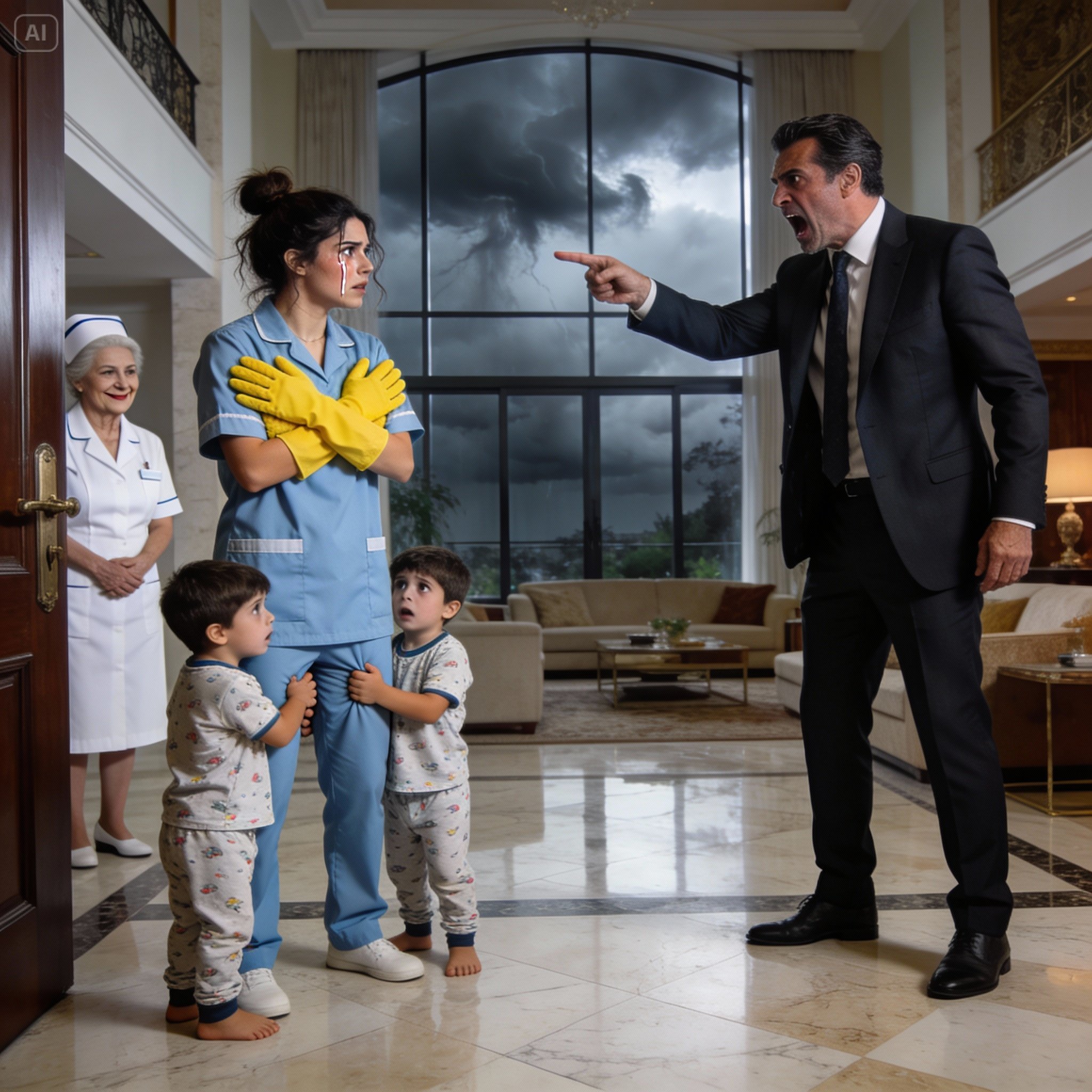
Javier Serrano stood beneath the archway. His immaculate suit was spattered with a few raindrops, his slicked-back hair perfectly in place, but his face… his face was the very picture of utter horror. He stared at his children as if they were ghosts. His eyes darted from Hugo’s legs to my gloves, and from my gloves to the empty wheelchairs.
“Get away from her right now!” Her shout was guttural, a mixture of panic and authority that made the crystal drops of the chandelier tremble.
“Mr. Serrano…” I tried to say, standing up quickly, but without letting go of Mateo’s hand, who was clinging to the fabric of my uniform as if I were his only lifeline in a shipwreck.
Javier didn’t look at me. He ignored me like you ignore an annoying piece of furniture. He crossed the living room in three long strides, his hard-soled shoes clicking like death warrants. He knelt in front of Hugo, who was weeping inconsolably on the floor.
“Hugo, son, does it hurt? Have you broken anything?” Javier felt his legs with trembling hands, searching for fractures, searching for the irreparable damage the doctors had promised would happen if the children made the slightest effort. “Answer me!”
“We were playing, Dad!” Mateo sobbed, trying to push away his father’s hands. “We were healing the Blue Girl!”
Javier looked up. And then he did look at me. His eyes, usually cold and calculating, were filled with a mixture of terror and such pure fury that I felt a chill run down my neck.
“I pay you to dust, Lucia,” he hissed, standing up and towering over me like a dark tower. “Not to kill my children.”
“Sir, with all due respect…” My voice trembled, but I kept my chin up. I wasn’t going to let him walk all over me. I knew the truth. “Your children weren’t going to break. They needed to move. They’ve been asking me to play for weeks when the nurse isn’t looking.”
“When the nurse isn’t looking?” Javier took a step toward me, invading my personal space. He smelled of expensive cologne and fear. “Are you doing this behind Olga’s back? Behind the backs of the medical team I hired? You could have left them disabled for life!”
“Look at them!” I yelled, pointing at the children, forgetting my place, forgetting that he was the millionaire and I was the girl who scrubbed his toilets. “Hugo just walked toward me. Mateo was jumping. When was the last time his medicine did that? When was the last time you saw them laugh without drooling?”
Javier looked at his children. For a second, I saw doubt in his eyes. Hugo had stopped crying and was looking at me adoringly. Cognitive dissonance must be making him dizzy. Either his doctors were lying, or this cleaning lady was an irresponsible witch. And Javier Serrano didn’t believe in witches; he believed in audits and reports.
“You’re fired,” she said, resuming her cool, executive demeanor. It was as if she flipped a switch. “You have five minutes to pack your things and get out of my house before I call security and report you for criminal negligence.”
“You can’t do that.” I took a step toward him, desperate. Not because of the money—God knows I needed it for my mother—but it wasn’t for that. It was for them. “If I leave, they’ll go back to sleep, sir. Olga…”
“Out!” Javier pointed at the door with a stiff finger.
At that moment, the sound of orthopedic heels echoed in the hallway like the roll of a war drum. Olga.
The nurse entered the room carrying a silver tray. Her white uniform was immaculate, her perpetually stern expression unchanged. On the tray, two syringes gleamed in the light, filled with a thick, amber liquid. The afternoon’s “medicine.”
“Good heavens!” exclaimed Olga, setting the tray down on a side table with a calculated clatter. “Mr. Serrano, I heard shouting. What happened? The children!”
Olga rushed over to the twins with sickeningly theatrical efficiency. She pulled a pulse oximeter from her pocket and placed it on Hugo’s finger before the boy could protest or hug me.
“They’re tachycardic,” he announced gravely, looking at the small digital screen. “Elevated heart rate, excessive sweating… Sir, I warned you a thousand times that unqualified staff shouldn’t interact with patients. Physical stress accelerates muscle degeneration.”
I saw Javier shrink back. The weight of guilt crushed his shoulders. Olga was the best nurse in Madrid, recommended by the director of the private hospital himself. She looked after the children 24/7. If she said they were in danger, to Javier’s logical mind, it was absolutely true.
“I’ve already taken care of that, Olga,” Javier said without looking at me, his voice breaking. “The young lady is leaving. Definitely.”
I felt a violent nausea in my stomach. I watched as the children, who a minute ago had been bursting with energy, shrank back at the nurse’s presence. I saw the sparkle in Mateo’s eyes fade when he saw the syringe on the table. It was the conditioned reflex of fear.
“They’re not stressed about the game,” I interjected, my voice growing stronger as I slowly removed my yellow gloves, one by one, with a deliberate click that echoed in the silence. “They’re scared of you, Olga.”
The nurse turned slowly. She gave me a condescending smile that didn’t reach her cold, shark-like eyes.
“Poor thing,” Olga said, addressing Javier but keeping her gaze fixed on me. “It’s common for domestic staff to become attached and mistake nervous excitement for clinical improvement. It’s the ‘placebo effect of the ignorant,’ Mr. Serrano. She thinks that playing cures genetic diseases. It’s endearing, but deadly.”
“It’s not a placebo,” I said, throwing my gloves onto the white leather sofa, an unthinkable act of rebellion in that house. “Those kids have muscles. They have strength. What they lack is energy, because you keep them drugged.”
The silence that followed was absolute, thick. Javier looked at me, astonished by the audacity of the accusation.
“Be careful what you say,” Javier warned, moving dangerously close. “You’re accusing a healthcare professional of malpractice. That’s defamation. I can ruin your life.”
“I’m accusing this woman of sedating her children so she doesn’t have to take care of them,” I blurted out, pointing at the syringes with my bare finger, reddened from work. “I’ve cleaned their rooms, sir. I’ve seen them sleep eighteen hours a day. I’ve seen that when you’re not around, she doesn’t even look at them. She spends all day on her phone watching TV series while they stare at the ceiling. Today, when she went out for her three-hour break, the children revived. They’re not just sick with muscle pain, Mr. Serrano. They’re poisoned.”
Olga’s face turned red, not from shame, but from suppressed anger. The veins in her neck bulged.
“It’s outrageous!” Olga shrieked. “I’ve been caring for terminally ill patients for twenty years. Are you going to let this mop insult my reputation and the reputations of the doctors who signed the diagnosis? The children need their medication now. We’re already behind schedule, and look how agitated they are. If I don’t give it to them now, they could have painful spasms tonight. Do you want them to suffer, Javier?”
Javier looked at the syringes. He looked at his children, who were now crying silently, resigned, defeated. Then he looked at me. I looked back at him with a desperate plea. “Believe me,” my eyes told him. “Please, be a father for once and believe me.”
But Javier’s logic, the logic of a businessman, intervened. He had reports, he had X-rays, he had the word of science. And on the other side, a small-town girl who hadn’t finished high school.
—Olga, give the children their medicine and take them to their room—Javier ordered in a tired voice, rubbing his temples as if he wanted to erase reality.
“No!” I shouted, trying to move toward the table to throw that tray on the floor.
Javier intercepted me. He grabbed my arm firmly. His grip was strong, like steel, but not violent. It was the grip of a man who was closing a failed deal and wanted to minimize the damage.
“That’s enough!” he said. “I’ll pay you the full month’s wages, I’ll give you a good severance package, but you’re leaving now. And if I ever see you near this property or my children again, I guarantee you won’t find another job in this country, not even cleaning sidewalks. Do you understand me?”
Tears stung my eyes. Not for myself, not because of the unfair dismissal. But for Mateo. The boy held out his hand to me as Olga gently pulled him toward the hallway, away from me.
“Goodbye, Blue Girl…” the boy whispered.
The nurse slammed the living room door shut, taking the light out of the house with her. I was left alone with Javier and the sound of the rain.
“Go away!” Javier let go of my arm with contempt. He turned and walked toward the liquor display case, his back to me. He needed a whiskey. He needed to forget what he had seen.
I took a deep breath. I knew I had lost the battle, but the fight for those children couldn’t end like this. I couldn’t let them die slowly in that house of horrors.
I bent down to pick up my old bag from the floor. As I grabbed it, my gaze fell on the yellow gloves I’d tossed on the sofa. In a swift, instinctive movement, just as Javier poured his drink and the ice clinked in the glass, I grabbed the gloves.
But I didn’t just take the gloves.
My hand, quick from years of manual labor, slithered like a snake toward the side table where Olga had set the tray down for a second before taking it away. There was a small, empty glass bottle next to where the syringes had been. The vial from which Olga had drawn the amber liquid. No one would notice an empty bottle. It was medical waste.
I tucked it inside the thumb of my left glove and crumpled the glove into my fist, hiding it against my chest. My heart was pounding so hard I thought Javier could hear it from across the room.
“I’m leaving, Mr. Serrano,” I said, walking towards the solid oak front door.
I paused for a second under the archway. The rain lashed against the windows, as if the sky itself were weeping for Hugo and Mateo. I turned one last time. Javier was there, glass in hand, staring into space.
“But I’ll give you one free question, unlike the advice from your doctors,” I said, my voice echoing in the empty room. “If your children are as sick as you say, why does the nurse keep the medicine bottles in her Louis Vuitton handbag and not in the home medicine cabinet?”
Javier paused, the glass halfway to his mouth. The amber liquid trembled.
“What did you say?” he asked, turning around slowly.
—Check the kitchen security cameras, sir. The ones from today at two in the afternoon. Right before you prepared the tray. See where the poison is coming from.
I didn’t wait for her answer. I opened the heavy door and stepped out into the storm.
The cold wind slapped at my face, soaking my blue uniform in seconds. The cold seeped into my bones, but I didn’t feel it. I pressed the yellow glove to my chest, feeling the outline of the small glass bottle inside.
I had the evidence. Now I just needed someone to believe me before it was too late.
I walked along the gravel path toward the exit gate. I didn’t have a car; I would have to walk to the bus stop, two kilometers away, in the pouring rain. As my canvas shoes sank into the mud, my mind kept replaying the image of Olga giving the children injections.
I knew something Javier didn’t. I had overheard Olga on the phone once, quietly mentioning the “booster dose.” If she was angry about my interference, if she wanted to make sure the children were “calm” so Javier wouldn’t see any more “miraculous improvements,” Olga could have increased the dose.
“My God, protect them,” I whispered, my tears mingling with the rain.
Meanwhile, inside the mansion, silence had returned. That hospital-like silence that Javier hated so much. He stared at the closed door through which I had left. He looked at his watch. It was 5:15 in the afternoon.
“Check the cameras.”
Javier slammed the glass down on the table. He didn’t want to believe me. He hated that a stranger questioned his controlled world. But if there was anything Javier Serrano hated more than disorder, it was being made to look like an idiot. And my question about the nurse’s personal bag had planted a seed of doubt that was impossible to uproot.
He took out his state-of-the-art mobile phone and opened the home security app. His fingers trembled slightly. He selected “Kitchen Camera 1.” He rewound the timeline.
What he saw on the small screen of his cell phone caused the glass of whiskey, which he had picked up again, to fall to the floor and shatter, scattering glass and alcohol across the Persian rug.
Olga wasn’t taking the medicine from the special refrigerator. In the video, the nurse looked around suspiciously, opened her personal bag, and took out an unlabeled plastic bottle—a reused mineral water bottle containing a cloudy liquid. She poured it into the orange juice, mixed it with the syringe, and smiled. A cold, self-satisfied smile.
—Damn it… —Javier felt a chill that had nothing to do with the air conditioning.
She ran for the stairs, taking them two at a time, breaking for the first time the “no running at home” rule. She had to stop that injection. She had to get that poison out of her children.
But when he reached the upstairs hallway, he heard the most terrifying sound in the world.
Absolute silence. No crying, no laughter, no complaints.
She flung open the nursery door. Olga was there, putting the empty syringes back in their case. The twins were in their beds, their eyes glazed, staring blankly ahead, mouths slightly open, drooling. Their breasts barely moved.
“They’re asleep now, sir,” Olga whispered, placing a finger to her lips with a macabre sweetness that chilled the blood. “Angels need rest. It’s been a day with too many strong emotions. I gave them a little extra to compensate for the stress caused by that crazy girl.”
Javier looked at his children, then at the nurse. For the first time in his life, he felt the primal urge of a predator discovering a threat in its nest. He wanted to pounce on her, to strangle her. But the rational part of his brain, the part that had made him a millionaire, screamed at him: “Evidence. You need to know what it is to save them.”
And the only person who had a clue, the only person who knew the truth, had just been evicted in the rain.
“Get out of here, Olga,” Javier said in a voice that sounded dead. “Go to your room. I’ll stay with them for a moment.”
—But sir, they need monitoring…
“I said get out!” roared Javier.
Olga, surprised by the tone, nodded and left, closing the door behind her. Javier approached Hugo. He touched his forehead. It was cold and damp. It wasn’t sleep. It was an induced coma.
Javier ran to the window. The storm was raging outside. In the distance, on the road leading to the exit of the housing development, he thought he saw a small blue patch moving slowly in the rain.
—Lucía… —he whispered.
Without a second thought, Javier stormed out of the room, bounded down the stairs, grabbed the keys to his sports car, and sped off into the night. He didn’t care about the suit, he didn’t care about the luxury car. All he cared about was catching me. Because if I was right, if I had the proof in that yellow glove, his children’s lives depended on him finding me before I vanished into the darkness.
I was walking along the shoulder of the road, shivering. The cold was unbearable, but the fear was worse. I heard the roar of an engine behind me. Powerful lights, xenon headlights, cut through the darkness and cast my long shadow on the wet asphalt.
The car skidded and braked sharply a few meters in front of me, blocking my path. I covered my eyes with my arm. I thought it was the police. I thought Javier had reported me and they were coming to arrest me.
The driver’s door opened upward, like the wings of a hawk. Javier stepped out into the rain. He was soaked in seconds, his white shirt clinging to his body, his hair disheveled. He didn’t look like the arrogant millionaire he’d been an hour ago. He looked like a desperate man.
He ran towards me. I backed away, pressing my back against the guardrail of the highway.
“I didn’t steal anything!” I shouted, pulling the yellow glove from my pocket and brandishing it like a shield. “I have the proof right here! It’s the jar!”
Javier stopped about half a meter away. He was panting.
“Get in the car,” he said. His voice wasn’t an order. It was a plea.
“No. You fired me,” I stammered, trembling with cold and rage. “You didn’t believe me.”
“Hugo is dying, Lucía,” Javier cried, his voice breaking into a sob that mingled with the sound of the rain. “Olga… Olga gave them more. They’re not breathing properly. I need to know what she gave them. I need the bottle.”
I felt my legs give way. The world stopped. The overdose. What I feared had happened.
“Succinylcholine!” I shouted, remembering the name I’d Googled after listening to Olga. “It’s a paralytic. If they gave you too much, you’ll suffocate while you’re awake.”
Javier paled even more under the headlights.
—Get in. Now. If they die, we all die today.
I didn’t hesitate. I got into the sports car. The interior smelled of new leather and panic. Javier started the engine, the tires screeching on the wet asphalt, and we sped around, heading back towards the mansion, towards the hell I had just escaped, to try to save the angels who slept there.
As the car devoured the road at 180 kilometers per hour, I clutched the yellow glove with the vial inside. I prayed. I prayed to every saint I knew.
“Hang on, my children,” I whispered. “The Blue Girl is coming back. Captain Papa has woken up.”
But neither of them knew that the battle had only just begun. That Olga wouldn’t give up so easily. And that that night, in the hospital, we would discover that the poison didn’t just come from the nurse’s syringe, but from the Serrano family’s own blood.
PART 2: THE BATTLE FOR BREATH
Javier Serrano’s sports car sliced through the rain like a silver blade, devouring the wet asphalt at a suicidal speed. Inside the cabin, the silence was thick, broken only by the roar of the engine and the ragged breathing of two people who shared the same terror. Lucía, soaked to the bone, clutched her yellow glove to her chest as if it were a sacred relic. Beside her, Javier drove with his white knuckles on the leather steering wheel, his eyes fixed on the road, but his mind on his children’s room.
“Tell me again what you heard,” Javier ordered, without taking his eyes off the road ahead. His voice sounded hoarse, unrecognizable.
Lucía swallowed hard, the cold rain and fear making her shiver violently. “It was two weeks ago. Olga was on the phone in the garden; she thought I was in the basement doing the laundry. She said, ‘The black market is dry, I need more succinylcholine or I’ll have to use pure benzodiazepines, and that leaves a trace.’ I… I looked up the name online that night. It said it was a muscle relaxant used in surgery for intubation.”
“Paralyzing…” Javier slammed his palm against the steering wheel, a sharp crack of frustration and guilt. “My God, it’s suffocating them. Succinylcholine paralyzes the diaphragm if the dose is high. They’re consciously drowning, Lucía. Consciously!”
The car skidded slightly as it rounded the curve leading into the “La Cima” residential complex. Javier corrected the trajectory with an expert swerve. In the distance, the blue and red strobe lights of an ambulance bounced off the stone walls of the mansion, tinting the rain with emergency colors.
—They’re here —Lucía whispered, feeling like her heart was going to jump out of her chest.
Javier didn’t brake until the last second. The car came to a stop across the gravel driveway, partially blocking the ambulance’s exit. Before the engine even died, Javier was already out, running through the downpour. Lucía followed, her canvas shoes sloshing in the mud, ignoring the pain in her legs.
The scene at the entrance of the house was choreographed chaos. The front door was wide open. A team of three paramedics rushed out, pushing two small stretchers, almost like wheeled cribs. On them were two tiny bundles connected to oxygen masks.
And there she was. Olga.
The nurse stood by the back doors of the ambulance, giving the performance of her life. She was crying, tearing at her hair, shouting hysterical instructions into the air. “It’s heart failure! Possible cyanide or rat poison poisoning!” Olga shrieked, making sure the two local police officers who had just arrived could hear her. “The maid! She had access to the cleaning poisons! She did it!”
Seeing Javier emerge from the rain like a vengeful specter, Olga ran to him. She tried to hug him, staining his suit with her fake tears. “Oh, Don Javier! Thank God you’re back! It’s awful… that woman…”
But then Olga’s shark-like eyes locked onto Lucía, who came running up behind Javier, panting. The nurse’s expression shifted in a split second: from feigned pain to a deadly, accusatory fury. “You! Murderer!” Olga raised a trembling finger, pointing at Lucía. “Officers! That’s the woman! Arrest her! She poisoned the children before she was fired for stealing!”
The two police officers, confused by the speed of events but reacting to the direct accusation, reached for their belts and advanced toward Lucía. She froze, fear pinning her to the ground. They were going to arrest her. They were going to take the evidence. And the children would die.
“Back off!” Javier’s roar was so powerful it stopped the police in their tracks. He physically placed himself between the officers and Lucía, using himself as a human shield. “Nobody touches this woman!”
Olga blinked; her story was falling apart. “But sir… she… she’s the one to blame…”
“Shut up, you viper!” Javier turned to face her with a barely contained violence that made Olga stumble backward until she hit the cold metal of the ambulance. He looked at her with such contempt that the nurse seemed to shrink. “I know what you did. I know about the purse. I know about the microdoses. I have it all recorded.”
The color disappeared from Olga’s face faster than rain sliding down metal.
Javier didn’t waste another second with her. He turned to the emergency room doctor who was trying to intubate Hugo on the first stretcher. The boy was grayish, lifeless, terrifying. “Doctor!” Javier shouted, grabbing the doctor by the shoulder of his uniform. “It’s not cyanide! It’s a massive overdose of neuromuscular blocking agents! Succinylcholine and sedatives!”
The doctor looked up, sweat mingling with the rain on his forehead. “Are you sure? The protocol is completely different. If I treat you with cyanide and it’s a paralytic, I’ll kill you. If it’s the other way around, I’ll kill you too. I need certainty.”
Javier looked at Lucia. “Give it to her!”
Lucía ran toward the examination table, dodging Olga’s attempt to grab her arm. She pushed the nurse with a strength she didn’t know she possessed, knocking her to the wet floor, and reached the doctor. With trembling hands, she pulled the small, empty glass vial from inside her yellow glove. “This!” Lucía shouted, placing it in the doctor’s hand. “This is what that woman was giving them. There are a few drops left at the bottom. Smell it!”
The doctor brought the vial to his nose, then quickly examined Hugo’s dilated pupils. “Damn it!” the doctor shouted to his team. “Code Red! It’s a neuromuscular blockade! Forget the cyanide antidote! They need immediate manual ventilation and neostigmine with atropine! Their diaphragms are paralyzed; they can’t breathe!”
The frantic activity changed pace. The paramedics stopped searching for ways to perform a gastric lavage and began manually pumping oxygen with Ambu bags, forcing air into the tiny lungs that had forgotten how to expand.
“Get them in! We’re going to the central hospital!” the doctor ordered. “We don’t have time!”
Javier jumped into the back of the ambulance. He turned and held out his hand to Lucía, who was still standing in the mud. “Are you coming with us?”
It wasn’t a question. It was a necessity. Lucía took his hand and went upstairs, sitting opposite him, next to Mateo’s stretcher.
Down below, at the entrance, Olga tried to get up from the mud, shouting that it was all a mistake, but she found herself facing two shadows. The police officers, who had heard the exchange and seen the doctor’s reaction, no longer looked at her as a victim. “Where do you think you’re going, ma’am?” the officer asked, pulling out the metal handcuffs. “You have a lot of questions to answer.”
The ambulance started up with a wail of sirens that tore through the night, leaving behind the cursed mansion and the corrupt nurse, but carrying with it a much more difficult battle: the struggle to keep two betrayed hearts beating.
Inside the vehicle, the noise was deafening. The rattling of the stretcher, the whistling of the oxygen, the beeping of the monitors. Javier stared at Hugo’s vital signs screen. The green line was erratic, weak, like a thread about to snap.
“Don’t die, son…” Javier whispered, tears finally breaking through his steely facade. “Please, Hugo, don’t die. Dad’s here. Dad was a fool, but he’s here.”
Lucía, sitting across from him, took Mateo’s limp hand in hers. It was ice cold. She began rubbing it frantically to warm it, her lips moving in a quick, desperate prayer. “Come on, Mateo… don’t go… the Blue Girl promises we’ll play tomorrow… I promise the floor isn’t lava…”
Suddenly, Hugo’s monitor emitted a long, high-pitched, continuous beep. The green line flattened. “Stop!” the paramedic shouted, dropping the Ambu bag and grabbing the paddles of the pediatric defibrillator. “He’s in asystole! Charging at 50 joules! Stand back!”
Javier felt his soul being ripped from his body. He pressed himself against the wall of the ambulance to make room. Lucía screamed the boy’s name, covering her mouth with the yellow glove she was still holding, now stained with mud and reality.
“Clear!” Hugo’s small body jumped onto the stretcher with the electric shock. A violent, unnatural jump.
The silence that followed was the second longest of Javier’s life. Everyone stared at the screen. Flat line. “No rhythm!” the doctor shouted. “Increasing load! Come on, kid, fight!”
Javier took Lucia’s hand across the ambulance aisle. He squeezed it so hard it hurt, but she didn’t complain. She squeezed back, her nails digging into his skin. In that inferno of lights and sirens, they were the only two human beings in the world who truly loved those children.
“Come back, Hugo!” Javier shouted, his voice breaking. “I swear I’ll change everything! I swear I’ll never travel again! Come back!”
—Clear! —Second blast.
The body jerked again. Silence. And then… Beep . A heartbeat. Weak, solitary, almost imperceptible. Beep… beep . The rhythm returned, chaotic, rapid, but present.
The doctor slumped back, exhaling heavily. “We have him… but he’s very weak. He’s been without his own oxygen for too long. I don’t know if the brain damage is reversible. The next 24 hours will be critical.”
Javier gasped and covered his face with his hands, sobbing uncontrollably, the cry of a broken man who had stared into the abyss. Lucía, instinctively, reached out and touched the millionaire’s shoulder, comforting him as if he were just another child in her care. “He’s alive, sir… he’s alive.”
The ambulance swerved sharply, entering the hospital’s emergency ramp. The rear doors opened, and the world transformed into a sea of white coats and fluorescent lights.
The corridor of the Pediatric Intensive Care Unit smelled of disinfectant and cold fear. Javier Serrano, the man who could move millions with a single phone call, sat in a hard plastic chair, his head in his hands, feeling like the most miserable person on the planet. His three-thousand-euro suit was ruined, but he didn’t care. The only thing that mattered was the hum of the machines behind the frosted glass doors.
A few meters away, Lucía stood leaning against the wall. She hadn’t sat down; she didn’t feel she had the right to occupy a space reserved for “family members.” She clutched her bag to her chest, shivering slightly.
The doors opened with a pneumatic hiss. Dr. Arriaga, head of toxicology and an old acquaintance of Javier’s, came out rubbing his eyes. His expression was grave. “Are they alive?” Javier asked, jumping to his feet. “They’re stable, Javier. For now,” Arriaga said. “The antidote worked. We neutralized the toxin. But we reached the limit. Hugo was clinically dead for almost a minute. Mateo’s lungs are severely compromised.”
“What… what exactly was it?” Javier asked, dreading the answer. “Succinylcholine and benzodiazepines. A brutal cocktail,” the doctor explained. “Succinylcholine paralyzes the muscles. It’s used to keep patients from moving during surgery. Javier… that woman was giving it to them in daily microdoses to simulate atrophy. And today, she gave them a lethal dose. What your children went through was torture. They were physically paralyzed, unable to move or cry, but their minds were awake. They felt everything. The fear, the slow suffocation… everything.”
Javier closed his eyes and a dry sob escaped his throat. The image of his children, trapped in their own bodies, staring at the ceiling while Olga watched television, shattered him. He had financed that torture chamber. “I’m a monster…” he whispered. “I hired her.”
“Don’t beat yourself up now. You need to be whole,” the doctor said. “The important thing now is waking up. We don’t know how they’ll react. And their muscles… they haven’t been used for months because of the drug. The atrophy is real now, not because of genetics, but because of chemical disuse.”
At that moment, two police officers entered the room, breaking the bubble of grief. They approached Javier. “Mr. Serrano,” the officer said, “we have an update. The detainee, Olga M., has partially confessed. She admits to administering the drugs, but claims she did so following your implicit instructions to ‘keep the house quiet.’ Her lawyer will argue that it was a misunderstood palliative care treatment.”
Javier looked up. His eyes burned with icy hatred. “My instructions?” Javier stepped closer to the policeman, invading his space. “I want her destroyed. I want every bank account she has investigated. That woman was drawing an executive’s salary and spending it on luxuries while drugging children. I don’t want a deal. I want her to rot in jail.”
“We need your formal statement and that of the key witness,” the policeman said, looking at Lucia.
Lucía shrank back. “She won’t say anything now,” Javier interrupted, protecting her. “She’s exhausted. She just saved my children’s lives. Take my statement, but leave her alone until tomorrow.”
The police officers nodded and left. Javier remained alone in the center of the room and then, slowly, turned toward Lucía. He walked toward her. “Lucía…” he said, his voice no longer carrying the imperious tone of his boss. “You knew. You saw it in a few days. I lived with them for two years and I didn’t see it. How could you?”
Lucía looked up, her tired brown eyes meeting his. “Because you were looking at the medical reports, sir. I was looking at the children. You were looking for a cure in the paperwork; I was just trying to make them smile. When you play with a child, you know when they’re tired and when they’re high. Your children had a hunger for life, Mr. Serrano. A terminally ill person doesn’t have that hunger.”
The words hit Javier hard. It was the truth. He had been a manager, not a father. “Forgive me,” Javier said, and to the astonishment of a passing nurse, the tycoon knelt on the hospital floor in front of his former employee. “Forgive me for firing you. Forgive me for not believing you.”
“No, sir, please get up,” Lucía tried to help him, extremely uncomfortable. “I won’t get up until you promise you won’t leave,” Javier said, taking Lucía’s rough hands. “I need you. They need you. I don’t know how to be a father to children who can live. Teach me.”
“I’ll stay,” she promised. “I’ll stay until they’re all right.”
Just then, an alarm sounded inside the ICU. A nurse rushed out. “Mr. Serrano! They’re waking up, but you have to come! They’re very agitated!”
Waking up was chaotic. When we entered the cubicle, Hugo and Mateo were screaming, trying to rip out their IVs. They were in withdrawal and terrified. “No! Don’t fall for it!” Mateo shouted, pushing the nurses away. “Calm down, Mateo, it’s me, Dad!” Javier tried to restrain him. But Mateo screamed even louder when he saw him. “Go away, you bad man! Go away!”
For Mateo, Javier was the dark figure who brought the evil nurse. The rejection was a stab in the back. Javier froze. His own son was afraid of him.
“We have to sedate them!” a nurse shouted. “No!” Javier roared. “No more drugs!”
Then Lucia came in. She was wearing yellow gloves, dirty and wrinkled. She walked to the center of the beds and raised her hands, moving her fingers like spiders, singing softly: ” An elephant was balancing on a spider’s web…”
The effect was magical. The children stopped screaming. Their eyes searched for the color yellow. “Mommy Gloves!” Hugo sobbed. Lucía approached, gently stroking them with the rubber band. “The Blue Girl is here. The magic gloves eat pain. Yum, yum.”
Javier watched from the corner, his heart broken but filled with gratitude. That woman had a power he didn’t. Lucía looked at Javier and beckoned him closer. “Hugo,” she whispered to the boy, “look who came to help me scare away monsters. It’s Big Daddy. He was driving the rescue car.”
Javier approached, swallowing his tears. “Yes, champ. The fastest car in the world to bring you to the Blue Girl.”
Hugo looked at him, hesitated, and finally nodded. “Okay.”
That night, in the ICU ward, the real recovery began. Not the medical kind, but the recovery of the soul of a broken family.
PART 3: THE WEIGHT OF TRUTH
Three weeks have passed since the night of the storm. The Serrano mansion no longer smells of disinfectant; it smells of sweat, exertion, and sports balm. The main living room has been stripped of its designer furniture and transformed into a makeshift gym. Parallel bars, mats, and Pilates balls now occupy the space where silence once reigned.
But recovery isn’t the fairy tale Javier had hoped for. It’s a trench warfare.
It’s Tuesday morning. Dr. Kovacs, a renowned German physiotherapist whom Javier brought in for a fortune, is working with Hugo. Kovacs is an immense man, technically skilled and brutally efficient. He doesn’t believe in empathy; he believes in pure biomechanics.
“Extend!” Kovacs orders with his marked accent, forcing Hugo’s right leg to stretch the tendon shortened by years of forced immobility.
Hugo screams. It’s a high-pitched shriek, full of tears and panic, that reverberates off the walls and pierces Javier’s chest, who watches from the doorway, a trembling cup of coffee in his hand. “He’s in pain…” Javier murmurs, taking a step forward.
“The pain is necessary, Herr Serrano,” Kovacs says without letting go of the leg, ignoring the boy’s cries. “The muscle is calcified. If we don’t break it, it won’t grow. If you want him to walk for college, he has to cry now.”
Mateo, sitting in his wheelchair beside them, weeps in solidarity, covering his ears. It’s a scene of medieval torture disguised as medicine.
“Stop!” The voice comes from the kitchen.
Lucía appears in the doorway. She’s no longer wearing the apron, but she is wearing the yellow gloves. They’ve become the children’s safety net; they won’t let anyone touch them unless Lucía is wearing her “powers.” She crosses the room with purposeful steps, crouches down next to the mat, and places her gloved hand on Hugo’s knee, right where the therapist applies pressure.
“Spit it out,” Lucia says. Her voice is low, but sharp. “Miss, I’m in the middle of a clinical session,” Kovacs replies disdainfully. “Take your rubbery hands off. This is science, not a daycare.”
“The boy is hyperventilating,” Lucía counters, pointing at Hugo’s chest. “His body is tense with fear. If you pull when he’s tense, you’ll tear him apart. You’re not helping, you’re breaking him.”
“And what do you suggest? Dancing?” the therapist scoffs. “Severe atrophy isn’t cured with songs. It’s cured with brute force. Mr. Serrano, keep an eye on your nanny or I’m leaving. My rate is a thousand euros an hour.”
Javier watches the scene. He looks at the expert with his diplomas. He looks at Lucía, who is stroking Hugo’s hair and whispering to him to calm him. And he looks at his son, who is clinging to the yellow glove like a life preserver. Business logic tells him that Kovacs is right: progress requires sacrifice. But his paternal instinct, the one that awakened in the ambulance, screams something else.
Javier puts down his cup and walks to the center of the room. “You’re right, Dr. Kovacs.” The therapist smiles smugly and takes hold of his leg again. “You’re right that your time is valuable,” Javier continues, standing over the German. “So valuable that I’m not going to waste any more of it. You’re fired.”
Kovacs jerks his leg away, stunned. “Excuse me? You’re throwing me out to leave the treatment in the hands of a maid? That’s irresponsible! I’ll sue!”
“Get out,” Javier says with icy calm. “And if you ever touch my children like that again, I’ll make sure you never practice law in Europe again.”
Kovacs angrily grabs his briefcase and storms out, slamming the door. Silence returns to the room. Only Hugo’s ragged breathing can be heard.
Javier loosens his tie and sits down on the floor, directly on the carpet, facing Lucía and the children. “Now what?” Javier asks, looking at Lucía with a mixture of terror and hope. “I was right about one thing: their tendons are short. If we don’t stretch them, they won’t walk.”
Lucía finishes drying Hugo’s tears with the tip of her rubber finger. “We’re not going to stop stretching, sir. But we’re not going to do it against them. We’re going to do it with them. The body doesn’t heal if the soul is afraid.”
Lucía gets up, goes to the toy closet, and takes out brightly colored elastic bands and cushions. “Let’s play Rubber Jungle!” she announces excitedly. “Oh no! My legs are stuck together with giant bubblegum. I need help. Who’s the strongest?”
She ties a ribbon to her foot and another to Hugo’s. “You pull me and I’ll pull you. If we win at chewing gum, there’s a prize.”
Intrigued, Hugo starts pulling. As he does so, he performs the same extension exercise that Kovacs forced, but he controls the force. He decides how much it hurts. And since it’s a game, his pain threshold changes. He laughs.
“Louder, Hugo,” Javier encourages, instantly understanding the dynamic. He takes off his suit jacket and joins in. He grabs another ribbon. “I am the Gum Monster!”
Javier pulls gently. Hugo laughs, gritting his teeth with effort, but there’s no more panic. There’s sweat from struggle, not torture. “Pull, Mateo!” Hugo shouts.
For the next hour, the mansion was filled with laughter and hard work. Javier ended up sweating, his shirt wrinkled, rolling around on the floor. In the end, Hugo had stretched his leg twenty times more than with the German and hadn’t even noticed.
When the children finally succumb to their afternoon nap, Javier and Lucía sit on the floor, exhausted. A new intimacy grows between them. “Thank you,” Javier says, looking at his own hands. “Today I felt like a father.” “You were always a father, Don Javier. I was just scared,” Lucía says, taking off her gloves. Her real hands are red from the heat of the rubber.
Javier looks at her. He really looks at her. And he feels something dangerous in his chest. But reality hits again. His phone vibrates. It’s a message from his head of private security.
Sir, we have completed the forensic tracing of Olga’s accounts. She was not acting alone. There are monthly transfers to an account in Switzerland. The recipient has been identified.
Javier reads the name and feels the air leave his lungs. Headline: Rodrigo Valdés.
Rodrigo. His brother-in-law. The brother of his late wife Elena. “Uncle Rodri” who brought expensive gifts at Christmas and who always told Javier: “Go to Tokyo in peace, I’ll keep an eye on the children.”
Javier gets up, pale. It all makes sense. Elena left a multi-million dollar trust for the twins, but with a clause: if the children died or were declared permanently incapacitated before the age of 18, the administration would pass to their biological family. To Rodrigo.
“Damn son of a bitch,” Javier whispers. It wasn’t just about money. It was blood treason. Rodrigo had paid to turn his nephews into vegetables and keep the inheritance for himself.
That same night, the intercom buzzes. “Mr. Serrano,” says the guard, “Mr. Rodrigo Valdés is here. He says he’s come to see his nephews after watching the news. He insists on coming in.”
Javier looks at Lucía. “Take the children upstairs and lock the door. Don’t go out for anything in the world.” “What’s wrong?” she asks, frightened by his tone. “The final monster has arrived.”
Javier lets Rodrigo in. His brother-in-law enters the living room with his usual elegance, dressed in light linen and sporting that politician’s smile. “Javier! Good heavens! I saw the news. What a horror about that nurse. How could you let someone like that into your house? I told you, you should have let me hire the staff.”
Javier waits for him by the unlit fireplace. He doesn’t shake his hand. “Hello, Rodrigo.” “I came as soon as I could. The family’s lawyers are worried. They say this looks like negligence on your part. And… what’s this?” Rodrigo points to the mats. “A cheap gym? The children need a clinic, Javier.”
“The children are improving,” Javier says, taking a step towards him. “Mateo walked today.”
Rodrigo’s smile falters. A nervous tic appears under his eye. “Did he walk?” he forces a laugh. “Javier, don’t fool yourself. The damage from succinylcholine is irreversible. The doctors say so. Don’t give them false hope.”
“How do you know it was succinylcholine, Rodrigo?” Javier asks gently.
The silence is thick. Rodrigo freezes. The press mentioned “drugs,” but the specific name was only in the confidential police report. “I… well, I guessed. It’s what they use…”
“It’s not the norm.” Javier pulls out his phone and projects a screenshot of the bank transfer onto the giant screen in the living room. “What’s normal is for an uncle to love his nephews. What’s not normal is for him to pay a nurse ten thousand euros a month to kill them while they’re still alive.”
Rodrigo stares at the screen. His mask slips. The kind man vanishes, and greed emerges. “You never loved them,” Rodrigo spits. “You killed my sister with your absence. That money belongs to the Valdés family. It’s mine!” “They’re your nephews,” Javier roars. “You almost killed them!”
“They were better off asleep!” Rodrigo shouts, backing away. “Without suffering, without missing a dead mother and an absent father. I was doing them a favor. And you… you’re incompetent. Do you think this proves anything? It’s a numbered account. You can’t prove it was me. Olga already confessed, but I have connections. I’ll claim you’re crazy, that you have a cleaning lady playing doctor. Social Services will take them away tomorrow.”
“Try it!” Javier roars.
“I already did it,” Rodrigo said with a wicked smile. “I made a call an hour ago. They’ll come for them first thing tomorrow. Enjoy your last night as a father, Javier.”
Rodrigo storms out of the mansion, slamming the door behind him. Javier is left trembling. Lucía runs downstairs. She heard the shouting. “Is it true?” she asks, her voice breaking. “Can you take them away from us?”
Javier looks at her. He sees the fear in her eyes, the same fear the twins had. “He’s my brother-in-law. He has political influence. But this time I’m not going to fight with money, Lucía. I’m going to fight with the truth. And I need you and the children to be ready for the most important performance of your lives.”
PART 4: THE YELLOW CAPTAIN
Dawn brought a cold, gray light, and with it, the sound Javier feared most: sirens. But they weren’t police sirens arresting a criminal; they were official vehicles from the Department of Child Protective Services, escorted by a local patrol car. Rodrigo wasn’t lying. He had pulled some strings.
Javier saw the lights from the window. “Lucía!” he shouted. “They’re here!”
Lucía came out of the children’s room. She was already dressed in her blue uniform and wearing her yellow gloves. She stood in front of the closed door. “They’re not going to take them,” she said with terrifying calm.
The doorbell rang. Javier answered. A stern-looking woman, Marta Galdó, showed her ID. Behind her, Rodrigo smiled from his car. “Mr. Serrano, we have an emergency order for the temporary custody of Hugo and Mateo. We’ve received reports of medical neglect and an unsafe environment. Hand the children over to us, or the police will force their way in.”
“This is a farce!” Javier shouted, blocking the way. “That man back there is the criminal!”
“Those allegations will be investigated,” the woman said coldly. “But my priority is the children. We have reports that they aren’t walking, they aren’t talking, and they’re being cared for by cleaning staff. That’s neglect. Separately.”
The woman pushed past Javier and went inside, followed by two police officers. Rodrigo got out of the car and followed them in like a vulture. “I only want what’s best for my nephews, Javier,” he whispered as he passed.
They went upstairs. Javier ran after them. When they reached the upstairs hallway, they encountered a barrier. Lucía. Standing in front of the door, unarmed, wearing only her rubber gloves.
“Back off,” Lucia said. “Miss, step aside. It’s a court order.” “Only people who love these children are allowed in here,” Lucia said, her eyes shining. “You don’t know their names. You’re just carrying papers.” “Take it away,” the woman ordered.
A policeman grabbed Lucía by the arm. She struggled. “No! Don’t touch them!”
The door behind her opened slowly. Everyone stopped.
Hugo stood in the doorway, leaning against the frame. His legs were shaking violently, but he was holding on. He was wearing his superhero pajamas. Behind him, crawling quickly and grabbing onto Lucía’s leg for support, Mateo appeared. He stood up too.
“Leave my Mom Gloves alone!” Hugo shouted in his high-pitched little voice.
The social worker gasped. Rodrigo’s report said they were vegetables. “But… the report says they don’t walk…” she murmured.
“The report is lying,” Javier said, coming to Lucia’s side and putting his hands on his children’s shoulders. “Look at them.”
Hugo took a hesitant step toward the policeman holding Lucia. He raised his small hand and pushed the officer’s leg. “Bad,” the boy said. “Let Lucia go.”
The policeman, a burly man, immediately released Lucía, embarrassed. Rodrigo, at the end of the corridor, paled. His alibi was crumbling live on air. “It’s a trick!” Rodrigo shouted. “They’re forcing them! They’re hurting them!”
“The only one who hurt them was you,” said a deep voice from the stairs.
Dr. Arriaga came upstairs accompanied by two federal agents. “Ms. Galdó, stop that order. I have certified toxicology evidence. The children were systematically poisoned with drugs purchased by this man.”
“Lies!” Rodrigo shouted, backing away. “We have Olga’s expanded confession, the bank records, and the physical evidence,” the federal agent said. “Rodrigo Valdés, you are under arrest for attempted murder and fraud.”
Rodrigo tried to run, pushing Javier to get down, but Javier grabbed him by the lapel. “You’re not going to run,” Javier growled, face to face with him. “You’re going to see them. You’re going to see the children you tried to break.”
Javier turned Rodrigo toward the twins. Hugo and Mateo were standing, clinging to Lucía’s legs. They were weak, yes, but they were alive and standing. “Look at them closely, Rodrigo. This is the last time you’ll see them outside a cell.”
Javier pushed Rodrigo toward the federal agents. The “good guy” was dragged down the stairs screaming. The social worker closed her file, visibly shaken. “Mr. Serrano… I apologize. Clearly these children are in the best hands.”
When they left, the silence lasted a second. “Dad won!” Mateo shouted, pulling away from Lucía and taking two unsteady steps toward Javier. Javier knelt down and took the impact of the two small bodies. He hugged them, crying. Lucía stood there, smiling, taking off her gloves. Her job was done.
Javier looked up at her from the floor. “Don’t take your gloves off yet,” he said with a radiant smile. “We still have a lot to rebuild. And I can’t do it without you.”
Lucía knelt with them, completing the circle. “I’m not going anywhere, Captain.”
EPILOGUE: SIX MONTHS LATER
The spring sun bathes the back garden of the Serrano mansion. There’s a white tent, hundreds of yellow balloons, and a large crowd. The press is outside, under close surveillance. Society waits to see if the “Serrano Miracle” is real.
It’s the twins’ fourth birthday. Javier adjusts his tie in his room. He’s nervous. Lucía comes in. She’s no longer in her uniform. She’s wearing a beautiful cream-colored dress. “Are you nervous, Captain?” “I’m afraid they’ll fall in front of everyone,” Javier confesses. “They will fall,” Lucía says, smiling. “They’re children. But they’ll get up. They’re not afraid of the ground anymore.”
They go down to the garden. The music stops. Javier takes the microphone. “Thank you for coming. I know what people are saying. That I was an absent father. It’s true. But today we’re not celebrating the past. We’re celebrating the effort.”
Javier drops the microphone and shouts towards the house: “Ready or not, here I come!”
Hugo and Mateo dart out into the garden. There are no wheelchairs. They run. It’s a clumsy run, yes, their legs are still stiff, but they run laughing. The crowd stifles a cheer. Mateo trips and rolls across the grass. People hold their breath. But Mateo leaps up. “I’m a bowling ball!” he shouts. “Attack!” Hugo yells, jumping on him.
Javier catches them in mid-air, falling to the ground with them, buried by laughter. Lucía cries tears of joy from the terrace.
At dusk, when the party ends, Javier takes Lucía to a secluded corner of the garden. He gives her a box. “I told you I wanted to talk about your contract,” he says. Lucía opens the box. Inside is a silver frame. Pressed behind the glass is a yellow rubber glove. Underneath it says: “The hand that held our world when it was falling apart.” Lucía sobs. “That glove is worth more than this whole house,” Javier says. “Because with it you taught me how to be a father.”
Javier takes out an old key. “It’s the key to the beach house. The doctors say swimming will help them. I want to take them all summer. But I won’t go if you don’t come. Not as an employee.” “Then how?” she asks. “As part of the family. As the woman who gave me my life back. I’ve fallen in love with you, Lucía.”
Lucía looks at the glove, the key, and Javier. —I fell in love with you the day you put on the yellow gloves and knelt on the rug, Javier.
They kiss in the orange light of the sunset. A kiss of survivors. “Dad! Lucia!” Hugo’s shout interrupts them. They come running, covered in cake. “Mateo says he’s faster, but I’m faster!”
Javier and Lucía separate, laughing. “We’ll find out on the beach tomorrow,” Javier says, winking.
Night falls on the mansion. There is no more fear. There is no more poison. In the main room, above the fireplace, rests the frame with the yellow glove. Javier turns off the light and takes the stairs two at a time. For the first time in years, he is eager to see what tomorrow will bring.
END