I slept on old rags in the kitchen and was treated worse than an animal, until the richest widower in the region arrived on horseback, looked me in the eyes and changed my destiny forever with a single command!
CHAPTER I: THE COLDNESS OF THE GROUND AND THE WARMTH OF HOPE
The cold of the terracotta tiles was always the first thing to greet me. Even before I opened my eyes, my body knew dawn was breaking because the early morning dew seeped under the back door, the one that led to the farmyard and never closed properly. I would wake up with numb bones, curled up on the thin, threadbare mattress that Dorotea, my stepmother, had decided was sufficient for me. It wasn’t a room, not even a pantry; it was the corner between the wood-burning stove and the washbasin, where ashes piled up and where the wind whistled in winter like a lost soul.
—Get up now, you lazybones—Dorothea’s voice echoed in my head, even though she was still snoring in her upstairs room, wrapped in linen sheets and feather quilts.
I sat up, rubbing my arms to warm them. I was seventeen, but my hands looked like an old woman’s—red, rough, with skin tanned by the icy well water and caustic soda soap. I smoothed down my gray dress, the same one I’d worn yesterday, the day before, patched so many times it was more new thread than original fabric. My father… oh, my father. When he was alive, I had colorful dresses, hair ribbons, and shoes that didn’t pinch. But my father went to heaven three years ago, taking the light of this house with him and leaving me at the mercy of the darkness his second wife brought.
I began my routine in silence, a silence I had perfected for survival. Breathing heavily was grounds for a scolding. Stepping on a creaking board was grounds for a pinch. I lit the fire, blowing on the dying embers until the smoke stung my eyes, and put the water on to boil for the coffee. As the aroma of roasted beans filled the kitchen, a pang of hunger twisted in my stomach. I knew that all I would have for myself was the crust of stale bread left over from the previous night’s supper, perhaps soaked in a little watered-down milk, if Dorotea wasn’t in a bad mood.
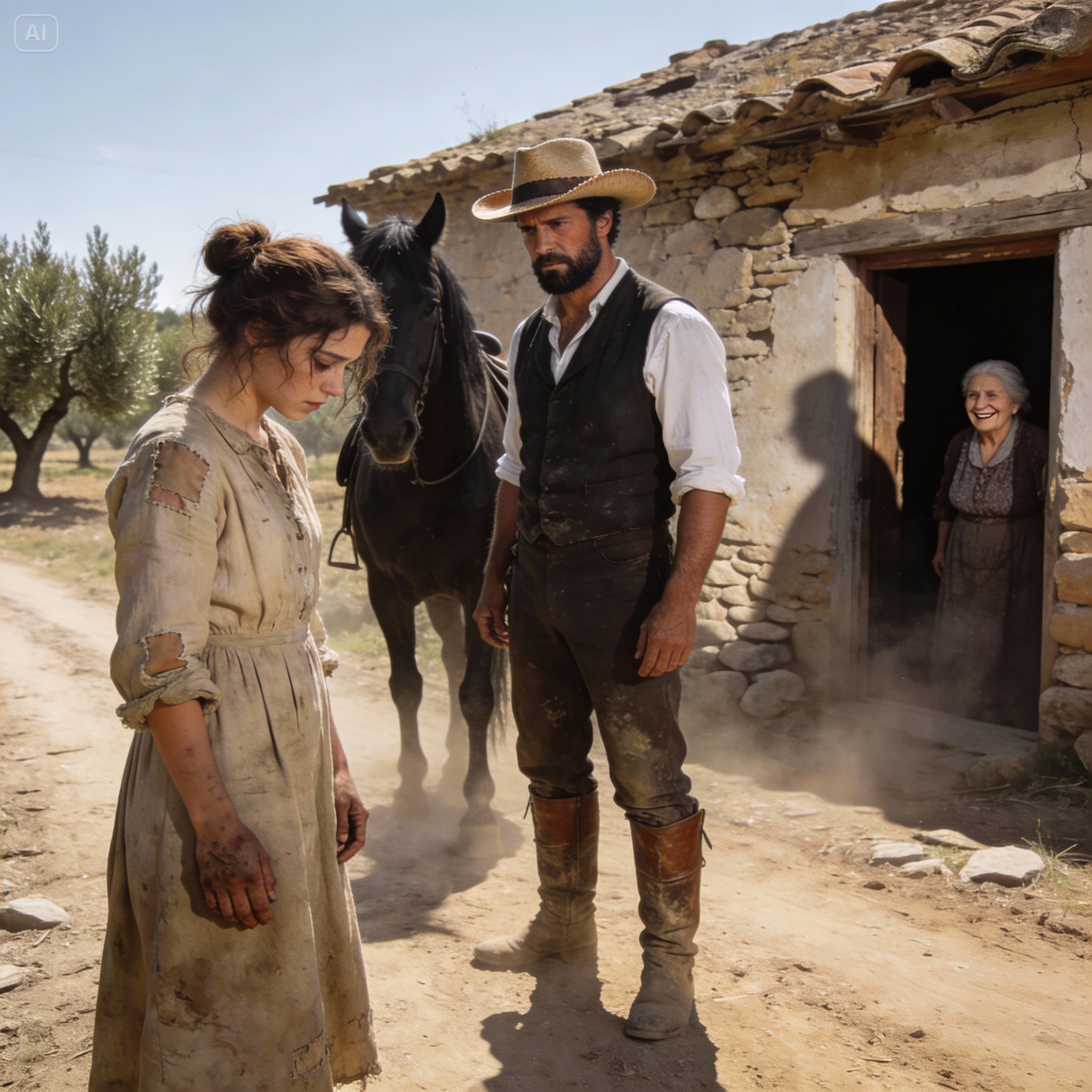
As the sun began to paint the olive groves surrounding our small farm near the village of San Lorenzo orange, the “ladies” awoke. Celina and Estela, Dorotea’s daughters, came down to the kitchen with sleepy eyes and that air of someone who believes the world exists only to serve them.
“The coffee’s weak,” Celina complained without even saying good morning, pushing the cup away.
“And the bread’s over-toasted,” Estela added, looking at me with disdain. “You’re useless, Francisca. Mom’s right, you’re not even good for swatting flies.”
I lowered my head.
“I’m sorry, miss,” I murmured. I always apologized. It was my shield. If I apologized quickly, sometimes the blows never came.
Dorotea stormed into the kitchen. She was a stout woman with a sour face, who always dressed in somber black to feign grief in front of the townspeople, though at home her mourning was as fake as her smiles at noon mass.
“Are you still standing here like an idiot?” she snapped, pinching my arm with those fingers that felt like pincers. “The well isn’t going to dig itself out. And I want the laundry washed and hung out to dry before the sun gets high. Move it, you old mule!”
I went out to the backyard, holding back tears. I didn’t cry. I had promised myself, at my father’s grave, that I wouldn’t give them the satisfaction of seeing me cry. I carried the buckets of water, feeling the metal handles dig into my palms, and began to scrub the clothes in the stone basin. The water was icy cold, cutting like knives.
“Lord, give me strength,” I prayed silently. “Or take me with you, but don’t leave me in this hell any longer.”
It was then, with my hands submerged in the grayish foam, that I heard the sound. It wasn’t the slow gait of the neighbors’ pack donkeys, nor the clatter of carts. It was the rhythmic, powerful hooves of a galloping horse approaching along the main road. I didn’t look up. No one important cared about an orphan washing other people’s clothes.
“Mr. Antonio!” Dorotea’s voice changed instantly. From that sour, viperous tone, it shifted to a cloying syrup that made me nauseous. “What an honor to receive you in our humble home! Please, dismount and come in.”
I stopped rubbing. Antonio? Antonio Cardoso? The name echoed in my mind. Everyone in the region knew Don Antonio. He owned the Cortijo de los Álamos, the largest and most prosperous estate in the area. It was said that he was an immensely wealthy man, but marked by tragedy. His wife had died in childbirth three years earlier, leaving him alone with a newborn daughter. Since then, they said, he had never been seen smiling. He was a businessman, tough, fair, but as cold as marble.
I risked glancing over my shoulder.
There he was. A tall man with broad shoulders that seemed capable of holding up the sky. He wore an impeccable riding outfit, with leather boots that gleamed in the dust of the road and a Cordoban hat that shaded a face with sharp features, tanned by the Spanish sun. He had dark, deep eyes that seemed to look through things, not at them.
“I’ve been told you have someone here who could be of service,” her voice was deep and resonant, like the rumble of distant thunder. There were no unnecessary greetings, no empty courtesies.
Dorotea nodded with an enthusiasm that chilled me to the bone.
“Of course, Don Antonio! My stepdaughter, Francisca. She’s a gem, I assure you. Hardworking, obedient, she knows how to cook, sew, clean… She’s perfect for a large house like yours.”
I felt like the world stopped. I was being offered up. Not as an employee, but as merchandise. My mouth went dry.
“Bring her here,” he ordered.
“Francisca!” Dorothea cried, turning towards me, and her face regained for a second that usual harshness before softening again for the visitor. “Come here, child, the master wants to see you.”
I hurriedly dried my hands on my dirty apron and walked toward the porch. My legs were shaking so badly I was afraid I’d fall to my knees in the dust. I kept my eyes fixed on my bare feet, ashamed of my filth, my poverty, my very existence.
Don Antonio said nothing for a long minute. I felt his gaze sweeping over me, not with lust, but with clinical scrutiny, like someone assessing whether a horse will last the day.
“Lift your head,” he said. It wasn’t a shout, but the authority in his tone compelled me to obey.
I raised my chin and my eyes met his. They were as black as a moonless night, but deep down, very deep down, I thought I saw a glimmer of infinite weariness.
“How old are you?”
“Seventeen, sir,” I replied, my voice barely a whisper.
“Can you read?”
Dorothea shifted nervously beside him.
“She knows…
” “I asked her,” Antonio interrupted without looking at her.
“Yes, sir,” I said. “My father taught me before… before he died. I can read the Bible and I know how to do math.
” “Do you know how to take care of children?
” “I’ve never taken care of any, sir. But I learn quickly and I’m patient.”
Antonio nodded slowly. He seemed to make a decision right then and there, a decision that would change the course of the stars above my head. He turned to Dorotea.
“I’ll take her. I need someone for my daughter Cecilia. She’s three, and city nannies don’t last a week. They’re too fussy. I need someone from the country, strong, who isn’t afraid to get her hands dirty.”
Dorotea almost clapped her hands with joy. I could see the peseta symbols flashing in her eyes.
“She’s yours, Don Antonio. Francisca is exactly what you need. When do you want me to come? ” ”
Now,” he said.
“Now?” I repeated, unable to contain myself.
He looked at me again.
“Now. I don’t have time to waste on back-and-forth trips. Pack your things. You’re coming with me.”
I froze. I looked at Dorothea, hoping, perhaps naively, that there would be a hint of hesitation, that she would say she needed time to say goodbye, that she couldn’t just let me go like that. But she only gave me a dismissive wave of her hand.
“Come on, child, don’t keep the gentleman waiting. Go get your bundle. It’s an opportunity you don’t deserve, so be grateful for it.”
I understood then, with painful clarity, that I was nobody. I wasn’t a daughter, I wasn’t a sister. I was a burden they had just gotten rid of.
I ran to the kitchen, to the corner of my shame. I had no suitcases. I grabbed a large cloth handkerchief and stuffed inside the only things I owned in this world: two patched dresses, a wool shawl that had belonged to my mother, a tortoiseshell comb missing two teeth, and my father’s small, worn Bible. That was all. Seventeen years of my life fit in a handkerchief.
When I came out, Don Antonio was already mounted on his horse, an imposing, jet-black animal. He looked down at me.
“Give me your hand.”
I hesitated. My hands were rough, stained with ash and soap. His, though large and strong, looked clean, encased in leather gloves.
“Come on,” he insisted.
I held out my hand. His grip was firm, secure. With a jerk, with a strength that surprised me, he hoisted me onto the horse’s rump, behind the saddle.
“Hold on to my waist,” he ordered. “And don’t let go. It’s a long way.”
I wrapped my arms around his waist, feeling the hardness of his muscles beneath his shirt. He smelled of tobacco, leather, sandalwood soap, and the countryside. It was a masculine and overwhelming scent.
Without saying goodbye to Dorotea, he spurred his horse and it started moving. I didn’t look back. I didn’t want to see my stepmother’s triumphant smile. I only looked ahead, at the broad back of that stranger who was taking me to an uncertain destination.
As we drove away from San Lorenzo, fear began to rise in my throat. What if he was a cruel man? What if the Cortijo de los Álamos was another hell, only bigger? Dorotea had taught me the hard way that girls like me weren’t lucky, they only had masters. And now, my master was named Antonio Cardoso.
The journey lasted almost three hours under the relentless sun of the plateau. My legs ached from the posture, and my throat was dry from the dust of the road, but I didn’t complain. Antonio didn’t speak either. He rode in silence, lost in his own thoughts, as if he had forgotten he was carrying a girl on his back.
Suddenly, the landscape changed. The neglected, dry fields gave way to olive groves aligned with military precision, to lush, green vineyards. The fences were repaired, the paths cleared. In the distance, I saw men working, tipping their hats as my companion passed by. We were entering their domain.
And then, I saw it. The Big House. The Farmhouse.
It was a majestic building with whitewashed walls that gleamed in the sun, red tiles, and a central tower. A cobbled courtyard opened up in front, with a stone fountain in the center that sang with the sound of cool water. There were geraniums in the windows, bougainvillea climbing the walls, and an air of rustic nobility that took my breath away.
Antonio stopped the horse in front of the main entrance. A stable boy ran to take hold of the reins.
“Welcome to Los Álamos,” he said, and for the first time his voice sounded a little less harsh, perhaps softened by the pride of being in his homeland.
He helped me down. My legs buckled as I touched solid ground after so long, and I stumbled. He caught me by the elbow to keep me from falling. His touch was brief, impersonal, but it prevented me from breaking my nose on the cobblestones.
“Doña Jacinta,” he called.
An elderly woman, short but sturdy, appeared in the doorway of the oak door. Her gray hair was pulled back in a tight bun, and she wore an immaculate white apron over her black dress. She had a stern face, but her eyes were lively and intelligent.
“Yes, Don Antonio?”
“This is Francisca. She’ll be taking care of Cecilia.”
Doña Jacinta scrutinized me from head to toe, lingering on my bare feet and my dirty dress. I shrank back, expecting an insult, a look of disgust.
“She’s very young,” she said, frowning. “And it looks like she’ll fall apart at the slightest breeze.”
“She’s stronger than she looks,” Antonio replied, and I was surprised when he defended me. “Take her to her room, give her something to eat and clean clothes. I don’t want her near the child in those rags.”
“Yes, sir. Come with me, girl.”
I followed Doña Jacinta inside. The coolness of the house was a balm. The floors were made of hydraulic tiles with geometric patterns, the walls were adorned with tapestries and landscape paintings. It smelled of beeswax and fresh flowers.
“You will be called Paqui, or Francisca if the master is present,” the governess told me as we climbed a staircase of fine wood. “Here we do not tolerate laziness, lies, or theft. If I catch you with pilfering, you’ll be out on the street before you can blink. Understood?”
“Yes, ma’am. I am honest,” I said in a whisper.
He led me to a room on the second floor, at the end of a hallway. He opened the door and I gasped.
It was a small room, yes, but it had a window overlooking the garden, a pine wardrobe, and… a bed. A real bed, with a mattress, white sheets, and a wool blanket.
“This… this is for me?” I asked, incredulous.
Doña Jacinta looked at me, and her expression softened a millimeter.
“Of course, woman. Where did you plan to sleep? In the stable? Mr. Antonio is a demanding man, but he’s not a tyrant. His employees sleep under a roof and eat hot meals. Now wash yourself; there’s water in the basin. I’ll bring you a dress from one of the girls who left last month.”
When I was alone, I ran my hand over the soft quilt. I sat on the edge of the bed, and it bounced slightly. It wasn’t the hard floor. There was no ash. No screaming. A single, treacherous tear slipped down my cheek. I wiped it away furiously. “Don’t cry, Francisca. You don’t yet know the price of all this.”
I went down to the kitchen half an hour later, washed and dressed in a simple blue suit and a white apron. I felt strange, clean. Doña Jacinta placed a plate of hot stew in front of me, with chickpeas, chorizo, and bacon. And bread. Soft, freshly baked bread. I ate slowly, savoring each bite as if it were a delicacy fit for kings, under the watchful eye of the governess.
“You eat as if you’ve been fasting for a week,” she remarked, pouring me a glass of milk.
“At my stepmother’s house… food was scarce for me,” I admitted.
She clicked her tongue.
“May lightning strike those who deny bread. You won’t go hungry here, child. Now finish, little Cecilia has just woken up from her nap.”
The little girl’s room was next to mine. I went in with my heart in my throat. I knew nothing about rich children. Was she a spoiled brat? Would she scream when she saw me?
The room was full of wooden toys, porcelain dolls that seemed to be staring at me, and a large four-poster crib. There, standing, clinging to the bars, was her.
Cecilia.
She was three years old, with untamed black curls and the same dark eyes as her father, but there was no storm in her, only curiosity. She looked at me seriously.
“Who are you?” she asked in her baby talk.
I approached slowly and crouched down to her level.
“Hello, Cecilia. I’m Francisca. I’ve come to play with you.”
She tilted her head.
“Do you have any stories?”
I smiled. A genuine smile, the first in a long time.
“I have lots of stories. Stories of princesses, dragons, and brave shepherds. ”
Her eyes lit up. She held out her arms to me.
“Hold me!”
I picked her up. She was light, tiny, and fragile like a little bird. She smelled of talcum powder and innocence. Instantly, she rested her little head on my shoulder and sighed. And in that small embrace, I felt something inside my chest, something that had been broken and cold for years, begin to heal.
“Daddy’s sad,” she whispered in my ear.
My heart ached.
“I know, sweetheart. But we’re going to try to make him smile a little, okay?”
The days turned into weeks, and the weeks into months. My life at the Cortijo de los Álamos took on a rhythm of its own. I would get up before sunrise, not out of fear, but to have Cecilia’s breakfast ready when she opened her eyes. I would bathe her, dress her, we would play in the garden under the shade of the cypress trees, I would read to her and sing her the lullabies my mother used to sing to me.
I rarely saw Don Antonio. He was a busy man, always on horseback traversing his lands, overseeing the olive harvest, negotiating with cattle dealers. When he was home, he shut himself in his study. Sometimes, at night, I would hear him walking down the hall, a heavy, slow gait. I knew he was going to Cecilia’s room. I would see him open the door a crack and stand there, watching his daughter sleep, as if she were the only thing that kept him grounded in this world.
I lay still in my bed, holding my breath, feeling a strange pang of compassion for that powerful man who had all the money in the world and yet seemed like the loneliest person on earth.
One summer afternoon, the heat was so intense the cicadas were singing like crazy. I was on the back porch, hemming Cecilia’s dress, while the little girl played with wooden blocks at my feet. I didn’t hear Antonio arrive.
“Francisca.”
I jumped and pricked my finger. A drop of blood sprang out, red and bright.
“Ow! Excuse me, sir, I didn’t hear you.”
He stood there, hat in hand, looking at us. His gaze shifted from the little girl, who was laughing happily as she stacked the blocks, to me.
“I’ve noticed the girl laughs more lately,” he said. His voice was neutral, but not harsh.
“She’s a very cheerful child, sir.
She just needed… company.” “She needed a mother,” he murmured, almost to himself, and a shadow of pain crossed his face.
I ventured to speak.
“No one can replace a mother, Mr. Antonio. But love… love can be found in many places. She knows you love her.”
He stared at me, and for a moment, I felt the air between us crackle with static electricity, like before a summer storm.
“And you, Francisca? Are you happy here?”
“Yes, sir. More than ever before.
” “Good.”
He pulled a package wrapped in brown paper from behind his back.
“I went to town today. I saw this in the haberdashery window. Doña Jacinta says your dresses are very worn.”
He handed me the package. I took it with trembling hands.
“Open it.”
I tore the paper. Inside was a soft, olive-green fabric with a small lace trim at the neckline. It was a new dress. Not worn, not hand-me-downs. New.
“Sir… I… I don’t know what to say. You’ll deduct it from my salary, I suppose.”
Antonio frowned.
“It’s a gift, Francisca. For taking good care of the only thing that matters to me.”
I clutched the cloth to my chest. No one had given me anything in years.
“Thank you,” I whispered, and this time I couldn’t stop myself. My eyes filled with tears.
He seemed uncomfortable with my emotion. He quickly put on his hat.
“Well. Good luck.”
And he turned, walking briskly toward the stables. But I saw—I could swear I saw—a faint blush on his weathered cheeks.
That night, I couldn’t sleep. I tried on the dress in front of the small mirror in my room. The green color highlighted the brown of my eyes and the curve of my waist, which had gained a little shape thanks to Doña Jacinta’s good cooking. I felt… pretty. And I felt guilty for feeling pretty while thinking about my employer. “He’s your master, Francisca. Don’t be silly. He’s a gentleman, and you’re the girl who slept on the floor.”
But fate, capricious as it is, had plans to entangle us further.
Autumn arrived, bringing with it rain and fevers. Cecilia fell ill. One night she began to cough, a dry, barking cough that shook her little chest. Her fever rose quickly.
Doña Jacinta prepared mustard poultices and chicken broth, but the girl didn’t improve. Antonio was desperate. He sent for the village doctor, who came, prescribed syrups and bloodletting, and left shaking his head pessimistically.
“It’s the garrotillo,” Doña Jacinta whispered, crossing herself. “May God help us.”
For three days and three nights, death haunted the farmhouse. I never left Cecilia’s bedside. I cooled her forehead with damp cloths, made her swallow drops of water with a spoon, sang softly to her so she wouldn’t be afraid of the shadows.
Antonio didn’t leave either. He sat in an armchair on the other side of the bed, his head in his hands, praying or cursing, I don’t know.
“Don’t take her,” I heard him plead one early morning, when her fever was at its highest. “Take me, Lord. You already took Elisa. Don’t take my daughter from me.”
Seeing that strong man, that unyielding oak, crumble like that broke my heart. I got up, walked around the bed, and without thinking, placed my hand on his shoulder.
“She’s strong, Antonio,” I said, using his name for the first time without the “don.” “She has his blood. She’s going to fight.”
He raised his head. His eyes were red, sunken, filled with terror. He covered my hand with his, squeezing it desperately, searching for an anchor in the midst of the storm.
“If she dies, Francisca… I’ll die with her.”
“She won’t die. I won’t leave her.”
And so we remained, bound by fear and by love for that little girl, while the storm raged outside. At dawn on the fourth day, the fever broke. Cecilia opened her eyes, weak but clear, and asked for water.
We wept. Antonio and I wept with relief, embracing briefly in a burst of euphoria before separating in shame. But something had changed. An invisible bridge had been built across the chasm that separated the master from the servant.
From then on, things were different. Antonio looked for excuses to be home. He would come into the garden when we were playing.
“What are you reading today?” he would ask, leaning against a tree.
“The story of David and Goliath,” I would answer.
He would smile, a smile that was beginning to reach his eyes.
“A good story.”
But happiness in a small town always comes with a poison. And the poison had a name: Doña Beatriz.
She was a wealthy widow from the neighboring town, elegant, perfumed, and with the firm intention of becoming the lady of Los Álamos. She visited frequently, bringing cakes and unsolicited advice.
“Antonio, my dear,” she would say, fanning herself in the drawing room, “that girl, the nanny… she takes too many liberties. Yesterday I saw her laughing with you in the garden. It’s not proper. People gossip.
” “Let them gossip, Beatriz,” he would reply curtly. “Francisca saved my daughter when the doctors had given her up for dead. She has my respect.
” “Respect is one thing, Antonio. But you need a wife of your own class. Someone who knows how to run a household, receive visitors… Cecilia needs a suitable mother, not an illiterate peasant woman.”
I listened from the hallway, my heart sinking. Beatriz was right. I was a peasant. I could read and write, yes, but I knew nothing about etiquette, or dancing, or how to serve tea without my hand trembling. Antonio deserved someone better.
I began to distance myself. When he entered a room, I left. I avoided his gaze. I locked myself into my role as the perfect servant.
One June night, the eve of Saint John’s Day, the air smelled of bonfires and jasmine. I was on the porch, picking up Cecilia’s toys, when he appeared. He was wearing a white shirt with rolled-up sleeves and seemed agitated.
“Why are you avoiding me?” he asked directly.
“I’m not avoiding you, sir. I’m doing my job.
” “You’re calling me ‘sir’ again in that cold tone. You used to call me Antonio.
” “That was… a moment of weakness, sir. It won’t happen again.”
He came closer to me. I could feel the heat emanating from his body.
“And what if I want it to happen again?”
I froze, clutching a rag doll to my chest.
“Don’t say that. Doña Beatriz says…
” “To hell with Doña Beatriz!” he exploded, startling me. “To hell with what the townspeople say, what the priest says, and what my ancestors say from their graves!”
He took hold of my shoulders, gently but firmly.
“Francisca, look at me.”
I looked at him. And I saw in his eyes a fire that burned me from within.
“I’ve been dead inside for three years. Three years seeing the world in shades of gray. And you… you came with your bare feet and your patched dress and brought the light back to this house. I don’t want a society lady who bores me in the drawing room. I want the woman who watched over my daughter as she slept. I want the woman who makes me feel alive.”
“Antonio… I’m poor. I have no dowry. My stepmother…
” “Your stepmother is a witch, and you are the queen of my house, if you wish to be.
” “What are you saying?
” “I’m saying that I love you. That I’ve fallen in love with you like a child, Francisca. And that if you don’t love me back, I’ll go mad.”
The world turned. Could it be true? The great Antonio Cardoso, in love with me?
“I…” My voice trembled. “I’ve loved him since the day he lifted me onto his horse, Antonio. But I was afraid.”
He let out a breath as if he’d been holding it for hours.
“Don’t be afraid. Never again.”
And he kissed me.
It was an awkward kiss at first, full of doubt, but then it grew deep, hungry, sealing a promise under the stars of Castile.
The news of the engagement spread like wildfire. “The Lord of Los Álamos is marrying the nanny!” It was the scandal of the year. At Sunday mass, I felt eyes piercing the back of my neck like pins. Doña Beatriz glared at me with pure hatred, fanning herself furiously. But Antonio took my hand in front of everyone and led me to the front pew, the one reserved for his family. And no one dared utter a word.
However, the past doesn’t bury itself so easily.
Three weeks before the wedding, a rickety cart arrived at the farmhouse.
I was in the kitchen helping Doña Jacinta prepare quince jelly. Hearing the knocks on the door, I went to open it.
There she was.
Dorotea.
But she wasn’t the imposing woman I remembered. She was thinner, her black dress was stained, and her eyes, once fierce, now resembled those of a cornered animal.
“Francisca,” she said, attempting a smile that came out as a grimace.
“Stepmother. What are you doing here?”
“I’ve come to see you, my child. I’ve heard the good news. You’re marrying Don Antonio! Who would have thought it! I always knew you’d go far.”
I felt a wave of disgust.
“Don’t lie.
” “It’s the truth. Look, Francisca… things haven’t gone well for us. The harvest was lost to hail. We have debts. The bank wants to take our house. Celina and Estela… well, they need dowries to get married. I thought that now that you’re going to be rich, you could help your family.”
“My family?” I repeated, and a bitter laugh rose in my throat. “Family? You made me sleep on the floor. You gave me the dog’s scraps. You sold Antonio like cattle to get rid of me. And now you come asking for money?”
“It was for your own good, to toughen you up…” she stammered.
“Well, you succeeded,” I said, standing up. “I am tough. Tough enough to tell you this: Go. Go and never come back. You won’t see a single penny of my husband’s.
” “You’re ungrateful!” she shouted, finally showing her true colors. “Without me, you’d be nothing! I raised you!” “
You outlived me,” I corrected. “And I outlived you.”
Antonio appeared behind me. His presence was like a protective wall.
“Is there a problem here, my love?” he asked, placing a hand on my waist.
Dorotea paled at the sight of him.
“Don Antonio… I only came to congratulate the bride…”
“You’ve already congratulated her,” he said in an icy voice. “Now get off my land before I unleash the dogs.”
Dorotea glared at us with hatred, spat on the ground, and stormed off cursing.
I turned to Antonio and burst into tears against his chest. He hugged me tightly.
“It’s over now, Paqui. It’s over now. No one will ever hurt you again.”
The wedding was simple, in the chapel on the estate. Only the workers were there, along with Doña Jacinta (who was crying her eyes out) and Cecilia, dressed in white like a little princess, carrying the rings. When the priest said, “I now pronounce you husband and wife,” and Antonio kissed me, I felt that finally, after so much cold, summer had arrived in my life.
But life, like the countryside, has cycles. And storms sometimes arrive when the sky seems clearest.
A year later, I was pregnant. Happiness in the house was absolute. Cecilia kissed my belly every morning, and Antonio treated me as if I were made of glass.
Until that September afternoon arrived.
A young woman, dressed in humble but dignified clothes, arrived at the door of the farmhouse. She carried a small child, about two years old, with black curls and dark eyes.
I went out to greet her, caressing my eight-month pregnant belly.
“Yes? What do you want?”
The woman looked at me anxiously.
“I’m looking for Don Antonio Cardoso.
” “My husband isn’t here; he’ll be back soon. Can I help you? I’m his wife.”
The woman lowered her gaze and hugged the child tighter.
“I’m sorry, ma’am. I’m so sorry. I didn’t want to come, but I have nowhere else to go. My husband died recently and… and this child…”
She lifted the little boy’s face to mine. And I felt the ground open up beneath my feet.
That boy… that boy had the same eyes as Antonio. The same as Cecilia.
“Who is this boy?” I asked in a whisper, though I already knew the answer.
“His name is Gabriel,” the woman said, weeping. “And he’s Don Antonio’s son.”
CHAPTER II: THE ASHES OF THE PAST AND THE TRIAL BY FIRE
The world, as I knew it, stopped dead in its tracks at that precise moment. There was no sound of thunder or earthquakes, only the incessant buzzing of cicadas in the olive trees and the frantic pounding of my own heart against my ribs. I stared at that boy, Gabriel. His dark eyes met mine with an innocence that hurt, an innocence that didn’t know his very existence was about to destroy the life I had painstakingly built upon the foundation of my own past suffering.
“Antonio’s son?” I repeated, and the words tasted like ash in my mouth. My hand, instinctively, pressed against my swollen belly, where my own son, the legitimate one, the one I’d been waiting for, was moving, oblivious to the storm that had just erupted in the garden.
The woman, Helena, lowered her head, ashamed but resolute in her despair. The dust of the road clung to the hem of her skirt, and the weariness of a thousand sleepless nights was etched in the dark circles under her young face.
“Yes, ma’am,” she whispered. “She’s two years old. She was born… she was born nine months after Don Antonio’s first wife died.”
I did the math in my head, though part of me wished I didn’t know how to add, didn’t know how to think. Three years ago. Just before I came to this house. Just when Antonio was a ghost, a man broken by grief, drowning his sorrows in oblivion.
“No…” I murmured, taking a step back, feeling my legs give way. Doña Jacinta appeared on the porch at that moment, drying her hands on her apron, alerted perhaps by my silence or by the tension that hung in the heavy afternoon air.
“What’s wrong, Francisca? Who is this woman?” the governess asked in her usual commanding tone, but stopped short when she saw the boy. Doña Jacinta knew Antonio’s every gesture, every line of his face, and when she saw Gabriel, she paled. She put a hand to her mouth, stifling a cry. “Holy Virgin…”
“He says he’s his son,” I said, in a voice I didn’t recognize as my own. It was cold, distant, as if I were narrating someone else’s life. “He says Antonio is the father.”
At that moment, the sound of horses’ hooves echoed in the driveway. It was him. Antonio was returning from the fields, probably tired, probably thinking about having dinner with me, about feeling our baby kick, about the peace we had managed to build. He didn’t know that his past was waiting for him, sitting in his own garden.
I saw him dismount near the stables and walk toward us, taking off his hat and brushing the dust off his vest. He was smiling. He came smiling. That smile that had taken me months, years, to coax from his lips.
“Francisca, my love, today the farmworkers said that the harvest of…” His voice trailed off. He stopped five meters from us. His smile froze and then crumbled, falling to the ground like a shattered mirror. His eyes fixed on Helena. Then on the child. And finally on me.
The color drained from her face so quickly I feared she would faint. Her sun-tanned skin turned grayish.
“Helena…” The name escaped her lips like a curse or a prayer; I couldn’t tell which.
“Hello, Antonio,” she said, her voice trembling as much as her hands. “I’m sorry… I’m sorry I came like this. But I had nowhere else to go.”
Antonio looked at the boy. Gabriel, frightened by the adults’ tension, hid his face in his mother’s neck.
“Is this…?” Antonio couldn’t finish his question.
“This is Gabriel,” Helena said. “Your son.”
The silence that followed was more terrible than any scream. I saw my husband, the man who had sworn eternal love to me, the man who had saved me from misery, shrink under the weight of an undeniable truth. He didn’t deny it. Not for a second did he try to lie. And that, strangely enough, hurt the most. Because it confirmed that it was real.
“Francisca…” Antonio took a step toward me, his hands outstretched like a beggar asking for alms.
“Don’t touch me,” I said. My voice was a sharp whisper. I took another step back, tripping over a pot of geraniums. I felt a violent nausea rise in my throat. “Don’t you dare touch me.”
“Let me explain, please, let me…
” “Explain what?” I shouted, and my shout startled the birds in the cypress trees. “That you have a child with another woman? That while I was taking care of Cecilia and mending your broken heart, you had left a part of yourself somewhere else?
” “I didn’t know!” he roared, his eyes filled with tears. “I swear to you on my parents’ memory, Francisca, I didn’t know! It was… it was before you. It was when I was dead inside, when Elisa died and I just wanted to stop feeling, stop thinking. It was a drunken, sorrowful night in the city. Helena worked at the tavern and… My God, I didn’t even remember her name until today.”
Helena sobbed softly.
“It’s true, ma’am. He left at dawn and never came back. I found out I was pregnant weeks later. I married another man, a good man who accepted the child as his own. I never meant to upset Don Antonio. But my husband died, we lost everything… and Gabriel isn’t to blame for our sins.”
I looked at the three of them. At Helena, devastated by shame but moved by a mother’s love. At Antonio, consumed by guilt and the fear of losing me. And at Gabriel, that innocent child who carried my husband’s blood.
I felt like I couldn’t breathe. The garden began to spin.
“Take them to the guesthouse,” I ordered Doña Jacinta, without looking at anyone. “Give them food and a place to sleep.”
“Francisca…” Antonio tried to say.
“And you,” I cut him off, looking at him with eyes that must have been filled with ice, “you’re not sleeping in my bed tonight. Don’t even come near me. I need to think about whether I still have a marriage or if all of this has been a lie.”
I turned, gathering my skirts with dignity, though inside I was bleeding, and went into the house. I climbed the stairs, each step feeling like a mountain. I locked myself in our room, that room that had been my sanctuary, and bolted the door.
Only then, when I was sure no one could see me, did I drop to my knees before the image of the Virgin we kept on the nightstand and weep. I wept with a fury and pain I thought would break my ribs. I wept for the betrayal, not of a present act, but of a past that returned to claim its due. I wept for the fear that my child, the one I carried within me, would have to share his father’s love. I wept because, deep in my soul, I knew that Antonio was a good man who had made a human mistake, and that made hating him impossible, and forgiving him, terribly difficult.
Night fell on the Cortijo de los Álamos like a leaden blanket. I didn’t go down to dinner. Doña Jacinta knocked on the door with a tray of broth and bread, but I told her to take it. I couldn’t eat another bite.
From the window, I saw a light on in the guesthouse, a small stone building on the other side of the courtyard. I imagined Helena there, bathing that child, perhaps explaining to him why the tall man in the hat had looked so horrified. And I saw Antonio. He was sitting on a bench in the garden, under my window, his head in his hands, motionless as a statue of grief.
Hours passed. The moon rose high in the Castilian sky, illuminating the silvery fields. I paced the room, caressing my belly.
“What do I do, my child?” I whispered to my baby. “What do we do? If I leave, we return to nothingness. If I stay… will I be able to look at that child without feeling resentment? Will I be able to look at your father without remembering that he was in another woman’s arms?”
I remembered my own childhood. I remembered how Dorotea looked at me, as if I were a mistake, a constant reminder of my father’s first wife. She hated me not for what I did, but for what I represented. And I had sworn, I had sworn before God, that I would never, ever make anyone feel what she made me feel.
That child, Gabriel, hadn’t asked to be born. He hadn’t asked to be the result of a night of despair and forgetfulness. He was Antonio’s own flesh and blood. He was Cecilia’s brother. He was my son’s brother.
“Love is patient, love is kind. It does not envy, it does not boast, it is not proud. It does not dishonor others, it is not self-seeking, it is not easily angered, it keeps no record of wrongs.” The words from my father’s Bible echoed in my mind. They were easy to read, but how difficult to live by, Lord! How bitter is the cup of forgiveness when you have to drink it to the dregs!
I heard footsteps in the hallway. Slow, heavy footsteps. They stopped in front of my door.
“Francisca,” Antonio’s voice was hoarse, broken by sobs. “I know you’re awake. Please, just… just listen to me. I’m not asking you to open the door. Just listen to me.”
I went to the door and rested my forehead against the cold wood, but I didn’t unlock it.
“I’m listening,” I said softly.
“I’m a fool,” he began. “A man full of flaws. When Elisa died, I thought my life was over. I wanted to destroy myself, Francisca. I drank to stop dreaming, I sought warmth in the wrong places because the cold of my bed was unbearable. It’s not an excuse, it’s… it’s the truth of my misery.”
He paused, and I heard him swallow.
“But then you came along. You, with your gentleness and your strength. You rebuilt me piece by piece. You taught me how to be a father again, how to be a man again. I love you, Francisca. I love you more than my own life. If you leave… if you decide to leave because of this… I’ll understand. I’ll give you everything you need to live well, you and our children. But you will have killed me again. Because without you, I am nothing.”
Tears began to stream down my cheeks again, but this time they were softer, less stinging.
“And the boy?” I asked through the door. “What about the boy?”
There was a long silence.
“He’s my son,” Antonio said finally, with a firmness that, despite everything, made me admire him. “I didn’t know, but now I do. And I can’t… I can’t turn my back on my own flesh and blood. I’d be a coward if I did. And you didn’t marry a coward. I’ll take care of him. But if you can’t bear his presence, I’ll find him a school, a home far away from here…”
I opened the door.
The latch clicked with a metallic clang that echoed like a gunshot in the silence of the house. Antonio looked up, surprised. He was sitting on the hallway floor, his shirt unbuttoned and his hair disheveled. He looked like he’d aged ten years in ten hours.
I looked down at him, in my white nightgown, my belly still full of life.
“No,” I said.
He looked at me, confused, terror flashing in his eyes.
“No? Are you leaving?
” “No,” I repeated, and I crouched down with difficulty to be at his level. I cupped his face in my hands. His beard scraped my palms. “I’m saying you won’t send him away.”
Antonio blinked, incredulous.
“Francisca, I… I’m not asking you to…”
“Listen to me carefully, Antonio Cardoso,” I said, looking deep into his soul. “I know what it’s like to be the odd one out. I know what it’s like to be looked at as if you’re a burden. I know what it’s like to sleep on the kitchen floor because the lady of the house can’t stand the sight of your face. And I’m not Dorotea. I’m not that woman.”
I took a deep breath, filling my lungs with courage.
“That child is your son. He’s Cecilia’s brother and the brother of the one on the way. And in this house, family isn’t thrown away. It stays.”
Antonio burst into tears. It wasn’t a quiet cry, a deep, guttural sob, like a man who had just been spared from the gallows. He hugged my legs, burying his face in my lap, clinging to me like a shipwrecked sailor to a plank.
“You’re a saint,” he sobbed. “You’re a saint, Francisca. I don’t deserve you.
” “No, I’m not a saint,” I said, stroking his disheveled hair. “I’m your wife. And this is what marriage is. It’s carrying the burden together when it’s too heavy for one of you. But I’m warning you, Antonio.”
He lifted his face, wet and red.
“Whatever.”
“Helena is staying at the guesthouse. She’ll work. She’ll earn her keep. I don’t want any doubt about who’s the lady of this house. And you… you’ll have to earn my trust again. I’m giving you forgiveness today, but trust… that you’ll have to work for every single day.”
“I will,” he swore, kissing my hands. “I swear I will. Every day of my life.”
I helped him up and we went into the room together. That night we slept in each other’s arms, but there was no passion, only the desperate need to feel each other’s heartbeat, to confirm that, despite the storm, the foundations of our home were still standing.
The next morning, the sun rose as if nothing had happened, but everything had changed. I went down to the kitchen early. Doña Jacinta was there, making coffee with a face like she’d been in a funeral. When she saw me, she ran to hug me.
“Oh, my child, my child… how are you? That man is a wretch, to bring this to your doorstep…
” “Antonio is a good man who made a mistake, Jacinta,” I said gently, pulling away from her. “And we’re going to fix it. Pack a breakfast basket. Eggs, bread, milk, and fruit. Let’s go to the guesthouse.”
Doña Jacinta stared at me, her eyes wide.
“You? Are you going?
” “Yes. I’m the lady of Los Álamos. It’s my duty to check on my guests.”
I walked toward the small stone house, crossing the cobbled courtyard. The farmhands were already working, and I saw some of them whispering as I passed. News travels fast in the countryside, faster than the easterly wind. I knew that by midday, the whole village would know that Antonio’s bastard had arrived. I knew they would talk. That they would mock me. That they would say Francisca, that “goody-two-shoes,” had to swallow her pride.
I raised my chin. Let them talk. My dignity didn’t depend on their venomous tongues, but on my actions.
I knocked on the door. Helena opened it, holding the child in her arms. Her eyes were puffy. When she saw me, she made an awkward attempt at a curtsy.
“Good morning, Mrs. Francisca.
” “Good morning, Helena,” I said, entering without knocking. “I’ve brought breakfast. Gabriel needs to eat well to grow strong.”
The child looked at the basket with hungry eyes. I took out a piece of bread and gave it to him. He smiled at me, a gap-toothed, sweet smile.
“Helena,” I said, looking into her eyes. “I spoke with my husband last night. You’ll be staying here.”
She gasped.
“Really? Oh, thank you, ma’am, thank you… I’ll do any work, scrub floors, look after the pigs…”
“You’re a seamstress, aren’t you? That’s what Antonio told me.
” “Yes, ma’am. I embroider and sew.
” “Good. We need skilled hands with a needle. You’ll mend the household linens, sew for the workers, and if you’re good, you can take on commissions from the village.” You’ll have a fair wage and a roof over your head. Gabriel will go to school when he’s old enough. Antonio will acknowledge him.
Helena burst into tears and tried to kiss my hand, but I stopped her.
“Don’t humiliate yourself. Hold your head high. We’re doing this for the child. But I want one thing to be clear between us, woman to woman.”
I moved closer to her, speaking softly but clearly.
“Antonio is my husband. My man. What happened between you was the result of a moment of pain and loneliness that’s over now. There’s no place for you in his heart; that place belongs to me and my children. If you ever, for even a second, try anything, if I see an inappropriate look or a word out of place, you’ll be gone as quickly as you came. Understood?”
Helena nodded vigorously.
“I swear, ma’am. I don’t love him that way. I loved my husband, my João. I respect and thank Don Antonio, but I know my place. I just want my son to have a future.
” “Then we agree. Welcome to Los Álamos.”
I left there feeling exhausted but strangely light. I had taken control of my life. I wasn’t a victim. I was a matriarch.
When I got back to the main house, Cecilia ran up to me.
“Mommy, Mommy! Who’s the boy? Daddy says he’s a friend.”
I looked at Antonio, who was standing in the doorway, watching me with a mixture of admiration and fear.
I picked Cecilia up and kissed her chubby cheeks.
“Daddy will explain it better when you’re older, sweetheart. But for now, yes, he’s a friend. And we’re going to take care of him, because in this house we take care of people. Right?”
“Yes!” she cried. “Can I show him my toys?”
I looked at Antonio and nodded slightly. He sighed with relief.
“Of course, princess,” he said. “Then we’ll go see him.”
CHAPTER III: THE HARVEST OF FORGIVENESS AND THE MIRACLE OF LIFE
The following month was a true test of my nerves and the strength of my marriage. Integrating Helena and Gabriel into the routine at the Cortijo wasn’t easy. Although Helena kept her word and remained discreet, working tirelessly with her needle and thread in the guesthouse, the shadow of her presence loomed over us.
The town, just as I had predicted, became a hornet’s nest. When we went to Mass on Sundays, the murmurs rose like a tide as we passed.
“Look, there goes the saint,” some women would say sarcastically. “Taking the bastard under her roof. What a spineless woman! If he were my husband, I would have cut him off…”
“It’s for the money,” others would say. “The girl was starving, what else could she do? She puts up with being cheated on because she likes a good meal.”
Those words stung. Of course they stung. They pierced my pride like thorns. Sometimes, sitting on the church pew, I felt like getting up and shouting at them that my decision didn’t stem from weakness or greed, but from a strength they would never know: Christian charity and unconditional love for my family. But Antonio would squeeze my hand, his fingers intertwined with mine so tightly my knuckles turned white.
“Don’t listen,” he’d whisper in my ear. “They’re fools. You’re above them. You soar where they crawl.”
At home, the tension gradually dissipated thanks to the children. Children don’t understand illegitimacy, inheritance, or sins of the flesh. For Cecilia, Gabriel was simply a new and fascinating playmate. At first, the boy was shy, hiding behind his mother’s skirts, but Cecilia’s cheerful persistence eventually won him over.
Soon, watching them run together around the yard, chasing the chickens or playing hide-and-seek among the oil jars, became a common sight. And I, watching them from the kitchen window while I peeled potatoes or sewed clothes for my baby, felt a strange peace. They were alike. They had the same laugh, the same gestures when they were angry. Blood calls to blood.
Antonio kept his promise to build trust. He didn’t go to the guesthouse unless it was absolutely necessary for maintenance, and he always let me know beforehand or asked me to come with him. He doted on me. He brought me wildflowers, massaged my swollen feet at night, and read me poetry in bed until I fell asleep. He was courting me again, earning the right to be my husband.
But my body was reaching its limit. The pregnancy, which had been uneventful, became complicated in the last few weeks. My ankles swelled up like wine boots, and a dull ache settled in my kidneys. Doña Jacinta looked at me with concern.
“That baby’s going to be big,” she said, touching my belly. “And you have narrow hips, Francisca. You need to rest.”
On the night of October 4th, the feast day of Saint Francis, my saint, I woke up with a pain that pierced me like a fiery lance. I screamed. It was a muffled cry that woke Antonio instantly.
“Paqui? What’s wrong?”
“He’s coming,” I gasped, clutching the sheets. “Antonio, he’s coming!”
Chaos reigned in the house. Antonio ran to find Doña Jacinta and sent a servant on horseback to fetch the village midwife, Doña Rosa. Cecilia woke up crying, frightened by the noises, and, to my surprise, it was Helena who appeared in the kitchen doorway to take care of her.
“I’ll look after her, Don Antonio,” Helena said from the doorway, not daring to go upstairs. “Take her with me to the little house. She’ll play with Gabriel and won’t hear… the shouting.”
Antonio looked at me, seeking my approval between contractions. I nodded, sweating profusely.
“Let her take her,” I managed to say. “I don’t want her to be scared.”
The following hours were a blur of pain and fear. The midwife arrived, a dry, efficient woman with strong hands that smelled of lavender and alcohol.
“The baby is breech,” she announced after examining me, with brutal frankness. “He’s in a breech position. It’s going to be a difficult birth, ma’am. You have to push with all your might, or we’ll both lose him.”
Fear filled the room. I saw Antonio in the doorway, pale as wax. He wanted to come in, but the midwife turned him away.
“Men out! You’re just in the way. Go and pray; you’ll need it.”
And I pushed. I pushed until I thought I would split in two. I pushed thinking of my father, thinking of Cecilia, thinking of the child who was yet to be born. The pain was unbearable, a black tide threatening to drown me. In the midst of my delirium, Doña Jacinta wiped the sweat from my brow and prayed the rosary aloud.
“Hail Mary, full of grace…”
“Help me, Mother!” I cried. “I can’t take it anymore!”
There was a moment, just before dawn, when I felt I was slipping away. The pain stopped suddenly, and a cold calm enveloped me. I thought it would be easy to let go, to cast off the moorings and float toward the light. But then I heard Antonio’s voice on the other side of the door. He was calling my name.
“Francisca! Don’t leave me! Fight, my love, fight!”
That scream anchored me to the earth. I couldn’t leave him alone. I couldn’t leave him a widower twice over. I couldn’t leave Cecilia without a mother. I drew strength from where there was none, from the very bowels of the earth, and gave one last push, a wild, animal roar.
And then, the weeping.
A loud, vigorous cry that filled the room and the entire world.
“It’s a boy!” exclaimed the midwife, lifting up a purple, bloody baby. “And what lungs he has!”
They placed him on my chest. He was warm, slippery, alive. I touched his little face, his tiny fingers.
“Pedro,” I whispered. “You will be called Pedro, like my father.”
When Antonio came in, trembling, and saw his son and me, alive though exhausted, he fell to his knees beside the bed and wept like a child. He kissed my hands, my face, my sweat-drenched hair.
“Thank you,” he repeated over and over. “Thank you, my God. Thank you, Francisca.”
The recovery was slow. I was bedridden for two weeks, weak from blood loss. During that time, the house ran like clockwork thanks to Doña Jacinta and, I must admit, Helena.
Helena took care of washing the baby’s clothes, keeping the older children occupied and quiet, and helping in the kitchen. She never went upstairs without permission, but her unseen work sustained my home while I regained my strength.
One day, when I was finally able to get up and sit in the porch rocking chair with Pedro in my arms, Helena approached timidly. She was carrying an embroidered blanket.
“It’s for the baby, ma’am,” she said, looking down. “I embroidered it myself. It’s soft cotton, so it won’t itch.”
I took the blanket. It was beautiful, white with small bunches of grapes embroidered in blue thread. Delicate work, done with love and respect.
“It’s beautiful, Helena. Thank you.”
She smiled nervously.
“Gabriel… Gabriel is asking if he can see the baby.”
I glanced toward the garden, where little Gabriel was waiting by a tree, watching us curiously.
“Tell him to come.”
Gabriel approached slowly. I lifted him slightly so he could see Pedro.
“Look, Gabriel. This is Pedro. He’s your brother.
” The word “brother” hung in the air, heavy and meaningful. Helena let out a stifled sob and covered her mouth. Gabriel touched Pedro’s little hand with a dirt-covered finger.
“He’s small,” he said.
“Yes, but he’ll grow. And you’ll teach him to play, won’t you?
” “Yes,” he said very seriously. “I’m big.
” “You’re big,” I affirmed. “And you’re good.”
At that moment, I understood that we had crossed the threshold. We were no longer a broken family trying to stick together with cheap glue. We were a mosaic. Different pieces, of different colors and origins, joined together to form something new, something resilient. We weren’t the perfect family depicted in church paintings, but we were real.
The months passed, and winter came and went. Spring brought new flowers and unexpected news. Doña Beatriz, the wealthy widow who had so scorned me, fell from grace. It was discovered that she was ruined, that her gambling debts and excessive spending had consumed her fortune. She had to sell her house and move to the city to live on the charity of distant relatives.
I didn’t rejoice in her misfortune, heaven forbid, but I would be lying if I said I didn’t feel a kind of divine justice. She who had called me a “peasant” was now destitute, while I, the nanny, was the respected lady of a prosperous land.
“The wheel turns for everyone, Francisca,” Doña Jacinta told me as she kneaded bread. “That’s why you should never spit upwards.”
Antonio was overjoyed. The farm was producing like never before. It seemed my presence had brought good fortune to the land. The olive trees were laden with olives, the vines yielded grapes as sweet as honey. He worked from sunrise to sunset, but always came home with a smile.
One night, while we were in bed, with Pedro sleeping in his crib beside us, Antonio looked at me very seriously.
“I went to the notary today.”
I tensed.
“Did something bad happen?
” “No. On the contrary. I’ve rewritten my will.”
He sat up and took my hand.
“I’ve legally recognized Gabriel. He’ll have my surname. He’ll have his share of the inheritance, a fair share so he can study or buy his own land someday. But the Cortijo… the Cortijo de los Álamos and most of the land are for our children, for Pedro and Cecilia and whoever comes after them. And I’ve stipulated that, if I’m gone, you’re the sole administrator and owner of everything until they come of age. No one can remove you, Francisca.” No one can ever tell you to pack your things again. This is your home, by law and by right.
I was so moved I couldn’t speak. That gesture, more than any jewel, was the ultimate proof of his love and respect. It was giving me security. It was giving me power. ”
Thank you, Antonio. But you won’t be missing. You’re going to live a hundred years.”
“With you by my side, let it be two hundred,” he joked, kissing me.
And so, life went on, weaving the threads of our destinies. Helena found her place in the world, respected for her work and protected by us. Gabriel grew up knowing who his father was, without the shame of the secret, but understanding the limits of his position with a maturity beyond his years. Cecilia and Pedro grew up inseparable.
And I… I stopped being the frightened little girl. I became Doña Francisca. I learned to manage the farm’s accounts, I learned to ride a horse like an Amazon, I learned to deal with cattle traders, looking them straight in the eye. But I never, ever forgot the cold floor of that kitchen. And every night, before going to sleep, I thanked God for giving me the strength to forgive, because thanks to that forgiveness, I had gained a kingdom.
CHAPTER IV: SUNSET ON THE POPLARS AND THE LEGACY OF LOVE
Time in the countryside isn’t measured in hours or minutes; it’s measured in harvests, full moons, and the centimeters children grow in doorways. Ten years passed like a sigh, a slow blink under the Spanish sun.
I was twenty-seven now, though I felt I possessed the wisdom of an old woman. My body had changed; my hips were wider after three births—yes, three, because after Pedro came little Sofía, a whirlwind of curls and laughter who was the spitting image of my mother—and my hands, though well-cared for, bore the marks of work and life. But when I looked in the mirror, I no longer saw the submissive maid. I saw a fulfilled woman, with the firm and serene gaze of one who had weathered storms and reached safe harbor.
It was a late summer afternoon. The air was thick with the sweet scent of ripe figs and dry earth. I was sitting on the veranda in my favorite rocking chair, watching the sun begin its slow descent toward the purple mountains on the horizon.
From there, I could see my whole world.
Down below, in the garden I had replanted myself with rose bushes and jasmine, was Cecilia. At fourteen, she was already a beautiful young lady, with the innate elegance of her biological mother but with my stubbornness in her eyes. She was sitting on a stone bench, reading a book to five-year-old Sofia, who listened spellbound, sucking her thumb.
Further on, in the fenced meadow, two boys were chasing a leather ball. Pedro, my nine-year-old son, as robust and strong as a bull, and Gabriel, who was already twelve. Gabriel had grown taller; he was a tall, slender boy with a special sensitivity. They got along well, with that rough camaraderie of men who share secrets and scraped knees. There was no resentment between them. Pedro knew that Gabriel was his brother, even though he lived in the little house in the garden. He knew it and accepted it with the same naturalness with which one accepts that the sun rises in the east.
And I saw Helena. She was gathering laundry from a line near her house. Her hair was a little grayer, but her face was calm. We greeted each other with a nod, as we always did. A greeting of mutual respect, a silent pact maintained over a decade. She had kept her word. She never asked for more than what was agreed upon, never tried to seduce my husband, never poisoned her son against us. In return, we gave her dignity, work, and a family. Gabriel had a father who taught him to ride a horse and manage the accounts, and he had siblings. That was more than many legitimate children had in this town.
I heard familiar footsteps behind me. The creaking of the wood betrayed Antonio. He sat down in the wicker chair beside me, letting out a sigh of weary contentment. At forty-five, gray hair silvered his temples and beard, giving him a distinguished air, like a biblical patriarch.
“What are you thinking about, woman?” he asked, stretching his legs and reaching for my hand with his. His touch still sent a warm shiver through me, a current of love that hadn’t diminished with the years, but had grown deeper, calmer, like the flow of a great river.
“I was thinking about how strange life is, Antonio,” I said, squeezing his fingers. “How God’s ways are crooked, but they always lead where they’re meant to.”
He followed my gaze to the children.
“Who would have thought, huh?” he murmured. “Ten years ago, I was a dead man and you were a scared little girl. And look at you now.
” “Do you regret it?” I asked suddenly. It was a question that sometimes, in my moments of weakness, still haunted me.
Antonio turned to look at me. His dark eyes shone with a fierce intensity.
“Regretting what? Being happy? Having the house full of life? Having the bravest woman in Spain by my side? Francisca, every day I wake up, I give thanks for that moment of madness when I decided to bring you with me. It was the only sane decision I’ve ever made.”
I smiled, feeling tears sting my eyes.
“And I’m grateful I had the courage to stay. To forgive.
” “That was your gift,” he said. “Your forgiveness was the seed of all this. If you had left the day Helena arrived… all of this”—he gestured to the garden, the children, the farm—“would be dust and ashes. I would have gone back to the bottle, Gabriel would have grown up hating me, and our children… wouldn’t even exist. You saved us all, Francisca. All of us.”
We stood in silence, watching the sky turn orange and pink. It was a perfect moment, one of those you want to bottle and savor when winter settles in your soul.
But then, I saw something else. A solitary figure walking along the main road, outside the farmhouse gate. It walked slowly, leaning on a cane, hunched over.
I stood up, squinting.
“Who is it?” Antonio asked, becoming alert.
“It’s… it can’t be.”
I went down the porch steps and walked toward the gate. The figure stopped. It was an old woman dressed in black rags, filthy, her face consumed by bitterness and poverty.
It was Dorothea.
Ten years had passed since I’d thrown her out, and time hadn’t been kind to her. She looked like a witch from a fairy tale, consumed by her own poison. She looked at me through the iron bars. Her eyes, once haughty, were now veiled by cataracts and defeat.
“Francisca…” she croaked. Her voice was a broken whisper.
I stopped six feet away from her. I didn’t feel fear. I didn’t feel hatred. I only felt immense pity.
“Dorothea.
” “I’m hungry,” she said. There were no insults, no demands. Only the naked truth of misery. “My daughters got married and left. They don’t want anything to do with me. I lost the house. I sleep on the street. I’m hungry.”
I looked at the woman who had made my childhood a living hell. The woman who had denied me bread so many times. I had the power to throw her out, to tell her to reap what she had sown. I had the right to leave her there.
But then I felt a small hand grasp my skirt. It was Sofia.
“Mommy, that lady is sad,” my daughter said in her sweet little voice. “Shall we give her a cake?”
I looked at my daughter, a product of love and kindness. If I acted out of revenge, what would I teach her? That hatred is repaid with hatred. And that was not the lesson of my life.
I sighed.
“Wait here, Sofia.”
I called to one of the servants who was passing by.
“Manuel, go to the kitchen. Tell Doña Jacinta to prepare a large basket. Bread, cheese, cold cuts, fruit, and a bottle of wine. And to bring a wool blanket.”
Dorotea looked at me, incredulous.
“You… you’re going to feed me?
” “Yes,” I said. “Because I’m not you. And because in this house, no one goes hungry. Not even enemies.”
When they handed her the basket and the blanket, Dorotea began to cry. It wasn’t a cry of repentance, perhaps, but of pure survival.
“Go,” I said gently. “Go with God, Dorotea. And don’t come back. Let this serve you well on your journey.”
She nodded, unable to speak, and shuffled off, clutching the basket as if it were gold.
I went back to the porch, where Antonio was waiting for me. He had seen everything. He didn’t say anything, he just hugged me and kissed me on the forehead. A kiss that was worth more than a thousand words of pride.
“You always surprise me,” he whispered.
Night finally fell. Doña Jacinta called us for dinner. We all sat around the large oak table in the kitchen, because we liked to eat there, by the warmth of the fire, and not in the cold dining room of the gentry.
Everyone was there. Antonio was presiding, and I was to his right. Cecilia, Pedro, and Sofía were also there. Gabriel was also dining with us that night, as he often did. And Doña Jacinta, who was very old by now, sat with us like another grandmother.
There was laughter. Pedro told an exaggerated story about how he had beaten Gabriel at soccer. Cecilia scolded Sofía for not eating her vegetables. Antonio poured wine and looked at me over the top of his glass, winking.
I looked at that scene. I looked at those faces illuminated by the candlelight. And I knew I had won.
I had won against poverty. I had won against abuse. I had won against betrayal. I had won against loneliness.
Everything I had suffered, every tear shed on the cold floor of that other kitchen, had been worth it to reach this exact moment.
“Mom?” Pedro asked with his mouth full. “Is it true that you slept on the floor when you were little?”
Silence fell over the table. Everyone looked at me. I had never hidden my past from my children.
I smiled, breaking off a piece of bread.
“It’s true, son. I slept on the floor, between the firewood and the hearth.”
“And weren’t you afraid?” Sofia asked, her eyes wide.
“I was very afraid,” I admitted. “But I also had hope. I knew God had something in store for me. And I knew I had to be strong.”
I looked at Antonio.
“And one day, a prince came on a black horse and took me away,” I said, joking.
Antonio burst out laughing.
“More like a grumpy ogre,” he corrected. “But the princess cast a spell on me and turned me into a man.”
The children laughed.
“The important thing,” I continued, becoming serious, “is that you never forget where we come from. Life is full of twists and turns. Today we’re on top, eating at an oak table, but tomorrow we might need help. That’s why we must be good. That’s why we must forgive. Resentment is a poison that only kills the one who harbors it. Love… love is the only thing that saves us.”
Years later, many years later, when Antonio had already gone to be with the Lord, leaving me a widow but surrounded by grandchildren, I still sat on that same veranda.
My grandchildren would sit at my feet and ask me,
“Grandma, tell us the story. The story of the girl in the kitchen.”
And I would tell it to them. I would tell them about the cold, about the loneliness, about the man on horseback, about the child who arrived unexpectedly, about forgiveness.
And it always ended the same way, gazing at the horizon of my land, that land that my children now lovingly cared for.
“Never give up, my little ones,” she would say, stroking their heads. “Never let anyone tell you that you’re worthless. And above all, never be afraid to love, even when it hurts. Because love is the only true miracle that exists in this world.”
And so, my story, the story of Francisca, the maid who became queen of her own destiny, became a legend in the valleys of Castile. A legend that reminds us that no matter how dark the night, dawn always, always comes.
END