Fired, Ruined and Stalked: How Madrid’s Most Dangerous Millionaire Watched Me in the Shadows for Two Years Before Claiming Me as His Revenge and His Only True Love.
Part 1
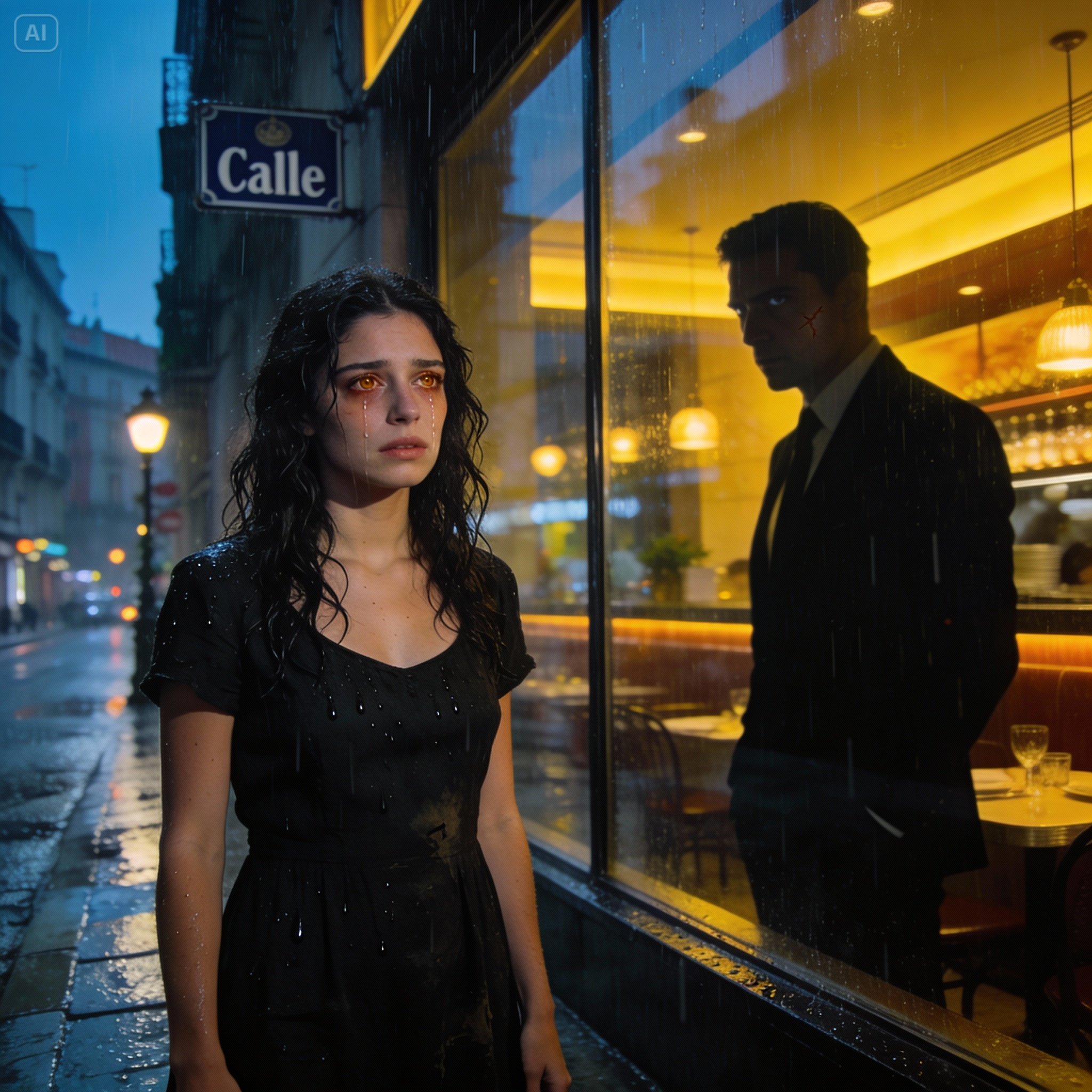
Rain in Madrid doesn’t always cleanse; sometimes, it simply sweeps the dirt from one place to another, turning the city’s dust into a grayish mud that seeps into your soul. That night, the downpour fell with biblical fury on the Paseo de la Castellana, as if the sky itself were trying to drown me. And I, Camila Santos, felt more willing than ever to let it.
My black dress, a simple garment I’d salvaged from a stall at the Rastro flea market three years ago for five euros, clung to my emaciated body like a cold, damp second skin. It was the only “decent” thing I owned, my armor for important meetings, my “normal girl” disguise. Now, soaked and heavy, it felt like a shroud. I could feel the cheap mascara sliding down my cheeks, black rivers tracing the map of my misery across skin that had forgotten what the sun or a gentle caress felt like.
I hugged myself, trying to control the trembling that was starting in my bones, and looked up. Across the avenue, gleaming like an unattainable jewel, stood Moretti . It wasn’t just a restaurant; it was a temple of glass and steel, the place where Madrid’s elite went to see and be seen, where a bottle of wine cost more than three months’ rent. Through the enormous windows, I saw them.
There they were. My former colleagues from Morrison & Associates . I saw Laura, with whom I’d shared the machine coffee that very morning; Javier, who had wished me “break a leg” before my presentation with a smile that now seemed like a hyena’s. They raised their fine crystal glasses, filled with golden liquid, laughing open-mouthed, carefree, alive. They were celebrating the end of the term. Or perhaps, in my paranoid and shattered mind, they were celebrating my dismissal. Celebrating my destruction. Celebrating that the “bookworm,” the girl who never went out for drinks because she had to rush off to take care of her mother, had finally been crushed.
An elderly woman, shielded by an umbrella and a fur coat, passed by me and brushed against my arm. “Are you alright, dear?” she asked, with that tone of genuine concern so typical of grandmothers here.
I tried to answer. I opened my mouth to say, “Yes, ma’am, I’m just waiting for the bus,” but the words caught in the lump in my throat. I could only shake my head, unable to make a sound. She looked at me for another second, sighed, and continued on her way, leaving me alone on my island of misery.
My phone vibrated in the pocket of my soaked bag. The buzzing was like an electric shock. Again. Relentless. Cruel.
I pulled it out with clumsy fingers, numb from the cold. The illuminated screen showed me the reality I was trying to ignore. A message from Elena, the nurse who cared for my mother at the public nursing home where, miraculously, we had managed to get a place after her stroke.
“Camila, honey, how was your appointment with the specialist? Remember that we need authorization for the new medications or we won’t be able to give them to you starting Monday.”
The message was a brutal reminder that I still hadn’t told anyone, not even Elena, my only friend, that I needed seventy-five thousand euros. Seventy-five thousand euros in two weeks for an operation at a private clinic, or my mother would die waiting on a social security waiting list that wasn’t moving.
The phone buzzed again. “Notice of non-payment: Los Olivos Residence. Third notice. If the outstanding monthly payment is not received by Friday, we will begin the process of transferring you to a social care facility.”
Another buzz. “Mr. Pérez (Landlord): Camila, I know times are tough, but your rent is due in 48 hours. You already owe me for last month. If you don’t pay, I’ll have to ask you to leave. I have people waiting for the apartment.”
My knees buckled. I leaned against the bus shelter, struggling to breathe. My fingers trembled as I logged into my bank’s app, knowing full well the horror that awaited me, like someone staring at an open wound.
Available balance: €213.45.
Two hundred and thirteen euros. That was all my life was worth. It wasn’t even enough to eat decently for a week in this city that had become incredibly expensive, much less to save anyone. Much less to save myself.
The light from a nearby streetlamp reflected off my wet wrist, illuminating the pale, thin scar that crossed my skin. A reminder of that night, six months after the accident, when I almost gave up. When surviving felt like divine punishment instead of a blessing. Sometimes, on nights like this, I thought I should have held on tighter.
My phone vibrated once more. This time, the name on the screen made my blood run cold, colder than a November rain.
Dario.
The message was short: “I know where you are. You can’t hide from me forever, Cami. I’m coming for you.”
I put my phone away as if it were burning hot. The bus that would take me back to my dilapidated studio in the Tetuán neighborhood, in an area that hadn’t yet been gentrified, wouldn’t arrive for another twenty minutes. Twenty minutes of standing here, exposed, soaked, shivering, staring at the restaurant where I couldn’t even afford a glass of tap water. Watching my life dissolve like a sugar cube in boiling coffee.
And then, I saw it.
Through the golden glow of Moretti ‘s window , he was there. Luciano Moretti.
At that time, I didn’t know his name. I didn’t know he owned the restaurant, the entire building, half a block in the financial district. I didn’t know he was known in the whispers of dark alleyways as “The Devil of Madrid,” the head of one of the most powerful criminal families with connections stretching from Italy to Russia.
All I knew was that he was the man who had walked into my conference room three hours earlier. The man who had whispered something in my CEO Mr. Morrison’s ear and watched with a perfectly expressionless face as security guards escorted me out of the building like I was a terrorist.
I’d watched it happen in slow motion, and I still couldn’t believe it was real. One moment, I was standing proudly presenting my year-end analysis, the numbers I’d checked three times, the report I’d sacrificed sleep, meals, and my own sanity for. The next, this stranger in an immaculate black suit, with eyes the color of a winter storm and a thin scar running from his temple to his cheekbone, had leaned over Morrison.
The CEO’s face had drained of all color. Security appeared beside me before I could finish my sentence. “Effective immediately,” they said, with that chilling corporate detachment, “you are dismissed for embezzling funds from client accounts. Fifty thousand euros. Do not return to your desk. We will mail your belongings. Do not contact anyone else at this company.”
No explanation of how the money had supposedly disappeared. No chance to defend myself. No severance pay, no references, nothing. Just the word embezzlement hanging in the air like a death sentence, destroying three years of eighteen-hour days, vending machine sandwiches, and perfect performance reviews in a single breath.
And when I tried to ask why, when I looked directly at the stranger with confusion, despair, and three years of accumulated exhaustion in my amber eyes, he simply looked right through me. As if I were invisible. As if I were nothing. As if I were already dead.
But the worst part, and there were so many “worst parts” that I had lost count, was what had happened in the morning.
Before the meeting, he had held the elevator door for me.
He had looked at me with those stormy gray eyes, he had really looked at me , and something in his gaze had made my heart stutter in my chest. He had noticed the dark circles under my eyes and, in a deep, grave voice, had asked me if I was all right. He had pressed the button on my floor before I could reach him. I, stupid and naive, had thought, “God, how pathetic I am .” I had thought that maybe, finally, someone saw me.
Not like the girl who survived the accident that killed her father and brother. Not like the woman with a sick mother, a stalker ex-boyfriend, and three jobs that weren’t enough. Just me. Camila. Someone worth noticing.
Instead, he had noticed me enough to annihilate me.
Now he sat in that restaurant, untouchable, unattainable, a god in his crystal temple, drinking red wine, and I was out here in the rain, the “nothing” he had made of me. He raised his glass to someone I couldn’t see. And then the light from the chandeliers caught his eyes, and for a moment, just a fraction of a second, he turned.
He looked straight through the window. At the street. At me.
Our eyes met through the curtain of rain, the bulletproof glass, and the impossible distance between our worlds. He didn’t smile. He didn’t look away. He simply watched me.
In the same way a predator observes wounded prey. In the same way a collector observes a rare piece they have already decided to acquire, regardless of the price.
My blood turned to ice. I should run. I should look away. I should do anything but stand there, suffocating, while a stranger with stormy eyes and a devilish reputation stared at me as if he knew every secret I’d ever kept. But I couldn’t move. I was rooted to the spot, mesmerized by the intensity of his attention.
And when the EMT bus finally arrived, screeching to a halt and splashing dirty water onto my legs, when I finally managed to tear my gaze away from his and climb aboard, my legs trembling, I could still feel his eyes on my back. I could still feel him watching.
What I, Camila Santos, didn’t know, what I couldn’t possibly know under any circumstances, was that Luciano Moretti hadn’t seen me by chance that morning. He had been watching me for two years.
And tonight, finally, he had grown tired of waiting.
The bus pulled away from the stop, carrying me into the damp Madrid night, away from the skyscrapers and luxury and into the working-class neighborhoods. Yet I couldn’t stop trembling. It wasn’t from the cold air conditioning on the bus, nor from my wet clothes, but from that gaze. Those gray eyes that still burned against my skin as if he were sitting right next to me on the hard plastic seat.
I chose the last seat, squeezed into the corner by the window, and watched the rain lash against the glass, trying to convince myself it had all been a coincidence. Trying to tell myself that a man like that couldn’t possibly know who I was, couldn’t possibly have any reason to care about an invisible, ruined girl like me.
But my body knew the truth long before my mind accepted it. Because every time I closed my eyes, I saw those gray eyes again. Not the cold eyes from the boardroom where he destroyed my career, but the eyes from that morning. The eyes in the elevator.
I remembered the moment with painful clarity. Only twelve hours had passed, but it felt like a lifetime. I had stepped into the elevator at Morrison & Associates in my worn heels, the report in my bag. And there he was. Tall, imposing, commanding the space with an almost natural authority.
She had put her hand out to stop the doors. She had looked at me. And I had felt as if I had been struck by lightning. As if I had forgotten how to breathe. As if I had truly been seen for the first time in three years, since the accident that took Dad and Miguel.
“You look tired,” she had said. Her voice was low, vibrant, like distant thunder. “Are you okay?”
And I, like a fool, had stammered some stupid answer about work. He had smiled, just a little, the corner of his mouth lifting, and my treacherous heart had pounded wildly, like that of a teenager who still believes in fairy tales.
Now I understood. That smile wasn’t concern. It was enjoyment. It was the smile of a cat before it pounces on a mouse. He knew, from that very morning, that I was going to be fired. Perhaps he had orchestrated it himself. And yet, he had held the door for me. Yet, he had asked if I was alright. Yet, he had looked at me in a way that made me believe I was special.
“Monster ,” I thought, clutching the bag to my chest. ” It’s a monster.”
But why would a monster care about prey as small as me?
The bus stopped at another stop. A couple of people got on, waving their umbrellas. I felt that strange sensation of being watched again. I spun around sharply, scanning the interior of the vehicle, but saw nothing but the tired faces of workers heading home late. The feeling didn’t go away, though. It clung to me like a parasite, whispering that I was being followed, that someone out there knew where I was, where I was going, my every step.
I shook my head, telling myself I was imagining things. I was too tired, too scared, too stressed. Too many things had fallen apart in a single day.
I didn’t know, I couldn’t have known, that three cars behind, a black Mercedes sedan with tinted windows, was silently following the bus. That inside, Luciano Moretti was looking at his mobile phone screen, where a red dot showed my real-time GPS location. That he had done this every night for two years. Following me from the office to my apartment, from my apartment to the bar where I worked weekends as a bartender to make ends meet, from the bar to the nursing home where my mother lay motionless.
He knew how many days a week I ate supermarket instant noodles for dinner. He knew I cried in the bathroom at work, turning off the tap so no one could hear me. He knew about the scar on my wrist.
Luciano Moretti had watched Camila Santos for two years, not as an ordinary stalker, but as a man waiting for the perfect moment to enter her life and never leave. And tonight, as he watched me standing in the rain with amber eyes filled with despair and a pride that refused to bend, he knew that moment had arrived.
The Devil of Madrid had found the only thing he wanted to possess, and he would not allow anything, or anyone, not even myself, to stop him.
The bus arrived at the terminal, in an area of Tetuán where old buildings mingled with converted industrial warehouses. I stepped off into the Madrid night with numb legs and a heart as heavy as a granite slab. The rain had eased somewhat, becoming an annoying drizzle, but the air remained damp and cold, chilling me to the bone.
I walked the three blocks to my building. It was an old, exposed-brick structure that had seen better days. The walls were covered in graffiti, the entrance lights flickered, and the musty smell of damp and cheap tobacco permeated the lobby.
I climbed the four flights of stairs because the elevator had been out of order for three months and the building management didn’t have the money to fix it. Each step felt like I was carrying the weight of the world on my shoulders. And when I opened the door to my small studio apartment, I didn’t turn on the light right away. I just stood there in the dark, listening to my own heartbeat and wondering why it kept beating when everything else had collapsed.
The apartment was tiny. I could stand in the middle of it and touch both the bed and the kitchen at the same time. The furniture was all secondhand, collected from the street on municipal collection days or bought on Wallapop for pennies. Nevertheless, I tried to keep it clean and tidy. It was my way of proving to myself that I still had some control over my life.
I took off my soaking black dress and threw it in a corner. I went into the bathroom, which was barely more than a closet with a shower. I turned on the tap and remembered, with a pang of misery, that my hot water had been cut off last week for non-payment.
I stepped under the icy stream anyway. I let the cold water run over my body, washing away the mascara, the tears, and the city rain. I let it numb me enough so I couldn’t feel the crushing pain in my chest. When I got out, my lips were blue and my hands were shaking uncontrollably. I put on an old pair of pajamas, worn at the shoulders, and went to the small kitchen.
I opened the cupboard. It was almost empty. A package of generic oriental noodles, an egg, and a bottle of water.
I cooked in silence. I didn’t turn on the television or play music. Only the sound of the boiling water and my own breathing filled the room. I sat in the plastic chair by the window, ate dinner in the dark, staring out at the deserted street, and thought about my mother.
I picked up the phone and called Elena. She answered on the third ring. Her voice sounded tired, but warm.
—Cami? Are you okay? How did the presentation go?
I lied. I said everything was fine. I said I’d have the money soon. I said not to worry. Meanwhile, inside, I was falling apart.
“Your mother has been more awake today,” Elena said, trying to cheer me up. “She moved her fingers when I read her your letter. Keep fighting, Cami. Keep waiting for you.”
I hung up and cried. Silent tears fell into the bowl of now-cold noodles. And in the darkness of that miserable apartment, memories surfaced like an oil spill.
Three years earlier. A rainy night just like this one. I was driving Dad’s car. We were coming back from celebrating Mom’s birthday. Dad was in the passenger seat, telling bad jokes that made us laugh out loud. Miguel, my little brother, was in the back, teasing me for not having a boyfriend.
I was laughing. I was happy. I didn’t see the truck run the red light until it was too late.
I remembered the brutal impact, the sound of twisting metal, the feeling of the car flipping over. I remembered my father screaming my name. And then, something that never quite fit into my memory. I remembered… gunshots.
Gunshots. In a car accident. It made no sense. But I remembered the sharp sound, bang, bang . I remembered turning around and seeing Miguel slumped in the back seat, blood on his chest, not from the impact, but from a red hole. I remembered trying to reach my father and only grasping empty air before the darkness swallowed me.
I woke up in the Tres de Mayo hospital three days later. Broken ribs, concussion. They told me my father and Miguel were dead. A tragic accident, they said. Hit-and-run driver, they said.
But I knew the truth, or the truth that my guilt had constructed. I was driving. I didn’t see the truck. I killed them.
Mom suffered a stroke when she received the news. She lost her speech and mobility. She was bedridden. And I lived every day knowing that I had destroyed my family in a single moment of carelessness.
I looked down at the scar on my wrist. Six months after the accident, I held a kitchen knife and thought that ending it all would be easier than continuing to breathe this guilt-laden air. But I couldn’t do it. Not because I wanted to live, but because Mom needed me. Who would pay the bills if I died? Even death was a luxury I couldn’t afford.
I put the bowl away. I was no longer hungry, just felt an immense emptiness.
My phone vibrated once more. I knew who it was before I even looked at the screen. My body had learned fear long before my mind could react. Two years of living with Darío had taught me that.
“I’m downstairs. I see you’ve turned off your lights. Do you think you can hide from me?”
I dropped the phone as if it were burning me. I ran to the window, crouching down to peer through the slit in the threadbare curtain at the dark street below.
He was there.
Standing beneath the only working streetlamp, her dirty blond hair dripping from the rain, her eyes raised to my window with that madness I knew all too well. That smile. The smile I once thought was love, but which was really possession. Control. Violence in disguise.
Dario. The man I loved when I was too young and too alone after the accident. The man who promised to take care of me and turned my life into a living hell of beatings and jealousy for two years. The man I ran from eight months ago after he nearly strangled me in a drunken rage.
I stepped away from the window, covering my mouth with my hand to stifle a scream, trembling uncontrollably. I knew I should call the police. I knew it was the right thing to do. But I also knew it would be useless.
I dialed 091 anyway, my voice a trembling whisper. “My ex-boyfriend is outside my building. He has a restraining order that expired a month ago, but he’s threatening me. He’s hit me before. I’m scared.”
The operator asked me the usual questions. Are you trying to break in? Are you carrying a visible weapon? Are you assaulting her right now?
“No,” I whispered. “He’s just standing there. Watching.”
—Miss, if you’re in a public place and you’re not trying to enter your home or displaying a weapon, we can’t send an emergency patrol. Go to the police station tomorrow to file a report.
I hung up. I wanted to scream. I wanted to break something. “What a morning.” As if tomorrow were guaranteed.
I curled up in the darkness, hugging my knees, peering through the crack. Darío didn’t move. He lit a cigarette, checked his phone, glanced at my window. He smiled. I knew he could stay there all night. He’d done it before. It was his game: wearing me down. Waiting for me to make a mistake.
I don’t know how much time passed. Maybe an hour. Then, I noticed something different on the street.
A black car. A high-end Mercedes, parked about fifty meters from Darío. A car that seemed completely out of place in this neighborhood of workers and industrial buildings. Too luxurious. Too clean.
I couldn’t see who was inside because of the tinted windows. But I had the strange feeling that whoever was there was looking at me. Not at Darío. At me.
And that feeling was more terrifying than seeing my ex-boyfriend.
Then, as if someone had given him an invisible command, Darío’s phone rang. He answered it, his face changing from arrogance to confusion, and then to fear. He hung up, looked around nervously, threw away his cigarette, and hurried off, disappearing into the darkness of the perpendicular street.
I let out the breath I’d been holding. But I didn’t move. I watched the black car. I waited for it to drive away.
But it didn’t. It stayed there, parked, silent and menacing like a guard beast.
Inside the Mercedes, Luciano Moretti lowered his phone after sending a message to his men: “Take care of him. Make sure he never comes near this street again. But don’t kill him yet. I want him to suffer first.”
Luciano looked up at the fourth-floor window where his girlfriend was hiding in the darkness. He knew she wouldn’t sleep tonight. He knew she was afraid. And that knowledge made him want to burn the whole city down for letting her feel that fear.
“Soon, beautiful,” he whispered in the solitude of the armored car. “Soon the fear will end.”
I don’t know when I fell asleep. Perhaps my body succumbed to exhaustion, though my mind was still screaming for help. I woke up in total darkness to the shrill sound of my phone ringing next to my ear.
The clock read 2:37 AM. On the screen: Mr. Pérez .
I answered in a thick, panicked voice. “Hello?”
Mr. Pérez’s voice sounded anxious, confused, with a tone that said, “Something’s very wrong.” “Camila, I’m at your apartment. The door’s wide open. Everything’s empty. No furniture, no clothes. Are you okay? Where have you gone? Did you run away without paying?”
I sat bolt upright in bed, my heart pounding against my ribs. I looked around. Streetlight streamed through the window. Everything was there. My old bed, the small table, the dirty bowl of noodles in the sink, my dress in the corner.
“What are you talking about?” I said, my voice trembling. “I’m on the floor. I’m in my bed.”
There was silence on the other end. Then Mr. Pérez spoke slowly, as if explaining something to a madwoman. “Camila… I’m in apartment 4B of my building. 1247 Industria Street. The apartment I rented to you. It’s empty. There’s no one here.”
I felt like a bucket of ice water had been dumped on my back. Because I was looking at the number on my own door, illuminated by the light from the hallway that filtered in from underneath. 4B . And the address I had memorized for six months… 1247 Industry Street .
But then I remembered something. Something vague. When I signed the contract, did it say Street or Avenue?
“Which building is it in?” I asked, my voice barely a whisper. “Street or Avenue?”
“Street,” he said. “Industry Street. Tetuán. That’s my building.”
The world bent beneath my feet. Because I knew, with absolute and sudden certainty, that I was on Industry Avenue . Two different buildings, two blocks apart.
I had lived here for six months. I had paid Mr. Perez’s rent (or so I thought) for six months. I believed this was my home.
But if this wasn’t his building… who had he signed the contract with? Who had he been paying? Whose apartment had he been living in?
“I’m going to call the police,” said Mr. Perez. “Something very strange is going on here.”
I hung up and stood there, unable to move, trying to process it all. Six months ago, I found the ad online. A steal. I came to see it. A man in a suit showed me the apartment, we signed the contract right there, he gave me the keys. I moved in. I lived.
But what if it was all a lie…
The police arrived twenty minutes later at my front door, on the Avenue. Two national police officers, looking tired. They asked me questions I couldn’t answer. They searched the apartment. They made phone calls.
They came back with information that made me feel dizzy.
“Miss Santos,” one of the officers said, looking at a tablet. “This apartment belongs to a real estate company called Inversiones Moretti . They own the entire building. There’s no rental agreement in your name. Legally, you’re occupying private property without a contract. But the company… has said there’s no problem. That you’re authorized.”
Moretti.
I repeated the name as if it were a cursed word.
Moretti. The name of the upscale restaurant where I’d stood in the rain. The name I’d seen on the building’s plaque this morning. The name of the gray-eyed man who’d destroyed my career with a whisper.
The police left, leaving me alone in an apartment that wasn’t mine. In a life that was falling apart piece by piece.
I sat in the dark, staring at the four walls. And for the first time I asked myself: Who had allowed me to live here? Who had paid for me to have a roof over my head? Who had watched me long enough to know I needed a place and given it to me without my knowledge?
The answer came knocking at my door at three in the morning.
It wasn’t the hesitant knock of a neighbor, nor the frantic pounding of Darío. It was a slow, rhythmic knock, full of authority. The knock of someone who knew the door would open, whether the person inside wanted it to or not.
My legs were shaking as I got up. I grabbed the small kitchen knife I’d kept nearby since Darío showed up. I went to the door without opening it.
“Who is it?” I asked. My voice broke.
—Open the door, Camila.
The voice came from the other side. Deep. Resonant. Like black velvet on steel.
It was the voice of the elevator.
I knew I should scream. I knew I should lock the door. But there was something in that voice—not a threat, but a promise—that made my hand turn the latch before my brain could stop it.
The door opened.
Luciano Moretti was there.
As tall as I remembered, filling the doorway. He was still wearing the crisp black suit from the restaurant, though his tie was undone and his shirt collar open, revealing the tanned skin of his throat. The fine scar on his cheekbone gleamed in the dim light of the hallway. His eyes, those stormy gray eyes, locked onto mine with an intensity that made me want to back away and forward at the same time.
Behind him, two enormous men in dark suits, obvious bodyguards, stood like statues. But they didn’t enter.
Luciano crossed the threshold uninvited, without asking permission, as if the apartment belonged to him. And I felt a chill when I remembered that, in fact, it did.
I backed up until my back hit the wall of the narrow hallway. I raised the knife between us, but my hand was shaking so much the weapon looked ridiculous.
He looked at the knife with something close to amusement. A crooked, dangerous smile curved his lips. “Are you going to stab me, Camila?” he asked. And the way he said my name, savoring each syllable with an accent that blended perfect Spanish with a hint of Italian, sent shivers down my spine.
“What are you doing here?” I asked, trying to sound tough. “Why did you fire me? Why am I living in your apartment? What do you want from me?”
Luciano closed the door behind him. Gently. Enclosing us in darkness. He took a step toward me. I had nowhere to go.
He stopped a step away. Close enough for me to catch a whiff of his cologne—sandalwood, leather, rain—and something else, something purely masculine and dangerous.
“I know everything about you,” she said. Her voice dropped an octave, becoming intimate, secretive. “I know you work three jobs and still can’t afford your mother’s clinic. I know you eat noodles five days a week to save every penny. I know Dario beat you for two years and you still have nightmares. I know you have that scar on your wrist because one night you thought the world would be better off without you.”
I felt as if I had been stripped naked. Not of clothes, but of skin. My defenses had been torn away. “How…?” I whispered. “How do you know these things?”
Luciano tilted his head, studying me as if I were an enigma he had solved long ago but that still fascinated him. “Because I’ve been watching you for two years, Camila Santos. Because you belong to me. And it’s time you knew it.”
I stared at him in horror. Two years. “You’re crazy,” I said, my voice rising. “You’re a stalker. I’m going to scream.”
Luciano didn’t flinch. He reached into his jacket and pulled out a thick brown folder. He dropped it onto the small table by the window. The sound echoed in the silence.
“Open it,” he said. It wasn’t a request. It was a challenge.
I didn’t want to do it. But my hand betrayed me. I put the knife down on the table and opened the folder.
What I saw made me forget how to breathe.
Photographs. Hundreds of them. Me walking towards the subway. Me serving drinks at the bar. Me sitting next to my mother’s bed, holding her lifeless hand. Me crying on a bench in Retiro Park at three in the morning.
Detailed reports. My schedules. My routes. My medical bills. The fake rental agreement I had signed. And, deeper still…
The accident report from three years ago. Photos of the wrecked car. My father’s name, Roberto Santos , circled in red. Handwritten notes in the margins in a sharp, aggressive script I didn’t recognize.
“Two years,” I whispered, looking up at him in horror. “You’ve been doing this for two years.”
Luciano moved closer. This time, I didn’t back away. My legs wouldn’t respond. “Two years, three months, and seventeen days,” he corrected. “Since the first night I saw you crying alone in the park after your shift at the bar. You were so thin the wind could have carried you away. But the next morning, you got up. You went to work. You smiled at the customers. You fought.”
“You’re sick,” I spat, tears starting to fall. “You spied on me. You followed me. Do you think I’m going to thank you?”
Something changed in her gray eyes. Respect. “I think,” she said slowly, “that you’ve lived alone for too long. That you’ve fought alone for too long. And that no one, not a single person, has ever protected you.”
“I don’t need anyone to protect me,” I interrupted. “I can take care of myself.”
Luciano looked at the bowl of cold noodles, the damp clothes, the knife on the table. Then he looked at me. “You take very good care of yourself,” he said, with a soft but hurtful sarcasm. “So good that you almost got kicked out. So good that your ex-boyfriend is stalking you. So good that your mother is going to be evicted from the nursing home.”
I wanted to slap him. I wanted to scream that he was the one who had taken my job today. But before I could, he made the final move. He completely invaded my personal space. His body heat enveloped me.
“I’m no good man, Camila,” he said, his voice hoarse. “I’m many things you should fear. I’m the Devil of this city. But I’m the only person in this damned world who’s going to keep you safe. And you’re done fighting alone.”
“Why?” I asked, my voice breaking. “Why me? Why do you care about someone as invisible as me?”
Luciano remained silent for a long moment. He turned toward the window, his back to me. His broad shoulders tensed beneath the expensive fabric of his suit. “Because it wasn’t an accident,” he said.
The world stopped.
-That?
She turned. Her eyes burned with an ancient fury. “The car accident. Three years ago. It wasn’t an accident. And you’re not invisible, Camila. You’re Roberto Santos’s daughter.”
My father’s name sounded familiar on her lips. Heavy. “Did you know my father?” I asked, feeling the ground disappear beneath me.
“Your father worked for my family for fifteen years,” Luciano said. “He was the chief accountant at Moretti Holdings . He knew every number, every transaction, every secret my family wanted to hide.”
“No…” I denied. “My father was an administrator at a small construction company.”
“Your father was the most honest man I’ve ever known,” Luciano interrupted. “He worked for us, but he never got his hands dirty. And once, when I was young and stupid, he saved my life.”
“So why did he die?” I asked, now crying openly. “Why did Miguel die? Why have I lived with this guilt for three years, thinking it was me?”
Luciano approached. He grabbed my shoulders. His hands were large, warm, and firm. “Because he discovered something. He found proof that someone in my family was stealing. Betraying the Moretti name. Laundering money for our enemies, the Volkov family from Russia. He was going to tell me. But the traitor found out first.”
I felt like I’d been stabbed. —That night… the truck…
“It was deliberate,” Luciano said venomously. “The truck hit you. And when the car stopped, someone got out and finished the job. They shot your father. They shot Miguel when he tried to protect him. The police were bribed to call it an accident. You survived because they left you for dead.”
I collapsed. My knees hit the cheap wooden floor. And I screamed. It wasn’t a pretty cry. It was an animal howl. Three years of guilt. Three years thinking I was my family’s killer. And it was all a lie.
Luciano knelt before me. He didn’t care about his three-thousand-euro suit. He grabbed my chin and forced me to look at him. “The man who ordered your father’s death is still alive,” he said. “He’s my own flesh and blood. He’s my brother. Dante Moretti.”
I froze. Her own brother. “I’ve spent two years gathering evidence,” he continued. “Two years watching you to make sure he didn’t finish the job again. But I need your help to take him down, Camila.”
I wiped my tears with the back of my hand. The sadness was giving way to something hotter. Darker. Anger. Pure, unadulterated anger. “What do you want from me?”
—I want you to come with me. I want you to be my bait. I want you to pretend to be mine so Dante believes you’re my weakness and comes out of his hole. And when he does… I’ll destroy him.
I looked into his eyes. I saw the monster. I saw the Devil. But I also saw the truth. “I’ll go with you,” I said. My voice sounded strange, harsh. “Not because I trust you. But because I want to see him fall.”
Luciano nodded. He stood up and held out his hand. “Let’s go home, Camila.”
I took her hand. And in that moment, I knew my old life was over.
Part 2: The Golden Cage in the Sky of Madrid
We left my building in Tetuán like a funeral procession, but one where the corpse was still breathing and walking on its own two feet. The rain had subsided, becoming that annoying, bone-chilling drizzle so typical of Madrid winters, but the cold inside me had nothing to do with the weather. It had to do with Luciano Moretti’s hand on the small of my back, guiding me toward the black Mercedes with a possessiveness that was alarming and, against all instincts of survival, strangely comforting.
The car’s interior smelled of new leather, that expensive, sterile aroma that only things worth more than an average person’s life possess. I sank into the back seat, feeling the heater envelop my numb body, and stared out the tinted window. The streets of my neighborhood, with their overflowing garbage containers, their metal shutters covered in graffiti, and the yellowish lights of the old streetlights, flashed by like slides of a life that already felt alien.
“Where are we going?” I asked. My voice sounded small in the airtight silence of the cabin.
Luciano was sitting next to me, but he kept a respectful distance. He wasn’t looking at me; his gray eyes were fixed on the road, scanning the surroundings through the windshield as if he were expecting an ambush at every red light on Bravo Murillo.
“To a safe place,” he replied, without turning around. “To my house.”
“Your house?” The word felt strange in my mouth.
—The Crystal Tower—he clarified—. The attic.
I swallowed hard. The Crystal Tower, one of the four skyscrapers that dominated Madrid’s northern skyline. It wasn’t just a building; it was a symbol of absolute power, of untouchable wealth. The idea that someone could live up there, above the clouds and the pollution, looking down on us mortals like ants, made me dizzy.
The journey was silent. The driver, a man with a bull-like neck and unblinking eyes, navigated the nighttime traffic of the Castellana with predatory fluidity. I saw the Santiago Bernabéu stadium pass by, gleaming like a spaceship that had landed in the middle of the city, and the ministerial buildings of Nuevos Ministerios, dark and silent. We were ascending, literally and metaphorically, into Luciano’s world.
When the car pulled into the private ramp of the underground garage, three armed men appeared out of nowhere to open the doors. They weren’t ordinary security guards; they wore headsets and moved with military precision. Luciano stepped out first and held out his hand. I hesitated for a second, staring at his open, broad, and strong palm, marked with lines that were surely stained with blood. But the alternative was to stay in the car or return to the street where Darío and misery awaited me. I took his hand.
A private elevator, lined with mirrors and dark wood, shot us skyward. The pressure in my ears told me how fast we were going. Floor 10, 20, 40… 50. When the doors opened, there was no landing. The elevator opened directly into the living room.
I was breathless.
The penthouse occupied the entire floor. The walls were nonexistent; everything was floor-to-ceiling glass. All of Madrid stretched out at my feet like a blanket of electric jewels. The orange lights of the highways, the white dots of the buildings, the darkness of the Casa de Campo in the distance. It was a view people would kill for, and I had a dark suspicion that Luciano had probably done exactly that to get it.
The interior was an ode to aggressive minimalism. Black marble floors veined with white, Italian leather sofas that looked uncomfortable because they were so expensive, abstract sculptures of twisted metal that cast long shadows. There were no family photos. No clutter. No warmth. It was a magazine-worthy house, perfect and cold as an operating room.
“Welcome to your new life,” Luciano said, letting go of my hand to take off his suit jacket. He tossed it carelessly onto an armchair. “Your room is at the end of the hall, the last door on the right. It has its own bathroom and a dressing room. You’ll find clothes in your size.”
I turned to face him, feeling the bubble of unreality about to burst. “Clothes in my size?” I repeated, feeling a flush of indignation creep up my neck. “How…? Oh, right. You’ve been spying on me for two years. I suppose you know my bra size too.”
Luciano paused as he unbuttoned his cufflinks. He looked at me, and that dangerous half-smile reappeared. “I know everything, Camila. But don’t worry, the clothes are new. Nothing secondhand.”
“I’m not your doll,” I snapped, crossing my arms over my old, worn-out pajamas. “You can’t just bring me here, put me in an ivory tower, and expect me to play house with you while you plot to kill your brother.”
He walked toward me, slowly. The sound of his hard-soled shoes against the marble echoed like a countdown clock. He stopped inches from me, invading my personal space, forcing me to tilt my head back to meet his gaze.
“Listen carefully, because I’m only going to say this once,” his voice lowered, becoming harsh. “You’re not here to play games. You’re here because outside these walls there’s a man who ordered the execution of your family and who won’t hesitate to put a bullet in your head if he thinks you’re a loose end. You’re here because you’re the only way to reach him.”
“And what am I to you?” I asked defiantly, though inside I was trembling. “A bait? A tool?”
Luciano raised a hand and, with a gentleness that belied the violence of his words, brushed a strand of damp hair away from my forehead. His fingers grazed my skin, and I felt an electric shock run down my spine. “You’re the weapon that will destroy Dante,” he whispered. “But while you’re under this roof, there are rules.”
“Rules?” I scoffed, trying to hide how his closeness affected me.
“First rule: You don’t leave this penthouse without me or Marco, my head of security. Ever. Not to buy bread, not to get some fresh air.” “Second rule: You don’t contact anyone. Your old phone stays here. I’ll give you a new encrypted one. If Elena or the residence calls, the calls will be forwarded to us first.” “Third rule…” He paused, his gray eyes scanning my face, settling on my lips. “In public, you’re mine. You’re my girlfriend, my lover, my obsession. You have to convince Dante that you’re my weakness. You have to let me touch you, kiss you, look at you as if you’re the only thing that matters to me in the world.”
I felt like I couldn’t breathe. “And in private?” I asked, almost in a whisper.
The intensity in his eyes wavered for a second, replaced by something darker, hungrier. “In private… you’re untouchable. Unless you ask otherwise.”
She pulled away abruptly, as if it were physically difficult for her to put distance between us. “Go to sleep, Camila. Your training starts tomorrow. And believe me, you’re going to need to rest.”
I stood alone in the immense hall, surrounded by glass and silence, feeling smaller than ever. But for the first time in three years, I didn’t feel the crushing weight of loneliness. I felt fear, yes. But I also felt something more dangerous: anticipation.
I couldn’t sleep. The bed was a gigantic cloud with Egyptian cotton sheets that cost more than my annual salary, but my body was too used to the sharp springs of my old mattress and the noise of Tetouan’s traffic. Up here, the silence was absolute, almost deafening.
The digital clock on the bedside table read 4:15. I got up, wrapped myself in a black silk bathrobe I found hanging in the bathroom (again, in my perfect size), and went out into the hallway barefoot. The floor was cold under my feet.
I wandered through the house like a ghost. I passed the kitchen, which looked like it had been plucked from an industrial design catalog, with black granite countertops and appliances that seemed untouched. I opened the refrigerator: it was full. Fresh fruit, expensive cheeses, bottles of mineral water from brands I’d never heard of, wine. I grabbed a bottle of water and drank it greedily.
I continued exploring. There was a private gym. A movie theater. And at the back, a half-open door from which a warm, yellow light emanated, contrasting with the bluish coolness of the rest of the house.
I approached. I knew I shouldn’t. I knew I was invading the Devil’s privacy. But curiosity was stronger than fear.
I pushed the door gently.
It was an office. But not just any office. The walls were lined with dark wood bookshelves, filled with antique books with leather spines. The air smelled of pipe tobacco, aged whiskey, and old paper. And there he was.
Luciano sat behind a massive desk, his shirt open and sleeves rolled up to his elbows, revealing strong forearms marked by veins and… scars. He held a glass of amber liqueur in one hand, the other resting on an open folder.
But what stopped me in my tracks wasn’t him. It was what was on the wall behind him.
A huge corkboard covered in photos. And in the center of that network of red threads and notes… there I was.
These weren’t the photos he’d shown me before. They were different. Photos of me as a child, taken from some school yearbook. A photo from my university graduation, where I was smiling next to my father and Miguel, before the world ended. Photos from the police report of the accident. Photos of Dante. Photos of men I didn’t know.
I went into the room. “Aren’t you sleeping?” I asked.
Luciano wasn’t startled. He looked up from his glass, his eyes bloodshot and tired, stripped of the cold mask he wore during the day. “Sleep is for the innocent, Camila. And I lost my innocence a long time ago.”
I approached the desk, ignoring the instinct that screamed at me to run. I looked at the photos on the wall. “It looks like a psychopath’s sanctuary,” I said, pointing to my own smiling face from five years ago.
Luciano let out a dry, humorless laugh. “Maybe it is. Or maybe it’s the map of my penance.”
“Penance?” I leaned on the edge of the desk, crossing my arms. “Why? Why do you feel guilty? It was your brother who killed them.”
Luciano downed his drink in one gulp, winced at the burn of the alcohol, and stood up. He walked to the window, his back to me. “Your father, Roberto… he came to see me two days before the accident. He tried to talk to me. He called me three times. He left messages saying it was urgent, that it had to do with the accounts from ‘Operation Matryoshka,’ which is what we called the money laundering with the Russians.”
He turned to look at me, and the anguish on his face was so raw I had to look away. “I was in Rome. I was busy closing a deal, drinking champagne, living the life of the untouchable heir. I ignored his calls. I thought, ‘I’ll talk to Roberto when I get back on Monday.’” His voice broke. “There never was a Monday. If I had answered the phone… if I had listened to him… he would be alive. You wouldn’t be alone.”
The silence that followed was heavy, laden with ghosts. I understood then that his obsession with me wasn’t just lust or control. It was guilt. He had been watching over me because he felt responsible for my destruction.
“It wasn’t your fault,” I said, surprising myself. I took a step toward him. “It was Dante. The blame lies with the one who pulls the trigger, not the one who doesn’t answer the phone.”
Luciano looked at me, and for a moment, I saw the man beneath the monster. A broken man trying to piece himself back together with violence and control. “I promise you one thing, Camila,” he said, coming closer until we were just inches apart. “When this is over, when Dante pays… I’ll give you back everything I took from you. I’ll give you back your life. I’ll pay for your mother’s treatment. I’ll buy you a house where no one can find you. And I’ll disappear forever.”
I felt a strange pang in my chest at the thought of him disappearing. “What if I don’t want you to disappear?” I asked, my voice barely a whisper.
He raised his hand, hesitating, and finally stroked my cheek with the back of his fingers, grazing the skin rough from recent crying. “You should want it. I am darkness, Camila. And you… you’re the only light I’ve seen in years. If you stay near me too long, I’ll extinguish you.”
“Maybe I don’t want to shine,” I whispered, unconsciously leaning toward his touch. “Maybe I’m just tired of being afraid of the dark.”
Luciano tensed. His pupils dilated, swallowing the gray of his irises. He leaned toward me, and for a second, I thought he was going to kiss me. His breath smelled of whiskey and desperation. My lips parted slightly, waiting, wanting…
But he pulled away sharply, breaking the spell. “Go to bed,” he ordered, his voice harsh again, raising the wall between us. “Tomorrow hell begins. You need to be ready.”
I left without saying a word, but as I walked back down the cold corridor, I knew something had irrevocably changed. I was no longer just a victim, and he was no longer just my savior. We were two shipwrecked souls clinging to the same piece of wood in the middle of a storm.
Part 3: Dressed to Kill
The “training” wasn’t what I expected. There were no etiquette lessons or classes on how to use fish cutlery, although I assumed that would come later. Survival came first.
Marco, Luciano’s head of security, was a former legionnaire, a mountain of muscle with a shaved head and infinite patience for other people’s pain. He took me to the gym at seven in the morning.
“The Boss says you have to know how to defend yourself,” Marco said in his thick southern accent, tossing me a pair of boxing gloves. “Dante’s a pig. He likes to hurt people. If he corners you, you can’t wait for Luciano to arrive. You have to buy time.”
For three days, my body became a map of bruises. I learned to strike with my elbows, to use my knees, to go for the eyes and the throat. I learned that when you’re small and weak like me, you don’t fight fair. You fight dirty. You bite, you scratch, you kick in the groin.
Luciano watched some sessions from the doorway, his arms crossed and his face impassive, though I could see his jaw clench every time Marco knocked me down on the mat. He never intervened. He let me get up on my own. And I was grateful for that. I needed to know I could get up.
But the real transformation happened on the fourth day.
A team of stylists invaded the penthouse. Women with briefcases full of makeup, hairdressers with dryers that looked like futuristic weapons, and an Italian tailor who murmured measurements while pricking me with pins.
They waxed, exfoliated, dyed, and cut my hair into soft, shiny waves. They did my makeup to highlight my amber eyes and conceal the shadows of three years of sleepless nights. And then, the dress.
Luciano entered the room when I was ready. He was wearing a black tuxedo that made him look like a dark prince. He stopped dead in his tracks when he saw me.
I was wearing a blood-red dress. It was silk, with a plunging back and a slit up the leg that climbed dangerously high. It clung to my body like molten metal. I looked at myself in the full-length mirror and didn’t recognize the woman staring back at me. I wasn’t the girl from the instant noodles. I wasn’t the fired accountant. I was a femme fatale . I was dangerous.
Luciano approached from behind. Our eyes met in the mirror. “Red,” he said softly. “The color of war.”
“I thought it was the color of passion,” I replied, feeling a knot in my stomach.
“In my world, they’re the same.” She leaned in and placed a diamond choker around my neck. The cold metal made me shiver. “Tonight we’re having dinner at Moretti’s . Dante will be there. It’s his turf, even though the restaurant bears my name. He’ll feel safe.”
—What do I have to do?
“Be mine,” he said, fastening the zipper with a final click. “Laugh at my jokes. Touch my arm. Look at me like I’m the sun. Make Dante think I’m so blinded by love for you that I’ve let my guard down.”
—And what will he do?
“He’ll try to seduce you. Or scare you. Or both. Dante envies everything I have. If he thinks I love you, he’ll want you to hurt me. It’s that predictable and that twisted.”
I turned to face him directly. I placed my hands on the lapels of his jacket, smoothing the imaginary fabric. “Then let’s give him a show he won’t forget.”
Dinner was a high-tension drama. The Moretti restaurant was packed; the murmur of conversations and the clinking of cutlery created an atmosphere of normalcy that contrasted sharply with the terror that chilled me to the bone. The maître d’ led us to the main table, the best one, under the central chandelier.
And there he was.
Dante Moretti. He resembled Luciano, but he was a distorted version. Where Luciano was darkness and control, Dante was false brilliance and chaos. He had green eyes, an overly wide smile, and a nervous energy that made him seem like a caged animal.
He stood up when he saw us arrive, opening his arms wide. “Brother!” he exclaimed, embracing Luciano with feigned strength. “And you’ve brought company. Well, well. The rumors were true. The monk has come down from the mountain.”
Luciano didn’t smile. He put his arm around my waist, pulling me close. I felt the warmth of his body through the fine silk of my dress. “Dante. This is Camila.”
Dante fixed his green eyes on me. They scanned me from head to toe, lingering on my neckline, the slit in my skirt, and finally on my eyes. There was no respect in his gaze. Only hunger and calculation. “Delighted, beautiful ,” he said, taking my hand and kissing my knuckles. His lips were moist, unpleasant. “My brother has exquisite taste. Though I’m surprised such a delicate flower survived in his hands. Luciano usually breaks everything he touches.”
I felt Luciano tense up beside me, a predator ready to strike. I squeezed his arm gently, reminding him of the plan. I smiled at Dante, a rehearsed smile, flirtatious but innocent. “Luciano takes very good care of me,” I said softly. “Perhaps you don’t know him as well as you think.”
Dante raised an eyebrow, surprised by my answer. He burst out laughing. “It has claws! I like it. Please, have a seat. The acorn-fed Iberian ham has just arrived.”
Dinner was a slow torture. We ate exquisite dishes that tasted like ash: porcini croquettes that I choked on, wild turbot that I barely touched. Luciano and Dante talked about “business,” using a code of words about imports, unions, and territories that I barely understood, but the subtext was clear: a civil war was about to erupt in the family.
I played my part. I stroked Luciano’s hand on the tablecloth. I whispered in his ear. I laughed at his dry remarks. And each time I did, I saw Dante’s eyes darken with envy. It was working. I was taking the bait.
Towards the end of dinner, Luciano excused himself to go to the bathroom, leaving me alone with the wolf. It was part of the plan, but that didn’t stop panic from closing my throat.
As soon as Luciano disappeared, Dante’s mask fell away. He leaned across the table, invading my space. The scent of expensive wine and malice emanated from him. “Do you know who I am, Camila?” he whispered.
—Luciano’s brother—I replied, keeping my voice firm.
“I am the future,” he corrected. “Luciano is the past. He’s old, he’s tired, he’s gone soft. Look at the way he’s looking at you. Like a lapdog. That makes him weak.”
“I believe that love makes him strong,” I said, reciting the lines I had practiced in my head.
Dante let out a mocking laugh. “Love is for idiots and the poor. In our world, love is a target painted on your forehead.” He reached out and touched my diamond necklace, his fingers brushing against the skin of my neck. I forced myself not to flinch. “Nice necklace. But it would have looked better on you if I’d bought it for you. Luciano doesn’t know how to play with fire. I do. And when he falls… and he’ll fall soon… come find me. I’ll show you what real fun is.”
I pulled away abruptly. “I’d rather get burned by him than freeze with you.”
Dante’s face hardened. For a second, I saw the killer. The man who had ordered my father killed without batting an eye. “Careful, child,” he hissed. “Fires sometimes consume the innocent.”
Luciano returned at that moment. He saw the tension, saw Dante’s hand near mine, and his aura turned black. “We’re leaving,” he said, without sitting down. He held out his hand. “Dante, dinner has been… eye-opening.”
Dante smiled again, leaning back in his chair like a king on his throne. “It’s always a pleasure, brother. Give the young lady a goodnight kiss for me.”
We left the restaurant and got into the armored car. As soon as the doors closed and the car started, the adrenaline left me abruptly and I began to tremble violently.
“Did he touch you?” Luciano asked, grabbing my hands. His voice was urgent, furious. “If he touched you, I’ll turn around and kill him right now. I don’t care about the plan.”
“I’m fine,” I said, though my teeth were chattering. “He just… threatened me. Said you’re going down. Said you’re the past.”
Luciano sighed and pulled me close. He hugged me tightly, burying his face in my hair. “She believed it,” he murmured against my neck. “She believed I cared about you. She believed you were my weakness.”
“And I’m not?” I asked, resting my head on his chest, listening to the rapid beating of his heart.
There was a long silence in the dark car, while Madrid sped past outside. “Yes,” she finally admitted, with an honesty that hurt me. “You are. And that’s what scares me the most.”
Part 4: The Farm Trap
The following days passed in a haze of tension and preparation. Marco intensified my training. “Hit harder, damn it!” he’d yell at me as I pounded the bag. “Imagine it’s Dante’s face. Imagine it’s the man who killed Miguel!”
And I hit. I hit until my knuckles bled inside my gloves. I hit with three years of pent-up rage.
One afternoon, while practicing a hold to escape a rear-end grab, I made a sudden movement. The substitute instructor, a new guy who didn’t know his own strength, threw me to the ground. I landed badly. My wrist buckled with a nauseating crack, and my lip split against the mat.
“Ow!” I cried, grabbing my hand.
The gym door burst open as if it had exploded. Luciano stormed in. He didn’t ask what had happened. He went straight to the instructor, grabbed him by the front of his shirt, and slammed him against the wall with superhuman strength.
“I told you to be careful!” Luciano roared, his eyes bloodshot. “Get out of here before I kill you!”
The man ran off, pale as death. Luciano knelt beside me. His anger vanished the moment he looked at me, replaced by a terrible anguish.
“Let me see,” he said gently, taking my injured hand.
“I’m fine, it’s just a sprain,” I tried to say, but I winced in pain.
He examined my wrist with a surgeon’s fingers. It was swollen and red, right over the old scar from the suicide attempt. Luciano looked at that white line, then at the bruised skin, and then at my split lip that was bleeding a little.
He took a handkerchief from his pocket and gently wiped the blood from my mouth. His eyes were dark, filled with a storm. “I hate this,” he whispered. “I hate seeing you hurt. I hate using you for this. I should send you away. To an island where no one knows your name.”
“I wouldn’t leave,” I told him, holding his gaze. “Not anymore. We’re in this together, Luciano. Until the end.”
He glanced down at my wrist. And then he did something that stopped my heart. He leaned down and kissed the old scar. It was a soft, reverent kiss, as if he were asking forgiveness for all the sins in the world. Then he moved up, kissing the swollen skin, and finally his eyes met mine.
We were on the gym floor, sweaty, me bleeding, his shirt wrinkled. And I had never felt so much electricity in my life.
He leaned towards me. I closed my eyes, anticipating the touch. His lips brushed against mine, tasting the blood, tasting the fear and the desire…
-Boss!
Marco’s voice shattered the moment like glass. Luciano abruptly pulled away, standing in one fluid motion, helping me to my feet as he readjusted his cold demeanor.
Marco was at the door, phone in hand, looking unfriendly. “We have a problem. Dante has moved up the deadlines. The meeting with Volkov isn’t next week. It’s tomorrow.”
“Tomorrow?” Luciano frowned. “It’s too soon. We’re not ready.”
“He’s throwing a party at the Moraleja estate,” Marco continued. “A ‘charity gala’ as a cover. Volkov will be there. They’re going to finalize the arms deal and the money laundering tomorrow night. If they sign, Dante will have the Russians’ support to take control of the family. They’ll kill you the next day.”
Luciano ran a hand through his hair, frustrated. He looked at Marco and then at me. “We have to act tomorrow. There’s no more time.”
“What does that mean?” I asked, feeling my stomach churn.
“That means we’re walking into the lion’s den,” Luciano said. “Tomorrow night, we’ll break into his house. You’ll be the distraction. I’ll search for the physical files in his safe while you keep Dante occupied. Marco and the team will be outside waiting for the signal.”
“What if it goes wrong?” I asked.
Luciano grabbed my shoulders. “It won’t go wrong. Because if it does, I’ll burn down all of Madrid before I let them touch a hair on your head.”
La Moraleja Estate was a fortress disguised as a mansion. High stone walls, security cameras on every corner, and luxury cars parked in the gravel driveway. The gala was in full swing when we arrived. Classical music drifted through the air, and waiters with trays of champagne circulated among the city’s corrupt elite and international criminals in formal attire.
I was wearing a silver dress this time, with a microphone hidden in the pearl earring in my right ear. Luciano was wearing a tuxedo, with a Beretta pistol concealed in his shoulder holster and an invisible earpiece in his ear.
“Remember,” he whispered before entering, kissing my temple. “Don’t leave the main area. Marco has his eyes on you from the hacked cameras. I’ll be ten minutes. Just ten minutes. Keep Dante occupied. Get him talking. Record everything.”
“Ten minutes,” I repeated, trying to keep my legs from trembling.
We entered. Heads turned. The arrival of the Devil and his new queen.
Dante appeared almost instantly, with that shark-like grin. “Luciano! Camila! I’m so glad you could come with such short notice.”
“I wouldn’t miss your… party,” Luciano said curtly. “I’m going to say hello to the city planning councilman. I think he owes me a favor. I’ll leave Camila with you for a moment. Look after her.”
It was the signal. Luciano walked away, blending into the crowd, heading toward the private area of the house where Dante’s office was. I was left alone with the monster.
“You look beautiful, Camila,” said Dante, offering me a drink. “Are you bored by my brother’s politics? He’s always been so serious…”
—A little —I admitted, taking the glass but not drinking—. You seem to know how to have more fun.
Dante smiled, moving closer than he should have. “Oh, yes. I know how to live. Come, I’ll show you the gardens. It’s a beautiful night.”
I hesitated. The garden was outside the main area. But I needed him to talk. I needed him to confess something into the microphone so we’d have legal evidence, not just stolen files. “Okay,” I said. “But just for a moment.”
We went out onto the terrace. The air was fresh and smelled of jasmine and pine. We moved away from the music. “You know,” said Dante, stopping by a fountain. “I feel sorry for you.”
“Sorry?” I asked, confused.
—Yes. Because you’ve fallen in love with a dead man.
My heart stopped. —What are you talking about?
Dante turned to me. His smile was gone. In its place was utter coldness. “Did you think I was stupid?” he said, pulling a device from his pocket. “I know Luciano is in my office right now. I know you’re wearing a microphone in your earring. My frequency scanner picked it up the moment you walked in.”
I put my hand to my ear, horrified. I took a step back, ready to run. “Luciano!” I yelled, but Dante was faster.
He grabbed my arm with brutal force, twisting it behind my back. The pain in my injured wrist blinded me for a second. “Scream all you want,” he whispered in my ear. “The music’s too loud. And my men are already waiting for your dear Luciano in the office. He’s going to die tonight, Camila. And you’re going to watch me do it.”
“No!” I tried to knee him, like Marco taught me, but the dress was too tight and Dante was stronger and heavier.
From the shadows of the garden emerged another man. Tall, with gray hair and icy eyes. Viktor Volkov. The Russian. “Bring her here,” Volkov said with a thick accent. “We’ll use her to make sure Luciano doesn’t resist before we kill him.”
Dante took a handkerchief from his pocket. It smelled of sweet chemicals. Chloroform. “Good night, beautiful, ” he said.
I tried to hold my breath. I tried to fight. But he pressed the handkerchief against my nose and mouth. The world began to spin. The lights of the mansion became blurry trails. My legs gave way.
The last thing I heard before darkness swallowed me was Luciano’s voice in my ear, through the earphone that Dante hadn’t seen.
—Camila! Get out of there! It’s a trap! Camila!
And then, silence.
Part 5: Hell in the Industrial Park
Waking up wasn’t like in the movies. There was no gentle blink or momentary confusion. It was a brutal jolt of reality, accompanied by a throbbing headache behind my eyes like a jackhammer breaking up the asphalt of Gran Vía. The metallic taste of blood and the sweet, chemical aftertaste of chloroform filled my mouth, making me want to vomit.
I tried to raise my hand to my head, but my arms wouldn’t respond. A sharp tug on my shoulders made me groan. I was tied up. Sitting in an old, splintered wooden chair, my hands secured behind my back with what felt like industrial plastic zip ties, the kind that cut off circulation if you try to move too much.
I opened my eyes. The world was blurry, tinged a sickly yellow by the light of a single bulb hanging from a soaring corrugated metal ceiling. The air was cold and smelled of engine grease, stale dampness, and brick dust. I wasn’t in the mansion in La Moraleja. The silence of the luxurious gardens had been replaced by the distant drone of trucks on a highway.
An industrial park. Probably in the south of Madrid, Villaverde or Vallecas, where abandoned warehouses become concrete tombs for the secrets the city doesn’t want to see.
—Sleeping Beauty has awakened.
Dante’s voice echoed in the empty space, bouncing off the metal walls. I turned my head, ignoring the throbbing pain in my neck. He was there, leaning against a rusty shipping crate, still in his immaculate tuxedo, though now it looked like a grotesque disguise amidst all the filth. Viktor Volkov stood beside him, filing his fingernails with a switchblade, his glacial indifference more frightening than any shouted threat.
“Where are we?” I asked. My voice came out hoarse, barely a croak.
“At the end of the road, Camila,” Dante said, walking toward me. His patent leather shoes crunched on the broken glass on the floor. “This place used to be my family’s distribution warehouse. Now it’s… well, let’s just say it’s the slaughterhouse.”
Around them, I counted at least fifteen men. Some were playing cards on top of an oil drum, others were smoking near the large sliding metal door, keeping watch. All armed. All with that empty look of mercenaries who kill for money, not for loyalty.
—Luciano will come —I said, injecting into my voice a certainty I didn’t feel.
Dante let out a dry laugh. “I hope so. In fact, I’m counting on it. I texted him ten minutes ago. ‘I have something that belongs to you. Come alone or she dies.’ Classic, right? But Luciano is predictable. His arrogance will make him think he can save you. And when he walks through that door…” He made an explosion gesture with his hands. “Boom. The Devil’s reign is over. And I’ll be the new King of Madrid.”
He crouched down in front of me, gripping my jaw tightly, digging his fingers into my cheeks. “Do you know why I hate you, Camila?” he whispered, his breath smelling of mint and decay. “It’s not who you are. It’s what you represent. Luciano never had any weaknesses. Not one. He was a perfect machine. Dad always loved him more. ‘Luciano is strong, Dante is reckless,’ he’d say. And now, finally, the great Luciano Moretti has made a mistake. He’s fallen in love with the daughter of the accountant I had killed. It’s poetic.”
He let go of me with a shove that made the chair wobble. “I’m going to enjoy killing him in front of you. And then Victor will have his fun with you before you join your daddy and brother.”
Dante walked away toward the men playing cards, laughing at some dirty joke. He left me alone in the middle of the ship, shivering with cold and terror.
But then I remembered Marco’s words in the gym, amidst the smell of sweat and liniment. “When you’re tied up, you have two options: wait to die or do the unthinkable. If they tie you up with zip ties, find the weak point. If you can’t break them… make yourself smaller.”
I closed my eyes and took a deep breath, trying to calm the heart that was pounding in my chest like a trapped animal. Luciano would come. I knew it. But if he walked into a trap with fifteen armed men waiting for him, he would die. And I couldn’t allow that. Not after everything we’d been through. Not after he’d given me back my life.
I had to warn him. I had to tell him it was an ambush.
I moved my hands behind my back. The ties were tight, digging into the skin of my wrists. Impossible to slide them off. My hands were thin, but not that thin.
I glanced to my right. One of the guards, a guy with a bulldog face and a scar over his eyebrow, was sitting down in a folding chair about ten feet away from me. He was nodding off, with a submachine gun resting on his knees and… a cell phone sticking precariously out of his back pocket.
She was far away. She was tied up. It was impossible.
But then I looked at my right hand. My thumb. Marco had explained it to me, though at the time I thought it was just theoretical nonsense. “The thumb is the stop. If you remove the stop, your hand slides. But it hurts, Camila. It hurts like hell.”
I glanced at Dante and Volkov, engrossed in a discussion about delivery routes. I looked at the guards playing around. No one was paying any attention to me. To them, I was just a frightened girl, a package waiting to be delivered or destroyed. That was their mistake.
I clenched my teeth. I clenched them so hard I thought they would break. I placed my right thumb against the palm of my hand, trapping it with my other fingers. I needed to dislocate the joint so my hand would be narrow enough to pass through the plastic loop.
I pushed. The pain was immediate, sharp, white. A lightning bolt shot up my arm and exploded in my brain. For Dad. I pushed harder. I felt the resistance of the ligaments. For Miguel. Cold sweat broke out on my forehead. Tears welled in my eyes, but I refused to let them fall. If I screamed, I was dead. If I cried, I was dead. For Luciano.
With a dull, wet crack that echoed in my ears like a gunshot, the joint gave way. My thumb popped out of place, lying limp and bent at an unnatural angle against my palm.
The world went black for a second. Nausea hit me hard. I had to bite my lower lip until it bled to keep from howling in agony. I breathed through my nose, trembling, counting backward from ten.
But he had done it.
With my right hand deformed and throbbing with a pain that made me see stars, I pulled. The cable tie scraped my skin, tearing off strips of epidermis, but without the thumb bone stopping it, my hand slid free.
It was free. Well, one hand was free.
I kept my arms behind my back, pretending I was still tied up. The pain was so intense it made me dizzy, but the adrenaline was a powerful drug. I waited. The guard in the chair snored softly. His head fell forward. Now.
I slid out of the chair. I didn’t get up; I let myself fall to the floor gently, as if I had fainted, rolling toward the side where the guard was asleep. No one looked. The sound of the other men’s laughter drowned out the scrape of my dress against the dirty cement.
I crawled, inch by inch, ignoring the fire in my right hand. I reached the guard’s chair. I could smell his stale tobacco. I reached out with my good hand, my left, toward his back pocket. My fingers brushed against the phone. He stirred. He grunted in his sleep. I froze, my heart in my throat. If he woke up, he’d shoot me right there. The guard scratched his nose, shifted, and went back to sleep.
I took out my phone. I swiped my finger across the screen. Locked. Damn. I looked at the guard. His index finger was resting on his thigh. It was insane. It was suicidal. I held the phone up to his hand. With a gentleness I didn’t know I possessed, I took his finger and placed it on the fingerprint sensor. The phone unlocked with a soft click.
I crawled back to the shadow of a large box, turning my back to them so the light from the screen wouldn’t give me away. My fingers were shaking so badly I could barely type. The pain in my right hand was so intense I could hardly think, but I remembered Marco’s number. Luciano had made me memorize it the first night. “For life-or-death emergencies only . “
I opened WhatsApp. I typed awkwardly with my left thumb.
LOCATION: INDUSTRIAL WAREHOUSE WITH “LOGISTICS SOUTH” SIGN. THEY’RE WAITING. IT’S A TRAP. 15 ARMED MEN + DANTE + VOLKOV. DON’T COME ALONE. BRING THE ARMY.
I sent my real-time location. Message sent. Double blue tick. Read.
I deleted the message. I deleted the recent call to the location. I crawled back to the guard, slid my phone into his pocket, my heart pounding, and returned to my chair.
It was incredibly difficult to sit back down and put my hands behind my back, pretending the restraint was still holding me. My dislocated thumb throbbed with its own rhythm, a constant agony.
Five minutes later, the large metal door creaked.
“There he is,” said Dante, smiling like a child at Christmas. “The guest of honor.”
Meanwhile, on the other side of Madrid, Luciano Moretti was driving like a possessed demon. His armored Mercedes devoured the asphalt of the M-30 at two hundred kilometers per hour, dodging cars with suicidal precision.
His hands gripped the steering wheel so tightly the leather creaked. His eyes were two pools of utter darkness. When Dante had sent him the location, his first instinct had been to go alone and kill them all with his bare hands. Fury was a red fog that clouded his judgment. They had touched Camila. They had dared to lay their filthy hands on her.
But then, Marco’s phone rang in the passenger seat.
“Boss,” Marco had said, his voice tense. “You have to see this.”
Luciano had looked at the screen. The message from an unknown number. The location. The warning.
“It’s her,” Luciano had whispered, feeling a mixture of terror and pride that almost buckled his knees. “She’s alive. And she’s freed herself.”
“He says fifteen men. Long guns,” Marco analyzed, typing furiously on his tablet. “If you’d gone in alone, they would have riddled you with bullets at the door. He saved our asses.”
“Mobilize everyone,” Luciano ordered, his voice turning cold, tactical, lethal. “I want Alpha Team, Bravo Team, and the snipers. I want you to surround that ship silently. No one fires until I’m inside.”
—Boss, it’s risky. We should go in first.
“No,” Luciano interrupted. “Dante wants to see me. If he sees the tactical teams, he’ll kill her before we can even get close. I’ll go in through the front door. You guys will be the shadows. And Marco…”
—Yes, Chief?
—When the dance begins… I don’t want any prisoners.
The car skidded on the exit toward the industrial park. Luciano braked sharply two hundred meters from the warehouse, hidden behind some piles of rubble. He got out, adjusting his tuxedo jacket, checking that the Beretta was loaded and had a round in the chamber. He put on his earpiece.
“Positions?” he whispered into the air.
—Snipers on the roof of the adjacent building. Thermal imaging confirmed. I see fifteen thermal targets. And one sitting in the center… it’s her. She’s alive —Marco’s voice confirmed through the earpiece—. We’re ready at your signal.
Luciano took a deep breath. The cold night air filled his lungs. He thought of Camila. Of her shy smile. Of her scar. Of how she had looked at him that night, dressed in red.
“I’m coming for you, love,” he whispered.
And he walked towards the door of the ship, alone, visibly unarmed, with death walking beside him.
Part 6: Blood on Concrete
The sliding door opened with a metallic groan that chilled me to the bone. Luciano’s silhouette appeared against the orange glow of the streetlights outside. He entered slowly, his hands raised to shoulder height, palms open. He wasn’t wearing a coat, just his tuxedo, and he seemed as out of place in that slaughterhouse as an angel in hell.
“You’re late, brother,” Dante shouted, his voice ringing with triumph. “I was beginning to think you didn’t care so much after all.”
Luciano didn’t look at Dante. His eyes scanned the room in a second, ignoring the armed men, ignoring Volkov. His eyes searched for me. And when they found me, when he saw my torn dress, my swollen lip, and the strange way I was holding my position, I saw something break inside him. A fracture in his icy mask.
“If you’ve touched her…” His voice was low, but it reached every corner of the ship. It wasn’t a shout; it was a promise of annihilation. “If you’ve hurt her, Dante, you’ll beg for a quick death.”
Dante laughed, jumping down from the box where he’d been sitting. He walked toward Luciano, stopping a few feet away from security. “Oh, how scary. The great Luciano threatening. Don’t you see where you are? You’re alone. Surrounded. Unarmed.” Dante gestured, and two guards approached to search Luciano. They took the pistol from his shoulder holster and threw it away. They took his cell phone.
Luciano let them do it, keeping his gaze fixed on his brother. “I’m not alone,” Luciano said calmly. “I’m never alone.”
“Oh, really?” Dante looked around mockingly. “Where are your friends? Hiding under your skirt? Admit it. You’ve lost. Dad was wrong. You weren’t the strong one. You were just the favorite. But today… today I write history.”
Dante pulled out a silver pistol, shiny and ostentatious, like everything about him. He pointed it at Luciano’s head. “Kneel down.”
Luciano didn’t move. “I said kneel!” Dante shouted, losing his composure. His hand was trembling slightly.
“Shoot,” Luciano said. His voice was steel. “Shoot if you have the guts. But you know that if you pull that trigger, you won’t get out of this ship alive.”
“I’m in charge here!” Dante yelled.
“No,” Luciano said. “You’ve never been in charge. You’re a kid playing with matches in a gas tank.”
Luciano stepped forward. “Kill him!” Dante ordered his men.
But before anyone could react, Luciano raised his left hand and snapped his fingers.
The ship’s dirty glass roof shattered inward. It was as if the sky had fallen. A rain of glass and black ropes descended. Men dressed in tactical gear, wearing masks and carrying assault rifles, rappelled down at breakneck speed. At the same time, the side windows exploded under sniper fire.
Bang. Bang. Bang. Three of Dante’s men fell before they hit the ground. Chaos reigned.
“Get down!” I yelled to myself, throwing myself off the chair. Since I was no longer tied up (though they didn’t know it), I was able to roll and take cover behind the nearest metal box.
The sound of gunfire was deafening. I saw muzzle flashes, heard screams, smelled gunpowder. Marco’s men were professionals; Dante’s mercenaries were street thugs. There was no comparison. It was a tactical massacre.
I saw Luciano move. He didn’t run for cover. In the middle of the shootout, he lunged forward, toward Dante. Dante, gripped by panic, fired wildly. A bullet grazed Luciano’s shoulder, tearing through his suit and sending blood spurting, but he didn’t even flinch. He reached his brother and struck him on the wrist, knocking the pistol out of his hand. Then he punched him in the throat, sending Dante to his knees, choking.
Volkov tried to aim at Luciano from behind. “Watch out!” I shouted from my hiding place.
Luciano turned around, but Marco was already there. He had come in through the side door. He fired twice. Volkov fell backward, two holes in his chest, his knife rattling uselessly on the floor.
The silence that followed the shooting was more shocking than the noise. It lasted three seconds. Then came the groans of the wounded and Marco’s terse orders securing the perimeter. “Clear! Sector one clear!”
Luciano didn’t wait for the report. He ran toward where I was hiding. “Camila!”
I emerged from behind the box, trembling, covered in dust and shards of glass. He fell to his knees before me. His hands, stained with his brother’s blood and his own, cupped my face. He frantically examined me, his gray eyes filled with a panic I had never seen before.
“Are you okay? Have they hit you?” He touched my arms, my torso, looking for bullet wounds.
“I’m fine, I’m fine,” I sobbed, the adrenaline leaving me and leaving me alone with the pain and the shock. “Just… my hand.”
He looked down and saw my right hand. He saw the deformed thumb, the skin torn from my wrist. He understood instantly what I had done. His face paled. “My God… you broke it yourself… to warn me…”
“I had to do it,” I whispered, tears now falling freely. “They were going to kill you. It was a trap.”
Luciano pulled me toward him with desperate force. He buried me in his chest, holding me so tightly I could barely breathe, but I didn’t care. I needed to feel that I was real, that I was solid, that I was alive. I felt his heart pounding against my ribs, fast, furious.
“You are… you are the bravest woman I have ever known,” he said against my hair, and I noticed his voice trembling. “Forgive me. Forgive me for bringing you to this.”
“It’s over,” I said, clutching his torn and blood-stained shirt. “Luciano, it’s over.”
“Not yet,” he said, stepping back slightly. His face hardened again, becoming the Devil’s mask.
He stood up and helped me to my feet, supporting me with his good arm around my waist. He turned toward the center of the ship. Dante was on his knees, coughing up blood, surrounded by three of Marco’s men who had guns pointed at his head. He looked at Luciano with hatred, but also with a deep, primal fear.
Luciano walked toward him, taking me with him, as if he needed me to witness the end. Or perhaps he needed my presence to keep from becoming a complete monster. He stopped in front of his brother.
“Why?” Luciano asked. Just one word.
Dante spat blood onto the ground. He smiled, showing red teeth. “Because you were always the sun, brother. And I was tired of living in your shadow. I wanted what you had. Power. Respect. Her.”
Dante looked at me lustfully, even defeated. “It’s a shame. I almost got him.”
Luciano pulled out a pistol Marco offered him. He pointed it at Dante’s forehead. My heart stopped. I knew Dante deserved to die. He had killed my father. He had killed Miguel. He had kidnapped me. But to see Luciano execute his own flesh and blood…
Luciano held the weapon steady for what felt like an eternity. Then he lowered it.
Dante blinked, confused. “What are you doing? Kill me! End this! Don’t you have the courage?”
Luciano crouched down until he was at eye level with him. His voice was an icy whisper, far worse than any shout. “Death is too easy, Dante. It’s an escape. And you don’t deserve to escape.”
Luciano stood up and looked at Marco. “Call Inspector García. Give her everything. The recordings from Camila’s microphone, the files from the safe, Volkov’s testimony if he survives. Give her Dante tied up with a rope.”
Dante’s eyes widened. “No! You can’t hand me over to the police! I’m a Moretti! We don’t talk to the law! They’ll kill me in prison. The family’s enemies will tear me apart the moment I set foot in Soto del Real.”
“Exactly,” Luciano said, turning away. “You’re going to spend the rest of your life locked in a cage, looking over your shoulder, waiting for the knife, knowing you lost everything because of your envy. You cease to be my brother. You cease to be a Moretti. Now you’re just a number in the system.”
“Luciano! Kill me! Kill me, you coward!” Dante shouted as Marco’s men dragged him out.
Luciano didn’t look back. He looked at me. “Let’s go home, Camila.”
He lifted me in his arms, ignoring my protest, ignoring his own shoulder wound. He carried me out of that hell of metal and blood, into the cold Madrid night, where police sirens were already beginning to wail in the distance.
In the back seat of the car, as Marco drove toward the family’s private hospital, Luciano didn’t let go of me for a second. He held my injured hand with infinite gentleness, kissing my fingers one by one.
“I love you,” he said suddenly, in the darkness of the car.
I looked at him, surprised. He had never said it in words before. “What?”
“I love you,” she repeated, looking into my eyes with a burning intensity. “I’ve loved you since the first time I saw you. I love you for your strength. I love you for your scar. I love you because you’re the only light in my shitty world. And I’m going to spend the rest of my life trying to deserve you.”
I smiled, despite the pain, despite the blood, despite everything. “You’re going to have to work hard, Moretti,” I whispered, resting my head on his good shoulder. “But you have your whole life to try.”
He kissed me. A soft kiss, salty with tears and metallic with blood, but full of an unbreakable promise. The Devil had found his redemption. And I had found my home.
Part 7: Dawn on the Castellana
Three months later.
Spring had arrived in Madrid with an explosion of light. The trees along the Paseo de la Castellana were green and leafy, and the air no longer smelled of rain and sadness, but of pollen and hope.
I was standing in front of a shop window in the Chamberí neighborhood. The glass was spotless, and the freshly painted gold lettering shone in the morning sun: SANTOS BAKERY – FOUNDED IN 2024 .
It wasn’t the small, dark place my father always dreamed of having but never could. It was a spacious, bright place with exposed brick walls and light wood counters. It smelled of freshly brewed coffee, cinnamon, and baked sourdough. The best smell in the world.
The door opened and Elena came out, wiping her flour-covered hands on her apron. “Boss!” she called, grinning. “Stop staring at the sign and come in. The organic flour order has arrived, and I don’t know where to put it. And there’s a line of five people waiting for your croissants.”
I laughed. “I’m coming, I’m coming. Don’t call me boss, Elena. We’re partners.”
I walked into the bakery. The warmth from the ovens enveloped me like a hug. I greeted the regulars—Mrs. Rosa from the third floor, the student who always came to study using the Wi-Fi, the young couple with their baby. Life was… normal. Wonderfully, boringly normal.
Three months felt like three lifetimes. Dante was in Soto del Real prison, in solitary confinement. The trial was scheduled for the fall, but with the evidence Luciano and I had submitted (recordings, financial documents, testimonies), his life sentence was practically a given. His assets had been frozen. His name, erased from the company’s history.
Viktor Volkov wasn’t so “lucky.” He survived the shooting, but was deported to Russia that same week. According to news reports, he disappeared as soon as he landed in Moscow. The Morettis’ enemies don’t forgive failures.
Luciano had kept his word. He had cleaned house. He had purged the organization of Dante’s loyalists, severed ties with arms trafficking, and redirected Moretti Holdings toward legitimate businesses: real estate, technology, and restoration. He was still powerful, still feared, but he was no longer a criminal. Or at least, he was trying to be.
But that wasn’t the most important thing.
That afternoon, I closed the bakery early. A black car was waiting for me at the door. It wasn’t an armored car with heavily armed guards, but a sleek sedan with a single driver: Marco, who now wore colorful shirts instead of tactical gear and smiled more often.
“To the hospital, Marco,” I said as I went upstairs.
We arrived at the private clinic La Luz. I went up to the fourth floor, room 412. I entered slowly. The room was full of flowers.
My mother, Rosa Santos, was sitting on the bed, wearing reading glasses, looking at a decorating magazine. She looked up when she saw me and smiled. A slightly crooked smile, still a consequence of the stroke, but real. Alive.
“Cami,” he said. His voice was raspy, but clear. It was no longer an unintelligible babble. The operation and the intensive rehabilitation that Luciano had paid for (insisting that it was “your father’s back pay plus interest”) had worked miracles.
—Hi, Mom—I went over and kissed her forehead—. How are you feeling today?
“Better. The doctor says I can go home next week.” He grabbed my hand. His grip was strong. “Did you bring anything?”
I smiled and pulled a paper bag from my purse. “Sourdough bread and an almond croissant. Smuggled in. Don’t tell the nurses.”
She laughed, and the sound was music to my ears. We had talked a lot these past months. I told her the truth about Dad and Miguel. We cried together. We screamed together. But knowing it wasn’t an accident, that it wasn’t my fault, and that those responsible had paid, had given us a peace we didn’t think was possible.
“That boy…” Mom said, biting into her croissant. “Is he coming today?”
—Luciano has an important meeting, Mom.
—Hmph. Meeting. Tell her that if she doesn’t come see her mother-in-law, I won’t save her dessert.
I blushed. Mom adored Luciano. He came to see her twice a week, brought her books, told her stories about Italy, and listened to her with endless patience. To her, he wasn’t the ex-mafioso who controlled Madrid; he was the “handsome, serious boy” who had saved her daughter.
I left the hospital with a light heart. Marco drove me back, but not to my old apartment in Tetuán, nor to the penthouse in the Torre de Cristal. The car stopped in front of a stately building in the Salamanca district, near the Retiro Park.
I went up to the second floor and unlocked the door with my own key. Luciano was in the living room. He had replaced the black marble and cold minimalism of the attic with warm wood floors, comfortable sofas piled high with cushions, and natural light. There were photos of us on the shelves. There was life.
He was standing by the balcony, looking out at the street. He turned when he heard me come in. He wasn’t wearing a suit anymore. He was wearing dark jeans and a gray cashmere sweater that softened his features. The scar on his face was still there, but his eyes were no longer stormy.
—Hello —he said.
—Hi —I put down my bag and walked towards him.
He wrapped his arms around me and kissed me. It was a slow, intimate kiss, full of a tenderness worth more than all the diamonds in Moretti’s jewelry store. My right hand, now healed but still bearing a fine surgical scar where my thumb had been operated on, caressed the back of his neck.
“How’s your mother?” he asked against my lips.
—She threatens to leave you without dessert if you don’t go see her.
Luciano laughed, a deep laugh that resonated in my chest. “I’ll have to go tomorrow without fail. I don’t want to upset Rosa. She’s more dangerous than the Russians.”
We stood embraced for a moment, watching from the balcony as the sun set over the rooftops of Madrid, painting the sky orange and violet. The rain of three months ago seemed like a memory from another life.
“Do you regret it?” he asked suddenly, with a tone of insecurity that he only showed to me.
-About what?
—Everything. Getting to know me. Leaving your career in finance to become a baker. Being with a man who has so much blood on his hands.
I stepped back slightly to look into his eyes. I stroked the scar on his cheekbone. “Luciano, look at me.” He looked at me. “Three months ago, I was alone in the rain, with 200 euros in the bank and wanting to die. I had nothing. I was nobody. You saw me when I was invisible. You gave me a reason to fight. You gave me justice. And you gave me love.”
I looked around the living room, at the warm light, at the photos, at the life we had built. “I don’t regret anything. Because this is the first time in my life I’m not running away. This is the first time I’m home.”
Luciano smiled. Not a predator’s smile, but an open, human, radiant smile. “Welcome home, beautiful .”
He kissed me again, and as the sun disappeared behind the Madrid horizon, I knew our story wasn’t a fairy tale. There were monsters, there were scars, and there was darkness. But we had learned that even in the darkest night, if you have someone to hold your hand, you can find your way back to the light.
The rain had stopped for good.
END