The untouchable teacher cut my hair in class to teach me a lesson in humility, unaware that my father, a ruthless State Magistrate, was about to give her and the entire school a masterclass on true justice.
The sound of scissors cutting paper is satisfying, almost therapeutic. But the sound of scissors slicing through a mat of human hair, your own hair, is a visceral, wet, and terrifying crack that resonates inside your skull like a gunshot. That sound, that final crack-hiss , is something I’ll never forget, even if I live a hundred years.
It was a Tuesday morning in Madrid, one of those mornings when the sky is so blue it hurts to look at it, but the air is cold and dry. The bell rang at IES Jefferson, a private school with aspirations of grandeur on the outskirts of the city, echoed through the exposed brick and terrazzo hallways. I, Nia Robles, settled into my usual desk in Doña Elvira’s Language and Literature class. Third row, exact center. I had calculated that position with the precision of an architect months before: close enough to look like a model student interested in the Generation of ’98, but far enough away to avoid the teacher’s stale coffee breath and predatory gaze.
The classroom buzzed with that nervous energy typical of eight-thirty in the morning. The students dragged their chairs, whispered about the weekend party in Malasaña, and listlessly pulled out their books. Doña Elvira stood beside her oak desk, her cardigan perfectly buttoned and her hair pulled back in a tight bun, so severe it seemed to stretch the skin of her face, projecting that image of Francoist authority she cultivated with such care.
—Today we will talk about symbolism in Lorca—he began, turning around to write on the blackboard.
Suddenly, her voice stopped abruptly. She turned slowly, like a turret searching for a target. Her eyes, small and dark like jet beads, fixed on my head. On my hair. A crown of natural curls, perfectly defined and moisturized, on which I had spent a sacred hour that morning in front of the mirror. It was my pride, my identity, my heritage.
—Miss Robles.
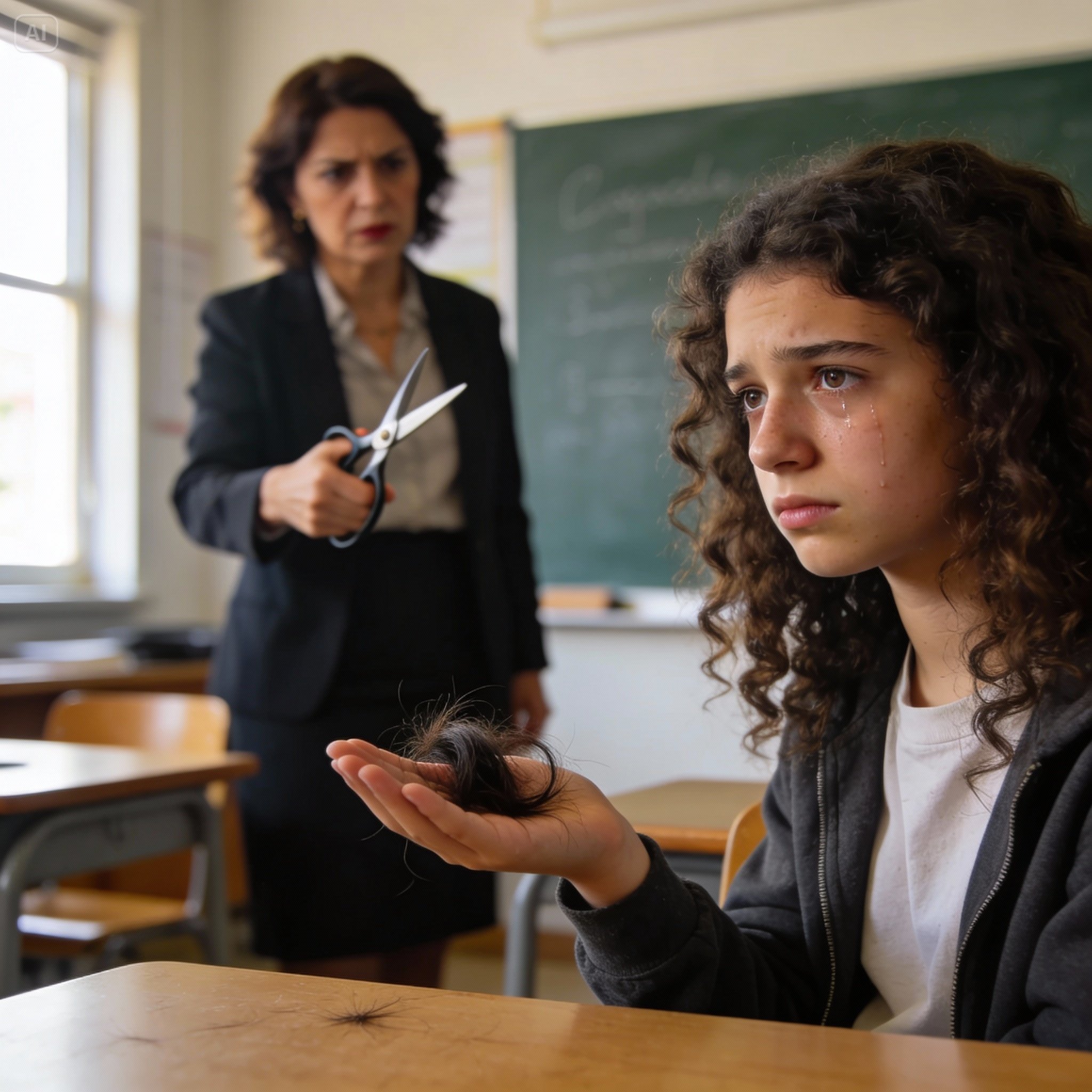
The classroom fell into a deathly silence. Even the buzzing of the fluorescent lights seemed to stop.
“Her hair violates the center’s decorum regulations,” she said, in a falsely calm voice that made your skin crawl.
My hands instinctively went up to my head and then fell onto the desk, gripping the wood. I’d worn this hairstyle since September without a single complaint.
—Doña Elvira, my hair complies with all the rules of the internal regulations. It’s clean, tied back, and…
“It’s unhealthy, excessive, and disturbing for the other students,” she interrupted, enunciating each syllable with such sharp disdain that I saw Marcos, the boy sitting in front of me, shrug. “Go to the Head of Studies immediately.”
Time stretched out. Out of the corner of my eye, I saw the illuminated screens of cell phones begin to appear beneath the desks. They were recording. My heart began to pound against my ribs, a war drum pounding in my chest, but I kept my voice steady. My mother always told me, “Nia, your voice is your power. Don’t tremble.”
—Doña Elvira, there’s nothing wrong with my hair. I’d like to stay for class; I have a right to an education.
Doña Elvira’s face went from pale to a violent red in a matter of seconds. She walked with a determined, almost military stride toward her desk. She yanked open the top drawer. The creaking of the old wood sounded like a warning.
—This type of challenge will not be tolerated in my classroom. Not today, not ever.
The metallic glint of a large, silver pair of sewing scissors caught the morning light as she walked down the aisle between the desks. Several classmates let out stifled gasps.
“Teacher, don’t go too far!” whispered David, two seats away.
“Silence!” she snapped without looking at him.
He leaned over my desk. He smelled of cheap lacquer and a stale, old-fashioned anger.
“If you’re not going to follow the rules of your own free will, I’ll help you comply,” he whispered, with an intimacy that made me nauseous.
Before my brain could send the signal to my legs to run, the scissors flashed. I felt the cold metal brush against my ear, then the tug.
Zas.
A thick, black, curly lock of my hair fell onto my open spiral notebook, landing softly on my syntax notes. The sound of the cut seemed to echo through the frozen classroom like a cannon shot.
More phones were raised openly. They weren’t hiding anymore. Sara, in the front row, covered her mouth with her hands, her eyes wide. Nobody moved. The shock had pinned us all to the ground.
I didn’t scream. I didn’t cry. Years of watching my father, Elías Robles, maintain his composure in Spain’s toughest courts echoed in my mind. “Never let them see you break, Nia. Dignity is armor they can’t penetrate.”
I slowly raised my gaze and looked directly into Doña Elvira’s eyes. I refused to look away. The teacher’s triumphant expression wavered slightly at my firmness. She expected tears, she expected pleas or the screams of a hysterical teenager. She found ice instead.
The cut hair lay between them like irrefutable evidence at a crime scene. I could smell the coconut oil oozing from the severed ends. My scalp burned, not from physical pain, but from the phantom humiliation of the part that was no longer there.
Doña Elvira took a step back, still holding the scissors, as if she suddenly realized what she had between her fingers.
“Perhaps now you’ll learn how to introduce yourself properly in my class,” he said, though his voice trembled slightly.
The silence lingered, heavy and viscous. No one breathed. The wall clock continued its ticking , oblivious to the violence that had just occurred.
Hurried footsteps in the hallway broke the spell. The door burst open.
—But what’s going on here?
It was the guidance counselor, Mrs. Pardo. She came in with an alarmed expression, probably alerted by a message from a student. She stopped dead in her tracks when she took in the scene: Mrs. Elvira with the scissors raised, my mutilated hair lying on my notebook, the sea of cell phones pointed like digital rifles.
“Good heavens…” he whispered.
With slow, almost robotic movements, I began to gather my things. I carefully closed my notebook. I put away my pencil case. Then, with extreme gentleness, I lifted the lock of hair I had cut from the table. I held it in the palm of my hand. It was heavy. Weighed more than physics could explain. It was a part of me. It was the hair my grandmother had taught me to love, the hair my mother helped me comb on Sunday afternoons while we talked about life.
I stood up. My classmates seemed to lean back as I passed, as if my misfortune were contagious. Their stares burned my skin; a mixture of pity, morbid curiosity, and relief at not being them.
—Nia, darling… —Mrs. Pardo tried to touch my arm.
I stepped aside gently, chin up, back straight as a rod.
—Please don’t touch me.
The hallway stretched out before me like an endless tunnel. Students from other classes peered through the peepholes in the doors. Whispers traveled faster than I could speak. “She cut her hair,” “She’s crazy,” “Did you see that?”
Each footstep echoed against the polished terrazzo floor. Cluck, cluck, cluck . The lock of hair in my hand felt warm. I didn’t run. I didn’t hide. I walked with the measured pace of someone who refuses to be expelled from their own space, of someone who knows that the victim must not lower their head.
I carried in my palm not only dead keratin; I carried the weight of every veiled racist comment, every “it’s not that big of a deal,” every time Doña Elvira had pointed at me while praising the straight-haired, blonde girls for the same actions. I carried the evidence.
Upon reaching the administration area, the fluorescent lights seemed to buzz more intensely, like angry wasps. I entered Director Clemente’s office.
I sat down in the hard plastic chair in the waiting room, my hair still cradled in my lap. Minutes later, Doña Elvira came in, followed by the director. She had composed herself; the scissors were gone, and now she wore a rehearsed mask of maternal concern.
—This is a very serious situation—began Director Clemente, a short, bald man who always smelled of menthol tobacco, sitting down behind his enormous desk. —Ms. Elvira, please explain your side of the story.
The teacher’s voice trembled with perfectly crafted grief. A performance worthy of a Goya Award.
“Mr. Principal, I was simply trying to maintain order. Student Robles has shown a pattern of constant defiance since the beginning of the school year. When I politely asked her to comply with the dress code, she became aggressive and confrontational. I felt… physically threatened.”
I jerked my head up. My blood was boiling.
—That’s a lie. You attacked me.
“Please don’t interrupt, Miss Robles!” Clemente cut me off without even looking at me, raising a hand. “Continue, Doña Elvira.”
“Her body language was aggressive,” she continued, taking out a tissue to dab at a nonexistent tear. “I’ve never felt so intimidated by a student in my twenty years of teaching. I was just trying, perhaps clumsily, to help her follow the rules so she wouldn’t get punished. It was an accident born of the tension.”
Director Clemente nodded sympathetically, as if they shared a secret pain.
“I understand. And your record here at Jefferson is impeccable.” He shuffled some papers and finally turned his attention to me. His gaze was cold, bureaucratic. “Robles, this kind of disruptive behavior cannot be tolerated in a center of excellence like this.”
“Disruptive?” My voice came out hoarse, but firm. “He cut my hair without my permission. It’s assault. There are videos. Everyone recorded it.”
Clemente tensed up upon hearing the word “videos”.
“Recording in classrooms is a serious offense according to Article 42 of the internal regulations,” he said quickly, pressing the intercom button. “Marisa, please go to the 2B classroom and confiscate all the cell phones. Any material illegally recorded on school grounds must be deleted.”
Through the glass of the administration office, I saw the secretary run out. They were going to erase the evidence. The system was protecting itself in real time.
“Those videos show the truth,” I insisted. “They show that she came after me with scissors.”
“That’s enough,” Clemente’s voice hardened. “Your defiant attitude only confirms the teacher’s version of events. You are hereby suspended for five school days for a very serious offense: insubordination, threats against the teaching staff, and disruption of school order.”
The injustice hit me like a physical punch to the stomach.
—Are you expelling me? She assaulted me.
“I will not tolerate false accusations against a respected official,” Clemente declared, signing the expulsion order with an aggressive scribble. “Doña Elvira will be taking a few days off for anxiety due to the stress you have caused her. But you must leave the center immediately. We will contact your parents.”
“No need,” I said, standing up and putting the lock of hair in my jacket pocket, wrapped in a tissue. “They’re coming. And believe me, Mr. Director, they’re going to want to see those videos.”
“Give me your cell phone, Robles,” Clemente demanded. “As proof of the illegal recording.”
I handed it over, knowing it was a lost cause at that moment, but the war had just begun. I knew anything on my phone would be erased.
A security guard, Mr. Torres, who always greeted me with a smile in the mornings, appeared at the door. Today he wasn’t smiling. He looked at me as if I were a dangerous criminal.
“Escort the student to the door. Make sure she doesn’t speak to anyone,” Clemente ordered.
As we walked toward the exit, escorted like a criminal, I noticed the terrifying efficiency with which the school closed ranks. Teachers locked classroom doors as I passed. The silence was absolute. I was the threat, the virus that had to be expelled for the organism to continue functioning.
Mr. Torres opened the front door for me.
“Wait out here for your parents,” he said, avoiding my gaze, and closed the heavy metal door behind him.
I sat on the granite steps of the entrance. The mid-morning sun beat down on me, but I felt icy cold. I took the handkerchief from my pocket and looked at the lock of black hair. It was evidence of a crime, but at that moment, it just seemed like something broken, sad, and lonely.
Twenty minutes passed. The school continued operating behind my back as if nothing had happened. No one came out to ask if I was okay. No one brought me water.
When the family car, a discreet black sedan, appeared around the corner, I got up slowly. My legs felt like lead. My mother was driving. My father didn’t usually come to pick me up at this hour; he was at the National Court working on cases that were on the news.
But when the car stopped and the window rolled down, I saw it was my mother, Angela, alone. Her face was pale.
I got into the car in silence. The scent of leather and my mother’s vanilla air freshener enveloped me, and for the first time all morning, I felt tears threatening to spill. But I swallowed them back.
—Nia? —my mother asked softly, starting the car.
I couldn’t speak. I just put my hand in my pocket, took out the handkerchief with my hair, and left it on the center console, between us.
My mother pulled the car over abruptly to the shoulder. She looked at my hair. She looked at me, at the uneven patch of hair on my head. Her hands, normally so firm and loving, trembled as she covered her mouth.
“Who was it?” Her voice was a dangerous whisper.
“Doña Elvira,” I said, looking out the window so I wouldn’t see her pain. “In front of everyone. She said I wasn’t presentable. The principal expelled me. They say I threatened her.”
My mother didn’t scream. Ángela Robles wasn’t one to scream. She closed her eyes for a moment, took a deep breath, and restarted the car with a determination that made the tires squeal on the gravel.
—Let’s go home. Your father needs to see this.
The journey was silent. I watched Madrid pass by through the window, a city that suddenly seemed hostile. When I arrived home, the smell of home-cooked food, of sofrito and bay leaves, greeted me like a painful embrace. It was the smell of normality, a normality I no longer had.
I sat down at the kitchen table. The oven timer ticked away the seconds. Tick, tock, tick, tock .
The front door opened. Heavy, confident footsteps. My father, Elías Robles, entered. He was still wearing his impeccable dark suit, though he had removed his tie. His presence filled the room. He was a large man, with a gaze that had made corrupt officials and drug traffickers confess, but which was always gentle with me.
However, today, when she came into the kitchen and saw us, her smile vanished instantly. She saw the lock of hair on the table, now stored in a clear freezer bag that my mother had found. She saw my red but dry eyes. She saw the bald spot on my head.
“What happened?” Her voice was calm, but laden with the weight of an electrical storm about to erupt.
My composure finally broke. My shoulders began to shake. I told him everything. The scissors. The humiliation. Director Clemente deleting the videos. The accusation that I was violent.
My father pulled out a chair and sat down opposite me. He didn’t interrupt me. He listened with the precision of a judge, processing facts, times, witnesses. His hands were clasped on the table, his knuckles white from the pressure.
When I finished, there was a long silence.
“What exact time did it happen?” he asked.
—At 9:15, I think.
—Who are the closest witnesses?
—Marcos and Sara. But they’re scared, Dad. They won’t say anything.
—Were there any other adults?
—The counselor came in next. She saw the scissors in her hand.
My mother intervened, placing a folder on the table.
“I’ve kept everything, Elias. The notes in my planner since September, the emails where he complained about her ‘attitude,’ the times he punished her by taking away her recess for things others did without consequences. I knew they were coming for her.”
My father nodded, taking the folder. His eyes scanned the documents with terrifying speed.
—This is good, Angela. Very good. They’ve been building a narrative to justify this, but they’ve left traces.
She got up and walked to the kitchen window. She looked out at the garden, but she knew she wasn’t seeing the rose bushes. She was seeing the chessboard.
“They think that because we’re a well-mannered family, we’ll just accept this with a meeting and an empty apology,” my father said, turning away. His voice had dropped an octave, becoming dangerously soft. “They think they can erase the videos and rewrite history. Director Clemente thinks his little fiefdom is untouchable.”
He looked me in the eyes.
—Nia, this is going to be tough. They’re going to try to paint you as the worst student in the world. They’re going to leak things. Your friends might distance themselves out of fear. Are you ready to fight?
I touched my cut hair. I remembered Doña Elvira’s smug smile.
—Yes, Dad. I’m ready.
“Good.” My father took his cell phone out of his inside jacket pocket. “Because they’ve just made the mistake of their lives. They chose the wrong girl.”
That same afternoon, the machinery was set in motion. But not ours. Theirs.
Television news vans began appearing outside the school. Someone had leaked the news, but distorted it. On the three o’clock news, the presenter announced: “Incident at a prestigious school in Madrid. A teacher is on leave due to anxiety after allegedly being threatened by a troubled student . ”
A photo of the school appeared on the screen, followed by a statement from the Parents’ Association supporting Doña Elvira: “An exemplary teacher with 20 years of impeccable service, a victim of violence in the classroom . ”
My mother abruptly turned off the television.
—They’re lying. They’re twisting everything.
My phone, which they had returned to me when I left (formatted, of course), started vibrating with messages from unknown numbers. Insults. Threats. “Go back to your country ,” one said, even though I was born in Chamberí. “Leave Doña Elvira alone ,” said another.
My father was in his home office. I heard him talking on the phone in a tone he rarely used.
—No, Miguel. I don’t want a settlement. I want the security footage from the hallway. I know it exists. The hallway cameras are part of a different closed-circuit system than the classroom cameras… Yes, get a court order to preserve the evidence now . Before it gets accidentally “damaged.”
He left the office with a gloomy expression.
—Principal Clemente has called a press conference for tomorrow. They’re going to come out swinging. They say you had a sharp object and that the teacher acted in self-defense.
“A sharp object?” I shouted, incredulous. “It was a BIC pen!”
—I know, daughter. But the truth doesn’t matter right now. What matters is the narrative. And they have the megaphone.
That night I couldn’t sleep. I stared at myself in the bathroom mirror, touching the uneven haircut. I felt ugly, scarred. But then I remembered my father’s words. “They chose the wrong girl.”
The following morning, the media circus was in full swing.
My father dressed not in his usual suit, but in an even more formal one.
“I’m not going to the court hearing today,” he said as we ate coffee that no one touched. “Today we’re going to file the criminal complaint.”
“Criminal?” my mother asked.
“Assault, degrading treatment, administrative malfeasance, and hate crime,” he listed. “And we’re going after everyone. The teacher, the principal, and the Education Department if necessary.”
Meanwhile, at the school, Principal Clemente was holding his press conference. We saw it on our phones. He was flanked by a lawyer from the teachers’ union.
“It’s regrettable that a family would attack a public servant to cover up a lack of discipline at home,” Clemente said into the microphones. “We fully support Doña Elvira.”
At that moment, my father’s phone rang. It was a blocked number. He put it on speakerphone.
“Justice Robles,” a distorted voice said, “we know you’re preparing a lawsuit. We advise you to reconsider. Your career is brilliant. It would be a shame if certain… complications came to light. Think about your future promotion to the Supreme Court.”
My father didn’t even blink.
—Tell whoever’s paying him we’ll see each other in court. And tell Clemente to start looking for a good criminal lawyer.
He hung up.
“Have they threatened you?” my mother asked, her eyes filled with fear.
“They’re scared, Angela. When power feels threatened, it bares its teeth. But they don’t know I have bigger fangs.”
The afternoon took an unexpected turn. My father received a call from a former colleague, now a prosecutor.
—Elias, I have something. A janitor from the school. He was fired this morning without warning. He says he saw something before they took his keys.
—What did you see?
—He says they forced him to delete the security camera server. But the man, a guy named Ramón, is old school. He made a backup on a USB drive before carrying out the deletion. He says he can’t sleep thinking about the girl.
My father jumped up from his chair like a spring.
—Where is that flash drive?
—He has it. He’s hiding. He’s afraid.
—Let’s go find him. Now.
My father and I got into the car. Rain was starting to fall on Madrid, turning the streets into gray mirrors. He was driving fast, his white knuckles on the steering wheel.
—Nia, if we get that video, it’s over. If it proves she dragged you there or that it was premeditated, they’ll have nowhere to hide.
We arrived at a modest apartment building in Vallecas. Mr. Ramón was waiting for us in the doorway, looking around, with a cap pulled down to his eyebrows. He gave us a small silver USB drive.
“I don’t want any trouble, Your Honor,” the man said, his hands trembling. “But what they did to your daughter… that’s not education. That’s evil. She was waiting for her at the door before the doorbell rang. She had it all planned.”
“Thank you, Ramón. I promise we’ll protect it,” my father said, putting the USB drive away as if it were gold.
We went back home. My mother already had the laptop ready on the living room table. We plugged in the USB drive. The file opened.
The image was grainy, black and white, but clear. There was the school hallway, at 9:10 in the morning. Doña Elvira was waiting by the door, compulsively checking her watch. She was nervous, tapping the scissors against her thigh. It wasn’t an accident. It wasn’t a spontaneous reaction. She was hunting me.
Then I appeared on the screen, walking calmly. As soon as I passed by, she came out like a cobra, grabbed my arm with such force that the image blurred for a moment, and shoved me into the classroom.
“My God…” my mother whispered.
—Premeditation—my father said, his voice icy. —Treachery. And the director knew it and covered it up.
At that moment, the doorbell rang.
We looked at the video intercom monitor. There were two National Police cars outside, their blue lights circling silently in the rain.
“Are they coming for us?” I asked, feeling panic close my throat.
“No,” my father said, adjusting his jacket and walking toward the door with the confidence of someone who has the law on his side. “They’re here because I just sent this video directly to the Juvenile Prosecutor’s Office and the Duty Judge.”
He opened the door. The cold night air entered the house. A police inspector stood at attention before my father.
—Your Honor. We have received the evidence. The judge has issued an immediate arrest warrant.
“Against whom?” my mother asked from the hallway.
The inspector looked at his notes.
—Against Ms. Elvira Granados for assault and hate crime. And against Director Clemente for obstruction of justice and cover-up. We’re going to the school right now.
My father turned towards me.
—Nia, put on your coat.
—Me? Why?
—Because I want you to be there. I want them to see that you’re not hiding. I want them to see their lie crumble.
The journey back to school was surreal. We were following the patrol cars. When we arrived, we saw that the emergency meeting of the School Council, called by Clemente to “condemn the student’s violence,” was still taking place in the gymnasium.
We entered through the main door. The security guards stepped aside when they saw the police and my father.
We walked towards the gym. I could hear Clemente’s voice over the loudspeakers, delivering his venomous speech.
—…and that is why we must stand firm against these elements that disturb our peace…
The double doors of the gym swung wide open. Silence fell like a ton of bricks.
Clemente froze at the lectern. Doña Elvira, sitting in the front row receiving the support of the parents, turned around. Her face paled like a sheet of paper when she saw the uniformed officers advancing down the center aisle, with my father and me behind.
—Howard Clemente —the inspector’s voice boomed—, you are under arrest.
“But what does this mean? I’m the director!” he stammered, looking around for someone to help him.
“And you, Elvira Granados,” the agent continued, pointing at the teacher. “Stand up. You’re under arrest.”
“You can’t do this to me!” she shrieked, losing all her aristocratic composure. “I only cut his hair! It was for his own good!”
“The video says otherwise, ma’am,” my father said, taking a step forward. His voice echoed through the gymnasium without the need for a microphone. “The video shows a premeditated attack on a minor. And deleting that video shows the cowardice of those who tried to cover it up.”
The parents, who minutes before had been applauding, now murmured and moved away from her as if she had the plague.
An officer put the handcuffs on Doña Elvira. The click of the metal closing around her wrists was the sweetest sound I had ever heard, much louder than the click of the scissors.
As they took her away, she looked at me. There was no arrogance in her eyes anymore. Only fear. Pure, unadulterated fear.
I stood firm, with my uneven hair, my dignity intact, and my father’s hand on my shoulder.
The chaos that broke out in the IES Jefferson gym after the arrest of Doña Elvira and Director Clemente was not the end, as I naively expected, but the beginning of a much dirtier, noisier and ruthless war.
As the National Police officers escorted Doña Elvira toward the exit, she thrashed about like a cornered animal. The mask of the “iron lady,” that façade of an educated aristocrat she had maintained for two decades, had completely shattered, revealing a woman consumed by panic and hatred.
“This is a mistake! Call my lawyer! Call my husband!” she shrieked, her voice cracking, as the flashes of a hundred parents’ cell phones illuminated her fall from grace.
I stood there beside my father, Elias, and my mother, Angela. My legs felt like jelly. The adrenaline that had kept me upright during the confrontation was beginning to dissipate, giving way to an uncontrollable trembling in my hands. My father put his arm around me, a solid and comforting weight. His suit was immaculate, but I could feel the tension in his muscles, hard as rocks.
“Don’t look down, Nia,” he whispered in my ear, in that deep voice he used to pronounce judgment. “Look them in the face. Let them see you have nothing to be ashamed of.”
We left the gymnasium behind the police escort. The corridor that formed among the parents was terrifying. Minutes before, many of them had been applauding Clemente’s speech about discipline; now, they stared at us with a mixture of morbid curiosity and awe. No one dared say a word. The power of truth, when it appears suddenly and in a police uniform, has the ability to silence hypocrites.
Stepping outside, the Madrid night greeted us with a fine, cold rain, the typical “chirimiri” that seeps into your bones without you even noticing. But the worst part wasn’t the weather, it was the lights.
Dozens of television cameras, mobile units from Telecinco, Antena 3, and TVE, crowded around the school gates. Someone had tipped off the press that something big was happening. The reporters swarmed the patrol cars where the detainees were being put, and then, like sharks smelling fresh blood, they turned their lenses toward us.
—Judge Robles! Is it true that you ordered the arrest out of personal revenge?
—Nia! How do you feel after reporting your teacher?
—Ms. Robles! Is it true that your daughter attacked first?
The questions were thrown into the air like poisoned darts. My mother covered my head with her coat, protecting me from the blinding strobe flashes.
“No comment,” my father said in a powerful voice, pushing his way through the crowd of microphones with an authority that made the cameramen back away. “Respect a minor.”
We reached the car. The sound of the central locking engaging was the only relief I felt for hours. My mother started the engine and we drove away, leaving the media circus behind, but taking the anguish with us.
That night, the house felt different. It wasn’t a home anymore, it was a bunker. My father took off his jacket and poured himself a glass of water in the kitchen, leaning against the counter with a deep sigh that seemed to come from the depths of his soul.
“Do you think they’ll stay in prison?” my mother asked, her eyes fixed on the blackness of the garden window.
Elijah shook his head slowly.
“No, Angela. This is Spain. The system is fair, and they have money and connections. The investigating judge will take their statements tomorrow. They’ll probably be released on bail. Elvira has no criminal record and will claim strong ties to the community. Clemente will say he was just following protocol.”
—But we have the video—I interjected, sitting at the table, unconsciously caressing the place where my curl used to be.
“The video is powerful evidence, Nia, but it’s not a verdict,” my father explained, sitting down across from me and taking my hands. “Now the real battle begins. The battle of the narrative. They’re going to try to destroy us before the trial even starts. They’re going to try to prove that you’re the problem, that I abused my position as a judge to intimidate them, and that your mother is a hysteric.”
“Let them try,” my mother said, with a coldness that surprised me. She took out her laptop. “I know how to play that game too.”
The next morning, my father’s prediction came true with terrifying accuracy.
I woke up to the sound of notifications on my phone. Hundreds. Thousands. My name, “Nia Robles,” was trending on Twitter in Spain. My heart pounding, I opened the app. It was a mistake.
Half of the comments were supportive, from people horrified by the leaked video (probably leaked by an outraged police officer or by Ramón himself). “What a disgrace to education , ” “Pure racism in the classroom , ” “Keep your chin up, Nia . ”
But the other half… the other half was a well of hatred.
Anonymous accounts, bots, and profiles of “respectable” people with flags in their bios were spreading misinformation at breakneck speed. They had taken photos of me from Instagram—normal photos of a teenager with her friends—and were retouching them or taking them out of context.
“The girl with the long hair is a known troublemaker in the neighborhood ,” said one tweet with thousands of retweets.
“Her father is a corrupt judge who hates teachers at private schools ,” said another.
“Sources close to the school claim the student was carrying a knife . ”
I went downstairs to the kitchen with tears in my eyes. My parents were already awake. The television was on. On the prime-time morning show, one of those shouty panelists was fiercely defending Doña Elvira.
—…because we can’t allow students to take control. If a veteran teacher says she felt threatened, we have to believe her. Twenty years of service! And now, because of cancel culture and an influential parent, this poor woman is sleeping in jail. It’s a disgrace.
My father turned off the TV with the remote control, with a curt gesture.
—Ignore it, Nia. It’s just noise. Paid noise.
“They’ve been released,” my mother said, looking at her phone. “Half an hour ago. The judge ordered their release on bail with charges and a restraining order of 500 meters away from you, Nia. But they’re free.”
I felt a sudden chill in my stomach. 500 meters. That meant they couldn’t get near the school if I was there, but the damage was already done. I was expelled, I remembered.
“So what now?” I asked.
“Now we’ll fight back,” my father said. “But not on TV, in court.”
That afternoon, we received the first legal salvo from the enemy. A motorcycle courier delivered a thick envelope to our door. It wasn’t an apology. It was a lawsuit.
The Teachers’ Defense Union, funded by who knows what shady sources, had filed a lawsuit against my father for “abuse of power, influence peddling, and false accusations.” And a civil suit against my parents for “damage to the honor and reputation” of Doña Elvira, demanding €200,000 in compensation.
I read the document over my father’s shoulder. The language was twisted, poisonous. They described me as a student “with serious adjustment problems,” “insolent,” and “part of a youth gang” (which was ridiculous; my “gang” consisted of two girls who read manga and ate sunflower seeds in the park).
“They’re trying to scare us,” my father said, throwing the document on the table as if it were dirty. “They want us to withdraw our complaint in exchange for them withdrawing theirs. It’s a schoolyard bully tactic, but with expensive lawyers.”
“Could this affect your job, Dad?” I asked, feeling guilt gnawing at me. If I had kept quiet, if I had let him cut my hair without a word, none of this would be happening.
Elias looked at me and smiled, a sad but fierce smile.
—Nia, listen to me carefully. My job is to uphold justice. If I allow them to attack my daughter and remain silent for fear of losing my position, I don’t deserve to be a judge. Let them come. Let them come with everything they have. My record is clean, and my conscience is clear.
But the pressure was mounting. In the mid-afternoon, my mother received a call from her sister, my aunt Clara.
—Angela, what’s going on? I got a call from work. They say people are asking about you, your accounts, your past… Journalists, they say, but they don’t seem like journalists. They look like private detectives. They’re digging for dirt.
My mother hung up the phone with trembling hands.
“They’re investigating the family, Elias. They’re looking for anything. An unpaid traffic ticket, an argument with a neighbor ten years ago… They want to destroy our reputation to invalidate our testimony.”
The feeling of being besieged was suffocating. I looked out the window. A black car with tinted windows had been parked on the opposite sidewalk for two hours. It wasn’t the police.
“I’m going out,” I said suddenly. I needed air.
“No,” my parents said in unison.
—Just to the garden, please. I’m suffocating in here.
I went out into the small back garden of our terraced house. The air smelled of damp earth and jasmine. I sat on the wooden bench where I used to read. I touched my hair. The cut was still there, uneven, rough to the touch. I felt violated, marked.
Suddenly, my phone vibrated. It was a direct message from Instagram. From Sara, the girl who sat in the front row and had covered her mouth when Elvira pulled out the scissors.
“Nia, I’m sorry I haven’t written to you sooner. I’m scared. My mother says not to get involved, that your father is dangerous. But I want you to know something. You’re not the only one. Last year, Elvira made Fatima cry until she transferred schools. And she made Javi, the gay boy in 11th grade, a living hell until he had to repeat the year. She chooses her victims. She chooses those she thinks can’t defend themselves. Thank you for speaking out.”
I read the message three times. The tears I’d been holding back all day finally flowed. They weren’t tears of sadness, but of rage. Pure, burning rage. It wasn’t just me. It was a pattern. It was a predator with chalk and an eraser.
I ran inside the house.
“Dad! Mom!” I shouted. “It’s not just me!”
I showed them the message. My father read it and his eyes lit up.
“Witnesses to a pattern of behavior,” he murmured. “This changes things. If we can prove that this isn’t an isolated incident, but rather a systematic pattern of harassment and discrimination, the hate crime charge is much stronger. And Director Clemente’s responsibility for failing to act becomes complicity.”
—But Sara says she’s scared—my mother pointed out.
“Fear is overcome when you see you’re not alone,” my father said. “Nia, can you contact Fatima or Javi?”
-I’ll try.
I spent the next few hours playing digital detective. I searched social media, asked trusted acquaintances. Little by little, names began to surface. Stories buried under silence and shame. A girl Elvira humiliated for her Andalusian accent. A boy she subtly called “retarded” in front of the whole class.
We were building an army of victims. But the enemy did not rest.
At nine o’clock that night, the doorbell rang again. This time it wasn’t the police, nor a messenger. It was a neighbor, Mr. Garcia, a kind old man who used to bring us tomatoes from his garden.
“Elias, Angela…” he said, visibly uncomfortable, standing in the doorway. “Look, I don’t mean to bother you, but… someone’s painted something on your garage fence.”
We all went outside. Under the yellowish light of the streetlights, the graffiti shone with fresh red spray paint, dripping like blood onto the white wall of our house.
“CORRUPT JUDGE”
“GET OUT OF HERE”
“LYING BRAT”
My mother put her hands to her mouth. My father stared at the red letters, motionless. I felt the ground open up beneath my feet. They had come to our house. It was no longer a legal battle; it was personal, physical, invasive.
“I’m going to call the police to file a report,” my father said with terrifying calm, pulling out his cell phone. “And then I’m going to get a bucket of paint and cover it up. I won’t give them the satisfaction of seeing it tomorrow morning.”
“Dad…” I said, my voice breaking. “What if they’re right? What if we have to leave? They’re ruining your life.”
My father turned around. The lamplight fell on his face, highlighting the lines of worry, but also the firmness of his jaw. He came closer to me and grabbed my shoulders, looking intently at me.
—Nia. Look at me. They’ve painted a wall. It’s paint. It can be removed. But what that woman did to you, the attempt to take away your identity, your dignity… that can’t be erased with solvent. That can only be erased with justice. We’re not going anywhere. This is our home. This is our city. And we’re going to show them that fear has changed sides.
That night, as my father painted the wall white under the moon, reclaiming our home meter by meter, I understood something fundamental. Justice isn’t something you’re given. It’s something you have to wrest from the hands of those who think they own the world. And I was prepared to get my hands dirty with paint, ink, or whatever it took to achieve it.
But I didn’t know that Director Clemente had an ace up his sleeve: a brother in the Education Ministry and a complete lack of scruples. The war had just escalated, and we were about to receive a blow that would leave us breathless.
The next day, the official notification arrived. Not from the court, but from the Ministry.
“File of forced transfer due to social maladjustment and serious conflict” .
They were expelling me. Not temporarily. Permanently. And not just anywhere. They were assigning me a place at a school on the other side of Madrid, known as a “center for special difficulties,” a euphemism for a place where they sent hopeless cases. They wanted to isolate me. They wanted me to disappear off the map, for my name to be forgotten, to become just another statistic of school failure so they could say: “See? She was the problem.”
My mother read the letter and tore it to pieces.
“Over my dead body,” he said.
“No,” my father said, picking up the pieces from the floor. “Don’t break it, Angela. This is evidence. It’s evidence of institutional retaliation. It’s administrative malfeasance. They’ve just given us the weapon to destroy them, even though they think they’ve shot us in the heart.”
He looked at me.
—Nia, you’re not going to that new school tomorrow. You’re coming with me tomorrow.
-Where to?
—To the place where Clemente and Elvira believe they are safe. Tomorrow there is an extraordinary plenary session at the Ministry of Education to discuss the “Jefferson Incident.” They think it will be a closed-door meeting to air their dirty laundry. But we are going in. And we won’t be going alone.
He smiled, and for the first time in days, I saw the judicial predator peeking out in his eyes.
—We’re going to take Sara. Fatima. Javi. And Ramon, the janitor. We’re going to take the truth to their door and kick it down.
The morning of the extraordinary plenary session at the Ministry of Education dawned gray and leaden, as if the Madrid sky had decided to dress in mourning for the occasion. However, inside my father’s car, the atmosphere was electric. It wasn’t fear we felt, but that vibrant tension that precedes a battle, the calm before the storm breaks.
We were crammed in. My father was driving, with that concentrated silence he used before an important trial. My mother was in the passenger seat, frantically checking papers. And in the back seat, there we were: the “army of the broken,” as I had begun to call us in my mind.
To my right was Fatima, a girl of Moroccan origin who now studied at another public school. Her hands still trembled at the mention of Doña Elvira’s name. To my left was Javi, who had repeated a year because of the anxiety caused by the teacher’s constant teasing about the way he spoke and moved. And in the middle, squeezed in, was Sara, who had run away from home that morning saying she was going to the library because her parents had strictly forbidden her from “getting into trouble.”
“Are you sure about this?” my father asked, looking at us in the rearview mirror as we entered the traffic jam on Paseo de la Castellana. “Once we’re in there, there’s no turning back. Your faces will be on full display.”
“I have nothing to lose, Your Honor,” Javi said, his voice surprisingly firm. “She took a year of my life. She made me believe I was stupid. I want to see her fall.”
—Me too— Fatima whispered. —Because of my mother, whom she insulted during a tutoring session by saying she didn’t understand Spanish.
Sara nodded, pale but determined.
“If I don’t do it now, I’ll regret it forever. I don’t want to be the girl who kept quiet and did nothing.”
We arrived at the Ministry building, a concrete and glass monstrosity in the city center. There was security at the door, of course. And we knew we weren’t invited. The meeting was “technical and administrative,” a euphemism for “secret and rigged.” Director Clemente’s brother, a high-ranking official named Rogelio Clemente, was presiding over the session. The plan was simple: file the case away administratively, ratify my expulsion, and let time bury the scandal.
My father parked the car in a driveway reserved for judicial authorities. He took out his magistrate’s badge and placed it on the dashboard.
-Come on.
We walked toward the entrance. The security guards saw us coming. A man in a suit and five unfriendly-looking teenagers.
“Good morning. Identification and reason for your visit,” said the guard, blocking the way.
“I am Magistrate Elías Robles,” my father said, showing his credentials. “And these are material witnesses in an ongoing investigation into hate crimes and malfeasance within the public administration. We are aware that a meeting is being held that directly affects the fundamental rights of my daughter and these minors.”
“They are not on the guest list, sir,” said the guard nervously.
“Article 24 of the Constitution guarantees effective judicial protection and prohibits being left defenseless,” my father retorted, his voice booming. “If you prevent me from entering a public meeting of a government body where the future of these citizens is going to be decided, I will be accusing you personally of obstruction of justice before you can even blink. Do you want to call your supervisor or let me through?”
The guard swallowed. He looked at the badge. He saw the determination in my father’s eyes. He stepped back.
—Third floor. Boardroom.
We rode up in the elevator in silence. The hum of the elevator sounded like the beating of my own heart. Thump, thump, thump . When the doors opened, we found ourselves in a carpeted hallway, silent and sterile. At the end, double doors of fine wood stood closed. Muffled voices could be heard.
My father didn’t knock. He pushed open the doors with both hands and we went inside.
The scene was straight out of a movie. An immense oval table. Twelve men and women in expensive suits. At the head, Rogelio Clemente, the director’s brother, with the same shiny bald head and the same smug expression. Beside him, to my surprise and horror, was Director Clemente himself (released on bail) and, even more incredible, Doña Elvira.
She was there. Sitting like a victim, with a handkerchief in her hand and a serious expression. When she saw us come in, she turned as white as a sheet.
“But what does this mean?” Rogelio Clemente roared, jumping to his feet. “This is a private meeting! Security!”
“Sit down, Rogelio,” my father said, walking over to the table and throwing a thick folder down on the polished wood. The thud echoed like a gunshot. “And tell your brother and his protégé to stop acting. The show’s over.”
“You have no jurisdiction here, Robles,” spat Director Clemente. “This is an administrative procedure. You’re violating the rules.”
“And you’re breaking the law,” my father replied. “You’re trying to bury a case of systematic assault and harassment. And what’s worse, you’re using public funds to defend a criminal.”
Doña Elvira stood up, trembling with rage.
“I’m not a criminal! I’m an educator! That girl provoked me! All these children are misfits who refuse to accept discipline!”
That’s when I stepped forward. Not my father. Me.
“We’re not misfits,” I said. My voice came out clear, strong, echoing in the room. “Javi, get up.”
Javi stepped forward.
“You called me ‘faggot’ and ‘retarded’ in front of the whole 3B class,” Javi said, looking Elvira in the eye. “You failed me three times in a row with a 4.9 even though I got all the answers right, just because you felt like it. You made me repeat the year. I still have the exams.”
Elvira gasped.
—That’s a lie… I…
—Fatima—I said.
Fatima stepped forward, taking a piece of paper out of her pocket.
—You told my mother that Christians were spoken in Spain and that if she didn’t like it, she should go back to her country. My mother is a professor of Hispanic Philology at the Complutense University. You lowered my grade for wearing the hijab outside of school.
The board members began to look at each other uncomfortably. Rogelio Clemente was sweating.
“These are allegations without proof…” Rogelio began to say.
“Proof?” my mother, Ángela, interjected, pulling another USB drive from her bag. “Here are the notarized sworn statements from ten other students. And here…” she pulled out some printed bank documents, “…here’s something we found last night.”
My father smiled. That was the trap we had set. While they were focused on defending me, my mother, who had been a financial auditor before leaving him to care for me, had followed the money trail.
“It’s curious,” my father said, taking the papers, “that IES Jefferson received three extraordinary grants for ‘integration and coexistence programs’ signed by you, Rogelio, which ended up in the hands of a training company owned by Doña Elvira’s husband. Courses that were never taught. Materials that were never purchased.”
The room fell into a deathly silence. Doña Elvira looked at Rogelio. Rogelio looked at his brother. Director Clemente looked like he was about to vomit.
“That… that’s impossible…” Elvira stammered.
“It’s quite possible,” my father said. “It’s called embezzlement of public funds and falsification of documents. And it turns this case of ‘school bullying’ into a high-level political corruption case. It’s no longer a playground fight. It’s jail. For all of you.”
Rogelio Clemente slumped in his chair, defeated. He knew he was finished.
“What do you want, Robles?” he asked in a hoarse voice.
“I want Principal Clemente’s immediate resignation,” my father said. “I want Elvira Granados permanently suspended without pay while the criminal investigation is underway. I want my daughter’s expulsion overturned and her record cleared. And I want an external audit of the entire school district.”
—You can’t demand that…
“I can, and I will. Because if you don’t sign those papers right now”—my father pointed to his watch—“in ten minutes my lawyer will file this documentation with the Anti-Corruption Prosecutor’s Office and the UDEF. And believe me, they love a good early morning raid.”
Elvira began to cry, but this time they were real tears. Selfish tears from someone who sees her life of luxury and privilege crumbling away.
—Rogelio, do something… —she pleaded.
Rogelio Clemente, the man who looked down on us with superiority five minutes ago, took a pen out of his pocket with a trembling hand.
“Bring the resignation papers,” he said to his secretary, without looking at anyone.
We left the Ministry an hour later. There was no confetti. No victory music. But as we went down in the elevator, Javi started laughing. A nervous, liberating laugh. Fatima joined in. And then Sara. And finally me.
We laughed until our stomachs hurt. We laughed because we were alive, because we had won an impossible battle, because we had seen the fear in the monsters’ eyes and discovered that they were just small, corrupt people.
But the war wasn’t entirely over. The final act was yet to come: Elvira’s criminal trial for the assault. And she, like the viper she was, had one last dose of venom up her sleeve.
Two days later, when it seemed that everything was starting to calm down, the incident occurred.
I was in a café near home, studying with Sara, trying to get back to normal. I’d taken off the scarf I used to cover my bad haircut. I’d decided to wear it like a battle scar.
Suddenly, three older boys entered the bar. They had an “ultra” look, with shaved heads and pre-constitutional flags on their wristbands. They recognized me instantly. The hate campaign on social media had taken hold among the most radical sectors.
—Look, it’s the “little black girl” who denounces the Spaniards —said one, approaching our table.
Sara shrank back in her chair. I tensed up, slamming the book shut.
“Leave us alone,” I said.
“Or what? Are you going to call your dad the judge?” mocked the leader, a man with a tattoo on his neck. “Your daddy isn’t here to protect you. You’ve ruined a good woman’s life. And someone has to teach you some respect.”
He grabbed my iced coffee and threw it all over me. The cold, sticky liquid soaked my shirt and hair. People in the café watched, some took out their phones, but no one moved. Fear paralyzes.
“This is just a warning,” he whispered, leaning closer to my face. “Withdraw the complaint, or next time it won’t be coffee. It’ll be acid.”
They left laughing, kicking a chair as they went.
I stood there, soaked, humiliated again. Sara was crying. The owner of the café approached with napkins, apologizing.
But something had changed in me. Before, in high school, I had been paralyzed. Not anymore. Now I felt crystal clarity.
I called my father. I didn’t cry.
“Dad,” I said when he answered. “They’ve come for me. They’ve threatened me.”
“Are you okay?” Her voice was pure anguish.
—Yes. I’m fine. But it’s over, Dad. No more playing fair. No more waiting for trial. We’re going after them with everything we’ve got. I want to give an interview.
—What? Nia, we said no press.
“They use the press to lie. I’m going to use it to tell the truth. I want them to see me. I want them to see what they’ve done to me and who supports them. If I hide, they win. If I face them, their threats lose their power.”
There was silence on the other end of the line. Then, my father’s voice sounded full of pride.
—Okay, honey. I’ll call a trusted journalist friend. Get ready. Tomorrow, all of Spain will know who Nia Robles is.
The interview was scheduled for Sunday prime time. The most serious investigative news program in the country. It wouldn’t be a circus. It would be a testimony.
I sat on the set, under the bright lights. They didn’t put makeup on me to cover my dark circles or my haircut. I was wearing my normal clothes. My father was behind the cameras, watching.
The journalist, a veteran and respected woman, looked at me with empathy.
—Nia, it’s your turn. Tell us what really happened that morning.
I looked at the camera. I imagined that on the other side was Doña Elvira, watching me from her house, biting her nails. I imagined Director Clemente. I imagined the boys from the cafeteria.
And I began to speak. I didn’t speak like a victim. I spoke like a survivor. I spoke of fear, yes, but also of dignity. I spoke of how the system protects the strong and crushes those who are different. I spoke of my hair, my story, my family.
And then, I looked directly into the lens and dropped the bombshell that my father and I had saved for last.
—And I want to say one more thing. To those who threatened me yesterday in the cafe, to those who vandalized my house, Doña Elvira. I’m not afraid of you. Because the truth is more stubborn than hate. And I have an audio recording. A recording my phone made the day of the attack before they took it from me, which was automatically uploaded to the cloud and which they couldn’t delete.
I paused dramatically. At Elvira’s house, the panic must have been absolute.
—In that recording, you can hear Doña Elvira say, and I quote: “I’m going to cut off that savage hair of his so he learns his place in this country.” That’s not discipline. That’s racism. And on Monday, that recording will be in court.
The program ended in absolute silence on the set, followed by spontaneous applause from the technical team.
As I left, my father hugged me.
—Checkmate, Nia. Checkmate.
The recording existed. It was the last bullet. And we had just fired it at the heart of their defense. The trial would no longer be necessary. They were finished.
On Monday morning, Madrid awoke with an emotional hangover after my interview. But for Doña Elvira and Director Clemente, the awakening was much more abrupt. At eight o’clock, the UDEF (Economic and Fiscal Crime Unit) raided the school district offices and Doña Elvira’s home. They were no longer just looking for evidence of an assault; they were looking for the money. My televised statement had opened Pandora’s box, and public opinion, which had been divided just days before, was now clamoring for heads.
The audio recording I mentioned in the interview was the key. My lawyers presented it first thing in the morning at the Court of Instruction Number 4 in Plaza de Castilla. By midday, it had been leaked to the press. Hearing Doña Elvira’s clear, venomous voice saying “wild hair” and “her place in this country” destroyed in seconds any possible defense based on “discipline” or “dress code.” It was pure hatred, distilled and served on a silver platter.
I was at home, watching the news with my mother. Angela was making tea, but her hands were trembling with excitement, not fear.
“Look, Nia,” he said, pointing at the screen.
Live on air, we watched as they carried out boxes and boxes of documents from Doña Elvira’s house. And then, the image that would be forever etched in everyone’s memory: Doña Elvira emerging from her semi-detached house, not with her head held high as she had in the gym, but covered with a jacket, handcuffed again, gently pushed toward an unmarked police car. This time, bail was out. The risk of destruction of financial evidence was too high.
My phone rang. It was my father.
—Nia, Angela. Put it on speakerphone.
—We hear you, Elias.
—I just came out of the Chief Prosecutor’s office. They’ve reached an agreement.
“An agreement?” I asked, feeling a pang of disappointment. I wanted to see her on the bench. I wanted to see her answer my questions.
“Listen, daughter. Elvira’s lawyer knows they’re doomed. With the audio recording and the evidence of embezzlement, she faces more than six years in prison. Her husband is also implicated because of the falsified invoices. They’ve offered a full plea deal.”
“What does that mean?” my mother asked.
—That means he pleads guilty to all charges. To the assault, the hate crime, the abuse of power, and the embezzlement. He accepts a three-year prison sentence, a lifetime ban from teaching in any public or private institution, a ten-year restraining order, and €150,000 in compensation for you, Nia.
A lifetime ban. He could never again hold scissors near a student. He could never again humiliate anyone.
—And Clemente? —I asked.
—Clemente has played the fool to save his own skin. He resigned this morning and implicated his brother Rogelio. They’re all going down, Nia. The entire corrupt network in the district.
I sank down onto the sofa. The relief was physical, like having a backpack full of stones lifted from my shoulders after months of carrying them. It was over. No long, painful trial, no more seeing his face. We had won.
“Shall we accept it?” my father asked.
I looked at my mother. She smiled and nodded.
—Accept it, Dad. Let him rot in jail and never set foot in a classroom again.
The following months passed like a blur, but a bright blur full of hope.
With the compensation money, my parents and I decided to create the “Nia Robles Foundation,” dedicated to providing free legal assistance to students who suffer harassment or discrimination from educational institutions. We didn’t want any other “Javi,” “Fatima,” or “Sara” to feel alone. We hired young, tenacious lawyers. My father, although he remained in the judiciary, became the honorary president.
I didn’t go back to Jefferson High School. Although they offered me a warm welcome back with a red carpet and public apologies from the new management team, that place was tainted for me. I accepted a scholarship at the British International School, a place where diversity wasn’t just tolerated, it was celebrated.
The first day of classes at my new school was a September morning, six months after the “incident”.
I woke up early. I went to the bathroom and looked at myself in the mirror.
My hair had grown. The curls were once again a thick, wild crown, reclaiming lost ground. The uneven cut had almost completely disappeared, blending into a healthy, shiny mane. But that day, I decided not to wear it loose.
I grabbed a purple ribbon. I pulled my hair back into a high, proud bun, letting a few curls fall over my forehead. I put on my new uniform. I felt different. Older. Wiser. I wasn’t the scared little girl who trembled before an authoritarian teacher anymore. I was Nia Robles, the girl who took down the system.
I went down to the kitchen. My mother was preparing breakfast, humming a song. My father was reading the newspaper, where a small column mentioned the imprisonment of Elvira Granados and Rogelio Clemente.
“You look beautiful, darling,” my mother said, giving me a kiss on the forehead.
“Nervous?” my father asked, folding the newspaper.
“A little,” I admitted. “It’s a new place. New people.”
“Remember one thing,” he said, standing up and adjusting my backpack. “You don’t need anyone to validate you. You carry your dignity with you. And if anyone tries to lay a hand on you…”
“I’ll show him who’s boss,” I finished the sentence, smiling.
-Exact.
I left the house. The sun was shining, this time warm and friendly. To my surprise, someone was waiting for me at the door.
It was Sara. She had also changed schools. Her parents, ashamed of their own initial cowardice and admiring my parents’ courage, had decided to take her out of Jefferson. We were going to go to the new school together.
“Nia!” she shouted, running to hug me.
—Sara! You look great.
—You look amazing. I love your hair.
We walked together to the bus stop. While we waited, a group of boys walked past. They looked at me. For a second, my old protective instinct kicked in. I tensed up. Would they recognize me? Would they insult me?
One of the boys stopped. He stared at me.
—Hey… you’re Nia Robles, right?
I clenched my fists, ready to respond.
—Yes, it’s me. Any problem?
The boy smiled and shook his head.
—No way. I just wanted to tell you… that my little sister has hair like yours. And the other day, when I was brushing it and she was crying because she wanted to straighten it, I played your interview for her. And she stopped crying. She said she wanted to be like you. So… thank you.
He turned around and continued walking with his friends.
I was stunned. Sara gave me a gentle nudge, grinning from ear to ear.
—You see, Auntie. You’re a legend.
We got on the bus. I sat by the window and watched Madrid go by. The streets were the same, the buildings were the same, but the world had changed a little. It had changed because we had refused to accept that things “are the way they are.”
I took a small object from my backpack that I always carried with me now. It wasn’t an amulet, it was a reminder. It was a small glass jar where I had kept the lock of hair that Doña Elvira cut from me.
At first, I kept it as evidence. Then, as a symbol of pain. But now, as the bus carried me toward my future, I saw it differently.
That dead hair was the price I had paid to find my voice. It was the sacrifice that had awakened my father, that had empowered my mother, that had liberated my comrades.
We arrived at the new school. The doors were open. There were flags from many countries. I heard laughter, different languages, and saw skin colors and hair types from across the human spectrum.
I took a deep breath. The air smelled of freedom.
“Shall we?” Sara asked.
—Let’s go —I said.
I walked into the school grounds with my head held high, my curls dancing in the wind, knowing that never again would anyone have the power to make me feel small. Because I had learned the most important lesson of all: scissors can cut hair, but they can’t cut the soul. And my soul, I knew now, was unbreakable.
The doorbell rang, but this time it didn’t sound like an alarm. It sounded like a welcome.
End.