The billionaire who was condemned to live in eternal darkness by the death of his brother discovers the light again thanks to the innocence of his maid’s daughter on a miraculous New Year’s Eve.
PART 1
The sound of rain pounding against the bulletproof window is the only thing that anchors me to reality. It’s a rhythmic, persistent, almost hypnotic sound that invariably transports me back to that night. It’s always the same night in my head. The wet asphalt of the A-6 motorway, the glare of car taillights reflecting like bloodstains on the black pavement, the smell of ozone and fear. And then, the screech. That damned metallic screech that lasts an eternity, the world spinning on its own axis, and the silence. An absolute, heavy, final silence, broken only by my own ragged breathing and the scream that never escaped my throat: “Eduardo.”
My name is Thales de Alcántara Valente. My bank account has more zeros than a sensible person could spend in ten lifetimes, my surname opens doors in the most exclusive clubs in Madrid and London, and yet, I live confined within four walls, enveloped in a darkness that is not physical, but of the soul.
Psychogenic blindness. That was the elegant diagnosis given to me by the best neurologists in Europe. “Your eyes are structurally intact, Mr. Alcántara,” they told me with that clinical detachment of those who have never lost anything important. “It is your brain that refuses to see.”
They’re right. My brain decided it had seen enough. It saw the sports car I was driving—because I insisted on driving, I insisted on going out in that storm, I insisted on flooring the gas pedal—turn into a twisted wreck. It saw life slip away from my little brother’s eyes. So, like a safety switch tripping during an electrical overload, my mind drew the curtain. It turned off the lights. And for the last two years, I’ve lived in perpetual night.
My room in the family mansion in the Salamanca district smells of confinement and stale lavender. The heavy velvet curtains are always drawn, though it makes no difference to me. I know this room by heart. I know it’s eighteen steps from the bed to the bathroom door. I know the mahogany nightstand is exactly at the height of my right hip when I sit on the edge of the mattress. I’ve mapped my world through touch and hearing, reducing my universe to the essential, to what I can control.
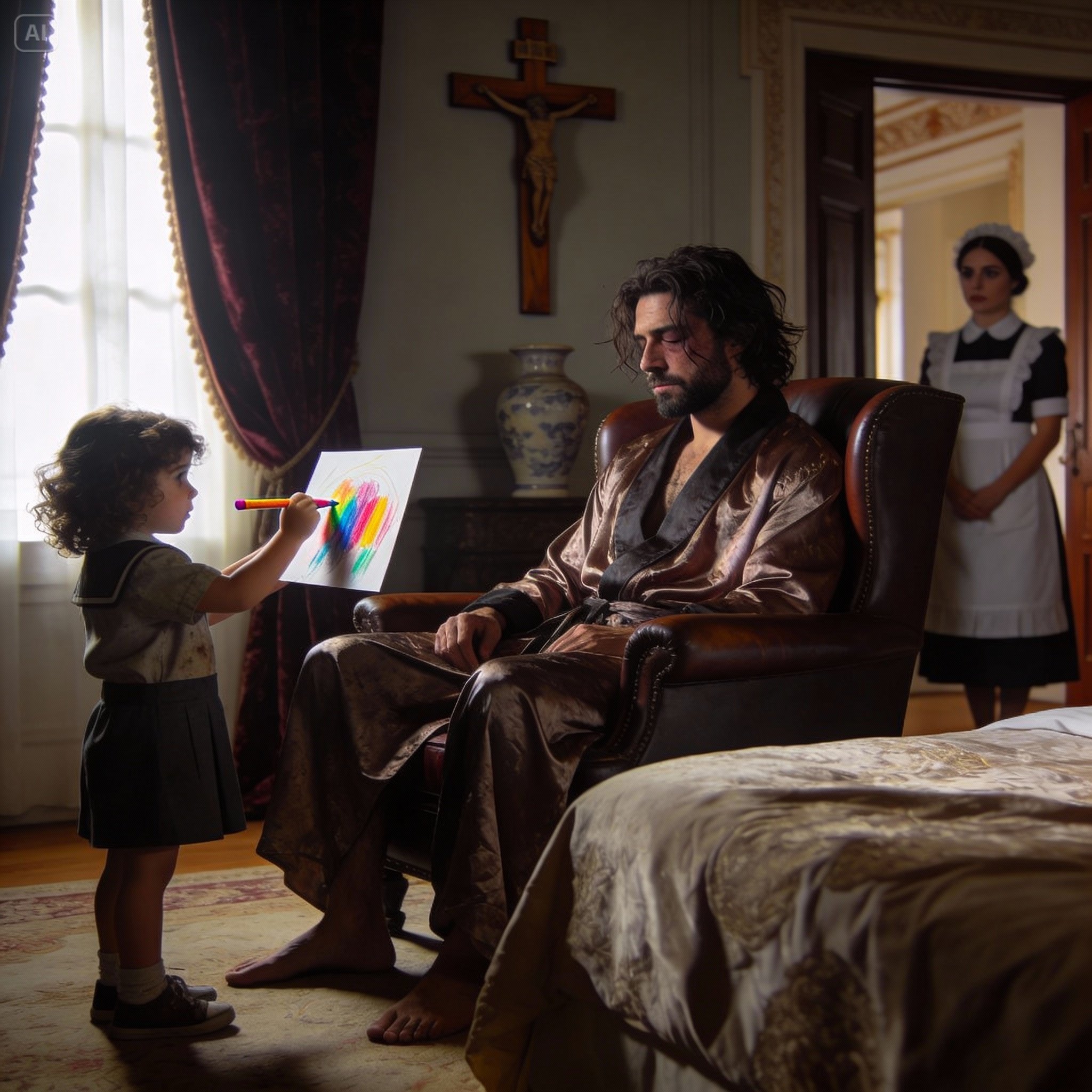
I hear footsteps in the hallway. They’re my mother’s stilettos, Doña Isadora’s. They clack metallically on the marble floor, unmistakable. Each step is an accusation. Click, click, click . She stops in front of my door. I hear her sigh before she turns the knob. She always sighs before entering, as if she needs to fill her lungs with fresh air before plunging into the toxic atmosphere of my depression.
—Thales, son —his voice is soft, but it carries tons of tiredness—. You have to eat something.
I don’t turn around. I’m sitting in my reading chair, looking towards where I think the window is, even though all I see is black.
—I’m not hungry, mother.
—You haven’t eaten anything since yesterday. Manuela has prepared the stew you like.
The smell of food makes my stomach churn. I don’t deserve the pleasure of a good meal. I don’t deserve the warmth of home.
—Tell Manuela to give it to the dogs. Or throw it away. I don’t care.
I feel her approaching. The rustle of her silk dress, the scent of her perfume, Chanel No. 5 , which tries, unsuccessfully, to mask the smell of sadness that has permeated this house since the funeral. She places a hand on my shoulder. I tense instinctively.
—Thales, please… Your brother wouldn’t want to see you like this.
The mention of his name is like a whip crack. I jump up, roughly pushing his hand away. My shin hits the side table, but the physical pain is a relief compared to the internal ache.
“Don’t mention his name!” I shout, my voice sounding hoarse and strange even to my own ears. “You have no right to speak for him! You don’t know what he would want!”
“He was my son too, Thales!” Her voice breaks, and that sound tears me apart, but my own guilt is an impenetrable shield. “I lost him too!”
“But you weren’t driving!” The phrase bursts out like a projectile. It’s the truth that separates us, the unbridgeable chasm between her pain and mine. “It was me! I killed him!”
The silence that follows is heavy. I can hear her ragged breathing. I know she’s crying, even though she’s trying to hide it.
“Get out of here,” I whispered, exhausted from the explosion. “Please, Mother. Just… leave me alone.”
I hear his footsteps retreating. The door closes with a soft click . And I am once again the king of my shadow kingdom. I sink back into the armchair, running my hands over my face, feeling the stubble and the invisible scars that sting beneath my skin.
Time in the dark is fluid. I don’t know if hours or minutes have passed when I hear the door open again. But this time it’s not my mother’s heels. It’s rubbery footsteps, stealthy but firm. And the smell is different. It’s not expensive perfume, it’s the smell of cleanliness, of Marseille soap, already somewhat sweet, perhaps cheap vanilla.
“Mr. Thales,” says a voice I don’t quite recognize. It’s a young voice, with a soft accent, not as stiff as my mother’s friends’. “I’ve come to clean the room.”
It’s Soraya. The new one. She’s been here a few months, I think. I’ve barely exchanged two words with her. Normally, the staff have strict instructions to enter, leave the tray, and leave without making a sound, like ghosts tending to a corpse. But this woman has the bad habit of talking.
“I don’t want you cleaning,” I growled, without moving. “Go away.”
“With all due respect, sir, this smells like a bear’s den,” she says, and I can hear the sound of a bucket of water being set down on the floor. “And the sheets must have a mind of their own by now. I’m going to change the bed.”
I turn towards the voice, indignant at its insolence.
Are you deaf? I told you to leave. You don’t have permission to be here if I don’t want you to.
“Mrs. Isadora pays me to keep the house clean, and that includes your room, whether you like it or not. Besides”—I hear the sound of curtains being violently pulled back—”you need light.”
The sound of the curtain rings sliding along the rod is jarring. Although I can’t see the light, I feel the sun’s warmth on my skin almost immediately. I shrink away, covering my eyes with my forearm like a vampire exposed to dawn.
“Shut that up!” I ordered.
—No. The sun disinfects. And you need to disinfect your soul a little, if you’ll allow me the boldness.
—I won’t allow it. You’re fired!
—Okay, well, when I finish making the bed I’m going to the unemployment office, but first I’m finishing my work —she replies with astonishing calmness.
I hear her tear the sheets off the bed with efficient movements. Flash, flash . She shakes the pillow. There’s no fear in her movements, nor that fearful reverence the other employees have. It disconcerts me.
“Why are you doing this?” I ask, letting my guard down out of sheer surprise.
—Make the bed? Because it’s my job.
—No. Challenge me. Don’t you know who I am?
Soraya stops for a moment.
—I know who you are, Mr. Thales. I remember what you used to look like.
That phrase chills me to the bone. Before. Before the monster. Before the darkness.
“I’ve been working in this house for five years, though you never really saw me,” she continues, her voice softening. “I remember when you used to arrive with your brother, Mr. Eduardo. You could hear them laughing from the garden. You always came in whistling.”
I freeze. The memory of that laughter is like a dagger.
“That man died,” I say dryly.
—No, sir. That man is sitting in an expensive armchair, feeling sorry for himself while the world keeps turning out there.
Rage bubbles in my chest, but there’s something more. A real pang that hurts more than any insult.
—You are insolent.
“And you’re stubborn. We make a good couple.” She shakes out the sheets again. “The bed’s clean. I’ve left your breakfast tray on the table. Try to eat something, even if it’s just so you don’t upset your mother, the poor woman is wasting away.”
She gathers her things. The bucket, the mop. She walks towards the door, but stops before leaving.
—I’ll be back tomorrow. And I’ll open the curtains again. So you’d better get used to the idea.
The door closes. I’m left alone, with Soraya’s clean scent lingering in the air and the warmth of the sun on my face. For the first time in months, I don’t just feel empty. I feel irritation. And irritation, at least, is a vivid feeling.
The next day, she made good on her threat. And the day after that. It turned into a kind of cold war between us. She would come in, open the curtains, and force me to listen to her comments about the weather, the traffic on the Castellana, the price of olive oil. I would answer her with monosyllables or hostile silences, but she seemed immune to my bad mood.
But the real invasion happened on a Tuesday.
It was nearly eleven in the morning. I was lying in bed, mentally counting the seconds to avoid thinking, when I heard a strange sound. It wasn’t Soraya’s footsteps. They were much lighter, quicker, and uneven. And they were accompanied by a buzzing sound, like that of a small bee.
My bedroom door was ajar—courtesy of Soraya, who insisted on “airing it out.” Footsteps entered. I sat up, alert. My senses have become so heightened that I can detect changes in air pressure when someone enters the room.
“Who’s there?” I asked, turning my head toward the sound.
The buzzing stopped. Silence. Then, a small, rapid breath.
“Are you a giant?” a voice asked.
It was a little girl’s voice. High-pitched, crystalline, terribly curious. I was so perplexed that I forgot to be angry.
-That?
—She asks if you’re a giant. My mother says that very important people live in this house, and in stories, important people live in castles and sometimes they’re giants.
“I’m not a giant,” I replied, frowning. “And this isn’t your house. Who are you?”
“I’m Anita. I’m four years old. Well, four and a half.” I heard the sound of feet approaching my bed. “Why are your eyes open if you’re asleep?”
—I’m not asleep.
—Then why aren’t you looking at me? You’re looking at the wall. I’m right here.
I felt a small, warm hand touch my knee on the bedspread. I shuddered. It had been years since anyone had touched me so naturally, without fear, without pity.
—I can’t see you, Anita.
—Why? Have your eyes run out of batteries?
I let out a short, dry laugh that surprised even myself.
—Something like that. My eyes aren’t working.
—Ah. —She seemed to process the information with the implacable logic of children—. Like the doll that King Melchior brought me, which closed its eyes and then one of them broke and it just kept winking. My mother fixed it with glue.
—I don’t think glue will work on me.
—My mother fixes everything. She’s a magician.
At that moment, I heard Soraya’s footsteps running down the hallway, hurried and full of panic.
—Anita! Oh my goodness!
Soraya burst into the room, almost skidding.
“Anita, I told you not to leave the kitchen!” Her breathing was ragged. “Mr. Thales, I’m so sorry. Oh my God! The daycare has closed because of a burst pipe, and I had no one to leave her with. My neighbor is in town, and… I’m so sorry, I’ll take her right now.”
I felt him tear the girl away from me.
“But Mom, I was talking to the sad giant!” Anita protested.
—Shh! He’s not a giant, he’s Mr. Thales. And you don’t bother him. Come on.
“Wait,” I said. The word came out of my mouth before I could stop it.
Soraya stopped dead in her tracks.
—Sir, I swear, it won’t happen again. I’ll put the cartoons on the tablet in the ironing room and…
“Sad giant?” I asked, ignoring his apologies.
I could “feel” Soraya blushing from here.
—That’s just kids being kids, sir. They have a lot of imagination.
“Why are you sad?” I insisted, addressing the girl.
Anita’s voice sounded clear and confident.
—Because you smell like gray.
—Do I smell gray?
—Yes. Gray smells like rain when your socks get wet and you can’t get them off. And you smell like that. Like wet socks and wanting to cry.
I was stunned. It was the most brutally honest description I had heard in two years of psychiatric therapy.
—Anita, please… —Soraya pleaded, mortified.
“Leave her alone,” I said, my voice softer. “She’s right. I smell gray.”
There was an odd silence. Then I felt Anita let go of her mother’s hand and come closer again.
—Well, don’t worry. I can bring you the yellow one.
—Yellow?
—Yes. Yellow smells like cookies and sunshine. I have a yellow drawing in my backpack. Do you want me to give it to you?
I swallowed. A lump formed in my throat, a painful, ancient lump.
—I can’t see your drawings, Anita.
“It doesn’t matter. I’ll explain it to you. It’s a very large sun wearing sunglasses because it shines so brightly. If you put it on your nightstand, maybe you’ll get a little yellow on it and get rid of the smell of wet socks.”
I reached out hesitantly toward the sound of her voice. I felt the rough paper of a school sheet being placed in my palm.
—Thank you, Anita.
“You’re welcome.” I heard her give her mother a loud kiss. “See, Mom? She’s not mad.”
“Come on, you little bugger,” Soraya said, her voice a mixture of relief and something else… tenderness? “Mr. Thales, if you need anything…”
—I’m fine, Soraya. Thank you.
They left the room, leaving behind an echo of vitality that made the ensuing silence even more deafening. I stayed there, sitting on the bed, clutching a crumpled sheet of paper with an invisible drawing on it, trying to remember what the cookies and the sun smelled like.
The following days, the routine changed. Soraya continued cleaning and opening the curtains, but now there was a stowaway. Anita would escape from the “safe zone” of the kitchen whenever her mother wasn’t looking. At first, Soraya would come running to look for her, terrified that I would fire her. But when she saw that I not only tolerated the girl but was even starting to wait for her, she relaxed a little.
Anita became my eyes. She would sit on the Persian rug at the foot of my armchair and tell me about the world.
“The sky is Smurf-blue today, Thales,” he said (he had stopped calling me giant and sir, much to his mother’s horror). “And there’s a cloud that looks like a rabbit eating a car.”
Other times he brought objects.
—Play this.
“It’s a stone,” I said, feeling the rough surface.
“It’s not just a rock. It’s a magic meteorite I found in the garden. If you squeeze it tight when you’re scared, it gives you superpowers.”
I found myself keeping the “meteorite stone” in the pocket of my silk robe.
But peace is a fragile state in this house. And the outside world, the one I tried to ignore, had cruel ways of knocking at the door.
Leticia.
Leticia Holanda had been Eduardo’s fiancée. They had been together since university. She was brilliant, ambitious, a lawyer at one of the most prestigious firms in Madrid. I loved her like a sister. But since the accident, our love had soured into pure, distilled hatred.
She blamed me. And she was right.
His visit arrived unannounced one Thursday afternoon. I heard the engine of his sports car in the gravel driveway. I would recognize that sound anywhere. My heart began to pound wildly, a war drum in my chest.
—Thales—my mother’s voice came through the intercom. —Leticia is here. She’s with her lawyer. She insists on seeing you.
I tensed up. Lawyer?
—Tell him to leave.
“He’s brought a court order, son. He says it’s to assess your capacity. You have to come down.”
Capacity. The word hung in the air like a threat. I stood up, groping for the cane I had refused to use but now needed. I smoothed down my robe, trying to reclaim some of the dignity I had lost years ago.
I went out into the hallway. I made my way along the wall, feeling my way, until I reached the railing of the main staircase. I could hear the voices downstairs in the lobby.
—…it’s unacceptable, Isadora. The Alcántara family fortune is crumbling due to a lack of leadership. Eduardo gave his life for this company, and Thales is letting it rot while playing the phantom of the opera.
Leticia’s voice was sharp, cutting like a scalpel.
I went down the stairs slowly. Counting the steps. One, two, three… Twenty-four. I reached the marble floor of the lobby.
“Leticia,” I said. My voice echoed in the wide space.
The silence became instantaneous.
“Thales,” she replied. There was no warmth, only ice. “I see you’re still going on with the charade.”
—It’s not a farce. I don’t see anything, Leticia.
—How convenient. You don’t see the company’s balance sheets plummeting, you don’t see the shareholders demanding explanations, and above all, you don’t see what you did that night.
I took a few steps towards her voice.
“I see what I did every time I try to sleep,” I said softly. “I see his face. I hear his voice. I don’t need eyes for that.”
—Spare me the melodrama. I’ve come with Mr. Garrido to formally notify you. We’ve initiated the legal process to have you declared legally incompetent. We’re going to request that you be stripped of control over your assets and the family business.
I felt the ground move beneath my feet.
—Do you want to have me declared legally incompetent?
“I want to salvage what’s left of Eduardo’s legacy. You’re in no condition to lead anything. Look at yourself. You’re a wreck, Thales. You live locked away, filthy, cared for by your mother like a child. You’ve given up on life. Well, if you give up on life, you give up on everything.”
“Leticia, for God’s sake!” my mother interjected, sobbing. “He’s your brother-in-law!”
“He was the murderer of my future husband,” she spat.
That sentence hit me harder than the accident. I staggered.
Suddenly, I felt something small bump against my legs. A warm presence came between Leticia and me.
“Don’t talk to her like that!” shouted a little girl’s voice.
It was Anita. She had escaped from the kitchen again.
“Who is this girl?” Leticia asked, puzzled.
“I’m Thales’s friend!” Anita was furious. I could picture her, fists clenched, confronting the tall, elegant woman. “And he’s not trash! He’s yellow! And you smell like black and spiky!”
“What is this?” Leticia sounded indignant. “Now you have children running around the house while everything is collapsing? This is the final proof, Isadora. This place is chaos.”
“Anita!” Soraya came running in, scooping the little girl up in her arms. “I’m sorry, I’m sorry! Mr. Thales, Miss…”
“Get the girl out of here, Soraya,” I said, trying to keep my composure, even though my hands were trembling. “This has nothing to do with them.”
“It’s all connected,” Leticia said. “It shows your lack of judgment. We’ll see each other in court, Thales. And I assure you, I’m going to win. By Eduardo.”
I heard the click of her heels as she walked away toward the door. The door slammed shut like a gunshot.
I stood there in the middle of the lobby, feeling smaller and blinder than ever. But then, I felt Soraya’s hand on my arm. She hadn’t left.
“Sir…” he whispered.
“She was right,” I said, my voice breaking. “I’m worthless. I should just let her have it all.”
“No,” Soraya said firmly. And then she did something she had never done before. She took my hand and squeezed it tightly. “You are not worthless. You are a wounded man. And wounded men heal. That woman is in a lot of pain, but pain doesn’t give her the right to destroy you.”
—She wants justice.
“She wants revenge. They’re different things.” Soraya sighed. “Anita’s right, she knows. You have a lot of yellow inside. It’s just hidden under the dust. And I’m very good at dusting.”
For the first time in two years, I didn’t feel alone facing the abyss. I had an insolent cleaning lady and a four-year-old girl watching my back. And strangely, that gave me more strength than all the Alcántara family’s money.
Leticia’s threat was real. The lawyers started calling. Meetings, medical examinations. My mother was desperate.
“We have to show you’re okay, Thales,” she told me one night while we were having dinner (I had started down to the dining room for dinner, guided by Soraya). “The New Year’s Eve Gala at the Hotel Mirador del Sol is coming up. It’s a family tradition. Your father founded it, Eduardo loved it. If you go, if you present yourself to society and give the welcoming speech, you’ll show that you’re still the head of the family.”
—Mother, I can’t give a speech. I can’t read my notes. I can’t see the audience. I’ll stumble, I’ll make a fool of myself. I’ll give them exactly what they want: the image of an invalid.
“You won’t be alone. I’ll be with you. And…” he hesitated for a moment, “and we can bring Soraya. She knows how to guide you without it being noticeable.”
I stopped with the fork halfway through.
—Soraya?
—You trust her, don’t you? More than anyone else.
It was true. In recent weeks, Soraya had become my compass. Her presence was constant, unwavering. She had taught me to discern the color of her emotions by the tone of her voice. I knew she was smiling when her voice became slightly higher at the end of sentences.
“I’ll ask him,” I said.
When I suggested it to Soraya the next day, while she was dusting the books I could no longer read, she remained silent.
—Me? At a fancy gala? Sir, I don’t have clothes for that. I’m from Vallecas, not La Moraleja. I don’t even know which fork to use for fish.
“I don’t care about the fork, Soraya. I care about you. I need your eyes. And I need… I need to know you’re there. If you’re there, I think I can do it.”
There was a long silence. Then, I heard the rustle of her clothes as she approached.
—If I go, can I take Anita? I have no one to leave her with on New Year’s Eve, my mother is going to her village.
I smiled.
—Anita is the guest of honor. She brings the color.
—Then it’s a deal. But you’re paying for the dress, just so you know.
—Deal.
Preparing for the gala was crazy. Tailors came to the house. Soraya described the fabrics to me.
“This one’s stinging,” she said. “This one’s as soft as a baby’s bottom… sorry, like silk. This one’s midnight blue, it goes well with her eyes.”
—How do you know it looks good on me?
—Because I have eyes in my face, Mr. Thales. And because… well, because you look very handsome when you’re not frowning.
I felt like my ears were burning.
-Thank you.
—You’re welcome. The truth is the truth.
The night of December 31st arrived. The Hotel Mirador del Sol is an imposing tower in the center of Madrid. The party was on the rooftop, with views of the entire illuminated city.
The noise was deafening. Orchestral music, laughter, the clinking of glasses. For me, it was a sensory assault. I clung to Soraya’s arm as if it were a life preserver in the middle of a shipwreck.
“Breathe, Thales,” she whispered in my ear. She smelled of jasmine that night. We had bought her an emerald green dress. Anita had told me she looked like a forest princess. “She’s doing very well.”
—I feel like everyone is looking at me.
“They’re looking at him because he’s the most elegant man in the room. And because Leticia is in the corner fuming at the sight of him here.”
—Is he here?
—Yes. Wearing a red dress that makes her look like she’s going to war. But don’t worry, I’m her shield. And Anita is her cavalry.
Anita was fascinated. I could hear her running around us, describing everything.
“There’s a tower of prawns, Thales! And flashing lights! It’s like Christmas, but on steroids!”
I relaxed a little. I managed to greet some members, guided by Soraya’s whispers (“At three o’clock, Mr. Ambassador, extend your hand… now”). Everything was going well.
Until there were ten minutes left before the chimes.
“I’m going to take Anita to the bathroom for a moment,” Soraya told me. “Stay here, by the column. Don’t move. I’ll be back in two minutes.”
—Okay. Be careful.
I stood there, alone in the midst of the bustle. People passed by, brushing against me. I began to feel anxiety rising in my throat. The air grew thick.
—Well, well —Leticia’s voice came from my left.
I tensed up.
—Leticia.
“You’ve managed to fool everyone for a while, Thales. But I see you trembling. You’re terrified. Without your maid, you’re nothing.”
-Leave me alone.
—Do you know what time it is? Almost midnight. The time Eduardo died. Do you remember? Do you remember how it was raining?
-Be quiet.
—Do you remember the sound of the brakes? Because I hear it every night. You’re here drinking champagne and he’s in a pine box.
“Stop it!” I turned sharply, trying to get away from her.
In my confusion, I bumped into a waiter. I heard the clatter of a tray falling to the floor, glasses shattering. The sound was identical to the accident. Broken glass. Metal.
Panic gripped me. The flashback hit me hard. I was back in the car. The rain. The screams.
“Soraya!” I shouted, lost in the darkness.
No one answered. The music kept playing.
I started walking blindly, pushing past people. I needed air. I needed to get out.
“Mr. Thales!” I heard Soraya’s voice in the distance, distressed.
—Soraya!
“I can’t find Anita!” Her shout echoed through the room and chilled me to the bone. “She slipped out of my hand when I left the bathroom! She’s vanished!”
The world stopped. My personal panic evaporated, replaced by a much purer and more urgent terror. Anita. My colorful little girl.
—What do you mean it’s disappeared?
—She’s not here! There are too many people! Anita!
I closed my eyes (though it was too late) and concentrated. I blocked out the noise of the orchestra, the laughter, the murmurs. I became a human radar. I searched for that specific sound, that buzzing of a bee, those uneven footsteps.
And then I heard it. Very faint. Far away. Up above.
“The top rooftop,” I said. “The emergency stairs.”
—What? —Soraya was crying.
—I heard her. She went up to see the lights. Come on!
I grabbed Soraya’s hand and we were the ones who ran. We climbed the metal stairs. The icy January wind hit our faces as we opened the door to the technical rooftop.
It was a dangerous place. No high railings. Just the abyss of Madrid at our feet.
—Anita! —Soraya shouted.
“Mom!” The voice came from the edge.
“Don’t move!” I shouted.
I broke away from Soraya.
—Guide me— I said. —Tell me where it is.
“He’s on the edge, sir. Three meters away. At twelve o’clock. Oh my God…”
I moved forward. My feet recognized the gravel on the roof. The wind roared.
—Anita, I am Thales. I am the giant. Speak to me.
“Thales, you can see everything,” she said, her voice trembling but filled with wonder. “But I’m afraid to go down. It’s so high up.”
—Don’t look down. Look at me… well, talk to me. I’m coming for you.
I took another step. Another. I felt the void close by. If I miscalculated, I would fall. But I didn’t care. If she fell, I would jump after her.
—Give me your hand, Anita.
I stretched my arm into the darkness. I felt the cold air. And then, I felt tiny, icy fingers grasp mine.
I pulled her towards me tightly, wrapping her in my arms, falling to my knees on the gravel.
“I’ve got it!” I shouted.
Soraya threw herself on us, hugging both of us, crying hysterically.
—Thank you, thank you, thank you!
And then, it began.
BOOM .
The first New Year’s Eve rocket exploded right above us. The sound was brutal. Instinctively, I flinched, bracing for the pain, bracing for the memory of the accident.
But Anita screamed in my ear.
—Look, Thales! It’s magic!
—I can’t see, Anita!
—Yes, you can! Open your eyes! The sky is bursting into color!
BOOM, CRACK, SSSSSH .
I opened my eyes. I expected the usual darkness.
But it wasn’t darkness I saw.
It was a flash. A blurry, red, intense stain. Like blood, but bright.
“What…?” I murmured.
Another burst. Green. This time I saw the shape. A palm tree of light expanding on my retina.
My heart stopped.
—Light—I whispered.
“Sir?” Soraya lifted her head from my chest.
I looked down. To where her voice was.
At first it was just a blurry smudge, a pale oval surrounded by darkness. But then, another rocket exploded, a golden one, immense, which lit up all of Madrid as if it were midday.
And I saw her.
I saw large, brown eyes, filled with tears. I saw a trembling mouth painted with cheap lipstick. I saw a curl of dark hair plastered to the forehead with sweat and fear.
It was the most beautiful face I had ever seen in my life.
—Soraya—I said, and my voice broke.
She looked at me, confused.
-Mister?
I raised my hand. I saw it move. I saw my own hand, trembling, reach for her face. I touched her cheek.
—You are… you are just as I imagined. But with more light.
Soraya stopped breathing.
—Can you… can you see me?
—I see you. —Tears began to well up in my eyes, burning.— I see you, Soraya. I see the green of your dress. I see Anita.
I looked down. The girl was looking at me with a huge smile, illuminated by the fireworks.
“I told you so!” Anita shouted, jumping up and down. “I told you yellow would cure you!”
I burst out laughing. A laugh that came from the depths of my soul, releasing two years of imprisonment. I cried and laughed at the same time, embracing a cleaning woman and her daughter on the rooftop of a skyscraper while Madrid celebrated that life, despite everything, goes on.
—Yes, Anita—I said, watching the sky explode in a thousand colors—. You were right.
The darkness was gone. Eduardo was still dead, the pain was still there, but the wall had fallen. Because you can’t live in darkness when someone forces you to look at so much light.
And as I held Soraya’s gaze, I knew that my life hadn’t ended on that road. It had only just begun.
PART 2
The rooftop of the Hotel Mirador del Sol continued to vibrate beneath my feet, or perhaps it was I who was vibrating. The last echoes of the fireworks faded into the Madrid sky, leaving trails of grayish smoke that, to my astonishment, I could clearly distinguish against the blackness of the night. It was a different gray than the one Anita had described; it wasn’t a sad gray, it was the residue of an explosion of joy.
I stayed there, kneeling on the cold gravel, my hands clinging to Soraya’s arms like the roots of an ancient tree, preventing me from soaring into the infinite sky I had just rediscovered. My eyes, unaccustomed to focusing, ached. It was a physical, sharp pain behind my eyeballs, as if atrophied muscles were protesting the sudden effort of processing light, color, and depth. But it was a blessed pain.
“Sir…” Soraya whispered again. Her face was just inches from mine.
Now that the fireworks had stopped, the light came from the decorative lights on the terrace and the amber glow of the city below. I devoted myself to studying her with an almost indecent eagerness. For months, I had constructed an image of her in my mind based on her voice, her scent of vanilla and soap, the texture of her hardworking hands. The reality, I discovered with a racing heart, was infinitely better.
Her skin was a warm olive tone, dotted with a couple of moles on her neck that formed a constellation I didn’t recognize. Her eyes were large, expressive, a deep brown that reminded me of damp earth after rain, but without the sadness of mud. And there were worry lines around her mouth and on her forehead, marks of a life that hadn’t been easy, battle scars that made her, to my newly opened eyes, the most beautiful woman who had ever walked the earth.
“Don’t call me sir,” I said, my voice hoarse, heavy with an emotion I could barely contain. “Please, not tonight.”
—Thales—she corrected, and seeing her lips move, synchronized with the sound of his name, was another small miracle.
Anita, still clinging to us, tugged at my lapel. I looked down. The little girl was a whirlwind of color. She wore a bubblegum pink coat over a frilly dress, and her dark curls were an enchanting mess. She looked at me with that frankness only children and the elderly who have nothing left to lose possess.
“Do you like my shoes?” she asked, lifting one foot. They were patent leather, with a little glitter.
I burst out laughing, a laugh that hurt my ribs.
—They’re the most beautiful shoes in the world, Anita. They shine almost as brightly as you do.
—I knew it! Mom said they were tacky, but I knew they were magic.
I stood up with difficulty. Vertigo struck me instantly. My brain, accustomed to judging distances by sound and touch, was overwhelmed by the visual perspective. The ground seemed to move. I staggered, and Soraya caught me by the waist with surprising strength.
“Slow down,” she said. “His brain has to learn to ride a bike again.”
“I’m fine,” I lied, leaning on her more than my pride would have allowed in my previous life. “I just need… I need to get down. There’s too much information up here.”
We walked toward the door leading to the stairs. Every step was an adventure. Seeing my own black leather shoes crunching on the gravel, seeing the rust on the door hinges, seeing the green “EMERGENCY EXIT” sign. It was all fascinating and terrifying at the same time.
We went down a flight of stairs and took the service elevator to avoid the main party crowd for a moment. When the stainless steel doors closed, I faced my greatest fear: the mirror.
The inside of the elevator was covered in mirrors. I turned around slowly and saw myself.
The man who stared back at me was a stranger. He was much thinner than I remembered. The tuxedo, though recently tailored, seemed to hang loosely on my bony shoulders. My face was pale, almost translucent, and my beard, though trimmed, had a few premature gray hairs that hadn’t been there two years ago. But it was his eyes that mesmerized me. They were sunken, surrounded by purplish circles, but the pupils reacted to the light. They were alive. Blue, bloodshot from crying and exertion, but alive.
“I look like a ghost,” I murmured, touching my own reflection in the cold glass.
“He looks like a shipwrecked sailor who’s just washed ashore,” Soraya gently corrected, looking at my reflection next to hers. “And shipwrecked sailors, Thales, have the most interesting gaze of all, because they’ve seen the abyss and come back.”
The elevator reached the ballroom floor. The arrival ding sounded like a boxing bell. Round two.
The doors opened and the noise of the party hit us full force. But this time it was different. It was no longer an amorphous mass of sound. Now I could see the sources of the noise. I saw the waiters with silver trays, the women in sequined dresses reflecting the light from the chandeliers, the men laughing with their mouths agape. The world was visual chaos, but it was my chaos.
“My mother,” I said, scanning the crowd. “I have to find my mother.”
—I was near the entrance, with Mrs. Leticia— said Soraya, tensing up a little.
I moved forward, holding Anita’s hand in one and Soraya’s in the other. People moved aside as we passed, perhaps because of my disheveled appearance after the dash to the rooftop, or perhaps because something in my expression had changed radically. I no longer walked with the hesitation of a blind man, but with the determination of one who searches.
I saw her. Doña Isadora was standing by a marble column, twisting a silk handkerchief in her hands. She wore a pearl-gray dress that made her look like a weather-worn Greek statue. She was pale, staring anxiously toward the stairs.
“Mother!” I called to her.
She turned around. Her eyes searched for me, expecting to find that same empty stare, that gaze that pierced people without seeing them.
I stopped two meters away from her. I stared intently into her eyes. I saw the exact moment she realized. I saw her pupils dilate, her mouth open slightly, and the handkerchief fall from her hands to the floor.
—Thales… —her voice was a barely audible thread above the music.
“I see you, Mom,” I said, and tears once again blurred my newly restored vision. “Your lipstick is a little smudged and you’re wearing granny earrings.”
Isadora let out a sob that seemed to come from the very depths of the earth. She threw herself toward me, ignoring protocol, ignoring the Madrid high society that surrounded us. She hugged me with desperate force, burying her face in my chest.
“My God, my God!” she repeated over and over. “It’s a miracle!”
“It’s not a miracle,” I said, looking up to meet Soraya’s eyes over my mother’s shoulder. “It’s… it’s a second chance.”
The people around us began to notice. The murmurs grew like a wave. “What’s going on?” “Is that Thales Alcántara?” “Are you watching?” I felt exposed, like a circus animal, but I didn’t care. I had my mother in my arms and the woman I loved (yes, I realized it in that instant, I loved her) by my side.
But the bubble of excitement had to burst. And the needle that pricked it was, inevitably, Leticia.
I stood a few steps away, watching the scene with a mixture of disbelief and suspicion. She was wearing that red dress Soraya had told me about, an aggressive color, arterial blood. She was beautiful, in a cold and painful way.
I gently pulled away from my mother and turned to face her.
Leticia did not back down, but I saw how her posture became rigid.
“What is this theater now, Thales?” he asked, though his voice lacked its usual biting wit. There was doubt.
—There is no theater, Leticia.
I walked toward her. I saw her eyes lock onto mine, searching for the trick, searching for the lie. I moved confidently, dodging a passing waiter, skirting around an empty chair. Details a blind person couldn’t fake.
I stopped in front of her. I could see the fine lines of bitterness around her mouth, the moist glint in her green eyes. Eyes that Eduardo adored.
“You have my brother’s eyes in that photo you keep in your office,” I said softly. “The one you took in Mallorca. The light was at an angle, and you were looking at him as if he were the center of the universe.”
Leticia paled. She took a step back as if she had been slapped.
—You can’t… you haven’t seen that photo in years.
—I’m seeing it now in my memory, and I’m seeing your face now. And I see the pain, Leticia. I see it as clearly as I see this red dress.
“How is this possible?” she whispered, letting her guard down for the first time. “The doctors said it was irreversible. They said your mind was broken.”
“I was. It broke because I couldn’t bear the guilt. I punished myself with darkness because I thought I didn’t deserve to see the world without him. But tonight…” I glanced at Anita, who was devouring a canapé she’d stolen from a tray, “tonight I understood that Eduardo wouldn’t want me to be dead inside.”
Leticia trembled. A single tear rolled down her perfect cheek.
—I… I still hate you a little, Thales. I can’t help it.
—I know. And I understand. I’m not asking you to forgive me today. Or tomorrow. I’m only asking you to stop trying to bury me prematurely. I’m going to rebuild my life, Leticia. I’m going to rebuild the company. And I’m going to do it by honoring Eduardo, not by hiding from his memory.
She held my gaze for a long, eternal minute. It was a silent duel between our shared past and this impossible present. Finally, she nodded. A brief, sharp, almost imperceptible movement.
“Prove it,” he said. “I’ll talk to my lawyers tomorrow about pausing the lawsuit. But I won’t drop it. If you relapse, if this is just a passing euphoria… I’ll destroy you.”
—Deal.
Leticia turned on her heels and left, making her way through the crowd with the dignity of a dethroned but not defeated queen.
I exhaled a breath I didn’t know I was holding in.
“Well,” Soraya said, appearing beside me and handing me a glass of water. “That was intense. Do you need to sit down, or would you rather faint right here?”
“I’d rather go home,” I said, drinking the water thirstily. “I want to see my house. I want to see my bed. I want to see if the sheets you put on are really as ugly as you said.”
Soraya smiled, and that smile lit up the room more than all the chandeliers put together.
—They’re made of flowers, sir. Prepare yourself psychologically.
The return trip in the car was an almost religious experience. My usual driver, Manuel, nearly had a heart attack when he saw me get in and say to him, “Manuel, you’re getting old, my friend,” while looking at his face in the rearview mirror.
I spent the whole journey with my nose pressed against the window, like a child. Madrid at night. The Castellana illuminated. The Puerta de Alcalá, majestic, bathed in golden lights. The traffic lights changing from red to green. The taxis with their diagonal red stripe. Everything seemed new to me, vibrant, saturated with life.
Soraya was sitting next to me. Anita had fallen asleep in her lap two minutes after I started the engine. In the silence of the car, I allowed myself to observe them again. The light from the streetlights entered the cabin rhythmically, creating a play of light and shadow on Soraya’s sleeping face. She looked exhausted, but at peace.
I reached out and, with a boldness born of euphoria, covered her hand, which rested on her daughter’s head. She opened her eyes and looked at me. She didn’t remove her hand.
“Thank you,” I whispered. “Thank you for giving me back the yellow.”
She intertwined her fingers with mine.
—You’re welcome, Thales. But now it’s up to you to support him.
We arrived at the mansion. Seeing the facade of the family home was a stark reminder of reality. It was imposing, yes, but also somber. The vines had grown too high, obscuring the windows. The paint needed repainting. It was the home of a family in mourning.
“Tomorrow,” I said to myself as Manuel opened the door. “Tomorrow we’ll start changing this.”
That night, I couldn’t sleep. I spent hours lying in bed, with the bedside lamp on, staring at the ceiling, staring at my own hands, staring at the drawing Anita had given me weeks before, which now rested framed (even if it was just a mental frame) on the bedside table.
It was an incomprehensible scribble of yellow and orange crayons, with something that looked like a smiling potato in the center. It was the most beautiful work of art I had ever seen.
The next morning, clinical reality took over. My mother had summoned an army of doctors. Dr. Arriaga, my main neurologist, arrived at eight in the morning with a look of utter skepticism.
—Mr. Alcántara, what your mother describes is medically improbable. Cortical or psychogenic blindness does not usually resolve in such an… explosive way.
“Try me,” I said, sitting on the edge of the bed, already showered and shaved. I had looked at myself in the mirror for twenty minutes while I shaved, rediscovering the geography of my own face.
The exam lasted two hours. Lights in the eyes, finger tracking, reading letters on a chart, handheld scanners. The room was filled with tense silence as the doctor reviewed the results.
Finally, Arriaga took off his glasses and rubbed the bridge of his nose.
—It’s… fascinating. Their neural pathways are active. The cortical response is normal. It’s as if the blockage has simply dissolved.
“I told him so,” my mother interjected triumphantly.
“From a scientific standpoint, we could talk about a massive release of post-traumatic stress, catalyzed by an extreme adrenaline rush,” the doctor explained, trying to rationalize the miracle. “The rooftop incident forced his brain to prioritize survival over the trauma. His instinct to protect the girl bypassed the psychological block.”
“Call it what you like, Doctor,” I said, standing up and walking to the window to throw open the curtains, letting the winter sun flood the room. “I call it waking up.”
—Well, I recommend caution. Wear sunglasses. You’ll get headaches. Your brain will tire quickly. Don’t try to do anything too soon.
—I have a company to rebuild, doctor. And a life to live. I don’t have time to take things slowly.
When the doctors left, I was alone in the room for a moment. It was clean, thanks to Soraya, but it still felt oppressive. Dark furniture, heavy decor.
“This is over,” I said aloud.
I went out into the hallway. I heard the vacuum cleaner downstairs. I took the stairs two at a time, feeling the energy coursing through my veins.
I found Soraya in the blue room, dusting. She was wearing her work uniform, her hair was pulled back in a messy bun, and, to my delight, she was humming an Alejandro Sanz song.
I leaned against the doorframe, crossed my arms, and just watched her. I watched her work for a full five minutes. The grace with which she moved, the strength of her arms as she moved a sofa to clean underneath. It was mesmerizing.
She must have felt my gaze, because she turned around suddenly, startled.
—Oh, sir! What a fright! I didn’t hear you arrive.
“Thales,” I corrected, entering the room. “And forgive me, I didn’t mean to scare you. I was just… admiring the view.”
Soraya blushed furiously, and that color creeping up her neck was another visual treat.
—Don’t make fun of me. I look awful in this uniform.
—You look perfect. But I have a professional question for you.
She straightened up, adopting her “efficient employee” posture, although her eyes shone with something else.
-Tell me.
—What do you think about redecorating this house?
—The whole house?
“Starting here.” I gestured to the navy velvet curtains that blocked the light. “I want to get rid of these awful things. I want light. I want the sun to come in. I want to… I don’t know, paint the walls a color that doesn’t look like a Victorian funeral.”
Soraya smiled, and I saw enthusiasm light up her face.
—Well, it was about time. I’ve always thought this living room was crying out for a cream or ivory color. And those curtains collect more dust than the Sahara Desert.
—Go ahead. You have carte blanche. Hire whoever you need. Buy whatever you want. I want this house to breathe again.
—Are you serious?
—Very seriously. Oh, and one more thing.
-Yeah?
I approached her, slightly invading her personal space. The scent of vanilla enveloped me. I could see the golden flecks in her brown irises.
—I’m not going to eat at home today. I’m going to the office.
Soraya’s eyes widened in shock.
—To the Alcántara headquarters? Today?
—Yes. Leticia challenged me. And I don’t intend to let her win. But I need a favor.
-Whatever.
“I need you to come with me. Not as a cleaner. As… my personal assistant. My right hand. My visual anchor. I still get dizzy in bright lights and large spaces. And I trust you more than anyone.”
Soraya hesitated. She looked at her uniform, her hands.
—Thales, I don’t know anything about businesses. I can’t speak politely. Those sharks are going to eat me alive.
“You stood up to me when I was at my worst. You stood up to Letizia of Holland without batting an eye. Believe me, Soraya, the executives at my company are kittens compared to you.”
She let out a nervous giggle.
—I don’t have clothes to wear to a luxury office.
—Then we’ll stop by a store first. You have an hour to get ready. Put the vacuum cleaner down. You’re getting a promotion today.
Soraya looked at me, biting her lower lip in a gesture that I found adorably human.
—You’re crazy.
—Completely crazy. Are you coming?
She sighed, took off her apron and threw it onto the Louis XV sofa with wonderful irreverence.
—I’m going. But if anyone gives me a dirty look for being the cleaning lady, I’ll mop their face.
I smiled.
—I’m counting on it.
PART 3
The Alcántara Group building stood on the Paseo de la Castellana like a tower of glass and steel, defying the gray January sky. For two years, it had been nothing more than an image in my memory, a symbol of my failure and Eduardo’s absence. Now, getting out of the car, I saw it for what it was: a sleeping giant waiting for its owner to return.
I was wearing my sunglasses, just as the doctor had suggested, not for style, but because the glare from the sun off the glass facade was like needles on my retinas. Soraya got out beside me. We had stopped at a boutique on Serrano Street. She had resisted, arguing that it was an unnecessary expense, but I finally convinced her. She was now wearing a camel-colored suit, simple yet elegant, which flattered her figure and gave her an air of professionalism that was almost intimidating. She had let her hair down, and her chestnut hair fell over her shoulders with a newfound freedom.
“I feel like I’m in disguise,” she whispered as we walked towards the revolving doors.
“You look powerful,” I assured her, offering her my arm. “And remember, you’re my eyes if mine fail. If you see me blinking a lot, pinch my arm.”
-With pleasure.
We entered the lobby. The sound of my Italian shoes on the granite floor resonated with authority. The usual murmur of the reception area stopped abruptly. I saw heads turn. I saw the receptionist, Marta, drop her phone. I saw the security guard, a guy named Ramón who had been there for twenty years, snap to attention so quickly his cap almost fell off.
“Good morning, Ramón,” I said, stopping in front of the security turnstile. I took off my sunglasses for a moment to look him in the eyes.
Ramón paled.
—Mr. Alcántara… Mr. Thales… Is that you?
—In the flesh. And seeing, Ramón. Seeing that you’ve grown a mustache. It suits you.
Ramón mumbled something unintelligible.
Is my access card active?
—Uh… yes… no… I mean, I think they deactivated it due to inactivity, sir. Security protocol.
“Good.” I jumped over the turnstile with an agility that surprised even myself. Soraya, with an amused smile, passed through the visitor entrance that Ramón opened for her, trembling. “Let’s go to the attic.”
The elevator ride to the 40th floor was tense. Soraya briefly squeezed my hand when no one was looking.
“He’s trembling,” she whispered.
“I’m terrified,” I admitted. “But don’t let it show.”
The doors opened on the executive floor. The silence here was different, denser, cushioned by expensive carpets and corporate fear. I walked toward my old office. My secretary, or rather, my former secretary, Elena, was at her desk. When she saw me, she put her hands to her mouth.
—Thales… Mr. Alcántara.
—Hello, Elena. Call a board meeting. Right now. Main boardroom.
—But… sir, Mr. Garrido (Leticia’s lawyer) and the financial director are in a meeting with Japanese investors.
—Better. That saves us time. Tell them the CEO is back and wants his seat.
I went into my office. It was exactly as I’d left it two years ago. There was a thin layer of dust on the family photos. I went over to the desk and picked up the silver frame where Eduardo and I were smiling, embracing on a boat. I looked at it. I really looked at it. I saw my brother’s smile, that easy smile I had extinguished. But for the first time, I didn’t feel the crushing weight of guilt. I felt nostalgia, yes, and love. So much love.
“Hey, brother,” I whispered. “Let’s fix this mess.”
Soraya was standing by the door, watching me respectfully.
“Are you ready?” he asked.
—No. But we’re going to do it anyway.
We entered the boardroom ten minutes later. The scene was straight out of a movie. Twelve men and women in suits sat around the oval table. Leticia wasn’t there, but her lawyer, Garrido, presided over the table with an air of self-importance.
When I opened the door, there was absolute silence.
“Good morning,” I said, walking to the head of the table. Garrido looked at me, confused, and then looked at Soraya, who was standing a step behind, notebook in hand (a prop we had also bought).
—Thales… —Garrido stood up, nervously—. We didn’t expect… we were told you were… unavailable.
“Being indisposed means having the flu, Garrido. I was blind. Past my mind.” I stood in front of him. “That’s my chair.”
Garrido hesitated for a second, glancing at the Japanese investors who were watching the scene with inscrutable curiosity. Finally, he stepped aside.
I sat down. The leather of the armchair creaked. I felt at home and at the same time on an alien planet.
“Gentlemen,” I began, speaking in fluent English that I wasn’t sure I remembered until the words left my mouth, “my apologies for the interruption and my long absence. There have been… health complications. But as you can see, my vision has returned. And with it, my vision for this company.”
For the next hour, I improvised. I relied on my eidetic memory to cite figures from two years ago, asked about current projects, and demonstrated that, even though my eyes had been closed, my brain never ceased to be that of an Alcántara. Soraya passed me water and discreetly jotted down names on a piece of paper when she saw me hesitate. We were an odd but functional team.
When they finished, the Japanese nodded in approval. The finance director was sweating. Garrido looked like he’d just sucked on a lemon.
When the room emptied, I collapsed onto the table, exhausted. The headache returned, throbbing.
“He did an incredible job,” Soraya said, coming closer to massage my temples. “He looked like the Wolf of Wall Street, but handsome and a good person.”
—I almost vomited three times.
—Well, it hasn’t been noticeable.
At that moment, the door opened again. It was Garrido. He no longer seemed so arrogant.
“Thales…” he began. “Regarding the incapacitation claim…”
“Save it, Garrido. Tell Leticia I’m back at work. If she wants to proceed with the trial, let her come and throw me out of this chair herself. But tell her something else too.”
-The fact that?
—Tell her I’m going to create the Eduardo Alcántara Foundation. We’re going to dedicate 10% of our annual profits to road safety and supporting victims of traffic accidents. And I want her to be its president.
Garrido opened his mouth, surprised.
—That she should preside over it? But she hates you.
“She doesn’t hate me. She hates the fact that her pain has nowhere to go. Give it a purpose and you’ll see how she changes. She’s the best lawyer I know. Eduardo would be proud to see her lead that.”
Garrido nodded slowly, with a new spark of respect in his eyes.
—I’ll pass it on. Welcome back, Thales.
When she left, Soraya looked at me with a tender smile.
—That was very noble.
“She’s been selfish. I need her to heal so I can heal. And I need you to be hungry, because I’m dying for a hamburger.”
—Does the big tycoon want a hamburger?
—I want a greasy hamburger, with lots of fries, in a place without linen tablecloths. And I want us to pick Anita up from school and eat together, the three of us.
—But Anita is at the local public school, Mr. Thales. It doesn’t really fit in for you to show up there in the official car.
—Well, we’ll go by subway. I haven’t been on the subway for fifteen years. It’ll be an adventure.
And it was. Travelling on line 1 of the Madrid metro in a three-thousand-euro suit was an anthropological experience. People stared. But I only had eyes for Soraya, who was laughing at my clumsiness trying to swipe the ticket through the turnstile.
We picked up Anita after school. When the girl saw me waiting at the door with her mother, she let out a scream that scared the pigeons away.
—Thales! You’ve come!
She threw herself into my arms. I lifted her into the air, spinning her around. The other fathers watched. The mothers whispered. “Who is that man?” “Is he Soraya’s boyfriend?”
—Hello, little artist. I’ve come to invite you to lunch. Do you like hamburgers?
—I love them! But Mom doesn’t like me eating “junk food”.
I looked at Soraya with a pleading expression.
—For one day… it’s a celebration.
Soraya rolled her eyes, but she was smiling.
—Okay. But then fruit for dinner.
We ate at a neighborhood burger place. It was the best meal I’d had in years. Watching Anita get ketchup all over her face, watching Soraya relaxed, laughing at my attempts to clean the baby without getting ketchup on my tie. I felt… normal. I felt alive.
But real life has layers. And I had a conversation I needed to have with Soraya. One that couldn’t be had over fries.
“Soraya,” I said when Anita went to play in the ball pit. “Can we have dinner together this Saturday? Just you and me.”
She stopped smiling and looked at me cautiously.
—Thales, you’re my boss. Today was… special. But we can’t get things mixed up.
“I’m not confused. I’m clearer than ever. I want to take you out to dinner. Not as your boss. As a man who wants to meet the woman who saved his life. I want to know about you. About your past. About Anita’s father. About your dreams.”
She looked down, playing with a paper napkin.
“My life isn’t a fairy tale, Thales. Anita’s father left when he found out I was pregnant. He said he wasn’t ready. He abandoned me when I was 22, penniless. I’ve cleaned floors, waited tables, swallowed my pride to raise that girl. My world and hers… they’re like different galaxies.”
I reached down on the sticky Formica table and took hers.
“You cleaned up my mess,” I said bluntly. “Literally and metaphorically. You saw me when I was a human wreck, locked in a dark room, crying for my brother. There’s nothing about your past that can scare me, because you’ve seen the worst of mine and you stayed.”
She looked up. Her eyes were bright.
—I’m scared, Thales. I’m scared this is just gratitude. The “savior complex” or something. That when the euphoria of seeing him wears off, he’ll realize I’m the cleaning lady and he’s an Alcántara.
—Try me. Give me time. Let me take you out to dinner. A date. If you don’t like it, if you get bored, if you see that I’m a stuck-up idiot… we’ll call it quits. But give me a chance.
Soraya glanced toward the ball pit, where Anita was waving frantically through the glass. Then she looked at me.
—Okay. Dinner. But I’m choosing the place. None of that Michelin-starred stuff where they serve you smoked foam. I want real food.
—Deal.
Saturday arrived with exasperating slowness. I spent the week working like a madman at the company, reorganizing departments, signing the Foundation’s creation, keeping the lawyers at bay. But my mind was on Saturday.
Soraya took me to a small Italian restaurant in Malasaña. Tables with checkered tablecloths, candles dripping wax onto empty Chianti bottles. It was perfect.
We talked for hours. She told me about her childhood in Vallecas, about her thwarted dream of studying nursing, about the paralyzing fear she felt when Anita was born and she found herself alone in the hospital. I told her about Eduardo. I told her things I’d never told anyone, not even the psychologists. I told her about the pranks we played on each other, how he always protected me even though I was the older one.
“He would have adored you,” I said, finishing my glass of wine. “He would have said you have ‘magic.'”
-You think?
—I’m sure of it. He always told me I needed someone to bring me down to earth. And you do that wonderfully.
We laughed. And in that moment, amidst the laughter, I realized that the pain of Eduardo’s death had changed. It was no longer an open wound oozing pus. It was a scar. It hurt if you touched it, yes, and it would always be there, marking my skin, but it no longer stopped me from moving. It no longer stopped me from living.
Leaving the restaurant, we walked for a while through the cold streets of Madrid. We arrived at the Plaza de Oriente. The Royal Palace was illuminated.
“It’s beautiful, isn’t it?” she said, looking at the palace.
“Yes,” I said, looking at her. “Beautiful.”
I stopped and turned to face her. The cold air made our breaths steam.
—Soraya, I have to do one more thing. Something difficult.
-The fact that?
—Tomorrow I’m going to the cemetery. I haven’t been since the funeral. I haven’t had the courage.
She nodded, immediately understanding the gravity of the moment.
—Do you want me to go with you?
—No. It’s something I have to do alone. I need to… I need to have a conversation with him. Man to man. But I’d like you to be home when I get back.
—I’ll be there. With Anita and a lemon cake.
-Thank you.
I approached her. The magnetic tension between us was palpable. I could see her lips slightly parted, the breath escaping her mouth. I wanted to kiss her. God, how I wanted to kiss her. But I felt it wasn’t the right time. First, I had to close the door on the past so I could open wide the door to my future with her.
I gave her a soft kiss on the forehead.
—Good evening, Soraya.
—Good evening, Thales.
PART 4
The Almudena Cemetery is a city within a city. A labyrinth of stone, cypress trees, and silence. On Sunday morning, the sky was clear, an almost insulting blue that contrasted sharply with the solemnity of the place.
I arrived in my car, driving myself for the first time in two years. It had been strange to feel the steering wheel in my hands again, to be in control of the vehicle. Manuel had offered to drive me, but I refused. I needed to prove to myself that I could do it. That the road was no longer my enemy.
I walked toward the Alcántara family mausoleum with a bouquet of yellow flowers in my hand. Sunflowers, to be exact. Anita had told me they were “flowers that face the sun,” and it seemed fitting.
The mausoleum was a sober structure of black granite. I opened the wrought-iron gate, which creaked, protesting its disuse. Inside, the air was cold and stagnant.
There it was. The white marble gravestone. Eduardo de Alcántara Valente. 1992 – 2022. Beloved son and brother.
I stood before the grave. I expected to collapse. I expected the darkness to attack me again, for blindness to try to reclaim its rights over my eyes. But it didn’t happen. What I felt was a deep, clean, liquid sadness.
“Hi, Edu,” I said. My voice echoed off the stone walls. “I’m a little late getting here. Sorry. I’ve been… I’ve been lost.”
I bent down and placed the sunflowers in the empty vase. The yellow burst against the white of the marble.
“I’ve blamed myself every second of every day, brother. I thought that if I stopped living, I would somehow pay for your death. I thought my darkness was the only worthy tribute to you. But I was wrong. A four-year-old girl told me that gray smells like wet socks and that you wouldn’t want that for me.”
I touched the cold letters of her name.
—I miss you. Damn, how I miss you. But I’m going to live, Edu. I’m going to live for both of us. I’m going to take care of Mom. I’m going to take care of the company. And I’m going to try to be happy, even though I’m scared. I’ve met someone. Her name is Soraya. You’d laugh at me, I’m head over heels for her and she’s my housekeeper. But she’s saved me, Edu. She and her daughter.
I stayed there a while longer, in silence, letting the tears fall freely. They weren’t tears of despair, they were tears of farewell. I was letting go of the ghost of my guilt to keep only the memory of love.
As I left the cemetery, the sun shone on my face. I put on my sunglasses and walked toward the exit. I felt lighter, as if I’d taken a heavy backpack off my back.
When I arrived at the main gate of the cemetery, I saw a familiar car parked there. A red Porsche.
Leticia was leaning against the hood of the car, smoking a thin cigarette. She was wearing dark sunglasses and a black coat.
I stopped. She saw me and threw away the cigarette, crushing it with her boot.
—Garrido told me you were coming today—she said, without preamble.
—Garrido talks too much.
—Garrido is impressed with you. And that’s saying something. He says the council meeting was… memorable.
—I did what I had to do.
—And what about the Foundation… —Leticia took off her glasses. Her eyes were swollen.— That was a low blow, Thales.
—It wasn’t a low blow. It was a peace offering.
—Do you really think I can run it?
“I can’t think of anyone better. You have the anger, you have the intelligence, and you have the love for him. Use it for something good, Leticia. Stop using it to attack me. It doesn’t work anymore. I’m not your punching bag anymore.”
She sighed, looking into the cemetery.
—I went in before you. I saw the yellow flowers. They’re awful. Eduardo liked lilies.
—Eduardo liked to laugh. And those flowers are cheerful.
Leticia offered a half-smile, the first I’d seen from her in two years. It was a sad, broken smile, but real.
—I’m withdrawing the lawsuit, Thales. I’ll sign the papers tomorrow. You’re free. You’re capable. And… I’m glad you see. I really am.
—Thank you, Leticia.
She came over and awkwardly gave me a quick hug. She smelled of tobacco and expensive perfume, a total contrast to Soraya’s vanilla and homey scent.
—Take care of yourself. And don’t ruin the company or I’ll kill you myself.
-Don’t worry.
I watched her get into her car and drive away. The last loose end of my past was tied up. It was time to go home.
Upon arriving at the mansion, the scent of lemon cake greeted me in the foyer. Soraya had kept her promise. I entered the kitchen. The scene I found could have been painted by a Renaissance master, if masters painted modern domestic scenes.
The kitchen was full of flour. Anita sat on the counter, her face white with dust, whisking something in a bowl. Soraya was taking the cake out of the oven, her hair a mess and a smear of batter on her cheek.
When they saw me, they both froze.
“Thales!” Anita shouted. “We’re making a welcome cake! But don’t look at the floor, we’ve spilled some flour!”
I looked at the ground. It was a white mess. I looked at Soraya. She was looking at me expectantly, trying to read my face, trying to figure out how things had gone at the cemetery.
I said nothing. I walked toward her, crossing the flour minefield without a care for my shoes.
“Are you okay?” she asked in a low voice.
“I’m better than fine,” I said. “I’m here.”
I grabbed her by the waist and lifted her onto the counter, next to Anita.
“Hey!” she protested, laughing. “I’m getting my dress dirty!”
—I don’t care about the suit. I don’t care about the flour. I don’t care about anything.
I moved closer to her face. Anita was staring at us, her eyes wide.
“Are you going to have a movie kiss?” the girl asked.
—Yes, Anita—I said, still staring at Soraya’s lips—. We’re going to have a movie-worthy kiss.
And I kissed her.
It was a kiss that tasted of lemon, sugar, and hope. It was a kiss that erased two years of darkness. Soraya wrapped her flour-covered arms around my neck, staining my jacket, my hair, everything. I clung to her as if she were the only solid reality in a spinning world.
When we separated, we were both breathless. Anita was clapping, smearing everything white with her little hands.
—Bravo! Now for the cake!
We laughed. We laughed until our stomachs hurt. We ate warm cake, drank cold milk, and for the first time, the Alcántara mansion didn’t seem like a mausoleum. It seemed like a home.
EPILOGUE: ONE YEAR LATER
The afternoon sunlight streams through the living room windows. The blue velvet curtains are gone. Now there’s white linen that dances in the breeze. The walls are painted a warm cream, and there are pictures everywhere. Not expensive auction pieces, but children’s drawings proudly framed. Yellow suns, crooked houses, families of stick figures holding hands.
I’m sitting on the sofa, reading the company’s quarterly reports. The numbers are positive. The Eduardo Alcántara Foundation opened its third rehabilitation center this week. Leticia texted me yesterday: “Good work, partner.”
I hear the front door open.
—We’ve arrived!
It’s Anita’s voice. I hear the sound of her backpack falling to the floor (someday she’ll learn to hang it up, or maybe not). She runs into the living room. She’s grown so much. She’s five and a half now and she’s missing two front teeth.
“Dad Thales!” he shouts, throwing himself at me.
The word “Dad” still brings a lump to my throat every time I hear it. He started saying it six months ago, out of the blue, and I just embraced it as the most important title I hold, much more so than CEO.
—Hey, bug. How was school?
—Good. I’ve learned to spell “hippopotamus”. It’s very difficult, it has a silent h.
Soraya enters behind her. She’s carrying shopping bags. She’s radiant. Her hair shines in the sun. She’s no longer wearing a uniform. Now she studies nursing in the mornings, fulfilling her dream, and in the afternoons she manages the logistics of this house and of my heart.
I get up and go over to her. I take the bags from her hands and put them on the floor.
—Hello, my love—I say to him.
She wraps her arms around my neck and gives me a quick kiss.
—Hello, Mr. Alcántara. How are your eyes today?
I look at her. I look at every detail of her face, every freckle, every eyelash. I watch Anita playing on the rug. I watch the light filling every corner of this house that was once a tomb.
“My eyes are perfect,” I reply, smiling. “They’ve never seen better.”
And it’s true. Because seeing isn’t just a matter of retinas and optic nerves. Seeing is knowing where the light is. And I, thanks to a little girl with shiny shoes and a woman who smelled of vanilla, have learned to always look toward yellow.
END