The Cry in the Frost: The Decision of an Andalusian Knight Who Defied Society and Risked His Legacy for the Love of a Helpless Mother.
The winter of 1839 descended upon Andalusia with a cruelty the village elders couldn’t recall seeing for decades. It wasn’t the damp, fleeting cold we were used to in the south, but a dry, cutting frost that turned the morning dew into shards of glass on the silvery leaves of the ancient olive trees.
I am Alejandro de Alcántara. For generations, my surname has been linked to these lands, to the Alcántara Estate, a vast expanse of fertile land that has yielded wheat, oil, and wine to feed half the region. But at fifty, as I gazed at my reflection in my bedroom mirror before dawn, what I saw was not the proud patriarch everyone thought they knew. I saw a weary man. I saw the furrows that loneliness had carved into my face, deeper than any plow in the earth.
Since Maria, my beloved wife, passed away five years ago from a terrible fever, color seemed to have drained from my world. My children, Mateo and Carolina, were the light of my life, but they were young, with their own worries, and I struggled to be the unwavering pillar they needed. I had become like stone: hard, resilient, but cold.
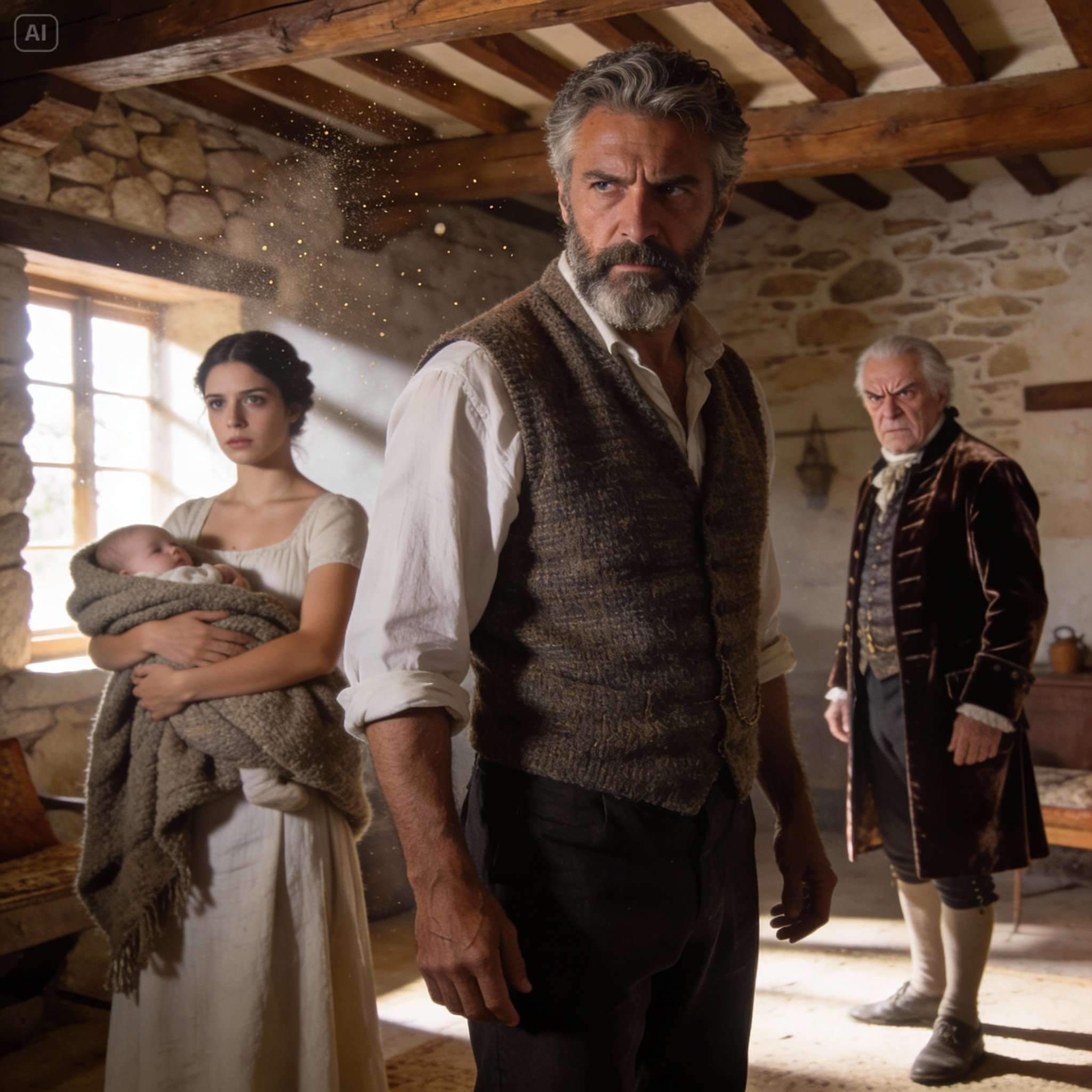
That morning, the house was utterly silent. I dressed in the dim light, declining the valet my station would have warranted. Thick wool trousers, well-worn leather boots, a white linen shirt, and my old leather waistcoat. I preferred the feel of reality, not the silk of fantasy.
I went down the stone stairs, feeling the cold seep through the soles of my boots. In the kitchen, the smell of toast and brewed coffee already filled the air. There was Constanza, my older sister.
“Good morning, brother,” she said without looking up from her ledgers. Constanza was efficiency personified. At forty-eight, she had renounced marriage to become the guardian of our home and our morals. She carried mourning in her soul and rigidity in her spine.
“Good morning, Constanza,” I replied, taking a piece of goat cheese and some bread. “Don’t wait for me for lunch. I’m going to check the northern boundaries. Last night’s frost might have damaged the old fences, and I don’t want the cattle to stray.”
She sighed, that characteristic sigh that mixed disapproval and resignation.
“You should send Vicente. You’re the boss, Alejandro, not a day laborer. You’re fifty years old, and the cold seeps into your bones.”
“Vicente has enough on his plate organizing the pruning crew,” I replied, finishing my coffee in one gulp. “Besides, I need some fresh air. Father always said the earth knows the boots of its owner.”
I left before he could reply. The outside air hit me like a slap. The sky was tinged with a pale violet, a prelude to a frosty dawn. I walked toward the stables, where the steam from the animals created a low, warm mist. There stood Trueno, my gray horse, looking up at me with his large, dark eyes. As I saddled him, I felt a strange pang in my chest, a disquiet I couldn’t quite put my finger on. Was it a harbinger of something? Or simply old age knocking at the door?
We rode north. The landscape was desolately beautiful. The winter wheat fields were covered in frost, shimmering like a sea of diamonds in the first rays of sunlight. The silence was absolute, broken only by the crunch of Thunder’s hooves on the frozen ground.
I had been riding for an hour, inspecting the dry-stone walls and wooden fences, when I reached the property line. There, the terrain became more rugged, giving way to a forest of holm oaks and cork oaks. In that area, there was nothing except an old tool shed that my grandfather had built and that had been abandoned for decades, its roof half-collapsed and its walls cracked.
That’s when I heard it.
At first I thought it was the cry of a bird of prey, or perhaps the moan of the wind seeping through the cracks of rotten wood. But the sound persisted, rhythmic, desperate. I stopped Trueno and strained to hear. The hair on the back of my neck stood on end.
It was crying. Human crying.
I jumped off, forgetting my age and my pain, and tied the reins to a low branch. I rode toward the shed, my heart pounding in my temples. The sound grew sharper, more heart-rending. It wasn’t possible. No one lived there. No one could live there in this weather.
I pushed open the door, which hung from a single rusty hinge. The metallic screech tore through the air. It took my eyes a few seconds to adjust to the dimness inside, where the only light filtered through gaps in the ceiling and walls.
What I saw stopped me in my tracks, freezing me more than the air outside.
In a corner, on a pile of damp, rotting straw, lay a huddled figure. It was a woman. Or what was left of her. She was wrapped in filthy rags, her matted brown hair falling over her face, and her lips had a bluish tint that chilled me to the bone. But the most shocking thing wasn’t her, but what she was protecting with her own body.
A baby. A small bundle wrapped in tattered cloth, whose face was red from the effort of crying.
The woman looked up when she saw me. Her large, sunken eyes, set in dark sockets, stared at me with utter terror. She cowered against the wall, clutching the child to her skeletal chest, like a wounded she-wolf defending her cub from a predator.
“Please…” Her voice was a broken whisper, barely a wisp of vapor in the cold. “Don’t hurt us. We’ll leave… we’ll leave right now.”
I froze. Human misery has a particular smell, a mixture of filth, disease, and fear, and that smell permeated the place. How could someone be dying like this in my land, a land of plenty?
I raised my hands slowly, showing my open palms.
“I’m not going to hurt you,” my voice came out hoarse, affected by emotion. “I am Alejandro de Alcántara, the owner of these lands. What are you doing here? How did you get into this?”
She was trembling violently. Not just from fear, but from hypothermia. The baby continued to cry, a faint sound indicating hunger and exhaustion.
“I had nowhere to go…” she sobbed, and the tears that ran down her dirty cheeks seemed to freeze. “I thought no one would come. We just wanted a roof over our heads. We haven’t stolen anything, I swear to the Virgin.”
“No one’s talking about stealing,” I said, taking a step forward. She tensed. “Girl, you’re going to die here. Tonight the temperature will drop even more.”
I took off my heavy wool coat lined with fur. Without thinking, I walked over and handed it to her. She looked at it as if it were an object from another world, unable to understand the gesture.
—Take it —I ordered gently but firmly—. Wrap the child.
With hands that felt like claws from the cold, she took the coat and wrapped it around the little one. The effect was almost immediate; the residual heat from my body and the thick wool began to soothe the baby.
“What’s her name?” I asked, kneeling at a safe distance.
—Amelia… Amelia Cortés. And he is Tomás.
—Amelia… —I repeated the name, feeling her weight—. Do you have any milk for him?
She lowered her gaze, embarrassed.
—My stomach has dried up… the hunger… the cold… I gave it water with some bread I found, but…
I didn’t need to hear any more. Rage and compassion mingled within me. Rage against whoever had left her in this situation, and compassion for that fragile life hanging by a thread. I knew what people would say. I knew what Constanza would say. A woman alone with a child, wandering the roads, was synonymous with dishonor in our rigid and cruel society. But at that moment, I wasn’t a nobleman worried about what others would say. I was a father. I was a man.
“Amelia, listen to me carefully,” I said, looking her in the eyes. “You’re not going to stay here a minute longer. You’re coming with me to the ranch.”
Her eyes widened in disbelief.
—Sir… I can’t. I have no money, I have no way to pay you. And the people… you are a respectable gentleman. If you take me…
“To hell with people,” I interrupted, surprising myself with my vehemence. “Do you think I’m going to let a child die on my land for fear of gossip? Can he even walk?”
She tried to get up, but her legs gave way. She was too weak. I went ahead and caught her before she fell. She was light as a feather, all bone and spirit.
“Let’s go,” I said, putting an arm around her shoulders to support her, while she clung to Tomás. “Thunder will take us.”
The ride back to the ranch was a haze of conflicting thoughts. Amelia sat in the saddle ahead of me, wrapped in my coat, with Tomás nestled between us. I could feel her trembling gradually lessening. I was in my shirt, exposed to the icy wind, but strangely, I didn’t feel cold. I felt an inner fire, a determination I hadn’t felt in years.
Upon arriving at the main courtyard of the hacienda, Pedro, the stable boy, ran out and was left speechless at the sight.
—Don Alejandro! But what…?
“Take charge, Pedro,” I ordered in my most commanding voice. “And keep your mouth shut. What you’ve seen doesn’t leave this room.”
I helped Amelia downstairs. In the daylight, her condition was even more pitiful. Her shoes were barely scraps of leather held together with string, and her dress was a patchwork of patches.
At that moment, the front door of the mansion opened. Constanza appeared in the doorway, impeccable in her dark morning dress. Her face went from surprise to indignation in a second.
“Alejandro…” Her voice was like a whip. “What does this mean? Who is this woman? And why are you half-naked and wearing… that?”
“This is Amelia, and her son Tomás,” I said, leading the girl toward the stairs, past my sister. “And ‘that’ is a human being, Constanza. They were dying in the old shed.”
“And you’ve decided to bring a homeless woman into our house?” she hissed, momentarily blocking my path. “Have you lost your mind? Think of the children, of our reputation.”
I looked into her eyes, those eyes that were so similar to mine.
“My sanity is intact, sister. What I would have lost if I had left them there would be my soul. Now, step aside. They need a warm room, broth, and clean clothes. And send for Rosa.”
Constanza pressed her lips together into a thin line, but pulled away. She knew when she couldn’t argue with me.
The next few hours were a whirlwind. We settled Amelia into a guest room in the east wing, away from the prying eyes of the day laborers. Rosa, our cook, a woman with a heart as big as her body, took charge with a maternal tenderness that touched me deeply. She made broths, heated water for bathing, and looked for old clothes that could be used.
I retreated to my studio, changed, and poured myself a glass of brandy. My hands were trembling slightly, not from the cold, but from the adrenaline. I had crossed a line. I had brought a stranger into my sanctuary.
That afternoon, after they had eaten and rested, I went to see her. The transformation was remarkable, though painful. Clean, dressed in a simple gray wool dress that had belonged to a former maid, Amelia looked like a different person. But the sadness in her eyes was deep, ancient.
She was sitting by the fireplace, rocking Tomás, who was now sleeping peacefully, clean and fed with goat’s milk.
“Don Alejandro,” he said, trying to get up.
“No, please, stay seated,” I said, taking a chair in front of her. “How are you feeling?”
“Thank you so much…” she whispered, her eyes filling with tears. “I can never repay you for this. You’ve given me back my life.”
“I don’t want payment, Amelia. I just want the truth. A young, capable woman doesn’t end up in a dilapidated shed on a whim. Where is her family? Where is the child’s father?”
She tensed and hugged the baby tighter. There was a long silence, broken only by the crackling of the wood in the fire.
“I’m from San Miguel de los Álamos,” he began, his voice trembling. “My father was a blacksmith. An honest man, but strict.”
San Miguel was two days’ journey away. Far away, but not far enough.
—And what about Thomas’s father?
Amelia closed her eyes and a single tear rolled down her cheek.
—His name was… his name is Álvaro. Álvaro de Guzmán.
I felt like I’d been punched in the gut. The Guzmáns. The richest, most powerful, and most arrogant family in the entire province. Don Fernando de Guzmán was a ruthless landowner, known for his cruelty in business and his obsession with lineage. His son Álvaro was a dissolute, handsome, and vain young man, with a reputation for leaving broken hearts in his wake.
“Álvaro de Guzmán…” I repeated, feeling the bile rise in my throat. “Does he know about this?”
“He… he promised to marry me,” she said, with a mixture of naiveté and pain that broke my heart. “He used to go to my father’s blacksmith shop. He told me I was different, that he loved me. I believed him, sir. I was foolish, I know. I gave him my virtue and my heart.”
He paused to catch his breath, as if the memory was taking away his oxygen.
—When I told him I was pregnant, he disappeared. I wrote to him, I begged him. He never answered. My father… my father went to the Guzmán ranch to demand honor. Don Fernando whipped him out, saying I was a… a harlot who wanted to steal his son’s fortune.
I could perfectly imagine the scene. Fernando’s arrogance, Álvaro’s cowardice.
“My father came back humiliated,” Amelia continued, sobbing softly. “He said I had sullied his name. When Tomás was born… he threw me out. He said he wouldn’t keep bastards. He gave me one day to leave. I’ve been walking ever since, begging, sleeping in haystacks… until I got here.”
Indignation boiled in my veins. A man of honor doesn’t do that. A man doesn’t seduce with lies and abandon his own flesh and blood.
“Amelia,” I said, leaning forward, “you are not to blame for the vileness of others. You have been brave in protecting your son.”
“I am a disgrace, sir. I know it. That’s why I can’t stay. As soon as I regain my strength, I will leave. I don’t want to bring shame upon your house.”
“This is my house,” I said firmly, “and whoever I choose lives here. You will stay here. You will work, if that makes you feel better. You will help in the kitchen, with the sewing. But you will never again go cold or hungry as long as I live. And as for the Guzmáns… may God have mercy on them if they cross my path, because I will not.”
She looked at me in disbelief, as if she were witnessing a miracle.
“Why?” he asked. “Why is he doing this for a stranger?”
I thought of Maria. I thought of how she always said that true nobility wasn’t in the coat of arms, but in the hands that help.
“Because it’s the right thing to do, Amelia. And because I believe God put them in my path for a reason. Maybe… maybe I needed to save them to save myself.”
The days turned into weeks. Amelia’s presence in the house was, at first, a source of tension. Constanza walked around with her lips pressed tightly together, monitoring Amelia’s every move as if she expected her to steal the money at any moment. But Amelia was hardworking, humble, and quiet. She rose before dawn to help Rosa, mended clothes with exquisite skill, and kept her room and the child spotless.
Little by little, the house began to change. The sound of a baby crying, which at first seemed strange to us, turned into babbling and laughter. Tomás was a robust and cheerful child, with large eyes that seemed to devour the world.
My children reacted in different ways. Mateo, at sixteen, was reserved like me, but I could see how he watched Amelia with respect. Carolina, fourteen, was fascinated by the baby. I often found her in the kitchen, playing with Tomás or helping Amelia feed him.
“Father,” Carolina told me one night during dinner, “Amelia taught me a new song on the guitar. She has a beautiful voice.”
“Oh, really?” I asked, feeling an unusual warmth.
—Yes. And she says that Tomás is almost crawling. He’s so smart…
Constanza cleared her throat loudly.
“You shouldn’t spend so much time with her, Carolina. Remember your position. She’s… well, she’s a domestic servant now.”
“She’s a person, aunt,” Carolina replied with a spark of rebellion that reminded me of her mother. “And she’s good.”
I smiled inwardly.
But all was not peace. Rumors began to circulate from the village. “The Lord of Alcántara has a concubine,” they said. “He’s lost his head over a beggar woman.” Some neighbors stopped greeting me as I left Mass. The parish priest looked at me disapprovingly. I didn’t care. For the first time in five years, I felt that my house had life.
And I… I found myself making excuses to slip into the kitchen, or the garden, when she took Tomás out into the sun. I liked watching the light play in her hair. I liked her quiet laughter. I liked the calm strength that emanated from her. It wasn’t just pity I felt; it was admiration. And something more dangerous.
One spring afternoon, three months after his arrival, I was in my study reviewing the accounting books when Vicente, my foreman, came in with a pale face.
“Don Alejandro,” he said, twisting his hat in his hands, “we have visitors. And they’re not good.”
-Who is it?
—Don Fernando de Guzmán. He’s here with his son and two armed guards. They’re in the courtyard.
I felt a sudden chill, followed by a burst of anger. I stood slowly, opening my desk drawer to make sure my old dueling pistol was there, loaded. I didn’t intend to use it, but it was reassuring to know it was nearby.
“Show them into the living room,” I ordered. “And tell Amelia not to leave her room under any circumstances. Put Pedro at the door of the east wing. No one is to go in there.”
I stepped out into the lobby just as the Guzmáns were entering. Don Fernando had aged, but his arrogance remained undiminished. He wore a velvet coat and carried a cane with a silver handle. Álvaro, his son, stood beside him, looking uncomfortable, his gaze shifty.
—Don Alejandro—said Fernando, without removing his hat—. I apologize for the intrusion, but we have an urgent matter to discuss.
“In this house it is customary to remove one’s hat and greet, Don Fernando,” I replied, remaining standing in the center of the room, without offering them a seat. “To what do I owe this honor?”
Fernando let out a dry laugh and took off his hat with a mocking gesture.
—Let’s get to the point. People in town are saying you have a woman here. Amelia Cortés. And a child.
“I have a housekeeper named Amelia,” I corrected coldly. “And your son lives with her. Is my domestic staff any of your business?”
—That child—Álvaro interjected, taking a step forward with feigned bravery— has my blood.
I looked at him with such deep contempt that the boy took a step back.
“Her blood?” I asked gently. “Curious. Amelia told me that when she asked for help, you denied that blood. You called her a liar and left her to die on the roads.”
“That was a misunderstanding,” Fernando grumbled. “We didn’t know… the circumstances. But now we know the child is a boy. A Guzmán. I won’t allow my grandson to grow up among pots and pans and dirty rags, raised by some whore.”
—That “woman” is the mother who kept him alive when you abandoned him—my voice began to rise—. What do you want?
“We want the child,” Fernando said, tapping his cane on the ground. “Álvaro will recognize him. We will raise him at the Guzmán Ranch as befits his lineage. We will give him my surname.”
“And the mother?” I asked, even though I already knew the answer.
“We’ll give him compensation,” Álvaro said, shrugging. “He can go to the city, start over. But the boy stays with us.”
I felt my blood boil in my temples. They wanted to take Amelia’s child away, not out of love, but out of pride, out of possession. They wanted an heir, not a child.
“Get out of my house,” I said, pointing to the door.
Fernando narrowed his eyes.
“Be careful, Alcántara. You don’t want me as an enemy. I have judges in my pocket. I have the mayor. If you don’t give me the child willingly, I’ll come with a court order. We’ll claim the mother is an immoral vagrant, and you… well, we’ll say you have her here for your depraved pleasures. I’ll ruin your reputation.”
I took a step toward him, invading his personal space. Despite my age, I was a man who worked the land; my shoulders were broad and my hands strong. Fernando was a man of the desk and excess.
“Listen carefully, Don Fernando. If you try to touch that child or his mother, if you try to defame me, you’ll discover that we Alcántaras have very deep roots and are made of very tough stuff. I’m not afraid of your judges or your money. Now, get off my property before I unleash the dogs.”
Fernando turned red with anger, but he saw something in my eyes that made him hesitate. He signaled to his son.
—This isn’t over, Alejandro. You’ll regret it.
They turned and left. I heard the clatter of their horses’ hooves before I could even breathe. I slumped into an armchair, trembling with rage. I knew it wasn’t an empty threat. They would be back. They would use the law, which was made by men like them for men like them. A poor, single mother didn’t stand a chance against a wealthy father claiming sudden “rights.”
I took the stairs two at a time and went to the east wing. Pedro stepped away from the door when he saw me. I went in without knocking.
Amelia stood by the window, pale as a ghost. She had heard the voices.
“They’re going to take him away…” she whispered, her voice breaking. “They’re going to take Tomás away from me.”
“No,” I said, closing the door behind me. “They won’t.”
“You don’t know Don Fernando. He’s capable of anything. He’ll bribe the judge. He’ll say I’m a lost cause. They have money, they have power… I’m nothing.”
She collapsed onto the bed, weeping with a despair that broke my heart. I approached her and, for the first time, dared to sit beside her and take her hands. They were ice cold.
—Amelia, look at me.
She raised her tear-filled eyes.
—There is a way. A way to stop them forever. The law favors the father, yes. But the law also respects marriage and legal adoption.
She looked at me, confused.
—Marriage? But… Álvaro will never marry me.
“I’m not talking about Álvaro,” I said, feeling my heart beat with a force I thought I’d forgotten. “I’m talking about myself.”
The silence that followed was absolute.
“Marry me, Amelia,” I continued, my voice firm. “If you are my wife, no one will be able to question your morality. And if I adopt Tomás as my legitimate son, as an Alcántara, Álvaro’s rights will be nullified. No judge will take a son from Alejandro de Alcántara to give him to a man who abandoned him.”
“Don Alejandro…” she withdrew her hands, frightened. “You can’t do that. You… you are a nobleman. I am the daughter of a blacksmith, a dishonored woman. It would destroy your life. Your sister, your children… the people… they will laugh at you. They will despise you.”
“Let them laugh,” I said, taking her by the shoulders again. “I’ve lived five years in a coffin of respectability and sadness, Amelia. Since you and Tomás arrived, I’ve felt the sun again. I’ve seen your strength, your kindness, your courage. I’m not offering you this just as a legal strategy.”
I swallowed, revealing my truth.
“I have a deep affection for you, Amelia. Admiration. And if you’ll allow me the boldness… I think we could be happy. I’m not asking for romantic love if you don’t feel it, but I offer you respect, protection, and a home forever.”
She looked at me, and I saw how disbelief gave way to something softer, warmer.
“Sir… Alejandro…” she whispered. “I… I’ve prayed for you every night. I’ve admired your kindness ever since that day in the shed. I thought a man like you was unattainable. Would you really do that? Would you risk everything for us?”
—For you, and for me. Because I don’t want to go back to being alone.
She let out a sob and threw herself into my arms. I hugged her, feeling her warmth, her scent of lavender soap and life.
“Yes,” she said against my chest. “Yes, I will marry you. And I will be the best wife a man could ever wish for. I swear it.”
The wedding took place three days later in the hacienda’s private chapel. It was a hurried but solemn ceremony. My old friend, Father Tomás (a coincidence that made us smile), officiated despite pressure from the local bishopric.
To my surprise, Constanza didn’t object. When I told her my plans and the threat from the Guzmáns, something in her rigid moral code kicked in. For her, family was sacred, and defending our own from an outside attack was paramount. Besides, I think deep down, she had grown fond of little Tomás. She even helped Amelia adjust her dress, a cream-colored gown we took from my mother’s trunks.
Mateo and Carolina were beaming. For them, it was a romantic adventure, a battle of good versus evil. Mateo served as my witness, and seeing the pride in my son’s eyes gave me more strength than any army.
When Amelia entered the chapel, simple and beautiful, her head held high despite her nerves, I knew I had done the right thing. I wasn’t just saving a child; I was reclaiming my own life.
The next day, I sent my lawyer to the city with the marriage papers and the formal adoption of Tomás de Alcántara. When Don Fernando received the news, they say he smashed a Ming dynasty vase against the wall. He tried to contest it, of course. There were months of tension, legal letters, and failed bribes. But I was Alexander of Alcántara, and now I had a reason to fight tooth and nail.
The scandal in the region was enormous. “The nobleman and the beggar woman,” they called us. Doors were closed to us. They stopped inviting us to dances and hunts.
And you know what? They were the happiest years of my life.
I discovered that society is fickle, but the love of a family is a solid rock. Amelia blossomed. She stopped being the frightened girl and became the lady of the house, managing with wisdom and treating the farmhands with a dignity they returned with absolute loyalty. Tomás grew up calling me “Dad,” and every time he did, it healed a part of my old heart.
A year after our wedding, in the middle of summer, Amelia gave me the news. We were sitting on the porch, watching the afternoon sun set over the olive trees.
—Alejandro—she said, taking my hand and placing it on her belly—. I think we’re going to have to enlarge the crib.
Tears streamed down my face without any shame. Nine months later, our daughter, Isabel, was born.
Life wasn’t easy. We had droughts, we had diseases, and we always had the shadow of other people’s envy. But every night, as I lay down next to Amelia, feeling her calm breathing and knowing that my children slept safely under my roof, I gave thanks for that frost of 1839.
I give thanks for the cold that forced me to seek warmth. I give thanks for the tears in the frost that awakened my sleeping heart. Because in saving them, it was truly I who was saved.
PART 2: THE HARVEST OF SILENCE
The months following our wedding weren’t marked by fireworks or grand public celebrations, but by a silent war, a battle fought with sidelong glances in the town square and venomous whispers behind the ladies’ fans at noon mass. Rural Andalusian society, so warm in its climate, can be icy in its judgment.
I vividly remember the first Sunday we went to church as husband and wife. I had insisted that Amelia wear her head held high. I bought her a dark blue silk dress, understated yet elegant, and a black lace mantilla that framed her face, which, thanks to good nutrition and peace and quiet, had regained a serene and luminous beauty.
The carriage ride was tense. Mateo, sitting opposite us, stared out the window with a frown, his fists clenched on his knees. Carolina, younger and more innocent, played with the ribbons on her dress, but she sensed the electricity in the air. Constanza, my sister, sat stiff as a post, quietly praying the rosary, preparing herself for the social battle that lay ahead.
“You don’t have to look at the ground, Amelia,” I whispered, taking her gloved hand. “You are the Lady of Alcántara. Your place is by my side, before God and before men.”
She squeezed my hand, searching for strength.
—I’m not afraid for myself, Alejandro. I’m afraid for you. I’m afraid that my presence will tarnish you in the eyes of your peers.
“My equals are not those who judge without knowing,” I replied firmly. “My equals are those who have honor. And in this region, they seem to be scarce.”
Upon reaching the church square, the usual bustle ceased as if someone had sliced the air with a knife. The groups of men smoking dark tobacco and discussing harvests fell silent. The women, clustered like colorful birds, turned their heads in unison.
I stepped out of the carriage first and offered my hand to Amelia. As her feet touched the cobblestones, I felt the weight of a hundred eyes upon us. We walked toward the portico. Don Fernando de Guzmán wasn’t there, but several of his associates were, minor landowners who depended on his favor. One of them, Don Luis de Vargas, spat on the ground just as we passed by.
Mateo made a move to stop, his face flushed with youthful fury, but I stopped him with a hand on his shoulder.
“Indifference is the greatest contempt, son,” I said softly. “We walked.”
We entered the cool, dark nave of the church. Our familiar pew, in the front rows, awaited us. I felt the emptiness around us. No one sat in the pews immediately next to ours. We were an island in a sea of hypocrisy.
Father Anselmo’s sermon, delivered by a man who had always feared the powerful more than God, was filled with veiled allusions to “purity of lineage” and the “danger of disordered passions.” Every word was a stone hurled at my wife. I kept my eyes fixed on the altar, feeling Amelia tremble imperceptibly beside me. I draped my arm behind her, over the wooden pew, in a possessive and protective gesture that scandalized the pious women in the third row.
As we were leaving, the incident occurred that would define our position for a long time. The mayor’s wife, Doña Elvira, crossed paths with us in the atrium. Amelia, in a gesture of innate courtesy, bowed her head slightly in greeting. Doña Elvira raised her chin, gathered her skirts as if afraid that contact with Amelia would soil them, and turned her face away with a theatrical expression of disgust.
That’s when Constanza, my sister, the guardian of traditions, did something that took my breath away. She stepped forward, blocking the mayor’s path.
“Doña Elvira,” Constanza said in a voice that echoed throughout the atrium, “I see your arthritis has worsened, as it prevents you from tilting your neck to return my brother’s wife’s greeting. You should take care of yourself; stiffness of the body is sometimes a reflection of stiffness of the spirit. And pride, if I remember today’s sermon correctly, is a deadly sin.”
The silence was deafening. Doña Elvira turned as red as a ripe tomato, mumbled something unintelligible, and hurried away. Constanza turned to us, winked discreetly, and said:
—Let’s go home. I’m hungry and Rosa has made stew.
That day I understood that, even if the outside world turned its back on us, within the walls of the Hacienda de Alcántara, we were invincible.
However, the social isolation had economic consequences. Some merchants, pressured by the Guzmáns, stopped buying our oil at the usual price. They tried to strangle us. But they underestimated two things: the quality of my product and the shrewdness of my new wife.
It was Amelia who, one night, while I was anxiously reviewing the account books, pointed out a mistake in our strategy.
“Alejandro,” he said, placing a cup of tea on my desk, “why do we insist on selling to local intermediaries? They’re afraid of Don Fernando.”
“It’s the way it’s always been done, Amelia. I have no other way of getting the oil to the city.”
“My father…” he began, then hesitated, as if afraid to mention his past. “My father, the blacksmith, sometimes did work for merchants who came from the north, from Madrid and beyond. They always complained that Andalusian olive oil passed through too many hands before reaching the capital, and that this increased the price and lowered the quality.”
I took off my glasses and looked at her with interest.
—Continue.
“If our neighbors won’t buy from us, let’s go after them. Vicente says this year’s harvest is exceptional. Why don’t we send Mateo to Seville or even Madrid with samples? If we sell directly to the big department stores in the capital, not only will we get a better price, but the Guzmáns won’t be able to interfere with our business. Their influence ends where the mountains begin.”
I stared at it, amazed. It was a risky idea, breaking with the local sales tradition, but it had an overwhelming logic.
“That would require organizing our own transport logistics,” I mused aloud. “Cars, guards for the roads…”
“We have the cars,” she said enthusiastically, her eyes sparkling. “And the day laborers are loyal. Many of them have cousins or brothers who could make the trip. Besides…” she smiled shyly, “I’ve been reviewing the kitchen and household expenses. I’ve found ways to save. We can use that money to finance the first trip.”
I got up and kissed her on the forehead.
—Amelia, you’re a box of surprises. Not only are you the queen of my house, but you’re going to be the salvation of my business.
And so we did. Mateo, proud of the responsibility entrusted to him, set off for Madrid with a convoy of our finest olive oil. Those were anxious weeks, waiting for news, fearing robbers or failure. But when he returned, he brought signed contracts with two of the capital’s most important suppliers and a bag of promissory notes that far exceeded our expectations.
The Guzmáns tried to blockade us locally, but when they saw our trucks leaving loaded for the north, they realized their siege had failed. Our prosperity became our greatest revenge.
But it wasn’t all business and social battles. In the privacy of our home, something much deeper was unfolding. The relationship between Amelia and the children blossomed in a way that healed old wounds.
Carolina, entering the difficult years of adolescence, found in Amelia not only a mother figure, but also a confidante. I remember one stormy afternoon, one of those that lash the south with thunder that makes the earth tremble. I found Carolina crying in her room, frustrated by an embroidery project she couldn’t finish and, I suspected, by some heartbreak typical of her age.
I was about to go in, awkward in my role as a widowed father, but I stopped when I saw that Amelia was already there. She sat on the edge of the bed, took the loom from Carolina’s hands, and with infinite patience, began to undo the knots in the thread.
“Life is like this thread, Carolina,” he said softly. “Sometimes it gets tangled and it seems like there’s no way forward. We pull and pull, and all we manage to do is tighten the knot. The secret isn’t strength, it’s patience. You have to find the right thread, let it go slowly, breathe… and start again.”
—But I’ll never get it right— Carolina sobbed. —I’m not like you or Aunt Constanza. I’m clumsy.
“You’re not clumsy, you’re passionate. And that’s a good thing. Look at my hands.” Amelia held out her hands, which, though well-cared for, still bore the subtle marks of years of hard work. “These hands have scrubbed floors, carried firewood, and endured the cold. And now they embroider silk. It doesn’t matter where you start or how many times you make mistakes. What matters is that you don’t put down the needle.”
Carolina rested her head on Amelia’s shoulder.
“I love you, mother,” the little girl whispered.
It was the first time he’d called her that. I saw Amelia’s back tense with emotion, and how she hugged Carolina with fierce strength. I walked away in silence, with a lump in my throat, thanking heaven for bringing that woman into our lives.
The most critical moment of that first year came not because of men, but because of nature. In late autumn, a fever epidemic struck the laborers’ barracks. It wasn’t the same fever that took Maria, but it was virulent. The men fell ill, unable to get up for the final olive harvest.
The town doctor, fearful of contagion and socially pressured not to treat “the plague victims” (as some cruelly began to call us), refused to come.
Vicente came to see me, desperate.
“Don Alejandro, half the crew is burning with fever. Their wives and children are falling ill too. If we don’t do something, they’ll die, and the harvest will be lost on the trees.”
I was getting ready to ride to the village and bring the doctor back at gunpoint if necessary, when Amelia appeared in the hall. She was wearing a thick apron over her dress and her hair was tied back in a practical scarf. Behind her, Rosa and two maids carried baskets of herbs, clean cloths, and bottles.
“Where are you going?” I asked.
“To the barracks,” she replied matter-of-factly. “My mother was a healer in her village before she died. I know remedies to bring down a fever: willow bark, thyme infusions, and good hygiene.”
—Amelia, it’s dangerous. You could get infected. Think of Tomás, of Isabel… —Isabel was just a baby back then.
“Tomás and Isabel will be fine with Constanza and Carolina. Those men and their families need help, Alejandro. They’re your people. They’re our people. I’m not going to sit around embroidering while they suffer.”
I couldn’t stop her. In fact, I went with her.
We spent three days and three nights in the workers’ barracks. Amelia was tireless. She cleaned up vomit, changed cold compresses, and forced robust, delirious men to drink her bitter concoctions. I watched her move among the straw and poverty with a grace no duchess could ever imitate. There was no disgust in her gestures, only an efficient and determined compassion.
One of those nights, while we were resting for a moment sitting on some fruit crates, Vicente approached. His eyes were red with tiredness, but he looked at Amelia with an almost religious devotion.
“Madam,” he said, taking off his cap, “my little boy has started sweating. His fever has gone down. You have saved his life.”
Amelia smiled, exhausted.
—Give him some broth as soon as he wakes up, Vicente. And make sure he doesn’t get cold.
“I swear on my life, Doña Amelia,” the foreman said gravely, “that as long as I am foreman of Alcántara, no man in these lands will allow anyone to speak ill of you. Anyone who disrespects you will have to answer to every one of us.”
When the epidemic passed, we didn’t lose a single man. And we gained something more valuable than the harvest: the unwavering loyalty of a hundred families. The rumors in the town could continue, the Guzmáns could conspire, but at the Alcántara Hacienda, Amelia wasn’t a “fallen woman.” She was “The Lady.” A saint who walked in the mud.
That experience cemented our marriage in a way that passion alone never could have. We had been comrades in arms. We had stared death in the face and made it blink.
One night, months later, we were in our room. Winter had returned, closing the cycle of the year. Amelia was brushing her hair in front of the mirror. I watched her from the bed, feeling a deep peace.
“Do you regret it?” I asked suddenly.
She stopped, holding the brush in the air, and looked at me through the reflection.
-About what?
—From this life. From the constant struggle. You could have sought an easier path, perhaps far from here.
She put down the brush, turned, and walked toward me. She sat on the edge of the bed and took my hand, that calloused hand of an old landowner.
—Alejandro, before I met you, my life was a dry leaf blown by the wind. I had no roots, no purpose, only fear. You gave me soil to take root in. You gave me a wall against the wind. The struggle… the struggle is what makes victory taste sweet.
He leaned in and kissed me, a slow kiss, full of promises and shared memories.
“Besides,” he whispered against my lips, “you’ve given me something I never thought I’d have. Honor. Not the honor of a family name, but the honor of knowing who I am and what I’m capable of.”
That night, as she slept beside me, I swore again that I would move heaven and earth to protect her. I didn’t know then that the past, like a storm that swirls and returns, was about to knock on our door once more, this time seeking not the mother, but the son.
THE SHADOWS OF THE PAST
Time in Andalusia has an elastic quality; summers stretch into endless siestas under the song of the cicadas, while the years fly by like swallows in spring. Eight years had passed since I found Amelia in the shed. Eight years of prosperity, of consolidation, and of a calm and mature love.
Tomás was almost nine years old. He was a bright boy, with sun-tanned skin and dark, intelligent eyes. Legally, he was an Alcántara, and I loved him as if he were my own flesh and blood. He called me father with a naturalness that filled my heart with pride. He knew nothing of his biological origins; for him, his story began on the hacienda, with a loving mother and a father who taught him to ride a horse and to distinguish the wheat from the chaff.
Isabel, our biological daughter, was seven years old and a whirlwind of laughter and black curls, the perpetual shadow of her older brother. They adored each other with that unique complicity that siblings who grow up happily share.
But peace is often the prelude to the storm.
It all began with the Seville Livestock Fair. It was the most important event of the year for the landowners of the south. For years we had avoided attending so as not to expose Amelia to the slights of high society, but Mateo, who was now twenty-four and taking on more and more responsibilities, insisted.
“Father, we can’t keep hiding,” he argued. “Our olive oil is famous in Madrid. Our horses are highly sought after. We need to show our strength. Besides, I want to present my own purebred Spanish horses.”
Amelia, always brave, supported Mateo.
“You’re right, Alejandro. The children are growing up. We can’t keep them in a glass bubble forever. Tomás wants to see the horses.”
I reluctantly agreed. We organized the trip with all the splendor the House of Alcántara could muster. New carriages, gleaming horses, and us dressed in our finest attire. I wanted it to be with envy, not disdain, if anyone looked at us.
The fair was a spectacle of color, dust, and noise. Stalls striped white and red, horsemen in riding outfits, women in frilly dresses. The aroma of manzanilla wine and fried fish filled the air. Tomás was fascinated; his eyes darted from side to side, absorbing everything.
“Father, look at that horse!” he shouted, pointing at a black stallion.
“It’s a good animal, son. But look at its hind legs, it’s angled slightly inwards. It’s not perfect,” I explained, enjoying watching him learn.
We were near the exhibition grounds when the encounter I had feared for almost a decade occurred.
A group of horsemen arrogantly pushed their way through the crowd. At the front rode a man I recognized instantly, though time had been harsh on him. Álvaro de Guzmán. He had put on weight, his face was puffy with wine, and his eyes had a murky gleam. Beside him, to my surprise, was not his father, Don Fernando (whom I knew was ill and confined), but a boy of about ten, riding a pony, dressed in extravagant finery.
Our eyes met. Álvaro stopped his horse abruptly. His gaze swept over my group: me, Amelia (who turned pale but kept her chin up), and finally settled on Tomás.
There was a moment of perverse recognition. Tomás had his mother’s features, but there was something in the shape of his jaw, in his gaze, that was undeniably Guzmán. Blood calls to blood, they say, even poisoned blood.
“Well, well,” Álvaro said in a thick voice, loud enough to make the onlookers stop. “The Alcántaras have come down from their mountain. And I see they’ve brought the whole… collection.”
I felt Mateo tense up beside me, ready to jump, but I put a hand on his arm.
“Good afternoon, Don Álvaro,” I said coldly. “If you’ll excuse us, we have matters to attend to.”
I tried to lead my family away, but Álvaro spurred his horse to block our path.
“That boy,” he said, pointing at Tomás with his riding crop. “He looks a lot like someone I know. What do you call him? Bastard? Or have you given him a dog’s name?”
Tomás, confused and frightened by the aggressive tone, clung to Amelia’s skirts.
“My name is Tomás de Alcántara,” said the boy in a trembling voice, trying to sound brave. “And my father is Don Alejandro.”
Álvaro let out a cruel laugh.
—Your father… Poor fool. Your mother is a whore who got into the old man’s bed to save herself from the stream, and you are the mistake she made before that.
The world stopped. Amelia let out a strangled scream and covered Tomás’s ears, but it was too late. The boy stared at Álvaro in horror, and then looked at me, searching for denial, for an explanation.
I didn’t think. The fury that seized me was cold, lethal. I loosed the reins of my horse, took two long strides, and grabbed Álvaro’s leg, pulling him with a strength I didn’t know I possessed at sixty years old. The Guzmán heir fell to the dust of the fairgrounds with a thud, losing his hat and his dignity.
Before he could get up, I was on top of him, my knee on his chest and my hand squeezing his neck. The fair’s guards rushed toward us, people were screaming, but at that moment, it was just him and me.
“Listen to me, you miserable piece of shit,” I growled in his face, so close I could smell the alcohol on his breath. “Come near my son again, insult my wife again, and I swear to God and the Devil I’ll kill you with my bare hands. I don’t give a damn about your name or your money.”
“Let him go! Civil Guard!” someone shouted.
Mateo was by my side, keeping Álvaro’s companions at bay with one hand on his knife.
“Back off!” my eldest son shouted. “It’s a matter of honor!”
I got up slowly, brushing the dust off my knees. Álvaro crawled backward, coughing, his face red with humiliation and fear. His own son, the boy on the pony, stared at his father on the ground, embarrassed for him.
“Let’s go,” I said to my family, regaining my composure.
We returned to the inn in silence. The damage was done. Tomás didn’t speak. He sat in a corner of the room, staring blankly into space.
That night I had the most difficult conversation of my life. Amelia was crying silently in the next room, feeling guilty, even though she wasn’t. I sat across from Tomás.
—Tomás—I said softly.
“Is it true?” he asked without looking at me. His voice was small and broken. “That man… is my father? Aren’t you my father?”
I felt like my heart was breaking. How do you explain the complexities of blood ties versus love to a nine-year-old?
“Look at me, son,” I asked him. He raised his moist eyes. “Being a father isn’t just planting a seed. Any animal can do that. Being a father is being there when you have a fever. It’s teaching you to ride. It’s worrying when you’re late coming home. It’s loving you more than life itself.”
I approached and took her hands.
“That man… he fathered you, yes. But he abandoned you. He left you out in the cold. Your mother saved you. And I… I chose you. I didn’t have to take you in, Tomás. I wasn’t bound by blood. I chose you because I saw my son in you. I gave you my surname because you are worthy of it. Blood makes you a relative, but loyalty and love make you family. You are an Alcántara. Do you understand?”
Tomás threw himself into my arms and cried all he needed to cry. He wept for the loss of a fantasy and the acceptance of a harsh reality. But when he calmed down, he had changed. He had lost some of his innocence, but he had gained a premature maturity.
“I don’t want to be a Guzmán,” he said fiercely. “I want you, Dad.”
—And I love you, son. Always.
However, Álvaro de Guzmán was not content with the public humiliation. His revenge was not a duel, for he was too cowardly for that. It was something more insidious.
A month after the fair, the water in our main irrigation canal stopped flowing. It was the height of summer, the critical time for the olive grove. If the trees didn’t receive water, the olives would dry out before ripening.
I went to inspect the main irrigation canal, which ran through communal lands but whose flow was controlled from a dam upstream… a dam located on land belonging to the Guzmán family. They had diverted the watercourse, claiming “urgent repairs.”
It was a death sentence for our harvest. Without water, we would lose all the year’s work. The olive trees would survive—they are hardy trees—but the economic ruin would be devastating.
“It’s an act of war,” said Mateo, banging his fist on the kitchen table. “We have to go there and break the dam. I’ll take the day laborers.”
“No,” Amelia said. She was standing by the window, looking out at the parched fields. “If we use violence, they’ll call the Civil Guard and throw you in jail. That’s what Álvaro wants. He wants to provoke you so he can destroy you legally.”
“So what do we do?” Mateo asked desperately. “Do we just watch the trees die?”
“No,” she said, turning with that steely gaze I so admired. “The water isn’t yours. The water belongs to the land. There’s an ancient royal edict, from the time of your grandfather, Alexander. I saw it in the archives when I was organizing the library last winter.”
—An edict?
—Yes. It grants the Alcántara estate perpetual water rights, above any other property, because these lands supplied the King’s army a hundred years ago. If that document is valid, Álvaro is violating a royal law, not just a local one.
We rushed to the library. We spent hours searching through yellowed papers and dusty files. It was Tomás who found it.
“Is this it?” he asked, holding up a parchment with a nearly disintegrated red wax seal.
I read it with trembling hands. It was true. We had absolute priority over the flow.
But being right and being recognized as right are two different things. We needed a higher authority to intervene, and quickly. The local judge was in the Guzmán family’s pocket.
“I have to go to Granada,” I said. “To the Royal Chancery. It’s the only court Don Fernando can’t bribe. But it will take me days. And trees don’t keep days.”
“Go,” Amelia said. “Mateo and I will make sure the trees survive.”
—What? There’s no water.
“We’ll do what was done before the dams,” she said. “We’ll carry water. We’ll form human chains from the lower river. It will be exhausting, day and night. But we’ll save the harvest.”
I set off for Granada with my heart in my throat. The journey was a nightmare of dust and haste. Upon arrival, I moved with the desperation of a shipwrecked sailor. I used old contacts, bribed secretaries, threatened, and begged until I finally secured an audience with a high-ranking magistrate.
When I presented the edict and explained the situation, the magistrate, a stern but fair man, was outraged by the blatant violation of a property right by a local chieftain. He signed an executive order for the immediate opening of the dam, under penalty of military intervention.
I returned to the hacienda accompanied by a detachment of soldiers that the magistrate had granted me to enforce the order.
What I found upon returning left me speechless.
It was night. Hundreds of torches illuminated the olive grove. Men, women, and children formed an endless human chain stretching from the river’s lower reaches, miles away, to the tallest trees. They passed buckets from hand to hand. Covered in mud and exhausted, they sang. They sang work songs to keep the rhythm going.
And there, in the middle of them, was Amelia. Her dress stained with mud, her hair loose, and her arms bruised, she passed around buckets like everyone else. Mateo was by her side. Even Tomás and Isabel were carrying small jugs of water to the thirsty workers.
When they saw me arrive with the soldiers, a shout of jubilation swept along the line.
We went to the Guzmán dam that same night. Álvaro tried to resist, shouting about his property rights, but when the captain of the soldiers showed him the royal order and put his hand on his saber, Guzmán’s courage evaporated.
They opened the floodgates. The sound of the water roaring into our canals was the sweetest music I had ever heard.
When I got home, I found Amelia sitting on the porch steps, too tired to move. I sat down next to her and put my arm around her shoulders.
—You did it—I told him. —You saved the estate.
“No,” she replied, resting her head on my shoulder. “We all saved her. They saved her”—she pointed toward the barracks where the day laborers were resting—”because they know we didn’t abandon them.”
That night, the Guzmáns lost much more than water. They lost the people’s fear. They had tried to dry us up, and they had only succeeded in making our roots grow deeper. And Álvaro, humbled by the law and by the strength of our unity, retreated into the shadows, defeated by a family he considered unworthy, but which possessed a nobility he would never know.
THE LEGACY OF THE OAK
The years passed, and with them, youth gave way to old age as summer gives way to autumn: gently, with golden hues and a cooler breeze. My hair turned completely white, and my hands, though still strong, began to tremble slightly after a long day. Amelia changed too; the lines around her eyes deepened, testament to shared laughter and worries, but her beauty acquired a timeless quality, a regal dignity that commanded respect from all who beheld her.
The Alcántara estate was at its peak. Mateo, now married with two young children, managed the daily operations with a blend of my prudence and modern innovation. He had introduced new pressing techniques that made our oil the purest in the region.
Tomás had returned from his studies at the University of Salamanca. He had become a handsome, serious, and brilliant man. He was a lawyer. He had decided to use the law—the same law that had once threatened to separate him from his mother—to defend the underprivileged. Seeing him in his office, surrounded by books, defending the rights of a day laborer against abuse, filled me with indescribable satisfaction.
At eighteen, Isabel was the free spirit of the house. She had inherited Amelia’s indomitable spirit. She rejected several wealthy suitors because, according to her, “they were looking for a dowry, not a companion.” Finally, she fell in love with the new village schoolteacher, a humble but cultured man, with whom she shared her passion for teaching the children of the workers to read.
Life was good. But fate always has one last twist.
One winter afternoon, much like the one when it all began, I received a letter sealed with the Guzmán coat of arms. The handwriting on the envelope was shaky, barely legible.
“Alexander of Alcántara. Come see me. I am dying. Fernando.”
Amelia read the note over my shoulder.
“You don’t have to go,” she said. “That man has only caused us pain.”
“He’s a dying man, Amelia. And death erases many grudges. Besides… I’m curious.”
I went to the Guzmán Hacienda. The place, which had once been a palace of opulence, showed signs of decay. The gardens were neglected, the paint peeling. Álvaro, the prodigal son, had squandered the family fortune on gambling and bad investments.
They took me to Don Fernando’s room. The old lion was reduced to skin and bones beneath the silk sheets. The room smelled of medicine and confinement. Álvaro was nowhere to be seen; he was probably in some brothel in the city, waiting to inherit what was left.
Fernando opened his eyes when he saw me. They were glassy eyes, but they still retained a glimmer of intelligence.
“You came…” he whispered.
—You called me.
—Sit down, Alcántara. I don’t have much time.
I sat down in a worn velvet chair.
—What do you want, Fernando?
The old man struggled to breathe.
“I’ve hated your last name my whole life. I envied you. Not for your money… I had more. I envied you because you had something I could never buy. Loyalty. True respect. My son… my son is a vulture waiting for me to stop breathing.”
He paused, coughing.
—I know that boy… Tomás… is my blood. I’ve been watching him from afar. I know he’s a lawyer. I know he’s a good man.
—He’s my son, Fernando. He’s an Alcántara.
“I know,” he said bitterly. “You won that battle long ago. But blood is thicker than water. I don’t want my lineage to end in the ruin that Álvaro will leave behind. I… I’ve changed my will.”
I tensed up.
—What have you done?
—I’m leaving the ranch to Álvaro. It’s unavoidable, the law requires it. But the cash, the investments abroad, the lands in the upper valley… I’m leaving those to Tomás.
I jumped to my feet.
—We don’t want your money. Tomás won’t accept it.
“It’s not for you. It’s for him. It’s my way of… atoning. Of acknowledging my mistake. That boy has the nobility my son lacked. Take him, Alejandro. Use him to expand your lands, to help your people… I don’t care. But don’t let Álvaro squander him.”
“Tomás will decide,” I finally said. “He’s a grown man. But I’m warning you, Fernando, money doesn’t buy forgiveness.”
“I’m not looking for forgiveness…” he murmured, closing his eyes. “I’m just looking for… a clean ending. Go now. I’m tired.”
Don Fernando died that night. When the will was read, Álvaro flew into a rage, threatened to contest it, and shouted curses. But Tomás, with his lawyer’s composure, reviewed the documents.
“We can reject him, Father,” Thomas told me that night. “I don’t want anything from that man.”
Amelia intervened.
—Tomás, that money was made at the expense of many people’s suffering. Your biological father and your grandfather exploited these lands. Perhaps… perhaps you can use that money to give something back. To do the good they didn’t do.
Tomás thought about it for a long time. Finally, he accepted the inheritance. But he didn’t buy himself any luxuries. He used the money to build a larger school in the village, where Isabel could teach. He financed a modern irrigation system for all the farmers in the valley, not just for us. And he created a fund to help single mothers in difficult situations. He named the foundation “Casa Amelia.”
It was the perfect closing of the circle. The Guzmán family’s hatred was transformed into love through the hands of the son they had despised.
The final years of my life were utterly peaceful. I liked to sit under the old oak tree near where the shed had once stood. That shed was gone now; in its place, Amelia had planted a garden of wild roses.
One afternoon, at eighty years old, I felt my strength failing me. There was no pain, only immense weariness, like that of a farm laborer after the harvest. I was in my bed, surrounded by pillows. The windows were open, and the scent of orange blossom drifted in.
My whole family was there. Mateo, strong and gray-haired. Carolina, sweet and maternal. Isabel, with her own children. And Tomás, holding my hand tightly.
But my eyes were only looking for one person.
Amelia sat down next to me. Her hair was as white as snow, her face a map of our life together.
“Don’t be afraid, Alejandro,” she whispered, stroking my forehead. “Everything is fine. The harvest is safe.”
“Amelia…” my voice was a whisper. “That day… in the cold… I thought I was saving you. But you saved me. You taught me how to live.”
“And you taught me how to love,” she replied, tears glistening in her clear eyes. “Rest now, my love. We’ll see each other soon.”
I looked around. I saw the faces of my children and grandchildren. I saw the legacy of love, honor, and hard work I was leaving behind. I wasn’t leaving an empire of money, but a bastion of values. I had defied convention, risked my reputation, and gained everything worth having.
I closed my eyes. The last thing I felt was the warmth of Amelia’s hand in mine, and the last thing I heard wasn’t a baby crying in the cold, but the laughter of my grandchildren playing in the garden. Winter was over for good.
END