700 BROTHERS OF STEEL: THE BOY WHO ENTERED HELL AND THE SILENT ARMY THAT PROTECTED HIM AT DAWN
Heat has a taste. People think it’s only felt on the skin, that it’s something external that hits you like the August sun in the Plaza Mayor at midday, but they’re wrong. Real heat, the kind that precedes disaster, tastes like old copper and burnt dust. It tastes like danger.
I smelled it before I saw it. I was walking down one of those narrow alleyways on the outskirts of Carabanchel, where the old brick buildings huddle together as if they were cold, though that night the air was stagnant, heavy. My backpack was slung over one shoulder, my faithful companion for the last three years, ever since I decided the street was safer than my stepfather’s house. Inside were my usual things: a change of socks, half a pack of Maria cookies, a water bottle refilled at a public fountain, and my freedom. A small thing to the world, but everything to me.
It was almost two in the morning. At that hour, Madrid usually sleeps a restless sleep, but the silence on that street was different. It was a tense silence, the prelude to a scream.
I stopped dead in my tracks. The smell had changed. It wasn’t just the usual stench of garbage containers and hot asphalt anymore. It was thick, bitter. It got stuck in my throat and scratched before settling in my lungs. I looked up. In the reflection of the broken windows of an abandoned building in front of me, I saw the pulse. Orange. Alive. Hungry.
And then, the scream.
It wasn’t a scream from a movie. It wasn’t a clear, articulated “Help!” It was a sharp, broken shriek, the sound of someone who’s realized their breath is running out and death is coming for them. It came from the house wedged between two closed industrial buildings at the end of the block. An old structure, with wooden beams and cheap insulation, the kind of place fire loves.
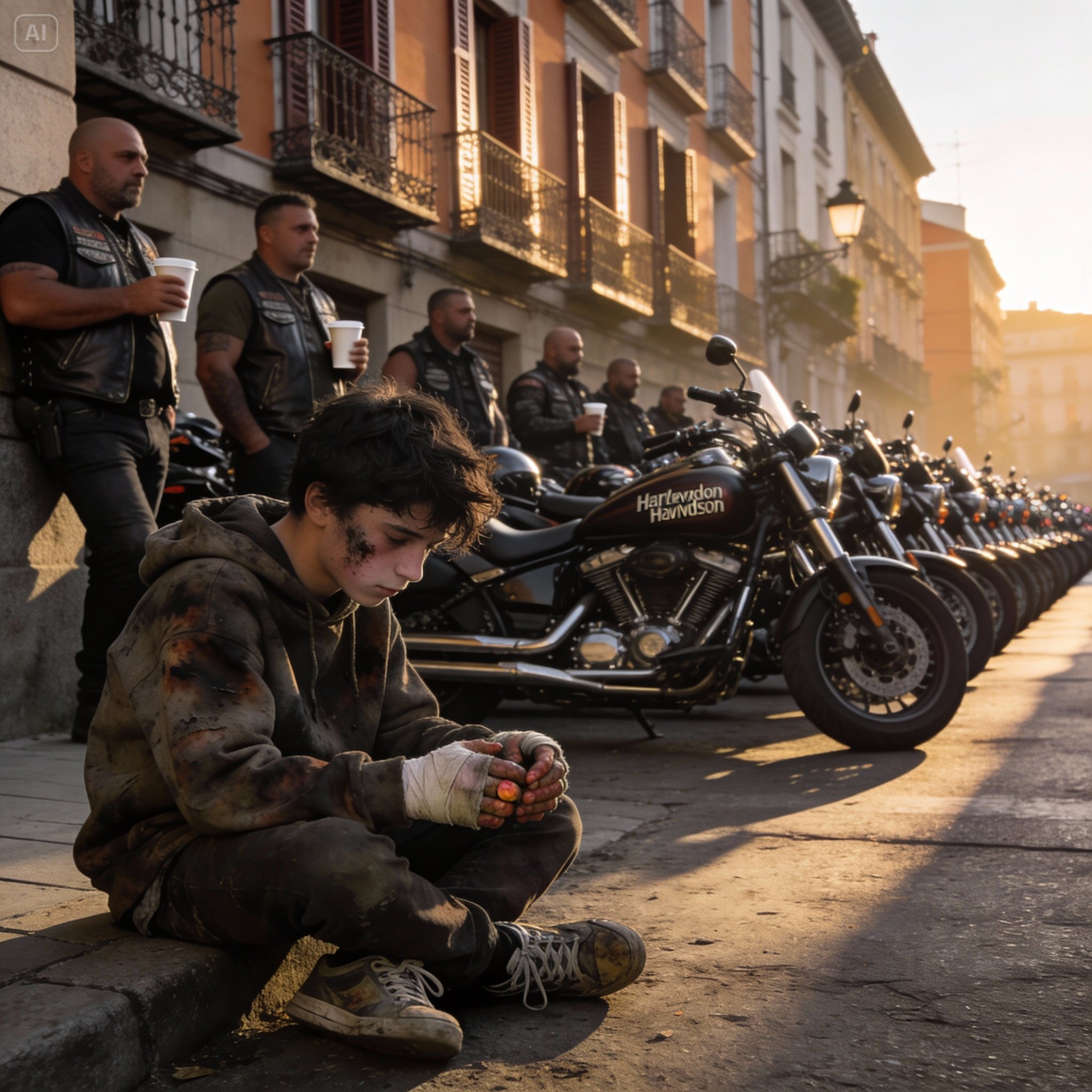
The flames were already pushing through the second-floor windows, rolling into the night as if they’d been waiting for permission to go out dancing. People were already outside. Neighbors in pajamas, their faces illuminated by the orange glow, pulling out their cell phones. Always their cell phones. Someone was shouting that the firefighters were on their way.
“They’re taking too long!” squealed a woman with curlers, clutching her chest.
No one was going in. I knew why. The survival instinct is a selfish beast. It tells you to stay put, to record, to watch, but not to move. You don’t go into a burning house unless you have a fireproof suit or unless your life is worth so little that you don’t care about losing it.
I didn’t think. Thinking is a luxury for people who have future plans. I only had the present, and the present was burning.
I dropped my backpack. It fell to the ground with a thud that I didn’t even hear over the roar of the fire. My feet moved on their own, my worn sneakers hitting the pavement. The front door wasn’t hot; it radiated a thermal fury I could feel from six feet away. I wrapped my right hand in the sleeve of my sweatshirt—too big, too dirty, my armor—and pushed. It didn’t open.
“Come on!” I growled, and kicked it right below the lock.
The old, dry wood gave way with a creak that sounded like a gunshot, sending a shower of sparks into the dark hallway.
The smoke hit me like a solid wall. It was a physical punch. It blinded me instantly, filling my mouth with the taste of melted plastic and old paint. I instinctively ducked, searching for cleaner air near the ground, coughing so violently I felt something tearing in my chest.
“Hey!” I shouted, my voice sounding strange, small against the monster’s roar. “Where are you?!”
No one answered. Only the creaking of dying wood and the sound of shattering glass somewhere above.
The wooden floor creaked beneath my weight. I crawled forward, one hand on the hot wall, the other sweeping the floor in front of me. Flames were licking the ceiling now, orange and blue tongues racing faster than anyone could move. It was unbearably hot, a heat that dried my eyes and made my skin feel tight, on the verge of cracking.
Then I heard it again. A cough. Wet, panicky, close. Very close.
“Stay there!” I yelled, spitting black saliva. “Don’t move!”
I turned the corner of the hallway and saw her.
She was a child. She couldn’t have been more than twelve. She was huddled at the bottom of the stairs, curled up in a ball. Her dark hair plastered to her face with sweat and soot. Her eyes were like two enormous white saucers, filled with an absolute terror that pierced your soul. One arm was wrapped around her ribs, as if it hurt to breathe; with the other hand, she scratched uselessly at the floorboards.
She looked at me, and I swear she saw me dead. She looked at me as if I were a final hallucination before the darkness claimed her.
“No… I can’t breathe,” he said in a voice that was little more than the scraping of sandpaper.
“I know,” I said, crawling up to her. “I’ve got you. Let’s go out.”
At that moment, something above us creaked with a terrible sound, like a giant’s bone breaking. A beam, perhaps. The house groaned. It was tired of holding itself up.
There was no time to be gentle. I slipped one arm under her knees and the other around her back. I stood up. She screamed, a short, sharp sound, when I moved her.
“I’m sorry,” I gasped, the smoke burning my throat. “I’m sorry, I’m sorry.”
She weighed little, but in that inferno, every kilo felt like a ton. Her weight collapsed on me, a dead weight, the smoke stealing what little strength she had left. My arms immediately began to burn. It wasn’t the muscular effort; it was the embers falling from the ceiling, biting through the fabric of my sweatshirt, seeking my skin.
I turned towards the door.
He was gone.
Or rather, the path to her had vanished. The corridor she had entered through was now a tunnel of fire. Flames crawled up the walls, the wallpaper curled and blackened in seconds, and the ceiling dripped something that looked like liquid fire. Molten plastic.
The heat was unbearable. It was a living, heavy thing, pressing against my shoulders, whispering in my ear that I was stupid, that I should let go, that I should try to save myself. That no one would miss me. Mateo, the boy with no last name, the boy with the backpack, ash among ashes.
I didn’t let go of her.
I lowered my head, pressed the girl against my chest to protect her face, and ran.
Every step felt wrong. Too slow. Too heavy. My lungs burned as if I’d swallowed hot coals. My vision narrowed, black dots blooming at the edges of my sight, dancing with the orange of the fire. I focused on one thing. Don’t let go. Don’t let go. If you fall, fall forward.
The stairs behind us collapsed with a crash that shook the foundations. I felt the shockwave of heat pushing against my back.
The front door frame was half-fallen inward, blocking the exit. Through the barely visible smoke, I saw the blue streetlights. The real world. The cold world.
I coughed violently, almost bending at the waist, but I maintained my grip.
“Hold on!” I shouted, although I don’t know if he heard me.
I lunged toward the remaining gap. My shoulder hit the burning wood of the frame. Pain. Pure and white. But we made it through.
I stumbled toward the sidewalk, and the cool night air hit my lungs like a hammer blow. I fell hard to my knees on the cold asphalt, still holding her. My body was shaking uncontrollably, a vibration that seemed to come from my bones.
“My God!” someone shouted.
Hands. Hands everywhere. Pulling, grabbing.
—She has her! She’s taken the girl!
Someone took it from my arms.
“No…” I tried to say, but the word broke off in a coughing fit that made me see stars.
As they lifted her to place her on the sidewalk, the girl stretched out a weak hand toward me. Her fingers brushed against my burned sleeve.
“He wouldn’t let go of me…” she whispered. Or at least that’s what I thought I heard amidst the din.
The sirens were wailing now, deafening. Red and blue lights bathed the street, making everything look like a strobe-lit nightmare. Firefighters ran past me, heavy boots pounding the ground, voices high and urgent, hoses slithering like giant snakes.
Someone tried to help me up. A paramedic, maybe. Or a police officer.
—Hey, kid, are you okay? Let me see those hands.
That was the moment. It’s always the moment.
Questions mean names. Names mean records. Records mean the system. Social Services. Juvenile detention centers with bars on the windows and roommates who steal your slippers while you sleep. It means losing the freedom I fought so hard to win. It means becoming just another number in a file.
I pulled away abruptly.
“I’m fine,” I croaked.
I stood up, unsteady on my feet. My head was spinning, the world seemed to be turning on a tilted axis. My arms were a map of pain, my skin blistered and red. My lungs were pure fire.
But no one was really looking at me. Everyone was focused on the little girl, on the house that was now roaring like an oven, on the organized chaos that makes sense to normal people.
I stepped back. One step. Two. I blended into the crowd of onlookers. Then into the side alley. Then into the darkness.
By the time the first hose released its jet of water and the fire hissed furiously, I was already gone.
I didn’t know the girl’s name. I didn’t know who her father was. I didn’t know that, at dawn, seven hundred Harley-Davidsons would circle the block, their engines silent and their riders shoulder to shoulder.
I only knew one thing: I hadn’t let go of her.
The wind hit me too late. That was the problem. I didn’t feel relief when I left the house. I felt shock.
My lungs closed up, trying to decide whether to breathe or keep burning. My arms closed around the empty space where the girl had been a second ago, my fingers clawing uselessly at the air. They had taken her from me.
I slid down against a brick wall in an alley three blocks away. I slid to the ground, my ass hitting the dirt and trash.
—Fuck… fuck… —I gasped.
I looked at my hands. In the pale light of a distant streetlamp, they looked like claws. The fabric of my sweatshirt had fused to my skin in places. There were coin-sized blisters on my knuckles. Red, ugly, throbbing.
The pain came then. Not the dull ache of adrenaline, but the sharp, screaming pain of my nerves awakening. I clenched my teeth until my gums ached to keep from screaming. Screaming attracts attention. Attention is dangerous.
I took off my sweatshirt with agonizingly slow movements. The fabric peeled off with a wet sound that made my stomach churn. I was left in my t-shirt, shivering in the Madrid night, even though my skin was burning.
I had to move. I couldn’t stay there. The smell of smoke clung to me like a second skin. I was a beacon. Anyone who passed by would know where I’d been.
I stood up, using the wall for support. My legs felt like jelly. I walked toward the river, the Manzanares. Down there, near the old bridges, were places where one could disappear. Where the water carried away smells and secrets.
As I walked, limping, trying to look normal every time a patrol car passed, my mind replayed the scene on a loop. The girl’s eyes. The creaking of the roof. The weight of her body.
Why had he done it?
The number one rule of the streets is: look after your own ass. Nobody else will.
He had broken the rule. And now he was hurt, visible, and vulnerable.
I reached the riverbank as the first light of dawn began to paint the sky a dirty gray. I sat down beneath the Segovia Bridge, where the shadows are long and deep. I crawled to a corner where I had hidden a bottle of water and some Betadine I had stolen weeks before.
Cleaning my wounds was private torture. I poured water over my hands, biting down on a piece of wood to keep from howling. The water came out black, full of soot. Then the Betadine. That was worse. It was like liquid fire.
I wrapped my hands in clean pieces of my own t-shirt, tearing them with my teeth. It was a mess, but it was better than nothing.
I lay back against the cold concrete. Don’t sleep, I told myself. Don’t sleep. If you sleep, they’ll find you.
But the body has its limits. Exhaustion dragged me down, into a dreamless darkness.
On the other side of the city, at La Paz Hospital, the emergency room doors suddenly opened.
The stretcher rolled in at full speed. Doctors and nurses moved with choreographed precision. Bright lights. Beeping machines.
—Twelve-year-old girl, severe smoke inhalation, possible rib fractures, first and second degree burns on extremities! —a paramedic shouted.
The girl, Lucia, drifted in and out of consciousness. The oxygen mask fogged up with each shallow breath.
“Did he say anything?” a doctor asked as they cut off his burned clothes.
The paramedic nodded, his face smeared with soot. “He asked about the boy.”
—Which boy?
—The one who took her out. He said he stayed.
In the waiting room, a man stood. He hadn’t sat down since receiving the call. He wore a leather jacket with a club patch on the back, worn from thousands of miles on the road. His hands were in his pockets, clenched into fists so tight his knuckles were white.
Diego “The Bear” Martinez wasn’t a man who was easily frightened. He had seen fights, accidents, and icy roads. But his neighbor’s call screaming that her house was on fire, that Lucia was inside… that had chilled him to the bone.
A nurse came out through the swinging doors. “Family of Lucía Martínez?”
Diego took two strides forward. “I’m her father. Is she alive?”
The nurse nodded, her eyes tired but kind. “She’s alive. She’s stable. We intubated her as a precaution because of the smoke, but her vitals are good. She has burns, but they’ll heal.”
Diego let out a breath he hadn’t realized he’d been holding. His shoulders dropped two centimeters. “Thank God.”
“And thanks to whoever got her out,” the nurse added. “The firefighters say if she’d been there one more minute… the corridor ceiling collapsed right after they got out.”
Diego frowned. “Who was it? The neighbors said the firefighters hadn’t gone in yet.”
“We don’t know,” the nurse said, looking at her notes. “A young boy. A teenager. Witnesses say he came in, took her out, and then… disappeared.”
—Did he disappear?
—He left. He was hurt, for sure. He had to be. But he didn’t stay to get medical attention.
Diego ran a hand over his face, scratching his stubble. A boy. A stranger. He went through hell for his daughter and left without even saying thank you.
“I want to find him,” Diego said. His voice was deep, like the low rumble of an engine. “I need to find him.”
“The police are looking for him, I suppose,” the nurse said. “To take a statement.”
Diego shook his head slightly. The police wouldn’t understand. The police would be looking for a hero or a criminal. Diego was looking for a savior.
He took out his phone. He dialed a number. Not the emergency number. “Paco. Wake the boys up. All of them.”
“What’s wrong, Chief?” the voice on the other end sounded sleepy but alert.
—Lucía is okay. But she’s gone from the house. A kid took her. A stranger. He’s hurt and he’s out there all alone. I want you to find him before the police do.
-So that?
—To thank him. And to make sure no one bothers him.
—How many should I call?
Diego looked through the hospital’s glass doors into the fading night. “Everyone, Paco. Call everyone.”
I woke up to the sound of the city waking up. Cars, buses, the distant murmur of normal life. The sun was already high, hitting the river water and hurting my eyes.
The pain returned suddenly. My hands were two blocks of throbbing agony. I was thirsty, with a dry, rasping thirst that reminded me of smoke.
I sat down, groaning. My back cracked. I felt like I’d been beaten up by five people.
I had to move. Staying still in broad daylight is dangerous. People see a dirty kid, with burned clothes and hands wrapped in rags, and they call the police. “For your own good,” they say. And then they put you in the system, and that’s it.
I put on the sweatshirt, even though it hurt against my skin. I pulled up the hood. Head down. I walk quickly. Invisibility is an art. Don’t look people in the eye. Walk with purpose, as if you were going somewhere important.
I headed towards a soup kitchen I knew in the Tetuán neighborhood, far from the site of the fire. Perhaps I could get something to eat and some clean bandages without too many questions.
But the city felt strange. There was a different hum in the air.
I walked past a bar with the television on. The morning news. I stopped for a second, pretending to tie my shoelaces—an impossible task with my hands—to listen.
“…fire in a single-family home in the southern district. A minor miraculously rescued…”
I kept walking. Miraculously. There was no miracle. There was pain, fear, and stupidity.
I crossed a large avenue and then I heard it. The sound.
It wasn’t a car. It wasn’t a truck. It was that deep, guttural sound you feel in your chest before you hear it with your ears. The sound of an American V-Twin engine. And then another. And another.
I looked towards the intersection.
Three motorcycles drove by. Big, black, chrome. The guys riding them wore leather vests with patches on the back. “Asphalt Wolves,” “Sons of the Wind,” names like that. They weren’t going fast. They were going slowly, in formation, occupying the lane with an authority that no one questioned.
People on the sidewalk stopped to stare. “What’s going on today?” a man in a suit asked next to me. “Is there a protest?”
I didn’t answer him. I kept walking.
But two blocks further on, I saw more. Groups of five, of ten. All converging in the same direction. North. Toward the hospital.
My heart leapt. Did they know who I was? Were they looking for me? Panic is a swift beast. I imagined that perhaps the fire had somehow been my fault, or that they thought I had started it. The guilty mind—even if you’re not guilty of anything—always thinks the worst.
I went into a park, seeking the shade of the trees. I sat on a secluded bench, hugging my knees, trying to control the trembling of my hands.
Some kids walked by, looking at their phones. —…I swear, man, they say there are like five hundred motorcycles surrounding La Paz. It’s crazy. They say they’re protecting something.
—Protecting what?
—No idea. But the police don’t even dare to fine them for illegal parking.
La Paz. The hospital.
I froze. They were there. Where the girl was.
Because?
Hunger gnawed at my stomach, but curiosity and fear were stronger. I had to know. But I couldn’t go near it. It would be suicide.
Hours passed. The midday sun in Madrid is unforgiving. I was sweating under my sweatshirt, the sweat stinging my sunburn. I felt feverish. Infection, my brain thought. Great. Just what I needed.
I needed antibiotics. I needed water. I needed to stop being myself for a while.
Around four in the afternoon, I couldn’t take it anymore. I went to a pharmacy. I went in, trying to hide my hands in my pockets.
“Do you have… do you have anything for burns?” I asked the girl behind the counter. My voice sounded awful.
She looked at me. She really looked at me. She saw the soot I hadn’t been able to completely remove from my face. She saw the singed sweatshirt. She saw the trembling.
“Let me see,” he said, his tone changing from professional to concerned.
—Just sell me something cheap. I have… I have three euros.
She came out from behind the counter. “Show me your hands, kid.”
I hesitated. If I had a problem, I would call 112.
“No, it doesn’t matter,” I said, and turned to leave.
“Wait!” she said. “I’m not going to call anyone. I just want to help. You sound like the guy on the news.”
I stopped dead in my tracks. My hand on the doorknob. “What news?”
—They say they’re looking for a boy. The one who took the biker gang leader’s daughter.
The world stopped. The biker boss’s daughter?
I turned around slowly. “What?”
“On TV,” she said, pointing to a small screen in the corner. “They’ve surrounded the hospital. They say they won’t move until they know the boy who saved her is okay. They say he’s one of their own, out of honor, even though they don’t know him.”
I stared at the screen. The aerial images were breathtaking. The hospital, a giant block of concrete and glass, was surrounded by a river of steel and black leather. Hundreds of motorcycles. Parked on sidewalks, in bus lanes, in plazas.
There was no violence. There were no banners. Only presence. Hundreds of men and women stood with their arms crossed, waiting.
“Seven hundred Harleys at dawn…” I murmured, recalling something I had once read in a book about knights of old.
“Is that you?” the pharmacist whispered.
I looked at my hands wrapped in dirty rags. I looked at the girl. She had the phone in her hand, but she wasn’t dialing. She was waiting.
“No,” I lied. I had to lie. “I just burned myself cooking.”
I left the pharmacy before he could say anything else. I ran. I ran until I was out of breath.
The daughter of a biker boss.
He had saved the princess from a kingdom of asphalt and gasoline. And now the army was encamped, waiting.
Waiting for what? To give me a medal? Or for me to show up and ask questions I didn’t want to answer?
I hid in an abandoned construction site near Plaza de Castilla. From the top floor, I could see the hospital towers in the distance. They looked small from up there, but the gleam of the chrome in the sunlight was unmistakable.
It was a fortress. And I was outside.
My fever spiked as night fell. My hands throbbed with their own rhythm, thump, thump, synced with my heartbeat. I felt both cold and hot at the same time. I curled up in a corner, on top of some empty cement sacks.
I dreamed of fire. I dreamed that the hallway stretched out and never reached the door. I dreamed that the girl was so heavy she dragged me to the floor and we burned together.
I woke up with a light shining in my face.
It wasn’t the sun. It was a flashlight.
I jumped up, ignoring the dizziness, backing away until my back hit a concrete pillar.
“Relax,” said a voice. Deep. Hoarse.
I lowered my hand to shield my eyes. There was a silhouette behind the light. Large. Broad. Leather jacket.
“Don’t come any closer,” I warned. My voice was a pathetic squeal.
—I’m not going to hurt you, kid.
The man lowered the flashlight so it wouldn’t blind me. He had a gray beard, a scar on his eyebrow, and a look that said he’d seen all the bad things in the world and decided to keep going. His vest said “Sergeant-at-Arms.”
“How did you find me?” I asked.
“The girl from the pharmacy,” he said. “She’s my niece. She called me. She said a boy with ghostly eyes and burned hands came in asking for priests.”
“It’s not me,” I said automatically.
The man laughed. It was a soft laugh, not mocking. “You smell like smoke from here, son. And like fear.”
He took a step forward. I tensed up to run, but there was nowhere to go. I was on the fifth floor with no stairs in sight, just the shaft he’d climbed through.
“My name is Paco,” he said. “The girl’s father is Diego. He’s my brother. Well, not by blood, but more than that.”
“I don’t want any trouble,” I said. “I don’t want any rewards. I don’t want anything. I just want you to leave me alone.”
“I know,” Paco said. “That’s what we told the police. That if they found you, they were going to scare you. That they were going to put you in a center and throw away the key. We know what that’s all about. Many of us have been where you are.”
He crouched down, getting down to my level, though he kept his distance. “Look, the hospital is surrounded. The police can’t move without running over a motorcycle. The journalists are like vultures. If you go down there alone, they’ll eat you alive.”
“Then I won’t go down,” I said.
“And you’ll die here from an infection,” he said, pointing at my hands. “It’s starting to smell bad, kid. Gangrene. If we don’t treat that tonight, you’ll lose your fingers. Maybe your hands.”
I looked at my dirty bandages. He was right. I could feel it in my blood. The poison was already flowing.
“If I go to the hospital, they’ll take my name,” I said. It was my mantra.
Paco shook his head. “Not if you come in with us.”
-That?
“We have a deal. Well, more like a demand. We’ve blocked the hospital all day. The director is on edge. The police are negotiating. We’ve said we’ll leave and clear the street on one condition.”
-Which?
—The boy who saved Lucía should be treated like a king, no questions asked, no names, no ID, no social services. He comes in, they treat him, and he comes out with us. Under our protection.
I stared at him. It seemed like a twisted fairy tale. “Why would you do that for me?”
Paco grew serious. His face hardened, but his eyes shone. “Because you came in when no one else did. Because you didn’t let go of her. Because you’re one of us, even if you don’t have a motorcycle. You know the code.”
He stood up and held out his hand. A huge, calloused hand, covered in grease and scars. “Come on, kid. There are 700 brothers waiting to escort you. Nobody’s going to touch you. I give you my word. And a Wolf’s word is worth more than any law in this city.”
I looked at her hand. I looked at my broken hands. I looked at the city at my feet, full of cold, indifferent lights.
I could stay there and rot. Or I could trust the leather monster.
I got up. I felt dizzy. Paco caught me before I fell.
“I’ve got you,” he said. The same words I had said to the girl.
—Okay —I whispered—. Okay.
We went down in silence. Down below, in the street, a motorcycle was waiting. A black, chrome beast. Paco got on and told me to get on the back.
“Hold on tight,” he said. “We’re going to make some noise.”
The engine started. The roar vibrated in my bones, but this time it didn’t scare me. It gave me strength.
We went out onto the Castellana. The night air hit my face, washing away the smell of smoke.
When we approached the hospital, I saw him.
It was incredible.
The entire street was a sea of motorcycles. Hundreds and hundreds of them. And in the middle, a clear corridor. An honor lane.
When Paco walked down the corridor, something happened that I will never forget.
In unison, as if from a single mind, 700 engines started.
BRUMMMMMMMMMMMMM.
The sound was physical. It was a thunderclap rising from the ground. It wasn’t aggressive. It was a greeting. A roar of respect.
We rode through the rows of bikers. Bearded men, women with headscarves, young, old. All looking at me. Some nodded. Others raised their fists.
At the emergency room entrance, the police had stepped aside. The doctors were waiting with a stretcher, but Paco stopped his motorcycle right in front of the door.
I got out, trembling, overwhelmed.
A man emerged from the crowd. Diego. The father. I recognized him by his eyes. He had the same eyes as the little girl, but filled with unshed tears.
He came up to me. He didn’t say anything. He simply hugged me. A hug that almost broke the ribs I had left that were still healthy, but that sustained my soul.
“Thank you,” she whispered in my ear. “Thank you for not letting go of her.”
He stepped back and looked at the doctors. “Treat him. Do the best you’ve got. And not a single question. Or we’ll burn this place down for real.”
The doctors nodded, pale but efficient. “Come this way, young man.”
As they took me inside, I turned around one last time.
Paco was there, next to Diego. Behind them, the army of chrome and leather.
Diego raised his hand. And seven hundred engines fell silent at once.
The silence was perfect.
I walked into the hospital. For the first time in my life, I wasn’t running away. I was arriving.
THE ASPHALT TRUCE AND ROOM 304
The hospital smelled clean, a harsh, chemical odor that clashed violently with the stench of smoke and grime that clung to my skin. It was the smell of authority, of places where decisions about your life are made without your consent. Normally, that smell would have triggered all my escape mechanisms. My legs would have raced toward the nearest emergency exit, my eyes would have scanned security cameras and guards. But not today. Today, my legs barely held me up, and my will had been placed in the calloused hands of a man named Diego.
They took me to a private emergency room cubicle. I didn’t go through the admissions desk. There were no questions about health insurance cards, addresses, or parents’ names. Diego walked beside me, a tower of leather and worry, and his mere presence seemed to open doors that would normally be locked and held back by bureaucracy.
“Here,” said a young doctor, pointing to a stretcher. She had dark circles under her eyes and a controlled expression of confusion. She looked at Diego, then at me, then at the two security guards who had prudently remained in the hallway, not daring to intervene. “What happened to him?”
“Burns,” Diego said gravely. “Smoke inhalation. And exhaustion. Fix it, doctor. Please.”
The doctor, whose name I read on her lab coat as “Dr. S. Mendez,” nodded and came over to me. As she began cutting the makeshift bandages I had fashioned from my own dirty T-shirt, she let out a sympathetic hiss.
“My God,” he murmured. “This doesn’t look good, kid. How long have you been like this?”
“Since last night,” I whispered. My throat felt like sandpaper.
The healing process was a different kind of torture than the fire. Fire is chaos, it’s adrenaline, it’s a swift battle. Healing is slow, methodical, and cold. When they began to clean away the dead tissue and ingrained dirt, I had to bite the edge of the pillow to keep from screaming. Tears streamed down my face, hot and humiliating, mingling with the soot on my cheeks.
Diego didn’t leave. He stayed in a corner, arms crossed, watching the door like a guard dog, but every time I moaned, I saw his jaw tense.
“Does it hurt a lot?” he asked at one point, with a gentleness that didn’t match his appearance.
“I’ve had worse,” I lied. No, I hadn’t had worse. This was hell.
—You’re tough, kid. Too tough for your age.
Dr. Méndez worked for almost an hour. She bandaged my hands with professional care, applied antibiotic ointments that felt like blessed ice on my burning skin, and inserted an IV in my arm for hydration and pain relief. As the painkiller began to flow through my veins, the world lost its sharp edges. The pain became a distant echo, something that happened to someone else.
“He needs to be admitted,” the doctor declared, removing her gloves. “Those hands need monitoring. There’s a risk of severe infection. And his lungs… it sounds like he swallowed half the house. He needs oxygen and observation.”
I tensed up on the stretcher. “No,” I said, trying to sit up. “No admission. If I stay, they’ll come.”
“Who will be coming?” the doctor asked.
—Them. The ones in the system. Social Services. The police. I can’t stay.
I looked at Diego in panic. The agreement was that they would heal me and I would leave. “Diego, you said that…”
Diego came over and placed a hand on my good shoulder. His hand was heavy, but it was a weight that anchored me, not one that dragged me down. “Relax, Mateo. Nobody’s going to take you anywhere you don’t want to go.”
She turned to the doctor. “Find her a private room. On the same floor as my daughter. And put ‘Patient X’ on the register. Or ‘Guest of the Wolves.’ I don’t care. But her name won’t go into the main computer.”
Dr. Méndez sighed, rubbing her temples. “Mr. Martínez, this is highly irregular. There are protocols. He’s a minor. I have a legal obligation to…”
Diego leaned slightly toward her. It wasn’t a threat. It was a plea disguised as intensity. “Doctor, that boy ran into the fire for my Lucía when no one else would. While the neighbors filmed it on their phones, he was burning his hands. If I put him in the system, I’ll lose him. They’ll send him to a center, he’ll escape, and he’ll end up dying of an infection under a bridge. Do you want that on your conscience? Because I don’t want that on mine.”
The doctor looked at both of us. She saw my eyes, like a cornered animal. She saw Diego’s determination. And then she looked toward the corridor, where the silent presence of hundreds of people waiting outside could be sensed.
“Floor 3,” he finally said, lowering his voice. “Room 305. It’s empty. 304 is your daughter’s. I’ll check her in manually and keep the card in my pocket until she leaves. But if the police come with a warrant, there’s nothing I can do.”
“If they come with a warrant,” Diego said, “they’ll have to get past seven hundred motorcycles. Thank you, Doctor.”
They took me away in a wheelchair, even though I protested, saying I could walk. The truth is, I couldn’t. Exhaustion had hit me like a ton of bricks as soon as the adrenaline wore off.
The third floor was strangely quiet. There were nurses whispering at the counter, but when they saw Diego pushing my chair, they fell silent and pretended to be busy. The respect—or fear—that Diego commanded was palpable.
They put me in room 305. It was a standard social security room, with cream-colored walls, a window overlooking the street, and that fluorescent lighting that makes you look sick even if you’re healthy.
“Rest,” Diego told me. “Paco’s at the door. Nobody comes in unless they’re a doctor or nurse. I’m going to see Lucía. She’s in the next room.”
“Does he know I’m here?” I asked.
—He talks about nothing else.
Diego left and I was alone. I went to the window and looked through the slats of the blind.
What I saw took my breath away.
The street, Avenida de la Ilustración, was transformed. It wasn’t a street in Madrid; it was a camp. Motorcycles were parked in perfect rows, a mosaic of gleaming metal stretching as far as the eye could see. The bikers weren’t making any noise. Some ate sandwiches sitting on the curbs. Others dozed on their machines. There were groups chatting in hushed tones.
The police had cordoned off both ends of the street, but they weren’t intervening. It was a tacit truce. A standoff, Spanish-style. The Civil Guard and the National Police were there, their blue lights idling lazily, but they kept their distance. They knew that forcibly clearing the area would be a pitched battle that no one wanted on the evening news.
I felt… small. And at the same time, strangely important. All those people, all that show of force, for me? For a kid who was eating out of the trash yesterday morning?
I lay down on the bed. The sheets were clean and fresh. It had been years since I’d slept in a real bed. My body sank into the mattress. I closed my eyes, thinking I would sleep for twelve hours straight.
But I couldn’t. The mind is treacherous. Every time I closed my eyes, I saw fire. I heard the creaking of wood.
An hour passed. Or two. The door opened gently.
It was Diego. —She’s awake— he said. —She wants to see you.
I sat up, ignoring the pain in my ribs. “Now?”
—Now. He says he won’t go to sleep until he’s sure you’re real. He thinks he imagined you.
He helped me into the wheelchair again and pushed me the short distance to room 304.
Lucia’s room was dimly lit, illuminated only by the light from the machines monitoring her vital signs. It smelled of lavender, probably some air freshener someone had brought to mask the smell of burning.
Lucía was in bed, looking incredibly small amidst all the wires and tubes. She had bandages on her arms and a nasal cannula for oxygen. Her hair, which she remembered as black and dirty, was now clean and shiny, spread out on the pillow.
When we entered, she turned her head. Her large, dark eyes fixed on me.
Diego led me to the bed and then discreetly retreated to the window, giving us space but staying close.
“Hi,” I said. I felt stupid. What do you say to the person you almost died with?
“Hello,” she whispered. Her voice was husky, just like mine. “I thought you were an angel. Or a ghost.”
“I’m just Mateo,” I said.
She looked at my bandaged hands, which rested on my knees. Her eyes filled with tears. “You burned yourself. Pulling me out.”
“You got burned too,” I said, pointing to his arms.
—Yes, but I was inside. You came in. Why?
That was the question. The million-dollar question. Why would a street kid risk his life?
I thought about my stepfather. About the beatings. About the night I left home with a broken nose and swore I would never let anyone hurt me again. I thought about all the times people had walked past me on Gran Vía looking at me with disgust or, worse, not even seeing me, as if I were part of the street furniture.
“Because you were screaming,” I said simply. “And no one else was moving. And I know what it’s like… I know what it’s like to be trapped in a bad place and have no one come.”
Lucía stretched out her hand, her fingers trembling, and gently touched the bandage on my right wrist. “My dad says you’re a hero. He says the Wolves never forget.”
—I’m no hero, Lucia. I just ran fast.
“You didn’t let go of me,” she insisted, with feverish intensity. “When the ceiling collapsed. When you tripped in the hallway. You could have let go to cover your face. But you held on tighter. I remember. I remember the smell of your sweatshirt. It smelled of rain and smoke.”
I swallowed, fighting back a lump in my throat. “Well, I wasn’t going to do the job halfway, was I?”
She gave a weak smile. “Thank you, Mateo.”
At that moment, the door burst open. It wasn’t a smooth entrance. It was an invasion.
A man in a gray suit, ill-fitting tie, and a badge around his neck entered, followed by two uniformed National Police officers.
Diego instantly moved away from the window, placing himself between them and the bed. His posture changed from that of a concerned father to a bulwark in less than a second.
“Can you tell me what you’re doing barging in like that?” Diego grumbled.
The man in the suit didn’t even flinch. He had cold eyes, like a bureaucrat used to winning by attrition. “I’m Inspector Garrido. We have reports that the unidentified minor involved in last night’s incident is at this facility.”
His eyes found me in the wheelchair. He smiled, a joyless smile. “There he is. Mateo, right? Or ‘The Ghost,’ as they call you on the files at the shelters you’ve escaped from. You have three warrants out for your arrest, kid.”
I felt my blood run cold. The safe world of room 304 shattered like glass. The system had found me.
“He’s under medical treatment,” Diego said, his voice dropping an octave, which was much more terrifying than if he had shouted. “And he’s under my protection.”
“Your protection has no legal validity, Mr. Martínez,” Garrido said, taking out a pair of handcuffs. “This boy is under the guardianship of the State. And the State has come to take him back. As soon as he’s discharged from the hospital—and from what I can see, he can already move—he’ll come with us to the Hortaleza Juvenile Detention Center.”
Garrido took a step towards me.
“No,” said Lucia from the bed, trying to sit up. “Dad, don’t let them take him!”
Diego placed a hand on the inspector’s chest. A gentle gesture, but firm as steel. “Inspector, look out the window.”
“I know what’s out there,” Garrido said disdainfully. “A circus. A parade of criminals on motorcycles. They don’t impress me. I’ve called the riot police. They’re on their way. If your ‘boys’ don’t disperse in thirty minutes, we’ll start charging. And you’ll be arrested for obstruction of justice, inciting public disorder, and kidnapping a minor.”
Diego didn’t let go. “It’s not a kidnapping if he wants to be here. And about the riot police… Inspector, there are seven hundred men out there. Many are veterans. Others are fathers. Others are lawyers, mechanics, construction workers. They’re not armed, but they’re angry. And they’re tired. If you order a charge against people who are peacefully watching over a hero who saved a little girl… well, let’s just say your political career is going to be very short when the videos come out on Twitter.”
Garrido hesitated. Just for a second. But it was enough. “I have an order,” he insisted, but with less force.
“And I have a debt,” Diego said. “And a Wolf always pays his debts. Mateo doesn’t leave here in a patrol car. He leaves with me.”
—That’s impossible.
“Let’s do this,” Diego said, pulling out his cell phone. “I’m going to call my lawyer. You call your superior. And in the meantime, ask yourself if you really want to be the man who handcuffed the boy who saved a twelve-year-old girl from the fire, while the girl cried and the cameras rolled. Because I assure you, there’s press in the hallway.”
Garrido looked at Lucía, who was crying silently. He looked at me, huddled in the chair, my hands bandaged. And he looked at Diego, who seemed ready to take on the world.
“You have one hour,” Garrido said, putting away the handcuffs. “One hour for the doctors to certify that he can be transferred. If there’s no legal solution in one hour, I’ll go all in. And I don’t care about Twitter.”
The inspector turned around and left, taking the uniformed officers with him.
Silence returned to the room, but now it was an electric silence.
Diego turned to me. “Mateo, can you walk?”
“If necessary, I can fly,” I said.
—Good. Because we’re leaving. Now. Before Garrido changes his mind or the reinforcements arrive.
“Where to?” I asked.
Diego smiled for the first time all night. “Home. To the Clubhouse. The law is different there.”
He looked at Lucia and kissed her forehead. “I’ll come back for you as soon as things calm down, darling. Aunt Elena is staying with you.”
“Take care of him, Dad,” she said. “Don’t let them lock him up.”
“Over my dead body,” Diego promised.
THE ESCORT OF THE ROAD KINGS
Leaving the hospital wasn’t an escape; it was a procession. Diego didn’t take me out through the back door, or hidden in a laundry cart like in the movies. He took me out through the front door, the revolving glass door that opened onto the plaza where the world had held its breath.
Paco was waiting for me right at the curb. He’d brought something: a leather jacket. It was old, worn at the elbows, and three sizes too big, but when he carefully placed it over my shoulders, making sure not to touch my bandaged hands, I felt a weight that wasn’t physical. It was the weight of belonging.
“Don’t zip it up,” Paco told me. “Let it breathe.”
They helped me climb onto the back of Diego’s motorcycle, a huge, matte black Harley Road King that looked more like a throne than a vehicle. The seat was comfortable, vibrating gently as the engine idled.
“Hold on to my seatbelt,” Diego said, climbing on in front of me. “And don’t let go. Whatever happens, you’re part of the motorcycle.”
The moment I sat down, the crowd of bikers surged. It was like a wave in a football stadium. They put on their helmets, zipped up their jackets, adjusted their gloves. Seven hundred engines revved in unison. The sound echoed off the hospital’s glass facade, making the panes rattle.
Inspector Garrido stood on the sidewalk, surrounded by a group of riot police in helmets and shields. They stared at us tensely, their hands near their batons. Garrido spoke into a walkie-talkie, gesturing furiously, but he didn’t give the order to advance. He knew he had lost this assault. He couldn’t stop a tide.
“Let’s go!” shouted Diego, raising his left fist.
The formation opened up. Four motorcycles moved in front of us, clearing the way. Four more positioned themselves behind and to the sides, forming an impenetrable security barrier. The rest deployed behind, a comet’s tail of steel and noise.
We went out onto the Castellana. Madrid stopped.
Literally. Traffic froze. Cars pulled over, drivers got out to look or stuck their phones out the windows. They weren’t honking angrily; they were staring in awe. It was a hypnotic sight. The afternoon light reflected off the chrome, creating glimmers that enveloped us.
I was in the eye of that hurricane, protected. The wind whipped against my face, drying the tears I didn’t even know I was shedding. For the first time in my life, I wasn’t invisible. And for the first time, I wasn’t afraid of being seen.
We cruised through the city like royalty. We passed the Four Towers, crossed over to the M-30. Seeing the size of the convoy, the traffic police opted for pragmatism: instead of trying to stop us, they started closing off traffic at intersections to let us through. They were giving us priority. It was ironic. The kid who yesterday was running from the police for sleeping in an ATM vestibule now had an involuntary official escort.
The journey took forty minutes. We left the city center, heading towards an industrial park on the outskirts, an area of old warehouses and potholed roads that the city council neglected to pave.
We arrived at a huge, black-painted building with a concrete perimeter wall and a reinforced steel door that opened automatically as we approached. Above the door, a rusty metal sign read: “CLUBHOUSE – MADRID CHAPTER”.
We entered the courtyard. The roar of the engines echoed through the walls. One by one, they parked with military precision. Diego stopped his motorcycle right in front of the warehouse’s main entrance.
He helped me down. My legs were trembling, a mixture of weakness and excitement.
—Welcome home, Mateo—he said.
The “Clubhouse” wasn’t what I expected. It wasn’t a dark, smoky dive filled with criminals plotting robberies. Well, there was smoke and it smelled of beer and motor oil, but the atmosphere was… family-friendly.
It was a gigantic, open-plan space. There was a very long bar along one side, pool tables, and worn leather sofas clustered around a huge television. In one corner, a fully equipped mechanic’s workshop with three motorcycles raised on platforms. In another, a kind of industrial kitchen from which the smell of stew wafted.
And there were people. Not just the tough bikers. There were women, some wearing vests, some not. There were a couple of kids running between the tables. An old German Shepherd was sleeping near the stove.
When we entered, there was a respectful silence. Then someone started to applaud. And another. And suddenly, the whole ship was applauding. They were whistling, banging on the tables.
“That’s the kid!” shouted one with a handkerchief on his head.
“Bravo, bullfighter!” shouted another.
I shrank back, overwhelmed. I wasn’t used to this. I was used to being told to “get out of here” or “get a job.”
Diego put a hand on my back and guided me through the crowd toward a back door.
—You need a shower, clean clothes, and a hot meal. In that order. And then you’ll sleep in a bed that isn’t a hospital bed.
He led me to a room area at the back of the ship. He pointed to a bathroom. “There are clean towels. I’ll leave your clothes at the door. Don’t lock it in case you get seasick, okay?”
I showered with difficulty, keeping my hands raised so as not to wet the bandages, washing myself as best I could. The hot water washed away the last layer of soot from my skin. I watched the black water go down the drain and felt that with it went a part of my former life. The “Ghost” Mateo was dissolving.
When I went outside, I found a pile of clothes on a chair: black jeans, a soft cotton t-shirt, and Converse sneakers that looked almost new. I clumsily got dressed with my mummy-like hands.
As I stepped into the hallway, I encountered a woman. She was about fifty years old, with gray hair tied back in a long braid and tattoos covering her arms. She was wearing an apron over her biker gear.
“Hello, darling,” she said. Her voice was rough but warm, like dark tobacco and honey. “I’m Carmen. ‘Grandma’ to these savages, though if you call me that I’ll break your legs. Just call me Carmen.”
—Hello, Carmen—I said.
—Come to the kitchen. I’ve prepared a broth and a steak that would raise the dead. You’re skin and bones.
I sat down at a long wooden table in the kitchen. Carmen placed a bowl of steaming soup in front of me and began cutting my steak into small pieces, as if I were a small child. I felt embarrassed, but with my hands bandaged, I couldn’t have done it myself.
“Eat,” he ordered. “And don’t speak.”
I ate like a horse. The food tasted heavenly. It tasted like home.
While I was eating, Diego came in. He sat down across from me, with a beer in his hand. He wasn’t wearing his leather jacket anymore, just a black t-shirt that revealed arms that were like ink maps.
“I’ve spoken with the lawyer,” he said. “Garrido is furious. He’s issued a nationwide arrest warrant. He says we kidnapped you.”
I stopped chewing. The fear returned, cold and sharp. “I have to go. I’m going to get you all in trouble. If they find me here, they’ll shut down the club. They’ll arrest you.”
I made a move to get up, but Carmen put a hand on my shoulder and sat me down again. “Sit down and finish your steak, kid.”
“Mateo,” Diego said, looking me in the eye. “Listen carefully. This club has survived raids, gang wars, economic crises, and divorces. An angry inspector doesn’t scare us. But we have to be smart.”
—What are we going to do?
—They’ll come tomorrow. With a court order. They’ll come in here and search under every rug.
—Then they will find me.
“No,” Diego said. “Because you have to make a decision.”
—What decision?
Diego leaned forward. “We can hide you. We have safe houses, friends up north, routes to get you out to Portugal or France. You’ll truly disappear. New identity, new life. You’ll never see your stepfather or the system again. But you won’t see us either. You’ll always be a fugitive.”
I swallowed hard. The idea of running away was tempting. It was what I did best.
“And the other option?” I asked.
—The other option is to stay. And fight.
—Fight against the police? Are you crazy?
“Not with fists, Mateo. Let’s fight with the law. My lawyer is a shark. We can petition for your emancipation. Or temporary guardianship. I can ask to be your legal guardian. I have a record, yes, but it’s all old. I have a legitimate business—a customization shop—I have a house (well, I had a house until last night, now I have the insurance), and I have Lucía.”
I froze. “You… you want to be my tutor?”
“Lucía says you’re family. And a wolf never argues with his pack. Besides, I need an apprentice in the shop. You’re quick, you’ve got guts. If you learn to fix carburetors half as fast as you run to the fire, you’ll be a good mechanic.”
—But the judge won’t give it to you. I’m a fugitive “criminal”.
“You’re not a criminal. You’re a victim of the system who fought back by surviving. And now you’re a public hero. The press is on our side. If Garrido tries to put you in a center after what you did, public opinion will turn against him. But for that to happen, you have to show your face. You have to stay here when they come tomorrow and say, ‘I’m not leaving. These are my people.'”
I looked at Carmen, who was smiling as she cleaned a knife. I looked at Diego, who was offering me a future that didn’t involve sleeping under cardboard boxes.
“What if it goes wrong?” I asked.
“If this goes wrong, they’ll send you to the Hortaleza center,” Diego admitted. “But I promise you one thing: we’ll come to visit you every Sunday. Seven hundred motorcycles parked at the center’s entrance. We won’t let them touch a hair on your head. You’re not alone anymore, Mateo. Never again.”
The sound of a distant siren pierced the ship’s walls. They were getting closer. Perhaps they weren’t waiting until tomorrow.
“I think Garrido has no patience,” Diego said, calmly getting up. “They’re here.”
There was a bang on the main metal door. A show of authority.
—OPEN UP! NATIONAL POLICE WITH A SEARCH WARRANT!
The music in the club stopped. Silence fell like a ton of bricks.
Diego looked at me. “Portugal or Madrid, Mateo? Run or stand your ground? You have ten seconds to decide.”
I looked at my bandaged hands. They were the hands that had pulled Lucía out. They were hands that had done something good. Hands that deserved to rest.
“Madrid,” I said. I stood up, feeling my legs finally steady. “I’m staying.”
Diego smiled. A predatory, proud smile. “Good choice, pup. Carmen, give him a jacket. One of the prospecting ones. Let them see he’s got color.”
Carmen took a black leather vest out of a closet. It didn’t have the large patch on the back, but it did have the small patch on the chest that said “PROSPECT.” She put it on me over my clothes. It was too big, but it felt like armor.
“We’re going to welcome the visitors,” Diego said.
We walked towards the main door. Paco was there, along with about twenty other bikers, blocking the entrance with their bodies.
“Open up, Paco,” Diego ordered.
The steel door slid upwards with a mechanical squeak.
Outside, the night was illuminated by dozens of blue flashing lights. There were three UIP (Police Intervention Unit) vans, several patrol cars, and Garrido’s unmarked car. The officers were deployed in a fan shape, wearing shields and helmets. It looked like a war zone.
Garrido was at the front, megaphone in hand.
“Diego Martinez!” he shouted. “Hand the boy over to me and no one will get hurt!”
Diego went out into the courtyard, his hands raised but without fear. I went out right behind him, feeling everyone’s eyes: police officers and bikers.
“The boy isn’t a package, Inspector,” Diego shouted. “The boy has a name. And he has a voice.”
Diego stepped aside, leaving me exposed to the police line. The lights blinded me. I felt the urge, the old urge, to turn around and run into the darkness of the building, escape through the back, jump the fence, and disappear.
But then I felt a hand on my shoulder. It was Paco. And another on my other shoulder. It was Carmen. And I looked back and saw all the Wolves coming out of the ship, standing behind me, a human wall of solidarity.
He was not alone.
I took a step forward, toward the police. I raised my bandaged hands for everyone to see. To show them the price I had paid.
“My name is Mateo,” I said. My voice trembled at first, but then it gained strength. “And I’m not going anywhere with you. I’m at home.”
THE JUDGMENT OF FIRE AND NEW BLOOD
The air in the industrial park courtyard was thick, charged with the static electricity that precedes violent storms. In front of me, a line of polycarbonate shields and dark uniforms. Behind me, the leather, the grease, and the unwavering loyalty of seven hundred souls. And in the middle, me. Mateo. A seventeen-year-old boy with burned hands and a vest that was too big for me.
Inspector Garrido lowered the megaphone. His face was a mask of disbelief and frustration. He wasn’t used to the children of the system standing up to him. He was used to fear, to submission.
“Mateo,” Garrido said, trying to soften his tone, though it sounded as fake as a wooden coin. “You’re confused. These people… they’re criminals. They’re manipulating you. You have to come with us for your own safety.”
“My safety,” I repeated, letting out a bitter laugh that scraped my injured throat. “Where was my safety when my stepfather broke my nose two years ago? I called the police. You came. And you believed him when he said I fell down the stairs. You sent me back to that house.”
Garrido blinked. The agents around him shifted uncomfortably. “That was a system error, if that’s true. But now…”
“Now I’m safe,” I interrupted. “These people haven’t asked for my last name. They haven’t asked for my papers. They’ve treated me. They’ve fed me. And they’ve defended me. You just want to close a case. They want to save a person. There’s a difference.”
Garrido gritted his teeth. He gestured to the riot police. The shields hit the ground in unison. CLACK! An intimidating sound.
“That’s enough talk,” Garrido said. “I have a court order. Hand over the minor or we’ll force our way in.”
Diego took a step forward, standing at my eye level. “Inspector, if you take one more step, it will be the biggest mistake of your life. Not because we’re going to fight. We’re not going to lift a finger against the police.”
“Oh, really?” Garrido scoffed.
“No,” said Diego. “Look up.”
Garrido and the police officers looked up.
On the roof of the building, and on the roofs of the adjacent buildings, there were shadows. But they weren’t snipers. They were cameras. Journalists. There were mobile television units parked on the parallel street, their spotlights pointed toward the courtyard. Diego had played his trump card while I ate my steak.
“All of this is being broadcast live,” Diego said calmly. “’Police raid social club to arrest yesterday’s fire hero, who peacefully sought asylum.’ That’s the headline, Garrido. You want to be the villain in that movie? Go ahead. Break some heads. Hit a burn victim. All of Spain is watching.”
Garrido turned pale in the glare of the sirens. He glanced up at the rooftops, where the red lights of the cameras blinked like accusing eyes. He knew he was trapped. The law was on his side, but morality and public opinion were against him. And in the modern world, image is everything.
His phone rang at that moment. Garrido answered it, listened for a few seconds, and his expression soured even more. “Yes, sir. Understood, sir. No, sir.”
He hung up the phone angrily. He gave a brusque signal to the riot police. “Retreat!” he barked. “Pack up your gear!”
He turned to Diego and me, pointing an accusing finger at us. “This isn’t over, Martínez. And you, kid… you’ve chosen a difficult path. I want to see you both in juvenile court tomorrow morning. If you don’t show up, I’ll come with the army if I have to.”
“We’ll be there,” Diego said. “With our lawyer. And with the truth.”
The police officers got into the vans. The blue lights disappeared, leaving the courtyard in a quiet twilight.
When the last patrol car disappeared, the Wolves erupted in cheers. They patted me on the back (gently), ruffled my hair. I felt… alive.
The following months were a blur of bureaucracy, cures, and learning.
The trial was brief. The media pressure was so intense that the judge had little choice. Between Dr. Méndez’s testimony, Lucía’s statements (who recounted how I saved her and how her father protected me), and the club’s lawyer’s impeccable report, the judge granted Diego temporary guardianship of “Mateo N.”, pending review in one year.
Garrido tried to argue, bringing up my history of escapes, but the judge cut him off: “Inspector, this boy entered a burning building to save a life. I believe he has shown more character in one night than many adults do in their entire lives. He deserves a chance.”
And the opportunity arrived.
I moved into a small apartment above Diego’s workshop. It wasn’t a palace, but it was mine. It had a door I could lock and a refrigerator that was always full.
My hands took months to heal. The scars remained. The skin on my knuckles and the backs of my hands was now an irregular map of pink and white tissue, shiny and taut. “Hands of Fire,” they called me at the workshop. But I retained my mobility. I could grip a wrench. I could hold a glass. I could pet the cat I adopted from the street.
I started working in the workshop as an apprentice. At first, I just swept and organized tools. Then, Paco taught me how to change oils. Then, how to take carburetors apart. I discovered I had a knack for mechanics. Engines have logic. If something isn’t working, there’s a reason. If you fix it, it works. Life isn’t like that, but engines are. They gave me peace.
Lucía made a full recovery. Her scars were internal, nightmares she sometimes had, but she came to the workshop every afternoon after school to do her homework in the office while I worked. We became… siblings. Not by blood, but by fire.
One year after the fire, the day arrived.
It was a Saturday night. There was a party at the Clubhouse. Barbecue, live rock music, whole families. I was at the bar, serving soft drinks (Diego was strict: no alcohol until 18, and not a drop if driving).
The music stopped suddenly. Diego climbed onto the makeshift stage. He picked up the microphone.
“Attention, pack!” he shouted. Silence fell instantly.
—Today marks a year since my daughter’s house burned down. A year since I almost lost everything. But fire, sometimes, cleanses. And sometimes, fire brings us strange gifts.
He looked for me in the crowd. “Matthew, come up here.”
My face felt like it was burning, and it wasn’t from the burns. I went up on stage, wiping my hands on my jeans.
Diego put his hand on my shoulder. “This kid came to us smelling of smoke and fear. His hands were mangled and his heart was locked away. This year, he’s proven to be hardworking, loyal, and brave. He’s learned the trade. He’s respected the code.”
He turned towards Paco, who came up on stage carrying something in his hands.
It was a leather vest. New. Black. Shiny.
But it wasn’t a “Prospect” vest.
Diego turned around to show his back.
There, embroidered in white and silver thread on the black leather, was the club’s logo: the howling wolf’s head. And below it, on a small personalized label, my new road name.
It didn’t say “Matthew”. It said “PHOENIX” .
“Because you rose from the ashes, kid,” Diego said, his voice breaking with emotion. “And because you reminded us all that sometimes you have to burn to save what matters.”
He took off my old prospect vest and put on the new one. It was heavy. It weighed more than the old one. It weighed like responsibility, like love, like family.
“Do you accept this patch and what it signifies?” Diego asked, now very serious. “Loyalty to the club? Respect for the road? Protection of the weak?”
I looked at the crowd. I saw Lucía in the front row, smiling and giving a thumbs-up. I saw Carmen crying and wiping her eyes with her apron. I saw Paco nodding proudly.
I looked at my hands. My scars shone under the spotlights. They were no longer marks of pain. They were medals. They were a reminder that I had chosen to stay.
—I accept —I said.
The roar that followed was louder than the motorcycles. They hugged me, patted me on the back, and doused me in beer (accidentally, of course).
That night, when I got home, I stopped for a moment in front of the mirror.
The boy with the backpack, the “Ghost,” the boy who ran away… was gone. In his place was a young man with scars on his hands, grease under his fingernails, and a vest that said he belonged to something.
The fire had once taken everything from me. But then, the fire had given me everything back.
I went out onto the balcony. Madrid shimmered in the distance, indifferent, vast. But down below, in the street, there was a parked motorcycle. My motorcycle. An old Sportster 883 that Diego and I had restored piece by piece.
Tomorrow we’re going on a ride. Seven hundred motorcycles and me.
I smiled. No, I hadn’t let go of the girl. And they hadn’t let go of me either.
END