My husband kicked me out of our house in Madrid with only an old card, but that plastic held a secret that made the banking elite tremble.
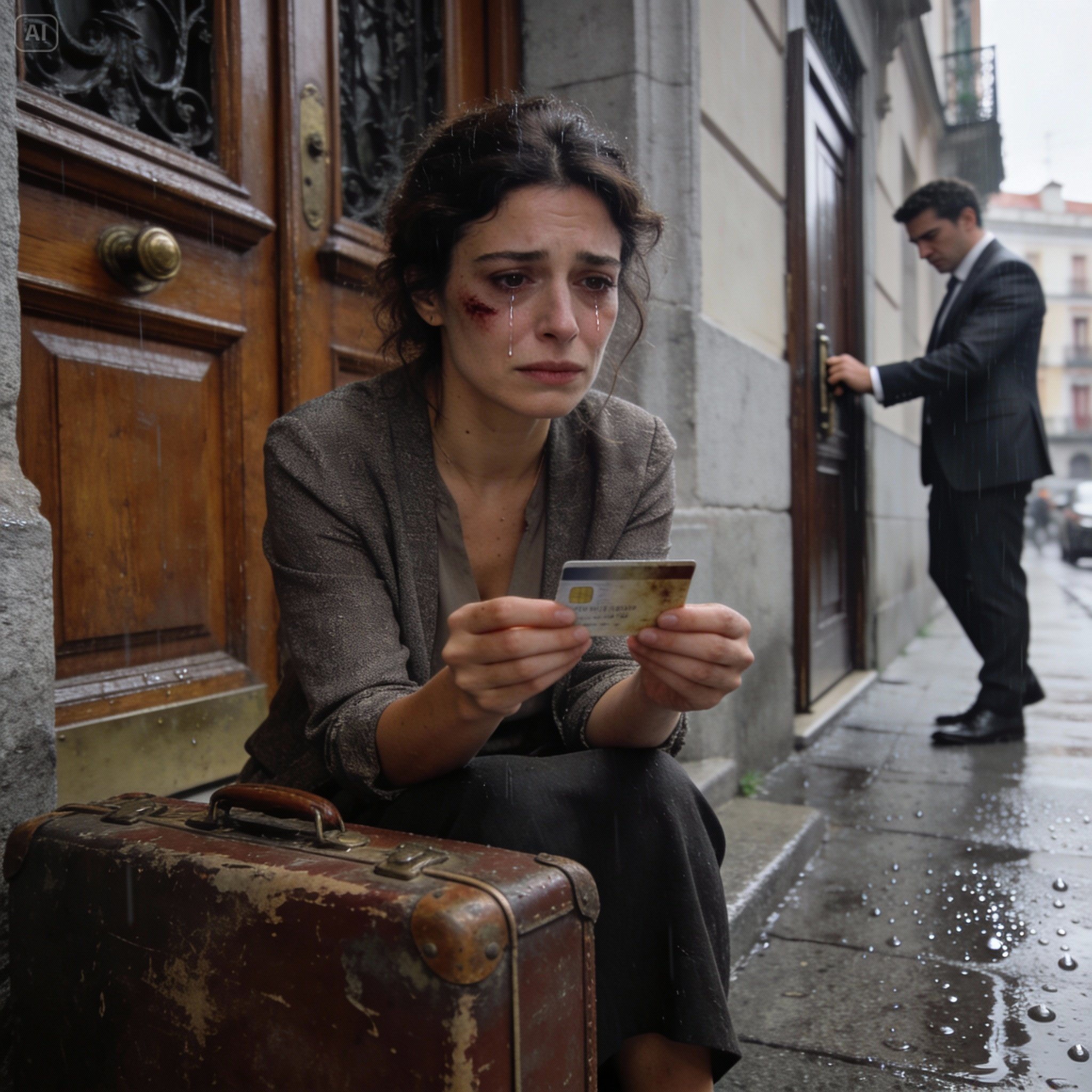
I didn’t see the suitcase coming. One moment I was begging Marcos to at least look me in the eye, to talk like two adults who had shared a decade of their lives, and the next, I heard the scraping sound of wheels on the freshly polished parquet floor. My own travel bag flew past inches from my feet and landed on the porch of our house on the outskirts of Madrid with a dull, final thud.
The air smelled of impending rain and the jasmine I had planted in the entryway three years ago, but my husband’s face was completely unfamiliar. There was no trace left of the man I had married at the Almudena Cathedral. All that remained was a cold, polished confidence, a disdainful look that made my stomach churn.
“Get out,” Marcos said. His voice was flat, emotionless, as if he were announcing that it was going to rain. “And take your useless tears with you. You’re dead weight, Emilia.”
He didn’t shout. He didn’t need to. That quiet certainty cut deeper than any shouted insult. He looked at me as if I were an accounting error he’d finally managed to correct.
“Marcos, what are you doing?” My voice cracked, pathetic and small. “We can talk about this. Just tell me what’s going on. Is it about the money? Is it the stress of the firm?”
He didn’t even bother to answer. He came inside, grabbed another bag, and threw it onto the porch next to the first one. Then he wiped his hands on his designer pants, as if touching my belongings had somehow soiled them.
From the doorway, Vanessa leaned against the wall, sipping from a mug I recognized instantly. It was my favorite mug, the one I’d bought on a trip to Toledo. She watched the scene with casual delight, like someone watching a boring but satisfying soap opera.
“You should have seen it coming, Emi,” Vanessa said softly, almost singing. “Some people just don’t fit in where they don’t belong.”
My breath caught in my throat. Vanessa was my “friend.” The woman who had dined at my table, whom I had comforted when her boyfriend dumped her.
“Vanessa… please, can you at least…?” I began, but she was already smiling. It was a slow, satisfied smile. The kind of smile that tells you this wasn’t sudden at all. This had been planned for months.
Marcos looked at his watch, a Rolex that we bought with “our” savings.
“I’m late for a meeting on Paseo de la Castellana. Just go. Don’t make a big deal out of this, Emilia. You’re thirty-two years old, don’t be pathetic.”
“Drama?” I almost laughed, but the sound caught in my throat. “You’re kicking your wife out of her own house. Out of our home.”
“This isn’t your home,” Vanessa said, placing the cup on the entryway table with a soft clinking sound. “Your name is no longer in the deeds.”
I felt like the world was tilting beneath my feet.
—What? That’s not possible. Marcos and I signed… he never…
Vanessa stepped away from the doorway, walked toward the porch, and bent down until her face was inches from mine. Her perfume smelled expensive, thick, and pretentious.
—I handled the paperwork myself a month ago. You signed an assignment of rights thinking it was a routine refinancing. Do you remember?
I remembered. Marcos had slipped a stack of papers onto the table one night, after pouring me a glass of wine, saying they were procedures to lower the mortgage payment. He had kissed my forehead and told me to relax while he signed. I trusted him. I trusted my husband.
Now my hands were trembling as I looked from Vanessa to Marcos.
—You… you planned this. You tricked me to rob me.
Marcos gave me a long, empty look.
—I planned a future, Emilia. You’re just not part of it anymore.
I would have collapsed right there if my pride, that stubborn pride I inherited from my grandmother, hadn’t forced me to straighten my back. I grabbed the handle of a bag, clinging to it like a life preserver.
“Fine,” I whispered, my voice trembling with suppressed rage, “but give me access to our savings. I have nothing on me. Just let me transfer what’s mine.”
Marcos’s expression flickered with something almost amused.
—What savings?
I froze.
He shrugged.
—Everything is tied up in business expenses right now. I told you so.
“You said it was temporary,” I breathed. “It was my life savings, my parents’ inheritance…”
—It was —he said calmly—. Until today.
The door closed before I could say another word. Vanessa’s final grimace was the last thing I saw before the lock clicked.
I stood on the porch with my bags around my feet, staring at the solid oak door as if perhaps it would open again, as if perhaps Marcos would realize the monstrosity he had just committed. But nothing moved. Not a curtain, not a shadow.
Finally, I forced myself down the steps, my legs shaking the whole way. When I reached the sidewalk, I couldn’t stop the hot tears from flowing. I hated crying in public, hated the spectacle, but the betrayal felt so sharp, so complete, that I couldn’t hold it in.
A car drove by slowly; the driver glanced at me and then quickly looked away. I knew what I must look like: a woman whose life had been emptied out in broad daylight in a residential neighborhood of Madrid. I dragged my bags toward the bus stop, my mind replaying moments I’d tried to ignore. Marcos arriving late, saying he was “networking.” Vanesa whispering to him in the kitchen when they thought I was asleep. The accountant dodging my questions about where our quarterly bonuses went.
It formed an image I never wanted to see.
When the bus groaned to the stop and I got on, I sat in the back seat and clasped my hands tightly. I wished I could call my grandmother. Grandma Gracia always knew what to do. Gracia always found a way to turn chaos into direction. But Gracia had been gone for three years, and all I left behind was a memory of her voice saying, “Don’t let other people define your worth, my child . ”
I swallowed hard. At that moment, I felt absolutely worthless.
I ended up in the cheapest hostel I could find near Atocha station, the kind of place where the receptionist didn’t ask questions because he didn’t care. The room smelled faintly of bleach and stale tobacco. My suitcase was in the corner, looking as lost as I felt. I collapsed onto the bed, my chest tight with exhaustion, betrayal, humiliation—all at once.
I closed my eyes and tried to breathe, but each inhale brought another memory I didn’t want. Marcos on our wedding night, promising to protect me. Marcos asking me to quit my job at the art gallery so he could “take care of me.” Marcos convincing me that his family would come to love me.
I had believed him. I had believed them all.
The next morning, the pain in my chest was dull but constant, like a bruise being pressed repeatedly. I needed a plan. I had no home, no money, no husband, and no family apart from a grandmother buried in the Almudena cemetery.
I opened my last remaining bag, an old leather suitcase that Gracia had given me years ago. Inside were some clothes, an old photo of the two of us at the San Isidro fair, and a sealed envelope I had never opened.
I looked at it, confused. I didn’t remember wrapping it, and Gracia had never explicitly given me an envelope like this. I picked it up carefully. My name, “Emilia Heredia,” was written in Gracia’s strong, flowing handwriting. Below it, in smaller letters: “For when the world forgets your worth . ”
I felt my throat close up. I tore open the envelope slowly, almost afraid of what I would find.
Inside was a faded, dusty bank card. It wasn’t a regular debit card, nor a credit card. It was something older, heavier, a matte black that almost looked like metal. I turned it over. On the back, in crisp blue ink, Gracia had written a single line: “Use it only when you’re ready to start over . ”
That made no sense. Gracia had never had much money. She lived on a teacher’s pension and an unyielding sense of pride. The idea that there was anything attached to this card seemed impossible. Yet the thought of even a few euros was enough to make my stomach twitch with hope. I hadn’t eaten since the previous morning.
I put the card in my pocket, grabbed my bag and headed to the nearest branch of Banco Central de la Castellana , the bank we used to pass on the way to school.
The building was imposing, renovated with glass doors that gleamed too brightly. Inside, it smelled of money, air conditioning, and polished furniture. Everyone moved with a quiet, professional efficiency.
I approached the cashier, a young man with slicked-back hair and nervous hands. He smiled at me with the forced politeness of someone serving a customer who clearly didn’t seem to have any money.
—Good morning. How can I help you today?
I placed the card on the marble counter.
—I’d like to check this balance, please.
The cashier took it, studied it with slight confusion, noticing the wear and tear and the outdated design. Then he shrugged and slid it through the machine.
The moment he did, the lights above us flickered.
The cashier frowned. The screen in front of him flashed bright red, then black, then red again. The computer emitted a sharp, metallic beep, and then all the monitors in sight went silent.
The room filled with a low hum. The staff looked up from their desks. A woman in a suit at the far counter froze mid-sentence.
“What the hell…?” the cashier whispered. He tried to swipe the card again. The machine shut off by itself.
A man three stations below whispered, in a strangled voice:
—That’s her name. Look.
I followed his gaze to the ATM screen where a single line pulsed in red letters: GRACIA HEREDIA – RESTRICTED ACCESS – FOUNDER LEVEL .
More people turned around. Murmurs stirred in the air.
“That’s impossible,” someone said. “After all these years… Should we call security? Management?”
The cashier’s face had gone pale. He looked at me as if I were something unexpected, something dangerous, something he didn’t know how to handle.
—Ma’am… one moment, please.
She hurried into the back room. I stood there confused, embarrassed, and now anxious enough that my fingers trembled. I wasn’t sure whether to run or wait. Part of me wanted to disappear before anyone else ever looked at me like that.
But before I could move, a man in an immaculate navy suit practically ran out of the back hallway. His tie was slightly crooked, his breathing uneven. He wasn’t an ordinary employee; he exuded authority.
I blinked.
—I’m Emilia. Gracia was my grandmother.
The man swallowed so hard I could see his Adam’s apple move.
—Please… I beg you to wait here. No, better yet, come with me.
The staff was whispering again, louder this time. “Gracia Heredia’s heir? Is it really her? I thought that line was extinct . ”
The man in the blue suit moved closer, his voice tense with caution.
—Madam, the CEO, Mr. Piqueras, wants to see you immediately.
I stared at him.
—The CEO? Why? I just wanted to check my balance. Maybe get some money for a snack.
“Please,” she said gently. “Don’t be afraid. But we need to go upstairs. To the executive floor.”
The executive floor? A place I’d never even seen in pictures. I kept walking past rows of wide eyes. Employees paused their calls. A woman near the break room covered her mouth with her hand as I passed. My heart was pounding so hard I could feel it in my teeth.
When we arrived at the private elevator, the man swiped a card and held the door for me. The elevator smelled of new leather and cool air. I stepped inside, clutching my grandmother’s card, trying not to panic.
The man pressed the top button, then leaned slightly forward, his voice barely above a whisper.
—We have been waiting twenty years for the rightful heir to walk through those doors.
The doors closed. I gripped the elevator handrail so tightly my fingers ached. The words the man whispered kept echoing in my mind. Rightful heir .
My grandmother. Gracia, who clipped supermarket coupons, who had been a schoolteacher and fixed faucets with electrical tape. Gracia, who kept cash in coffee cans and baked doughnuts for neighbors who didn’t deserve them. How could any of this make sense?
The elevator ascended slowly, each floor passing with a soft chime that made my pulse race. I tried to steady my breathing, but my chest couldn’t find a rhythm. I didn’t belong here. I was wearing worn jeans and dirty sneakers from the street. I wasn’t ready for whatever lay beyond those polished doors.
When the elevator finally stopped, the screen read Executive Level . The doors opened onto a quiet hallway lined with frosted glass and abstract art that probably cost more than my old house.
The man in the blue suit came out first and signaled for me to follow him.
—This way, Miss Heredia.
I forced myself to move my legs. My sneakers squeaked against the shiny floor, the sound too loud in the quiet space. I felt eyes on me the whole way, though no one else appeared in the hallway. The air had an odd weight, as if everyone in the building were holding their breath at once.
We stopped in front of a double door made of dark wood. The brass plaque read: Javier Piqueras – CEO .
The man called once.
—Sir, she’s here.
A voice came from within, calm, controlled.
—Let him in.
The man opened the door and stepped aside. I hesitated for a second, fear rising like a tide inside me, but turning back wasn’t an option. I went into the office.
The room was enormous, with floor-to-ceiling windows that offered a panoramic view of Madrid, from the Cuatro Torres business district to the mountain range on the horizon. The desk was an elegant piece of black glass, and behind it stood Javier Piqueras. He was in his fifties, with silver hair and a posture as sharp as a razor.
He looked at me once and stared as if he already knew me.
“Miss Heredia,” he said, his tone odd. Not warm, not cold, something like caution mixed with respect. “Thank you for coming.”
I felt my voice waver.
—I didn’t really choose to come here. Your staff… something happened with the card.
—Yes —Javier gestured for me to sit down, although he didn’t sit down himself—. We are aware.
I sat down anyway because my knees could give out at any moment. I placed the old bank card in my lap, the plastic warm to my touch. Javier was still staring at me as if I were examining a rare glass.
—How long have you had that card?
“I don’t know,” I said honestly. “My grandmother left it in an envelope. I never opened it until this morning.”
He inhaled slowly, almost as if he were stabilizing.
—Miss Heredia, your grandmother was not an ordinary customer.
My stomach tightened.
—I know she had an account here, but she didn’t have any money. We struggled a lot when I was growing up. She raised me alone.
Javier’s eyes blinked.
—I’m afraid she hid many things from him.
I didn’t know what to say to that. Gracia didn’t keep secrets, not big ones. She was honest to a fault. But Javier Piqueras seemed like a man who didn’t speculate. He seemed like someone delivering news he’d rehearsed for years.
He walked around the desk and stood closer, giving me the full weight of his attention.
—Her grandmother was one of the founding investors of this bank, a silent partner. Her stake was substantial.
I almost laughed. It came out as a tiny crashing sound.
—What? No. No. That can’t be right. My grandmother lived in a rented house with bad plumbing in Carabanchel. She never even bought a new car.
Javier nodded once.
—I can imagine she preferred privacy, but facts are facts. She owned 20% of this institution.
My throat got dry.
—Twenty percent? That’s… impossible. Why didn’t you ever tell me?
—That —he said quietly— is the question the Board of Directors has been asking itself for two decades.
He took the card from my hands and held it as if it were something fragile.
—This card is linked to a secure vault account. It has not been accessed since Gracia Heredia stopped responding to communications from the Board.
I shook my head.
—She never stopped responding. She just… never said anything about the bank. Not once.
“I believe you,” Javier said, but his eyes held a shadow of something heavier, something that gave me goosebumps. “Even so, there’s a protocol we must follow. Your grandmother’s shares were tied to a succession clause. Upon her death, the rights are transferred.”
He paused. I waited, my pulse pounding.
—To your heir—he finished—. To you.
I stared at him, unable to breathe.
—I have no money. I have nothing. I can’t even buy lunch today. My husband kicked me out yesterday.
Javier gave a small, tense smile.
—That’s about to change. But you must understand, his legacy isn’t just financial. It’s political. There are board members who won’t be happy that he’s resurfaced. Some spent years assuming that Gracia’s line was over.
I blinked hard.
—Why would they think that?
Javier’s jaw tightened.
—Because the Heredia family’s shares grant them majority control when combined with a certain voting bloc. Their presence shifts the balance of power. Some will see it as… inconvenient.
The room suddenly felt colder.
“I didn’t ask for any of this,” I whispered.
“No one asks for destiny,” Javier said gently. “But it comes anyway.”
He gave me back the card.
—I’ll have my assistant bring you the preliminary documents. We’ll begin the verification process today.
-Verification?
—Proof of identity, proof of lineage, a formal claim. Do you understand? This level of inheritance must be legally confirmed.
“Of course,” I said, even though I didn’t understand anything at all.
Before I could ask any more questions, the office door opened and a woman walked in. She was wearing a tailored suit and holding a tablet to her chest.
“Mr. Piqueras,” he said. “The president of the Board is asking if you have…” Then he saw the card in my hand. His breath caught in his throat.
Javier gave her a look that stopped whatever she was about to say.
—Not now. Prepare the verification package and alert security that we may need an escort protocol.
“Escort?” I whispered.
Javier ignored the question. The assistant nodded and hurried out, her heels clicking down the hall.
When the door closed, Javier leaned back against the edge of his desk.
—Ms. Heredia, you should know that your grandmother didn’t simply invest in this bank. She shaped it. She challenged decisions, exposed unethical practices, and forced internal audits. Some admired her; others didn’t.
I felt a chill slide down my spine.
—What are you saying?
—That her absence changed the culture of this place. For the worse. There are people who built their careers on the idea that she was gone forever. And now you’re here. And they’ll respond in ways you might not expect.
I clenched my hands to stop them from trembling.
—I just wanted to check the balance. I’m not trying to start a war.
Javier’s eyes softened.
—Miss Heredia. You didn’t start anything. But your presence will end something.
I sat back, overwhelmed. My life had collapsed 24 hours ago. Now I was sitting in a corner office on the Castellana being informed that I had inherited a silent empire I never knew existed.
I wanted to get up and leave, but my legs wouldn’t obey.
“What happens now?” I whispered.
Javier opened his mouth to reply, but the door burst open. His assistant stood there, breathless, the tablet trembling in his hands.
—Sir, security says the south entrance has been compromised. Someone is trying to access restricted files related to the Heredia account.
I left the building with my head spinning, having received a cash advance from a “temporary” account that Javier had authorized. It wasn’t much compared to what they said the inheritance was worth, but it was enough for a decent hotel and food.
As soon as I stepped outside, my phone vibrated. It was a number I didn’t recognize, but I answered it out of habit.
—Emi! Finally! Where on earth have you been?
My stomach lurched.
—Marcos.
I almost hung up, but he spoke again before I could.
“I heard a rumor,” he said, and I could hear the anger he was trying to mask with feigned concern. “People from my firm say they saw you at the Central Bank yesterday with private security, going up to Piqueras’s apartment. Is that true?”
I looked around the sidewalk, suddenly aware of every face that passed by.
—Why do you care?
Marcos let out a nervous laugh.
—You are still my wife.
“Ex-wife,” I said sharply. “You ended that yesterday, remember?”
—Don’t exaggerate. We were emotional. We can talk about anything. Just tell me what’s going on with the bank.
I almost laughed. Wow, that didn’t take long.
—It means—I said, in a low, firm voice—that you kicked me out with nothing and now you hear that I went into a bank and suddenly you want to talk.
“I’m trying to fix this,” he snapped. “You don’t understand finance, Emilia! If there’s money involved, you need someone who knows how to handle it.”
—I know how to manage my life, Marcos. And I know you lied to me. I know about Vanessa and I know you emptied our accounts before kicking me out.
There was silence on the other end. A heavy, guilty silence.
I hung up the phone. My heart was pounding.
I walked to a nearby coffee shop to calm down. I sat at a corner table. I needed to think. Javier had warned me: “Don’t trust anyone.”
Suddenly, a shadow fell upon my table.
I looked up expecting to see the waiter. But it wasn’t him.
It was Vanessa.
She was wearing enormous sunglasses and a designer coat. She sat down across from me without asking a question.
“I knew you’d be around,” he said, taking off his glasses. “You were always predictable, Emi.”
“What do you want, Vanessa?” I asked, surprised by how firm my voice sounded.
“I want you to be smart. Marcos is losing his mind over these bank rumors. He says you have access to something big.”
—That’s none of your business.
Vanessa leaned forward, lowering her voice.
“Listen, honey. I don’t know what you found at that bank, but Marcos isn’t the only one asking questions. There are people… dangerous people he works with, who are very interested in knowing why the name Heredia has reappeared in the systems.”
—Are you threatening me?
“I’m warning you. Marcos is an idiot, but he’s an idiot with connections. And you… you’re just an unemployed art teacher who got lucky with an old credit card. Don’t play in the big leagues, they’ll eat you alive.”
I got up, trembling with rage.
—Tell Marcos to rot. And you too.
I left the café, feeling their eyes on my back. I walked quickly, blending into the afternoon crowd in Madrid. The rain started to fall again, cold and gray.
I sought refuge under a bus stop shelter. As I shook the water off my coat, a young man, dressed in somewhat shabby office clothes, stood beside me. He had a bank ID card hanging from his pocket, but it was upside down.
“Miss Heredia?” he whispered without looking at me.
I tensed up, ready to run.
-Who are you?
—Don’t look. I’m Arturo. I work in the archives at the bank. I saw what happened yesterday.
-AND?
Arturo looked around nervously, then took a manila envelope from under his jacket and handed it to me.
“This was supposed to be crushed this morning. Direct orders from the Board. But… my grandmother knew yours. She said Gracia was a saint. She couldn’t let them destroy this.”
I picked up the envelope. It was heavy.
-What is it?
“The proof,” Arturo said, and his eyes met mine for a second, filled with fear. “Proof that your grandmother didn’t sell her shares. They were stolen. And there are names there… names that will shock you.”
—What names?
—Be careful, Emilia. Don’t trust Piqueras. He was there when it happened.
Arturo turned around and blended in with the people getting on the bus, disappearing as quickly as he had arrived.
I stood there in the Madrid rain, the envelope burning my hands. I sat on the cold metal bench and opened the clasp. Inside was a single plastic sleeve containing an old black and white photograph.
My fingers trembled as I pulled it out. It showed a younger Gracia, perhaps in her forties, shaking hands with three men in suits in front of a bank construction sign. The smile on my grandmother’s face looked determined, proud, powerful.
I swallowed hard. I looked at the men next to Gracia.
I didn’t recognize the first one.
The second one did: Javier Piqueras, much younger.
The third one… my breath stopped.
The third one was Marcos’s father. My father-in-law.
I stared at him, stunned. I’d seen that man at Christmas parties, presiding arrogantly over the table. He’d never even hinted at knowing my grandmother beyond a polite greeting. But in the photo, he was standing right next to her, shaking her hand like a business partner.
I turned the photo over. There was writing on the back. Quick, furious.
“I was betrayed once. Don’t let it happen to you.”
A clap of thunder rumbled across the Madrid sky. Someone inside that bank, perhaps more than one person, had betrayed my grandmother. And my ex-husband’s family was involved.
My phone vibrated again. An email.
SENDER: MARCOS CALDWELL.
SUBJECT: IMMEDIATE LEGAL ACTION.
I opened it with trembling hands.
“Emilia, effective immediately, I am filing a lawsuit for emotional distress, theft of confidential documents, and unlawful possession of marital property. My father has told me all about the old affair. You have no right to any of that. Return the card or you will go to jail.”
My vision blurred. Theft? Jail? They were building a case before I could even understand my inheritance.
Then another message arrived. Unknown number. A voicemail.
I pressed play.
The wind could be heard, then a distorted voice whispering: “She doesn’t know anything yet. But if she finds the ledgers hidden in safe deposit box 404, we’re finished. Find her, Marcos. Find her before she talks to the press.”
The message ended.
I lowered the phone slowly. The rain soaked my hair, but I no longer felt the cold. I felt something else: a burning clarity.
They wanted to scare me. They wanted me to go back to being the submissive Emilia, the one who signed papers without reading them, the one who let her husband and her friend walk all over her.
But I looked at my grandmother’s picture one more time. Her chin held high. Her strength.
I got up from the bench. I dried my tears.
“Not this time,” I whispered to the rain. “Not this time, Marcos.”
I had the card. I had the photo. And now, thanks to the voicemail, I had a number: Safety Deposit Box 404.
I headed for the subway. I wasn’t going to hide. I was going back to the bank. I was going to find that box. And if I had to burn the whole building down to get the truth out, I would.
Because she was no longer just Emilia, the discarded wife.
It was Emilia Heredia. And the war had just begun.
The subway ride back to the center of Madrid was a haze of anxiety and adrenaline. I clutched Arturo’s envelope to my chest, hidden beneath my soaked coat, as if it were a bomb about to explode. Around me, people stared at their phones, tired after work, oblivious to the fact that the woman sitting in the corner, her makeup smeared and her shoes dirty, held in her hands the dynamite that could blow up one of Spain’s oldest financial institutions.
I arrived at the Banco Central headquarters on Paseo de la Castellana just before closing time. The lobby lights shone with clinical intensity, casting long shadows on the polished marble. But something had changed since my visit that morning.
There was no longer curiosity in the employees’ eyes. There was tension.
Two security guards, much more burly than those in the morning, stood in my way before I could reach the access turnstiles.
“Miss Heredia,” one of them said, his voice like cement. “We’ve been instructed to deny you entry. Please leave the premises or we’ll have to call the National Police.”
My heart was hammering against my ribs.
“I have an appointment with Mr. Piqueras,” I lied, though my voice trembled slightly. “And I have the right to access my safe deposit box. It’s the law.”
“You have no appointment on record,” the guard replied, taking an intimidating step forward. “And your client status is under review for fraud. Get out.”
Fraud . The word hit me like a slap in the face. Marcos and his father had moved fast. They were trying to invalidate my identity before I could claim what was rightfully mine.
“This is a mistake,” I insisted, raising my voice so that everyone in the lobby could hear me. “I’m Emilia Heredia. My grandmother founded this bank. You can’t fire me!”
Some customers turned away. The guard grabbed my arm, his fingers digging into my bicep.
—That’s enough. Let’s get her out of here.
—Let me go!
I was about to be dragged out of the building, humiliated once again, when the executive elevator doors opened with a soft clinking.
—Release her immediately!
Javier Piqueras’s voice echoed through the lobby, sharp and authoritarian. He strode toward us, his face a mask of barely contained fury. The guards released me instantly, backing away like scolded children.
“Mr. Piqueras, the Board of Directors ordered…” the guard began.
“I know what the Board ordered,” Javier interrupted, looking me straight in the eye. “But as long as I’m the CEO, no one touches a VIP client in this lobby. Understood?”
The guards nodded and returned to their posts. Javier gave me a barely perceptible nod.
—Follow me, Emilia. Quickly.
I didn’t need him to tell me twice. We walked toward the elevators, feeling the eyes of the entire staff on my back. Once the doors closed and the elevator began descending toward the vaults, Javier loosened his tie, letting his facade of absolute control fall away. He looked exhausted.
“I shouldn’t have come back today,” she said quietly. “They’re preparing a court order to block my entry. I had to use my executive veto to buy time, but it won’t last long.”
“I need to check box 404,” I said, ignoring his warning. “I know it’s there.”
Javier tensed up. He turned slowly toward me, his reflection in the metal of the elevator showing me a man trapped between two worlds.
“Who told you about box 404?” he asked, his voice barely a whisper.
—That doesn’t matter. Just open it.
The elevator stopped on basement level 3. The air down here was cold, recycled, and as silent as a tomb. Javier walked toward the immense circular door of the main vault. He scanned the scanner and typed in a long code. The steel mechanisms groaned, and the door opened with a hydraulic sigh.
Inside, rows and rows of metal safe deposit boxes gleamed under the fluorescent light. Javier walked to the oldest section, where the metal was dull and the numbers were hand-engraved.
He stopped in front of box 404.
“I need your card,” he said.
I handed him Gracia’s old card. Javier inserted it into the slot. Then he took a master key from his pocket and turned it. There was a sharp click .
“I’ll give you some privacy,” he said, turning away. “But hurry, Emilia. Security will have already notified the president of the Board. Marcos and his father will be on their way.”
I took out the metal box. It was heavy. My hands were shaking so much that I almost dropped it on the inspection table.
I lifted the lid.
There were no gold bars. There were no bundles of banknotes.
There were three old, worn, black leather-bound ledgers. And on top of them, a letter sealed with red wax.
I opened the first book at random. It was accounting records, dates from twenty-five years ago. Columns of numbers, transfers, names of shell companies in tax havens. And in the margin of each page, notes in my grandmother’s unmistakable handwriting.
“Money Laundering – Castellana Project – Approved by RC”
RC
Rafael Caldwell. Marcos’s father.
I frantically flipped through the pages. My grandmother hadn’t been ousted for incompetence or lack of interest. She’d discovered that her associates, including the father of the man I’d married, were using the bank to launder money from illegal real estate deals on the coast.
She had tried to stop them. And they had destroyed her.
I opened the letter. The paper rustled, yellowed with age.
“My dear Emilia,
If you’re reading this, it means I’m no longer here to protect you, and the truth has come out. I’m sorry. I’m sorry I couldn’t give you the life of luxury you deserved, but I had to keep you hidden.
When I refused to sign off on their shady deals, they threatened me. Not me, but you. You were just a child. They said if I spoke out, you’d get hurt. So I made a deal: my silence and my withdrawal in exchange for your safety and keeping my 20% stake in a phantom account, untouchable until you were old and strong enough to claim it.
Rafael Caldwell is a dangerous man. And I fear his son, Marcos, has been raised in his image. If Marcos has approached you, if you’ve married him… I pray it’s love, but I fear it’s a strategy by his father to keep the enemy close.
These books are your sword and your shield. Destroy them and you’ll be rich, but the bank will still be rotten. Use them, and you’ll declare war. The choice is yours, my brave girl.
Love,
Your Grandma, Gracia.”
Tears fell onto the paper, blurring the ink. A sob escaped my throat, echoing in the empty vault.
It had all been a lie. My marriage. My life. Marcos hadn’t fallen in love with the simple girl at the art gallery. His father had sent him to find me, to keep an eye on me, to make sure Gracia Heredia’s granddaughter never discovered the secret. And when the bank needed cash and I became “unnecessary,” or perhaps too curious, they decided to get rid of me.
Rage replaced the pain. A cold, hard, calcified rage.
I closed the box, put the books and the letter in my large bag, and dried my face.
“Is it over?” Javier’s voice came from the entrance. He seemed more nervous now, looking at his watch.
“Yes,” I said, my voice sounding strange to my own ears. Deeper. Louder. “Let’s go.”
We went back up to the lobby. But when the elevator doors opened, the way wasn’t clear.
Marcos was there.
He was wearing his impeccable three-piece suit, but his face was red and sweaty. Beside him stood his father, Rafael Caldwell, a man who had always looked at me as if I were a cheap piece of furniture, and two lawyers with briefcases.
Javier stopped dead in his tracks.
—Rafael. I wasn’t expecting you so soon.
“Spare me the pleasantries, Javier,” Marcos’s father spat. His voice was like sandpaper. “That woman has bank documents in her purse. Stop her.”
Marcos took a step towards me. His eyes scanned my dirty clothes, my washed face, with a mixture of disgust and despair.
“Emilia, please,” she said, trying to adopt that condescending tone she used when she wanted to manipulate me. “You’re confused. You’re hysterical. Give me the purse. Dad and I can fix this. We’ll get you an apartment, a monthly allowance… you don’t have to make this difficult.”
I looked at him. I really looked at him for the first time in years. And I didn’t see my husband. I saw a parasite.
“I don’t want your pension, Marcos,” I said, clutching my purse. “And I’m not confused. I’m awake.”
“Those documents are confidential!” Rafael shouted, losing his composure. “If you walk out that door with them, I’ll sue you until you’re broke! I’ll accuse you of industrial espionage!”
“Go ahead and try it,” I challenged him. “And I’ll accuse you of money laundering, tax fraud, and coercion. I have Gracia’s books, Rafael. I know everything.”
The color drained from the old man’s face. Marcos looked at his father, real panic crossing his eyes for the first time.
“Security!” barked Rafael. “Stop her! She’s stolen bank property!”
The guards hesitated. They looked at Javier Piqueras.
The lobby was silent. It was the moment of truth.
Javier looked at Rafael, then at me. He took a deep breath and straightened his jacket.
“Let Mrs. Heredia through,” Javier ordered, his voice ringing clearly. “She’s the majority shareholder of this company. Nobody touches her.”
Rafael turned purple.
—You’re fired, Piqueras! You’re finished!
“Perhaps,” Javier said with icy calm. “But today, I’m still in charge. Emilia, leave. Now.”
I didn’t wait. I walked past Marcos, bumping his shoulder with mine. He tried to grab my arm, whispering:
—You’re going to regret this, you bitch.
I pulled away abruptly.
—The only one who’s going to regret it is you when I’m done with you.
I went out into the Madrid downpour and ran. I didn’t look back. I knew Javier had bought me a few minutes, maybe an hour, but the war had just escalated. Now they knew I had the books. Now they knew I could destroy them.
And they would stop at nothing to get them back.
I ran to my old car, which I had parked on a side street. My hands were shaking so much that I dropped the keys twice before I could open the door. I locked myself inside, lowered the locks, and started the engine.
My phone started ringing. Marcos. Then an unknown number. Then Vanessa.
I turned it off and threw it onto the passenger seat.
I drove aimlessly for an hour, obsessively checking the rearview mirror, convinced that every black car was a hitman sent by Rafael Caldwell. Finally, I got off the M-30 and looked for a roadside motel on the outskirts, a seedy place where you paid in cash and they didn’t ask for ID.
The room was even worse than the last one. Thin walls, itchy sheets. But it had a strong lock.
I propped a chair against the doorknob. I took out the ledgers and Grace’s letter and spread them out on the cheap bed.
I spent the night reading. Each page was a dagger to my heart, but also a brick in the fortress I was building around myself. I saw how they had embezzled pension funds. I saw how they had financed illegal construction. And I saw how, year after year, they paid bribes to keep inspectors away.
They were white-collar criminals, hiding behind Armani suits and hyphenated surnames. And I had them by the throat.
At three in the morning, a noise outside my door made me freeze.
Footsteps. Slow, heavy.
Crunch of gravel.
The motel had exterior walkways. Someone was walking right past my window.
I turned off the bedside lamp and slid down to the floor, my back against the wall, hugging the books to my chest.
The doorknob turned.
It was closed, but the chair vibrated against the wood.
Someone tried to push.
“Emilia…” a voice whispered. It wasn’t Marcos. It was the distorted voice from the voicemail. “I know you’re there. Don’t open it. Listen.”
I froze, unable to breathe.
“They have your location. They tracked your car’s signal. You have five minutes before Rafael’s men arrive. Get out the bathroom window. There’s a gray car waiting in the back. The keys are in the tire. Go.”
The footsteps ran away.
Was it a trap? Or was that my guardian angel, that Arturo guy?
I looked at the books. If I stayed here and they found me, I’d disappear. It would be a tragic accident. “Depressed woman commits suicide in motel after divorce.” I could see the headlines.
I had no choice.
I got up, stuffed everything into my bag, and ran to the bathroom. The window was small, but I managed to squeeze through. I fell onto the wet grass at the back of the building.
Indeed, there was an old gray Seat parked in the shadows, far from the security lights.
I ran towards it, felt over the front left wheel. My fingers touched cold metal. The keys.
I got into the car just as I heard the screech of tires at the motel’s main entrance. Two black SUVs sped in. I saw silhouettes of men getting out, men who didn’t look like lawyers.
I started the Seat and pulled out through the service exit, with the lights off, gliding into the darkness of the motorway before they could see me.
My heart was pounding so hard my chest ached. I was alone. I was being hunted. But as I drove toward the dawn that was beginning to break over the Castilian horizon, I realized something.
I was no longer afraid. Fear had burned away in that vault. Now only determination remained.
He was going to come back. He was going to call an emergency shareholders’ meeting. He was going to walk right in and watch his empires of lies crumble.
But first, I needed an ally. Someone who understood these books better than I did. Someone who had been purged by the bank and was just as thirsty for revenge as I was.
I turned on my phone, just for a second, to look up a name I’d seen repeated in the margins of my grandmother’s books. A former auditor who was fired ten years ago for “inappropriate conduct” right after trying to investigate Caldwell’s accounts.
Manuel Torres.
If I could find it, I would have the ultimate weapon.
I drove north, away from Madrid, away from my past life, ready to become the woman Gracia always knew I could be.
PART 3 (Final)
I found Manuel Torres in a small town in the Sierra de Guadarrama mountains. He lived in a modest cabin, raising dogs and far removed from the financial world that had rejected him. He was an older man, around sixty years old, with the hardened gaze of someone who had witnessed too much corruption.
At first, he didn’t even want to open the door for me.
“I don’t want to know anything about the Central Bank,” he shouted at me through the wood. “Get out!”
—I am Gracia Heredia’s granddaughter—I shouted back, in the morning rain—. And I have Rafael Caldwell’s black books.
The door opened immediately.
We spent the next six hours working at his kitchen table, drinking black coffee and connecting the dots. Manuel was brilliant. Where I saw numbers, he saw crimes. He translated my grandmother’s notes into an irrefutable chronology of federal offenses.
“With this,” Manuel said, tapping his finger on the table, “you not only regain control of the bank. With this, Rafael and half the board go to jail for twenty years.”
“That’s exactly what I want,” I said.
“But you need to go public,” Manuel warned. “If you go to the police now, the Caldwells have judges on their payroll. They’ll bury the evidence. You have to do it somewhere they can’t hide.”
—The Annual General Meeting is tomorrow—I remembered. I had seen the announcement in the bank lobby.—They were going to use it to announce my “resignation” from the shares and the merger with the Caldwell group.
Manuel smiled, a wolfish smile that gave me chills.
—Then, Emilia, let’s ruin their party.
The next morning, I dressed for war. I didn’t own any expensive clothes, so I used what I had: a clean white shirt, my black jeans, and a jacket Manuel lent me. I pulled my hair back into a high, tight ponytail. I checked myself in the car mirror before getting in. I didn’t look like a banker. I looked like a survivor.
The event was being held in the main auditorium of the Central Bank on Paseo de la Castellana. There were press, investors, and photographers. Marcos and his father were on stage, smiling, projecting success and stability. Vanesa was in the front row, wearing a dress that cost more than my car, clapping like a trained seal.
I slipped in through the service entrance using Manuel’s old access card, which incredibly still worked on the back doors. Arturo, my anonymous contact, was waiting for me there.
“They’re about to vote,” Arturo whispered, sweating. “You have to go in now.”
I nodded. I clutched the books to my chest.
Rafael Caldwell was at the lectern, speaking into the microphone.
—…and therefore, we are pleased to announce that, after resolving certain minor administrative issues, the Caldwell family will consolidate full control of the foundation shares, ensuring a prosperous future…
I opened the double doors at the back of the auditorium with a sharp bang.
The sound echoed in the silent room. Hundreds of heads turned.
I walked down the central aisle. My steps were firm. I didn’t look at the cameras. I looked directly into Marcos’s eyes.
“Objection!” my voice sounded clear, without a microphone.
Rafael froze. Marcos stood up from his chair, pale as a ghost.
—Security, get this crazy woman out of here! —Rafael shouted into the microphone, his voice cracking.
“I’m not crazy,” I said, stepping onto the stage steps as the guards hesitated, confused by the presence of the cameras. “And I’m not leaving. I’m Emilia Heredia, the majority shareholder of this bank. And I have something to say.”
I reached the lectern. Rafael tried to block me, but Javier Piqueras, who was sitting at the head table, stood up and, to everyone’s surprise, gently moved Rafael away from the microphone.
“Let her speak,” Javier said.
Marcos ran towards me.
—Emilia, don’t do this. I’ll destroy you. I’ll publish those photos, I’ll say you’re unstable…
I brought my face close to the microphone.
“Ladies and gentlemen, shareholders,” I said, my amplified voice filling the room. “What I have here is not delusion. These are the original accounting books of my grandmother, Gracia Heredia. Books that prove that for twenty years, the Caldwell family has been stealing from your dividends to finance private projects and launder money.”
A murmur of shock swept through the room like a wave. Camera flashes erupted in a storm of light.
“She’s lying!” Vanessa shrieked from the front row. “She’s just bitter because her husband left her!”
I made a copy of the documents and threw it into the air. The sheets fell on the first row of investors like snow.
—Page 40, line 12—I read—. Transfer of two million euros to the private fund ‘Vanesa’ in the Cayman Islands, the day before quarterly losses were announced for small investors.
Vanessa suddenly fell silent. The entire room turned towards her.
—And here —I continued, pointing at Rafael—, is proof of bribes paid to urban planning officials from the bank’s reserve account.
Rafael Caldwell staggered. He looked like he was about to have a heart attack.
—This is… this is illegal. Those documents are stolen…
“They’re my property,” I said coldly. “Just like this bank.”
Javier Piqueras took the microphone.
—As CEO, and in view of the evidence presented, I request an immediate motion of censure against President Rafael Caldwell and the suspension of Marcos Caldwell from all his legal functions.
“I second the motion!” shouted a major investor from the third row.
—And me! —shouted another.
Chaos erupted. The police, whom Manuel had called in advance, entered through the side doors.
I saw them handcuff Rafael. I saw Marcos try to slip away through a side exit, only to be intercepted by two officers. He looked at me one last time, his eyes filled with hatred and fear. I just gave him a look of pity.
“Goodbye, Marcos,” I whispered.
EPILOGUE: Six months later
The corner office on the executive floor is no longer made of black glass and cold metal. I’ve added plants. Lots of plants. And I’ve hung a photo of my grandmother and me at the San Isidro fair behind the desk.
The bank cleanup was brutal. Half the board was fired or arrested. The stock price initially fell, but then, when we announced our new policy of full transparency and fair lending for working families, it soared.
Javier Piqueras resigned voluntarily, accepting his share of the blame for remaining silent for years, although his eventual cooperation saved him from prison. He now lives peacefully on the coast.
Manuel Torres is my new audit chief. Nobody dares to steal even a paperclip under his watch.
Me too?
I finished my management studies. I learned quickly. I’m not your typical banker. I don’t wear thousand-euro suits. I come to work in jeans and I address the cleaning ladies by their first names.
Today, while I was signing the papers for a new scholarship on behalf of the “Gracia Heredia Foundation”, my assistant came in.
“Mrs. Heredia, there’s a man in the lobby. He says he’s your ex-husband. He says he just wants to talk, that he’s broke and needs help.”
I put the pen down on the table. I walked towards the window overlooking the Castellana, looking at the rainy Madrid that once seemed so hostile to me and now felt like my own.
I remembered the day he kicked me out. I remembered the suitcase flying. I remembered feeling like trash.
“Tell him no,” I said softly, without turning around. “Tell him that Emilia, the woman he threw out, is no more. And that Mrs. Heredia doesn’t have time for strangers.”
—Yes, ma’am.
When the door closed, I touched the old bank card that I now kept in a frame on my desk.
“We did it, Grandma,” I whispered. “We know our worth.”
And for the first time in a long time, I smiled. A real, full smile, in control of my own destiny.