Sergeant Cárdenas thought he was humiliating a mere recruit in the Almería desert, unaware that he was signing his own death warrant in front of his infiltrated superior officer.
CHAPTER I: THE ART OF INVISIBILITY UNDER THE SPANISH SUN
The heat at the “Cerro Negro” training grounds, in the arid lands of Almería, is not merely a temperature; it is a physical presence, an oppressive weight that settles on your shoulders and presses you against the dusty ground. By 6:00 a.m., the sun was already threatening to turn the concrete barracks into ovens, and the air smelled of an unmistakable mixture of diesel fuel, stale sweat, and the dry aroma of the wild rosemary that stubbornly grew along the edges of the camp.
I, Jessica Morgan, a 26-year-old “soldier” and supposed college dropout from a small town in the sparsely populated rural area of Teruel province, adjusted my boots. My hands moved with practiced clumsiness, deliberately half a second slower than my comrades’. I made sure my bun, though regulation, had that slightly disheveled look of someone who hasn’t yet mastered strict military discipline.
—Come on, Morgan, we’re late and Sergeant Cárdenas looks like he wants to have recruits for breakfast today—whispered Lucía Fuentes, my bunkmate, a 19-year-old girl from Seville with a heart too big for this place.
“I’m coming, I’m coming…” I replied, injecting a tremor of anxiety into my voice that I didn’t feel at all.
Inside, Lieutenant Colonel Rebeca Torres, 34, an expert in intelligence and special operations, a graduate with honors from the General Military Academy in Zaragoza and with a master’s degree in Operational Psychology from the University of Salamanca, observed the scene with the coldness of a predator. No one here knew that the woman who struggled to keep up in the morning runs spoke four languages fluently, had coordinated joint operations with NATO on three continents, and had the authority to shake the foundations of this base with a single secure phone call to Madrid.
My mission was clear, although painful: to be the perfect victim.
For the past six weeks, I had disappeared into Jessica’s skin. I had studied the files of dozens of recruits who had dropped out of training, absorbing their insecurities, their hunched body language, their doubts. I had learned to lower my gaze, to shrug my shoulders, to swallow my pride—that uniquely Spanish pride that makes us raise our chins in the face of adversity. Here, my pride had to die so that the truth could live.
Camp Cerro Negro, officially a center of excellence for professional troops, had become a black hole of rumors that had reached the highest offices of the Ministry of Defense on Paseo de la Castellana. There were tales of brutal hazing bordering on torture, of financial extortion of vulnerable soldiers, of a system of cronyism where middle officers reigned like feudal lords. But the official reports always came out clean. Fear is a very effective silencer, and misguided loyalty is the cancer of any army.
They needed someone on the inside. Someone who wouldn’t raise suspicion. Someone like “the poor girl from Teruel who was penniless.”
We went out to the parade ground. First Sergeant Daniel Cárdenas was already there, strutting in front of the formation with the arrogance of someone who believes himself a god in his little kingdom of dirt and cement. At 38, Cárdenas had the build of a fighting bull that is beginning to lose agility but gaining in malice. His small, dark eyes scanned the ranks, searching for weakness, like a shark smelling blood in the water.
“Attention!” His shout echoed off the walls of the barracks, causing a flock of sparrows to take flight from the few trees.
The formation tensed. Cárdenas walked slowly, his boots clacking against the asphalt. The sound was a metronome of terror for the actual recruits. For me, it was the soundtrack to my investigation. Every insult, every abuse of power, every arbitrary “fine” he collected in cash, was recorded in my photographic memory, ready to be transcribed into the encrypted reports I sent every night from a device hidden in the false bottom of my locker.
Cárdenas stopped in front of me. I could smell his breath of strong coffee and black tobacco.
“Morgan,” he said, dragging out the syllables with contempt. “What is this?”
He pointed at my boots. They were clean. In fact, they were spotless, polished to perfection. But the truth didn’t matter in Cárdenas’s world; only power mattered.
“They’re my boots, Sergeant First Class,” I replied, my voice trembling, staring at the third button of his tunic, as the regulations require.
“Your boots?” he laughed, a dry, cruel laugh. “What I see are two pieces of leather that insult the Spanish flag. Do you think you can defend your country with that crap on your feet? Do you think they teach you to be slobs in Teruel and we’re going to let you get away with it here?”
I felt Lucía, next to me, tense up. Miguel Rodríguez, a serious and observant young man from Madrid on the other end, clenched his jaw. They knew it was unfair. They all knew it.
“No, First Sergeant,” I said.
“Get down!” he suddenly shouted, his face turning red. “Twenty push-ups, right now! And I want you to apologize to the floor for dirtying it with your presence!”
I threw myself to the ground. The asphalt was already burning my palms. As I went up and down, counting aloud, I felt a wave of cold anger run down my spine. Not because of the physical exercise; I could do a hundred of these without breaking a sweat. My anger was because of what this man represented: the perversion of military values. The Army is about sacrifice, honor, camaraderie. Cárdenas had turned it into his sadistic playground.
—One… two… three… —he counted, and with each number, he added another charge to his future court-martial. Abuse of authority. Degrading treatment. Serious breach of discipline.
When I finished, I stood up, dusting myself off. Cárdenas looked at me with feigned disgust.
—Pathetic. This afternoon you’re going to the kitchens. You’re going to peel potatoes until your fingers fall off, let’s see if that teaches you what hard work is. Get out of my sight.
—At your service!
As I walked back to the line, I noticed the looks on everyone’s faces. There was pity, yes, but also fear. Cárdenas’s message was clear: if I can do this to her for no reason, imagine what I can do to you if you say a word.
But Cárdenas had made the classic mistake of tyrants: underestimating those who seem insignificant. He didn’t know that the woman he had just sent to peel potatoes had withstood 48-hour interrogations in conflict zones without flinching. He didn’t know that he was sharpening the knife that would cut her career short, not with violence, but with the implacable bureaucracy of military justice.
CHAPTER II: PSYCHOLOGICAL WARFARE
The following days were a masterclass in workplace harassment and psychological abuse. The Almería heat intensified, exceeding 40 degrees Celsius in the shade, and Cárdenas’s temper flared with the temperature.
I became her personal project. If the company was doing well, it was thanks to her leadership; if someone failed, somehow, it was the fault of Private Morgan’s “negative influence.”
“Look, Morgan,” he told me one afternoon, as he forced me to clean the latrines with a toothbrush—a task as cliché as it was humiliating—”you’re no good at this. You’re soft. Go back to your village, marry a farmer, and forget about being a soldier. You’ll be doing us all a favor.”
I stopped for a second, wiping the sweat from my forehead with the back of my hand.
“First Sergeant, I want to serve my country,” I replied, holding onto the paper.
“Your country doesn’t want you,” he spat.
That sentence hurt me more than any physical exercise. Not for myself; I knew who I was and what my country had entrusted to me. It hurt me for all the recruits he’d said the same thing to before me, young men and women full of hope who had given up, believing they weren’t good enough, when in reality they’d just had the bad luck of running into a toxic commander.
The isolation strategy began to intensify. Cárdenas started punishing the group for my supposed mistakes.
“Morgan’s three seconds late!” he shouted. “The whole section, ten-kilometer race with full gear! Thank the girl from Teruel!”
At first, it worked. Some recruits started eyeing me with resentment. I heard whispers in the mess hall, saw them move aside when I sat down with my metal tray. It’s an old tactic: divide and conquer. Break the unit’s cohesion and no one will organize against you.
But he underestimated the kindness of people like Lucia and Miguel.
One night, after a grueling night march where Cárdenas had forced me to carry the radio and extra medical equipment “to toughen me up,” I collapsed into my bunk, feigning total exhaustion. In reality, I was mentally going over the names of the officers who had allowed this by looking the other way.
I felt a hand on my shoulder. It was Lucia. She was handing me an energy bar and a canteen of fresh water.
“Here,” she whispered. “Don’t listen to him. He’s a bastard.”
“Thank you, Lucia. But you’re right, I’m making sure you all get punished,” I said, testing her loyalty.
“No way,” Miguel interjected, appearing from the darkness of the hallway. He was holding the notebook where he drew and wrote in his free time. “He punishes us because he enjoys doing it. You’re just this week’s excuse. I’ve been taking notes, Rebecca… well, Jessica. The schedules don’t add up. Supplies disappear. Something’s rotten here, and it’s not you.”
I was surprised. Miguel had instincts. If he survived this, he’d make an excellent intelligence officer.
“Be careful, Miguel,” I warned him, stepping out of character a little. “People who write things down sometimes get into trouble.”
“I’d rather get into trouble than become one of their lapdogs, like Private Barroso,” he replied, nodding towards the bunk of one of Cárdenas’s informers.
That night, under the hum of the fans that barely stirred the hot air, I realized that my mission wasn’t just to punish a guilty man, but to save the future of soldiers like them. They were the true Spain: supportive, brave, with an innate sense of justice. They deserved commanders who were worthy of them.
The final escalation began on a Tuesday. Cárdenas was nervous. There were rumors of an inspection, although no one knew where they were coming from (I did; I had sent the request for a “random administrative review” to unnerve him). And a cornered animal is dangerous.
During target practice, he approached me. I was focused, with my HK G36, a rifle I knew like the back of my hand. I had to force myself to miss, to scatter my shots, even though my muscles remembered perfectly how to group them in the center of the target at 200 meters.
“Useless!” Cárdenas shouted, kicking me in the boot. “You’re wasting the King’s ammunition! Each bullet costs money and you’re just throwing them away!”
He yanked the rifle out of my hand, something totally prohibited on the firing line for safety reasons.
—Get out of my line of fire. Go clean the shell casings. One by one. And I want them to shine.
While collecting the hot shell casings from the ground, Cárdenas addressed the troops.
“This is what happens when we let just anyone in. The army isn’t an NGO. You come here to kill or be killed. And Morgan isn’t even good for getting in the way.”
I looked at the gold-plated shell casings in my hand. Bronze and brass. Heavy. Patience, Rebecca , I told myself. Patience . I already had enough evidence to bring him down, but I needed something irrefutable. I needed him to cross the line in front of witnesses, something so blatant that not even his friends in the officers’ mess could cover it up.
And he, in his infinite stupidity and arrogance, was about to give it to me.
CHAPTER III: THE SACRIFICE OF HAIR
Friday arrived with a tense calm. The sky over Almería was an insulting blue, without a single cloud. It was the day of the dress uniform inspection. We were all lined up, immaculate, sweating profusely inside our fine uniforms.
Cárdenas conducted an inspection. He was in a particularly vile mood. He had received a call that morning (courtesy of my reports) questioning the canteen’s accounting books. He knew someone was watching him, but he didn’t know who. His paranoia was looking for an outlet, and his eyes fell on me.
My uniform was perfect. Ironed, clean, medals (none, of course) aligned… well, the absence of them. Shiny boots.
He stopped behind me. I felt his toxic presence on the back of my neck.
“The hair,” she whispered.
My reddish-brown hair was in a low bun, secured with a matching hairnet and bobby pins, as specified in Article 14 of the uniform regulations. I looked impeccable.
“Any problem with my hairstyle, Sergeant First Class?” I asked, looking straight ahead.
“It’s an insult,” he said, raising his voice so everyone could hear. “It’s a rat’s nest. Have you washed your hair this week, Morgan? Or are you saving water for the town?”
—My hair complies with regulations, Sergeant First Class. It doesn’t touch my shirt collar.
The silence that followed was absolute. She had committed the cardinal sin: to reply. But it wasn’t an act of indiscipline; it was bait. And he took it with the force of a trap.
“Are you answering me, recruit?” He walked until he was standing in front of me, his face inches from mine. I could see the veins in his neck throbbing.
—I’m quoting the regulations, Sergeant First Class.
“I am the rulebook!” he roared. He turned to two large recruits, Barroso and Torres (no relation to me), two boys who were so afraid of him they would do anything.
—Hold her back!
“But, First Sergeant…” Torres hesitated.
—I said hold her down! Or do you want a court-martial for disobedience?
With trembling hands, they grabbed my arms. I offered no physical resistance. If I’d wanted, with two Krav Maga moves I could have dislocated Barroso’s shoulder and brought Torres to his knees, and in three more seconds Cárdenas would have been eating asphalt. But my strength today lay not in my fists, but in my stoicism.
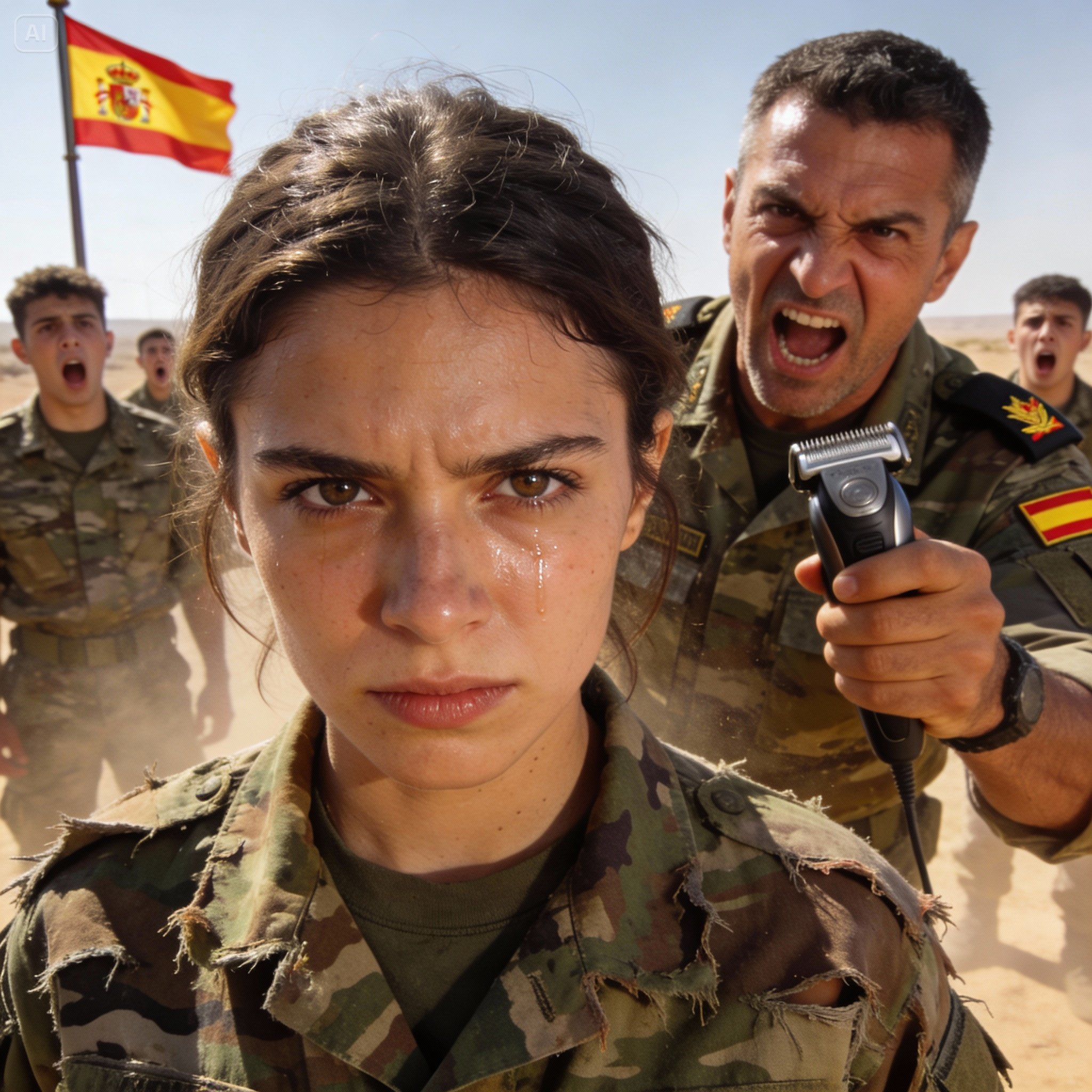
Cárdenas pulled an electric razor from his pocket, the kind used for quick cuts during maneuvers. The whirring sounded like a chainsaw in the silence of the courtyard.
“Let’s fix this ‘regulations’ problem,” he said with a sadistic smile. “If you want to be a soldier, you’re going to look like a real soldier. None of that posh girl hair.”
He brought the machine close to my head. The first contact of the cold metal against my scalp was a shock. Then, the tug. Strands of my hair, cared for over years, fell onto my shoulders and slid down to the dusty floor.
Out of the corner of my eye, I saw Lucía crying silently in formation. Miguel’s fists were so clenched his knuckles were white. Sergeant Cárdenas wasn’t cutting hair; he was shearing it, leaving bald patches, mocking my femininity and my dignity.
“Look how beautiful you are now, Morgan,” he mocked as he carelessly ran the clipper over my skin, scratching it. “Now you really look like someone ready to fight.”
I didn’t cry. I fixed my gaze on the horizon, on the red and yellow flag that fluttered lazily on the main flagpole. I thought of the women who had served before me. I thought of General Herrera, my mentor, who had warned me how hard this would be.
Let him finish , I told myself. Let each strand of hair be a year in prison for him.
When she finished, she turned off the machine and blew off the remaining hairs on the blades. They let me go. I ran my hand over my head; I felt the bare skin, the uneven cuts, the mess. I felt naked, exposed, but strangely invincible.
“There you go,” Cárdenas said. “A free lesson. Now, pick up your trash and go back to your barracks. I don’t want to see that head of yours until you grow something decent.”
I crouched down slowly. I gathered a lock of my own hair. I stood up and looked him straight in the eyes. For the first time in six weeks, I dropped the mask of the frightened recruit. I let Lieutenant Colonel Torres show through my eyes.
“Are you going to regret this, Sergeant First Class?” I asked. My voice didn’t tremble. It sounded with the authority of steel.
Cárdenas blinked, confused for a second by the change in tone, but his arrogance quickly regained control.
—My only regret is not having done it on the first day. Get out of here!
I walked toward the barracks with my head held high, despite my grotesque appearance. I felt the eyes of the entire company on my back. They were no longer mocking glances. They were looks of horror and, strangely, of reverential respect. I had endured the unbearable without breaking.
Upon entering the empty barracks, I went straight to my locker. I took out my toiletry bag. Inside, in a false bottom, was the secure satellite phone.
I dialed the direct number.
—Office of Major General Herrera, Ministry of Defense—a clear voice replied.
—This is Lieutenant Colonel Rebeca Torres speaking. Code Red. I repeat, Code Red in Cerro Negro.
There was a pause on the other side.
—Lieutenant Colonel, proceed.
—The integrity of the mission has been compromised due to a direct physical assault against a senior officer by the primary target. I have witnesses, I have physical evidence. I request immediate intervention and the removal of hostile elements. And General… I want you to come personally.
—Rebecca… are you okay? —the General’s voice lost its formal tone for a moment.
“My safety is intact, ma’am. But my patience has run out. I want the Military Police and the Legal Corps here tomorrow at 8:00 a.m. The show is over. It’s time to clean house.”
I hung up the phone. I looked at myself in the small metal mirror on the locker. I looked like a war casualty, my skull patched and my eyes red with dust. But I smiled. A wolfish grin.
Tomorrow, Sergeant Cárdenas was going to discover that within the Army hierarchy, there were predators far bigger than him. And that he had just bitten the wrong one.
CHAPTER IV: THE JUDGMENT OF THE DESERT
Saturday morning dawned with an eerie calm. Cárdenas acted as if nothing had happened, or perhaps, in his twisted mind, he thought he had restored the natural order of things. He saw me in formation, my head shaved and battered, and let out a mocking chuckle.
—Nice hairstyle, Morgan. Very aerodynamic.
I didn’t answer. I just stared up at the sky to the east.
At 8:00 sharp, a deep sound began to vibrate in the air. It wasn’t the wind. It was a steady, pop-pop-pop-pop rhythm that grew rapidly.
“What the hell is that?” Cárdenas asked, looking up at the sky.
Three black dots appeared over the mountains of Almería. They quickly grew into unmistakable silhouettes: Super Puma helicopters of the Spanish Army. But they weren’t alone. They were escorted by Military Police vehicles that sped through the main gate of the base, their blue lights flashing.
The formation broke slightly. The recruits murmured.
“Attention! Nobody moves!” shouted Cárdenas, although his voice sounded uncertain for the first time.
The helicopters landed on the adjacent helipad, kicking up a cloud of dust that enveloped us all. From the main helicopter, its rotors still spinning, descended a figure that made the base captain, who had just rushed out of his office in his pajamas and with his uniform askew, turn pale.
It was Major General Patricia Herrera.
Behind her, a team from the Military Legal Prosecutor’s Office and four agents from the Military Police wearing intervention armbands.
Cárdenas was stunned. He knew how to recognize ranks. A Major General doesn’t visit a training camp in the middle of nowhere on a Saturday morning to have coffee.
The entourage advanced toward us with purposeful steps. General Herrera stopped in front of Cárdenas. He greeted them with a spasmodic rigidity.
“At your service, my General!” he shouted, sweating profusely.
The General didn’t return the salute. Her gaze swept over the formation of frightened recruits until it stopped on me. She saw my head, the uneven cuts, the visible humiliation. Her eyes hardened like diamonds.
“First Sergeant Cárdenas,” she said in a calm voice that resonated more than any shout. “Are you responsible for the training of this unit?”
—Yes, General. We are… we are proceeding according to schedule.
“And are you responsible for the condition of this recruit?” he pointed at me.
Cárdenas swallowed hard.
“It’s… a disciplinary measure, General. For hygiene and lack of uniformity. Recruit Morgan is problematic.”
The General nodded slowly. Then she turned to me.
—Private Morgan. One step forward.
I left the line. My boots hit the ground firmly. I stood in front of General Cárdenas.
“How are you feeling, soldier?” she asked.
—Operational, my General.
—Good. Because your undercover mission ends now.
The General turned towards the formation, towards the gaping recruits, towards Lucía and Miguel, and finally towards Cárdenas, who was beginning to understand that the ground was opening up beneath his feet.
“Ladies and gentlemen,” the General announced. “I want to introduce you to the person standing before you. This is not Private Jessica Morgan.”
He paused dramatically.
—Before you is Lieutenant Colonel Rebeca Torres, of the Armed Forces Intelligence Corps.
The silence was broken by audible gasps. I saw Lucía’s face contort. I saw Miguel smile slightly, as if his suspicion had been confirmed. But Cárdenas’s face… that was a work of art. It went from red to deathly white in a second. His eyes darted from my boots to my face, trying to process the impossibility of the situation.
“Lieutenant… Colonel?” Cárdenas stammered.
I stood up straight. I no longer shrugged. My posture changed, adopting the authority I had earned through years of service.
“Yes, Sergeant First Class,” I said, my voice clear and strong. “And you have just made the biggest mistake of your life. You have physically assaulted a superior officer, subjected the troops under your command to degrading treatment, falsified reports, and dishonored this uniform.”
Cárdenas took a step back, as if he had been hit.
—I didn’t know… I thought…
“You thought I was weak because I was a woman and a recruit,” I interrupted. “You thought you could walk all over me because no one was watching. But I have news for you, Cárdenas: someone is always watching. And integrity isn’t shown when you have a general in front of you; it’s shown when you’re alone with the most vulnerable recruit. And you have failed miserably.”
I turned towards the Military Police.
—Officers, proceed.
Two police officers approached Cárdenas. They took his service weapon. They put the handcuffs on him. The sound of the metal closing around his wrists was the sweetest melody he had heard in years.
“First Sergeant Daniel Cárdenas,” the legal officer said. “You are under arrest on charges of abuse of authority, assault on a superior officer, embezzlement, and indecent conduct. You have the right to remain silent, although I suggest you do so for the judge.”
As they dragged him away, Cárdenas looked at me one last time. There was no more hatred in his eyes, only a deep fear and the realization that his life, as he knew it, was over.
I turned to my colleagues. Towards “my” section. They were stunned.
—Rest —I ordered, in a softer tone.
I approached Lucía and Miguel. Lucía still had her mouth open.
“Are you… are you an officer?” she asked.
—I am, Lucia. And I’m sorry I lied to you. But it was the only way to protect you all.
She looked at my shaved head.
—He cut your hair… you let him do that… for us.
—Hair grows back, Lucia. Honor, once lost, cannot be recovered. You have shown more honor in these six weeks than he has in his entire career.
Miguel extended his hand to me.
—At your service, Lieutenant Colonel. I knew there was something unusual about you. Nobody peels potatoes with such fury and such skill at the same time.
I burst out laughing. It was a liberating, genuine laugh.
EPILOGUE: SIX MONTHS LATER
I returned to Cerro Negro six months later. The heat was still the same, but the air felt different. Cleaner.
The new Captain in command, a fair and strict but humane man, greeted me at the entrance. The facilities had been renovated. The recruits were running, singing, and working hard, but there was no fear in their eyes, only determination.
Cárdenas had been sentenced to five years in the Alcalá Meco military prison and dishonorably discharged from the Army. His reign of terror was history.
I ran into the new class of corporals. There they were: Corporal Lucía Fuentes and Corporal Miguel Rodríguez. They looked impeccable, professional, and like leaders.
“My Lieutenant Colonel,” they greeted in unison, with brilliant respect.
I wore my hair short, a “pixie” style that was starting to become fashionable, but I wore it like a war medal.
—You’ve done a good job with the new ones—I told them.
—We learned from the best example of what not to do… and from the best example of what sacrifice is —Miguel replied.
I watched the Spanish flag waving against the deep blue sky of Almería. It had been worth it. Every bending, every insult, every strand of hair lost. Because true power lies not in oppressing the weak, but in making oneself vulnerable to defend them. And that is a lesson that no one at Camp Cerro Negro would ever forget.