The secret of the olive grove: How an orphan and a shepherd defied the cruelest chieftain of the Sierra de Ronda to recover the stolen water.
THE HEIRESS OF SILENCE
My name is Marta. For nineteen years, that was my entire name. Just “Marta,” or sometimes “the girl,” “the maid,” “the servant.” At the Cortijo de Los Almendros, nestled in the heart of the Andalusian mountains, surnames were a luxury reserved for the owners, for the gentlemen who rode horses among endless rows of olive trees and vineyards. My life was measured in scrubbed floors, starched linen sheets, and silence. Above all, silence.
“See, hear, and say nothing, Marta. That’s what keeps you under a roof and with a plate of stew on the table,” Doña Asunción, the cook who raised me when my mother died in childbirth and nobody wanted to know about me, always told me.
I grew up thinking my invisibility was my greatest virtue. I moved through the corridors of that immense manor house like a ghost, my espadrilles making no sound on the hydraulic tiles. I learned to read Don Eusebio Barragán’s emotions by the sound of his boots: slow, heavy steps meant trouble with the harvest; quick, sharp steps, anger. Don Eusebio owned everything within sight. In the village of San Lorenzo de la Sierra, his word carried more weight than the mayor’s and almost as much as the priest’s.
But the day my life was shattered, Don Eusebio’s footsteps didn’t sound like anger, they sounded like triumph.
It was a July afternoon, one of those when the heat crushes your will and the cicadas deafen the countryside. I’d been sent to the main office to fetch a pitcher of ice water with lemon. The oak door was ajar. I was about to knock, as was proper, but an unfamiliar voice stopped me. It was Don Cayetano, the town notary, a nervous little man who always sweated profusely.
“Don Eusebio, this is… irregular. Very irregular,” the notary said, his voice trembling. “The boundaries of these lands have been marked since the 1890 land registry. The La Fuente Vieja spring belongs to the village’s communal land. It has always been this way. If we change these plans, it will leave the orchards of the families in the lower valley dry.”
I froze, the silver tray trembling in my hands. I knew which spring they were talking about. It was the only source of water for the plots of small farmers, humble people like Mrs. Reme or old Anselmo, who barely scraped by with their tomatoes and peppers.
—Cayetano, don’t talk to me about history, talk to me about the future—Don Eusebio’s voice was grave, like rolling stones—. Those families don’t have papers, only customs. And customs can be erased with ink. Look at this map.
I peeked through the crack, barely a centimeter. Don Eusebio had unfurled a yellowish parchment on his mahogany desk.
“I’ve found this ‘ancient’ document,” Eusebio said with biting irony. “Look at the seals. Look at the watermarks. According to this map, which you’re going to certify as authentic this very afternoon, the spring has always been within the boundaries of my farm. The peasants have been ‘stealing’ my water for a century.”
—But, Don Eusebio… those seals… you know that… —the notary stammered.
—I know you have a gambling debt in Seville that it would be a shame to make public, Cayetano. And I know this map is the only truth that will exist from tomorrow onward. Sign.
The sound of the pen scratching the paper was like a gunshot in the afternoon silence. It had condemned half the town to ruin. I felt a sudden nausea, a dizziness brought on by the heat and the injustice, and the glass pitcher slipped a millimeter on the tray. The clinking was minuscule, but in that office it resonated like a bell.
Don Eusebio looked up abruptly. His eyes, black and cold as a mine shaft, fixed themselves on the crack in the door. They fixed themselves on my eyes.
He didn’t shout. Don Eusebio never shouted when it was truly dangerous. He got up slowly, walked to the door, and opened it wide. I stood there, petrified, clutching the tray to my chest like a useless shield.
“Marta,” he said. His tone was soft, terribly soft. “How long have you been there, daughter?”
—I just… I just arrived, sir. I brought the water— I lied, but my voice was a thread that was breaking.
He looked me up and down. He analyzed the trembling of my hands, the cold sweat on my forehead, the guilt in my eyes. He knew that I knew.
—Leave the water and go.
I practically ran out of there, my heart pounding in my ribs. I locked myself in the ironing room, trying to breathe, trying to convince myself that nothing would happen. “I’m insignificant,” I told myself. “She won’t care about me.”
I made a mistake.
That same night, Leandro, Don Eusebio’s eldest son, came into the kitchen while I was cleaning up. Leandro had his father’s cruel beauty: tall, well-dressed, with the arrogance of someone who had never had to ask for anything politely. He leaned against the doorframe, chewing on a toothpick.
“My father says you’re tired, Marta. That you look stressed,” Leandro said, approaching slowly. “He says maybe the mountain air isn’t good for you. That perhaps you should go… far away. Or that something might happen to you if you stay and talk too much.”
—I haven’t said anything, young master Leandro.
—No, not yet. But you maids hear too much. And my father doesn’t leave any loose ends. Tomorrow the foreman, “One-Eyed,” will come to take you for a walk. He says he’ll take you to the train station so you can go to the city.
A chill ran down my spine. “One-Eyed Man” didn’t take anyone to the station. When One-Eyed Man took someone from the farmhouse, that person never reappeared. There were stories of day laborers who demanded their wages and ended up at the bottom of a ravine, hunting “accidents.”
“I understand,” I whispered, lowering my head.
—You’d better. Enjoy your last night here.
As soon as Leandro left, I knew I couldn’t wait until dawn. If I stayed, I was dead. I went to my little cot and took out the few things I had: a wool shawl of my mother’s, some coins I had saved, a small knife I used to cut thread, and an old notebook where I kept track of the pantry accounts.
But before leaving, I did something I didn’t even know I’d dare to do. I went back to the office. I knew Don Eusebio was having dinner on the terrace at that hour. I entered like a ghost. The fake map was no longer on the table, but there was a draft in the wastebasket, a sketch with numbers and strange symbols that Eusebio had used to instruct the notary. I picked it up, folded it, and tucked it against my chest, next to my skin. I didn’t know what purpose it would serve, but I knew it was proof of his sin.
I jumped out of the pantry window into the olive grove. The moon was full, illuminating the countryside like an accusing spotlight. I started running. Not along the main road, but across the fields, towards the mountains, where the terrain became steep and difficult.
I ran until my lungs burned and my sandals fell apart. I ran crying, praying to Our Lady of Mount Carmel.
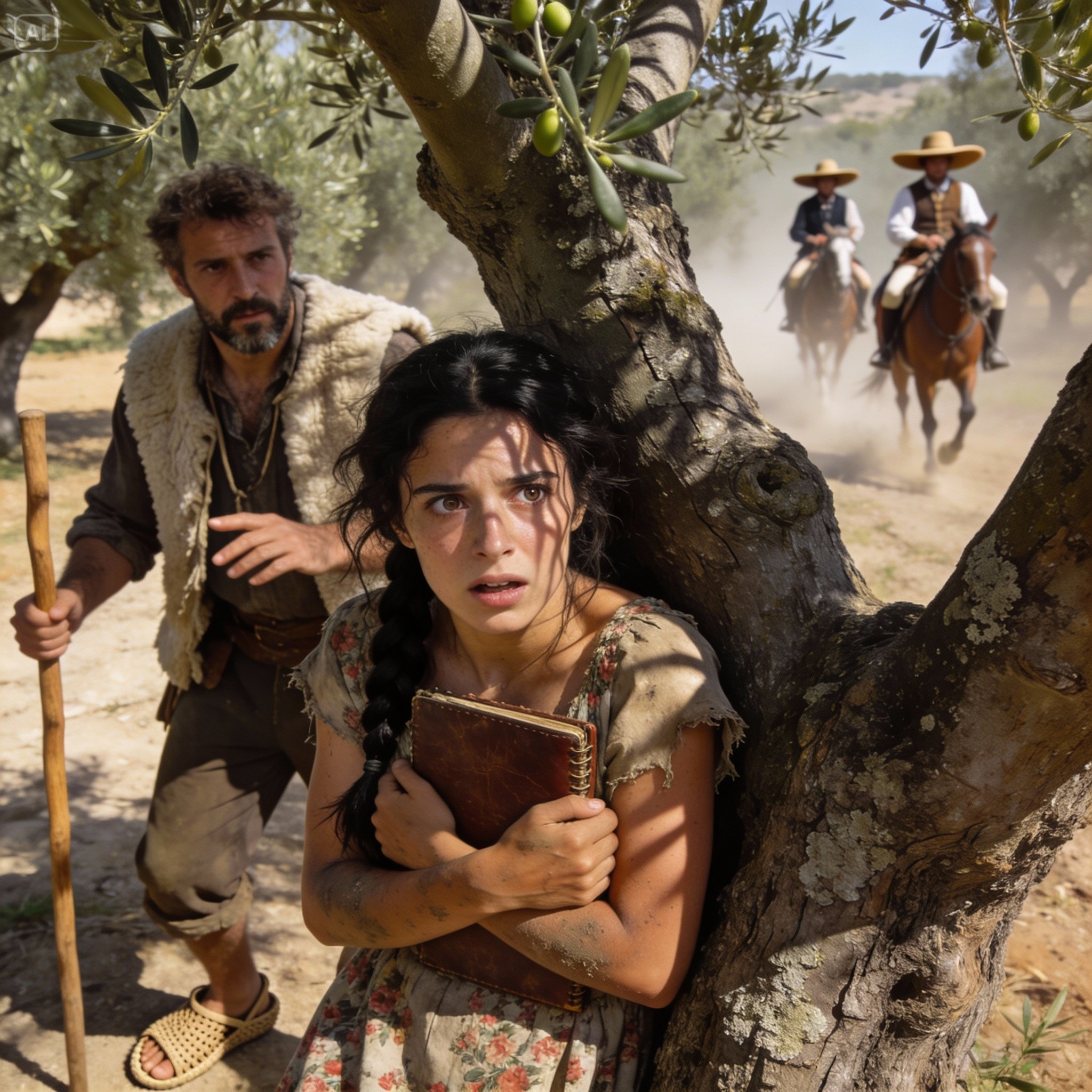
At dawn, I was exhausted, hiding in a cave near the Arroyo de las Piedras. I thought I had lost them. But then I heard barking. Hunting dogs. And then, the sound of horses’ hooves striking limestone.
I peeked out from behind the bushes. There were three of them. One-Eyed Man was in front, his shotgun slung across his saddle. Behind him were two of the estate’s guards. They weren’t looking for me to take me to the train. They were hunting me like a hare.
“It has to be around here!” shouted One-Eyed Man, spitting tobacco on the ground. “The trail ends at the stream!”
“Don Eusebio said he doesn’t want any mistakes. If that girl talks, the whole water plan falls apart,” one of the guards replied.
Panic made me make a mistake. I tried to retreat into the darkness of the cave, but I stepped on a dry branch. The crunch was sharp and crisp. The dogs turned their heads in unison and began to bark furiously, pointing to my hiding place.
“There it is!” shouted One-Eyed Man.
I ran out of the cave, scrambling over the rocks, my dress and skin torn by brambles. I could hear the horses approaching, feel the dogs’ breath. I reached a cliff, a dead-end ravine. Below, the river rushed down. Behind it, Eusebio’s men.
I turned around, cornered. One-Eyed Man dismounted, with a rotten, yellow smile.
—The race is over, little bird. Don Eusebio sends his regards.
I closed my eyes, waiting for the end. I pressed the paper to my chest. “Let the truth be known,” I prayed. “May someone find this paper.”
Then a whistling sound cut through the air. It wasn’t the wind. It was something human, but wild.
A rock, hurled with inhuman accuracy from high above, struck El Tuerto’s hand. The shotgun fell to the ground. Before they could react, a figure leaped from a rocky ledge that seemed impossible to climb.
He fell between the men and me, raising a cloud of dust.
He was a man. No, he seemed like part of the mountain itself. He wore shepherd’s clothes, old but sturdy, a raw wool vest and worn leather boots. His long, black hair was tied back in a ponytail, and several days’ growth of beard shaded his face, weathered by the sun and wind. In his hands he didn’t hold a firearm, but a thick, gnarled olive-wood staff, which he wielded as if it were an extension of his arm.
—This land is royal territory—the man said. His voice was deep, calm, with a thick accent from the deep mountains. —There is no hunting here, and certainly not of young girls.
The One-Eyed Man clutched his bruised hand, cursing.
—Who are you, you wretch? Get out of my way. This is Don Eusebio Barragán’s business.
“The mountain doesn’t care about your Don Eusebio,” replied the stranger without moving an inch.
The two guards spurred their horses to run him down. The man moved with the agility of a lynx. He dodged the first horse, struck its front hooves with his staff, causing the animal to rear and throw the rider. He grabbed the reins of the second and with a brutal jerk drove it into the bushes.
One-Eyed Man tried to reach his shotgun from the ground, but the shepherd stepped on the weapon with his boot and put the tip of his staff to his throat.
“Get out,” said the stranger. “And tell your dogs that if they cross the edge of the high mountain range again, they won’t come down.”
One-Eyed Man, pale and sweating, looked the man in the eye and saw something that frightened him more than Don Eusebio. He signaled to his men, who got up, sore and dirty.
—This won’t end like this, gypsy. Don Eusebio will burn your mountain.
—Let him try.
They left, dragging their pride and their sorrows down the mountain. When the sound of hooves faded, silence descended once more upon the ravine, broken only by my ragged breath.
The man turned towards me. Up close, his eyes were a deep honey color, intelligent and sad at the same time.
“Are you hurt?” he asked.
I tried to speak, but my legs gave way and I fell to my knees. He approached slowly, like someone approaching a frightened animal, and offered me a calloused, strong hand.
“My name is Mateo,” he said. “And it seems you’ve gotten yourself into a very big mess, little girl.”
“They’re going to kill me,” I managed to whisper. “They know everything.”
“No one dies today,” he said, helping me to my feet with astonishing ease. “I know caves where not even Eusebius’s demons can find you. Come on.”
We walked for hours. Mateo knew the mountains as if he had drawn them himself. He led me along paths hidden beneath ancient holm oaks, and we crossed streams, hopping from stone to stone to avoid leaving footprints. Finally, we reached a majada, a shepherd’s shelter made of dry stone perched atop a peak, almost invisible from below.
There she gave me fresh spring water and a piece of goat cheese that tasted heavenly. She treated my scratches with an herbal ointment that smelled of rosemary and arnica.
“Why are you helping me?” I asked when I was finally able to stop trembling. “You know who Don Eusebio is. He owns everything.”
Mateo was stoking a small bonfire. He looked at me through the flames.
—Eusebio Barragán owns the papers, not the land. My grandfather herded these peaks before Eusebio’s father could even read. They drove us out of the valley, called us thieves, gypsies, intruders in our own home. They took away our water down below, but they don’t know that the water springs up here.
He took out a wineskin and drank a long swig.
“Besides,” he added, “I saw the way that foreman was looking at you. I’ve seen that look before, when they’re hunting wolves. And I always go with the wolf, never with the hunter.”
I pulled the crumpled paper from my chest.
“It’s not just hunting, Mateo. It’s theft. Don Eusebio wants to steal the Old Fountain Spring. He forged a map.”
Mateo put down the wineskin and approached. He took the paper respectfully. His eyes scanned the scribbles and numbers. Suddenly, he let out a dry, humorless laugh.
“This map…” he murmured. “Look at these symbols here, by the river. Do you see these three wavy lines and the cross?”
—Yes. Eusebio said they were old property marks.
“They are markings, yes. But not property marks. They are marks of the old shepherds, of my people. They indicate the ‘careo ditches,’ the underground channels that the Moors made centuries ago to cultivate water. That map that Eusebio says is his… is a poorly made copy of the maps my grandmother kept. He doesn’t know what those symbols mean. He thinks they are boundaries, but they are waterways.”
He looked at me with a new intensity.
—If Eusebio has the original, or an old copy, it means that he stole the archives of the Brotherhood of Farmers, which disappeared during the war.
“Can we prove it?” I asked, feeling a spark of hope.
—Not us alone. Our word is worthless against yours. I am a “wild” shepherd and you… you are a fugitive. We need someone who understands ancient laws and who isn’t afraid.
“Doña Beatriz,” I said suddenly. “The healer from San Lorenzo. She knows things. She sometimes looked at me with… with pity. And once I heard her arguing with the priest, defending the poor.”
Mateo nodded.
“I know her. She cured my mother once when the village doctor refused to go up into the mountains. She’s a woman of integrity, even without a degree. But going down to the village is dangerous. Eusebio will have eyes on every corner.”
“I have to try, Mateo. If I don’t, the town will wither away. And I’ll never stop running.”
Mateo stood up and looked towards the valley, which was beginning to turn orange with the sunset.
—You won’t go alone. I’ll take you. But there’s something else you should know, Marta.
He hesitated for a moment, as if weighing his words.
“That map isn’t the only thing Eusebio is hiding. There are rumors in the mountains, stories the old folks tell by the fireside. They say Eusebio had a daughter with a servant twenty years ago. A woman named Soledad.”
My mother’s name hit me like a physical slap.
—Solitude… Soledad was my mother.
Mateo looked at me with infinite sadness.
“I know. You look like her. I saw her once, washing clothes in the river. She was the most beautiful woman in the valley. When she died, they said it was from childbirth, but they also said that Eusebio never acknowledged the child because he was about to marry Doña Clara, the rich woman from Seville. He abandoned you in his own kitchen to keep an eye on you, but without giving you his surname.”
Tears blurred my vision. All my life I’d felt like a stranger, an intruder, and it turned out I had more right to be in that house than his own wife. My father. The man who wanted me dead was my father.
“Then,” I said, angrily wiping away my tears, “he doesn’t just owe me the village water. He owes me a life.”
“Exactly,” Mateo said, extending his hand again. “And we’re going to collect. Tomorrow we’ll go down to see Doña Beatriz.”
We spent the night in the sheepfold. Mateo gave me his wool blanket and slept by the door, watching the stars and the sounds of the mountain. I couldn’t sleep. Rage and fear mingled in my chest. But for the first time, I didn’t feel alone. I had an ally. I had a truth.
At dawn, we descended. Mateo guided me through treacherous ravines where the horses couldn’t keep up. We reached the outskirts of San Lorenzo at midday, hiding among the olive groves. Doña Beatriz’s house was secluded, near the old cemetery.
We waited until no one was around and slipped into the backyard. Doña Beatriz was there, drying chamomile in the sun. When she saw us, she wasn’t startled. She put down her basket and looked at us with her sharp, gray eyes.
“I knew you’d come, Marta,” he said. “Rumors travel faster than birds. They say you’ve stolen, that you’ve run off with a lover. But I know Eusebio is lying.”
“I haven’t stolen anything, Doña Beatriz. He wants to steal the water. And he wants to kill me because I saw him.”
I showed her the draft map and told her what Mateo had told me about the symbols. Doña Beatriz listened in silence, nodding gravely.
“That’s true,” she said. “Eusebio is a well of greed. But there’s something else, Marta. Go inside the house. Quickly.”
Inside, the house smelled of lavender and beeswax. Doña Beatriz went to an old carved wooden chest, opened a false bottom, and took out a rusty tin box.
“Your mother, Soledad, died in my arms,” Beatriz said, her voice breaking. “She knew Eusebio would never acknowledge you. But Soledad wasn’t stupid. She kept letters. And she kept something more important.”
He opened the box and took out an official document, sealed by the church and the old court, dated days before my birth.
“Eusebio was in love with her, in his own twisted way. Before marrying Doña Eusebio, he signed a paternity acknowledgment in private, before the old priest, Don Anselmo, may he rest in peace. He did it in case something happened to him, so that you wouldn’t be left without a father. But then, ambition got the better of him. When he married for money, he buried this document and buried your identity. He gave it to me to keep and threatened to burn my house down if I revealed it.”
I picked up the paper. There it was, in black ink: Marta Barragán Morales . Recognized as the natural daughter of Eusebio Barragán.
“With this document,” Mateo said, his voice echoing in the small room, “Marta is not a runaway servant. She is the rightful heir to half of Eusebio’s land. Including the ancient springs that came as part of the dowry of Eusebio’s grandmother, who loved Soledad very much.”
“My God…” I whispered. “That’s why he’s so afraid of me. It’s not just because of the water fraud. It’s because if I claim my name, he’ll lose half his fortune and his reputation will be ruined in the eyes of his wife’s family.”
“Exactly,” said Doña Beatriz. “But Eusebio has the mayor and the Civil Guard sergeant in his pocket. If you go to court now, the document will ‘disappear’ and you’ll turn up dead in a ditch.”
“So, what do we do?” Matthew asked, gripping his staff.
“Tomorrow is the Pilgrimage of the Virgin of the Sierra,” said Doña Beatriz, a sly smile spreading across her face. “The whole town will be in the Plaza Mayor. The Civil Governor is visiting from the capital. Eusebio will be there, presiding, pretending to be a saint. He won’t be able to do anything to you in front of hundreds of people and the Governor.”
“It’s madness,” I said. “They’ll arrest me before I even get to the podium.”
“Not if you don’t go alone,” Mateo said. “The people are tired, Marta. They’re thirsty. If Doña Beatriz talks to the women, the widows, the mothers… and I talk to the men in the fields, the day laborers who hate Eusebio… we can surround you. We can be your shield.”
Doña Beatriz nodded, with fire in her eyes.
“I know every woman who has given birth in this town. I know their secrets and their pain. Many have suffered because of Barragán. I will summon them. Tonight, we will spread the word like wildfire. Tomorrow, Marta, you will not be an orphan. You will be the voice of us all.”
We spent the night awake. Mateo went out into the shadows to talk to the shepherds and farm laborers. Doña Beatriz visited house by house, whispering in the kitchens. I stayed staring at the paper that said who I really was, feeling how the fear transformed into a cold, hard force, like Toledo steel.
The day of the pilgrimage dawned. The sun shone brightly. The town was filled with music, adorned horses, and women in flamenco dresses. But beneath the joy, there was an electric tension. Eyes met. There were more people than usual in the square, country folk, humble people, dressed in their Sunday best, with serious faces.
Don Eusebio stood on the balcony of the Town Hall, next to the Governor and his son Leandro. The king smiled, waving his hand in his castle.
At twelve o’clock sharp, when the bells rang for the Angelus, we left.
I didn’t run away, nor did I hide. I walked down Calle Real, head held high. To my right was Mateo, with his walking stick and his fierce gaze. To my left, Doña Beatriz, in her black mourning clothes. And behind…
Behind them came the people.
First there were ten women, then twenty. Then the men from the countryside, with empty hands but clenched fists. Hundreds of people walking silently behind me.
When we entered the square, the music stopped. The silence spread like an oil slick.
Don Eusebio saw me. His smile froze. He gripped the balcony railing so tightly his knuckles turned white. Leandro whispered something to the Civil Guard Sergeant, who signaled to his men to block our path.
“Stop right there!” shouted the Sergeant, standing in front of me with his tricorn hat pulled low. “Where do you think you’re going, girl? You’re wanted for theft.”
Mateo stepped forward, placing himself between the guard and me.
—She hasn’t stolen anything. She’s come to return what’s ours.
“Get out of the way, savage,” growled the Sergeant, reaching for his pistol holster.
But then, Doña Beatriz raised her voice, clear and powerful like thunder.
“If you touch her, you touch us all! This girl is flesh and blood of our blood!”
The women behind me stepped forward, forming a human wall. “Justice!” one shouted. “The water belongs to the people!” another farmworker yelled.
The Governor, from the balcony, watched the scene with confusion and alarm.
“What does this mean, Don Eusebio?” he asked. “Who is that girl?”
Eusebio was pale, sweating profusely.
“She’s nobody, Governor. Just a crazy woman, an ungrateful maid…”
I seized the moment. I took the document out of the tin box and held it up to the balcony, towards the sun, for everyone to see.
“I’m not a servant, Don Eusebio!” I shouted, and my voice didn’t tremble. It echoed off the whitewashed walls of the plaza. “I’m Marta Barragán Morales! Your daughter! And I have proof that you’re stealing water from San Lorenzo and forging royal deeds!”
The murmur of the crowd turned into a roar. Eusebio looked like he was about to have a heart attack right there.
“He’s lying!” Leandro shrieked. “It’s a forgery!”
“Bring the notary down!” Mateo shouted. “Bring the maps!”
The public pressure was unstoppable. The Governor, sensing the scandal and wanting to save his own skin, ordered silence.
“Bring the girl up here,” said the Governor. “And bring in the notary. We’re going to clear this up right now.”
I climbed the steps of the Town Hall. I could feel Eusebio and Leandro’s hateful stares, but they no longer burned me. Upon entering the council chamber, I placed the birth certificate and the draft map on the table.
“Explain yourself,” said the Governor.
I looked my father in the eyes. He was no longer the giant who had dominated my childhood. He was an old man, frightened and mean.
“This man,” I said, pointing at Eusebio, “forced the notary to change the boundaries so he could steal the Old Spring. He used ancient symbols I didn’t understand, thinking they were property markers, when they’re actually marks of the village’s old irrigation ditches, as the mountain shepherds well know. And he’s been hunting me down to kill me because I saw him. But worse than that…” I touched the birth certificate. “He denied me my name and let my mother die in poverty while he amassed a fortune.”
The Governor examined the papers. He called the notary, who was among the public, trembling like a leaf.
—Don Cayetano, is this true?
Cayetano looked at Eusebio, then at the angry crowd below, then at the Governor. He knew Eusebio was finished.
—Yes… yes, Your Excellency. He forced me. He threatened me. The authentic map… I have it stored in my safe. The one he presented is a fake.
Eusebio collapsed in his chair, covering his face with his hands. Leandro tried to run out the back door, but two Civil Guards, seeing how the wind was blowing, stopped him.
THE FALL OF THE GIANT
The silence in the plenary hall was broken by the metallic clang of handcuffs. It was a sharp, decisive sound, louder than any shout. The Civil Guard Sergeant, the same man who minutes before had been ready to arrest me, was now carrying out the Governor’s order with martial rigidity.
—Don Eusebio Barragán —he said, avoiding eye contact with the man who had paid him bonuses for years—, you are under arrest for document fraud, coercion of a public official, attempted homicide, and theft of public water.
Seeing Don Eusebio in handcuffs was like watching an equestrian statue fall in the middle of the plaza. It seemed impossible, unnatural. His face had gone from the red of anger to an ashen gray. He didn’t look at the Governor, nor the notary, nor his son who was whimpering in a guarded corner. He looked at me.
But in her eyes there was no longer a threat. There was disbelief. She couldn’t conceive that “the cleaning lady,” the girl who scrubbed her floors, had been the architect of her destruction.
“You’re nobody,” he whispered hoarsely as they pushed him toward the exit. “You’re a stain on my family name.”
I took one step closer, just one, with the dignity that the documents I still held in my hand gave me.
“I am Marta Barragán,” I said, loud enough for the council members and the Governor to hear. “And I am going to cleanse the family name that you have sullied with mud and greed.”
When the Civil Guard brought Eusebio and Leandro out onto the balcony to take them down to the patrol cars, the square erupted. It wasn’t an explosion of violence, but of liberation. Hundreds of voices shouted in unison. Women wept and embraced each other. Men threw their hats in the air.
Doña Beatriz hugged me so tightly that she almost took my breath away.
“You did it, daughter,” she sobbed. “For your mother. For all of us.”
Mateo stood beside me, leaning on his walking stick, observing the scene with that characteristic mountain calm. He wasn’t smiling like the others. He looked at me with pride, yes, but also with concern. He knew that winning the war didn’t mean peace would come easily.
“Now the hard part begins, Marta,” he whispered in my ear. “Now you have the power. Be careful that the power doesn’t change you.”
THE WATER RETURNS TO ITS COURSE
The following months were a legal and emotional whirlwind that shook the foundations of San Lorenzo de la Sierra. The trial was swift and highly publicized. With the testimony of notary Cayetano, who confessed to reduce his own sentence, and the physical evidence of the falsified map, Eusebio’s defense crumbled.
He was sentenced to fifteen years in prison. Leandro, his accomplice and the one who carried out the dirty orders, received ten. The “Los Almendros” farm was seized to pay the millions in fines and compensation to the farmers who had lost their crops due to the water theft.
But the most shocking thing was not the prison, but the inheritance.
The judge confirmed my parentage. Legally, I was the eldest recognized daughter. Since Eusebio’s legitimate wife, Doña Clara, had died years before without leaving a will and her assets were held jointly, and with Eusebio and Leandro civilly disqualified for their crimes, the temporary administration of the unseized assets fell to me.
Overnight, the maid became the owner.
I remember the first time I entered the farmhouse as the owner, not as a servant. The keys felt heavy in my pocket. The house was empty, silent. The furniture covered with white sheets looked like ghosts of an opulent past.
I walked to the study, the place where it had all begun. I sat in my father’s leather armchair. It was too big for me. I felt like an intruder.
Mateo came in shortly after. He had been standing in the doorway, his boots covered in dust from the road.
“This doesn’t seem like your place,” he said frankly.
“It isn’t,” I replied, standing up immediately. “This house smells of fear. It smells of secrets swept under the rug.”
—What are you going to do with her?
I looked out the window at the vast olive groves that shone in the afternoon sun.
“Give it back,” I said. “Give back what matters.”
That same week I called a meeting of the Farmers’ Brotherhood in the courtyard of the farmhouse. Everyone came: old Anselmo, Mrs. Reme, the young people who had thought about emigrating to Germany because there was no future here.
I unfolded the actual map on a trestle table.
“The water from the Old Fountain is once again communal,” I announced. There was a stunned silence, followed by incredulous murmurs. “And not only that. I’ve spoken with the lawyers. We’re going to reactivate the old irrigation channels that my father blocked up to divert the water to his private land. Mateo will oversee the work. He knows the old layout better than anyone.”
Mateo stepped forward, unfolding his own sketches.
“Water isn’t manufactured, it’s sown,” he explained to the farmers in his deep voice. “If we open the channels in the high mountains and let the snow seep into the rock, we’ll have water all summer long, for everyone. Not just for the landowner.”
The transformation of the valley was miraculous. In less than a year, the “lower plain,” which had been languishing, was awash in a vibrant green. The vegetable gardens produced fist-sized tomatoes and sweet peppers. People stopped looking at the ground as they walked. They had regained their pride.
THE SCARS OF THE SOUL
But it wasn’t all easy. There were nights when I woke up screaming, dreaming that hunting dogs were chasing me through the ravine. There were days when some neighbors looked at me suspiciously, whispering that “blood is thicker than water” and that sooner or later I would turn into a tyrannical Barragán.
I had to fight my own demons. There were frustrating moments, when bureaucratic procedures got bogged down, when I felt tempted to bang my fist on the table, to shout, to use the influence of my family name to crush the problems. In those moments, I felt Eusebio’s shadow growing inside me.
It was Doña Beatriz who saved me from myself.
One afternoon, he found me crying in the kitchen of the farmhouse, overwhelmed by inherited debts and pressure.
“I’m afraid, Beatriz,” I confessed. “I’m afraid of becoming like him. I have his nose, I have his eyes. Sometimes, when I get angry, I hear my own voice.”
Beatriz took my hands, those hands of hers that had brought half the town into the world and said goodbye to the other half.
“Blood gives you kinship, Marta, but not destiny. You have Eusebio’s blood, yes. But you also have Soledad’s blood. And above all, you have your own will. Eusebio chose fear every morning. You choose compassion. That’s what makes you different.”
—What if I fail?
—Then you’ll have us to remind you who you are. Me, Mateo… especially Mateo.
Matthew.
He had continued living in his mountain pasture, only coming down to the farmhouse to oversee the waterworks and to see me. Our relationship was like the landscape that surrounded us: rugged, silent, but deep and resilient. There had been no grand declarations of love, no flowers, no romantic dinners.
There were shared glances over the irrigation plans. There were hands that brushed against each other as a tool was passed. There was the absolute certainty that he had jumped into a ravine to face three armed men just to save me.
One autumn day, when the first rains began to fall, I went up into the mountains to look for him. I found him repairing the roof of his shelter.
“You’re going to get wet,” he said to me from above, smiling.
—I like the rain. It means the year will be good.
She jumped down and stood in front of me. The rain soaked our clothes, making our hair stick to our faces.
“I’ve turned the farmhouse into a cooperative,” I blurted out. “I’ve given ownership of the land to the workers. I’ve kept only the small caretaker’s house and a plot of land to grow my own things. I don’t want to be the ‘lady.’ I want to be Marta.”
Mateo stared at me intently. Water trickled down his beard.
—That’s crazy, Marta. You’ve given away a fortune.
“I didn’t give it away. I paid off a historical debt. And besides…” I took a step toward him, closing the distance we always kept between us. “The guard’s house is too big for me alone. And it’s cold in winter.”
Mateo let out a laugh, a pure and joyful sound that echoed off the mountains.
—It’s even colder up here.
—I have good blankets. And they say that human warmth is the best remedy.
He kissed me right there, in the rain, the taste of wet earth and freedom lingering on his lips. It wasn’t a movie kiss. It was a real kiss, rough and sweet, the kiss of two survivors who had found their home in each other.
EPILOGUE: THE JUSTICE OF THE EARTH
Three years have passed since that day in the Plaza Mayor.
San Lorenzo de la Sierra is no longer the fiefdom of a single man. It is a vibrant, noisy, and complex town, as free towns should be.
Don Eusebio died in prison last winter. A heart attack, they said. I went to the funeral. There weren’t many people, just a few old associates out of obligation and me. I didn’t cry. Nor did I feel hatred. I only felt immense sorrow for a man who had all the gold in the world and died poor in love. I left a white rose on his grave, not for him, but for the peace of my own soul. I closed the circle.
Leandro is still in prison, although they say he’s found God or something like that. Perhaps there’s hope for him too.
I live in the small house at the foot of the mountains. Mateo and I got married last spring in a simple ceremony at the chapel, officiated by the same priest who once feared my father but now plays dominoes with us on Sundays. I’m pregnant with our first child. If it’s a girl, she’ll be named Soledad. If it’s a boy, he’ll be named Libre.
Sometimes, in the afternoons, I sit on the porch and look out over the valley. I see the clear water running through the irrigation ditches we restored. I see the olive trees laden with fruit. I see the children playing in the square where I was once tried and where I found my voice.
They used to call me useless. They used to call me a shadow. Now they call me Marta, the water girl.
And I’ve learned that justice isn’t something judges in wigs hand out in faraway courts. Justice is like water: if you stagnate it, it rots; if you let it flow, it gives life. We had to break the dam with our own hands, we had to bleed and cry, but in the end, the river always returns to its course.
Never underestimate the person who silently serves you coffee. Never underestimate the person who knows the mountain paths. And above all, never underestimate the power of truth when it’s spoken aloud under the Andalusian sky.