“The Window Seat”: The day Javier Morales abandoned his millionaire empire on a flight over Zaragoza to save a girl who was looking for her mother in the clouds.
The sound of my own footsteps echoed hollowly on the navy blue carpet of the jetway connecting the terminal to the plane. It was a sound I knew by heart, the rhythm of my life: heel, sole, heel, sole. Five-hundred-euro Italian leather shoes striking the airport floor in Bilbao, Madrid, London, or New York. Javier Morales, the “shark of finance,” the man who had just closed three acquisitions in the Basque Country worth eighteen million euros in less than seventy-two hours.
I should be feeling euphoric. I should be celebrating, maybe calling Álvaro, my assistant, to book a table at Zalacaín or some trendy Michelin-starred restaurant for when I got back to the office. But as I walked toward the Iberia plane’s entrance, all I felt was a bone-chilling weariness, an exhaustion that went beyond the physical. It was as if the weight of my bank account was crushing my chest. Zero hours of decent sleep in a week. The only thing my brain could process at that moment was the visceral desire to sink into seat 3A, order a Jerez brandy—a good one, a Cardenal Mendoza if they had it—and switch off my brain until the wheels touched down at Zaragoza airport.
I stepped into the cabin. The air conditioning blasted onto my face, dry and artificial, with that characteristic smell of burnt coffee and industrial air freshener. I gave an automatic nod to the flight attendant, María Ángeles Ruiz. I knew the crew; I flew so much that flight attendants were more of a constant presence in my life than any woman I’d dated in the last five years.
I walked down the Business corridor , holding my briefcase firmly in my right hand and my phone in my left, checking a half-written email for investors in Singapore.
—Row 3, seat A —I muttered to myself, looking up.
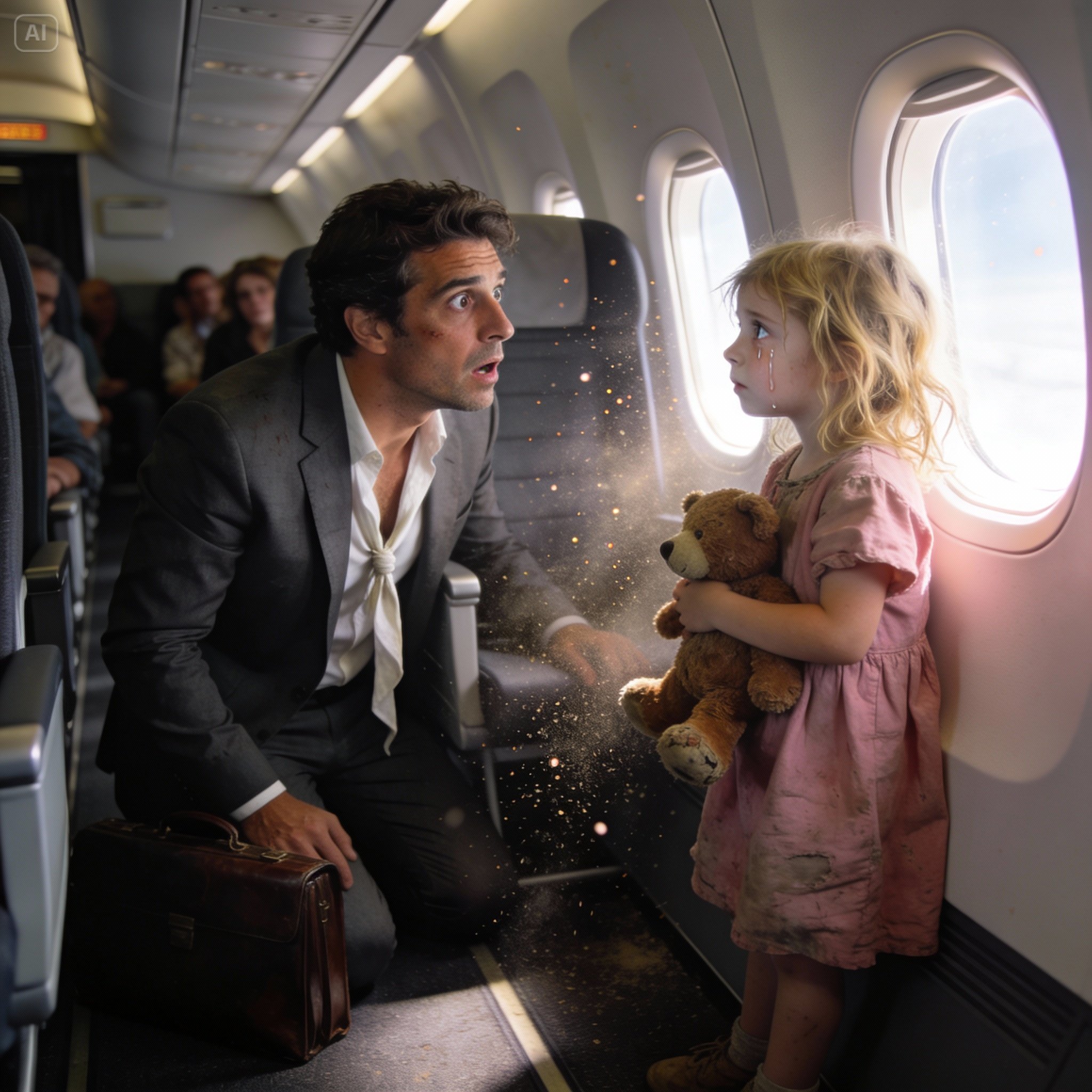
And then, I stopped. The world froze.
There, in my seat, my reserved, paid, and sacred refuge, was not the empty space I expected. There was a small bundle. A tiny creature with blond hair, fine as corn, that fell haphazardly over thin shoulders that trembled slightly.
She was a little girl. She couldn’t have been more than four years old.
She wore a pale pink dress that had seen better days; it was too big for her, as if it had been hand-me-downs or bought with the thought that “she’d grow into it.” Her little legs dangled far from the ground, and against her chest, clutched with a force that turned her knuckles white, she held a teddy bear so worn that it was missing an eye and its fur was matted with time and, she suspected, with tears.
But what struck me wasn’t her clothes or her teddy bear. It was her eyes. She was staring out the window with an intensity that was painful to watch, as if searching for something specific in the vast gray expanse of the runway.
“Miss,” María Ángeles’ voice cut through the air behind me. It sounded tense, oscillating between professional courtesy and irritation. “I’ve already told you this isn’t your seat. You must return to economy class immediately. Your aunt is in row 24.”
The girl didn’t move. She didn’t even blink. It was as if she couldn’t hear, or as if what she was seeing outside the window was the only thing real in her universe.
I felt a pang of impatience, my default reaction. I was Javier Morales. My time was money. My comfort was non-negotiable. But then, the girl turned her head slightly, and I saw the glistening trail of tears tracing her pale, almost translucent cheeks.
—This seat belongs to Mr. Morales —María Ángeles insisted, stepping forward to take the girl by the arm.
—Wait—I said.
My voice came out hoarser than I intended. Something twisted in my stomach, a physical, uncomfortable sensation I hadn’t felt in… how long? Fifteen years? Since the day we buried Dad and I was left alone facing a financial empire and an emotional abyss. I had learned to manage companies, but I never learned to manage the emptiness. I filled it with contracts, with meetings, with figures on spreadsheets.
But that girl… that loneliness that emanated from her was like a mirror.
María Ángeles stopped, her hand suspended in the air, and looked at me in surprise. The silence in Business Class was absolute. I felt the other passengers’ eyes on the back of my neck. The ruthless businessman, the man of the magazines, stopped by a stowaway girl.
I took a step forward. I don’t know why I did it, but my knees buckled. I knelt in the aisle. The fabric of my designer cold wool suit, imported from Milan, brushed against the dirty carpet of the plane. I didn’t care. From that height, I was at their eye level.
They were blue. Immense. And they were filled with a sadness so ancient that no child should ever know it.
At his feet, a small, cheap cloth bag contained what appeared to be his entire worldly wealth.
“Hello,” I said. My voice sounded strange to my own ears, soft, lacking the metallic authority I used in boardrooms. “What’s your name?”
The girl was slow to react. She looked away from the clouds and focused on me. There was a second of assessment, a primal instinct of distrust, but then her lips trembled.
“Lucía,” he whispered. It was a thread of a voice, as fine as silk.
“Lucía,” I repeated. The name carried weight. I savored each syllable. “It’s a beautiful name. It means light. I’m Javier.”
I pointed to the seat next to me, 3B, which was empty.
—Do you mind if I sit here with you for a moment?
She nodded slightly, an imperceptible movement. I slid into the seat next to me, ignoring María Ángeles, who was still standing there, stunned, unsure whether to follow security protocol or let the scene continue.
I turned to face her. Up close, the wear and tear on her clothes was more evident. The dress was patched with clumsy stitches. She smelled of cheap soap and sadness.
“Lucía,” I continued, trying to keep my tone low and intimate, “I heard what you said earlier. You said this seat is the closest to heaven. Why?”
The little girl squeezed the teddy bear even tighter. Her little fingers dug into the old stuffing. She looked down, and for a moment I thought she wouldn’t answer.
“Mom’s in heaven,” she finally said. The words fell like stones. “The nurse at the hospital told me. She said Mom’s an angel now and she’s watching over me from up there.”
I swallowed. The lump in my throat grew bigger, more painful.
—A tear rolled down her cheek and fell onto the pink dress.
“I want to be near her,” he continued, his voice breaking. “As close as possible. That’s why I ran away from Aunt Carmen and came to this seat. If I’m here, by the big window… maybe Mom can see me better. Maybe she can hear me when I talk to her.”
Crack.
It was a quiet sound, but I felt it in the center of my chest. The wall I had built brick by brick over fifteen years, that fortress of indifference and pragmatism, cracked. I looked at that four-year-old girl, orphaned, lost, clinging to the magical logic of childhood to survive unbearable pain. She believed that a few thousand feet of altitude would bring her closer to the person she loved most.
And I… I was worried about my comfort. About my legroom.
Suddenly, my eighteen million euros, my acquisitions, my penthouse in the city center, my sports car… it all seemed obscene. Ridiculously insignificant.
“When…?” I cleared my throat. “When did it happen, Lucia?”
“Three days ago,” he replied, looking out the window again, as if he feared his mother would disappear if he stopped watching the sky. “Mom had been sick for a long time. She had something in her blood. Leukemia, the doctors said. Difficult words.”
She paused to catch her breath, a trembling gasp that shook her small body.
—But Mom always smiled when I went to see her. She would tell me, “Lucía, my love, everything is going to be all right, we’ll be home soon and we’ll make pancakes.” But then… then the nurse came into the waiting room where I was with Aunt Carmen and said that Mom had flown away.
I was speechless. I looked around. A man in a suit and tie in row 4 was discreetly wiping his eyes. An older woman, two rows behind, had her hand over her mouth, stifling a sob. The atmosphere of the plane had changed; the air felt different, charged with a shared humanity rarely seen in first class.
“And where are you going now?” I asked, though I dreaded the answer.
“To Almería,” she said. “Aunt Carmen lives there. She said I have to live with her now. She bought the cheapest ticket.” She lowered her head, ashamed, as if poverty were a crime she had committed. “We had no money. Mama spent it all on the expensive medicines. Aunt said I should sit in the back, where there are no windows, but I… I needed to see the sky.”
I understood everything. The desperation. The escape. The pathetic and courageous attempt to maintain a connection. And I, Javier Morales, was about to become the villain of this story if I allowed them to move it.
I got up slowly. The decision formed in my mind not as a financial calculation, but as an absolute moral certainty.
I turned to María Ángeles. The flight attendant looked at me apprehensively, probably expecting me to demand my rights, to assert my platinum frequent flyer status.
“María Ángeles,” I said. My voice rang out firmly in the silent cabin. “I want you to transfer my reservation to any other available seat on the plane.”
She blinked, confused.
—But, Mr. Morales… you reserved 3A. It’s the best seat. It’s your usual seat.
“It doesn’t matter,” I interrupted, raising a hand. “Even in economy class. If I have to use the restroom, I’ll use the restroom.”
-But…
“Listen carefully,” I said, softening my tone but maintaining my intensity. “This child needs this seat more than I do. More than any of us. She needs to see the sky. She needs to say goodbye to her mother. And if I have to sit between two suitcases in the hold to allow her to do that, I’ll do it gladly. Is that clear?”
A stunned silence followed my words. Then, a murmur. I looked at Lucia. She had looked up, her eyes wide, a mixture of disbelief and gratitude shining in them.
“Really?” she whispered. “Can I stay here?”
I knelt again, no longer caring about the suit or corporate dignity. I smiled at him, and it was a genuine smile, one that came from a forgotten place inside me.
“Of course you can stay here, little one. This is your seat now. It’s your window to the sky. Stay there, watch the clouds, look for your mom. Talk to her all you need to. I’m sure she can hear you.”
For the first time, I saw a hint of a smile on her face. It was fragile, like a flower opening in winter, but it was there.
“Thank you,” she said, and then, on impulse, reached out her little hand and touched my jacket sleeve. “Thank you for letting me be near Mom.”
My eyes felt like they were burning. I had to blink rapidly to keep from collapsing right there.
“You don’t have to thank me, Lucia. Never thank anyone for treating you with humanity. It’s what we should all do. Always.”
I stood up, picked up my briefcase, and walked toward the back, toward economy class. As I passed by, I felt a hand on my arm. It was the passenger from row 4, an older man with a distinguished air.
“That was a beautiful gesture, son,” he said softly. “I’m Dr. Antonio Herrera, a retired pediatrician. I’ve seen many things in my life, but today… today you’ve restored a little of my faith.”
I nodded, unable to speak, and continued walking until I found a free seat in row 6, still in the front section, but far from my usual “throne”.
The plane took off. I felt the thrust of the engines against my back, watched as Zaragoza grew smaller beneath us and disappeared into the clouds. But my mind wasn’t on the flight, nor on business. It was on seat 3A.
During the flight, I couldn’t help but turn around again and again. I could see the top of her little blonde head, always pressed against the window. She didn’t move the entire flight. She didn’t ask for water, she didn’t play. She just stared and whispered things that only she and the sky could hear.
Dr. Herrera, who had changed seats to sit next to me (the flight wasn’t full), broke my reverie halfway through the journey.
“That girl is in shock,” she said gently, cleaning her glasses with a cloth. “The trauma of losing a mother at that age… leaves deep scars. Invisible scars.”
I looked at him with concern.
Will he be okay?
The doctor sighed.
“It depends. It depends on who cares for her now. It depends on the love she receives. Children are resilient, Mr. Morales, incredibly strong, but they need an anchor. They need to know they’re safe. If that aunt of yours…” She trailed off, heavy with doubt. “If she finds a loving home, she’ll heal. If not… the abyss could swallow her whole.”
His words pierced my mind like shards of glass. The abyss. I knew the abyss. I had lived in it, decorating it with money, for fifteen years.
“Ladies and gentlemen, we are beginning our descent to Almería airport.”
The commander’s announcement pulled me from my thoughts. I looked out the window. The arid and beautiful landscape of Almería stretched out below us, the Mediterranean Sea shimmering like a sheet of beaten silver.
Anxiety began to swell in my chest. Irrational anxiety. In a few minutes we would land. Lucía would get off the plane, meet up with that “Aunt Carmen,” and disappear from my life forever. She would be just an anecdote to tell at some charity dinner. “Oh, yes, I once gave up my seat to an orphan, how noble of me.”
But the idea disgusted me. I felt a connection, an invisible thread that bound me to that girl in the pink dress.
The landing was smooth. The plane taxied down the runway and came to a stop. The sound of seatbelts unfastening filled the cabin. People jumped up hurriedly, eager to turn on their phones and get back to the rat race.
I remained still, observing.
I saw María Ángeles approach Lucía and help her with her cloth bag. The little girl hugged her teddy bear, looked out the window one last time—a silent goodbye—and stood up.
I got up too. I didn’t think about it. I just did it. I let the passengers in the front rows get through and joined the queue right behind them, keeping a safe distance.
We went down the steps. The Almería heat hit us, dense and salty. Lucía walked slowly, lost in the vastness of the runway, guided by the ground attendant towards the terminal.
I followed her. I went through security, collected my carry-on bag (which I hadn’t checked), and headed to the arrivals area. I hid behind a column, feeling ridiculous, like a spy in a cheap movie, but unable to leave.
Lucía was there, standing in the middle of the flow of people, small, vulnerable.
Five minutes passed. Ten. Fifteen. The girl began to cry again, silent tears sliding down her face. No one came to get her.
—Lucía!
A harsh voice cut through the air. I looked out.
A woman in her fifties, with hair dyed an artificial mahogany and visible gray roots, approached with a heavy gait. She wore worn sweatpants and a tight-fitting T-shirt. Her face was a map of bitterness; she had those deep lines around her mouth that denote years of frowning, not smiling.
“Here you are, finally!” the woman barked, without bending down to hug the child. “I thought you’d never come out. Parking costs a fortune, you know? I’ve been circling for twenty minutes.”
Lucía instinctively took a step back. I saw the fear in her eyes. That woman was Aunt Carmen. And there wasn’t a trace of love in her welcome.
—Hello, aunt—said Lucia, trembling.
—Come on, move it. I don’t have all day. And stop crying, you’re making me nervous. Your mother isn’t coming back no matter how much you whine.
The woman grabbed her wrist so roughly that every muscle in my body tensed. She didn’t ask how she was. She didn’t offer her condolences. She simply yanked her along like an annoying suitcase.
“Listen carefully,” Carmen continued, dragging her toward the exit. “In my house, the rules are different. I don’t have money for luxuries or patience for nonsense. You’ll sleep on the sofa, you’ll help out where you can, and I don’t want to hear a single complaint. I’m already doing enough by not putting you in social services. You’re just another mouth to feed, and I don’t have money to spare.”
My blood was boiling. Literally. I could feel my pulse hammering in my temples.
They left the terminal. The afternoon sun was blinding. Carmen dragged Lucía towards a distant parking lot, where a gray SEAT Ibiza, dented and with a headlight held on with electrical tape, waited in the sun.
He opened the trunk and threw Lucia’s cloth bag inside as if it were trash. Then he opened the back door.
—Come in. And be careful not to stain the upholstery.
Lucía went upstairs, small and docile. Carmen slammed the door shut.
I stood on the sidewalk, keys to my rental car—a black Audi reserved by the company—in my hand. My rational mind, the mind of a businessman, was screaming at me: “Javier, leave. It’s none of your business. You have a conference call in an hour. You have a life. This is a family matter, it’s legal, you can’t interfere.”
But then, I saw Lucia through the rear window of the Ibiza. She had turned around and was looking back towards the airport, with that expression of utter desolation.
And my heart, that organ I thought was atrophied, took over.
“To hell with the meeting,” I muttered.
I ran towards the Audi. I threw the briefcase onto the passenger seat, started the engine, and sped off. The gray Ibiza was pulling out of the parking lot, paying the ticket at the barrier. I tailgated it, leaving a car’s length of space so as not to be obvious.
The chase began.
We drove through the streets of Almería. The traffic was chaotic. Motorcycles weaving through traffic, heat, noise. Carmen drove aggressively, running dark amber lights. I followed her, my hands sweating on the leather steering wheel.
“What are you doing, Javier?” I asked myself aloud. “What do you think you’re going to accomplish? Are you going to kidnap her? Are you going to call the police? She hasn’t committed any crime… yet.”
But I couldn’t stop.
The surroundings were changing. We left behind the wide avenues and modern buildings. We entered a neighborhood of narrow streets, tall, crumbling buildings, and laundry hanging from balconies, waving like flags of surrender. It was a tough, working-class neighborhood, ravaged by the crisis.
The Ibiza stopped in front of an apartment building that looked like it was about to collapse. The facade was gray with pollution, the entrances dark. Carmen got out, took Lucía out, and pushed her toward the entrance.
—Come on, get in! I don’t have all day!
They disappeared into the darkness of the staircase.
I double-parked the Audi, ignoring the honking of a delivery van. I turned off the engine and stood there, breathing heavily. The car’s air conditioning stopped and the heat began to seep in.
I looked at the building. Third floor. A light came on in a window. I could see the silhouette of the woman gesturing.
My phone rang. It was Álvaro.
—Javier, where are you? The people in Singapore are online. They’ve been waiting for five minutes.
“Álvaro,” I said. My voice sounded strangely calm now. “Cancel the meeting.”
—What? Javier, that’s eighteen million…
—Cancel everything. The meeting, the dinner, tomorrow’s flight back. Everything.
—But… has something happened to you? Are you sick?
“No,” I replied, looking out the third-floor window. “On the contrary. I think I’m finally cured.”
I hung up.
I got out of the car. The heat was stifling. I crossed the street, dodging trash on the sidewalk. I went into the building. It smelled of dampness, cat urine, and cheap bleach. There was no elevator. I took the stairs two at a time, guided by the sound.
Shouts could be heard.
I reached the landing on the third floor. The door on the left, a thin wooden door with peeling paint, was the source of the noise.
“I told you to get rid of that filth!” Carmen’s voice was hysterical. “It’s full of germs! Who knows what bugs he’s bringing home from the hospital!”
“No! Please, aunt!” Lucia cried, terrified. “It’s Mom’s! It’s all I have!”
—I don’t want any old junk here! Throw it in the trash!
I heard a struggle, a thud—perhaps the teddy bear against the wall—and then the little girl’s heart-wrenching cries. Cries that tore my soul in two.
I stopped thinking. Rage, a protective and ferocious rage I didn’t know I possessed, overwhelmed me.
I banged on the door. I didn’t knock. I rapped on it with my fist.
BOOM! BOOM! BOOM!
Silence fell instantly inside.
Heavy footsteps. The bolt turned. The door swung open.
Carmen was there, her face red with anger, her hair disheveled.
“Who the hell is…?” he started shouting, but he stopped when he saw me.
It must have been a striking image. A man of six feet one inch, impeccably dressed in a suit that cost more than his entire building, standing on his dirty landing, with an expression that would have made my toughest competitors tremble.
“Good afternoon,” I said. My voice was pure ice. “We need to talk.”
Carmen backed away, intimidated despite her aggression. Her eyes scanned my clothes, my watch, my shoes. The scent of money and power confused her.
“Who are you?” he stammered. “Are you with the police? Social services?”
I took a step forward, forcing her to back up into the dark hallway of the apartment. I looked over her shoulder.
The apartment was a mess. Old furniture, stacks of boxes, a musty smell. And there, in a corner of the living room, huddled on the floor, was Lucía. She was hugging her knees. The teddy bear lay a couple of meters away, discarded near a garbage bag.
Our eyes met.
“Javier…” she whispered. And in that single word there was so much hope that it hurt me.
I turned towards Carmen.
“My name is Javier Morales,” I said, taking a business card from my inside pocket and placing it in her hand, though she was too dazed to read it. “I’m the man who was sitting with your niece on the plane. And I’m the man who’s going to make sure that girl doesn’t spend another minute in this hell.”
Carmen blinked, regaining some of her defensive composure.
—What’s your problem? This is private property. That’s my niece. She has no right to…
“I have every right my conscience gives me,” I interrupted, taking another step. She bumped into a piece of furniture in the entryway. “I’ve heard how he treats her. I saw him dragging her around the airport. And I just heard him trying to take away the only thing she has left of her mother. That’s called psychological abuse, ma’am. And in Spain, it’s a crime.”
“I… I didn’t touch her,” she defended herself, lowering her voice, frightened. “I’m just… I’m just stressed. I don’t have any money. I didn’t ask for this. My sister died and left me with this mess. I can’t handle this. Look at me! I can barely make ends meet.”
Her voice broke at the end. And for a second, I saw the truth. She wasn’t a monster from a fairy tale. She was a woman overwhelmed by life, poor, bitter, incapable of managing her own misery, much less that of a traumatized child.
“I know,” I said, softening my tone slightly. “I know he has no resources. I know this is too much for him.”
I bent down and picked up the teddy bear from the floor. I dusted it off gently and walked toward Lucia. Aunt Carmen didn’t dare stop me.
I knelt in front of the girl. She looked at me as if I were a ghost. I handed her the doll.
—Here, Lucia. Nobody’s going to take this away from you. Ever.
She grabbed the teddy bear and then threw herself into my arms. She hugged my neck with desperate force, burying her face in my shoulder. She smelled of tears and fear. I lifted her in my arms. She felt so light, so fragile.
I turned towards Carmen, with the girl clinging to me like a koala.
“You said you can’t handle this,” I said, looking her straight in the eyes. “You said it’s just one more mouth to feed. That you have no money.”
“It’s the truth,” Carmen admitted, tears of frustration welling in her eyes. “I work twelve hours a day cleaning stairwells and it’s not enough. What do you want me to do?”
“I want you to let me help her,” I said firmly. “No, rather. I want to take the weight off her shoulders.”
—What… what do you mean?
I took a deep breath. I knew what I was about to say was crazy. My lawyers would kill me. My board of directors would think I’d lost my mind. But never in my life had I been so sure about an investment.
“I want to adopt her,” I blurted out.
The silence in the room was absolute. Only the hum of an old refrigerator could be heard.
—What? —Carmen looked at me as if I were speaking Chinese.
—I want to take responsibility for Lucía. Legally. I want to give her a home, an education, love. I want her to have the life her mother would have wanted for her.
—But… you don’t know her. You met her today.
“Sometimes a day is enough to know what you have to do,” I replied. “Look, ma’am. You don’t want her. She’s a burden to you. But for me…” I glanced at the little blonde head resting on my shoulder, “for me, she’s a chance to do something good for the first time in a long time.”
Carmen slumped into an old chair, defeated. She covered her face with her hands.
—My sister… she wanted the girl to be with family.
“Your sister wanted the girl to be happy,” I replied. “And you know, deep down, that she won’t be here. You’re bitter, tired, and poor. Lucía will only remind you of everything you’ve lost and everything you don’t have. You’ll end up hating her, and she’ll hate you.”
Carmen sobbed. She knew he was right.
“I have money,” I continued, brutally honest. “Lots of money. I can hire the best lawyers. I can make this a long, ugly war in court, proving you’re unfit. Or… we can do it right. You give me temporary custody, we start the foster care process, and then the adoption. I’ll handle everything. You can see her if you want, when things calm down. But Lucía is coming with me. Today.”
Carmen looked up. Her eyes were red. She looked at the little girl, who was still clinging to my neck, refusing to look at her aunt.
—Does she… does she want to go with you?
I looked at Lucia.
“Lucía, darling,” I whispered. “Do you want to come with me? Do you want me to take care of you?”
She lifted her head. Her blue eyes looked at me, and then at her aunt.
“Aunt Carmen…” she said, her voice trembling. “Javier is good. He let me sit near heaven. I want to go with him.”
Carmen nodded slowly, tears streaming down her scarred cheeks. It was a moment of surrender, but also of relief. She was shedding a weight she knew she couldn’t bear.
“All right,” he whispered. “Take her. Take her before I change my mind or do something I’ll regret. But promise me… promise me you’ll take care of her. That you’ll give her everything I can’t.”
“I swear on my life,” I said. And I meant it.
“Take her away,” he repeated, making a vague gesture with his hand. “Her clothes…”
“She doesn’t need anything from here,” I said. “I didn’t want anything that would remind her of this place. Just the teddy bear. We’ll buy everything new.”
I walked toward the door with Lucía in my arms. Before leaving, I stopped and looked at Carmen one last time. I took a wad of bills from my wallet—I always carried cash for emergencies—and placed it on the entryway table. There were about two thousand euros.
“So you can take a break,” I said. “My lawyers will call you tomorrow to finalize the paperwork. Don’t worry about the legal fees. I’ll take care of it.”
I left the apartment. I went downstairs with Lucia in my arms, feeling her little heart beating against mine.
We went outside. The sun was beginning to set, painting the sky orange and purple. The air seemed cleaner.
I got to the car, opened the door, and sat Lucía in the passenger seat, carefully fastening her seatbelt. She was still clutching her teddy bear.
“Javier?” he asked when I sat behind the wheel.
—Tell me, little one.
—Where are we going?
I started the engine. I looked at the sky of Almería, vast and beautiful.
—Let’s go home, Lucia. Let’s start over.
—And will I be able to see the sky from your house?
I smiled, and felt something inside me heal.
—My house has huge windows, Lucia. You’ll be able to see the sky, the stars, and the moon. You’ll be able to talk to Mom every night.
She sighed and rested her head against the back of the chair.
—Okay. Then I’m ready.
I put it in first gear and the car drove away from that gray neighborhood, heading towards a future that, for the first time in years, didn’t scare me, but filled me with hope.
I drove toward the city center with a caution bordering on paranoia. My hands gripped the Audi’s steering wheel as if it were the helm of a ship in the middle of a storm. I glanced in the rearview mirror every few seconds, fearing I’d see a police car, or perhaps Carmen’s gray SEAT Ibiza chasing us. But the street was quiet, bathed in the golden light of the Almería sunset.
Beside me, Lucía remained silent. Her enormous eyes scanned the interior of the luxury car, her finger tentatively touching the leather upholstery, amazed by its softness. The teddy bear was still clutched to her chest, her shield against a world that had treated her too harshly in her short four years of life.
“Are you hungry?” I asked, breaking the silence. My voice was too loud in the soundproof booth.
Lucia nodded slightly, without looking at me.
“My stomach is making noises,” she confessed in a whisper.
—Then let’s fix that. We’ll go to a hotel, order the most delicious dinner in the world, and relax. Does that sound good?
“A hotel?” she asked, frowning. “Like in the movies? Aunt Carmen says hotels are for rich, stupid people.”
I let out a short, dry laugh.
—Well, your aunt is partly right. Sometimes we rich people are really silly. But they have really big, soft beds. And they have room service, which is like magic: you order food by phone and it shows up at your door.
Lucia’s eyes widened. The magic of food delivery seemed to impress her more than the fifty-thousand-euro car.
I headed to the Hotel Catedral, in the heart of the old town. It was a charming place, elegant yet welcoming. I parked at the entrance and handed the keys to the valet, a young man who looked at me curiously. The scene must have been quite something: an executive in a wrinkled three-piece suit, carrying a leather briefcase and holding the hand of a little girl in a patched, dirty-pink dress and worn-out sneakers.
We entered the lobby. The air conditioning was a welcome relief from the heat outside. I walked purposefully to the reception desk, exuding the authority I had honed over years in boardrooms.
“Good afternoon,” I said to the receptionist, who was looking at us over the top of his glasses. “I need your best suite. For a week, for now.”
The man blinked, looking alternately at my American Express Centurion card—the black one, the one with no limit—and at the little girl hiding behind my leg.
“Of course, Mr. Morales,” he said, recognizing the name or perhaps simply reacting to the weight of the titanium card. “We have the Alcazaba Suite available. It overlooks the plaza and has a jacuzzi.”
—Perfect. And I need food brought up immediately. A Margherita pizza, fries, cut fruit, fresh orange juice… and a bottle of red wine for me. A Muga, if you have it.
—Right away, sir. Luggage?
I looked at Lucia’s small cloth bag, which I was carrying slung over my shoulder next to my briefcase.
“That’s all,” I said. “We’ll take care of the rest tomorrow.”
We went up in the elevator. Lucía watched the numbers change with fascination. When we entered the suite, she froze in the doorway. The room was enormous, decorated in warm tones, with wood and white linen. There was a king-size bed that looked like an ocean of clouds, and a picture window overlooking the majestic Almería Cathedral.
“Is all this for us?” she asked, taking a hesitant step onto the plush carpet.
—It’s all for us, little one. You can jump on the bed if you want.
Lucia looked at me as if I had suggested she set fire to the curtains.
—Mom wouldn’t let me jump on the bed. She said the springs would break.
I crouched down in front of her.
—Well, this bed is very strong. And today is a special day. Today the rules are a little different.
I let her explore the room while I took off my jacket and loosened my tie. I felt exhausted, physically and emotionally, as if I’d run a marathon. I went to the minibar, took out a bottle of water, and drank half of it in one gulp. Then I took out my phone. I had fifteen missed calls from Álvaro and five messages from the partners in Singapore.
I ignored them all. I looked up another number. “Garrigues Law Firm – Carlos Mendoza.” Carlos was the best family lawyer in Spain, a legal shark who charged per minute what Aunt Carmen earned in a month. And he was an old friend from university.
“Javier?” she answered on the third ring. “Do you know what time it is? I was having dinner.”
—Carlos, I need your help. And I need it now.
—You sound serious. Tax problems? A hostile takeover?
—No. I… I picked up a girl.
There was a long silence on the other end of the line.
—Please tell me you’re not saying you’ve kidnapped someone.
“It’s complicated,” I said, looking at Lucía, who was sitting on the edge of the enormous bed, swinging her little legs. “It’s a long story. She’s an orphan. Her aunt abused her psychologically. I’ve reached a verbal agreement with the aunt, but I need to secure it legally. I want custody, Carlos. I want to adopt her.”
Carlos let out a sigh that sounded like a balloon deflating.
—Javier, my friend… you’re talking about a process that takes years. Social Services, suitability assessments, judges… You can’t just buy a child, no matter how noble your intentions may be.
“I’m not buying her. I’m saving her. And I have her aunt’s signature, or I’ll have it tomorrow. I have resources. I have a house in Zaragoza. I have a clean record. Carlos, listen carefully: I don’t care how much it costs or who we have to pressure. Make it happen. I want you to fly to Almería first thing tomorrow. Bring the emergency foster care papers, the guardianship papers, whatever it takes.”
-Xavier…
—Carlos. I’ve never asked you for anything personal. I’ve earned your firm millions of euros in commissions. Do this for me.
There was a pause. I heard the clinking of a glass on the other end.
—Okay. I’ll take the first flight. But Javier… be prepared. This isn’t going to be like buying a company. There are feelings, traumas, and bureaucrats involved. It’s going to be the toughest negotiation of your life.
“I know,” I said, watching Lucia hug a pillow. “And it’s the only one I care about winning.”
I hung up just as the doorbell rang. Room service.
Dinner was a quiet but revealing affair. Lucía ate with ravenous hunger, smearing tomato sauce all over her face, devouring the pizza as if she hadn’t had a hot meal in days. I barely touched my food; I was feeding off watching her. Every time she looked at me and smiled with her mouth full, I felt a crack inside me seal a little more.
After dinner, I drew her a bath. The suite’s bathroom had a huge whirlpool tub. I poured soap in and let the bubbles rise.
“It’s like a cloud!” exclaimed Lucia, plunging her hands into the foam.
I left her alone to bathe, respecting her privacy, staying on the other side of the half-open door to make sure she was alright. I heard her humming a children’s song, a little off-key. I smiled. It was the most beautiful sound I had ever heard, better than any symphony or the sound of the New York Stock Exchange bell.
When she came out, wrapped in a hotel bathrobe that was wrapped around her three times, she looked like a different child. She was clean, rosy from the warmth of the water, and her eyes shone a little brighter.
“I don’t have pajamas,” she said, suddenly realizing.
—It’s okay. You can use one of my T-shirts. It’ll be like a giant nightgown.
I put one of my white Egyptian cotton T-shirts on her. It came down to her ankles. She looked ridiculously adorable.
I laid her down on the giant bed. She placed the teddy bear beside her, gently settling it in.
“Javier,” she said, when I turned off the main light and left only the bedside lamp on. “Can I really talk to Mom from here?”
I sat on the edge of the mattress.
—Of course. Look.
I got up and drew back the heavy curtains. Through the window, the night sky of Almería unfolded, clear and starry, above the dark silhouette of the Alcazaba.
“Do you see that bright star over there?” I pointed to Venus, which shone alone.
Lucia sat up, looking in amazement.
—It’s very bright.
—Perhaps it’s her. Saying goodnight to her brave little girl.
Lucía closed her eyes and whispered something inaudible. Then she lay back down.
—Good night, Star Mom. Good night, Javier.
—Good evening, Lucia.
I sat in an armchair by the window, watching her sleep. I didn’t sleep a wink all night. My mind was a whirlwind of plans, fears, and strategies. What did I know about being a father? I didn’t know how to change diapers (though she wasn’t using them anymore, thank God), I didn’t know about schools, vaccines, or braids. My life was orderly, sterile, predictable. This was chaos.
But as I watched her sleep, her breathing soft and rhythmic, I knew I would embrace that chaos with all my might.
The next morning, reality hit early.
At eight o’clock sharp, Carlos was in the hotel lobby. He came upstairs with a folder full of documents and a “I told you so” look on his face. But when he saw Lucía having pancakes with chocolate on the suite’s terrace, his expression softened.
“Okay,” Carlos whispered, pulling me aside. “Now I understand. She’s adorable. And she looks a bit like you, oddly enough.”
—Focus, Carlos. What’s the plan?
“The plan is an all-out offensive. I contacted Social Services in Almería first thing this morning. I explained the situation: mother deceased, aunt in a precarious and vulnerable situation, voluntary relinquishment of guardianship. You’re coming in as an ’emergency foster’ with a view to full adoption. Your financial and social profile helps, Javier, let’s not kid ourselves. If you were an unemployed plumber, they would have already taken the girl away. But being Javier Morales opens doors.”
“Use them all,” I ordered.
“We have a meeting with Aunt Carmen and a notary at noon. We need her to sign the resignation of guardianship and appoint you as the primary guardian. Then we’ll go to family court. I’ve managed to get the investigating judge to see us this afternoon. It’s a personal favor they owe me.”
—Okay. While you organize the paperwork, we have a more important mission.
-Which?
—Go shopping. The girl has nothing to wear.
The morning was surreal. I took Lucía to the shopping district in Almería. We went into a luxury children’s boutique. The saleswomen gave us strange looks at first, because of Lucía’s appearance, but as soon as I took out my credit card, they broke into fake smiles.
“I want everything,” I said, pointing at the clothing racks. “Dresses, trousers, comfortable shoes, coats… everything. In her size. And something cheerful. Nothing gray or black.”
Lucía was lost in thought. She was trying on dresses, twirling in front of the mirror. For the first time, I heard her laugh out loud. A crystal-clear laugh that made the saleswomen smile for real this time.
“Can I wear this?” she asked, pointing to a pair of jeans and a T-shirt with a sequined butterfly on it.
—Of course. And those pink sneakers too.
We left the store laden with bags. Lucia walked with more confidence, as if the new clothes had given her armor against the world.
At noon, the atmosphere changed. We arrived at the notary’s office. Carmen was there, waiting for us. She looked even smaller and grayer under the office’s fluorescent light. When she saw Lucía, clean, with her hair done and wearing new clothes, her eyes filled with tears.
“You look beautiful, baby,” Carmen murmured.
Lucía ran to hug her. There was no resentment in the little girl, only pure love. That broke my heart a little more.
—Hi, Auntie. Javier bought me shoes that light up. Look! —She stomped her foot and the soles flashed.
Carmen smiled sadly and then looked at me. There was shame in her eyes, but also gratitude.
—He keeps his word, from what I can see.
—Always—I said.
We sat down. Carlos unfolded the documents. He explained the legal terms gently but firmly. Carmen listened, nodding, her hands twisted in her lap.
—This means that he is relinquishing parental rights and proposing Mr. Morales as his legal guardian and adoptive parent—Carlos concluded.
Carmen picked up the pen. Her hand was trembling.
“It’s for the best,” she said, more to herself than to us. “I can’t… I can’t give her shoes with lights. I can’t give her anything.”
He signed. The sound of the pen on the paper was the sound of a life changing course.
When we finished, I handed Carmen an envelope.
“It’s not charity,” I said before she could protest. “It’s a start. I’ve spoken with a property management company in Almería, owned by a business partner. They need a cleaning and maintenance manager. It’s a permanent contract, with insurance and a good salary. It starts on Monday if you’re interested.”
Carmen opened the envelope. There was an address and a contact. She looked at me, and the tears finally overflowed.
“Why?” he asked, his voice choked with emotion. “I was horrible to you. I was horrible to her.”
“Because we all deserve a second chance, Carmen. And because Lucía wants it. If you’re okay, Lucía will be even better. I want you to be the aunt she deserves. Come visit her when you feel up to it. But come sober, come calm, and come with love. Otherwise, I won’t open the door.”
Carmen nodded, unable to speak, and left clutching the envelope to her chest as if it were a life preserver.
The following weeks were a strange mix of bureaucracy and tenderness. I rented a villa on the outskirts of Almería, with a pool and garden, to wait for the provisional paperwork to allow us to travel to Zaragoza. Carlos worked his magic in the courts, and I juggled things at home.
I learned that four-year-olds have boundless energy. I learned that broccoli is public enemy number one. I learned to braid hair (thanks to YouTube tutorials) and to read stories using different voices for each character.
But there were also tough times.
On the third night in the new house, Lucía had a nightmare. I was awakened by her bloodcurdling screams. I ran to her room. She was sitting on the bed, sweating, screaming, “Mom, don’t go! Don’t leave me!”
I hugged her, rocking her trembling body while she cried inconsolably.
—Shhh, I’m here, Lucia. I’m here. You’re not alone.
“I want my mom!” she sobbed. “I want her back!”
—I know, darling, I know. It hurts a lot.
I didn’t try to distract her. I didn’t tell her to stop. I simply let the pain out, absorbing it myself. She cried until she was exhausted, until she fell asleep again in my arms. I stayed there all night, my aching back against the headboard, watching over her sleep, silently promising that star mother that I would take care of her daughter even if it cost me my life.
Little by little, the good days began to outweigh the bad ones.
Lucía started calling me “Javier” less frequently and occasionally slipping in “dad” by accident, which she would then shyly correct. I didn’t pressure her. I waited.
One afternoon, we were at the beach. It was November, but in Almería the sun was still warm. Lucía was collecting seashells on the shore, focused on finding the whitest ones. I was sitting on the sand, watching her, when my phone rang.
It was Carlos.
—We have it, Javier. The judge has granted pre-adoptive custody and permission to move. You are free. You can go to Zaragoza.
I hung up and looked out at the sea. I felt a mixture of euphoria and vertigo. It was real. There was no going back.
“Lucía!” I called to her.
She came running, her hands full of sea treasures and sand.
-What’s happening?
—What do you think about going to my house? To my real one. To Zaragoza.
—Is it far?
—A little. We’ll go by plane.
Her face darkened for a moment. The memory of the last plane was linked to loss and fear.
“But this time,” I hastened to add, “we’ll go together. We’ll sit together. And we’ll ask for the window seat so you can wave to Mom the whole way. Okay?”
She thought about it for a moment, looking at a mother-of-pearl shell in her hand.
—Okay. But the teddy bear is coming too.
—The teddy bear is the co-pilot. That’s non-negotiable.
The flight to Zaragoza was very different from the first. I chartered a private jet. Not to show off, but to protect her. I wanted her flight experience to be peaceful, magical.
When we took off, Lucia pressed her nose against the window.
“Hi, Mom!” she shouted happily. “I’m going to Javier’s house! He says there’s snow!”
I looked at her and smiled, but inside I was praying. I was praying to be enough. To be able to fill the immense void that little girl had in her soul.
We arrived in Zaragoza at dusk. The north wind was blowing cold, a stark contrast to the mild climate of the south. I bundled Lucía up in her new pink down coat until she looked like a walking marshmallow.
My penthouse on Paseo de la Independencia was a masterpiece of minimalist design: all glass, steel, black, and white. When we walked in, I realized for the first time how cold it was. It wasn’t a home; it was a status symbol. There were no photos, no clutter, no life.
Lucia let go of my hand and walked through the immense hall, her footsteps echoing on the marble floor.
“It’s very… big,” she said, her voice echoing.
—Yes. It’s too big for just one person. That’s why we needed you to come. To fill it.
In the following days, minimalism died.
The designer living room was filled with toys. The imported glass coffee table was covered in sheets of paper with crayon drawings. The white leather sofa… well, let’s just say the white leather sofa met its chocolate stains very early on. And I didn’t mind. Every stain, every discarded toy, every fingerprint on the pristine glass, transformed that museum into a home.
Javier Morales, the man who couldn’t tolerate a pen out of place on his desk, was now tripping over Lego pieces in the hallway and smiling.
But the real test came with Christmas.
Zaragoza was decked out in its finest. The lights on Alfonso Street shone like a tunnel of stars. And Lucía was captivated. She had never had a real Christmas, with presents and a tree. Her mother had been ill the last Christmas, and money was tight.
I decided it would be the best Christmas ever.
We bought the biggest tree that would fit in the living room. We spent an entire afternoon decorating it. I played Christmas carols at full volume, something my neighbors in the exclusive building certainly didn’t expect from the serious Mr. Morales.
While Lucia was trying to hang a golden ball on a high branch, I lifted her up in my arms.
“Higher, Dad,” she said, laughing.
She froze. Me too.
He looked down at me, the ball in his hand, his eyes wide. He had escaped. The magic word.
“Can I… can I call you Dad?” she asked shyly, looking down. “I know you’re not my real dad, but…”
I lowered her slowly, but I didn’t let go. I knelt in front of her, looking into her eyes, feeling like my heart was going to burst out of my chest.
—Lucía, a father isn’t just the one who gives you life. A father is the one who takes care of you, who reads you stories, who scares away monsters, and who loves you more than anything in the world. And I do all of that. So yes. I am your dad. Your real dad.
She smiled, a smile that lit up the entire attic more than the lights on the tree.
—I love you, Dad.
—And I love you, my love.
That was the moment. The point of no return. The papers said I was his guardian, but his heart had the final say: we were family.
However, my transformation did not go unnoticed by the outside world. My partners were nervous. I had canceled meetings, delegated important decisions to Álvaro, and declined business trips.
“Javier, you have to get back in the game,” Álvaro told me one morning, while we were reviewing contracts in my home office, with Lucía sketching at our feet. “There are rumors that you’re losing your touch. That you’ve softened.”
I looked at my daughter, who was focused on painting a purple sun.
—I haven’t softened, Álvaro. I’ve focused. Before, I invested in companies, in assets that went up and down. Now I invest in the future. In life.
—I understand, boss. But the Singaporean investors…
“Tell them to wait. Or find someone else. I’m not going to miss Lucia’s school Christmas play to argue about 2% profit margins. I have enough money to live ten lifetimes. Now I want to live this one.”
Álvaro smiled, closing the folder.
—I knew you’d say that. By the way, the Foundation already has a name.
—Oh, really?
—Lucía Morales Foundation. For comprehensive assistance to orphaned children.
I nodded, satisfied. It was my legacy. Not skyscrapers, not mergers. But a safety net so that no other child would have to sit alone on a plane clutching a stuffed animal, believing that was their only connection to love.
Winter advanced. Snow covered Zaragoza, just as she had promised Lucía. And the day arrived when Carmen came to visit.
She was nervous. So was I. Three months had passed since Almería. I picked her up at the AVE train station. She looked different. Her hair was freshly dyed, she wore simple but clean, new clothes, and she looked healthier. Work and stability had done her good. She no longer seemed like a woman cornered.
“Hello, Javier,” he said, shaking my hand firmly. “Thank you for the ticket.”
—Thank you for coming, Carmen. Lucia is very excited.
When we got home, Lucia ran towards her.
—Aunt Carmen!
The hug was long and genuine. Carmen cried, but they were pure tears. We spent Sunday together. We ate, we laughed. Carmen told her stories about her mother when they were little, stories that Lucía listened to eagerly, filling in the gaps in her memory.
I saw Carmen look at Lucia, and then at me.
“You’ve performed a miracle,” she told me during a moment when Lucia went to the bathroom. “She’s happy. She’s healthy.”
—She has performed a miracle, Carmen. She has saved me. I only provide the house and the food.
When she said goodbye, Carmen hugged me too.
—Take care of her. She’s the best thing we have.
—With my life.
Life went on, woven day by day with threads of routine and love. And so we arrived at that December morning, with the snow falling and the smell of pancakes filling the kitchen, where I finally understood that success isn’t measured in euros, but in good morning hugs.
Spring arrived in Zaragoza with an explosion of color that seemed to reflect the state of my soul. The almond trees blossomed, the Ebro River flowed swiftly and brightly, and Lucía grew at a rate that both frightened and amazed me.
She was no longer the scrawny girl from the plane. She had gained weight, her cheeks had a constant, healthy flush, and her blonde hair shone in the Aragonese sun. But the most profound change was in her eyes: that abysmal sadness, although it never completely disappeared—grief is a tide that rises and falls—had given way to an insatiable curiosity and a contagious joy.
Our routine had settled in like the foundations of a solid building. I would get up at seven, make breakfast (I had become an expert at French toast and fruit smoothies), and wake Lucía up with tickles. I would take her to school, a bilingual center where she had adapted surprisingly quickly, making friends and demonstrating a lively intelligence.
My work mornings had changed drastically. I no longer spent twelve hours chained to my office in the corporate tower. I worked from home or went to the office only for essential matters. I had delegated most of my operational responsibilities. My partners, initially skeptical, had to admit that, surprisingly, my strategic decisions were now sharper. I had a mental clarity I had previously lacked, clouded by stress and excessive ambition. Now, every decision had a purpose: to secure Lucía’s future and that of the Foundation.
The Lucía Morales Foundation had become my main project. It wasn’t just a way to get tax breaks or improve my image. It was a personal crusade. We were dedicated to identifying cases of early childhood vulnerability, providing psychological support to grieving children, and facilitating resources for foster families. Every time I visited one of our centers and saw a child smile because someone had listened to them, I felt a satisfaction that no million-dollar bonus had ever given me.
But not everything was perfect. Real life never is.
One afternoon in April, I received a call from the school. It was Lucia’s tutor.
—Mr. Morales, could you come? Lucia has had an… incident.
My heart stopped. I drove to the school imagining accidents, falls, hospitals. When I arrived, I found Lucía sitting in the principal’s office, arms crossed and brow furrowed, swinging her legs. She didn’t seem hurt, but she was furious.
“What happened?” I asked, kneeling beside her.
The director sighed.
—Lucía pushed a classmate during recess. Mateo.
I looked at my daughter, surprised. Lucia was sweetness personified. She had never been aggressive.
—Lucía, is it true?
She nodded, without looking at me.
—Why did you do it?
“Because he’s stupid,” he muttered.
—Lucía…
“He said I don’t have a mom!” she burst out suddenly, turning to me with tears in her eyes. “He said that because you’re my dad and I don’t have a mom at home, I’m weird. And that moms don’t live on stars, that’s just baby talk.”
I felt a pang of pain, but also of anger toward that invisible child named Mateo. I took a deep breath. I had to be the adult. I had to be the father.
“I see,” I said calmly. I turned to the principal. “Is the child alright?”
—Yes, it was just a push. But we have a zero-tolerance policy for physical aggression.
—I understand. I’ll talk to her.
We went home in silence. Lucia stared out the window, sulking and sad. When we arrived, we sat down on the sofa.
—Lucía, you can’t push people, even if they say nasty things.
—But she said Mom doesn’t exist!
“Mateo is wrong,” I said, taking his hands. “But you know the truth. You know where Mom is. And you know that love doesn’t disappear just because we can’t see the person.”
She sobbed.
—But I want her here, Dad. I want her to pick me up from school like the other kids’ moms. I love you, but… I miss her.
I hugged her tightly, letting her cry. It was the first time she had verbalized that longing for normality, that frustration at being “different”.
“I know, honey. And it’s okay to miss her. It’s okay to be angry. But we can’t hit others. We have to be stronger than that. We have to teach them that there are many ways to be a family. We’re a family of two, plus a star. And it’s a perfect family.”
That night, before going to sleep, we took out the photo album that Carmen had helped us put together with pictures sent via WhatsApp. Photos of her mother smiling, photos of Lucía as a baby. We talked about her, laughed, and cried. It was a necessary healing session.
The next day, Lucía went to school and apologized to Mateo. With the dignity of a four-and-a-half-year-old, she explained that her mother lived in heaven and had the best job in the world: watching over the clouds. Disarmed by her confidence, Mateo gave her half his sandwich at recess.
Summer brought our first “official” vacation. We went to Disneyland Paris. Seeing Lucia wearing Minnie Mouse ears, hugging the princesses, and staring wide-eyed at the fireworks over the castle was the culmination of a year of transformations.
On the return flight, we were sitting in Business Class (this time in seats 1A and 1B). Lucia was looking out the window.
“Dad,” he said, pointing at the cottony clouds. “Do you think Mom saw Mickey from up there?”
—Sure it does. It has the best view in the park.
Lucia smiled and rested her head on my shoulder, falling asleep soon afterwards, with the old teddy bear —which traveled everywhere— under her arm.
I lay awake, reflecting. I thought about the man I was a year ago: cynical, solitary, obsessed with control. And I looked at the man reflected now in the dark airplane window: tired, yes, with a few more gray hairs, but with a light in his eyes that hadn’t been there before.
He had learned that fatherhood is not an exact science, nor a predictable business. It’s a daily leap of faith. It’s a constant fear of making mistakes and overflowing joy at small victories. It’s the art of being present.
We landed in Zaragoza. It was night. As I drove home with Lucía asleep in the back seat, we passed my old office, the illuminated skyscraper where I had spent so many sleepless nights chasing ghosts of success.
I didn’t feel nostalgia. Just relief.
We arrived home. I carried Lucía in my arms to her bed, took off her shoes, and tucked her in. I kissed her forehead and stayed there for a moment, listening to her breathing, that sound that had become the soundtrack of my life.
I went to my room and opened the window, just as I had done six months before. The summer sky was clear, studded with stars. I looked for the brightest one, the one Lucia always waved to.
“We’re getting there,” I whispered to the warm night breeze. “She’s happy. She’s strong. She has character, just like you, I suppose. Thank you for sending her to me. Thank you for saving me.”
I closed the window and went to sleep, with a peace that surpassed all understanding.
The future would undoubtedly bring challenges. Adolescence, difficult questions, first heartbreaks. But I wasn’t afraid of them anymore. I had Lucía. I had a purpose. And I was absolutely certain that, as long as we were together, we would always find our way, guided by the light of a star and the unwavering love of a father who learned to be one at 30,000 feet.
And so, the story of the girl in seat 3A and the lonely millionaire didn’t end with “happily ever after,” because real life doesn’t end, it continues. But it continued full of laughter, Sunday pancakes, drawings on the refrigerator, and the unwavering certainty that love, when it’s true, gives you wings more powerful than any airplane.