Expelled pregnant from the family mansion in Lugo, I survived in a “cursed” ruin thanks to an old cow and discovered the hidden treasure that my husband protected for me.
The rain in Galicia doesn’t fall; it embraces you, envelops you, and sometimes, suffocates you. That April morning in 1856, the sky over the Lugo region seemed to weep with me. The raindrops beat against the windows of the grand ancestral home of the Méndez family with a monotonous insistence, a mournful drumbeat that accompanied the broken beating of my own heart.
I, Elena, barely twenty-two years old and with a belly that promised seven months of life amidst so much death, felt like an intruder in my own grief. Joaquín, my beloved Joaquín, had left just three days before, consumed by a sudden fever that took him with the speed of a sigh. And now, while his body rested in the damp earth of the cemetery, his family was preparing to bury me alive.
We were gathered in the main hall of the Pazo de los Méndez. It was an imposing room, with granite walls, antique tapestries, and a fireplace where oak logs were burning, although the heat didn’t reach the corner where I had been relegated.
Sebastián, Joaquín’s older brother, presided over the table. He was forty-five years old and had the eyes of a bird of prey. Beside him, his sisters, Marta and Olivia, dressed in full mourning, whispered like magpies. They never accepted me. To the Méndez family, old-fashioned noblemen fallen on hard times but clinging to their pride, I was “the seamstress,” the nobody’s daughter who had bewitched the youngest member of the family.
“Let’s get on with it,” Sebastian said impatiently, banging his bony knuckles on the table. “I have business to attend to in Santiago and I don’t want to waste the day on paperwork.”
Don Anselmo, the town notary, a nervous little man with round glasses who seemed to shrink under Sebastián’s gaze, broke the red wax seal. His hands trembled. He loved Joaquín. Everyone with a heart loved Joaquín.
—I, Joaquín Méndez y Castro —Don Anselmo read, and hearing his name was like a knife to the chest—, in full possession of my faculties, declare my last will…
Sebastian leaned back in his chair, smiling smugly. He already saw himself as the master of everything. And he wasn’t wrong, at least not entirely.
“The main estate, the vineyards in the valley, and the cattle are now in the hands of my brother Sebastian, to ensure the continuity of the family name,” the notary read.
Marta and Olivia nodded, satisfied. Don Anselmo cleared his throat, and his eyes searched for me above the papers. There was pity in his gaze. I hated that pity.
—To my sisters, Marta and Olivia, I bequeath the sum of two thousand reales to each of them.
“Only two thousand?” Olivia huffed, adjusting her lace shawl. “Joaquín was always a sentimental cheapskate.”
—And to my wife, Elena… —Don Anselmo’s voice broke for a moment. A dense, heavy silence fell, broken only by the crackling of the fire— I bequeath the cow named “Estrella” and the property known as the Pazo del Olvido, located on the edge of Mount Cuco, with all its lands and belongings.
The silence lasted one more second, before breaking into laughter.
Sebastian laughed so hard he had to hold his stomach. Marta let out a sharp, cutting laugh.
“The Manor of Oblivion!” exclaimed Sebastián, wiping away a tear of laughter. “That ruin! Joaquín had a sense of humor even in his grave!”
“An old cow and a house with falling-down roofs?” Olivia looked at me with pure contempt. “Well, seamstress, at least you’ll have somewhere to die. Although they say the dead don’t rest in that place.”
I remained motionless. My hands caressed my belly, trying to calm the thrashing baby, perhaps sensing my distress. The Manor of Oblivion. I knew the place by hearsay. It was an old family property, abandoned decades ago, lost in the thick of the woods. Terrible stories were told about that place: strange lights, wailing in the night, the legend of old Tobias who died there, mad and alone.
“It’s a bad joke,” said Sebastian, regaining his composure. “But it’s legal. Elena, you have until sunset to get your belongings out of this house. You can take that useless cow with you when you leave. It’s in the sick animals’ pen.”
Don Anselmo tried to intervene. “Don Sebastián, for God’s sake, the widow is pregnant. You can’t send her away in this weather, to a place that’s practically in ruins…”
“Shut up, notary!” roared Sebastian. “She’s not one of us. Joaquín made the mistake of marrying a penniless woman, and I’m correcting that mistake. The Pazo del Olvido is hers. Let her go.”
I stood up. The effort made my hips ache, but I didn’t let them see my pain. I lifted my chin, searching for that dignity my mother had taught me before she died.
“I accept the inheritance,” I said. My voice was thin, but firm. “If that’s what Joaquín wanted for me, I accept it.”
Marta snorted. “Proud to the very end. You’ll be begging for alms at the church door soon enough, Elena. And we won’t even give you the scraps.”
“I won’t come back,” I promised them, looking them one by one in the eyes. “Not even if I’m dying.”
I left the living room without looking back. I went up to the room I had shared with Joaquín, the room where we had dreamed of watching our son grow up. I made a bundle of my clothes, my Bible, and the wool shawl Joaquín had given me on our first anniversary.
Before leaving, I checked his nightstand drawer one last time. There, hidden in the false bottom that only I knew about, was an envelope. “For Elena,” it read in his handwriting. I tucked it to my chest, against my skin, feeling like I was carrying a piece of him with me.
I went downstairs. Sebastian was standing guard at the door like a jailer. “Out,” he said. “And may the rain wash you from our memory.”
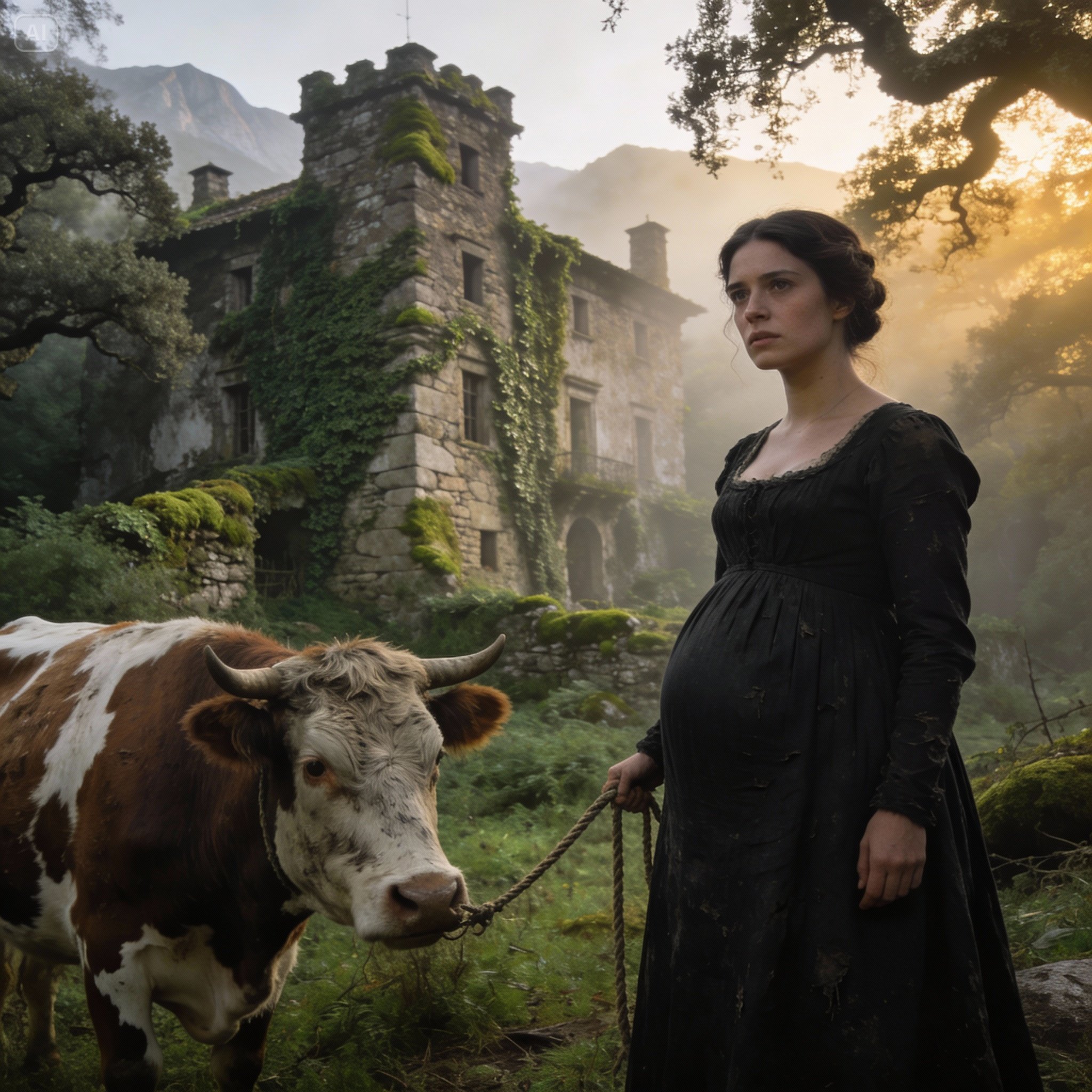
I walked through the drizzle to the back corrals. Mud stained the hem of my black dress. There, away from the dairy cows and strong oxen, stood she.
Star.
She was a Galician blonde cow, but old, with a sunken back and irregular white patches on her reddish coat. She looked at me with enormous, dark, liquid eyes. There was no fear in her, only infinite calm.
“Hello, beautiful,” I whispered, extending my hand.
The animal exhaled warm steam into the cold air and brought its wet snout close to my hand. Then, with an unexpected gentleness, it lowered its head and softly touched my belly. I froze. It was such a human gesture, so comforting, that the tears I had held back in front of my brothers-in-law’s vultures finally flowed.
“We’re alone, Estrella,” I said, tying an old rope to her halter. “Just you, me, and little Joaquín. Let’s go home.”
The path to Pazo del Olvido wasn’t a path at all; it was a scar of mud and stone that wound its way up the mountain. It took us three hours. The rain intensified, and the north wind blew fiercely, shaking the branches of the ancient chestnut trees, which seemed like skeletal fingers pointing at my misfortune.
My feet bled inside my worn boots. My back screamed in pain. But every time I faltered, Estrella stopped and waited for me, or even gently nudged me with her snout, giving me strength.
We arrived at dusk, when the shadows were already lengthening, turning the forest into a wolf’s mouth.
The property lived up to its name. The “Pazo” was a two-story stone house devoured by ivy. The slate roof was riddled with holes through which the gray sky filtered. The windows were empty sockets, without panes. Weeds reached waist-high around the porch. And the silence… the silence was absolute. No birds sang. No crickets chirped. Only the distant murmur of the Miño River and our labored breathing.
“My God, Joaquín,” I sobbed, falling to my knees in the long grass. “Why have you sent me here?”
I took the letter from my chest, protecting it from the rain with my shawl, and opened it with numb fingers. Joaquín’s handwriting danced before my tired eyes.
“My beloved Elena,
If you’re reading this, it means I’ve passed away, and my family’s cruelty has revealed its true face. Forgive me for not protecting you better while I was alive, but trust me now.
They see ruins, but you should see foundations. They see an old cow, but you should see a guardian. The Pazo del Olvido holds the legacy of Tobias, the man who returned wealthy from the Americas and died here. No one in the family ever dared to seek the truth because their souls are filled with fear and greed.
Look where no one else is looking. See with your heart, not your eyes. The key is under the lintel stone. Estrella knows where to step. Trust the cow. Trust yourself. You are stronger than all the gold in the world.
I will love you until the stars go out.
Your Joaquín.”
“Estrella knows where to step.” I read the phrase over and over. I looked at the cow. She wasn’t grazing. She was standing in front of the main entrance of the ruined house, staring at the door as if waiting to be invited in.
I stood up, wiping away my tears. Fear wouldn’t feed my son. Action would.
I searched under the lintel stone of the entrance, moving a moss-covered granite slab. There, wrapped in an oilcloth, was a large, rusty iron key. My heart skipped a beat. Joaquín wasn’t lying.
I opened the door. The hinges creaked with an agonized wail that echoed in the darkness. The interior smelled of dampness, of dust that had stood still for so long. I lit the small lantern I carried in my bundle. Shadows danced on the peeling walls.
There were pieces of furniture covered with sheets that looked like ghosts. A sturdy chestnut table, overturned chairs, a cold hearth filled with ashes from half a century ago.
That first night was hell. The wind whistled through the cracks like the souls of the Santa Compaña. I huddled in a corner of the kitchen, the only place that seemed dry, wrapped in blankets, with Estrella tied up on the porch, mooing softly now and then, as if reassuring me that she was still there.
At dawn, hunger woke me. I ate a piece of stale bread and cheese I had saved and drank water from a well in the backyard, praying it wasn’t poisoned. The water was sweet and cold.
—“Estrella knows where to step”—I repeated.
I let the cow loose. Instead of searching for the tender grass near the river, Estrella walked purposefully toward the back of the house, where the land rose to a rocky hill covered in gorse and heather. I followed her.
She stopped in a strange clearing, a circle where the vegetation didn’t grow much. She began to tap the ground with her right front hoof. Over and over. Cluck. Cluck. Cluck.
I approached. The ground looked like ordinary earth, but when I knelt down and pushed aside the surface layer of mud and rotten leaves, my fingers touched something hard. It wasn’t natural stone. They were flagstones. Flagstones laid by human hands.
With a strength I didn’t know I possessed, driven by desperation and Joaquín’s promise, I searched the tool shed for an old iron bar and began to dig. Hours passed. Sweat mingled with the drizzle on my forehead. My stomach ached, my soul ached, but I didn’t stop.
I lifted the first slab. Beneath it was a dark gap. I put the lantern in.
It wasn’t a tomb. It was a chest. An oak chest, reinforced with iron bands, preserved by the dry atmosphere of that makeshift underground chamber.
I broke the rotten padlock with the iron bar.
What I saw when I opened the lid took my breath away. There were no gold coins glittering like in fairy tales. There were books. Worn leather notebooks. And beneath them, wrapped in linen rags, were glass jars filled with irregular gold nuggets and dust, and documents bearing royal seals.
I opened one of the notebooks. The date was 1820. “Diary of Tobias Nunez. I have found the vein. The Romans exploited it, but they did not exhaust it. It is still here, under Mount Cuco. Gold runs through the veins of this land like blood through my body. But I must hide it. If the Mendez family finds out, they will kill me like a dog. I have created the legend of the curse to drive them away. I will only leave the secret to someone worthy…”
I sat on the edge of the hole, a flask of pure gold in my hand, trembling. Joaquín had discovered Tobias’s diaries when he was a child, playing in the forbidden ruins. He had kept the secret his entire life, waiting for the moment to use it to free himself from his family. And now, that secret was mine.
But the peace was short-lived.
Two days later, I heard the unmistakable sound of horses’ hooves approaching along the road. I peered out of the broken window upstairs. There were three riders. In the center was Sebastián. On either side of him were two men I recognized as notorious foremen, thugs who did the dirty work in the region.
Fear chilled me to the bone. Sebastian wasn’t going to wait for hunger to kill me. He’d come to finish the job.
I ran downstairs, grabbing the iron bar as my only weapon. I went out onto the porch.
Sebastian stopped his horse a few meters away. The animal was panting nervously. “I see you’re still alive, sister-in-law,” he said with a crooked smile. “I came to see if the ghosts had already taken you, but it seems you’re more stubborn than they are.”
“This is my property, Sebastian,” I shouted, trying to keep my voice from trembling. “Get out!”
“Your property…” he laughed. “Look, Elena, I’m going to be generous. Sign this paper renouncing the inheritance, and I’ll give you one hundred reales so you can go to a convent. If you don’t sign… well, my men will have to drag you out. And an accident in these ruins… a pregnant woman falling down a rotten staircase… it’s such a tragic thing, but so common.”
The two thugs dismounted, pulling knives from their belts. They advanced toward me.
I backed up until I hit the stone wall. There was no escape. I was going to die there, and my son with me.
“Hold her back!” Sebastian ordered.
That’s when it happened.
A deep, guttural, terrible moan echoed from the side of the house. It didn’t sound like an animal, but like the earth itself roaring.
The star appeared.
But this wasn’t the gentle old cow I knew. She came charging, head down, horns pointing straight ahead. Her eyes, usually so kind, were bloodshot and fixed on the men who were threatening me. She moved with an agility impossible for her age, as if the spirit of Tobias had possessed her half-ton body.
“Watch out!” shouted one of the thugs.
Too late. Estrella charged into Sebastian’s horse. The impact was brutal. The horse whinnied in terror and reared up, throwing Sebastian into the mud.
The thugs tried to approach her, but Estrella whirled around furiously, delivering a kick that struck one of them squarely in the chest, sending him flying into the brambles. The other, terrified by the fury of this beast who seemed like a demon risen from hell, dropped his knife and ran to his horse.
Sebastián, covered in mud, tried to get up, but Estrella stood over him. The cow was snorting, her breath steaming from her nostrils, inches from my brother-in-law’s face. One of her hooves was on his chest, pressing down just enough to keep him from moving, but not crushing him.
I was stunned. My “useless cow” had cornered the most powerful man in the region.
“Get her off me!” Sebastian shrieked, his voice high with panic. “She’s crazy! She’s a witch!”
I approached slowly, still holding the iron bar. I looked at Sebastian, humiliated on the ground, and then at Estrella, my guardian.
“She’s not a witch, Sebastian,” I said, feeling a new strength rising within me. “She’s the owner of this house. And it seems she doesn’t like you.”
“I’ll report you!” he spat. “I’ll say you attacked me! No one will believe a crazy woman who lives in the woods!”
“Go ahead and try it,” I challenged him. “But remember one thing: if you come back here, if you set foot on my land again, I won’t be the one to stop you. And next time, Estrella might not be so merciful.”
I made a gesture and, incredibly, the cow took a step back, freeing him. Sebastian stumbled to his feet, sore and terrified. He mounted his horse with difficulty and, along with his men who were already fleeing, galloped down the mountain without looking back.
I stroked Estrella’s neck, which trembled slightly as the adrenaline left her body. She was back to being the old, tired cow, but I knew the truth.
That night, as the rain fell once more on the Pazo del Olvido, I knew the war had just begun. Sebastián wouldn’t stop. He would use the law, his influence, and his money to destroy me. But he didn’t know two things: that I had enough gold to buy half the province, and that I had the truth on my side.
The next morning, I packed one of the gold jars and prepared to go down to the village. I wasn’t going to hide. I was going to hire the best lawyer in Madrid if necessary. I was going to clear Joaquín’s name and recover what was mine.
But the road to justice would be more dangerous than any mountain trail. Because gold attracts wolves, and I was about to walk into the mouth of the biggest one of them all.
The journey to the city of Lugo was torture. Every bump in the road rattled my back, but the weight of the gold vial hidden in my clothes gave me a strange strength. I didn’t go to see the local lawyers; I knew Sebastian had them all in his pocket. I went straight to the post and telegraph office.
I needed to get in touch with Don Francisco de Asís y Borbón, a renowned lawyer in A Coruña whom Joaquín had mentioned to me before. “He’s the only honest man I know who wears a robe,” he used to say. I sent him an urgent telegram, spending my last silver coins.
I waited two days in a cheap inn, eating broth and bread, without taking my hand off my bundle for a second. The answer came: Don Francisco would come. He was intrigued by the case of a widow, a will, and a “guardian cow.”
When Don Francisco arrived, he was just as I had imagined: a tall man with gray sideburns and a stern but fair gaze. We met in a private room at the inn. I told him everything. I showed him Joaquín’s letter. And then, with trembling hands, I placed Tobías’s diary and the gold flask on the table.
The lawyer adjusted his glasses and examined the nuggets. He whistled softly. “Mrs. Elena… this changes everything. This isn’t just a family dispute. This is a matter for the Crown. If these lands have ancient exploitation rights, as this newspaper says, you are a very wealthy woman. But you are also in mortal danger.”
“I don’t care about the money for myself,” I said. “I want it for my son. And I want to see Sebastian on his knees, begging for forgiveness for insulting his brother’s memory.”
“Then we’ll do something better than sue him,” Don Francisco smiled. “We’ll set a trap for him.”
I returned to the Pazo del Olvido with precise instructions. I had to resist. I had to make noise. Don Francisco would secretly legalize the mining rights in A Coruña, before Sebastián could even suspect there was gold.
Weeks passed. My belly grew. Estrella never left my side. I repaired the kitchen roof myself and began clearing the weeds. Curious locals started to approach. I paid them with small gold nuggets—telling them they were my grandmother’s jewelry that she was selling—to help me bring food and firewood. Soon, the rumor that the “widow of the Pazo” wasn’t dead, but rather thriving, reached the Méndez family.
Sebastian tried his final move. He didn’t come with thugs this time. He came with the local Civil Guard officer and an eviction order signed by a corrupt judge, claiming that I was mentally unstable and that the property was a danger to me and the child.
“It’s for your own good, Elena,” Sebastián said, with that fake concern that made me nauseous. “The judge has ruled that you’re not in your right mind. We’ll take you to the Conxo sanatorium.”
The Civil Guard sergeant, a gruff man who seemed uncomfortable with the situation, stepped forward. “Madam, please don’t make this difficult.”
That’s when we heard the carriage.
A black, elegant carriage, drawn by four horses, appeared on the muddy road. Don Francisco de Asís stepped out, carrying a leather briefcase and a document with official seals from the Provincial Government.
“Stop right there!” the lawyer’s voice boomed. “Sergeant, if you touch my client, I assure you that you will lose your uniform before nightfall.”
Sebastian paled. “Who are you? This is a family matter.”
—I am the legal representative of Doña Elena Méndez, legitimate owner of the Pazo del Olvido and the Santa Bárbara Mine, duly registered with the Ministry of Development three days ago —announced Don Francisco, showing the papers.
“Mine?” Sebastian stumbled. “What mine?”
“The gold mine that your brother Joaquín discovered, and which you, in your boundless arrogance, scorned along with the widow,” I said, stepping out onto the porch. I felt like a queen, even though I was dressed in rags. “Everything under this earth is mine, Sebastián. Every gram of gold. And you… you have nothing.”
The news hit like a bombshell. The sergeant glanced at Sebastian, then at the official documents, and finally removed his tricorn hat in front of me. “My apologies, ma’am. It seems there’s been an error in the information we received. We’re withdrawing.”
Sebastian stood alone in the middle of the yard. He looked at the house, at the land he had despised, and his face contorted into a mask of pure hatred and despair.
“You knew it!” he shouted. “Joaquín knew it! Thieves!”
“The only thief here is you, who tried to steal your nephew’s future,” I replied. “Now go. And this time, don’t come back. Because the next time I see you, it will be in court, answering for attempted assault and fraud.”
Sebastian mounted his horse, defeated, hunched over. He was no longer the fearsome patriarch. He was a small, greedy man who had lost the greatest prize of his life because he didn’t know how to see with his heart.
Months later, my son Joaquín was born in the Pazo, which was no longer a ruin. With the first gold extracted, I hired bricklayers, carpenters, and glaziers. I restored the house not to erase its past, but to honor it.
I didn’t keep all the wealth for myself. I founded a school in the village and a small hospital, just as Joaquín would have wanted. I paid fair wages to the miners who came to work the mine. The “Pazo del Olvido” became known as the “Pazo de la Estrella.”
Sebastián and his sisters were ruined. Their vineyards were ravaged by phylloxera that same year, and without the inheritance they expected, they lost their ancestral home. It is said that Sebastián ended up living off the charity of distant relatives in Vigo, bitter and alone.
I never remarried. My heart belonged to Joaquín and that land.
Estrella lived many more years, treated like a queen, sleeping in a heated stable and eating the best grass in Galicia. When she died of old age, I buried her on the hill, right above the main gold vein. I planted a chestnut tree on her grave.
They say that on stormy nights, if you listen closely, you can still hear a deep, protective moo echoing through the valley, reminding everyone that true value lies not in what glitters, but in loyalty, love, and the courage to face the darkness.
This was my inheritance. And it was enough.