THE MIRACLE IN THE RAIN IN SEVILLE: HOW A HOMELESS GIRL SAVED THE HEIR TO AN EMPIRE AND FOUND HER OWN DESTINY
PART 1: THE FURY OF THE SKY
The streets of Seville resembled a raging river that March afternoon. It wasn’t the typical fine rain that sometimes caresses the orange trees in spring; this was different, a raging fury crashing down on the Andalusian capital, transforming the beautiful avenues into torrents and the narrow alleyways of the old town into treacherous traps. The sky, normally a vibrant blue, had turned a menacing leaden gray, almost black, as if night had decided to arrive hours early to devour us all.
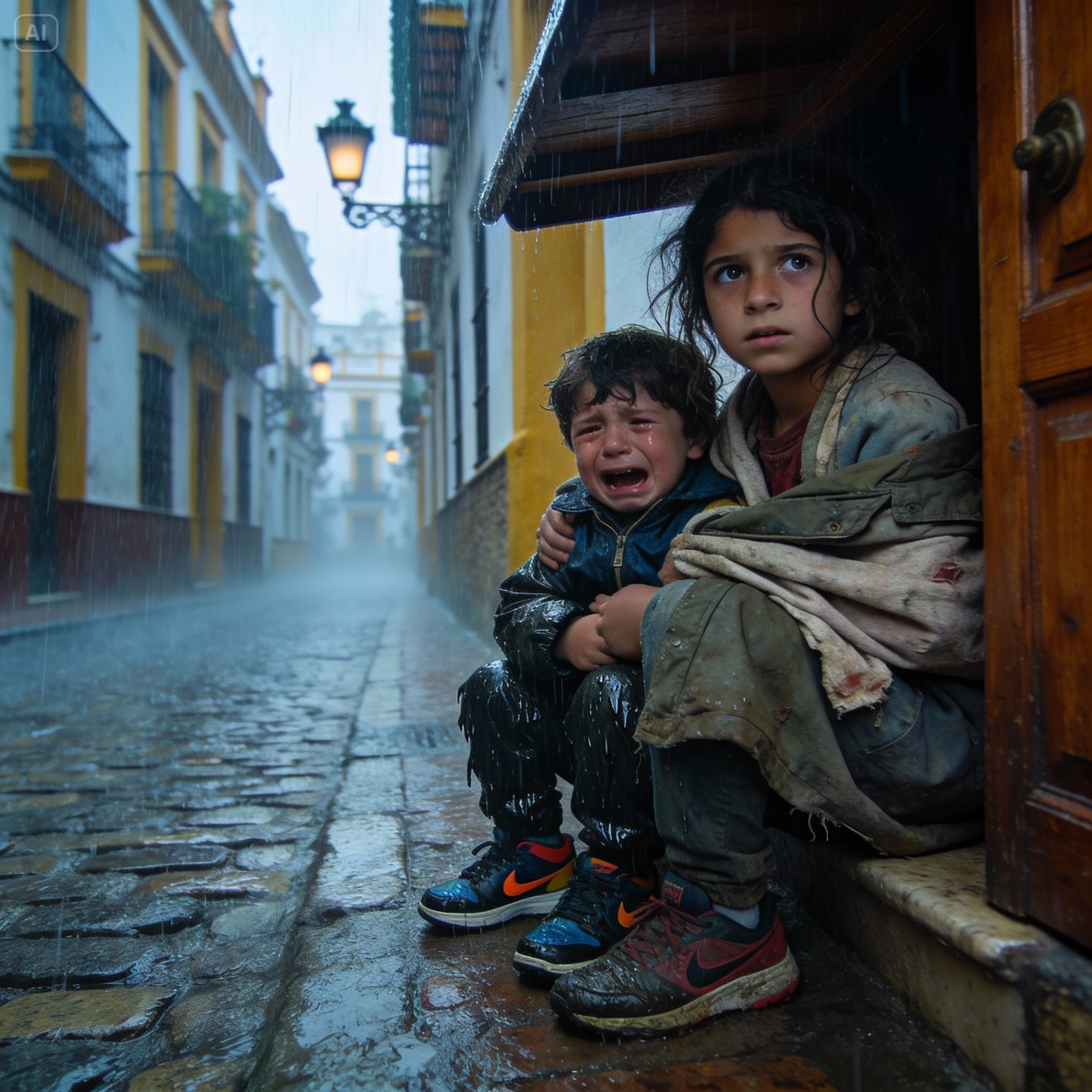
My name is Yasmin. I was eight years old that day, though my eyes had already witnessed more pain and loneliness than many of the elderly people sitting on the benches in Maria Luisa Park. For the tourists running desperately for shelter in cafes or under the awnings of souvenir shops, that storm was just an anecdote, an inconvenience to their vacation. For me, it was a matter of life and death.
My bare feet knew every loose cobblestone of the uneven pavement in the Santa Cruz neighborhood. I knew which corners cut through the wind and which channeled it like icy knives. I had learned to read the clouds above the Giralda long before I could decipher the words in a book. I had no known family, no home, no one waiting for me with a hot meal. My earliest memories were a blurry mix of cold nights sleeping under the bridges of the Guadalquivir, the dull ache in my stomach that never quite went away, and the strange solidarity of other “invisible” people like myself, who protected me as best they could in this adult world.
At eight years old, I possessed the grim wisdom of one who had been forced to grow up through hardship. That day, as the water began to rise dangerously over the curbs, I found a dry hollow beneath the canopy of an old pharmacy near the Cathedral. My clothes, rags that had once held color, were soaked and clung to my skeletal frame like a frozen second skin. I wasn’t shivering only from the cold; there was something malevolent about that storm, a violence that made the shop windows rattle.
Just a few kilometers from my precarious refuge, in a parallel universe filled with comforts I couldn’t even imagine, Mauricio Bernal, one of Andalusia’s most important technology entrepreneurs, was living his own personal hell. His fortune, built by importing electronic components, was useless against the terror that chilled him to the bone: his son Gabriel, barely four years old, had disappeared.
I knew nothing about Mauricio, not about his pain, nor that he had lost his wife Clarissa two years earlier to a rapidly progressing cancer. I didn’t know that he was trying to be both father and mother, that a routine visit to the pediatrician downtown that day had taken a fatal turn. Gabriel, curious like any child who doesn’t know the evil in the world, had been distracted by a stray puppy while his father paid the bill. In a matter of seconds, the boy had run after the little animal, turning the corner and being swallowed up by the labyrinth of streets and the crowd fleeing the rain.
While Mauricio mobilized the National Police, hired private security, and offered desperate rewards, the storm washed away all traces. Security cameras became useless under the curtain of water, and the streets were deserted.
Gabriel was terrified. The little dog had disappeared long ago, and he wandered aimlessly, soaked to the bone, his designer sneakers caked with Sevillian mud. He cried, calling for his “daddy,” but the roar of thunder drowned out his childish voice. Panic, cold, and exhaustion were consuming him. It was then, when the winds began to tear branches from the orange trees, that fate—or perhaps God, as Doña Paqui would say—pushed him toward my shelter.
I saw him arrive, staggering. He curled up at the far end of the pharmacy entrance, trembling violently. His tears mingled with the rain. I watched him with the keen eyes of a street lynx. I knew instantly he didn’t belong in my world. His clothes, though dirty, were made of thick, good fabric. He smelled of expensive soap and fabric softener, a scent I’d almost forgotten. He had that fragile expression of someone who’s never had to fight for a piece of bread.
My first reaction was caution. The streets had taught me that getting involved with rich kids led to trouble. If the police saw me with him, they’d think I’d robbed him or hurt him. Invisibility was my shield, and he was a magnet. But then he looked at me. His red, terrified eyes met mine, and I saw something that shattered my defenses: he was just a kid. Smaller than me. More scared than me. In that moment, under the full force of the sky, social differences dissolved. We were two human infants facing nature.
I felt a pang in my chest, a precocious maternal instinct forged in me by hard life. I approached slowly, like someone approaching a wounded cat so as not to frighten it.
“You’re lost, aren’t you?” I whispered, trying to make my voice sound soft over the roar of the rain.
Gabriel looked up. He nodded, hiccuping.
“I want my dad,” he whimpered.
“What’s your name?” I asked, sitting down at a respectful but close distance.
“Gabriel. Gabriel Bernal,” he replied, wiping his nose with the sleeve of his designer jacket.
Bernal. The surname conjured up images of tall buildings and black cars, but it didn’t matter at that moment. The wind shifted, and the rain began to sweep away our shelter. I knew the marquise wouldn’t hold much longer; the wind was tearing tiles off the nearby roofs. We needed to get to “The Palace,” as we ironically called the old, abandoned building near the Alfalfa where we forgotten ones slept. But getting there meant crossing through hell.
“Gabriel, listen to me,” I said, looking him straight in the eyes. “I know a safe place. But we have to run. Are you brave?”
He looked at me doubtfully, but seeing the firmness on my face, he nodded.
—Yes.
I took off my only dry garment, an old T-shirt I kept in a supermarket plastic bag, and put it over her head like an extra hood.
“This will protect you a little. When I say ‘go,’ you run after me and don’t let go of my hand for anything in the world. Understood?”
He grasped my calloused hand with his soft, cold fingers. He squeezed tightly. And so, two children from opposite worlds launched themselves into a race against the most violent storm Seville had seen in decades.
PART 2: THE REFUGE OF THE FORGOTTEN
The race was a battle. The water was ankle-deep, and the current pulled us toward the overflowing storm drains. Gabriel kept slipping on his smooth soles, but I wouldn’t let him fall. “Come on, you can do it!” I yelled, pulling him along when his strength faltered. We dodged garbage containers floating down the street and fallen branches.
When we finally reached the abandoned building, we were exhausted. We climbed the back stairs to the second floor, where the wind didn’t reach. There was our makeshift home: old mattresses, candles, and the warmth of my strange family.
There were Doña Paqui, an elderly woman who prayed the rosary and had lost her home due to bank defaults; Juan, a man who talked to himself but had the kindest heart in all of Andalusia; and La Peque, a teenager who had run away from an abusive stepfather. When they saw us enter, they stood up, alarmed.
“Holy Virgin, Yasmin! What have you got there?” exclaimed Doña Paqui, crossing herself.
“His name is Gabriel. He was lost in the storm,” I explained, panting, as I helped the boy sit down on a mattress.
Their reaction is what I will always remember with pride. There were no questions about money, no fear of the police in that moment. Only humanity. Doña Paqui took out a wool blanket she kept like a precious treasure and wrapped Gabriel in it. Juan, in his gentle madness, offered him his only orange. La Peque began rubbing his hands together to warm him up.
Gabriel was stunned. He had never been in such a dirty, dark place, but he had also never felt such genuine care from strangers.
“Thank you,” he whispered, taking a sip of the water I offered him.
“Don’t be afraid, my child,” Doña Paqui told him. “We don’t have luxuries here, but thank God, we have a roof over our heads tonight.”
That night, as the storm raged outside, the magic happened. Gabriel, the rich boy, listened to Juan’s stories about his children he never saw, and to La Peque’s dreams of becoming a nurse. And we heard about her father, about how he used to read her stories, and how much she missed her mother who was in heaven.
—My mom is also watching over me from above—I told him, lying piously to comfort him, although deep down, I wanted to believe it was true.
Gabriel fell asleep clinging to my arm. I stayed awake, watching over him, thinking about what my life would be like if someone were searching for me with the same desperation they were surely showing this child.
PART 3: THE DECISION AND THE REUNION
Morning arrived with an eerie silence. The rain had stopped, leaving a clear sky and washing the streets clean. Gabriel woke up confused, but when he saw me, he smiled. That smile was worth more than all the coins the tourists had thrown on the ground.
Juan came running, carrying a wet newspaper he’d found.
“They’re looking for him! They’re looking everywhere!” he shouted. “They’re offering 50,000 euros, Yasmin. Fifty thousand!”
I looked at Gabriel’s picture on the crumpled paper. “MISSING.” I felt a lump in my throat. We could ask for the money. We could escape poverty. But I looked at Gabriel, sharing a piece of stale bread with La Peque, and I knew he wasn’t a lottery ticket. He was my friend.
—Gabriel —I said seriously—. We have to take you to your dad.
We went out into the street. The Seville sun was beginning to dry the puddles. We walked towards Plaza Nueva, where we knew the police would be. People were staring at us: a homeless girl and a well-dressed but dirty boy, holding hands.
We saw a National Police car. My heart was racing. I was afraid they’d blame me, that they’d lock me up in a juvenile detention center. I stopped.
“You go, Gabriel. Run towards them.”
He looked at me, let go of my hand, and then, with a determination that chilled me to the bone, gripped it again, even tighter.
“No. You’re coming with me. You saved me.”
We walked together toward the officers.
“I’m Gabriel Bernal,” the boy said firmly to the policeman who almost choked on his coffee.
Chaos erupted in seconds. Radios blared, people ran. And suddenly, a black car screeched to a halt. Mauricio Bernal jumped out. He looked haggard, pale, and distraught.
“Gabriel!” The scream was heartbreaking.
Father and son embraced in a hug that brought tears to the eyes of onlookers. I stepped back slightly, feeling small, ready to disappear back into the shadows. My mission was complete.
But then Gabriel pulled away from his father and pointed at me.
“Dad, this is Yasmin. She saved me from the storm. She gave me her dry clothes. She took care of me.”
Mauricio turned toward me. I expected to see contempt in his eyes, or suspicion. But what I saw was such immense gratitude that it made my knees tremble. He came closer, knelt on the damp ground, not caring about his expensive suit, and looked me in the eye.
“Did you take care of my son?” he asked, his voice breaking.
“I only did what had to be done, sir,” I replied, lowering my head.
Mauricio took my dirty hands in his.
“You’ve given me back my life, Yasmin. I have no words, nor enough money in the world to repay you for this.”
The police wanted to question me, but Mauricio stopped them with a gesture.
“She’s coming with us,” he declared.
“Where to?” I asked, frightened.
“Home. To eat. To rest. And then… we’ll see.”
PART 4: A NEW DAWN
What happened next seems like a fairy tale, but I swear on the Giralda that it’s true. Mauricio didn’t just take me to his house, which looked like a royal palace. He wanted to meet Doña Paqui, Juan, and La Peque. He went to the abandoned building and saw where we had sheltered his son. He cried when he saw our poverty and our dignity.
That day, Mauricio didn’t just get his son back; he gained an extended family. He helped us all. He got Juan medical treatment and a simple job in his company’s gardens. He gave Doña Paqui a small apartment where she could live out her final years with dignity and pray in peace. He paid for La Peque’s nursing studies.
And what about me?
Mauricio sat down with me in his immense living room, with Gabriel playing at our feet.
“Yasmin,” he said, “this house is very big, and since my wife died, it’s been very quiet. Gabriel says you’re his soul sister. And I… I think he’s right.”
He legally adopted me three months later. It wasn’t easy at first; I had to learn to eat with utensils, to go to school, to sleep in a soft bed without waking up scared. But I had Gabriel, my brother, my partner through thick and thin.
Ten years have passed since that rainy afternoon in Seville. Today I am a young university student. I study Law because I want to defend those who have no voice, the children who are still out there, in the rain, waiting for someone to see them.
Gabriel is fourteen now and is the kindest boy I know. Often, when it rains heavily in Seville, we sit together on the porch, watch the rain fall, and smile.
People say I was a hero for saving the millionaire’s son. But they’re wrong. That storm didn’t just save Gabriel. It saved me. It taught me that true wealth isn’t in bank accounts, but in the ability to lend a hand when the world is falling apart.
Mauricio, my father, always says that was the worst and the best day of his life. He lost his breath for a few hours, but he found the strength to live the rest of his days.
And you, who are reading this… the next time you see a storm, or someone invisible on the street, remember: sometimes, angels don’t have wings and go barefoot and dirty. Sometimes, hope hides in the darkest places, waiting for just a small gesture of kindness to shine.