Despised by everyone on the streets of Seville, this beggar revealed a truth that forever changed the life of the little girl who saved him from death.
(Part 1 of 3)
The March heat in Seville can be treacherous, but that afternoon it wasn’t just hot; it was a liquid inferno rising from the asphalt and distorting the air. I walked quickly, or at least as quickly as my thin legs would allow, feeling the soles of my bare feet harden a little more with each step on the scorching sidewalk of Avenida de la Constitución. In my hands, I clutched a worn plastic bag containing our treasure of the day: two tomatoes the greengrocer was going to throw away because they were too soft, and a loaf of day-old bread the bakery lady had given me out of pity.
My name is Joana. I’m eight years old, or so my grandmother Concepción says, and I live in a shack made of wood and corrugated iron in an illegal settlement on the outskirts of the city, a place that “respectable” people prefer to pretend doesn’t exist. But that afternoon I was far from home, in the city center, where tourists admire the Giralda and executives hurry along, glancing at their expensive watches.
That’s when I saw him.
The man was walking ahead of me, dragging his feet wrapped in dirty rags. His clothes were a collection of gray and black shreds, stiff with grime. He smelled of neglect, that sour, old smell that makes people wrinkle their noses and cross to the other side of the street. And then, suddenly, he just shut down. His body collapsed onto the hot pavement with a thud, like a sack of potatoes falling from a truck.
The world kept turning. That was what struck me most, even more than the blow. A man had just collapsed, and Seville continued its frenetic pace. A couple of tourists stepped aside to avoid tripping over his legs; a man in an impeccable blue suit made a visible face of disgust and quickened his pace, muttering something about “drunks” and “street cleaning.”
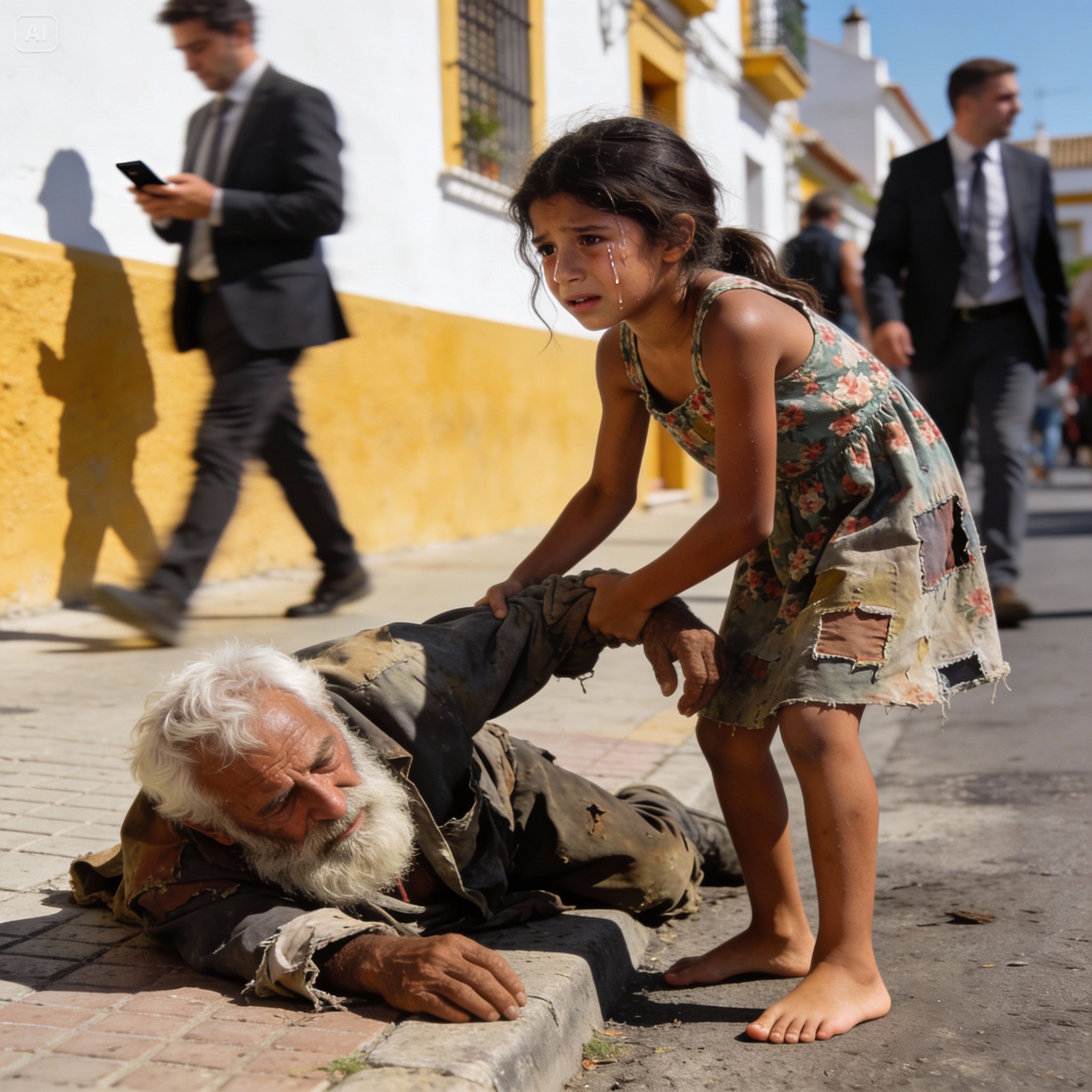
Nobody stopped.
My eyes, perhaps because they were still young, or perhaps because they looked too much like those of my mother, whom I never knew, couldn’t look away. I dropped my bag. The tomatoes rolled a little and the bread teetered on the curb, but I didn’t care. I ran.
“Lord! Lord!” I cried, my high-pitched voice cracking from the dryness in my throat.
I knelt beside him. Up close, he looked even worse. His beard was matted and covered in dust, and his skin had that grayish, waxy tone my grandmother had when her blood pressure dropped. His lips were purple. He was trembling, not from the cold, but from something deep inside.
“Help! Please, someone help!” I shouted, looking at the faces floating past us.
No one stopped. A woman pulled her young son by the hand, leading him away from me as if poverty were contagious. I felt a hot rage, stronger than the afternoon sun, bubble in my chest. How could they be so blind? How could they let someone die just because they smelled bad?
I knew the University Hospital was about four or five long blocks away. I’d been there once with Grandma. Four blocks. For a healthy adult, five minutes. For me, dragging a man who weighed three times as much as me, it felt like a mission to the moon.
“Don’t die, sir. Hang in there,” I whispered in his ear.
I tried to lift him. It was useless at first. He was dead weight. But then, he opened his eyes a little. They were a strange honey color, glassy, vacant. He let out a painful groan.
“I have to… take him…” I gasped, tucking my shoulder under his armpit.
I pulled with all my might. My knees creaked. My feet slipped. But I managed to get him to his knees. Then, using my own frail body as leverage, I managed to get him half to his feet, putting almost all his weight on me. I felt like my bones were going to break. The smell was unbearable, a mixture of stale sweat and disease, but I bit my lip and took the first step.
—Come on. One more step.
It was the longest journey of my life. People were staring, yes. Some with morbid curiosity, others took out their phones, perhaps to record the “picturesque” scene of misery, but no one offered a helping hand. My shoulders burned as if I had embers under my skin. Sweat soaked my patched dress, sticking it to my back.
She was crying. She was crying from pain, from rage, from fear. What if she died on top of me? What if I got to the hospital and they turned me away for not having papers or money? But I kept going. Step by step, dragging the tips of her worn-out shoes along the pavement.
Near the emergency room entrance, my legs gave way. I tripped and we almost both fell, but an orderly who was smoking a cigarette by the door saw us. He threw away his cigarette and ran towards us.
—My God! Girl! What are you doing?
“He fell… in the street… nobody stopped,” I managed to say before I completely ran out of air.
The orderly, a large man with a kind face, carried the man as if he were a feather and shouted for a stretcher. In seconds, nurses and doctors surrounded the beggar. They lifted him onto the stretcher and disappeared behind the swinging glass doors.
I stood there, alone, in the middle of the cold, white hallway, shivering from the sudden change in temperature from the air conditioning. I looked at my feet; they were black with dirt, and I had a cut on my big toe that was bleeding a little.
Are you okay, little one?
A young nurse crouched down to my level. She had kind eyes.
“I have to go get my tomatoes,” was all I could think to say. Grandma Concepción was counting on those tomatoes for dinner.
“Your tomatoes?” she smiled sadly. “Honey, you just saved that man. He was having a massive heart attack. If you’d been five minutes longer…”
I didn’t feel like a hero. I felt small, dirty, and worried. The nurse cleaned the cut on my foot, gave me orange juice and some cookies that I devoured in seconds, and asked for my name and address. I gave her directions to the shack: the dirt road behind the abandoned industrial buildings, where the postal code ceases to matter.
When I left the hospital, the sun was already setting, painting Seville in shades of orange and purple. I ran back to where I’d left the bag. Miraculously, it was still there, though someone had stepped on the loaf of bread. I shook it out as best I could and ran home, my heart still pounding in my chest.
Grandma Concepción was standing in the doorway of the shack, wringing her hands in her apron. When she saw me, her face went from terror to relief in a second.
—Joana! For God’s sake! Where have you been?
I told her everything while we ate the watery soup I’d made with the crushed tomatoes. I told her about the man, the weight, people’s indifference, the hospital. Grandma listened in silence, with that stoic expression women who have suffered too much have. When I finished, she came over and kissed my forehead.
“You have your mother’s heart, my child. Luciana was the same. She could never watch anyone suffer without doing something.” Her eyes filled with tears. “Sometimes I think that’s what killed her, feeling too much in a world that feels nothing.”
That night I couldn’t sleep. My whole body ached, but every time I closed my eyes, I saw the beggar’s honey-colored eyes fixed on mine. There was something in that gaze… it wasn’t just pain. It was recognition. As if, through the fog of death, he had seen a ghost.
Three days passed. Life in the settlement went on: searching for water, mending clothes, surviving. I had almost convinced myself that it had all been a bad dream.
Until the car appeared.
It wasn’t just any car. It was a black Mercedes, shiny, obscenely clean for our dusty, muddy roads. It moved slowly between the shacks, dodging chickens and naked children, like a spaceship landing on another planet. It stopped right in front of our door, which hung by a rusty hinge.
The neighbors came out to look. Nobody came here in a car like that unless it was the undercover police or someone looking for trouble.
The driver, a man in uniform, got out and opened the back door. First came a polished wooden cane. Then, a leg in fine trousers. And finally, the man.
I almost didn’t recognize him. He was clean-shaven, his gray hair was combed back. He wore a suit that must have cost more than all the houses in my neighborhood combined. But it was his eyes. Those honey-colored eyes that had looked up at me from the ground.
Behind him came another man, younger, with a folder in his hand and a grumpy face.
The old man walked toward our door, leaning heavily on his cane. Grandma Concepción came out, drying her hands, ready to defend her home from whatever they came to claim.
But when her eyes met the old man’s, she froze. Her face drained of all color, turning as white as a sheet. She brought a hand to her mouth to stifle a scream.
“No…” she whispered. “It can’t be. You’re dead.”
The old man stopped two meters away from her. I saw his hands trembling on the handle of his cane.
—Concepción… —his voice was hoarse, broken—. I thought I was. For twenty-eight years, I have been dead while still alive.
“Go away!” my grandmother suddenly shouted, her voice rising with a fury I’d never known. “Get out of here! You’ve done enough damage! You killed her!”
I looked from one to the other, scared and confused. I clung to my grandmother’s legs. The old man looked down at me, and for the first time, I saw a single tear run down his shaven cheek.
“I’m not here to hurt you, Concepción. I’m here because this girl…” he said, pointing at me with a trembling finger. “This girl saved my life three days ago.” And when she looked at me, I saw Luciana.
The old man fell to his knees in the dust, ignoring his expensive suit, ignoring the chauffeur who tried to help him. He lay there, at eye level.
“I’m Guillermo. Guillermo Alcántara,” he said, looking at me as if I were a miracle. “And I think… My God, I think I’m your grandfather.”
(Part 2 of 3)
The silence that followed that statement was so heavy it seemed as if the air had solidified under the Seville sun. The neighbors murmured, but for me the world had shrunk to that man kneeling on the ground and my grandmother, who was trembling like a leaf in the wind.
—Come in —Grandma Concepción finally said, her voice harsh but resigned—. We’re not going to put on a show for the whole neighborhood.
The shack was small, barely a room divided by cheap curtains. The man who called himself Guillermo sat down in one of our plastic chairs patched with electrical tape. The other man, the one with the briefcase, who introduced himself as the lawyer Mr. Mendoza, remained standing, looking with obvious discomfort at the wooden walls and the corrugated asbestos roof that let rays of light through the nail holes.
“Explain yourself,” my grandmother demanded. She was holding me by the shoulders so tightly it hurt, as if she were afraid the man was going to rob me.
Guillermo sighed. He looked as if he had aged ten years since he came in.
—Concepción, you have to believe me. I never knew… I never knew I was pregnant.
“Lies!” my grandmother spat. “Luciana called you. She wrote to you. She went to your office in the Torre Sevilla a thousand times. And you sent your guards to throw her out like a dog. You told her she was a gold digger, that that child wasn’t yours.”
“I didn’t do that!” Guillermo struck the ground with his cane, and the force of his voice made us jump. “It was my father! It was Octavio!”
And there, in our small kitchen, she began to unravel a story that seemed like something out of a soap opera, but that hurt like a real wound.
He told us how, almost thirty years ago, as the young heir to the Alcántara empire, one of the wealthiest families in Andalusia dedicated to the export of olive oil and agricultural technology, he fell madly in love with Luciana, a humble girl who worked in a bookstore in the Santa Cruz neighborhood. They loved each other passionately, in secret, against the wishes of his father, a tyrannical man obsessed with lineage and money.
—When my father found out about our relationship, he threatened to disinherit me. I didn’t care. But then… then he showed me the photos.
They were fake photos, fabrications created by a corrupt private investigator, showing my mother with another man. Forged reports claiming she was only after the money.
“I was young, stupid, and proud,” Guillermo admitted, his voice cracking with regret. “I confronted her. I yelled horrible things at her. She cried, swore it was all a lie, but I was blinded by jealousy. I broke up with her and went to London on family business. My father took care of the rest. He intercepted her letters, blocked her calls… he made me believe she’d been paid to disappear.”
Grandma Concepción was crying silently now.
—She never accepted a single penny. She died in childbirth, alone, calling for you.
The pain on Guillermo’s face was so raw that I had to look away.
—I know. I knew it five years ago, when my father, on his deathbed, confessed everything to me to “cleanse his conscience.” He told me the truth. That he separated us, that he falsified everything. I went crazy, Concepción. I looked for Luciana, but I discovered she was dead. I looked for the baby… but you had disappeared.
“I hid,” said the grandmother. “I didn’t want the Alcántaras near my granddaughter. I didn’t want them to do to her what they did to her mother.”
“I fell into a deep depression,” Guillermo continued, looking at his hands. “My life lost all meaning. I handed over control of the company to my other son, Bernardo, the product of a loveless marriage orchestrated by my father. I started drinking. And a few months ago… I simply couldn’t take it anymore. I gave up everything. I left my mansion, I gave up my credit cards, my cell phone, everything. I wanted to experience what it was like to have nothing. I wanted to punish myself. I’ve been living on the streets, sleeping in ATMs, eating from the garbage… until my heart gave out three days ago.”
He stared at me.
—And then, an angel lifted me up. An angel with the face of my Luciana.
The lawyer cleared his throat.
—Mr. Alcántara, the DNA tests are ready to legally confirm it, but…
“To hell with the paperwork!” roared Guillermo. “Look at her, Mendoza! It’s her! She’s my blood!”
The following days were a whirlwind. The DNA test confirmed what William’s heart already knew: I was his granddaughter. But it wasn’t all an immediate fairy tale.
Guillermo’s arrival in our lives brought with him Bernardo, my uncle. He appeared one day at the shack, a tall man, impeccably dressed, with the same nose as my grandfather but with a cold and calculating gaze.
“This is ridiculous, Dad,” he said, looking at our wobbly table with disgust. “You’re being ripped off. It’s a classic scam. These people…”
—“These people are your family, Bernardo,” Guillermo interrupted with an authority that frightened me. “And this girl is your niece.”
“She’s a bastard child from a youthful fling,” Bernardo spat.
Grandma Concepción grabbed the broom, ready to beat him out, but Guillermo got in her way.
—Be careful what you say. I’m back, Bernardo. And I’m going to make changes.
Guillermo never returned to his mansion. He rented a large, bright apartment near Triana and took us with him. At first, I felt out of place. The bed was too soft, the food too plentiful. I missed the sound of rain on the corrugated iron roof. But my grandfather tried so hard…
We spent our afternoons sitting on the terrace watching the Guadalquivir River. He taught me to read better, told me stories about my mother, how she loved Bécquer’s poetry, how she laughed. For the first time, my mother stopped being a blurry photograph and became a real person.
But Guillermo’s health was fragile. The heart attack had left his heart very weak. Just a few months after we met, he fell ill again. The doctors said there wasn’t much they could do.
That’s when Bernardo tried his final move. He tried to have his father legally declared incompetent, claiming senile dementia, to prevent him from changing his will in my favor. There were lawyers, shouting, documents… I just wanted my grandfather to get better.
“I don’t want the money, Grandpa,” I told him one afternoon, sitting on the edge of his hospital bed. “I just want you to stay.”
He smiled at me, weakly, stroking my hand.
“Money is just a tool, Joana. What matters is what you do with it. And I have to make sure you and your grandmother are protected from the sharks, just like my son Bernardo. But there’s something even more valuable I’m going to leave you.”
He took an old, yellowed envelope from the bedside table.
—I found it among my father’s things. It’s the only letter from your mother that he didn’t destroy. I don’t know why he kept it. Perhaps as a trophy. I want you to read it when I’m gone.
William died two weeks later, on a quiet autumn afternoon. He passed away peacefully, knowing he had found what he was looking for.
The funeral was a huge social event in Seville. Important people, press, everyone feigning grief. Bernardo was there, receiving condolences with a somber expression. But when the time came for the reading of the will, his face changed.
Guillermo had left the main company to Bernardo, yes. But he had created a secure trust for me and Grandma Concepción, with enough funds to live ten comfortable lifetimes, and most importantly: he had left me ownership of the old family home in the country, the olive grove where he and my mother had hidden so many times, and 51% of the voting shares of the family’s charitable foundation.
Bernardo was furious, but he couldn’t do anything.
That night, in our new house, I opened my mother’s letter.
(Part 3 of 3)
My hands were trembling so much I almost tore the brittle paper. My mother’s handwriting was round and firm, the blue ink faded with time.
“Dear Guillermo,
I don’t know if you’ll read this. Your father says you don’t want anything to do with me, that you’ve moved on. If that’s true, I respect it. But I need you to know the truth, not for me, but for the child I’m carrying. Yes, it’s a boy, or a girl; my heart tells me it will be a strong girl.
There was no one else. There never was. The photos are a lie, but I understand that your family’s power can distort reality to the point of making you doubt your own soul. I don’t hate you, Guillermo. I love you. And because I love you, I set you free. I won’t fight for your money, nor will I tarnish your name with scandals. I will raise this baby with the love of both of us.
I only ask one thing of you: if fate ever brings you together with her, don’t look at her with your father’s eyes. Look at her with your own. You’ll see she has your smile. Her name will be Joana, like your grandmother, the one you told me was the only one who understood you.
Be happy, my love. I’ll try to be.
Always yours, Luciana.”
I cried until I couldn’t breathe. Grandma Concepción hugged me and we cried together, closing a cycle of pain that had lasted almost three decades. My mother hadn’t died with resentment. She had died loving and forgiving. And that was the greatest legacy she had left me.
The years passed.
I didn’t become a spoiled brat of Seville’s high society. The money was there, yes, but my grandmother made sure I never forgot where I came from. I studied hard. I went to university, graduated with a law degree, driven by a fierce need for justice.
Over time, Bernardo softened. Or perhaps he gave in. When he saw that I had no intention of destroying the company, but rather of using the Foundation to help, we began to have a cordial relationship. He was never an affectionate uncle, but we learned to respect each other.
Today I am 28 years old. I run the Alcántara Foundation. We dedicate ourselves to something very specific: we provide scholarships and support to single mothers without resources and we maintain soup kitchens in the poorest neighborhoods of Seville and Andalusia.
Every afternoon, when I leave my office, I walk along Constitution Avenue. Sometimes I stop at the exact spot where my grandfather fell that day in March. The heat is still the same. People still hurry by, looking at their phones, oblivious to what’s happening around them.
But not me.
I always carry coins in my pocket, and, most importantly, I always carry time. If I see someone sitting on the ground, I stop. I look them in the eyes. I ask them their name. Because I learned, in the hardest and most beautiful way possible, that beneath the rags of a beggar can lie the story that changes your life forever.
I learned that dignity isn’t about wearing a suit and tie.
I learned that two bruised tomatoes offered with love are worth more than a banquet offered with arrogance.
And I learned that we should never, ever ignore a cry for help.
Because in the end, when I carried that man on my eight-year-old shoulders, I wasn’t just saving my grandfather. I was saving myself.