Hidden terror in a Seville mansion: A father discovers that the perfect fiancée was poisoning his paralyzed daughter with horse sedatives after the brave confession of the employee’s son.
PART 1: THE SCREAM IN THE GARDEN
“Your daughter can walk, Don Fernando. She can walk, but Miss Marina won’t let her.”
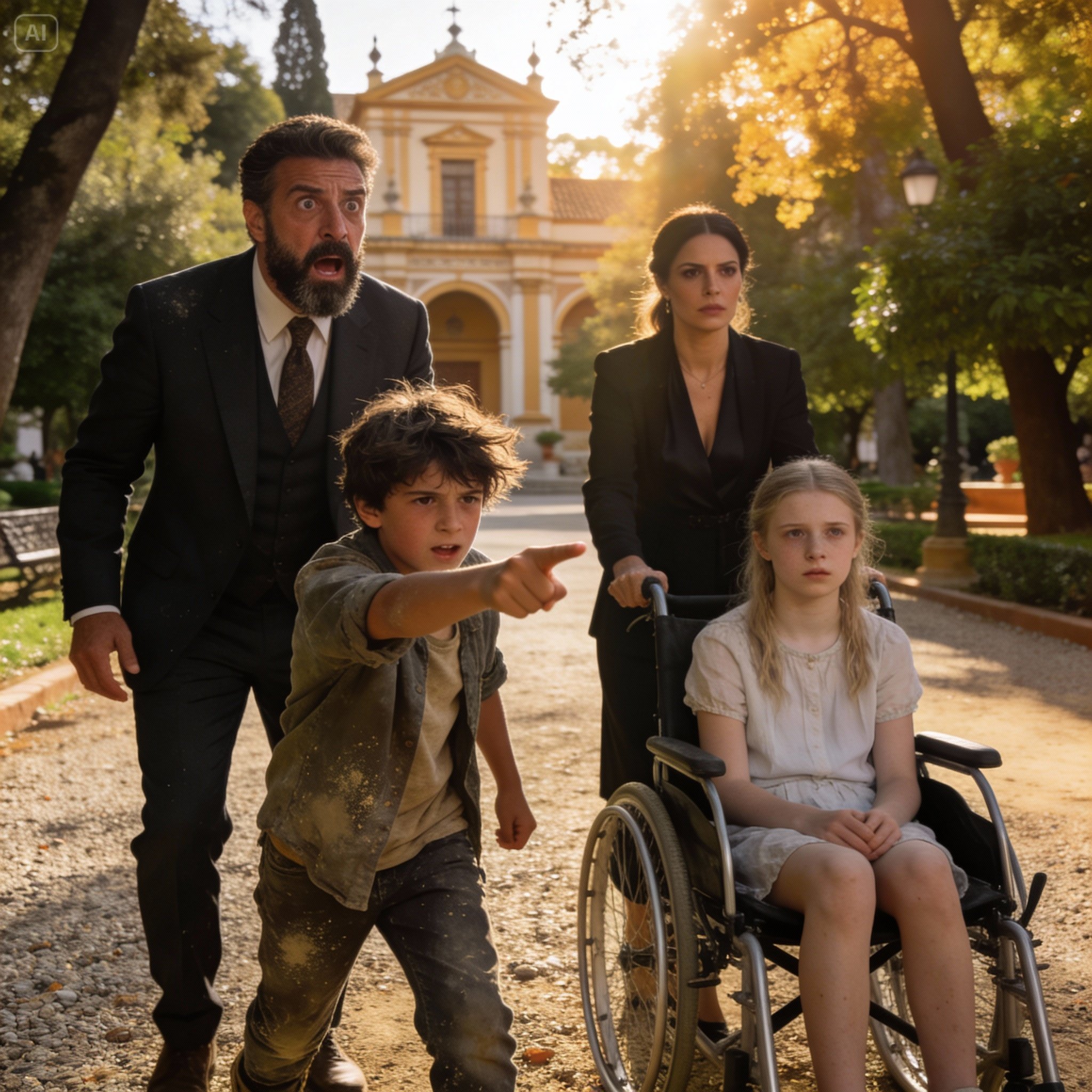
Those words pierced the warm air of the Sevillian afternoon like icy knives. I stopped dead in my tracks. The sound of the cicadas in the trees of the Maria Luisa Park seemed to cease abruptly, or perhaps it was my own blood that stopped circulating.
I turned around slowly. Carlos, Carmen’s son—Carmen being our longtime housekeeper—was standing there, panting. The poor boy’s shirt was stained with mud, his hair plastered to his forehead with sweat, and his eyes wide with panic. But he wasn’t looking at the ground, as he usually did out of shyness. He was looking at me. And then, with a trembling finger, he pointed directly at Marina.
Marina was standing behind Beatriz’s wheelchair, my daughter’s. Her hands, always perfectly manicured, tightened on the rubber grips. I saw her posture change in a fraction of a second: from that of a solicitous and affectionate girlfriend to something rigid and defensive.
“Fernando, please,” she said, letting out a nervous giggle that sounded like breaking glass. “The boy is just playing. He has too much imagination, you know how he is at this age.”
But I didn’t listen to her. I looked at Beatriz. My little girl. Twelve years old. Six months ago, Beatriz was a whirlwind, running around the garden of our house in the Santa Cruz neighborhood, climbing the orange trees, and coming home with scraped knees and a smile that lit up the whole house. Now, she was sitting in that chair, pale as wax, with purplish dark circles under her large, sad eyes. “A degenerative and fulminant neurological condition,” Marina had said, citing the private specialists she herself was managing.
I took two steps toward Carlos. I crouched down to his level. I could smell the fear in him, mixed with the smell of earth and a child’s sweat.
—Repeat what you just said, Carlos—I asked him in a hoarse voice.
“She puts things in Beatriz’s food,” the boy blurted out, stumbling over his words. “Things to keep her from moving her legs. I’ve seen her, Don Fernando. When she thinks no one’s looking. She takes out a small bottle and puts a few drops in the orange juice.”
Beatriz, who had been staring blankly, turned her head. Her eyes met mine. And in that instant, I saw something that chilled me to the bone: it wasn’t confusion. It was fear. And a tiny, almost invisible spark of hope.
“That’s a lie!” Marina shouted, losing her usual composure. “Fernando, are you going to believe a child who makes up stories to get attention? I take care of your daughter day and night! I’m the one who gives her medicine, bathes her, and feeds her!”
“And you’re the one poisoning her!” Carlos shouted, tears of rage streaming down his dirty face. “My mother has been working in her house for two years. I see what happens when Mr. Fernando is at the office. Beatriz tries to get up when you’re not there. She clings to the walls!”
I felt a ringing in my ears. “Beatriz…” I whispered, ignoring Marina. “Daughter, look at me. Is it true? Can you feel your legs?”
Beatriz swallowed. She looked at Marina, then at me. Her hands, thin as twigs, gripped the armrests. “Sometimes…” Her voice was a thread, weak from months of sedation. “Sometimes I feel ants, Dad. Like when your foot falls asleep. And… and when Marina comes out, I try to wiggle my toes. And they move a little.”
“They’re spasms!” Marina interrupted, taking an aggressive step toward us. “They’re involuntary reflexes, Fernando! The neurologists explained it to us a thousand times. Don’t give the girl false hope!”
“What neurologists?” Carlos asked defiantly. “Because no doctor ever comes to the house. And my mother says you never go out for appointments. The adapted van is always parked in the same spot.”
It was like a physical punch to the gut. I started going over the last few months. The “appointments” Marina took Beatriz to… they always coincided with my busiest meeting times. I had never gone. Marina always said, “Don’t go, darling, you get so nervous and upset the baby. I’ll take care of it; it’s better to keep things normal.” Blinded by grief and work, I had agreed. I had entrusted my daughter’s life to the woman who had promised me eternal love after the death of my first wife.
I got up slowly. The Seville sun was still blazing, but I felt deathly cold. “Marina,” I said, with a calmness that frightened even myself. “What time are the doctor’s appointments?”
“It depends… it varies according to the clinic’s schedule,” she stammered. Her blue eyes, which had once seemed like the sky, were now two pools of calculating ice.
“That’s a lie,” Carlos said. “They never go out. They stay home. And there’s more. I heard her on the phone the other day. On the terrace. She was saying, ‘It won’t be long now. The girl is getting weaker and weaker. Soon I’ll be able to ask for whatever I want.'”
The silence that followed was absolute. Marina paled so much that her makeup seemed to crack on her skin. “Let’s go home,” I said. It wasn’t a suggestion. It was an order.
PART 2: THE HOUSE OF SECRETS
The walk back to our villa was silent torture. I pushed Beatriz’s wheelchair with furious determination, my knuckles white on the rubber. Carlos walked beside me, like a little soldier, and Marina followed a few steps behind, shuffling, frantically dialing numbers on her cell phone and hanging up before she could speak.
“Give me that phone,” I demanded without turning around. “It’s private, Fernando. You’re acting like a madman.” “Give me. The. Phone.”
I snatched it from her hand and shoved it in my pocket. She gasped, indignant, but the fear on her face was real. I knew her house of cards was crumbling.
We arrived at the house. It was a beautiful, typical Andalusian building, with whitewashed walls and an interior courtyard full of flowers. Carmen, Carlos’s mother, was in the laundry room, hanging up white sheets that shimmered in the sun. Seeing us come in so hurriedly, she dropped a wicker basket.
“Mr. Fernando…” she said, drying her hands on her apron. “Has something happened?”
—Let’s go to the kitchen, Carmen. Right now.
We went into the kitchen. It was the heart of the house, spacious, with hand-painted tiles and the smell of cleanliness. But now it seemed like a crime scene.
—Carlos—I said, looking at the boy. —Where is he?
The boy didn’t hesitate. He dragged a wooden chair to the main cupboard. He climbed on nimbly. “Here,” he said, moving aside the tins of La Vera paprika and saffron. “Behind the spices, where my mother can’t reach without the ladder.”
He took out a small, tinted glass bottle. No label. He handed it to me like it was a bomb. I opened it. It didn’t smell of anything. Clear liquid.
“What is this, Marina?” I asked, showing it to her.
She was huddled against the refrigerator. “It’s… it’s a homeopathic supplement. For her immune system. Fernando, for God’s sake, you’re making a big deal out of this…”
“Lies!” Beatriz shouted from her chair. Her voice was louder than it had been in months. “That’s the bottle he gets the drops for my juice from! He tells me they’re vitamins, but it always tastes bitter!”
“And this?” Carlos had run to the freezer. He moved aside bags of peas and boxes of ice cream. From the back, he pulled out a sealed black bag. Inside was another jar, this one containing a white powder.
Marina lunged at him. “Give me that, brat!”
I stepped in. I grabbed her wrists. Her skin was cold and damp. “Don’t you dare touch him,” I growled.
Carmen, who had been watching everything with tears in her eyes, stepped forward. She was a simple, hardworking woman who never got into trouble. But a mother’s love is a force of nature.
“Mr. Fernando…” she said, her voice breaking. “I have to tell you something. God forgive me for not speaking up sooner, but I was afraid. She… Miss Marina… threatened to fire me and have my family deported if I said a word.”
I let go of Marina, who fell against the counter, breathing heavily. “Speak, Carmen.”
“I’ve seen her, sir. Many times. She puts those drops in the girl’s juice. And… and she also makes you a special tea every night. Remember? That herbal tea she says is for your stress.”
I felt like the world was spinning. The tea. Every night, Marina would bring me a steaming cup to my office while I reviewed accounts. “Drink it, my love, you need to rest.” And I would drink it, grateful. And twenty minutes later, I would feel heavy, confused, and fall into a deep, dreamless sleep, waking the next day with a headache and a fatigue that nothing could relieve.
“What were you giving me?” I asked, feeling a metallic taste in my mouth.
Marina straightened up. Suddenly, the mask of victimhood fell away. Her posture changed. She smoothed her skirt, lifted her chin, and looked at me with a coldness that made me doubt whether there had ever been a human being behind those eyes.
“Digitalis,” he said, with the same nonchalance he would use to ask for the check at a restaurant. “Purified foxglove extract. In low doses, it causes chronic fatigue and confusion. In cumulative doses… well, let’s just say that a massive heart attack at forty-five from ‘overwork’ doesn’t raise any red flags for a businessman.”
Beatriz let out a terrified sob. Carmen crossed herself.
“And what about my daughter?” I asked, clenching my fists until my nails dug into my flesh. “What have you done to my daughter?”
“Veterinary muscle relaxants,” she explained, in an almost didactic tone. “They block neuromuscular transmission. The girl loses strength, falls, her muscles atrophy from lack of use. It perfectly simulates a degenerative disease. And best of all: it creates total dependence.”
“Why?” I whispered. I couldn’t wrap my head around such evil. “I gave you everything. This house, my money, my love… I was going to give you my last name.”
Marina let out a dry laugh. “Your love? Fernando, you’re boring. You’re a sad, widowed man obsessed with his work. I didn’t want your love. I wanted your inheritance. And a disabled, orphaned girl is a goldmine in family court. With the father dead and the girl in my care, I would control the trust. I would be the ‘courageous mother’ in the eyes of society. Untouchable. Rich. And free.”
I lunged at her. Rage blinded me. I wanted to tear her apart. But Carmen shouted, “Sir, wait! There’s someone outside!”
The sound of a powerful engine roared into the gravel driveway. It wasn’t a delivery car. It was two heavy vehicles. Doors slammed. Quick, heavy footsteps approached the front door.
Marina smiled. A shark-like smile. “Did you think I worked alone?” she said gently. “This is an industry, darling. And my partners just arrived to clean up the mess.”
PART 3: THE RESISTANCE
“Run!” I shouted.
I pushed Carmen and Carlos toward the service door that led to the backyard. I grabbed Beatriz’s chair. “No!” Beatriz cried. “Dad, I can try!”
The little girl, my brave little girl, placed her hands on the armrests. Her legs trembled like jelly, but adrenaline works wonders. She stood up. Staggering, she took a step. Then another. “Come on!” I picked her up. She weighed so little… too little.
We stepped out onto the patio just as the front kitchen door was kicked open. Two men entered. They wore expensive suits, but their faces were those of thugs. One had a scar across his eyebrow; the other was looking impatiently at a gold watch.
“Catch them!” Marina shouted from the kitchen. “Don’t let them leave the property!”
We ran through the garden, between the orange and lemon trees. The scent of orange blossom was intense, intoxicating. I ran with Beatriz in my arms, feeling her heart pound against my chest like a frightened little bird. Carmen and Carlos were ahead, heading for the back wall that faced the alley.
“There!” shouted one of the men.
I heard footsteps behind us. They were quick. I couldn’t run any faster. Marina’s “tea” had done its work; my lungs were burning and my legs felt like lead. We reached the wall. It was high.
“Carlos, jump!” Carmen ordered. She lifted the boy up and he climbed up like a cat. “Mom, give me your hand!”
Carmen looked back. The men were fifty meters away. I was arriving breathless with Beatriz. “Mr. Fernando, bring the girl in. Quickly!”
I lifted Beatriz over the wall. Carlos grabbed her from the other side, pulling her with a force that didn’t match his size. Carmen jumped. I turned around. The men were on top of me. I couldn’t jump. I didn’t have time. I had to gain seconds on them.
I stood in front of the wall. “Run!” I shouted to the other side. “Go to the police station!”
The man with the scar got there first. He threw a punch that I narrowly dodged, but the second one landed in my ribs. I fell to the ground, onto the dry earth of the garden I loved so much. Marina appeared, walking calmly behind them. “What a disappointment, Fernando,” she said, looking down at me. “It could have been a peaceful death in your bed. Now it’s going to be… unpleasant. A violent assault gone wrong. Very tragic.”
The man with the watch pulled out a knife. The blade gleamed in the Seville sun. I closed my eyes. I thought of Beatriz. At least she was out. At least she would live.
And then, the sound of the sirens.
Not one. Not two. A symphony of sirens. They wailed, approaching along the main avenue and, even better, along the back alley.
Marina’s eyes widened. “What have you done?” she hissed at the man with the clock. “It wasn’t me! We cut the landline!”
From the other side of the wall, I heard Carlos’s voice, shouting proudly: “My mother sent my aunt an emergency message an hour ago! She said that if we didn’t call in 60 minutes, she should alert the Civil Guard!”
“Damn maid!” Marina shouted.
The iron gate at the main entrance was ripped through the air, rammed by a police van. Uniformed officers flooded the garden, weapons raised. “Get down! National Police! Drop your weapons!”
The thugs hesitated for a second, long enough to find themselves surrounded. They dropped their knives. Marina, however, tried to run toward the house, perhaps looking for another way out, or perhaps for her fake passports. She didn’t get far. Two officers intercepted her before she reached the porch. I saw her struggle, shouting obscenities, losing all her feigned elegance, revealing the cornered beast she truly was.
PART 4: THE TRUTH COMES TO LIGHT
They helped me up. My ribs ached, but I’d never felt so alive. In the alley, an officer was helping Beatriz. She was standing. Leaning against the patrol car, but standing. I ran to her and we hugged. We cried. We cried like never before, under the compassionate gaze of the neighbors who were beginning to appear.
Carmen was there, hugging Carlos. I went over to them. “Carmen…” I couldn’t get the words out. “You saved our lives.” “No, sir,” she said, stroking her son’s hair. “It was this brave one. He never stopped watching. He never stopped believing something was wrong.”
That night, the house was filled with forensic technicians. They took away the jars. They took Marina’s computer. And what they found was worse than we imagined.
Marina wasn’t her real name. She was a con artist wanted in three European countries. She belonged to a network called “The Black Widows.” These women were trained to infiltrate wealthy and vulnerable families, isolate their members, and slowly eliminate them using medical and pharmacological knowledge. They had fake doctors, corrupt lawyers—an entire system.
In her diary, they found notes. “Subject 1 (Fernando): High cardiac resistance. Increase digitalis dose week 4.” “Subject 2 (Beatriz): Muscle atrophy progressing as expected. The child is docile. Elimination not necessary, more valuable as a dependent.”
Reading that was like staring into the abyss.
PART 5: THE REBIRTH
Six months have passed since that day. Seville is beautiful in spring. The scent of orange blossom has returned, but now it doesn’t make me dizzy; it fills me with hope.
Beatriz’s recovery has been tough. We had to do a lot of physical therapy to awaken those muscles that had been weakened by the poison. There were screams, there were tears of frustration, there were days when she wanted to give up. But every time she faltered, Carlos was there. “Come on, Bea,” he would tell her. “One more step. If you could jump over a wall running from the bad guys, you can walk to the swing set.”
And he did. Today, as I write this, I look out the window of my office. I no longer drink “specialty teas.” I drink a strong black coffee, prepared by Carmen, who is no longer my employee, but the manager of my house and part of my family. I have paid for Carlos’s studies at the best private school in the city; he wants to be a detective, and I have no doubt that he will be the best.
In the garden, I see Beatriz. She’s not in the chair. She’s standing next to an orange tree. She’s a little unsteady, yes, but she’s walking. She’s laughing at something Carlos says to her. She’s wearing a yellow dress, and the sun is shining on her face, and there’s color in her cheeks. She’s alive.
Marina and her associates are in pretrial detention, without bail, awaiting what will be an exemplary trial. Their network has crumbled, piece by piece, thanks to the evidence we found in my kitchen.
I learned the hardest lesson of my life. Evil sometimes disguises itself as an angel, has a perfect smile, and cooks you dinner. But good… good sometimes comes disguised as a mischievous child with muddy hands and a heart of gold.
Never underestimate a child’s intuition. And never, ever stop fighting for those you love. Because as long as there is a breath of life, there is hope.
Now, if you’ll excuse me, my daughter is calling me from the garden. She wants to race to the fountain. And I think I’ll let her win.