In a hidden farm in the Sierra de Madrid, on Christmas Eve, my grandfather, a “beggar,” took off his rags, revealed a fortune of millions of euros, and gave my family the most brutal lesson in humility of their lives.
The snow was falling with unusual fury on the A-6 highway. It was one of those December nights in Madrid where the cold doesn’t just bite into your skin, it seems to bite into your soul. I was driving my father’s old SEAT, the windshield wipers battling the storm, while in the back seat, the silence was so thick you could almost touch it.
My parents were arguing, as always, about money.
“I just don’t understand why we have to drag him to this company dinner, Ricardo,” my mother said, looking disdainfully toward the passenger seat where my grandfather, Don Manuel, stared blankly out the window. “Your father barely knows how to behave. Last year he spilled wine on his shirt and became the talk of all your business partners.”
“I know, Patricia, I know,” my father replied, hitting the steering wheel in frustration. “But I have no one to leave him with. Besides, if I don’t take him, the neighbors will start talking. You know how people are in this town. The gossip would kill us if they found out we left the old man alone on Christmas Eve.”
I gripped the steering wheel tightly, feeling anger rise in my throat. My grandfather Manuel said nothing. He just adjusted his old, threadbare coat, the one he’d worn for as long as I could remember, and continued staring at the snow. I reached out and gently squeezed his shoulder. He turned, looked at me with those tired but strangely clear eyes, and winked at me almost imperceptibly.
“Relax, Javi,” he whispered so only I could hear. “Everything’s going to be alright.”
I had no idea how right he was, or how wrong we all were about who the man sitting next to me really was.
The address my father had received for the supposed “Charity Gala Dinner” took us off the highway and into an exclusive area of the Sierra de Guadarrama mountains, near San Lorenzo de El Escorial. The houses here weren’t houses; they were stone and wood fortresses, hidden behind high walls and ancient pine forests.
“Are you sure this is the place?” my mother asked, smoothing down her designer dress (which, by the way, we had bought on installments).
“That’s what the GPS says. It must be some foreign investor’s property,” my father replied nervously.
We arrived at a five-meter-high wrought-iron gate. An impeccably dressed security guard approached the car. Before my father could roll down the window to explain, the gate slowly opened, revealing a driveway illuminated by hundreds of golden lights that led to a stunning, Herrerian-style mansion that commanded respect and power.
“Oh my God…” my mother whispered. “Behave yourself, Manuel. For the love of God, don’t embarrass us.”
We got out of the car. The icy wind hit our faces, but my grandfather got out with an agility I hadn’t seen in him for years. We walked toward the main entrance, where two massive oak doors swung open.
What we found inside was not a party full of people. There was no music, no waiters with trays of canapés, and no other guests.
The main hall was immense, with marble floors that gleamed like mirrors and vaulted ceilings from which crystal chandeliers hung. In the center, there was a long table, set but empty. And at the far end, a massive mahogany desk, surrounded by professional lighting equipment, television cameras, and three men in dark suits checking monitors.
“What is this?” my father asked, his voice trembling. “Have we come to the wrong place?”
Suddenly, the lights in the hall intensified, focusing on us. I felt a knot in my stomach.
“No, Ricardo. You haven’t made a mistake,” said a familiar voice. But it didn’t sound like the weak, fragile voice I knew. It sounded powerful, authoritative, full of a force that made the air vibrate.
He was my grandfather.
She walked to the center of the room, under the spotlights. With a fluid, decisive movement, she unbuttoned the old, worn coat that smelled of mothballs and damp. She let it fall to the marble floor with a thud.
Underneath, he wore a navy blue Italian tailored suit, so perfectly cut it looked like a second skin. He wore gold cufflinks and a watch that, I’m sure, cost more than my parents’ house. He straightened up. His back, always hunched, smoothed out. He seemed to have been rejuvenated twenty years in an instant.
“Dad?” My father took a step back, almost stumbling.
—Welcome to my house— said my grandfather, extending his arms. —The real house of Manuel Rodríguez.
The men in suits moved quickly. One of them approached and handed him a leather folder.
“We’re live, Don Manuel,” the man said. “Three hundred thousand people are tuned in. The number keeps going up.”
“Live? What are you talking about?” my mother shouted, putting her hands to her mouth.
My grandfather approached the desk and sat down. His presence filled the room.
“My son, Ricardo, Patricia…” he began, looking directly into one of the cameras. “For fifteen years, I pretended to be a helpless old man. I let them take away my dignity. I let them serve me the leftovers, give me the coldest room in the house, the one with leaks where the heating ‘coincidentally’ never works.”
I was paralyzed. My mind was trying to process the information. My grandfather? The man I used to sneak sandwiches to because my mother said “old people don’t need so much for dinner”?
“Why?” I asked, approaching him.
He looked at me, and his eyes softened.
“Because I needed to know the truth, Javi. I needed to know who the people claiming to be my blood relatives really were. I’m the founder and majority shareholder of Grupo Inversiones Rodríguez SL . I own the shopping centers where your mother strolls on Sundays, the construction company that built the housing development where you live, and half of the vineyards in the Ribera del Duero region that your father loves so much.”
My father slumped into a chair, white as a sheet.
—Impossible… You’re ruined. You lost the hardware store years ago…
“That’s what I let you believe,” my grandfather interrupted sharply. “My lawyers have managed my fortune through shell companies for two decades. I wanted to retire, to rest. But when your mother died and I came to live with you, I saw your true colors. I saw the greed. I saw the contempt. And I decided to test your hearts.”
A deathly silence fell. Only the buzzing of the cameras could be heard.
“Do you know what hurt me the most?” she continued, her voice breaking slightly for the first time. “It wasn’t sleeping on that sagging mattress. No. It was hearing you, last week, talking in the kitchen while you thought I was napping. I heard you calculating how much my funeral would cost and deciding you’d do it as cheaply as possible, no flowers, no obituary, ‘so as not to waste money.’”
My mother burst into tears, but they weren’t tears of sadness, they were tears of pure terror. She knew the cameras were recording. She knew all of Spain, her friends, her neighbors, were watching this.
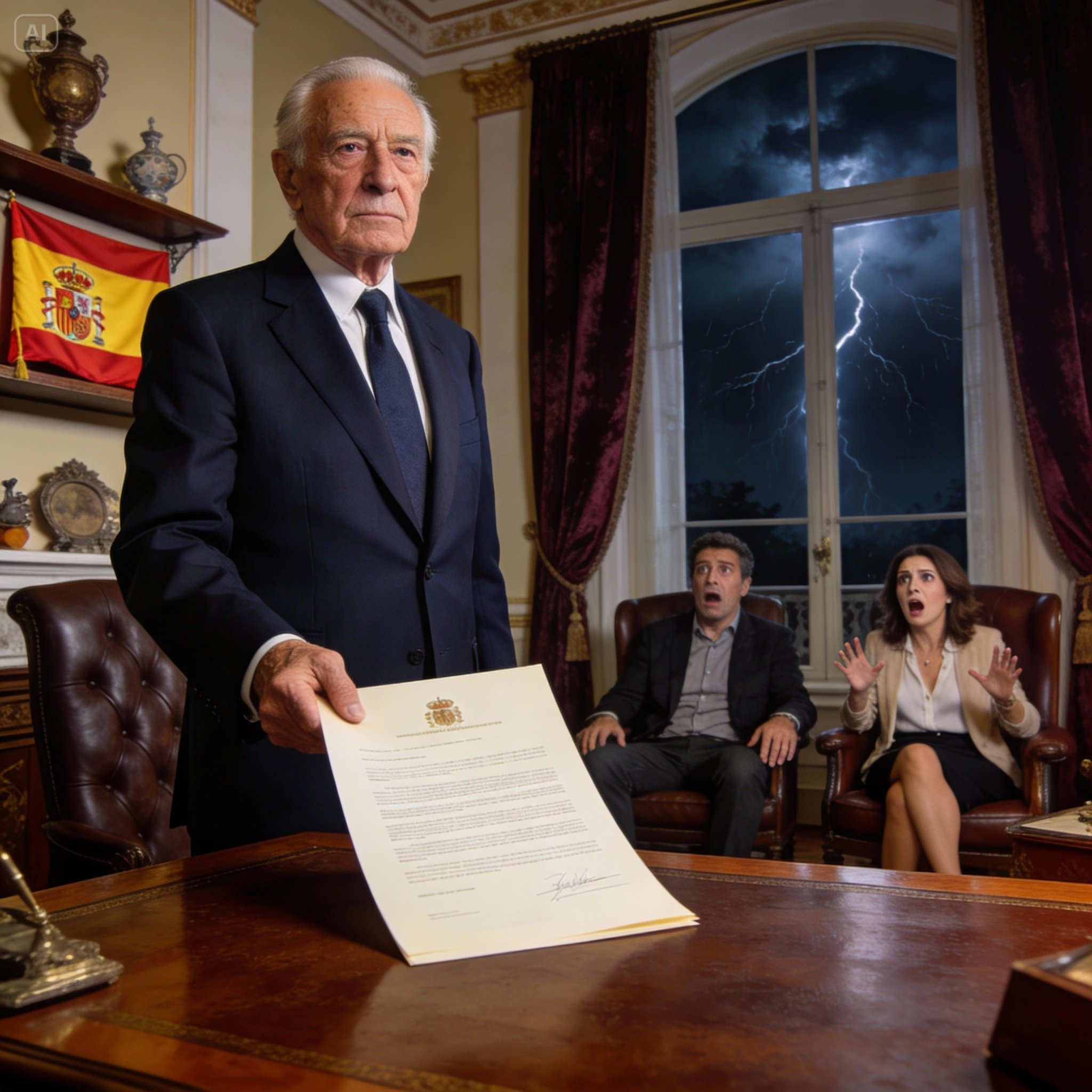
“So I decided to teach them a lesson,” my grandfather said, opening the leather folder. “This is my will. Or rather, it was my will until an hour ago.”
He held up a document.
—Here, I was planning to leave everything to you. More than two hundred and fifty million euros in assets, properties and cash.
Two hundred. Fifty. Million. The world was spinning.
“But justice, true justice, is not blind,” he said, tearing the paper in two pieces in front of the camera. “Justice has a memory.”
He turned to the notary who was present, a serious man with glasses.
—Proceed with the reading of the new testament, Don Alfonso.
The notary cleared his throat and began to read in a monotonous but clear voice:
—“To my son Ricardo, who complained that my blood pressure medication was an unnecessary expense and rationed it to save money, I bequeath the exact amount he estimated my health was worth: One hundred euros. So he can buy himself a good bottle of wine and toast to his greed.”
My father hid his head in his hands.
—“To my daughter-in-law Patricia, who forbade me from sitting on the new living room sofa because she said it ‘smelled old’ and made me eat in the kitchen like the servants, I bequeath my old hardware store furniture. Perhaps she can sit there and reflect on human dignity. Monetary value: Zero euros.”
The comments on the large screen on the wall flashed by at breakneck speed. “Bravo!”, “Justice!”, “What shameful children!”. The humiliation was public, total, and absolute.
Then my grandfather stood up and walked towards me.
“And for my grandson, Javier…” she said, her voice filled with a warmth that brought tears to my eyes. “Javi, you were the only one who saw a human being beneath those rags. You used to bring me churros and chocolate on Sunday mornings with your allowance, even though your parents would scold you. You’d sit with me to watch football and explain the new signings. You stood up for me when they yelled at me for walking slowly.”
He took my hands. His hands were strong and warm.
—To you, Javier, I bequeath total control of Grupo Inversiones Rodríguez , all my properties, my accounts, and my assets. Two hundred and forty-nine million euros.
I couldn’t breathe. It couldn’t be real.
“On one condition,” he added, looking intently at me. “Part of that money must be used to build and maintain the most dignified and luxurious retirement home in Spain. A place where no one is forgotten, where no one is treated like an old piece of furniture. I want you to run it.”
“Grandpa… I don’t want the money, I just want you to be okay,” I managed to stammer through my tears.
—I know, son. That’s why I’m giving it to you. Because you’re the only one who didn’t ask for it.
The broadcast ended minutes later. Silence returned to the room, but it was a different kind of silence. Heavy for my parents, but light for me.
“Dad…” my father tried to say, approaching me with tears in his eyes. “I’m sorry. We were stressed, the debts…”
Don Manuel raised his hand, stopping him dead in his tracks.
“Debts are paid with money, Ricardo. But cruelty is paid for with loneliness. I’m not going to throw you out on the street, because I’m not like you. You’ll continue living in your house, but the house now belongs to Javi. And you’ll have to learn to live on your salaries, without my help.”
The following months were a storm, but of a different kind. The video went viral worldwide. My parents couldn’t go out in public without feeling ashamed. They lost friends, they lost status. They had to face the reality of who they were.
But something miraculous happened. The humiliation shattered his pride.
At first, it was out of necessity. I was overwhelmed managing the estate and organizing the foundation for the care home. I needed help. My father, who had been fired from his job because of the scandal, offered to do the bookkeeping for the care home’s construction. My mother, who had fallen into a deep depression, started going to the construction site, first just to watch, then to help clean, and finally to organize the volunteers.
A year later, we inaugurated the “Dignity and Memory” Residence on the outskirts of Toledo, in a beautiful setting overlooking the Alcázar.
That day, I saw my father pushing a resident’s wheelchair, laughing with him. I saw my mother serving food in the dining room, with a humble smile I’d never seen on her before. They weren’t wearing designer clothes. They were wearing the foundation’s volunteer uniform.
I approached my grandfather, who was watching the scene from a bench in the garden, under the spring sun.
“Have you forgiven them?” I asked him.
He sighed and smiled.
“Forgiveness is for oneself, Javi. I no longer hold a grudge. Look at your parents. For the first time in their lives, they’re doing something useful for others. They needed to lose everything to find themselves.”
“You were right,” I said, hugging him. “It was the hardest lesson, but the only one that worked.”
“Never underestimate the power of an old coat, son,” he laughed. “Sometimes, you have to disguise yourself as nothing to see who is everything.”
Today, my grandfather is 92 and still goes to the office every morning, even if it’s just to read the newspaper and affectionately scold the interns. My parents manage the day-to-day running of the nursing home, working harder than ever, but sleeping soundly. And me… I still buy churros on Sundays, sitting with my grandfather, knowing that his true legacy wasn’t millions, but the integrity he kept hidden beneath that worn coat until the perfect moment.
The next time you see an old person walking slowly, or someone who seems to have less than you, remember Don Manuel. Remember that life is full of twists and turns, and that sometimes, the king disguises himself as a beggar to test the loyalty of his court.
Don’t wait until there are cameras rolling to be a good person. Do it because it’s the right thing to do. Because in the end, all we take with us is the love we gave and the dignity with which we lived.