Thrown out of my son’s wedding in Ronda because of my dress: a lesson she’ll never forget.
Night fell over the Serranía de Ronda with that heavy heat typical of the Andalusian summer. The sky turned violet and orange, a perfect setting for what should have been the happiest day of my son Alejandro’s life. However, when the engine of my old Land Rover started, leaving the party behind, my eyes were dry. There were no more tears. Only an immense emptiness in my chest, where for twenty-eight years an unconditional love had pulsed for the son I gave birth to, raised, and protected with such fierceness.
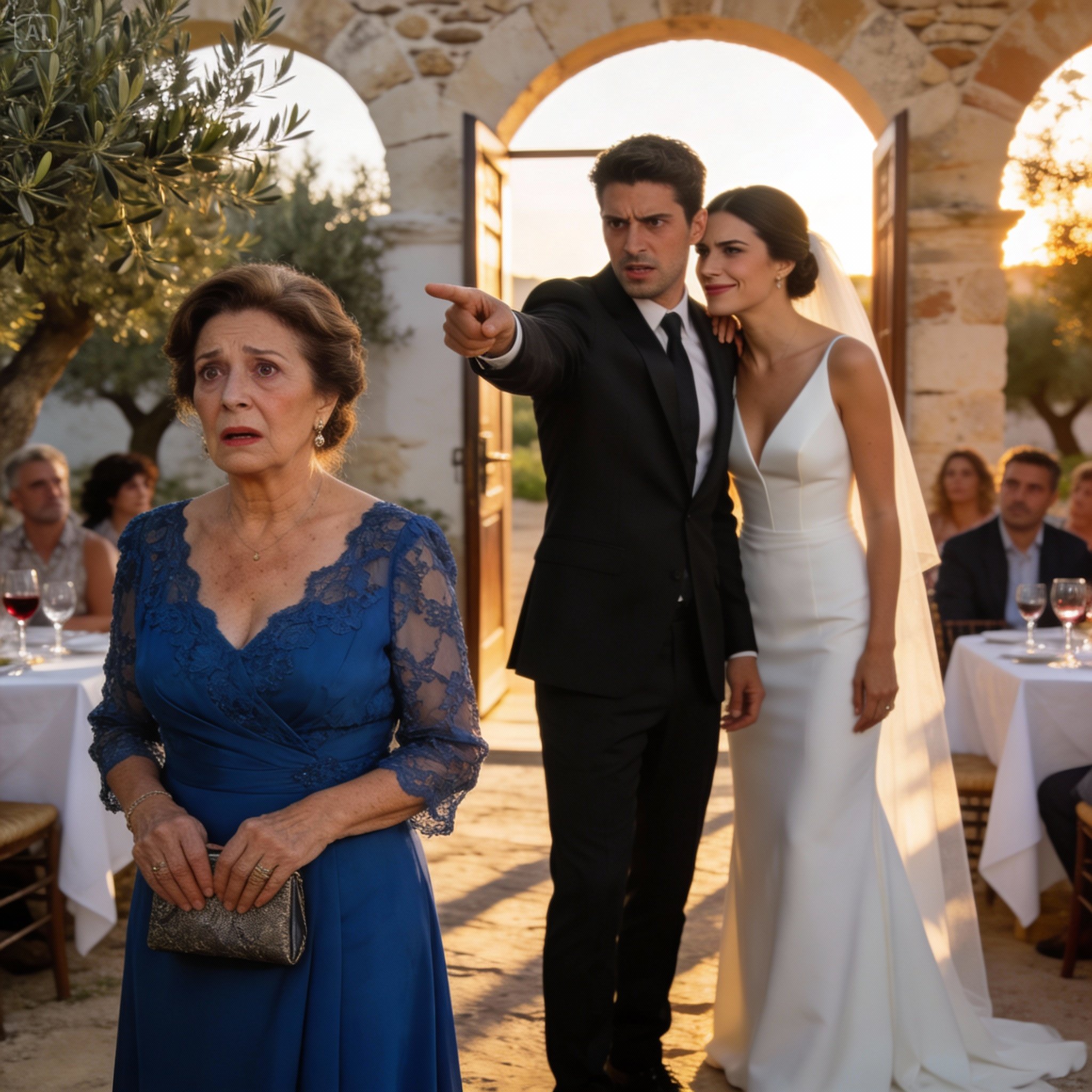
“Go away, Mom. My fiancée doesn’t want you here.”
Those words echoed in my head, reverberating in my temples to the rhythm of the bumps on the dirt road that separated the reception hall from my house. My own house. Because the wedding was being held on our property, El Cortijo de los Almendros , the land my great-grandfather bought with the sweat of his brow, that my father cared for during the war, and that my husband, Manuel, and I rebuilt when we were about to lose everything in the crisis of the nineties.
I arrived at the main entrance. I parked the car and turned off the engine. The silence of the countryside was deafening. In the distance, very far away, I could hear the echo of the orchestra’s music. They were playing a pasodoble. They were probably opening the dance. My son was probably dancing with her, with Marta, that city girl, a marketing executive for a multinational company in Madrid, who looked at our olive trees as if they were a papier-mâché set and complained about the dust on her designer shoes.
I entered the house. I took off my high heels at the entrance, feeling the coolness of the terracotta tiles under my tired feet. I walked to the hall mirror and looked at myself. The royal blue dress. It was beautiful. It was my mother’s dress. A seamstress from the village had altered it, modernizing the cut but preserving its essence. I felt beautiful, I felt like a worthy godmother. Showy? Perhaps the blue was intense, but doesn’t a mother have the right to shine on the day she gives her son away at the altar?
“He’s stealing the show,” she had told him. And he, my Alejandro, the boy who hid behind my skirts when it thundered, the man who promised to take care of me when his father died of a sudden heart attack fifteen years ago, had chosen her.
I carefully, almost reverently, took off my dress and hung it in the closet. I put on my robe, made some chamomile tea, and sat down in the kitchen. The same kitchen where Alejandro learned to add by counting chickpeas, where I tended to his scraped knees, where we cried together over Manuel’s death, gathered around this massive oak table.
I couldn’t sleep that night. I lay looking out the window, watching the sunrise over the olive groves, silvered by the first light of day. Those trees were silent witnesses to my sacrifice.
Around eleven in the morning, my cell phone vibrated on the table. Alejandro .
I felt a silly pang of hope. Maybe he had noticed. Maybe he was calling to apologize, to tell me that he let his nerves get the better of him, that he loved me.
I took a deep breath, cleared my throat, and hung up.
-Sim?
“Mom,” she said in a hoarse, tired voice. She was probably hungover. “Can you come to the big house? We need to talk.”
There was no “How are you?”, nor “Excuse me?”. Just an order.
I hung up without answering. I made a cup of strong coffee, that dark roast coffee that Manuel liked so much, and waited. I knew he would come. He always came when he needed something.
Before Marta, Alejandro and I were an inseparable pair. When Manuel died, Alejandro was twelve years old. I remember the funeral, the stifling August heat in the cemetery, and his little hand squeezing mine with an unusual strength for a child.
“Don’t worry, Mom,” he whispered to me that day. “Now I’m the man of the house. I’ll take care of you and the farm.”
And he tried. God knows he tried. He matured quickly. He learned to prune, to negotiate the price of olives at the cooperative, to fix the old tractor that was always leaking oil. He studied agronomy in Córdoba and returned full of ideas.
“Mom, my place is here, with you, in Los Almendros ,” she told me on her graduation day. I cried tears of joy.
We worked side by side. I took care of the accounts and administration; he took care of the farming. At night, we would sit on the porch to watch the sunset with a cold beer and some olives that I had seasoned.
“You know, Mom,” he would say, “one day my children will be running around here. They’ll learn to ride horses like me.”
—I hope so, son. I hope you find a woman who loves this land as much as we do.
I will find her, I promise.
But it wasn’t quite like that. He met Marta at a tourism fair in Madrid. She was sophisticated, ambitious, a typical city girl. The first time she came to the country house, I saw the look of displeasure on her face when she stepped onto the sand.
“Do you live here year-round?” he asked, looking at the old wooden beams and the black-and-white photos of my grandparents. “It’s a bit… isolated, isn’t it?”
“We live here and we’re from here,” I corrected him with a forced smile.
From that day on, Alejandro began to change. His visits to Madrid became frequent. He started talking about “profitability,” “assets,” and “modernization.” He stopped sitting with me on the balcony.
Mom, Marta has some good ideas. We could make a lot of money if we changed our approach.
—This isn’t just a business, Alejandro. It’s our home. It’s your inheritance.
—It’s a bit of both, Mom. We have to be realistic.
I had never used that word, “realistic,” before.
The sound of an approaching car startled me from my reverie. It was Alejandro’s car. And she was with him.
They went out. He, wearing sunglasses and looking disheveled. She, impeccable, in a white Ibizan-style dress and a wide-brimmed hat, as if she were a tourist on her own “property.” They entered the kitchen without knocking.
“Mom, I told you to come,” Alejandro said, taking off his glasses. He avoided looking me in the eye.
“This is my home, Alejandro. I don’t walk around like some kind of servant. Especially after what happened last night.”
Marta let out an impatient sigh and leaned against the counter, crossing her arms.
“Look, Victoria,” she said, addressing me informally with a familiarity I hadn’t shown before, “let’s leave the drama to the soap operas. We’re here on business.”
“Business?” I asked, turning to my son. “Is your mother a business?”
—Mom, please. I need the keys to the condo administration office. The keys to the office, the keys to the bank account, and the deeds.
I felt an intense shiver run down my spine. The keys. They always hung around my neck, a silver chain with the old wrought-iron keys that had opened the doors of this farmhouse since 1920.
—What do you want them for, Alejandro?
—Marta and I want to make some changes. You know, modernize. We’re thinking of remodeling the main room, knocking down the walls of the old rooms and creating an open space.
“Tear down the partitions?” My voice trembled. “These walls are a hundred years old.”
“They’re old, Mom. And they smell musty,” Marta added disdainfully. “We want to turn this into a luxury boutique hotel. ‘Experience Rural Luxury.’ Events, exclusive weddings, yoga retreats for foreigners…”
—Turn our house into a hotel? And where am I going to live?
There was silence. A dense, suffocating silence. Alejandro looked at the floor. Marta spoke.
“Well, Victoria, we thought you’d feel more comfortable in an apartment in the village. Or perhaps in a residence in Malaga, near the sea. There they take care of you, provide ready-made meals… It’s more practical. We’ll be living in the penthouse in Seville and will come here to organize events on weekends.”
“Are you kicking me out?” I asked, feeling disbelief give way to a cold, serene fury.
“It’s not about kicking you out, Mom,” Alejandro said quickly, looking up for the first time. “It’s about… relocating you. It’s best for everyone. Besides, I need the money. We want to take out a loan for the renovations, and the bank requires the property as collateral.”
Are you going to mortgage Los Almendros ?
“It’s an investment, Mom. You don’t understand why you’re stuck in the past. Dad wouldn’t want us to live as farmers our whole lives when we have this potential.”
“Don’t even think about mentioning your father’s name!” I yelled, slamming my fist on the table. The sound echoed like a gunshot in the kitchen.
Alejandro took a step back. Marta rolled her eyes.
“Look, Victoria,” she said, “legally, half of this belongs to Alejandro. His father left it to him. So stop being selfish and give us the keys. The architect is expecting us tomorrow.”
There it was. The naked truth. Greed dressed in white silk.
Manuel, my dear Manuel, was a man of vision. She loved her son, yes, but she knew the frailty of human nature and, above all, she loved and respected me as her companion in life and in all her endeavors.
In his will, he had divided the bare property: 50% for me, 50% for Alejandro. But there was a clause. A clause that Alejandro, in his youthful arrogance, never bothered to read carefully, or perhaps had forgotten.
Clause of universal and lifelong usufruct with exclusive administrative power .
I rose from my chair. I walked slowly toward them. I felt taller, stronger. The shame of the previous night had evaporated, replaced by the dignity of a matriarch defending her territory.
“You’re right about one thing,” I said, looking Marta straight in the eyes until she looked away. “Manuel died fifteen years ago. And I’ve lived each of those days honoring his memory, working this land from sunrise to sunset so that nothing would be lacking. So that you, Alejandro, could study in the city. To pay for that lavish wedding you kicked me out of yesterday.”
—Mom, don’t start with that victim speech…
“Shut up!” My voice cracked like a whip. “Now I’ll speak. You’re right, your father left half the property to you. But the keys—” I pressed the cold metal against my chest—”the control, the management, and the right to live and decide over every square meter of this land as long as I breathe, he left to me. To me.”
Alexander turned pale.
-What?
“That’s called a lifetime usufruct, son. You signed it before a notary when you were 18, don’t you remember? You were too busy thinking about buying your first car with part of the inheritance. As long as I’m alive and in full possession of my mental faculties, I decide . I decide whether to plant or uproot. I decide whether to paint or tear down a wall. And I decide who enters and who leaves this house.”
—But Mom… this can’t be… the bank said that…
“The bank probably told you that you need the usufructuary’s signature to get the mortgage loan. And you know what, Alejandro? I’m not going to sign .”
Marta turned red with anger.
—This is ridiculous! Alejandro, do something! We can’t lose the investment, we’ve already paid the architect the advance!
“That’s your problem,” I said, sitting down again and taking a sip of my coffee, which was already cold but tasted divine. “This property is off-limits. There will be no hotel. There will be no events for people who can’t tell a green oak from a cork oak. And there will be no mortgages that jeopardize your grandparents’ legacy.”
“Mom, please…” Alejandro’s tone changed. Now, his voice sounded pleading, like that of a child who had broken a plate and wanted to hide it. “Marta and I have plans… we need the money…”
“Then work,” I replied. “Work like your father and I worked. Get up at five in the morning. Get your hands dirty. Earn a living.”
“You’re a bitter and selfish woman,” Marta spat, clutching her designer handbag. “Let’s go, Alejandro. Let’s find a lawyer. This isn’t over. She’ll hear from us. If necessary, we’ll have her declared legally incompetent.”
I burst out laughing. It was a genuine, loud laugh that threw them off balance.
“Try it, my dear. Everyone in town knows me. The notary is my second cousin. The doctor plays dominoes here on Sundays. Try saying I’m crazy and see who ends up losing everything.”
Alejandro looked at me one last time. In his eyes, I saw a mixture of anger and, deep down, shame. He knew I was right. He knew he had betrayed the one who had never disappointed him.
“Go, Alejandro,” I said gently. “Go with your wife. You have a life to build in the city. Be happy there. But the keys stay here. With me.”
They left, slamming the door. I heard the car drive away, kicking up a cloud of dust.
I was alone in the kitchen. But, for the first time in a long time, I didn’t feel alone. I felt free.
The following months were difficult, I won’t lie. The silence in the house was heavy. Rumors spread like wildfire through the village: “Vitória disinherited her son,” some said. “Her son wanted to sell everything and leave her destitute,” others, more precise, said.
But life, like the fields, has its cycles. After the harsh pruning of winter, spring arrives with renewed vigor.
Without the burden of supporting a son who wanted to live beyond his means, and with the property completely under my control, I began to make changes. But not the changes Marta wanted.
Entrei em contato com uma cooperativa local de mulheres empreendedoras. Transformamos os antigos celeiros em oficinas de artesanato e produção de produtos orgânicos: sabonetes de azeite, geleias de figo, mel das nossas colmeias. Abri as portas da casa de campo não para casamentos luxuosos, mas para visitas escolares onde as crianças aprendiam sobre a origem dos alimentos, como cuidar de um cavalo e como respeitar a natureza.
A fazenda estava repleta de vida, de risos de crianças, de mulheres trabalhadoras que, como eu, se esforçavam para progredir. Los Almendros floresceu novamente.
Um ano depois do casamento, recebi uma carta. Não era de um advogado. Era do Alejandro.
Não o abri durante três dias. Deixei-o na lareira, olhando-o com desconfiança. Finalmente, numa noite chuvosa, servi-me de uma taça de vinho e abri-o.
Mãe,
Nem sei por onde começar. Marta e eu nos separamos. O “projeto” do hotel foi mais ideia dela do que minha, e quando ela percebeu que não conseguiria o dinheiro para a herança, as coisas ficaram… complicadas. Acho que você tinha razão em muitas coisas. O azul do seu vestido não era o problema. O problema era que a sua luz nos fazia ver nossas próprias sombras.
Estou morando em um pequeno apartamento em Córdoba. Voltei a trabalhar como engenheiro agrônomo em uma empresa de irrigação. É um trabalho árduo, estou começando do zero, mas me sinto… mais eu mesmo do que nos últimos anos.
Não estou pedindo seu perdão. Sei que o que fiz naquela noite e o que tentei fazer depois foi indizível. Só queria que você soubesse que papai estaria orgulhoso de você. Você defendeu o legado dele, até mesmo do próprio filho. Obrigado por não me deixar destruir nossa casa.
Alexandre.
Eu chorei. Chorei todas as lágrimas que não derramei no dia do casamento. Chorei de dor, mas também de alívio. Meu filho, meu verdadeiro filho, estava ali, por baixo de todas aquelas camadas de tolice e ambição que a vida moderna lhe havia imposto.
Não liguei para ele imediatamente. Esperei um pouco. Respeito precisa ser conquistado, e o perdão, mesmo quando concedido, não apaga as cicatrizes instantaneamente.
Dois anos se passaram desde então. Hoje, Los Almendros é uma referência em turismo rural sustentável na Andaluzia. Ganhei um prêmio do Governo Regional pelo meu trabalho com mulheres rurais. E aos domingos… Alejandro vem aos domingos.
Ele não vem pedir dinheiro. Não vem trazer “projetos”. Vem de roupa de trabalho e me ajuda a cuidar das oliveiras. Comemos juntos na cozinha. Às vezes conversamos, às vezes apenas ouvimos o vento nas folhas.
Ele ainda não passa a noite aqui. Ainda há uma distância segura entre nós. Mas outro dia, quando estava saindo, parou na porta.
“Mãe”, disse ela, sem se virar. “Aquele vestido azul… ficou lindo em você.”
Eu sorri.
—Eu sei, filho. Eu sei.
I closed the door gently. I touched the keys hanging around my neck, warm against my skin. Life takes many turns, but the earth remains. And we, mothers, like the earth, endure droughts, storms, and frosts, and always, always, we sprout again.
If you’re reading this and feel that someone is disrespecting you, leaving you out, or making you feel inferior, remember my story. Remember that your dignity is non-negotiable. That sometimes, saying “NO” is the greatest act of self-love you can practice. And that you should never, ever, hand over the keys to your life to anyone, no matter how much you love that person.
Because, in the end, all we have is our story and the strength to tell it. And you, do you hold the keys to your own life or have you handed them over to someone else? Tell me everything, I’m listening.